The Definitive Country Almanac: The Black Ledger — Part 2#
Kethra Almanac • Approved 19 September 2026 • drafted 19 September 2026 • Sections 5–8 (Sections 1–4 are in Part 1)
Status: approved. Briana approved the whole almanac on 19 September 2026 (the Almanac Approval Decision). Where this file calls something a proposal, read it as approved, except the open points that decision lists.
Status before approval: proposal throughout, except what Part 1 lists as established in earlier files. Part 1's four kinds of statement, Known, Alleged, Rumoured and Behind the ledger, apply here too. Everything under Behind the ledger is this almanac's proposal for what is actually true, and no character outside the Ledger knows it.
Section 5: Government, Law & Politics#
Constitutional Framework#
None. The Ledger has no charter, no court and no law of its own.
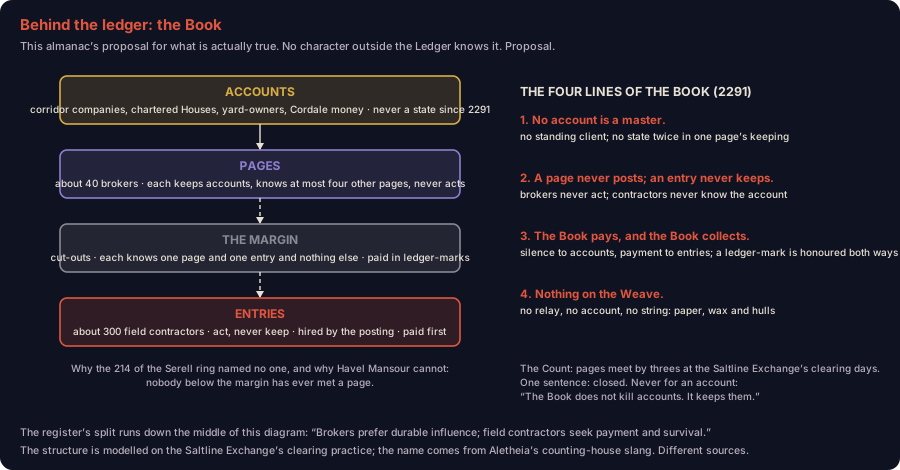
Behind the ledger. It has four rules, which its pages call the four lines of the Book. They were written in 2291, when the pages closed the Book, and they have been broken once each.
| Line | Rule | What it means |
|---|---|---|
| 1. No account is a master. | No client is a standing client; no state is an account twice in one page's keeping | Written in 2291, after a decade in which two states had been standing accounts and both had tried to close their brokers. The Revoked (the Crown almanac) are the lesson, learned from outside. |
| 2. A page never posts; an entry never keeps. | Brokers never act; contractors never know the account. Every posting passes through the margin, a cut-out who knows one page and one entry and nothing else. | Why the 214 of the Serell ring named no one; why Havel Mansour cannot |
| 3. The Book pays, and the Book collects. | Its promise to an account is silence; its promise to an entry is payment; a ledger-mark is honoured in both directions, or the Book is worth nothing | The register's fear, in the Book's own words: "An exposed client ledger that makes its protection promises worthless" |
| 4. Nothing on the Weave. | No relay, no Weave account, no string. Paper, wax and hulls. | "Characters with secrets use couriers" (chapter 11) |
How the Book is run#
Behind the ledger.
- No head. The Inquiry Office assumes a Keeper of Accounts; there is none. The Book has not met itself since 2291.
- The Count. Pages who can reach Saltline meet by threes, never more, on the Exchange's clearing days, when every notary, factor and underwriter on Kethra has honest business there, and where "Never ask whose side someone is on" (the Line almanac) is the law of the room. A page knows at most four other pages. What the Count decides, it decides by the ledger-marks each page holds: a page owed many favours is a page whose word carries.
- The margin. Between every page and every entry stands one person who knows one of each. Margins are paid in ledger-marks, not crowns, and are the Book's most trusted people, because they are the only ones who can name anyone.
- The register's split, as the Book lives it. "Brokers prefer durable influence; field contractors seek payment and survival." A page's whole interest is that the Book outlive the posting; an entry's is to be paid and to live through it. When an entry is caught, the page's interest is that the entry be closed, and the entry knows it, which is why entries are paid in advance and why the Book's worst enemies are its own former entries. The Guild's Ledger Rule (the Guild almanac) works on exactly this seam: it voids a struck banner's hands' records, and a hand with no record is an entry the Book can hire and cannot trust.
Sanctions#
Behind the ledger. The Book has no court and one sentence.
| Against | What happens |
|---|---|
| A page who is exposed | Closed, by the Book, before the page can be questioned. The Notary is alive because she sued instead of running. |
| An entry who talks | Closed |
| A margin who talks | Closed, and the page they served retires |
| An account who talks | Nothing. "The Book does not kill accounts. It keeps them." An account's name and posting are the Book's capital: "compromised intermediaries" (the register) are what it holds. The pages have argued since Serrin whether this is a rule or a weakness. |
What the law can do#
The Ledger's work is a crime in every jurisdiction, and a different crime in each. "Justice depends on where you are, and characters know it" (Chapter II).
| Jurisdiction | Who pursues it | The crime | The worst it can do |
|---|---|---|---|
| The Homeworld Assembly | The Accord Inspectorate ("Hunted": the Assembly almanac) | Black sockets only. The Tribunals cannot hear "anything that is not an Accord" (the Assembly almanac); a killing is not one. "The Assembly convicts; the member punishes." | Nothing itself: no prisons |
| The Caldren Crown | The Crown Inquiry Office: "Serious crime, organised crime, and violations of the Accords" (Chapter II) | Murder, at the Assizes before a jury of twelve (the Crown almanac); a black socket, at an Accord Tribunal | Greywater Keep, for life. No execution since 1988 (the Crown almanac). |
| The Vardane Imperium | The Office of the Marshal Watch (the Vardane almanac) | Anything, at a military tribunal of three officers | "Execution for treason and Accord crimes, by firing squad, in public" (the Vardane almanac): a black socket is an Accord crime. Bond, for the rest. |
| The Ilyr Sanctum | The Office of Keys | None: "Licence violations abroad are not crimes in Ilyr law. The penalty is revocation, which can cripple an industry." (The Ilyr almanac.) | Revocation, on the host state, not the Ledger. Ilyr's private view of the Crown is the Ledger's market: "Caldren assurances do not bind every noble patron or military contractor." |
| Vesper | The Habitat Marshals | Vector law: "A ship that moves without a vector is a hazard, and a hazard is seized" (the Vesper almanac); the Compact Court for killings | Unrostering. "No execution, and no airlock." |
| The Line ports | Each port's harbour guard and its own courts | Whatever the port's law says; "by word" has no standing in court | Expulsion from the Line, honoured by every port (the Line almanac) |
| The Cinderbelt | Yard law; the Convoy Guard | Whatever the shift says | "Put off the rock" (the Coalition almanac). No execution since 2204. "Nobody on Kethra has ever overturned a Coalition judgment." |
| The League | The Bench of Three, or "the next captain in" | Killings and informing, heard together (the League almanac) | Dousing. No executions. |
| The Rovessa | Each House, under Deck Law | On a deck, Rovessa law; "Neither may board the other without leave" (the Rovessa almanac). The Inquiry Office calls Deck Law the Ledger's best law. | Beaching |
| The coast states | Each state's courts | Murder; no death penalty since 1398 (the coast states almanac) | Prison. The Refuge Law frees any Bonded runaway who reaches the coast. |
| The Southern Holds | The Moots | Murder | "A few hundred Holds in the Southmark and the Bowl still allow it for murder" (the Southern Holds almanac): the only executions outside the Imperium |
Two facts govern all of it. "Breaking it is the gravest crime on Kethra" (Chapter II) is said of the Quiet Sky Accord, not of murder; the Ledger has never been accused of a Quiet Sky breach. (Behind the ledger: its pages would close any entry who attempted one.) And there is "no article against war between members" in the Charter of Aletheia (the Assembly almanac), so what one member's companies pay to have done to another's is no planetary crime unless it touches an Accord.
Foreign Relations & Defence#
Standing#
The Ledger has no foreign relations. It has accounts, accusers, and the one power that has struck it in writing.
Relations#
The Free Banner Guild row follows the relationship register, in both directions. The others are what the files record, with behind the ledger where the Book's own view is proposed.
| Power | Relation | What the files say | Behind the ledger |
|---|---|---|---|
| Free Banner Guild | Credible contracts versus deniable coercion (the register) | The Ledger's public position: "The Guild protects its own market under moral language." Its private assessment: "Guild arbitration and records make our most profitable arrangements difficult to conceal." It wants "Silence, access and pliable subcontractors". The Guild's public position: "Their methods undermine enforceable employment." Privately: "A client who buys a covert betrayal can make every legitimate contract unsafe." The Guild wants "Exposure of clients who commission betrayal". What would mend it: "Specific evidence exonerates a contractor from a disputed attack." What broke it: "A compromised contract kills personnel who relied on agreed terms." (Serrin, 2306: the Guild almanac.) | The Guild is the Book's mirror: the same trade, signed. The Ledger Rule (2311) cost the Book its cheapest entries and gave it its angriest. |
| Homeworld Assembly | "Hunted" (the Assembly almanac) | "The Inspectorate's oldest open file: unlicensed sockets by the hundred, and no factory ever found." Chief Inspector Bettina Okonkwo since 2306. The Requisition Bill (2313) would reach hulls. | The Inspectorate is the only pursuer the Book fears, because it is the only one with a planetary register, and the Book's sockets are the only thing it owns that can be counted. |
| Caldren Crown | The file | The Crown Inquiry Office's file since 2231 (proposal; what it says is alleged). The Revoked: League captains who say they raided on secret Crown letters, "letters the Crown calls forgeries" (the Crown almanac). Ilyr's view: "Caldren assurances do not bind every noble patron or military contractor" (the Ilyr almanac). | A quarter of the Book's accounts are chartered Houses and their contractors. The Crown itself has not been an account since 2291. |
| Vardane Imperium | Accuser | "The Imperium says the League hires it" (the League almanac). The Marshal Watch alleges the Marrach counting-house. "Informers are common" (Chapter III). | A third of the Book's accounts are Imperial Families' corridor companies, in their disputes with one another. The Imperium itself has not been an account since 2291. The Marshal Watch's Marrach allegation is right about one counting-house. |
| Outer Lantern League | Accuser | "The League says the Ledger has killed its captains for Imperial money. Nobody can prove either." (The League almanac.) The Captains' Roll names nine (alleged). | Three of the nine. The other six were the League's own quarrels, which suits the Book. |
| Vesper Orbital Compact | A story about a clerk | "Every year someone claims the Ledger buys strings from a relay clerk. The Relay Guild has never found one." (The Vesper almanac.) Whether Vesper reads what it carries is "the system's oldest open question" (the Vesper almanac), and this almanac does not settle it. | Once, in 2297, a page bought four months of the string-ledger from a Traffic Office clerk: who wrote to whom, and when, never the words. The clerk was unrostered for debt before the year was out, which is how the story started. The Relay Guild has never found one because it was never a Relay Guild clerk. |
| Rovessa Caravans | Never a client, never a carrier, knowingly | Carriers "carry no soldier and no weapon of war" (the Rovessa almanac), and the register flags weapons hidden in relief cargo without the carrier's consent | Deck Law is the Book's best law, and the Book has used it: a courier aboard a carrier is aboard a jurisdiction no port may board. The Houses would beach anyone who knew. |
| Line free ports | The clearing house | The Saltline Exchange "clears contracts between powers that will not trade with each other directly" (the Line almanac); the Counting Desk (alleged) | Three pages hold Exchange seats. The Line's rule against asking sides is the Book's constitution. |
| Cinderbelt Coalition | The ground | Yard law; the independents; the Seam | A quarter of the Book's accounts are yard-owners and concession-holders in claim disputes at the Seam, on both sides of it |
| Lesser Crowns | The money | "Cordale thinks in ledgers and remembers debts" (the Lesser Crowns almanac); the Notary (alleged); Serell, where the ring was broken | An eighth of the Book's accounts are Cordale money; the Notary is a page |
| Ilyr Sanctum | The source it never touches | Most black sockets are Ilyr's design without Ilyr's licence; the Office of Keys polices licences abroad by revocation (the Ilyr almanac) | No page is Ilyr, no account is Ilyr, and the Book has never posted inside the Sanctum, because "Foreigners stay in the Castaly Quarter" (the Ilyr almanac) and a foreigner beyond it is the only thing in Ilyr that is noticed |
| The Kronos colony | Unlisted, "if it exists" (the Kronos colony almanac) | The Bandsman (alleged); the bands; the Dark Hour | The Bandsman is real, and buys what the bands know for Hearth chits. The Office of Protection has never found him because he is one of its own contract engineers. |
| Homeguard Command | Never met | Homeguard has no post in the belt (the Homeguard almanac) | Homeguard's picket watches every transmitter in orbit (the Vesper almanac), which is one more reason the Book has none |
| Free Oreth coast states | A door | The Refuge Law; the Stellan Exchange, which "the Crown says" is "the leak in every blockade" (the coast states almanac) | Runaways become entries; the Stellan Exchange clears what Saltline will not |
| Southern Holds | Unmapped | "Every frontier dispute ends up being about a seeding charter" (Chapter II); the Continuance Circle "sabotages seeding works and threatens charter companies" (Chapter V). No file links the Circle to the Ledger, and this almanac does not. | The Book has posted in the charter-country, for charter companies against one another. Never for the Circle, which does not pay, and never against the free Holds, which have nothing a page wants. |
Defence#
Behind the ledger. The Book has no army and needs none.
| Entries | About 300, hired by the posting |
| Frames | Four, at Unlisted, each with a hand |
| Hulls | None owned; about a dozen independents' hulls it can hire at any time |
| Informants | "Deniable force, informants and compromised intermediaries" (the register): the bands at Hearthport, clerks at three exchanges, and what two pages hear at their own desks, the Habitat Marshals' supply agent and a contract engineer of the Office of Protection |
| Doctrine | A hand on every blade. The Book keeps the Frame Accord's first rule, a hand in every frame, because an unmanned killer is the one thing every power on Kethra would hunt together, and because "Only a person may kill" (Chapter V) is the one law its entries believe in. |
Section 6: Economy, Infrastructure & Industry#
Macroeconomics#
Behind the ledger.
| Metric | Value |
|---|---|
| Postings | About 300 a year, worth about Cr 400 million in crowns and their equivalents. The Free Banner Guild's contracts are about Cr 6 billion (the Guild almanac); the Book is small, and means to stay so. |
| Balancings | About a tenth of the postings, some 30 a year, and about half the money |
| Pages' share | Ledger-marks, not crowns: a page is paid in favours owed |
| Entries' pay | Crowns, in advance, at about three times what the Guild pays a hand for a season (the Guild almanac); an entry who is paid afterwards is an entry who may not be |
What the Book does#
| Posting | Share of postings | Notes |
|---|---|---|
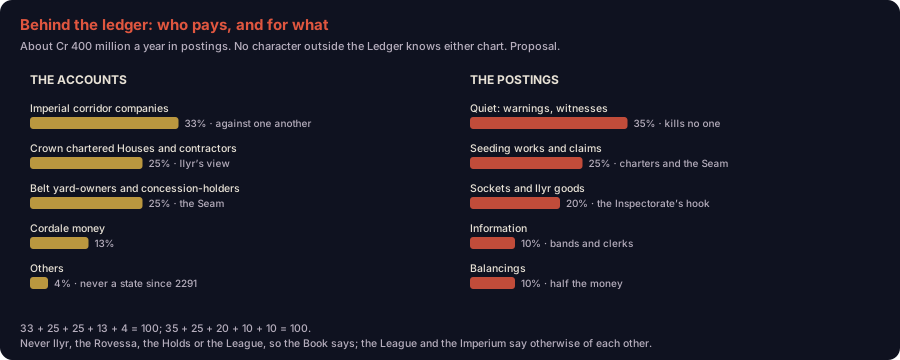
| Quiet: intimidation, a warning delivered, a witness persuaded | 35% | Most of the Book's work kills no one, which is why a file that counts deaths sees so little of it |
| Seeding works and claims: sabotage in the charter-country; claim-jumping at the Seam | 25% | "Every frontier dispute ends up being about a seeding charter" (Chapter II) |
| Sockets and Ilyr goods: smuggling, selling on | 20% | The Inspectorate's only hook |
| Information: bands, clerks | 10% | The register's leverage |
| Balancings | 10% | Half the money |
Who the accounts are#
| Account | Share | The dispute |
|---|---|---|
| Imperial corridor companies | a third | Families' corridor companies against one another: shares, phosphate, the Bonded |
| Crown chartered Houses and their contractors | a quarter | Ilyr's view (the Ilyr almanac), and House against House |
| Belt yard-owners and concession-holders | a quarter | Claims at the Seam, on both sides of it |
| Cordale money | an eighth | Insurance, debts, "Cordale thinks in ledgers and remembers debts" (the Lesser Crowns almanac) |
| Others | the rest | Never a state since 2291; never Ilyr, the Rovessa, the Holds or the League. So the Book says; the League and the Imperium say otherwise of each other. |
Money#
- Crowns. Alleged (the Inquiry Office): cleared through the Saltline Exchange. Behind the ledger: cleared as insurance claims and voyage shares at the Saltline Exchange and Driftmark, and, when Saltline will not, at the Stellan Exchange.
- Ledger-marks (Chapter VI's rumour; behind the ledger, real): a favour owed, written nowhere, tradable between pages. The Book's only currency among pages, and the reason it cannot be bought out: its capital is debts of silence, and they are not for sale.
- Behind the ledger: cinder scrip in the belt, Hearth chits at Kronos, "illegal, and trusted" (the Kronos colony almanac), wolf-silver on the frontier (Chapter VI): whatever cannot be traced where the posting is.
Industry#
None known. "No factory ever found" (the Assembly almanac). Behind the ledger: there has never been one. The Book's sockets are diverted civil cores, on the Brisk Foundry pattern (the Ilyr almanac), and Corridor War salvage refitted at Hob, "no questions asked" (the League almanac), and at Unlisted. It builds nothing.
Infrastructure#
None owned. Behind the ledger: the independents' rocks; a cache at Unlisted; three Exchange seats; the Dark Hour; paper.
Communications#
- Couriers (Chapter VI), by hull. Behind the ledger: a pouch under the black seal rides the same hulls as diplomatic bags and sealed Ilyr documents, with none of their protection.
- Behind the ledger: never a relay. "Vesper hears everything" (chapter 11); the string-ledger logs every string's sender, recipient and time (the Vesper almanac); the Imperial relay is closed to everyone but the Imperium (the Vardane almanac); Homeguard's picket watches every transmitter in orbit (the Vesper almanac). The fourth line of the Book is the world's geography, written down.
- The relay-clerk story (the Vesper almanac) is above, under Vesper. Behind the ledger: it happened once, and it was the string-ledger, not the strings. Whether Vesper reads what it carries remains open.
Section 7: Culture, Arts & Daily Life#
Holidays & Celebrations#
None. Behind the ledger: one silence. Nothing is posted on the Unmapping (3 Thaw), the one day the relays are silent (the Vesper almanac), because a day of silence is a day everyone is listening. Pages keep their families' holidays as their families do, which is the point of being a page.
Culinary Traditions#
None. An entry eats where the posting is.
Arts & Literature#
The Ledger makes nothing, and is written about constantly.
- Two Hundred and Fourteen (2286), by Dario Vantongeren: a Serell-ring convict's twenty years in Greywater Keep, and his claim that he never knew who paid him. The Inquiry Office's most-read book, for what it does not say.
- The Black Seal (2299): an Aletheia novel of the Inquiry Office, which the Office calls nonsense and every new inquirer reads. It gives the Ledger a head, a seat and a flag; behind the ledger, it is wrong about all three.
- Letters of Light (2296), by the Revoked captain Yaw Ivanek (the League almanac): the Lamp Raids, and the paymaster that disowned them. Not about the Ledger, and the Ledger's best explanation.
- Minutes of the Banner Court (2306–): the Serrin case (the Guild almanac), the only case in which any court has named the Ledger; it found the banner and could not find who paid.
- The Captains' Roll: the League's list of nine captains it says the Ledger killed (alleged), read at the Wick each Lampfall.
Sports & Recreation#
None.
Social Norms & Etiquette#
Behind the ledger. An entry learns these or is closed.
- "Whose side?" "By word." The only greeting, between people who have never met.
- Never a name. A page is an alias; an entry is a posting; an account is a number in a margin's head.
- Never the Weave. Not a string, not an account, not a search.
- The black seal is never broken except by the hand it is addressed to. A pouch that arrives opened is a posting that did not happen, and a courier who is closed.
- Paid first. An entry is paid before the posting or the posting does not happen. The Line's "Pay first, argue later" (the Line almanac), turned inside out.
- "Unmapped." The palm-down sweep that means not to be spoken of (Chapter IV), used as everyone uses it, which is the Book's whole camouflage: on Kethra everyone has something unmapped.
- A hand in every frame, and a quiet sky. No frame without a hand; nothing aimed at the sky. The Book breaks the laws of every state, and the Frame Accord's socket licensing with them, and keeps the two rules the whole planet would hunt it for, because the planet is the one enemy it cannot outlast.
Section 8: Appendices & Reference Materials#
Statistical Tables#
The two files from 2231 (alleged; none proven): the Inquiry Office's deaths and the Inspectorate's seizures.
| Period | Deaths attributed to the Ledger | Socket seizures attributed to File One | Notes |
|---|---|---|---|
| 2231–2250 | 7 | about 40 | The counting-house deaths; the file opens |
| 2251–2270 | 19 | about 310 | Serell, 2262: 214 convictions |
| 2271–2290 | 46 | about 190 | The Corridor War; "the war was fought within the Accords" (the Assembly almanac), and the belt was not |
| 2291–2310 | 38 | about 260 | Serrin's 41 are the Banner Court's, not the Office's |
| 2311–2314 | 9 | about 100 | Okonkwo's Inspectorate |
| 2231–2314 | 119 | about 900 | "unlicensed sockets by the hundred" (the Assembly almanac) |
Working. 7 + 19 + 46 + 38 + 9 = 119. 40 + 310 + 190 + 260 + 100 = 900.
Behind the ledger: the Office's 119 is too high by about a third, because it counts every counting-house death it cannot explain, and too low many times over, because it does not count the Seam, the belt or the Imperium's corridors: the Book balances about 30 accounts a year.
The Ledger of the Dead#
Deaths attributed to the Ledger by a named party, in order. Alleged throughout; the one with a court finding is marked.
| AL | Where | Who died | Who says it was the Ledger | Standing |
|---|---|---|---|---|
| 2231 | Aletheia | An underwriter, a Weave-clerk and a chartered House's factor, in one winter | The Crown Inquiry Office | The file's first page |
| 2244 | Driftmark | An insurer who had refused a claim | The Inquiry Office | Accident, by Driftmark's court |
| 2262 | Serell | A witness in the socket ring, before trial | The Inspectorate | Unsolved |
| 2273 | Cinder Hollow | A yard-owner's agent in a claim dispute | The Coalition's Council of Yards | "Put off the rock" was the sentence on a rival's crew; the agent was dead first |
| 2283 | Tolvard | A corridor company's factor | The Marshal Watch | A military tribunal had a Bonded man shot for it as treason in 2284; the Marshal Watch reopened the case in 2290 |
| 2286 | The Seam | Eleven prospectors of an independent claim | The Coalition and the Imperium, of each other | A skirmish, officially |
| 2293 | The Wick | Captain Oksana Petrosyan's predecessor on the Captains' Roll, the first of nine | The League | "Nobody can prove either" (the League almanac) |
| 2297 | Vesper Prime | Nobody: a relay clerk whom no one has ever found | Rumour | The relay-clerk story |
| 2301 | Cordale | Nobody: the Notary sued | The Office lost | |
| 2303 | The Wick | Captain Oksana Petrosyan | The League | The Imperium says her own crew did it |
| 2306 | Serrin | 41, nine of them a Guild banner's own hands | The Banner Court (the Guild almanac) | The one court finding: the banner was paid to stand down. Who paid is unproven. |
| 2309 | Marrach | A counting-house clerk who had asked for a Crown visa | The Marshal Watch, and the Crown, of each other | Unsolved |
| 2312 | Hearthport | A band, found at the Dark Hour | The Inquiry Office (the Bandsman's file); the Office of Protection says the residents, and the Hearth Council says the Office | Unsolved |
| 2314 | Saltline | A Tide-clerk, in Thaw, while the Serrin appeal was being prepared | The Guild's advocates | Open |
Behind the ledger. Of the fourteen rows, six were the Book's, the first only in part: 2231 (two of the three), 2262, 2283, 2293, 2306 and 2314. The rest were other people's, and the Book has never corrected anyone.
Gazetteer#
Every place below is on the interactive Atlas, with the status rumoured except the Serrin train. The generated Register of the Black Ledger lists them.
| Place | Kind | What it is |
|---|---|---|
| Counting Desk, the | Alleged | A desk at the Saltline Exchange, by the Inquiry Office's file |
| Ledger's Reach | Rumoured | "Not on any chart" (chapter 11) |
| Marrach counting-house, the | Alleged | By the Office of the Marshal Watch |
| Serrin train, the | The site of the 2306 betrayal | The deaths are the Guild almanac's; the marker is this almanac's |
| Unlisted (Kronos XV) | Rumoured | "Rumoured to be a Black Ledger cache" (chapter 11) |
Bibliography#
In-world sources#
- The Black Ledger, the Crown Inquiry Office's file (2231–), and its list of eleven aliases
- File One, the Accord Inspectorate's oldest open file (2154–)
- Two Hundred and Fourteen (2286); Letters of Light (2296); The Black Seal (2299)
- Minutes of the Banner Court: the Serrin case (2306–)
- The Captains' Roll, the League's list (2293–)
- The Relay Guild's yearly denial (2297–)
Development sources#
- 00 - Spine and Status · Chapter I · Chapter II · Chapter III · Chapter IV · Chapter V · Chapter VI
- 10 - Who's Who, 11 - Kronos and the Cinderbelt and 15 - The Kronos colony
- The accusers' almanacs: the Assembly, the League, Vesper and the Free Banner Guild; and, for law and money, the Crown, the Imperium, Ilyr, the Line ports, the Lesser Crowns, the coast states, the Coalition, the Rovessa, the Southern Holds and Homeguard
- The faction roster and the relationship register: the Ledger's type, objective, fear, leverage and split, and its positions towards the Free Banner Guild and the Guild's towards it. Its Noetic Directorate and Hollow Compact entries are not used: both are "Not placed on Kethra" (the spine).
- Almanac structure supplied by Briana.
Guidance for AI actors#
- Four kinds of statement. A character outside the Ledger can know what is Known, repeat what is Alleged by the party they belong to, and pass on what is Rumoured. Nobody outside the Ledger knows anything under Behind the ledger, and no scene may give it to them.
- A Ledger character knows their corner. A page knows their accounts, their margins and at most four other pages. An entry knows one margin and one posting. Nobody knows the Book, because there is nothing to know: no head, no seat, no list.
- Do not settle: whether Vesper reads the strings it carries (the Vesper almanac: "Open. Do not settle it in a scene."); the Kettle informers (the League almanac); who paid at Serrin; whether Unlisted exists, to anyone outside the Ledger. A scene may reach Unlisted only if Briana approves it.
- The Frame Accord holds, even here. A Ledger frame has a hand in it. An unmanned killer is not a Ledger story; it is the Iron Winter, and every faction on Kethra hunts it together.
- No flag, no name of its own, no head. A character who claims to speak for the Black Ledger is lying, or is a page who has just broken the second line.
- Keep the names apart: the Ledgers (Imperial), the Serell Ledger (a newspaper), the string-ledger (Vesper's), Serell (Cordale) and Serrin (the Imperium).
- This almanac is approved. Briana approved the whole almanac on 19 September 2026 (the Almanac Approval Decision).