Chapter I: Biology and Demographic Realities#
Kethra Almanac • Approved 19 September 2026 • drafted 18 September 2026
Status: approved. Briana approved the whole almanac on 19 September 2026 (the Almanac Approval Decision). Where this file calls something a proposal, read it as approved, except the open points that decision lists.
Status before approval: Everything in this chapter is a proposal built on the spine. All the people on Kethra are human, descended from Earth. This chapter covers how 2,300 years on a new world have shaped them.
Units: ages are given in Kethran years (K-yr). One Kethran year is 1.092 Earth years, so a Kethran aged 70 is about 76 in Earth years.
1.1 Evolutionary Lineages & Sub-species Branches#
One species, with a narrow start#
Every human on Kethra is Homo sapiens, descended from the roughly 214,000 Founders who came down from the Patience, the Covenant and the Lodestar. The Founders came from many peoples of Earth-of-the-songs, and the ships' crews deliberately chose a genetically diverse population.
Then came the Silence. The Grey Cough and the collapse of the settlements cut humanity to about 58,000 people by AL 120. Every Kethran alive descends from that remnant.
The bottleneck left three marks:
- Less variety than on Earth. Kethrans are less genetically varied than Earth's population was, so some inherited conditions are common and some Earth traits are gone.
- "Landfall grey" eyes. A pale grey iris is far more common than on Earth, especially in the old heartland families.
- Traits by region. Isolation during the Silence left strong regional patterns. Aelos and the northern Rime are the most distinct.
Changes the Founders made on purpose#
The Founders made two deliberate biological interventions. Both are older than the Mending Ban (see Chapter II), and both are sacred history.
- The Gift. An engineered community of gut bacteria that can break down the mirror-image sugars in native plants and neutralise some native proteins. With the Gift, and with proper leaching and cooking, humans can get useful calories from processed native food. Without it, native food passes straight through the body or makes people ill.
- It passes from mother to child at birth and through breastfeeding. This single fact shapes frontier kinship (see 2.5).
- Courses of antibiotics can destroy it (see 1.4).
- The Founders' Mending. An inherited genetic change that dampens the human immune reaction to the commonest native allergens. It spread through the whole population within a few centuries, so almost every Kethran carries it. People who don't ("unmended") are rare, and cannot live near the Wild.
Branches of humanity (populations, not species)#
| Population | Where | Distinguishing traits | How it arose |
|---|---|---|---|
| Heartland lines | Calathe, the Thess valley | High frequency of Landfall grey eyes | Closest descent from the Landfall remnant |
| Aelosi | The Ilyr Sanctum | The most genetically distinct group on the ground; many rare traits | Centuries of isolation after the archive-keepers sailed east during the Silence |
| Orethi | The Vardane Imperium, the Oreth coasts | Darker average colouring; strong family resemblances within the old imperial families | Migrations across the western sea from AL 500 onward, then long, separate growth |
| Line-born | The Line Isles, Rovessa carriers | Mixed ancestry; the most varied population on Kethra | Every people's crossroads |
| Eldvangers | The southern frontier (Southern Holds) | Mixed, with a heavy heartland share. Strong "Gift-lines" passed through mothers. | Settled from AL 1620 by Caldren, Vardane and Line migrants |
| Upwellers | The Vesper Orbital Compact | Born in spin-habitats at 0.8–1.0 g. Usually adjust to Kethra's surface within weeks. | 250 years of orbital life |
| Cinderborn | The Cinderbelt | Born at about 0.3 g. Tall and fine-boned. Most cannot live at full surface gravity without medical support. | About 170 years of belt settlement |
Cinderborn are not a separate species, and calling them one is a notorious insult ("shells"; see Chapter IV). They are a group of people who cannot come home. Their bones and hearts are built for low gravity, and moving to Kethra's surface is a medical ordeal. This fact drives belt politics.
Where the lines diverged#
| When | What happened |
|---|---|
| AL 44–120 | The Silence bottleneck |
| AL 300s | The archive-keepers sail east, founding the Aelosi line |
| AL 500s | Migration across the western sea to Oreth |
| AL 1620s | Crossing of the Line to settle Eldvang |
| AL 2068 on | Permanent orbital settlement |
| AL 2140 on | Settlement of the belt, and the first Cinderborn generation |
1.2 Anatomical & Physiological Baselines#
The human body works on Kethra much as it did on Earth. The differences are in the conditions it lives under.
| System | Kethran baseline |
|---|---|
| Breathing | About 0.95 Earth atmospheres with 23% oxygen. At sea level this is slightly richer than Earth's air. Newcomers from orbit feel alert, and sometimes lightheaded. Altitude sickness begins a little higher than on Earth. |
| Gravity | About 1.00 g. The body develops normally on the surface. |
| Sight | Human eyes are poor at seeing deep red, and Hyperion's light falls at that end of the spectrum. Red nights look dim and flattened: shapes are clear, but colour is weak and blues vanish. Reading by red-night light is possible but tiring. Capital fashion uses indigo partly because it looks black under Hyperion. |
| Sleep and body clock | The human body clock naturally runs about 24.2 hours, and Kethra's day is 26. After 2,300 years, most Kethrans adapt easily. About 1 person in 8 still struggles, sleeping in drifting, broken patterns known as "Earth-sleep". In the red-night season, many people sleep badly because the nights never get fully dark ("redwake"; see 1.4). Blackout shutters in every bedroom are the answer (see Chapter III). |
| Energy needs | An average adult needs about 2,400 kcal a day, and frame pilots and Hedge workers far more. A 26-hour day means four meals are common: breakfast, midday, supper, and a late redmeal in the red-night season. |
| Diet | Earthkin food is necessary. Processed native food is possible only with the Gift, and it supplies calories but few nutrients. Iodine, vitamin B12 and some fatty acids must come from Earthkin sources or supplements. |
| Heat | Normal human tolerance. Frontier people in the red summers adapt through behaviour: working at night, keeping cool cellars and wearing ember cloaks. |
| Physical limits | Human norms apply. The main hazards on Kethra are duskdust in the lungs (1.4), native venoms and toxins, blackfrost, and ember storms. |
Frame pilots. Piloting a frame means a direct neural link to the machine through link-sockets: licensed implants at the base of the skull (see 2.3). Long hours linked cause fatigue, headaches and, in veteran pilots, a lingering sense of the frame's body after unlinking, called the "phantom frame". These effects set the practical limits of frame piloting. They are handled through VectorZ play.
1.3 Life Cycle Chronology#
| Stage | Kethran years | Earth years (approx.) | Notes |
|---|---|---|---|
| Pregnancy | about 245 Kethran days | 266 days | Called "eight moons": eight of Pandia's cycles. |
| Weaning | 1–2 | 1–2 | Weaning comes late on the frontier, to secure the Gift. |
| Walking and first words | about 1 | about 1 | |
| Naming, entry into the family song | 1 | 1 | See Chapter V. |
| Schooling begins | 5 | 5.5 | |
| Coming of age | 16 | 17.5 | Full legal age in the Crown. The frontier marks it at 15 with the Wolf Run (see Chapter V). |
| Frame-licence minimum age | 17 | 18.6 | |
| Common age at first marriage | 23 in the capital; 19 on the frontier | 25 / 21 | |
| Life expectancy at birth | 73 in the Crown heartland; 64 on the frontier; 61 in the belt; 69 planet-wide | 80 / 70 / 67 / 75 | |
| Oldest recorded Kethran | 112 | 122 | Tobin Arrask of Hollin, died AL 2276 |
Signs of ageing. The usual human signs, with local character:
- Sun-lines are deeper on the frontier.
- "Red-eye" is a slow yellowing of the eye lens in people who work outdoors through many red-night seasons, and a mark of old age.
- Link-socket scarring in old pilots.
Fertility. The average number of births per woman over a lifetime is 1.7 in the Crown, 2.9 in the Southern Holds and 1.4 in Vesper orbit. Belt fertility is low and medically managed.
1.4 Immunological Baselines & Pathogen Profiles#
What can make a Kethran sick#
Native microbes almost never infect humans. Their chemistry is too foreign for them to grow in a human body. Kethran disease therefore comes from two sources:
- Earth pathogens that came with the Founders.
- Native toxins and allergens, which harm people without infecting them.
Endemic diseases#
| Condition | Cause | Notes |
|---|---|---|
| Common colds and influenza lines | Earth viruses | Every Kethran knows them |
| Rustlung | Duskdust, the wing-dust of gloamwings, together with native spores | An allergic, scarring lung disease. It is worst among Hedge workers and in red-night seasons. The Founders' Mending reduces it, but it cannot be cured once established. The frontier's cough. |
| Tidemouth | Toxins from native algae in shellfish-like finners and in tide pools | Numbness, paralysis and death. Frontier children learn "don't taste the tide". |
| Reedlurker envenomation | Venom | Stops the heart. Antivenom is kept in every Hedge post. |
| Giftloss | Antibiotics or severe illness wiping out the Gift | The person cannot digest processed native food. A serious problem on the frontier, a mere inconvenience in the capital. It is treated by "the Sharing": a transfer of gut bacteria from a Gift-strong relative. In frontier custom, the Sharing is a family rite. |
| Iodine deficiency | Diet | Endemic during the Silence. Now rare where salt is iodised; it still occurs in the remote Holds. |
Pandemics in history#
| When | Name | What happened |
|---|---|---|
| AL 44–61 | The Grey Cough | A Founders' respiratory virus that mutated. It killed about 60% of the population and brought on the Silence. Remembered in the Cantorate's "Song of the Grey Years". |
| AL 1422–1431 | Salt Fever | A cholera-like Earth bacterium spread through the Line ports. About 3 million died. It created the first public water boards. |
| AL 1877–1880 | The Wet Winter Flu | A global influenza outbreak. About 11 million died. It prompted the Crown's Health Office. |
| AL 2233–2236 | Vesper Fever | An outbreak in the closed air of an orbital habitat. About 40,000 died in orbit. It led to the Compact's quarantine rules. |
How disease spreads#
The routes are the ordinary human ones: air, water, touch and food. On Kethra, the tides and the Line trade decide the pattern. Port cities are where outbreaks begin, and double-spring floods spread waterborne disease. Quarantine at the Line ports is an old institution. Rovessa carriers fly the grey pennant when a crew is ill.
Ailments of space and of the psyche#
| Name | Who | What |
|---|---|---|
| The Hollows | Belt workers and long-haul crews | Depression and loneliness shaped by the 7-hour light delay: "every word from home is already old". A leading cause of death in the belt. |
| Redwake | Everyone, in the red-night season | Sleeplessness and irritability under nights that never go dark. Cases rise as Hyperion brightens. |
| Earth-sleep | About 1 in 8 people | A body clock that won't settle into the 26-hour day (1.2) |
| Downwell sickness | Upwellers and Cinderborn on the surface | Heavy limbs, fainting, bone pain. For Cinderborn it can be fatal. |
| Sennet | A cultural condition, not a disease | Grief for Earth-of-the-songs: a longing for a home no one alive has seen. Capital physicians recognise it as a form of depression. The Cantorate treats it as a spiritual condition. |
| Phantom frame | Veteran pilots | The lingering sense of the frame's body (1.2) |
1.5 Demographic Distribution Matrix#
Where people live (AL 2314)#
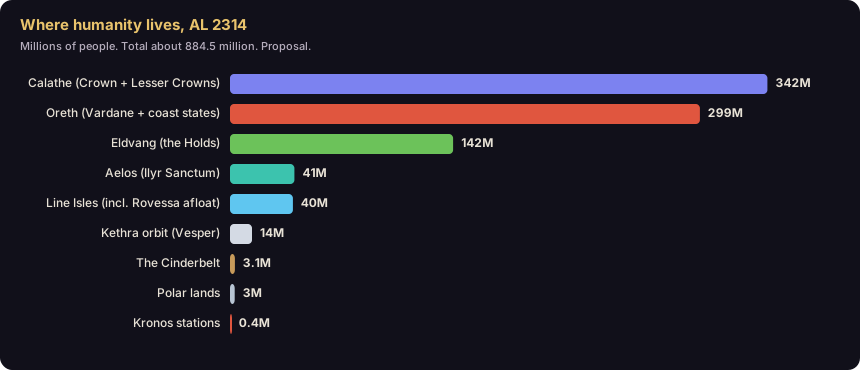
| Region | Population (millions) | Land area (million km²) | People per km² of land | People per km² of gardenland (approx.) | Urban share |
|---|---|---|---|---|---|
| Calathe | 342 | 48 | 7.1 | 48 (7.2 million km² of gardenland) | 68% |
| Oreth | 299 | 29 | 10.3 | 55 (5.4 million km²) | 61% |
| Aelos | 41 | 12 | 3.4 | 41 (1.0 million km²) | 74% |
| Line Isles, including the afloat Rovessa | 40 | 6 | 6.7 | 100 (0.4 million km²) | 66% |
| Eldvang | 142 | 41 | 3.5 | 28 (5.0 million km²) | 38% |
| Polar lands | 3 | 30 | 0.1 | — | 90% (stations) |
| Kethra total | 867 | 170 (including 6 of other islands) | 5.1 | about 46 (867 ÷ 19) | about 60% |
| Orbit (Vesper) | 14 | — | — | — | 100% |
| Cinderbelt | 3.1 | — | — | — | 100% |
| Kronos/Ymir stations | 0.4 | — | — | — | 100% |
| All humanity | about 884.5 |
Reading the density columns. Density across all land is low, because most land is native Wild. Density on gardenland, the seeded farmland people actually live from, is the figure that matters. Regional gardenland adds up to 19.0 million km²: 7.2 + 5.4 + 1.0 + 0.4 + 5.0. Eldvang has the most farmland per person, because its seeded land is new and its people are few. That is exactly why people migrate there.
Births, deaths and growth (per 1,000 people per Kethran year)#
| Region | Birth rate | Death rate | Natural growth |
|---|---|---|---|
| Caldren Crown | 11.2 | 8.4 | +0.28% |
| Vardane Imperium | 13.0 | 9.1 | +0.39% |
| Ilyr Sanctum | 9.4 | 8.9 | +0.05% |
| Southern Holds | 22.6 | 11.8 | +1.08% |
| Vesper orbit | 9.8 | 6.2 | +0.36% |
| Cinderbelt | 12.1 | 10.4 | +0.17% |
| Kethra overall | 13.9 | 9.2 | +0.47% |
Migration#
- Southward, across the Line. This is the great movement of the last 700 years. Land-hungry heartland families head for the Eldvang Holds. The flow has grown as heartland farmland has filled.
- Upward, to orbit and the belt. It is steady, and mostly one-way for anyone who has children in the belt.
- Inland, away from the Stair. A slow retreat from the lowest coastal steps as the seas rise. The capital insists it is "prudence". The Living Worlds Movement calls it the first evacuation.
- Seasonal. Frontier labourers go north for the northern harvest, and Line crews follow the Girdle storms.
Age structure#
| Children under 16 | Working age, 16–64 | 65 and over | |
|---|---|---|---|
| The Crown | 17% | 62% | 21% |
| The Holds | 34% | 59% | 7% |
The Crown's population is ageing and the frontier's is young. Each side thinks the future belongs to it, which fuels the politics of the charters.
Guidance for AI actors#
- Everyone knows whether they are "Gift-strong". On the frontier it is the first thing a healer asks.
- Cinderborn characters cannot simply visit Kethra's surface. Any scene that brings one downwell carries physical cost and danger.
- Rustlung, the cough of the Hedge and the frontier, is a class and regional marker. Capital characters notice it.
- Ages are in Kethran years. Convert only if a character is doing something scholarly.
Prepared by Claude.