KETHRASELENNE · THE ALMANAC
DRAFT EDITION
20 SEPTEMBER 2026
All-in-one edition · approvedThe spine, the world almanac and the Caldren Crown country almanac on one page, for reading straight through or printing. Briana approved the whole almanac on 19 September 2026. Canon records are on their own pages.

Kethra Almanac — Read Me First: Spine and Status#

Approved 19 September 2026 • drafted 18 September 2026 • Written by Claude at Briana's request, using the almanac structure she supplied

This folder answers every section of Briana's almanac structure for the planet Kethra (called Selenne in the capital), and then gives a full country almanac for its capital nation, the Caldren Crown.

This document is the spine. Every number, name and date the chapters rely on is fixed here first. If the spine and a chapter ever disagree, the spine is correct and the chapter needs fixing.

How to read the status of anything#

  • CANON: approved by Briana. On 19 September 2026 she approved the whole almanac at once (the Almanac Approval Decision). The table below lists that decision and the points she approved one by one.
  • Still open: the few questions the Almanac Approval Decision lists (some left to Briana, three given to Whisperling), and the in-world mysteries the chapters mark (open) on purpose.
  • Anything added after 19 September 2026 is a PROPOSAL until Briana approves it. (Before that day everything outside the table was a proposal. Each file keeps its old status line, headed "Status before approval", for the record.)
  • A proposal that Briana rejects should be struck out, not quietly rewritten, so that the record stays honest.

What is already canon#

Canon Source
The planet is in Andromeda and is not Earth. The capital calls it Selenne; the frontier calls it Kethra. Planet Naming Decision; Planet Naming Resolution — Selenne
Binary system, the Aion system. Kethra orbits Theia/Sól, a yellow-white G-class star. The red giant Hyperion/Surtr orbits far outside, coming as close as about 150 AU and going as far as about 450 AU, over about 3,500 years. Kethra Star System DRAFT v2; Star Naming Decision; Star System Approvals
The system's own name is Aion (no frontier-register counterpart yet), and AL 2314 is confirmed as the saga's exact starting point, not just its approximate opening. Star System Name and Saga Start Decision (20 September 2026)
A gas giant at about 5 AU. The Cinderbelt at about 50 AU. Red nights and hot eras. Star System Approvals
A 26-hour day. A year of about 368 Kethran days. A 27° tilt. Lit northern winters. Two moons: Pandia/Máni (large and bright) and Ersa/Hati (small and dark). The capital keeps a solar calendar; the frontier keeps a lunar one. Kethra Day Year Seasons Moons Approval
Humanity came from Earth. Earth's location is lost, and Earth is remembered as Earth-of-the-songs. Earth Heritage Decision; Earth Heritage Phrase
The saga begins on Kethra. Its eras run: colonial wars → alien contact → unification → expansion and golden age → colonial fracture → Varkhesh invasion of the homeworld (Kethra). The songs hold no history of Earth. In the last saga, intelligence traces the Varkhesh Hive's seat to Earth. How Earth became the Hive's home is a protected mystery. The Zhorak are removed. The Homeworld Assembly and the Crown factions live on Kethra. Saga Structure Correction; Saga Timeline Clarification; Saga Placement Decisions (these supersede the earlier Saga Timeline Update)
Names echo their sources but do not dictate design. Motifs may mix, but a name and its design never come from the same source. Naming Principles; Addendum — Mixing Sources
The Living Worlds Movement and the Continuance Circle are on Kethra in AL 2314. Living Worlds Placement Decision (19 September 2026)
Ember storms occur in the north as well as in the Eldvang lowlands. Ember Storms Decision (19 September 2026)
The Mending Accord (AL 2163) is the formal name of the treaty that bans heritable changes to the human genome; the Mending Ban is the everyday name for the ban it sets. Mending Accord Naming Decision (19 September 2026)
The whole Kethra Almanac, as it stands on 19 September 2026, except the open points that decision lists. Almanac Approval Decision (19 September 2026)

The spine (approved with the whole almanac, 19 September 2026)#

S1. Deep time and the present#

Anchor Value Notes
Dating system AL, "After Landfall". The capital counts in solar years of 368 days. The frontier's lunar count drifts from it; see Chapter IV.
Present year AL 2314 About 2,528 Earth years after Landfall (2314 × 1.092).
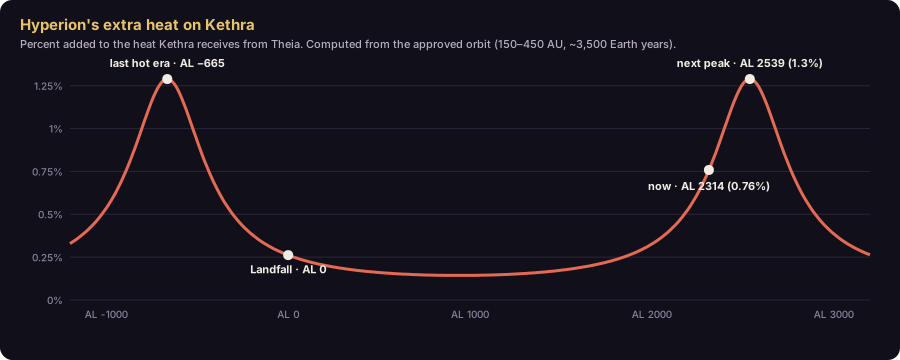
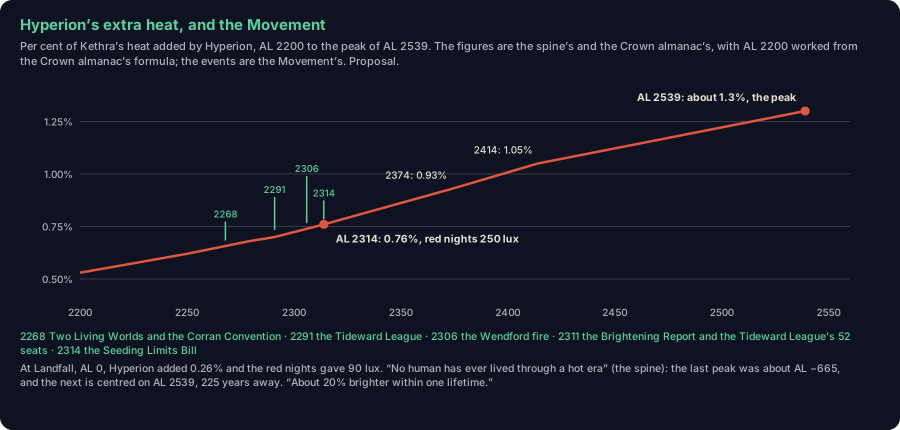
Hyperion today About 195 AU away and closing. It adds about 0.76% to Kethra's heat. Red-night light is about 250 lux. Worked from the orbit. The approved period of about 3,500 years is in Earth years, which is about 3,204 Kethran years. Closest approach falls in AL 2539, 225 Kethran years (246 Earth years) from now.
Hyperion's trend About 20% brighter within one lifetime. About 0.93% extra heat by AL 2374 and about 1.05% by AL 2414. It peaks at about 1.3% in AL 2539. Old people remember dimmer red nights. This is real, not nostalgia.
At Landfall (AL 0) About 333 AU away and receding. About 0.26% extra heat; red nights about 90 lux. The Founders landed in a cool, dim era.
The last hot era Its peak came in about AL −665, 726 Earth years before Landfall and about 3,250 Earth years before the present. No human has ever lived through a hot era. The land remembers it (see S3).
The next hot era Centred on AL 2539 The central environmental fact of the present day.
Place in the saga AL 2314 stands at the opening of the first era, the colonial wars. Alien contact has not happened. Confirmed by Briana, 20 September 2026: AL 2314 is the saga's exact starting point. The Corridor War, the charter disputes and belt unrest are the ground the colonial wars grow from.

S2. The planet#

Value
Radius about 6,340 km
Gravity about 1.00 g. Kethra has about Earth's mass, which keeps the approved moon figures valid.
Surface area about 505 million km²
Ocean 66% of the surface
Land about 172 million km²
Atmosphere about 0.95 Earth atmospheres; 23% oxygen (Earth: 21%); traces of CO₂ and argon. Fires burn hotter and spread faster than on Earth.
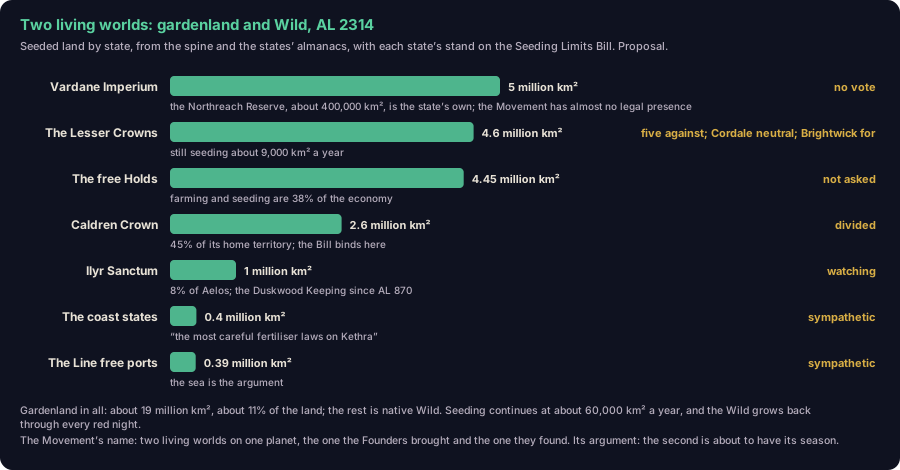
Gardenland About 19 million km² (about 11% of the land) has been converted to Earth-descended ecology. The rest is native Wild.

S3. Geography#

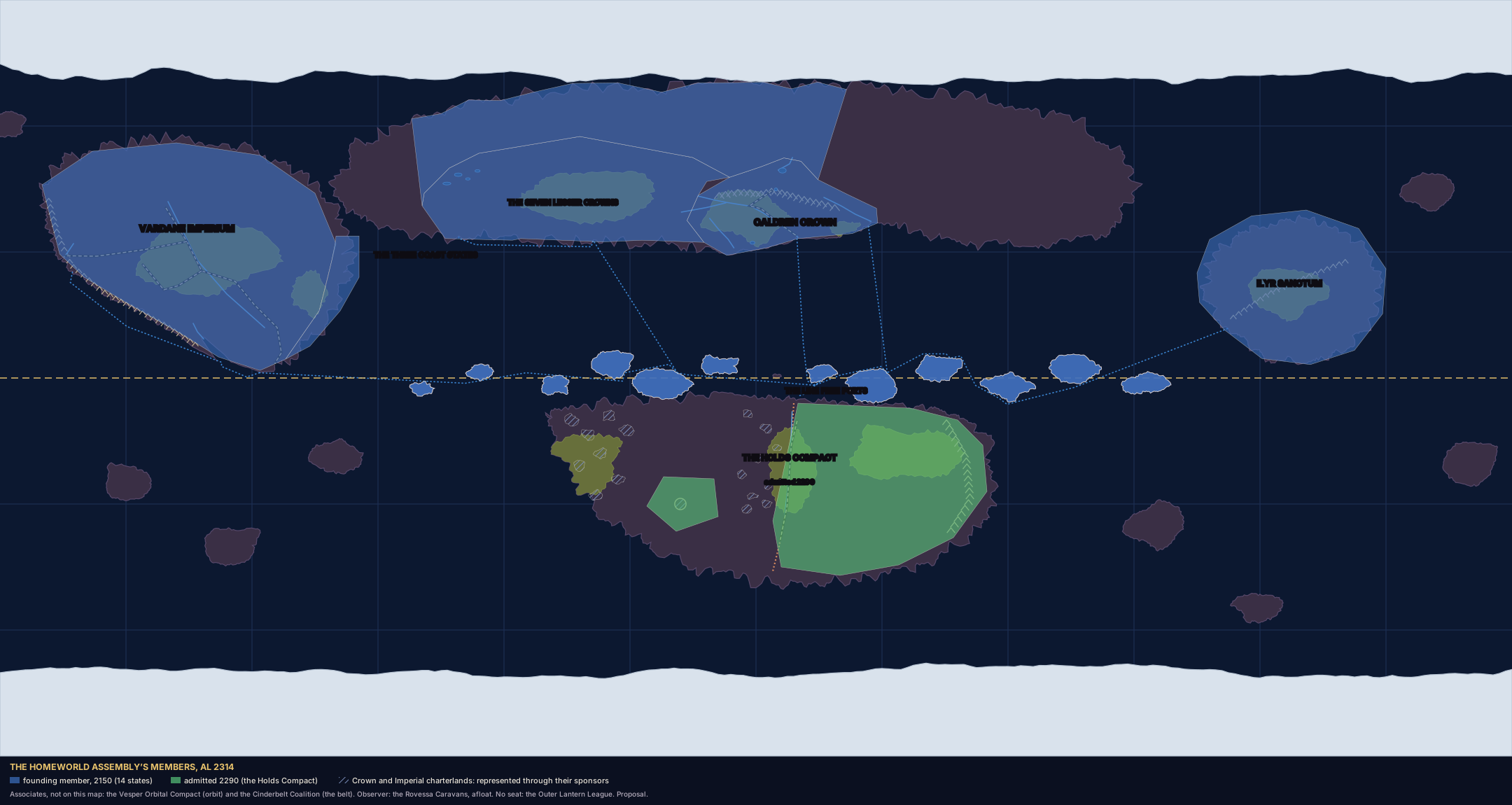
Region Capital name Frontier name Area (million km²) Population (millions) Summary
Northern heartland continent Calathe the Old Shore 48 342 Where Landfall happened. Home to the Caldren Crown (214 million) and the Lesser Crowns (128 million).
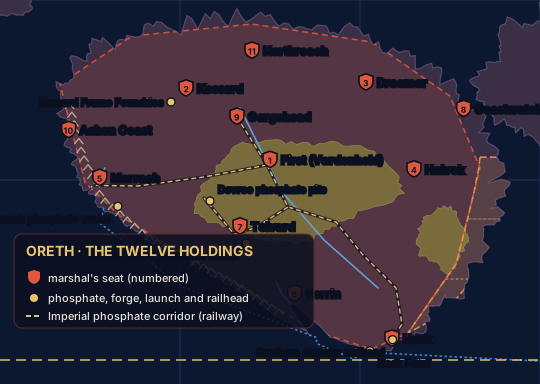
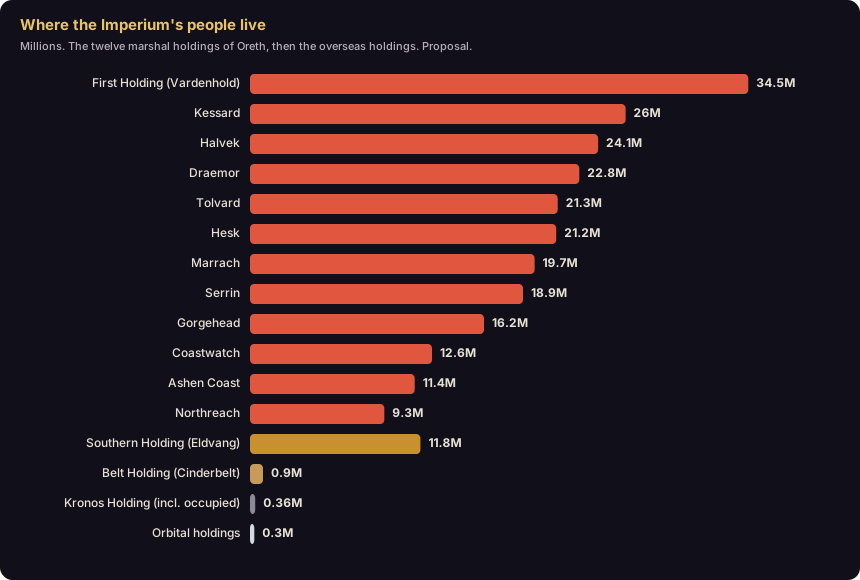
Western continent Oreth Oreth 29 299 The Vardane Imperium (238 million) and the free Oreth coast states (61 million).
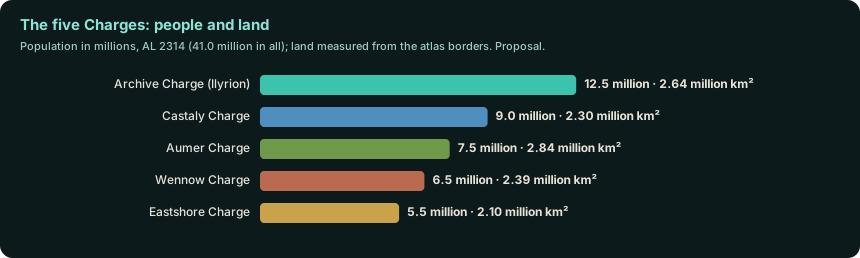
Eastern island continent Aelos Aelos 12 41 The Ilyr Sanctum. Isolated for centuries.
Equatorial sea the Girdle Sea the Girdle The equator runs through it, and everyone calls the equator the Line.
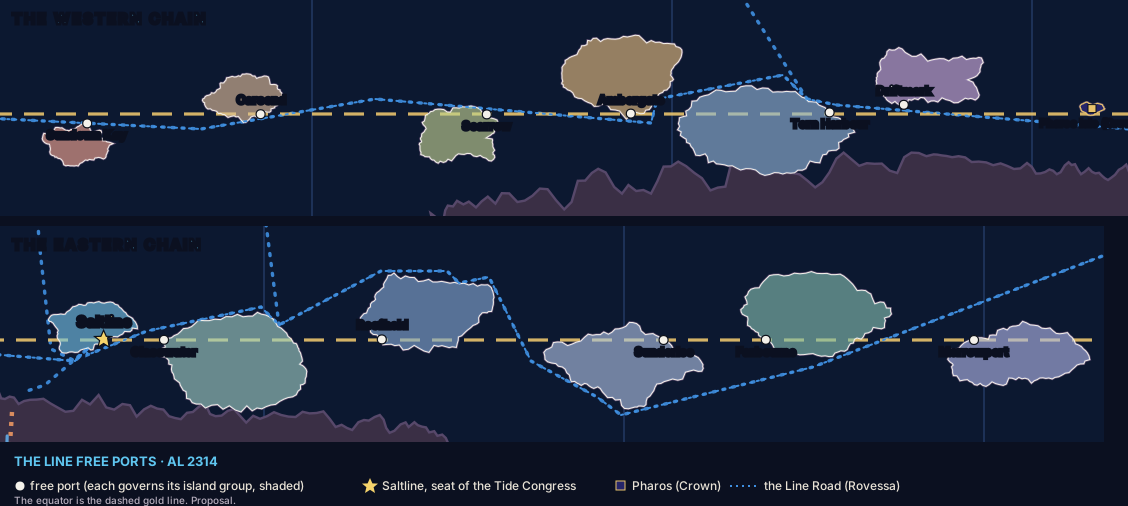
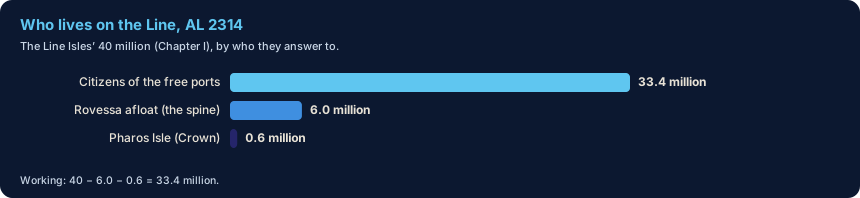
Equatorial islands the Line Isles the Line Isles 6 40 Free ports, spaceports and Rovessa home harbours. Includes about 6 million Rovessa who live afloat.
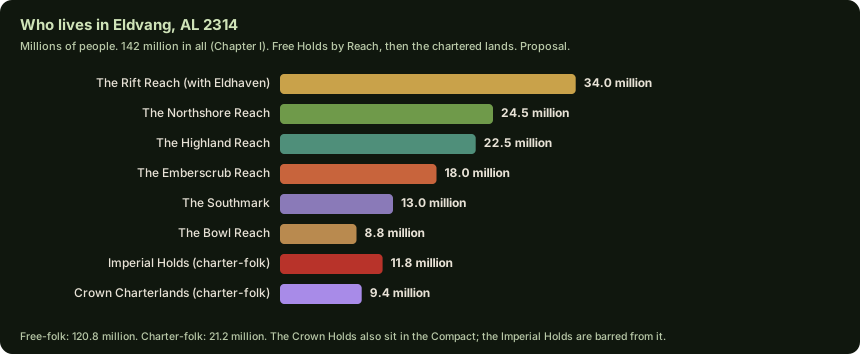
Southern frontier continent Notia Eldvang 41 142 The frontier: the Southern Holds. Red summers.
Northern polar lands the Rime the Rime 14 1 Ice and research stations
Southern polar continent the Southern Ice Nifl 16 2 Ice and mining camps
Other islands 6 Scattered islands
Total 172 867

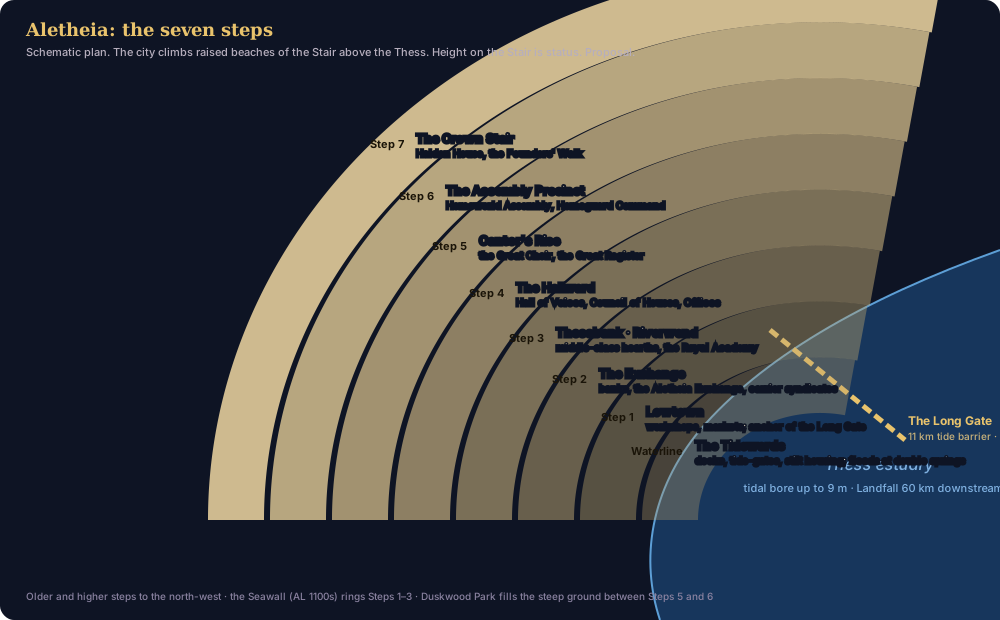
The Stair. Warm eras raise the seas and cool ones lower them, while Calathe's southern coast slowly rises. The result is a staircase of raised beaches: bands of old shoreline that climb the coasts like steps. The youngest step, from the last hot era, is about 12 m up; the oldest in the Thess estuary are about 140 m up. The Founders built on the Stair. Aletheia, the capital, stands on it. The coming hot era will slowly flood the lowest steps again, with sea level rising about 0.3 m per century now and accelerating.

The Line. The equator, running through the Girdle Sea. It separates the northern heartlands, which say "Selenne", from the southern frontier, which says "Kethra". To "cross the Line" means to go south, or to make a choice that cannot be undone. *(What the book's title means is not settled here. Briana, 19 September 2026: "It's the line between empires." Whisperling, please make a determination and bring Briana the result for approval.)*

S4. Humanity off the planet#

Settlement Population Governing body
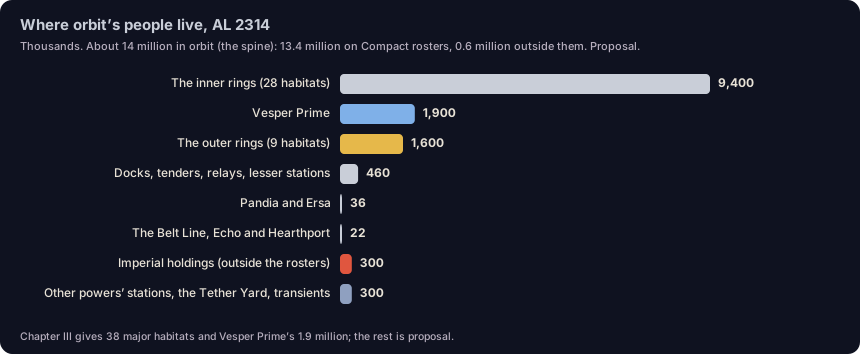
Orbit around Kethra, and the moons Pandia and Ersa 14 million Vesper Orbital Compact
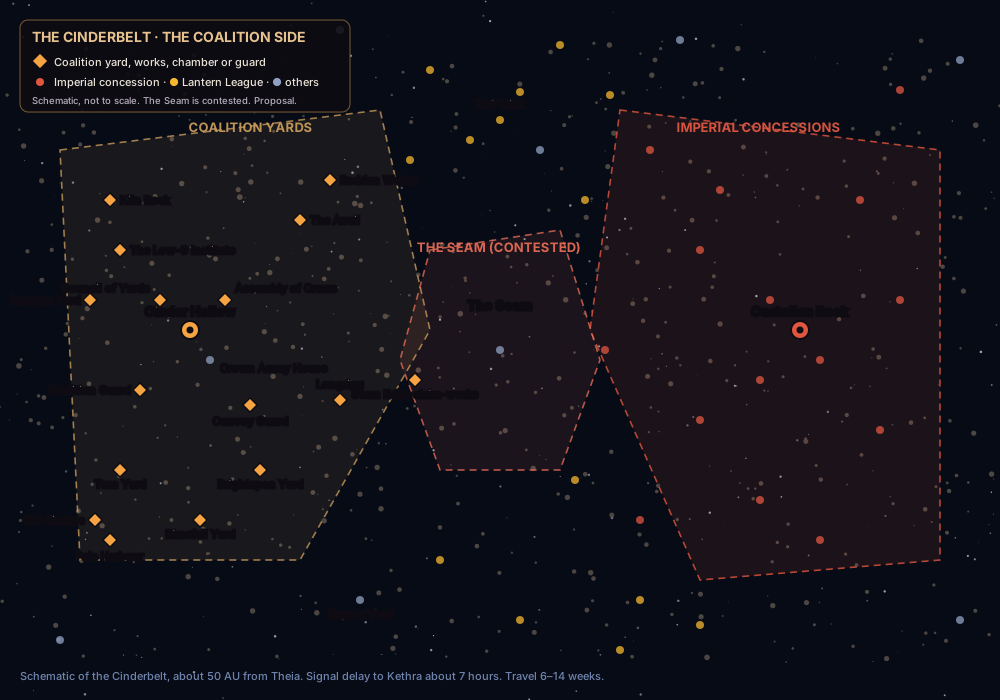
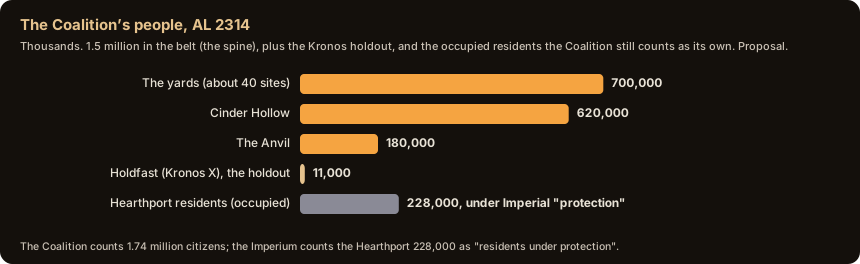
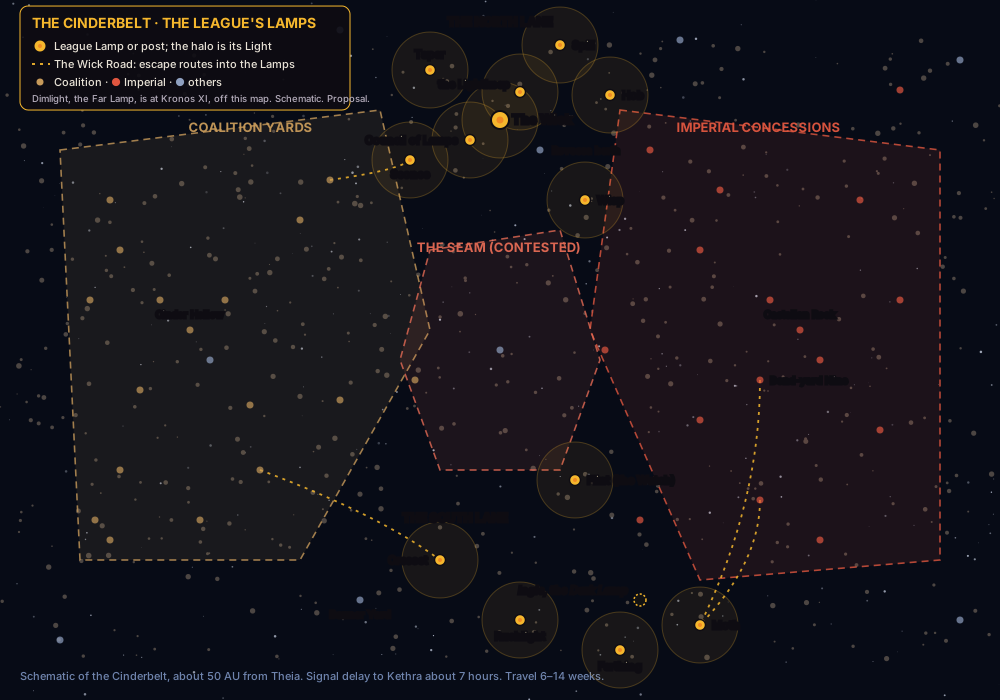
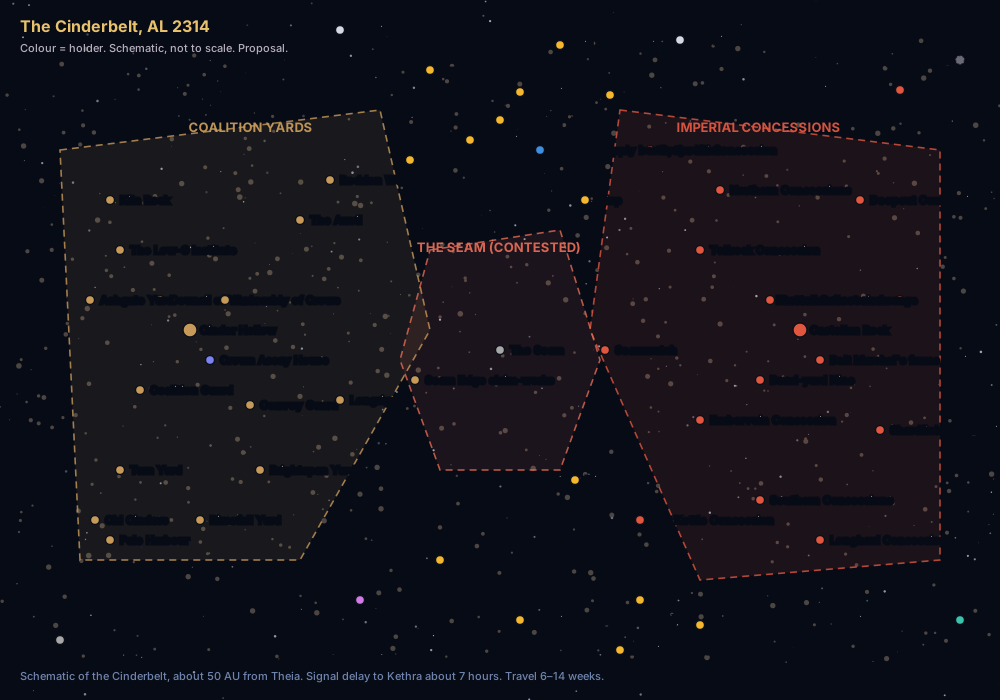
The Cinderbelt, about 50 AU out 3.1 million Cinderbelt Coalition, 1.5 million; Vardane Imperium (Castellan Rock and about 60 concessions), 0.9 million; Outer Lantern League, 0.5 million; others, 0.2 million. See Kronos and the Cinderbelt.
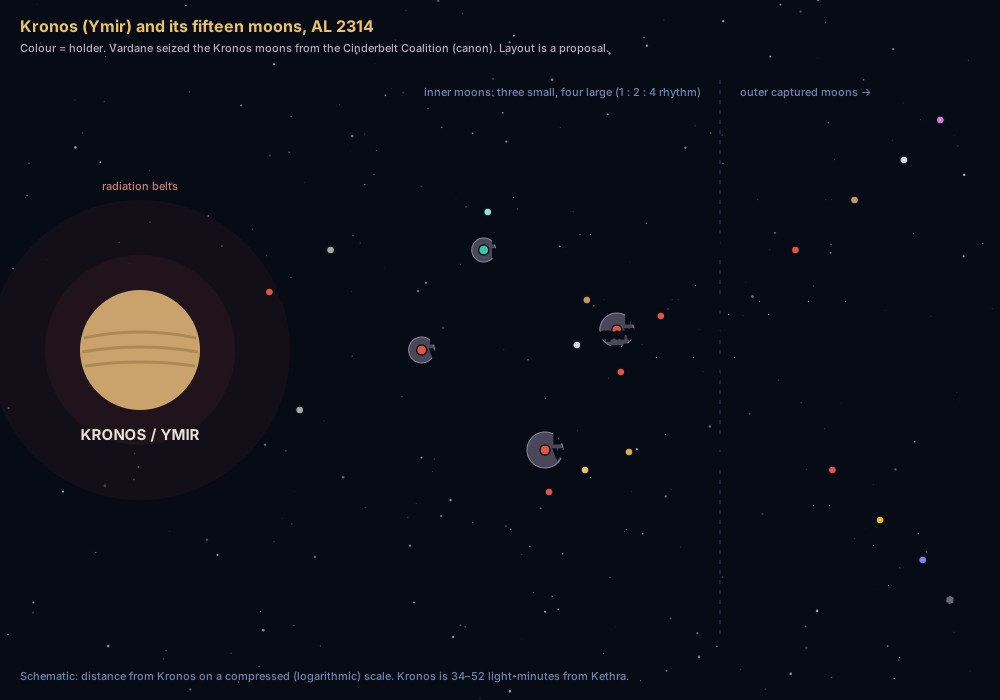
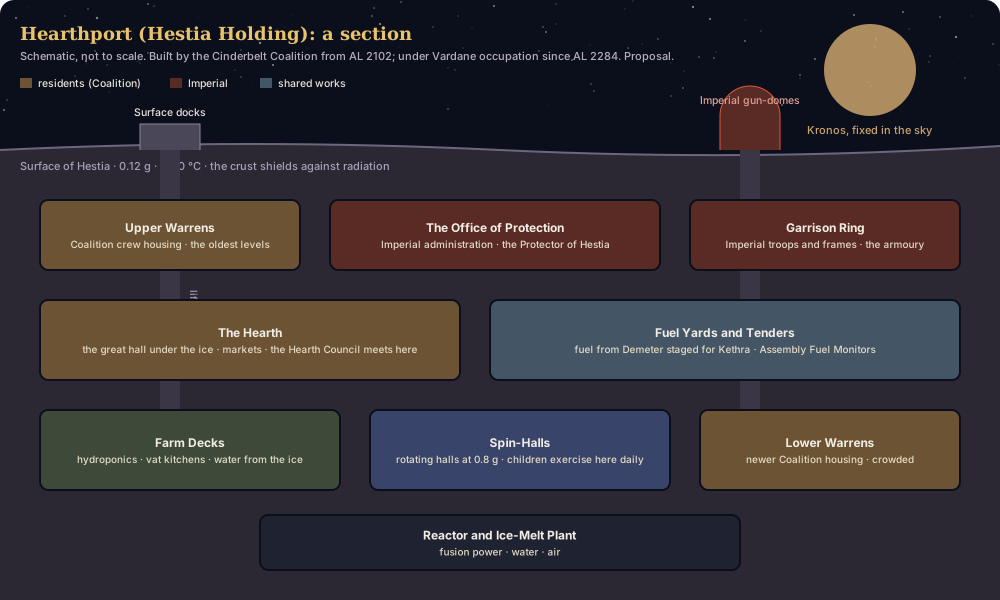
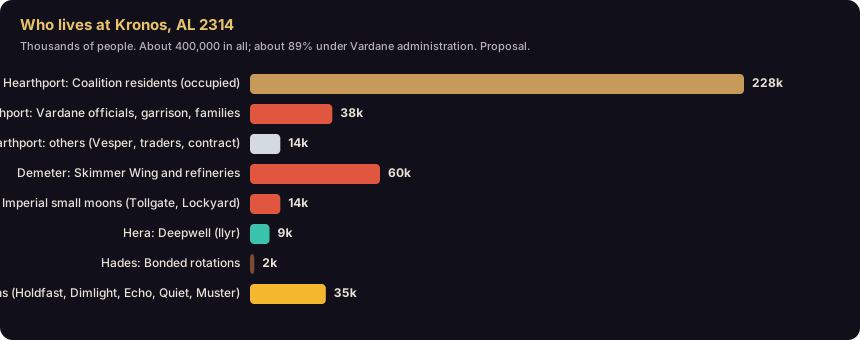
The gas giant's 15 moons: capital name Kronos, frontier name Ymir 0.4 million Vardane Imperium, by occupation: seized from the Cinderbelt Coalition in the Corridor War (canon: the seizure; proposal: the date, AL 2284). About 89% of the people live under Vardane administration. Coalition, Lantern, Vesper, Crown, Ilyr and Free Banner footholds remain, and the Black Ledger is rumoured to have one (corrected 19 September 2026: earlier wording listed the Ledger's foothold as a fact; the Who's Who, chapter 11 and the Kronos colony almanac give it as rumour). See Kronos and the Cinderbelt.
Total humanity about 884.5 million
  • Light delay: a signal takes about 7 hours each way between Kethra and the Cinderbelt. Every conversation with the belt is a letter, not a call.
  • Travel: fusion torch-ships reach the belt in weeks to months.
  • No faster-than-light travel. It was lost (see S5), so humanity cannot leave the system.

S5. How humanity came here#

  1. Earth-of-the-songs. The songs hold no history of Earth. They hold fragments: a green world under one moon, its creatures and old gods, the Leaving, and the Crossing. Why the ancestors left is lost. The songs say only that they saw something coming and went before it came. Nothing in any song names or describes what they saw. *(Why the ancestors left is not settled for the author either, and must be told without settling the protected mystery of how Earth became the Hive's home. Whisperling, please make a determination and bring Briana the result for approval.)*
  2. The Crossing. The ancestors crossed by a means the songs call the Long Door. How it worked was lost in the Silence. Seven ships set out; three reached Kethra: the Patience, the Covenant and the Lodestar. They carried about 214,000 people, most of them in cold sleep, along with seed stocks, embryo banks and Earth soil cultures.
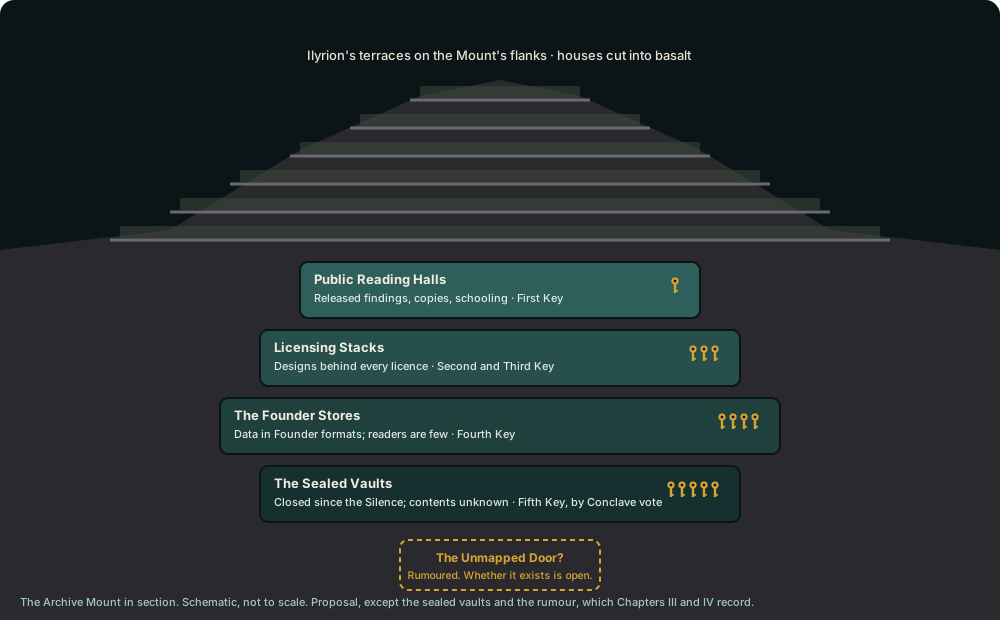
  3. The Forgetting. On landing, the Founders sealed every navigation record and swore the Oath of the Unmapped: no one would ever seek Earth, so that whatever they fled could never follow a path back. The records were sealed, not destroyed. They were lost over the following centuries, as the Founders' data-stores failed during the Silence and the last people trained to read them died. Whether any sealed fragment survives, perhaps in Ilyr, is rumour and an open question. The Oath is the oldest law on Kethra and the root of its deepest taboo.
  4. Landfall, AL 0. The ships came down on the southern coast of Calathe, at the place still called Landfall.
  5. The Gift. The Founders engineered a gut flora that lets humans partly digest processed native foods. It passes from mother to child.
  6. The Silence, AL 41–about 400. The ships' fabricators failed. The Grey Cough, a mutated Earth virus, swept the settlements from AL 44 to 61. The population fell to about 58,000 by AL 120. The knowledge behind the Long Door was lost, along with most written records. The songs survived, kept by the first song-keepers, the origin of the Cantorate.

S6. Eras (full history in Chapter IV and the country almanac)#

Era Years
The Crossing, the Forgetting and Landfall before AL 0 to AL 0
The Founding AL 0–41
The Silence AL 41–about 400
The Kindling: chiefdoms and the first kingdoms about AL 400–812
The Crown Era, from the Charter of Caldren (AL 812) AL 812–1500
The Relearning: printing, steam, electricity, the Vault Openings AL 1500–1900
Settlement of Eldvang across the Line from AL 1620s
The Ascent: flight, computing, orbit (AL 2011), frames, the belt (AL 2140) AL 1900–2150
The Iron Winter: an autonomous war-machine disaster AL 2141–2146
Homeworld Assembly founded by the Charter of Aletheia AL 2150
The Corridor War: Caldren against Vardane AL 2279–2291
The Armistice of Saltline AL 2291
The present AL 2314

S7. Where the approved factions sit on Kethra (proposal)#

These are native Kethran institutions with Kethran names. They are not inherited from songs.

Faction Placement on Kethra
Caldren Crown Constitutional monarchy in southern Calathe. Capital Aletheia, which is also the seat of the Homeworld Assembly. The capital nation.
Vardane Imperium Rigid imperial state on Oreth. Capital Vardenhold. Uneasy armistice with Caldren after the Corridor War. Holds the Kronos moons (seized from the Coalition) and extensive Cinderbelt operations. Controls food (phosphate) and power (fusion fuel).
Ilyr Sanctum Aelos (see the Ilyr Sanctum almanac). Founded by keepers of the Founders' archive who sailed east during the Silence. Restricts technology because it knows what the songs' war cost. Capital Ilyrion.
Order of the Veiled Sun The Ilyr Sanctum's elite military order, flying exceptional frames.
Rovessa Caravans (See the Rovessa Caravans almanac.) Trading families living aboard great sea-carriers on the Girdle Sea. Neutral carriers across the Line. Home port Saltline.
Free Banner Guild Licensed mercenary frame companies
Black Ledger Assassins and deniable operators. Hidden.
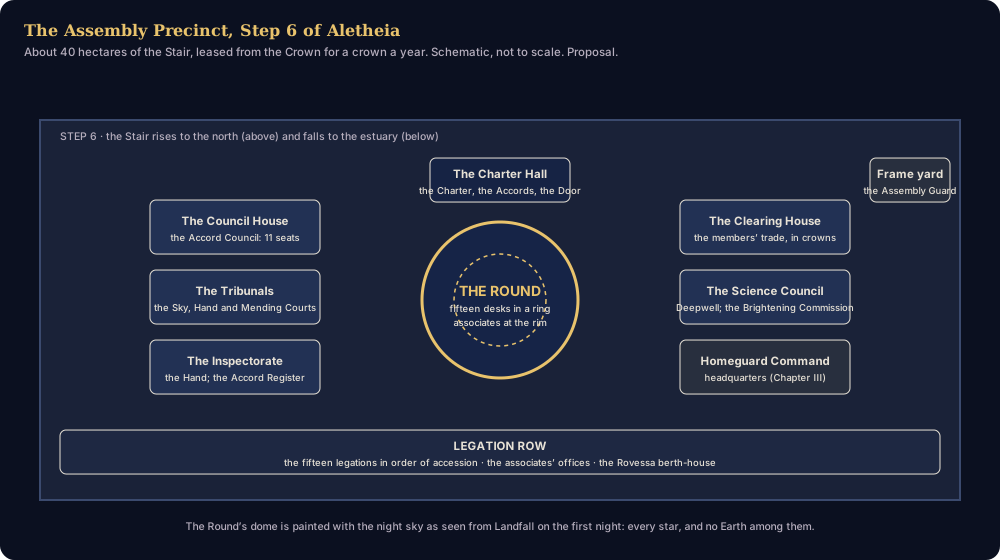
Homeworld Assembly The planetary union: 15 member states, founded AL 2150. Its name declares Kethra the new homeworld.
Homeguard Command The Assembly's joint defence command
Vesper Orbital Compact Governs orbit and the moon stations
Cinderbelt Coalition Belt industry and shipyards, seated at Cinder Hollow. The largest belt power. Dispossessed of its Kronos moons by the Imperium, and wants Hearthport back.
Outer Lantern League Belt and outer-system settlements resisting coercive orbital and Coalition rule
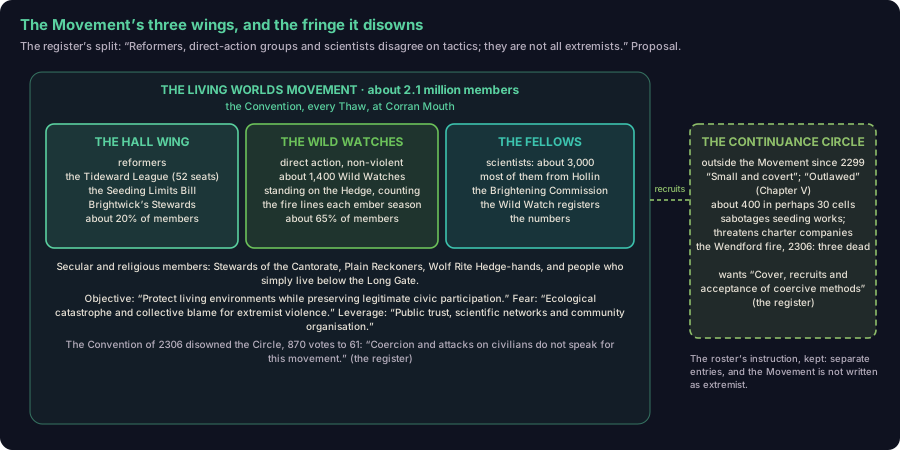
Living Worlds Movement and Continuance Circle Placement: canon. Briana approved it on 19 September 2026 (the Living Worlds Placement Decision; the canon table above). Everything else about them is a proposal. The register places these in the colonial-fracture saga, which is neither the Homeworld group nor the Crowns group, and that later placement is not overruled. On Kethra they carry Kethran names, like every faction in this table: an environmental movement protecting the native Wild and preparing for the hot era, and its extremist fringe. (Until 19 September 2026 this row was marked "Tentative" and "Briana to confirm or strike", and said the pair "would be inherited names", against this table's own preamble.)
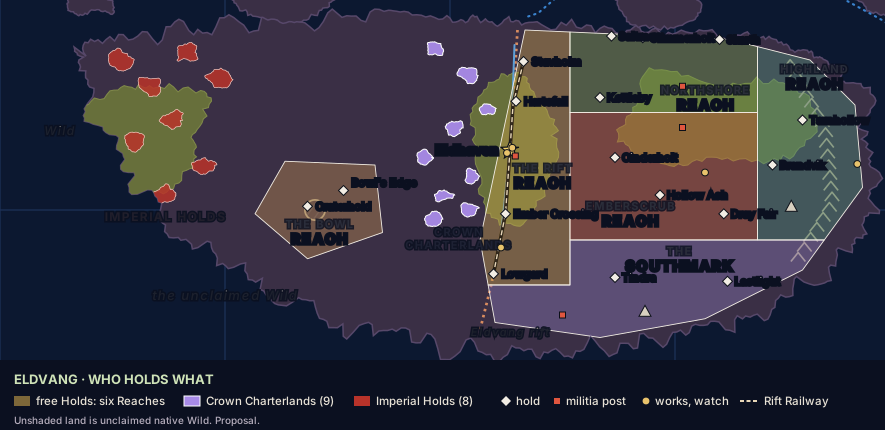
Southern Holds An original grouping, not a roster faction. (See the Southern Holds almanac.) Self-governing frontier settlements in Eldvang. Some are chartered to Caldren ("Crown Holds") or to Vardane ("Imperial Holds"); others are free. They are bound loosely by the Holds Compact. Their disputes over charters echo the colonial wars in the songs.

| Concord Fleet | Not yet formed in AL 2314. In the saga, it is the joint fleet raised when alien contact comes, in era 2. Its seed may be Homeguard Command's small orbital arm. Coalition politics over command and contributions follow the register. |

Not placed on Kethra: the Varkhesh, Orravan Empire, Ithryx, Helion and Distant Systems factions, Crossgate Exchange, Hollow Compact, Wayfarer Exchange, Farwatch Service and Noetic Directorate. Some may enter in later eras of the saga (alien contact, expansion, the fracture, the Reckoning). Their casting is Briana's to decide, except one question she gave to Whisperling on 19 September 2026: which faction is the "alien empire" of sagas 1–2. Whisperling, please make a determination and bring Briana the result for approval.

S8. Technology in the present day#

  • Frames. Piloted fighting and working machines, the VectorZ machines. The law of the Frame Accord requires a human hand in every frame: "No frame without a hand." This dates from the Iron Winter.
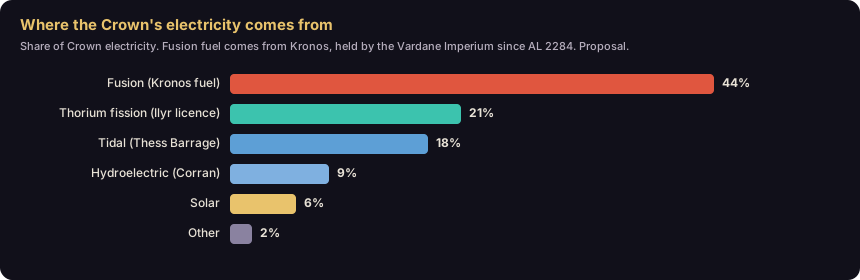
  • Energy. Fusion power, thorium fission and tidal power.
  • Space. Fusion torch-ships within the system. Orbital spin-habitats.
  • No faster-than-light travel. No outward signalling. The Quiet Sky Accord limits powerful broadcasts aimed out of the system.
  • The Mending Accord (AL 2163), called the Mending Ban in everyday speech. Heritable human genetic editing is banned. Therapies that are not inherited are licensed.
  • Listeners. Ilyr trains a small number of "Listeners" using Founder neural technology. Whether their abilities are real psionics is an open question.

S9. The Caldren Crown in brief (full detail in the country almanac)#

  • Area: 5.9 million km²
  • Population: 214.3 million
  • Capital: Aletheia, metropolitan population 11.2 million
  • Government: constitutional monarchy. The current monarch is Elisande II of House Halden, reigning since AL 2289.
  • Currency: the crown (Cr), divided into 100 marks
  • Religion: the state church is the Cantorate, the Church of the Song
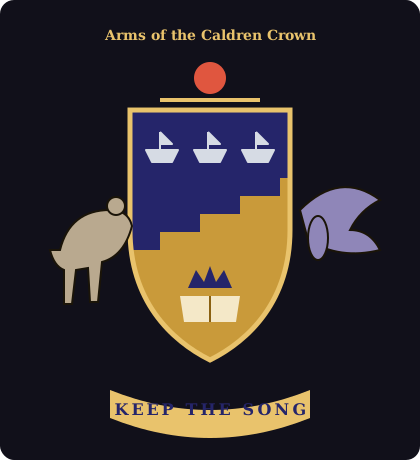
  • Motto: Keep the Song

Guidance for AI actors (applies to every chapter)#

  1. Names mark origin.
    • Capital people and officials say Selenne, Theia, Hyperion, Pandia, Ersa, Kronos, Notia.
    • Frontier people say Kethra, Sól, Surtr, Máni, Hati, Ymir, Eldvang.
    • Choosing the other side's name is a deliberate act: a sneer, a sign of respect, or a person who has moved.
  2. Nobody knows where Earth is. Nobody may try to find out. Merely suggesting it is shocking.
  3. The songs are not history. They hold fragments: a green world, the Leaving, the Crossing, the Founders' warning. Characters treat them as scripture, poetry or unreliable memory, depending on who they are.
  4. Nobody on Kethra has heard of the Varkhesh. There is no Kethran word for them. The Founders' warning names nothing; popular imagination calls it "the Dark that listens". Never connect the Dark to anything specific. How Earth became the Varkhesh Hive's home is a protected mystery, and no character, scene or document may hint at an answer.
  5. The red nights are getting brighter. Everyone over 40 has noticed. What it means is a political and religious fault line.
  6. Earth-descended food is life. Most native plants and animals are useless or dangerous to eat. Farmland is precious; the Wild is vast.
  7. The almanac is approved (19 September 2026), so what it says is fact in play. Anything added later is a proposal until Briana approves it. Where a chapter marks something (open), do not invent an answer in a scene; flag it instead.

Files in this almanac#

File Contents
01 - Introduction 0.1–0.5: the physical world
02 - Chapter I 1.1–1.5: people as living bodies
03 - Chapter II 2.1–2.5: class, government, law, family
04 - Chapter III 3.1–3.5: cities, homes, habitats
05 - Chapter IV 4.1–4.5: speech, script, history, myth
06 - Chapter V 5.1–5.5: religion, rites, morals, taboos
07 - Chapter VI 6.1–6.5: economy, money, industry, food, transport
08 - Country Almanac Part 1 Caldren Crown, Sections 1–4
09 - Country Almanac Part 2 Caldren Crown, Sections 5–8
10 - Who's Who Every faction of the First Colonial War on one page
11 - Kronos and the Cinderbelt Kronos's 15 moons and the belt, faction by faction
13 - Vardane Imperium, Part 1 Country almanac: the Vardane Imperium, Sections 1–4
14 - Vardane Imperium, Part 2 Sections 5–8, including every holding
15 - Kronos colony Colony almanac: Kronos and occupied Hearthport
16 - Register of Vardane Holdings Every Imperial installation (generated)
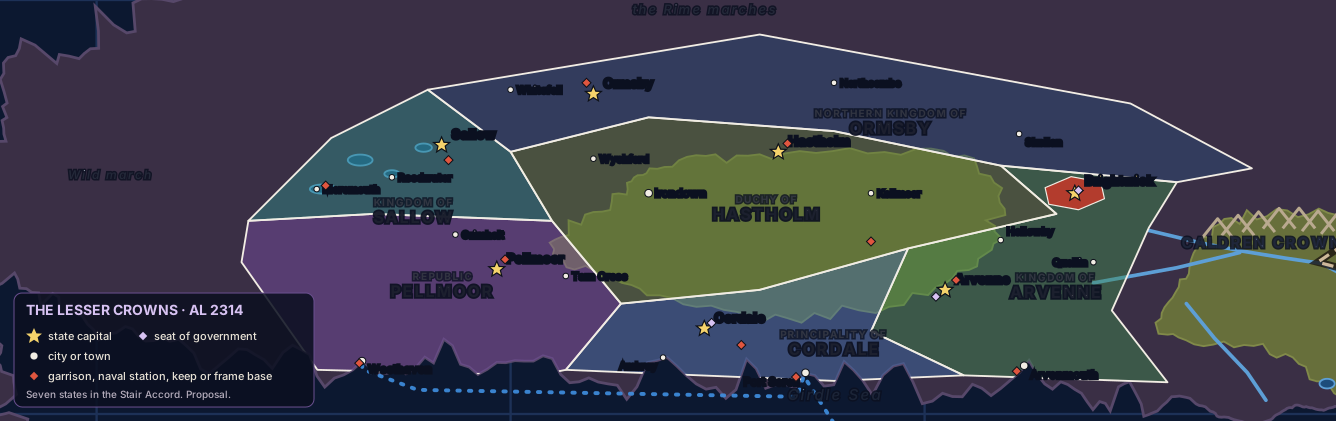
17 - Lesser Crowns, Part 1 Country almanac: the seven Lesser Crowns, Sections 1–4, with every ruler
18 - Lesser Crowns, Part 2 Sections 5–8: the Stair Accord and each state profiled
19 - Register of the Lesser Crowns Every Lesser Crowns city, town and installation (generated)
20 - Ilyr Sanctum, Part 1 Country almanac: the Ilyr Sanctum, Sections 1–4, with every First Custodian and Master of the Order
21 - Ilyr Sanctum, Part 2 Sections 5–8: the Conclave, the five Charges, licences, the Order
22 - Register of the Ilyr Sanctum Every Ilyr and Veiled Sun place (generated)
23 - Rovessa Caravans, Part 1 Country almanac: the Rovessa, Sections 1–4, with every Helm of the Captains' Table
24 - Rovessa Caravans, Part 2 Sections 5–8: the Table, the Houses, neutrality, the Share
25 - Register of the Rovessa Caravans Every Rovessa berth, tower and carrier (generated)
26 - Southern Holds, Part 1 Country almanac: the frontier, Sections 1–4, with every Speaker of the Compact
27 - Southern Holds, Part 2 Sections 5–8: Moot to Compact, the Reaches, the charters, debt
28 - Register of the Southern Holds Every free Hold and post, with the chartered Holds (generated)
29 - Line Free Ports, Part 1 Country almanac: the twelve free ports, Sections 1–4, with every Portreeve of the Line
30 - Line Free Ports, Part 2 Sections 5–8: the Tide Congress, each port, neutrality, the Exchange
31 - Register of the Line Free Ports Every free port and harbour institution (generated)
32 - Free Oreth Coast States, Part 1 Country almanac: Tessmere, Merrin and Stellan, Sections 1–4, with every First Consul and First Syndic
33 - Free Oreth Coast States, Part 2 Sections 5–8: the three states, the Three Shores Council, the Grey March
34 - Register of the Free Oreth Coast States Every town, fort and institution of the Three Shores (generated)
35 - Cinderbelt Coalition, Part 1 Country almanac: the Coalition, Sections 1–4, with every Yardmaster and Crew Speaker
36 - Cinderbelt Coalition, Part 2 Sections 5–8: the two chambers, the rocks, the Seam, output, culture
37 - Register of the Cinderbelt Coalition Every Coalition rock, yard and post (generated)
38 - Outer Lantern League, Part 1 Country almanac: the League, Sections 1–4, with every Lamplighter
39 - Outer Lantern League, Part 2 Sections 5–8: the Council of Lamps, trimmers and flints, the Arrears, the Light
40 - Register of the Outer Lantern League Every Lamp and League post (generated)
41 - Vesper Orbital Compact, Part 1 Country almanac: the Compact, Sections 1–4, with every Compact Chair
42 - Vesper Orbital Compact, Part 2 Sections 5–8: the Board and the guilds, the roster, the Arrears, the relays
43 - Register of the Vesper Orbital Compact Every Compact ring, office, fleet, base and relay (generated)
44 - Homeworld Assembly, Part 1 Country almanac: the Assembly, Sections 1–4, with every Speaker and Warden-General
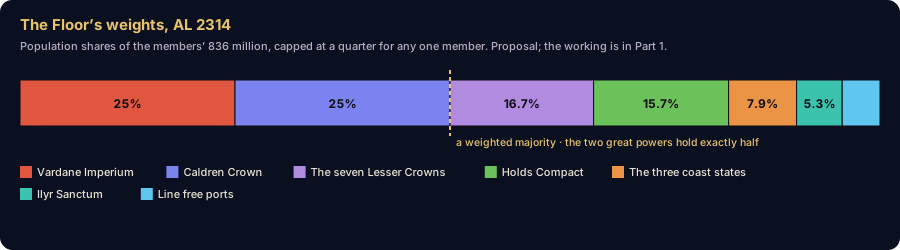
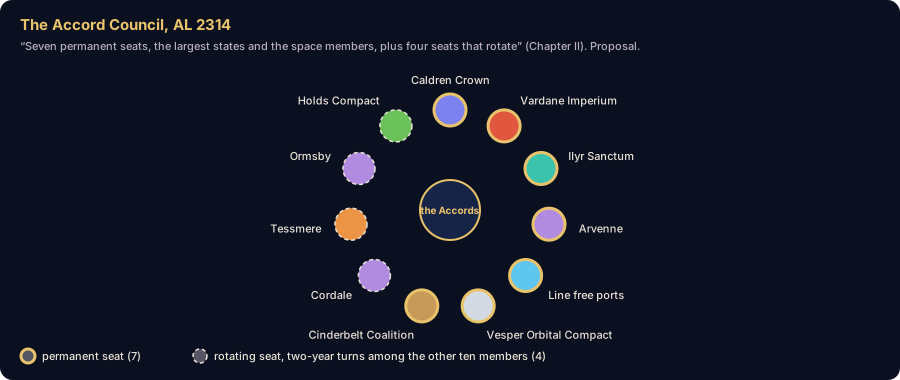
45 - Homeworld Assembly, Part 2 Sections 5–8: the Charter and the Accords, the Floor and the Council, Homeguard Command, the Requisition Bill
46 - Register of the Homeworld Assembly Every Assembly and Homeguard body, post and memorial (generated)
47 - Homeguard Command, Part 1 Country almanac: Homeguard, Sections 1–4, with every Chief of Staff
48 - Homeguard Command, Part 2 Sections 5–8: the chain of command, the Contingent Rules, the split over the Seam, the forces
49 - Register of Homeguard Command Every Homeguard post and contingent station (generated)
50 - The Free Banner Guild, Part 1 Country almanac: the Guild, Sections 1–4, with every First Banner
51 - The Free Banner Guild, Part 2 Sections 5–8: the Banner Court, the Neutral Roll and the Withdrawal Clause, the clients, the Roll of Banners in full
52 - Register of the Free Banner Guild Every Guild hall, court, yard and depot (generated)
53 - The Black Ledger, Part 1 Country almanac: the Ledger, Sections 1–4: known, alleged, rumoured, and behind the ledger
54 - The Black Ledger, Part 2 Sections 5–8: the four lines of the Book, what each law can do, the accounts, the Ledger of the Dead
55 - Register of the Black Ledger Every rumoured and alleged Ledger site (generated)
56 - The Living Worlds Movement, Part 1 Country almanac: the Movement, Sections 1–4, with every Convenor and every leader of the Tideward League
57 - The Living Worlds Movement, Part 2 Sections 5–8: the Convention, the Tideward League, the Seeding Limits Bill, the Continuance Circle
58 - Register of the Living Worlds Movement The Movement's halls, its Convention's grain hall and its first Wild Watch, and the Circle's one proven act (generated)
12 - Atlas Gazetteer Every atlas asset as tables (generated from the atlas data on each build)
The Atlas Interactive maps: Kethra, its orbit, Kronos and the Cinderbelt. Every city, town, hold, base and station, with filters.
figures/ Maps, plans, charts, flags and arms used in the chapters (SVG)

Name checks for new names in this almanac#

These are informal checks against well-known fiction and games; they are not trademark clearance.

  • Kronos is used for the Klingon homeworld in English-language Star Trek material.
  • Ymir is a moon of Saturn.
  • Aletheia is a Greek word for "truth" and has been used in some minor works.
  • Calathe resembles Calathea, a genus of houseplants.
  • Nifl echoes Niflheim in Norse myth. This is deliberate: it is the frontier's name.

No prominent clashes were found for Oreth, Aelos, Notia, Eldvang, Vardenhold, Ilyrion or Saltline.

Prepared by Claude.
Introduction: Origins and Environmental Catalysts#

Kethra Almanac • Approved 19 September 2026 • drafted 18 September 2026

Status: approved. Briana approved the whole almanac on 19 September 2026 (the Almanac Approval Decision). Where this file calls something a proposal, read it as approved, except the open points that decision lists.

Status before approval: §0.1 restates canon. Everything else is a proposal built on the spine.

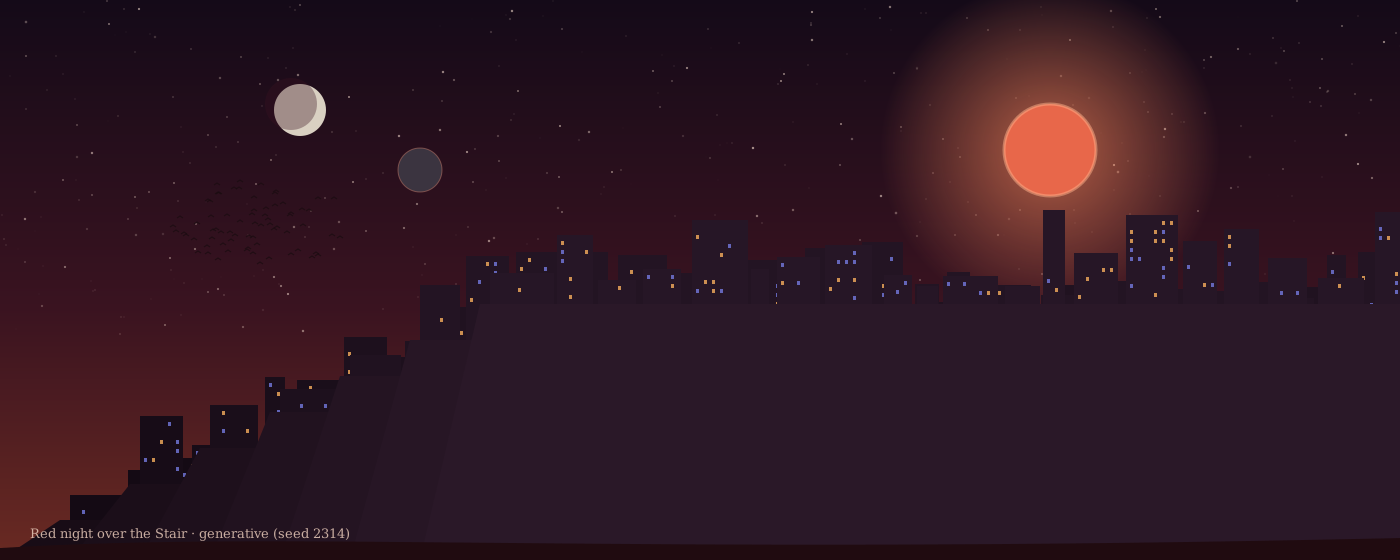
Generative artwork: a red night over the terraces of Aletheia, with Hyperion, the two moons and swarms of gloamwings
Red night over the Stair. Generative art from a fixed seed (2314): the red giant Hyperion over Aletheia's terraces, with pale Pandia, dark Ersa and gloamwing swarms.

0.1 Cosmic Context & Planetary Metrics#

Canon except where marked.

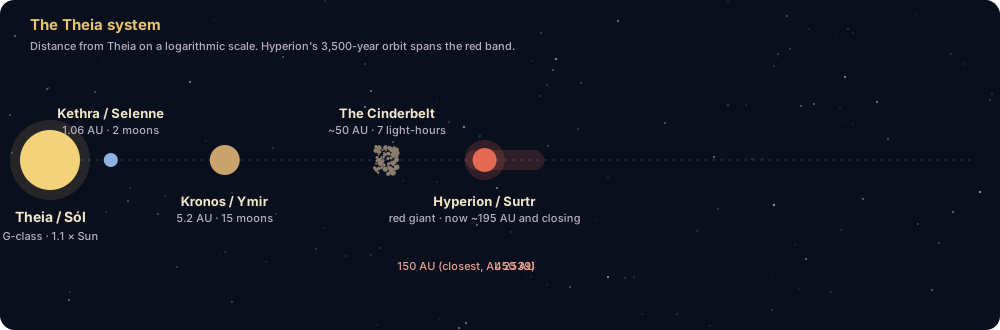
The Aion system. Kethra orbits Theia (frontier name: Sól), a yellow-white G-class star. Theia is about 5.5 billion years old and about 10% brighter than our Sun is today. Far outside Kethra's orbit, the red giant Hyperion (frontier name: Surtr) swings between about 150 and 450 AU, completing one orbit in about 3,500 Earth years (about 3,204 Kethran years). The system also contains:

  • a gas giant at about 5 AU, named Kronos in the capital and Ymir on the frontier (these names are a proposal);
  • the Cinderbelt, a rubble belt at about 50 AU, at the edge of Theia's system.
Metric Value
Distance from Theia 1.06 AU
Orbital eccentricity about 0.03
Sunlight received about 98% of what Earth receives, plus Hyperion's contribution
Year about 368 Kethran days (about 399 Earth days)
Day 26 hours
Axial tilt 27°
Seasons four, each about 92 days long at mid-latitudes
Moons Pandia/Máni: large, bright, phase cycle of 30.5 days. Ersa/Hati: small, dark, phase cycle of about 3.1 days, rising about every 1.5 days.
Red-night season 4–5 months a year. It falls in the northern winter in the present era, so the south has red summers.
Radius, gravity, area (proposal) about 6,340 km; about 1.00 g; about 505 million km², of which 66% is ocean
Atmosphere (proposal) about 0.95 Earth atmospheres; 23% oxygen

Where Hyperion is now (proposal, AL 2314). Hyperion is about 195 AU away and closing. It adds about 0.76% to the heat Kethra receives, and red nights are about 250 lux: roughly the light of a dim room, coloured deep red-orange. It will reach its closest point around AL 2539. Over a single human lifetime the red nights brighten by about a fifth. That is enough for any grandparent to notice, and enough to argue about.


Chart of the Theia system: Theia, Kethra, Kronos, the Cinderbelt and Hyperion on a logarithmic distance scale
The Theia system on a logarithmic distance scale. Hyperion's orbit spans the red band.
Line chart of Hyperion's extra heat on Kethra from AL −1200 to AL 3200, peaking near AL −665 and AL 2539
Hyperion's extra heat on Kethra, worked from the approved orbit. The present (AL 2314) sits on the rising slope toward the next hot era.

0.2 The Cradle: Original Habitats & Geography#

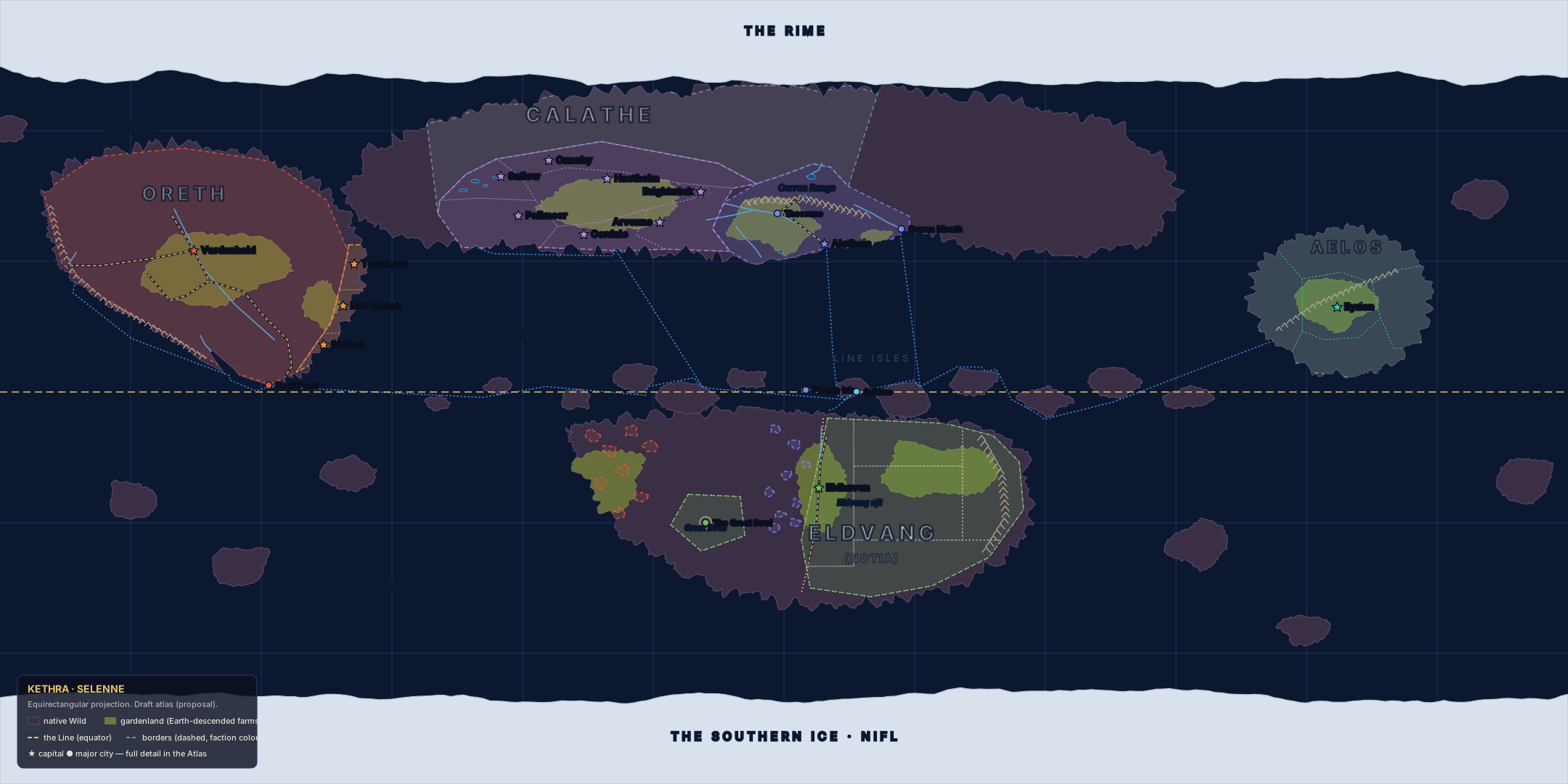
World map of Kethra showing Calathe, Oreth, Aelos, Eldvang, the Line Isles, polar lands, borders, farmland and capitals
Kethra (Selenne). Dashed lines are borders in faction colours; olive is gardenland; the gold dashed line is the Line. For every town, base and station, open the interactive Atlas.

The ground itself#

Kethra is geologically alive. Plate tectonics recycles its crust, which keeps its carbon cycle and climate stable over long ages, as on Earth.

Continent Geology
Calathe (north) An old, stable continental core, fringed on its south by the Corran Range. The Corran is a young, high range of folded mountains; its tallest peak, Mount Corran, reaches 7,120 m. Below it runs the long valley of the River Thess, about 3,900 km from source to sea. Its mouth forms a wide, funnel-shaped estuary with some of the strongest tides on the planet.
Oreth (west) An active margin. A chain of volcanoes runs along its western coast, and earthquakes are frequent. Its interior basins hold Kethra's richest phosphate beds, the reason Oreth's supply routes matter to everyone.
Aelos (east) An island continent raised by a volcanic hotspot. It is mountainous, fertile in the lowlands, and cut off from the rest of the world by open ocean.
The Line Isles (equator) Volcanic island arcs along the Girdle Sea. They are ringed by reefstone: vast, living native structures similar to coral. The best spaceport sites on the planet are here, because launching from the equator gets the most help from Kethra's spin.
Notia / Eldvang (south) A continent split by a great rift valley. Its interior is a dry plateau, and highlands rise on its eastern edge. At its heart lies the Great Bowl, a 300 km crater left by an impact in the bombardment era.
The Rime and the Southern Ice (poles) Ice-covered land. The Southern Ice holds metal-rich rock that is mined in the short summers.

The Stair#

Every warm era raises the seas and every cool one lowers them, while the land along Calathe's southern coast slowly rises. Over hundreds of thousands of years this has left a staircase of raised beaches: bands of old shoreline stepping up the coasts. These are called the Stair. The youngest step, from the last hot era about 3,000 Earth years ago, stands about 12 m above today's sea. The oldest steps in the Thess estuary stand about 140 m up, and the slopes between steps are steep. The steps are flat, well drained and easy to build on. The Founders built on them, and so has almost everyone since. Aletheia, the capital, rises in terraces up the Thess estuary Stair.

The working behind these dates: Hyperion's last closest approach was around AL −665, about 726 Earth years before Landfall. Add the roughly 2,528 Earth years since Landfall and the peak was about 3,250 Earth years ago. Seas lag behind temperature by centuries, so the seas stood highest a few centuries after the peak, roughly 2,800 to 3,100 Earth years ago. They were still falling when the Founders arrived.

Native biomes#

Native plants are dark: deep purple, bronze and near-black. Their pigments absorb both Theia's yellow-white light and Hyperion's red. Native biomes were named in Landspeech by the Founders:

Biome Where Character
Duskwood Temperate Calathe, eastern Oreth, Aelos Tall, dark forest with a canopy that almost never lets light through. It is quiet in the day and loud with animals on red nights.
Reedland River valleys and estuaries Giant hollow reeds, some higher than a house. Marsh, ambush predators, and the source of blackreed timber.
Salt-steppe Interior Calathe and the Eldvang plateau Dry grassland on salty soil, home to vast herds of shalebacks.
Emberscrub The Eldvang lowlands Low, oily, fire-adapted scrub. It burns in the red summers and grows back from its roots.
Reefstone shallows The Girdle Sea Warm, clear, full of life. All of it is inedible to humans.
Wild tundra The polar margins Moss-like mats, dormant for half the year

The first habitats#

Why the Founders chose Landfall. They picked the south coast of Calathe at the mouth of the Thess, for four reasons:

  • It is temperate.
  • The river gives fresh water.
  • The Stair offered flat, freshly exposed ground where native life was thin and Earth soil cultures could take hold quickly.
  • The deep tidal estuary made a harbour.

The Seven Terraces. The first settlement was built on seven steps of the Stair above the estuary. It is still called the Seven Terraces, and it is now a quarter of the town of Landfall.

Spreading out. From Landfall, settlement spread up the Thess valley and along the Calathe coast. It moved only as fast as native ground could be seeded with Earth life (see 0.4). This is why the old heartland is a long chain of river-valley farmland, with Wild on either side.


0.3 Climatological Drivers#

What makes Kethra's weather different from Earth's#

  1. Slower spin. A 26-hour day gives slightly weaker spin effects on the winds than Earth's. As a result:
    • the tropical wind belts are wider;
    • the dry subtropical deserts sit a little further from the equator, at about 33–38° latitude instead of Earth's 30°;
    • tropical storms grow larger and move more slowly.
  2. Stronger tilt. At 27°, summers are hotter and winters colder than at the same latitude on Earth. Polar nights are longer.
  3. Richer air. With 23% oxygen, fires ignite more easily and burn hotter.
  4. Two moons. Tides are strong and complex, and shallow coasts mix constantly with the open ocean.
  5. Hyperion. It gives light through the red-night season and a slowly rising share of heat over the centuries.

Severe weather#

System Where and when What it does
Girdle storms The Girdle Sea, in late summer of each hemisphere Huge, slow tropical cyclones. They can stall over the Line Isles for days. The Rovessa read their signs better than any weather service.
Ember storms Worst in the Eldvang lowlands, in the red summers. They occur in the north as well (canon since 19 September 2026). There they come in late summer, in the dry country of the northern continents: above all the drier stretches of the Stair coast, and Calathe's interior. Aelos, oceanic and mild, has fewer. Wildfires that make their own weather. Hot air rises off the fire and pulls wind in behind it, so the fire drives itself forward. They are fed by high oxygen and by built-up fuel. In the south that fuel is emberscrub dried over the red summer; in the north, it is grass, scrub and forest dried over the summer. Northern ember storms usually start from the lightning of late-summer storms blowing in off the Girdle Sea, which is why northerners say they "come off the sea". Frontier towns are designed around them (see Chapter III).
Blackfrost Eldvang and southern Oreth, in winter The southern winter falls in the dark season, with no red light. Nights are long, cloudless and bitterly cold. Frost kills crops and livestock in hours.
Double springs Every coast, whenever both moons line up with Theia Tide ranges peak. In funnel-shaped estuaries like the Thess, the incoming tide can rise as a single travelling wave (a tidal bore) up to 9 m high: the Thess Bore. When double springs coincide with a storm, low cities flood.
Longstorms Northern Calathe, in autumn Slow, persistent weather systems bringing weeks of rain. They feed the northern rivers.

Ocean and air currents#

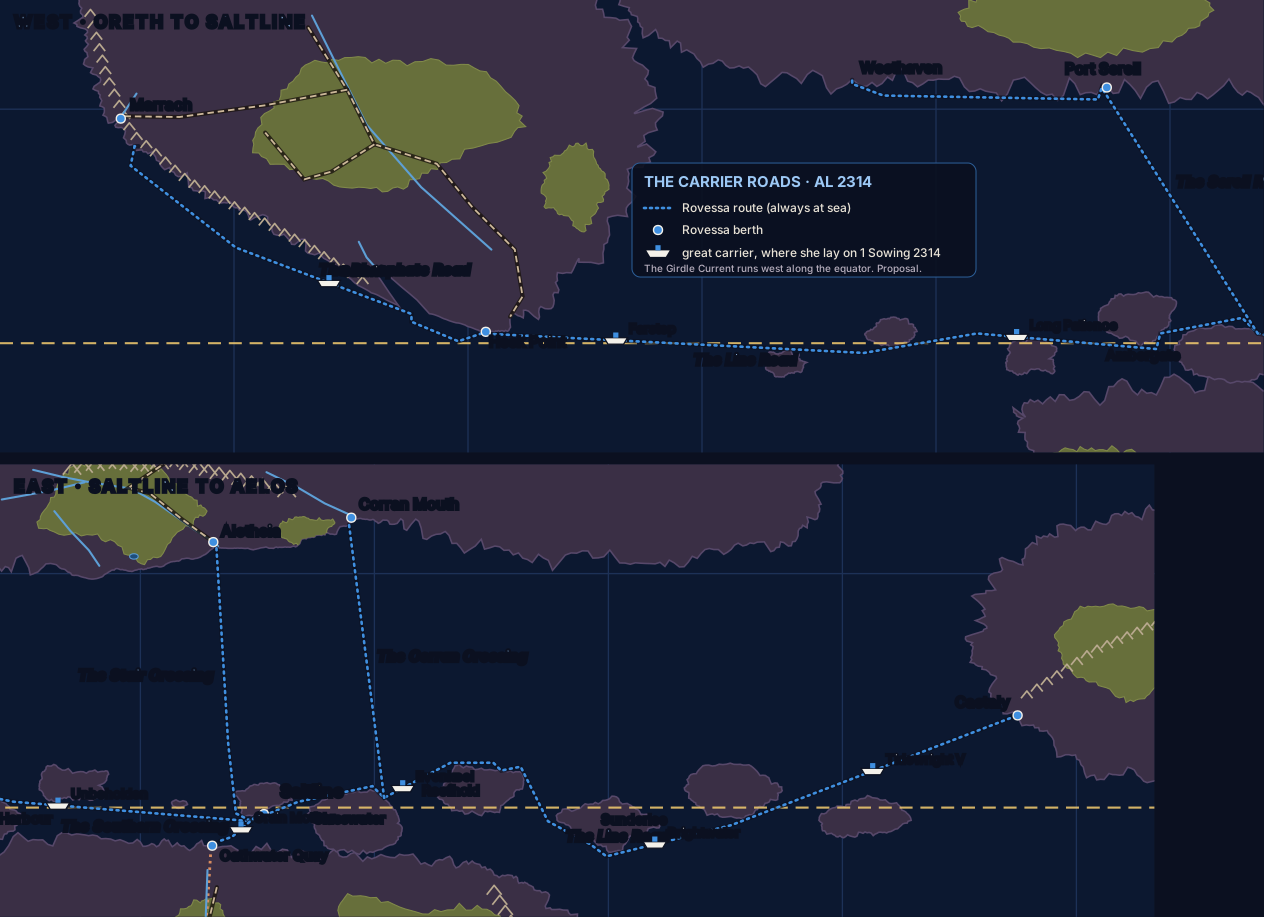
  • The Girdle Current runs westward along the equator. Every Rovessa route is built around it.
  • The Warm Reach carries warm, wet tropical water along the southern and eastern coasts of Calathe. Rain-bearing winds come off it all year. This is why the Thess coast, where Aletheia stands at 34° N, is green and humid rather than part of the dry subtropical belt. The deserts at that latitude lie in the continental interiors and on the west-facing coasts.
  • The Southern Cold flows up from the Southern Ice along western Eldvang. It keeps that coast foggy, dry and rich in native sea life.
  • Winds follow bands like Earth's, but wider: easterlies in the tropics, westerlies at mid-latitudes, and polar easterlies near the poles.

How the seasons turn#

Season Northern character (the Crown heartlands) Southern character (Eldvang, at the same time of year)
Winter in the north / summer in the south Lit winter. Long, cold nights glowing red from Hyperion. Snow in the north of Calathe. Native plants keep growing at night. Red summer. Heat by day, red nights, emberscrub drying out. The ember-storm season.
Spring in the north / autumn in the south Thaw and planting. Hyperion rises later each night and fades from the nights. Harvest, and the fire season ending
Summer in the north / winter in the south Short, fully dark nights. The northern crop-growing peak. Late in the season, the north's ember storms. Dark winter. Blackfrost. The hardest season.
Autumn in the north / spring in the south Harvest. Hyperion returns to the evening sky. Thaw and planting, racing to finish before the red summer

Why the red nights matter to farming#

Native plants photosynthesise in Hyperion's deep red light. Earth crops barely can. During every red-night season the native Wild keeps growing through the night, while Earth fields merely rest, so the Wild presses in on the farmland. As Hyperion brightens, the Wild's advantage grows. This is the practical engine of Kethra's environmental politics:

  • The farmers of the capital call it "the Creep".
  • The Living Worlds Movement calls it the planet reasserting itself.

Long cycles#

Hyperion and the gas giant together stretch and relax Kethra's orbit over tens of thousands of years. Combined with the slow wobble of Kethra's axis, this produces ice ages and warm periods. Ilyr scholars have reconstructed several of these cycles from sediment cores. The Cantorate's position is that they are of no religious concern.


0.4 Natural Resources & Abundance Variances#

The chemistry that shapes everything#

Native life on Kethra is built from carbon, water and proteins, like Earth life, but it evolved separately:

  • Its sugars are mirror images of Earth's.
  • It uses three amino acids that Earth life never uses.

The consequence is that most native food is indigestible to humans, and some is poisonous. Humans live on Earth-descended crops and livestock, grown in seeded ground called gardenland. Processed native foods can be eaten only because of the Gift, the Founder-engineered gut flora described in Chapter I. Even then, they have to be leached and cooked first.

Seeding the ground#

Native soil does not support Earth crops until it has been converted. Farmers do this with Earth soil cultures: bacteria, fungi and worms descended from the Founders' soil banks. Converting a field is known as the Seeding. It takes about 30 years to reach full yield. As a result:

  • Farmland is precious and inherited.
  • Taking another state's gardenland is the oldest reason for war.
  • Converting new land is a multi-generation investment. The capital's banks lend against it.

Minerals and materials#

Resource Where Notes
Iron, copper, aluminium Calathe (Corran foothills), Oreth Plentiful. The Relearning was built on Corran iron.
Phosphate Oreth interior basins Scarce and strategic. Earth crops need phosphorus, and Kethra's surface keeps little of it. Whoever controls the Oreth phosphate corridors feeds the planet. This was the root of the Corridor War.
Iodine Earth-stock kelp farms along the Calathe and Line coasts Native life does not concentrate iodine, so there is almost none in the food chain unless kelp is farmed. Iodine deficiency and its effects were endemic in the Silence. Salt is iodised by law in the Crown.
Thorium Beach sands of Aelos and eastern Eldvang Fuel for fission reactors, and plentiful. Uranium is scarce.
Rare earths The Eldvang rift Needed for frames, electronics and magnets. A major source of frontier wealth, and of disputes over charters.
Coal and "old-dark" (oil) Calathe, Oreth, Eldvang Formed from ancient native life. They powered the Relearning. Now mostly replaced by other fuels, though Vardane still burns them.
Blackreed Reedlands Native timber. It is structurally sound, and rot-proof, because Earth fungi cannot digest it. A prized building material.
Reefstone The Girdle Sea Cut and burned to make lime and cement for Line construction
Helium-3 and hydrogen The atmosphere of Kronos/Ymir Fusion fuel, harvested by skimmer stations
Nickel-iron, platinum-group metals, water ice The Cinderbelt The richest materials in the system. It takes weeks to months to get them home.

Water#

  • Calathe: abundant rivers, fed by the Corran snows and the northern longstorms.
  • Oreth: a wet western coast and a dry interior.
  • The Line Isles: heavy rainfall, and cisterns in every town.
  • Eldvang: well watered in the eastern highlands and along the rift; arid across the interior plateau. Water rights are the frontier's second great source of disputes, after the charters.

Energy reserves in brief#

Tidal power is Kethra's great renewable resource, and the Thess estuary is the best site on the planet. Fusion fuel comes from Kronos/Ymir. Thorium is plentiful. Solar power works, but gives less than it would on Earth at the same latitudes because of the long winter nights.


0.5 Flora and Fauna Trajectories#

Two kingdoms of life#

Naturalists divide all life on Kethra into two separate trees:

Capital term Frontier term
Life descended from the Founders' stocks Earthkin Songborn
Native life Selenekin Wildborn

Native animals#

Most native land animals have six limbs. Some walk on all six; others walk on four and handle things with two. Native animals find humans as inedible as humans find them. Native predators therefore attack people to defend territory, or by mistake, not to eat them. Most learn to avoid humans. The exceptions are the ones people fear.

Animal Where Notes
Shaleback Salt-steppe A large six-legged grazer with overlapping armour plates. It moves in herds of thousands. A stampede flattens anything in its path.
Tidehound Tidal flats, especially at double springs An amphibious pack hunter that strikes at anything moving in the shallows. It bites, kills and leaves the body, because it cannot eat humans. That is why it horrifies people.
Reedlurker Reedland An ambush predator. Its venom is merely painful to native prey but can stop a human heart.
Gloamwing Everywhere, in the red-night season Night-flying pollinators that swarm by the million in red light. Harmless, but their wing-dust (duskdust) triggers lung disease (see Chapter I).
Ember beetle Emberscrub Lays its eggs in freshly burnt ground and is drawn to fire. Frontier children call the first swarms after a fire "the embers' children".
Glassmoth Duskwood Transparent-winged. It catches Hyperion's light like stained glass. A common image in capital art.
Finners Every sea The generic name for native fish-like animals. They are inedible, and they swarm around Earth fish pens.

Domesticated species#

Species Origin Role
Dray Native. The only native animal ever domesticated. A six-legged draught beast that eats native plants, so it can work land that has not been seeded. It pulls ploughs through the Wild. Its hide and bone are used; it is never eaten. It is the frontier's working animal and its symbol.
Goats, sheep, pigs, poultry, ducks Earthkin The common livestock
Cattle Earthkin Few in number, because they need a lot of seeded land. Beef is a luxury in the capital and almost unknown on the frontier.
Horses Earthkin Rare. Kept for ceremony and sport, not for work.
Dogs and cats Earthkin Everywhere. Frontier dogs are bred to scent reedlurkers and tidehounds.
Honeybees Earthkin Critical. Earth crops depend on them, and they are fragile. The Hive Wardens are one of the oldest guilds (see Chapter VI).
Earth fish: carp, tilapia, trout lines Earthkin Farmed in pens and seeded lakes. Seafood from the open sea is native and inedible.

Earthkin that went wild#

  • Rats arrived with the Founders against every precaution. They are the most successful Earth animal outside the gardenland, living on human stores and waste.
  • Feral goats strip seeded ground at the edges of the Wild.
  • Earth grasses invade the margins of the Wild. The Living Worlds Movement treats this as a harm to the native Wild.

Where the two kinds of life meet: the Hedge#

The boundary between gardenland and Wild is called the Hedge, and it is a live front. Earth weeds and feral animals push outward from the fields. Native growth, including blackthatch, a fast native creeper, pushes inward during every red-night season. Hedge work is its own trade: clearing, burning and re-seeding the boundary.

Where things are heading#

Trend Consequence
Hyperion is brightening Longer and stronger red-night growth for native plants. More fuel in the south, so more ember storms. The Creep accelerates.
Seas are rising, about 0.3 m per century now and accelerating The lowest steps of the Stair will flood again. Coastal farmland is lost to salt.
Warming Earth crops shift toward the poles. Blackfrost weakens in the south; red summers become hotter.
Human expansion Seeding continues at about 60,000 km² a year planet-wide. It is slowed by the phosphate supply and the 30-year conversion time.

The Living Worlds Movement argues that the coming hot era is the native Wild's season, and that humanity must set limits on the Seeding before the planet sets them instead. The Cantorate teaches that the Father's Return will be a time of plenty. Farmers watch the Hedge.


Guidance for AI actors#

  • Every scene has a red-night status. In the northern winter nights are red-lit; in the northern summer they are black. In the south it is the reverse. Characters plan around it.
  • Food is never casual. Everyone knows which foods are Earthkin and which are processed native. Offering someone the wrong food is an insult, or a danger.
  • Tides. People living on the coast know the moons' positions the way people on Earth know the weather.
  • What a person knows about native animals depends on where they live. A capital clerk has never seen a tidehound. A frontier child can imitate its call.

Prepared by Claude.

Chapter I: Biology and Demographic Realities#

Kethra Almanac • Approved 19 September 2026 • drafted 18 September 2026

Status: approved. Briana approved the whole almanac on 19 September 2026 (the Almanac Approval Decision). Where this file calls something a proposal, read it as approved, except the open points that decision lists.

Status before approval: Everything in this chapter is a proposal built on the spine. All the people on Kethra are human, descended from Earth. This chapter covers how 2,300 years on a new world have shaped them.

Units: ages are given in Kethran years (K-yr). One Kethran year is 1.092 Earth years, so a Kethran aged 70 is about 76 in Earth years.


1.1 Evolutionary Lineages & Sub-species Branches#

One species, with a narrow start#

Every human on Kethra is Homo sapiens, descended from the roughly 214,000 Founders who came down from the Patience, the Covenant and the Lodestar. The Founders came from many peoples of Earth-of-the-songs, and the ships' crews deliberately chose a genetically diverse population.

Then came the Silence. The Grey Cough and the collapse of the settlements cut humanity to about 58,000 people by AL 120. Every Kethran alive descends from that remnant.

The bottleneck left three marks:

  • Less variety than on Earth. Kethrans are less genetically varied than Earth's population was, so some inherited conditions are common and some Earth traits are gone.
  • "Landfall grey" eyes. A pale grey iris is far more common than on Earth, especially in the old heartland families.
  • Traits by region. Isolation during the Silence left strong regional patterns. Aelos and the northern Rime are the most distinct.

Changes the Founders made on purpose#

The Founders made two deliberate biological interventions. Both are older than the Mending Ban (see Chapter II), and both are sacred history.

  1. The Gift. An engineered community of gut bacteria that can break down the mirror-image sugars in native plants and neutralise some native proteins. With the Gift, and with proper leaching and cooking, humans can get useful calories from processed native food. Without it, native food passes straight through the body or makes people ill.
    • It passes from mother to child at birth and through breastfeeding. This single fact shapes frontier kinship (see 2.5).
    • Courses of antibiotics can destroy it (see 1.4).
  2. The Founders' Mending. An inherited genetic change that dampens the human immune reaction to the commonest native allergens. It spread through the whole population within a few centuries, so almost every Kethran carries it. People who don't ("unmended") are rare, and cannot live near the Wild.

Branches of humanity (populations, not species)#

Population Where Distinguishing traits How it arose
Heartland lines Calathe, the Thess valley High frequency of Landfall grey eyes Closest descent from the Landfall remnant
Aelosi The Ilyr Sanctum The most genetically distinct group on the ground; many rare traits Centuries of isolation after the archive-keepers sailed east during the Silence
Orethi The Vardane Imperium, the Oreth coasts Darker average colouring; strong family resemblances within the old imperial families Migrations across the western sea from AL 500 onward, then long, separate growth
Line-born The Line Isles, Rovessa carriers Mixed ancestry; the most varied population on Kethra Every people's crossroads
Eldvangers The southern frontier (Southern Holds) Mixed, with a heavy heartland share. Strong "Gift-lines" passed through mothers. Settled from AL 1620 by Caldren, Vardane and Line migrants
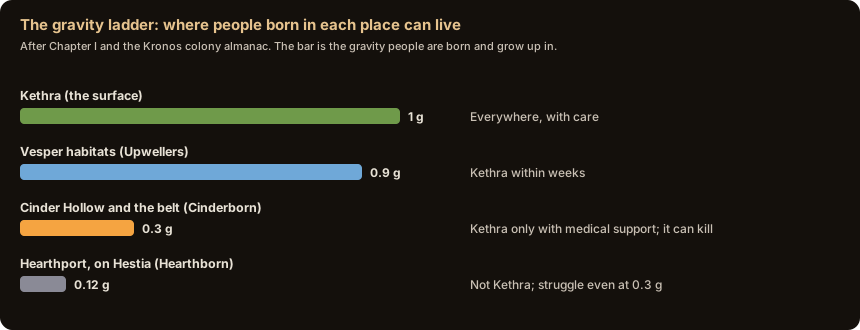
Upwellers The Vesper Orbital Compact Born in spin-habitats at 0.8–1.0 g. Usually adjust to Kethra's surface within weeks. 250 years of orbital life
Cinderborn The Cinderbelt Born at about 0.3 g. Tall and fine-boned. Most cannot live at full surface gravity without medical support. About 170 years of belt settlement

Cinderborn are not a separate species, and calling them one is a notorious insult ("shells"; see Chapter IV). They are a group of people who cannot come home. Their bones and hearts are built for low gravity, and moving to Kethra's surface is a medical ordeal. This fact drives belt politics.

Where the lines diverged#

When What happened
AL 44–120 The Silence bottleneck
AL 300s The archive-keepers sail east, founding the Aelosi line
AL 500s Migration across the western sea to Oreth
AL 1620s Crossing of the Line to settle Eldvang
AL 2068 on Permanent orbital settlement
AL 2140 on Settlement of the belt, and the first Cinderborn generation

1.2 Anatomical & Physiological Baselines#

The human body works on Kethra much as it did on Earth. The differences are in the conditions it lives under.

System Kethran baseline
Breathing About 0.95 Earth atmospheres with 23% oxygen. At sea level this is slightly richer than Earth's air. Newcomers from orbit feel alert, and sometimes lightheaded. Altitude sickness begins a little higher than on Earth.
Gravity About 1.00 g. The body develops normally on the surface.
Sight Human eyes are poor at seeing deep red, and Hyperion's light falls at that end of the spectrum. Red nights look dim and flattened: shapes are clear, but colour is weak and blues vanish. Reading by red-night light is possible but tiring. Capital fashion uses indigo partly because it looks black under Hyperion.
Sleep and body clock The human body clock naturally runs about 24.2 hours, and Kethra's day is 26. After 2,300 years, most Kethrans adapt easily. About 1 person in 8 still struggles, sleeping in drifting, broken patterns known as "Earth-sleep". In the red-night season, many people sleep badly because the nights never get fully dark ("redwake"; see 1.4). Blackout shutters in every bedroom are the answer (see Chapter III).
Energy needs An average adult needs about 2,400 kcal a day, and frame pilots and Hedge workers far more. A 26-hour day means four meals are common: breakfast, midday, supper, and a late redmeal in the red-night season.
Diet Earthkin food is necessary. Processed native food is possible only with the Gift, and it supplies calories but few nutrients. Iodine, vitamin B12 and some fatty acids must come from Earthkin sources or supplements.
Heat Normal human tolerance. Frontier people in the red summers adapt through behaviour: working at night, keeping cool cellars and wearing ember cloaks.
Physical limits Human norms apply. The main hazards on Kethra are duskdust in the lungs (1.4), native venoms and toxins, blackfrost, and ember storms.

Frame pilots. Piloting a frame means a direct neural link to the machine through link-sockets: licensed implants at the base of the skull (see 2.3). Long hours linked cause fatigue, headaches and, in veteran pilots, a lingering sense of the frame's body after unlinking, called the "phantom frame". These effects set the practical limits of frame piloting. They are handled through VectorZ play.


1.3 Life Cycle Chronology#

Stage Kethran years Earth years (approx.) Notes
Pregnancy about 245 Kethran days 266 days Called "eight moons": eight of Pandia's cycles.
Weaning 1–2 1–2 Weaning comes late on the frontier, to secure the Gift.
Walking and first words about 1 about 1
Naming, entry into the family song 1 1 See Chapter V.
Schooling begins 5 5.5
Coming of age 16 17.5 Full legal age in the Crown. The frontier marks it at 15 with the Wolf Run (see Chapter V).
Frame-licence minimum age 17 18.6
Common age at first marriage 23 in the capital; 19 on the frontier 25 / 21
Life expectancy at birth 73 in the Crown heartland; 64 on the frontier; 61 in the belt; 69 planet-wide 80 / 70 / 67 / 75
Oldest recorded Kethran 112 122 Tobin Arrask of Hollin, died AL 2276

Signs of ageing. The usual human signs, with local character:

  • Sun-lines are deeper on the frontier.
  • "Red-eye" is a slow yellowing of the eye lens in people who work outdoors through many red-night seasons, and a mark of old age.
  • Link-socket scarring in old pilots.

Fertility. The average number of births per woman over a lifetime is 1.7 in the Crown, 2.9 in the Southern Holds and 1.4 in Vesper orbit. Belt fertility is low and medically managed.


1.4 Immunological Baselines & Pathogen Profiles#

What can make a Kethran sick#

Native microbes almost never infect humans. Their chemistry is too foreign for them to grow in a human body. Kethran disease therefore comes from two sources:

  1. Earth pathogens that came with the Founders.
  2. Native toxins and allergens, which harm people without infecting them.

Endemic diseases#

Condition Cause Notes
Common colds and influenza lines Earth viruses Every Kethran knows them
Rustlung Duskdust, the wing-dust of gloamwings, together with native spores An allergic, scarring lung disease. It is worst among Hedge workers and in red-night seasons. The Founders' Mending reduces it, but it cannot be cured once established. The frontier's cough.
Tidemouth Toxins from native algae in shellfish-like finners and in tide pools Numbness, paralysis and death. Frontier children learn "don't taste the tide".
Reedlurker envenomation Venom Stops the heart. Antivenom is kept in every Hedge post.
Giftloss Antibiotics or severe illness wiping out the Gift The person cannot digest processed native food. A serious problem on the frontier, a mere inconvenience in the capital. It is treated by "the Sharing": a transfer of gut bacteria from a Gift-strong relative. In frontier custom, the Sharing is a family rite.
Iodine deficiency Diet Endemic during the Silence. Now rare where salt is iodised; it still occurs in the remote Holds.

Pandemics in history#

When Name What happened
AL 44–61 The Grey Cough A Founders' respiratory virus that mutated. It killed about 60% of the population and brought on the Silence. Remembered in the Cantorate's "Song of the Grey Years".
AL 1422–1431 Salt Fever A cholera-like Earth bacterium spread through the Line ports. About 3 million died. It created the first public water boards.
AL 1877–1880 The Wet Winter Flu A global influenza outbreak. About 11 million died. It prompted the Crown's Health Office.
AL 2233–2236 Vesper Fever An outbreak in the closed air of an orbital habitat. About 40,000 died in orbit. It led to the Compact's quarantine rules.

How disease spreads#

The routes are the ordinary human ones: air, water, touch and food. On Kethra, the tides and the Line trade decide the pattern. Port cities are where outbreaks begin, and double-spring floods spread waterborne disease. Quarantine at the Line ports is an old institution. Rovessa carriers fly the grey pennant when a crew is ill.

Ailments of space and of the psyche#

Name Who What
The Hollows Belt workers and long-haul crews Depression and loneliness shaped by the 7-hour light delay: "every word from home is already old". A leading cause of death in the belt.
Redwake Everyone, in the red-night season Sleeplessness and irritability under nights that never go dark. Cases rise as Hyperion brightens.
Earth-sleep About 1 in 8 people A body clock that won't settle into the 26-hour day (1.2)
Downwell sickness Upwellers and Cinderborn on the surface Heavy limbs, fainting, bone pain. For Cinderborn it can be fatal.
Sennet A cultural condition, not a disease Grief for Earth-of-the-songs: a longing for a home no one alive has seen. Capital physicians recognise it as a form of depression. The Cantorate treats it as a spiritual condition.
Phantom frame Veteran pilots The lingering sense of the frame's body (1.2)

1.5 Demographic Distribution Matrix#

Where people live (AL 2314)#

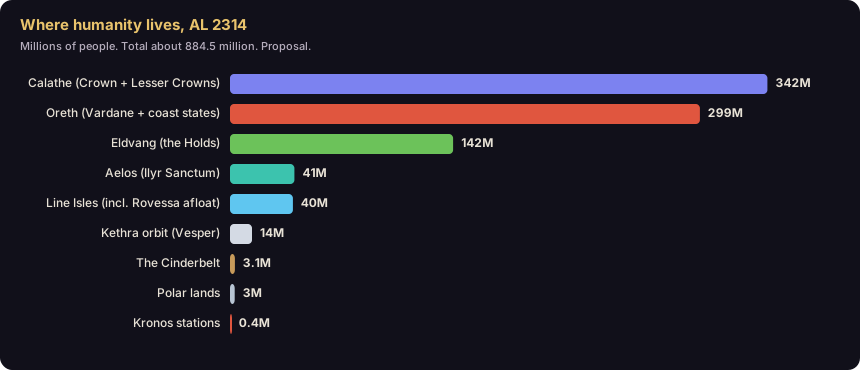
Bar chart of population by region: Calathe 342 million, Oreth 299, Eldvang 142, Aelos 41, Line Isles 40, orbit 14, Cinderbelt 3.1, polar 3, Kronos 0.4
Where humanity lives, in millions.
Region Population (millions) Land area (million km²) People per km² of land People per km² of gardenland (approx.) Urban share
Calathe 342 48 7.1 48 (7.2 million km² of gardenland) 68%
Oreth 299 29 10.3 55 (5.4 million km²) 61%
Aelos 41 12 3.4 41 (1.0 million km²) 74%
Line Isles, including the afloat Rovessa 40 6 6.7 100 (0.4 million km²) 66%
Eldvang 142 41 3.5 28 (5.0 million km²) 38%
Polar lands 3 30 0.1 90% (stations)
Kethra total 867 170 (including 6 of other islands) 5.1 about 46 (867 ÷ 19) about 60%
Orbit (Vesper) 14 100%
Cinderbelt 3.1 100%
Kronos/Ymir stations 0.4 100%
All humanity about 884.5

Reading the density columns. Density across all land is low, because most land is native Wild. Density on gardenland, the seeded farmland people actually live from, is the figure that matters. Regional gardenland adds up to 19.0 million km²: 7.2 + 5.4 + 1.0 + 0.4 + 5.0. Eldvang has the most farmland per person, because its seeded land is new and its people are few. That is exactly why people migrate there.

Births, deaths and growth (per 1,000 people per Kethran year)#

Region Birth rate Death rate Natural growth
Caldren Crown 11.2 8.4 +0.28%
Vardane Imperium 13.0 9.1 +0.39%
Ilyr Sanctum 9.4 8.9 +0.05%
Southern Holds 22.6 11.8 +1.08%
Vesper orbit 9.8 6.2 +0.36%
Cinderbelt 12.1 10.4 +0.17%
Kethra overall 13.9 9.2 +0.47%

Migration#

  1. Southward, across the Line. This is the great movement of the last 700 years. Land-hungry heartland families head for the Eldvang Holds. The flow has grown as heartland farmland has filled.
  2. Upward, to orbit and the belt. It is steady, and mostly one-way for anyone who has children in the belt.
  3. Inland, away from the Stair. A slow retreat from the lowest coastal steps as the seas rise. The capital insists it is "prudence". The Living Worlds Movement calls it the first evacuation.
  4. Seasonal. Frontier labourers go north for the northern harvest, and Line crews follow the Girdle storms.

Age structure#

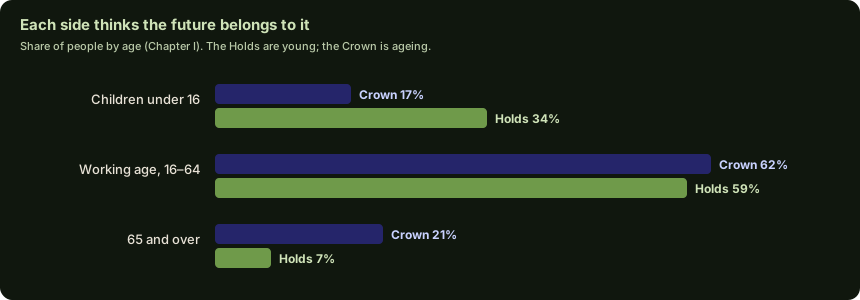
Children under 16 Working age, 16–64 65 and over
The Crown 17% 62% 21%
The Holds 34% 59% 7%

The Crown's population is ageing and the frontier's is young. Each side thinks the future belongs to it, which fuels the politics of the charters.


Guidance for AI actors#

  • Everyone knows whether they are "Gift-strong". On the frontier it is the first thing a healer asks.
  • Cinderborn characters cannot simply visit Kethra's surface. Any scene that brings one downwell carries physical cost and danger.
  • Rustlung, the cough of the Hedge and the frontier, is a class and regional marker. Capital characters notice it.
  • Ages are in Kethran years. Convert only if a character is doing something scholarly.

Prepared by Claude.

Chapter II: The Structural Hierarchy#

Kethra Almanac • Approved 19 September 2026 • drafted 18 September 2026

Status: approved. Briana approved the whole almanac on 19 September 2026 (the Almanac Approval Decision). Where this file calls something a proposal, read it as approved, except the open points that decision lists.

Status before approval: Everything in this chapter is a proposal built on the spine. Most sections describe the Caldren Crown in full and summarise the other societies. Where a roster faction appears, its role follows the relationship register's draft wherever that fits.


2.1 Structural Stratification & Caste Mechanics#

The Caldren Crown: four strata#

Stratum Share of population What defines it
The Chartered Houses about 0.4% (96 Houses and their branches) Hereditary nobility. Each House holds one of the seats created by the Charter of Caldren (AL 812) and its later grants. Houses own much of the old gardenland and sit by right in the Council of Houses.
The Songed about 23% Families who can recite their descent, generation by generation, back to a named Founder on one of the three ships. This lineage-recital is a family song, recorded in the Cantorate's Great Register. The Songed are the gentry and professional class: officers, clerics, jurists, the old merchant families.
The Commons about 67.6% Registered citizens with full legal rights, whose family songs break during the Silence or whose ancestors arrived from elsewhere. Most Kethrans are Commons.
The Unsonged about 9% Families with no registered song at all. Most descend from Silence-era people who fell outside the Cantorate's records, from displaced frontier families, or from the fatherless and motherless of the great epidemics. They have had full legal equality since the Great Charter of AL 1733. The social barrier remains.

How class shows on the outside#

  • Indigo. Deep indigo cloth is costly to dye, and under Hyperion it reads as black. Old money wears it. New money overdoes it.
  • Song-rings. A ring engraved with a verse of the family song. Chartered Houses wear gold rings, the Songed silver, and Commons who have bought a registered verse wear steel. The Unsonged have none. An empty ring finger is noticed.
  • Speech. Hallspeech, the capital's formal register, marks education (see Chapter IV). So does using the capital names (Selenne, Theia, Hyperion) without self-consciousness.
  • The calendar. Refined people date letters by the solar calendar. Anyone who uses moon-dates in the capital is assumed to be from the frontier, or from the Line.
  • Food. Eating processed native food ("Wild bread") in public marks poverty or frontier origin. Beef, honey and wine from the Stair are status foods.

What stops people rising#

  1. Seats in the Council of Houses are hereditary. New Houses are created rarely: nine since AL 1900.
  2. Access to the Great Register. A Commons family can buy a registered verse, but only by proving descent. That takes archives, time and fees.
  3. Marriage. Songed families prefer Songed marriages. Houses marry Houses, or buy Songed wealth.
  4. Education. The Royal Academy and the Cantorate College draw mostly from Songed families, even though scholarships exist.
  5. Frame licences. Pilot training is expensive. Military service is the main path up for Commons and Unsonged youth. The Royal Frame Corps is the most socially mixed institution in the Crown, which is exactly why the Houses distrust it.

The other societies in brief#

Society Structure
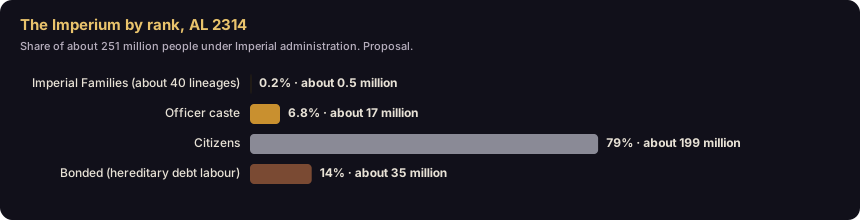
Vardane Imperium Rigid. At the top, the Imperial Families: about 40 lineages that supply the Imperator and the Marshal Council. Below them the Officer caste, entered by birth or by exceptional service. Then the Citizens. At the bottom the Bonded: labourers tied to state corridors and phosphate works by debt that passes to their children. Class shows in uniform: nearly every adult Vardane wears a rank-coloured collar.
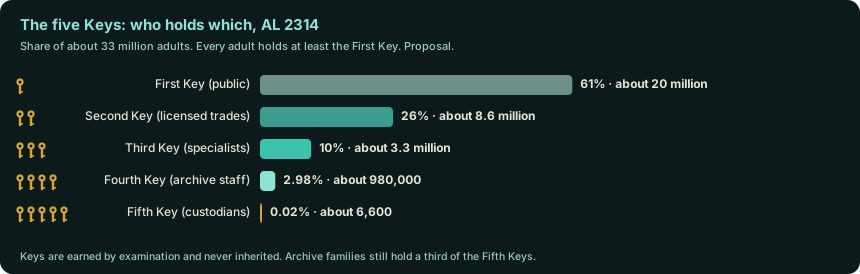
Ilyr Sanctum A custodial meritocracy. Rank comes from examination and from the grade of access a person holds to the Founders' archive. There are five Keys: First Key (public) to Fifth Key (custodians). No rank is inherited, but archive families dominate the upper Keys.
Southern Holds Close to equal within each Hold. What divides people is status under charter: charter-folk live under a Crown or Imperial charter; free-folk live in free Holds. On top of that runs Gift-standing: descent through a strong maternal Gift-line carries prestige.
Rovessa Caravans Organised by carrier Houses, one family per great ship. There are captains and crew-kin. The rank that matters is berth: which deck you sleep on. Young captains are challenging the old Houses (see the register).
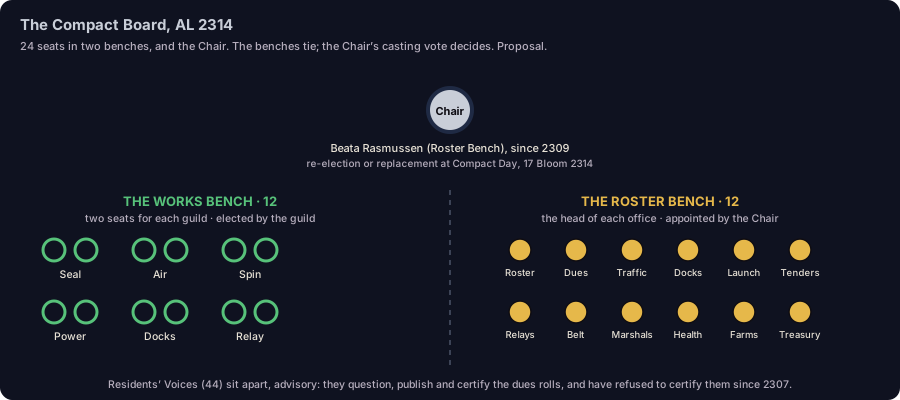
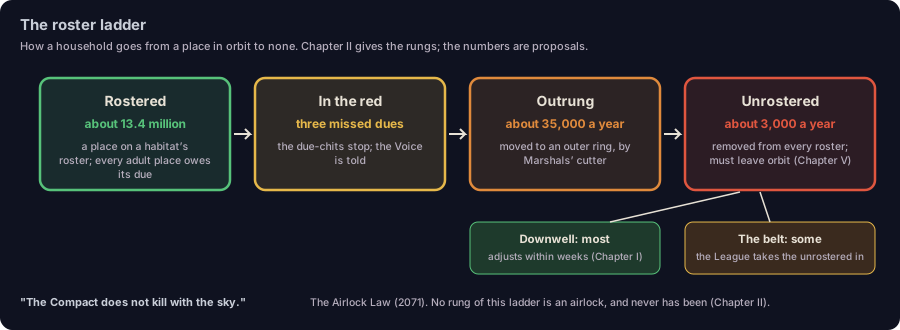
Vesper Orbital Compact A technical hierarchy. Engineers, the maintenance guilds, hold real power. Officials administer. Residents pay dues. Those who fall behind on dues can be moved to the "outer rings", the least maintained habitats.
Cinderbelt Yard-owners and crews. Beyond them lies a gap between those who can go downwell and the Cinderborn, who cannot.

2.2 Architectural Models of Governance#

The Homeworld Assembly: planetary#

The Assembly was founded by the Charter of Aletheia in AL 2150, after the Iron Winter showed the planet what uncoordinated war machines could do. It has 15 member states, including the Crown, the Imperium, the Sanctum, the Line free ports and the Holds Compact (admitted AL 2290). Its seat is Aletheia. The Vesper Orbital Compact and the Cinderbelt Coalition hold associate seats: they can speak, and vote only on space affairs. Their status is disputed (see the register).

Organ Function
The Assembly Floor One delegation per member state. Most decisions are by weighted majority; the Accords require unanimity.
The Accord Council Seven permanent seats, the largest states and the space members, plus four seats that rotate. It guards the three Assembly Accords (see 2.3).
The Speaker of the Assembly Elected for six years. Presides, represents the planet, and has no army.
Homeguard Command A joint defence command built from national contingents. Its mandate is planetary defence and enforcing the Accords. Its commander, the Warden-General, rotates among member states every four years.
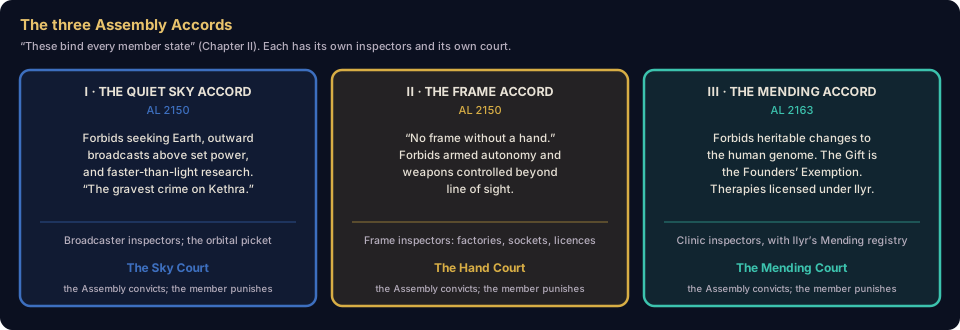
The Accord Inspectorate Inspects frame factories, heavy broadcasters and gene clinics. It is the Assembly's most hated and most necessary body.

The Caldren Crown: constitutional monarchy#

The chain of command:

The Crowned of Caldren (monarch) — head of state; commander-in-chief in name
   │  (acts on the advice of the First Voice; keeps reserve powers)
   ├── The Council of Houses (upper chamber, 144 seats)
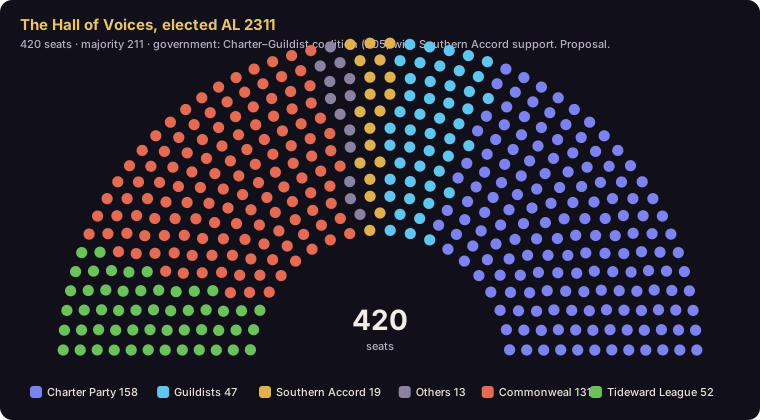
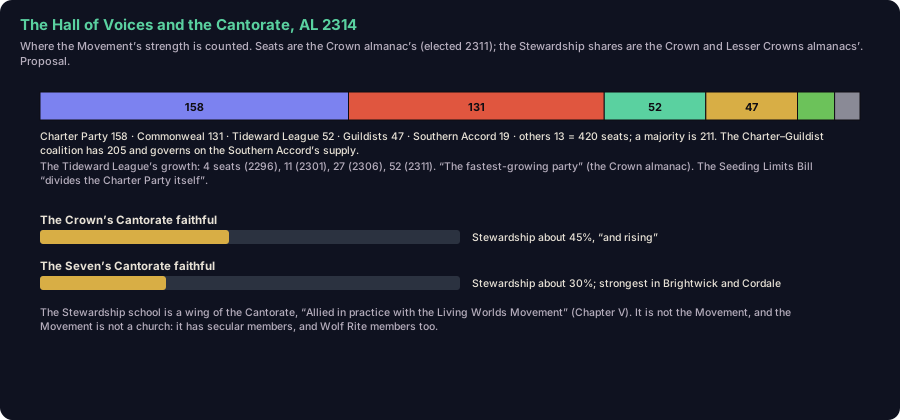
   ├── The Hall of Voices (lower chamber, 420 seats) ── elects ──> The First Voice (head of government)
   │                                                                   │
   │                                                          The Cabinet of Offices
   │        ┌──────────┬──────────┬───────────┬──────────┬───────────┬───────────┬────────────┐
   │     Treasury    Justice   Defence &   Harvest &   Charters &  Tides &     Health &
   │                           Frames      Seeding     the South   Works       Learning
   │                                                                   (plus Foreign, Home,
   │                                                                    Trade, Space Offices)
   └── The High Bench (supreme court, 9 Justices) — independent

The detail is in the country almanac.

The others#

State Model Chain of command
Vardane Imperium Military-imperial The Imperator is elected for life by the Imperial Families from among themselves. Beneath the Imperator sits the Marshal Council of 12 marshals, who command the Imperium's fortified provinces ("holdings"). The Council of Corridors runs the supply routes. There is no elected chamber. City Assemblies of Citizens have petition rights only.
Ilyr Sanctum Custodial The Custodial Conclave: 21 Fifth-Key holders, chosen by examination and peer vote. Its First Custodian chairs. The Order of the Veiled Sun answers to the Conclave. Its oath is to "the Sanctum and the people entrusted to it", which leaves room for conflict, as the register notes.
Southern Holds Confederal Each Hold governs itself through a Moot of all adult Hold-folk. Moots send speakers to the Holds Compact, which meets twice a year at Eldhaven. The Compact has little authority of its own. Charter Holds must also answer to a Crown or Imperial Charter-Warden.
Line free ports Merchant republics Each port is governed by a council of ship-owners and guild-masters. Saltline is the largest, and the Rovessa's home harbour.
Rovessa Caravans Family confederation Each carrier House governs its own ship. Matters between Houses go to the Captains' Table.
Vesper Orbital Compact Technocratic board The Compact Board is made up of engineers and officials. Habitats elect Residents' Voices with advisory rights.
Cinderbelt Coalition Dual council A Council of Yards (owners) and an Assembly of Crews (workers). Both must agree on labour law, and they rarely do.
Outer Lantern League Captains' coalition Negotiators and militant captains compete for the League's voice (see the register).

2.3 Institutional Law & Civil Statutes#

The constitution of the Crown#

The Crown has no single constitutional text. Instead it has three foundational documents:

  1. The Charter of Caldren, AL 812. It created the Crown and the Chartered Houses and bound the monarch to "keep the song and the law".
  2. The Great Charter, AL 1733. It created the Hall of Voices, abolished legal distinctions between the Songed and the Unsonged, and subordinated the monarch to Parliament.
  3. The Charter of Rights, AL 1964. It guarantees speech, assembly, a fair trial, freedom of belief and the right to leave the Crown, including across the Line.

Planetary law: the three Assembly Accords#

These bind every member state.

Accord Year Content
I. The Quiet Sky Accord AL 2150 Codifies the ancient Oath of the Unmapped. It forbids: any attempt to locate Earth; any broadcast aimed out of the system above set power limits; and any construction of a faster-than-light drive, or research into one. Breaking it is the gravest crime on Kethra.
II. The Frame Accord AL 2150 "No frame without a hand." Every armed machine must carry a human pilot linked to it and in control. Autonomous weapons, and weapons controlled remotely beyond line of sight, are banned. Written in response to the Iron Winter.
III. The Mending Accord AL 2163 Bans heritable changes to the human genome. The Founders' Gift and Mending are grandfathered as the Founders' Exemption. Therapies that are not inherited are licensed, largely under Ilyr supervision.

Other laws that matter everywhere#

  • Link-socket licensing. Neural implants for frame piloting require a state licence and an Accord registration number. Unlicensed sockets ("black sockets") are a serious crime in the Crown and common in the belt.
  • Ilyr technology licences. The Sanctum licenses restricted technologies, including link-socket designs, advanced medical therapies and fusion control systems, and requires proof of civilian end-use. Diverting licensed technology to weapons ends the licence. This is the main source of the Crown–Sanctum and Imperium–Sanctum tensions in the register.
  • Listeners. Ilyr-trained Listeners are licensed like doctors. Whether their talent is real is argued in every tavern (see the spine, S8).
  • "Magic". Kethra has no magic. The nearest things are technologies the Accords forbid, and whatever the Listeners actually do (open).

Company and charter law#

  • Chartered companies. A company in the Crown exists by royal charter, registered with the Office of Trade, with limited liability. The great chartered companies are the Thessane Works (frames), the Corran Iron Company, the Saltline Carrier Syndicate and the Harrowgate Bank.
  • Seeding charters. The right to convert native land to gardenland, and to own what results. Seeding charters are how the Crown and the Imperium extended their claims across the Line. Every frontier dispute ends up being about a seeding charter.
  • Guild monopolies. Chartered guilds hold legal monopolies over certain trades, such as the Hive Wardens and the Tide-Pilots (see Chapter VI).

2.4 Judicial Enforcement & Carceral Frameworks#

Policing in the Crown#

Body Role
The Wardens The civil police, organised by Reach, with the Aletheia Wardens for the capital. Unarmed on ordinary patrol since AL 2011; armed units exist.
The Crown Inquiry Office Serious crime, organised crime, and violations of the Accords within the Crown
Tide Wardens Harbour and coastal police, including smuggling and quarantine
Hedge Rangers Rural and Wild-edge policing: poaching, illegal seeding, and animal attacks
Military Provosts Discipline within the forces, including frame-crime by service pilots

Trials#

The Crown's courts are adversarial and follow common law (law built up from past judges' decisions), sitting within the Charter framework:

  • Lower Courts hear minor offences. A single magistrate sits.
  • Assizes hear serious crimes. A judge sits with a jury of 12 drawn by lot. Since AL 1733 the lot has been drawn from every stratum, and Chartered House members are excused only by application.
  • The Court of Appeal, then the High Bench.
  • Cantorate courts hear matters of family song: registration, disputed descent and unsinging. Since AL 1964 their rulings can be appealed to the civil courts.
  • Accord Tribunals are Assembly courts for breaches of the Accords. They sit in Aletheia and are staffed from member states.

Punishment#

Penalty Notes
Fines and restitution Most common
The Keeps Crown prisons. There are 31 across the Reaches; the largest is Greywater Keep. Sentences are served in Kethran years.
Indenture Formerly transportation to the Cinders: forced labour in the belt, abolished in AL 2203. Its modern successor is voluntary "belt indenture" in exchange for a reduced sentence. Critics call it transportation by consent, and the scandal is current.
Unsinging A Cantorate penalty, now reserved for grave betrayal of family or state. The person's name is struck from their family song. It carries no legal consequence and a devastating social one.
Exile across the Line Historic. Offenders were set ashore in Eldvang, and many frontier Holds were founded by such exiles. The practice was abolished in AL 1811. Frontier folk still remember it, and still resent the capital's assumption about where frontier families "come from".
Execution Abolished in the Crown in AL 1988. Still carried out in the Vardane Imperium for treason and Accord crimes, by firing squad and in public. The Holds leave it to their Moots; most have given it up.

Enforcement elsewhere#

  • Vardane: military tribunals for most serious crime. The Bonded answer to corridor courts run by their employers.
  • Ilyr: restorative hearings for most crime. Archive crimes go before the Conclave and are punished severely.
  • The Holds: Moot-justice. The whole Hold hears the case. Banishment into the Wild is the ultimate penalty, and in practice it is often a death sentence.
  • Orbit: the Compact's Habitat Marshals. Airlocks are never used as punishment. The most feared penalty is loss of residency: being moved out to the outer rings.
  • The belt: Coalition and yard law, plus Lantern "captains' justice" (see the Outer Lantern League almanac). The 7-hour light delay makes appeals to the capital theoretical.

2.5 Domestic Social Units#

The hearth: the Crown household#

The standard household is a hearth: a couple, their children, and often one or two grandparents, living around a shared kitchen that holds the song-niche. The song-niche is a shelf or alcove where the family song scroll, or for poorer families a single registered verse, is kept.

  • Hearth size: 3.4 people on average in the Crown; 6.1 in the Holds.
  • Extended family: the wider hearth-kin gathers at Landfall Day and Song-Night (see Chapter V). Old Songed families keep hearth-halls: family houses where cousins may lodge by right.

Marriage#

The Crown Other societies
Definition The binding of songs: a civil and religious union of two adults of any sex. Each partner's verse is added to the other's family song. Vardane: a man and a woman only, arranged within one's rank. Ilyr: a civil contract, renewable every 10 years. Holds: pairs, and triads (three adults) are legally recognised in most Holds, a practical answer to labour needs. Rovessa: marriage confers a berth, and is negotiated between carrier Houses.
Divorce Civil. The songs are "unbound", and each partner's verse is struck from the other's family song.
Names Partners choose which family name to keep, or join the two. Children may take either.

Power between the sexes#

  • The Crown is formally equal. The Great Charter of AL 1733 opened the Hall of Voices to all; since AL 1847 the Crown passes to the eldest child regardless of sex. In the Chartered Houses, inheritance follows the same rule.
  • Vardane is patrilineal: the Imperial Families descend through fathers, and only men hold marshalcy. This is a live grievance among Vardane officer daughters.
  • The Holds are matrilineal in practice, because the Gift passes from mothers:
    • Frontier descent is counted through Gift-lines: mother to daughter to granddaughter.
    • Farmland is often inherited through the mother's line, because the family that feeds you is the family whose Gift you carry.
    • Men hold Moot offices freely. The Gift-mothers' councils decide inheritance.
  • Ilyr is equal. Rank belongs to the individual, by examination.

Raising children#

  • The Crown: hearth-based. Parents are responsible, and grandparents do much of the caring. Schooling is free and compulsory from 5 to 16 (K-yr). Songed families send children to the Cantorate's song-schools, where every child learns the whole Canon of the Songs.
  • The Holds: communal. Hold-crèches care for the young during harvest and ember seasons. Every adult of the Hold may correct any child. The Gift-mother, the maternal grandmother, has authority equal to the parents'.
  • Vardane: children of the officer caste enter cadet schools at 10.
  • Rovessa: children are raised by the whole ship, and apprenticed on deck by 10.
  • Orbit: professional child-care collectives. Parents' work shifts dominate.

Guidance for AI actors#

  • Class is legible. A character notices song-rings, indigo, accent and which calendar someone dates by. Use these details and don't state class outright.
  • The Unsonged are legally equal and socially marked. Capital characters may be carelessly cruel about it without meaning to be.
  • On the frontier, ask about the mother. Kinship, land and the Gift all run through her.
  • The Accords are sacred and practical at once. Breaking the Quiet Sky Accord is treated like treason and blasphemy together.
  • Justice depends on where you are, and characters know it. Crown Assize, Vardane tribunal, Hold Moot and belt captains' justice are all different.

Prepared by Claude.

Chapter III: Domestic Architecture and Urban Planning#

Kethra Almanac • Approved 19 September 2026 • drafted 18 September 2026

Status: approved. Briana approved the whole almanac on 19 September 2026 (the Almanac Approval Decision). Where this file calls something a proposal, read it as approved, except the open points that decision lists.

Status before approval: Everything in this chapter is a proposal built on the spine.

Amended 19 September 2026, with Briana's approval: six cities were added to Other great cities: Brightwick, Corran Mouth, Arvenne, Tessmere, Port Serell and Stellan. The list was drafted on 18 September, before those cities were named, and each has 3.1 million people or more. Their lines are taken from their own almanacs.

Design note. Following the naming principles, Kethran architecture borrows motifs freely, and never from the same source as the name it carries. Aletheia has a Greek name, so its look is not classical Greek. It is terraced stone, blackreed timber and indigo glass, shaped by tides and red nights.


3.1 Habitat Metropolises & Sprawling Settlements#

Aletheia: capital of the Caldren Crown and seat of the Homeworld Assembly#

Setting. The north shore of the Thess estuary, about 60 km upstream from Landfall, at 34° N. The city climbs seven great steps of the Stair. The oldest parts sit highest. The newest and poorest parts sit lowest, closest to the rising water.

Population: 11.2 million in the metropolitan area, 4.3 million in the city proper.

Schematic plan of Aletheia: seven terraces climbing from the Thess estuary, with the Long Gate across the water
Aletheia's seven steps (schematic). See Aletheia in the Atlas.

Plan: seven terraces, from the water up

Terrace Name Character
Waterline (below the Stair) The Tidewards Docks, the tide-gates, warehouses and the poorest housing, much of it built on blackreed stilts. It floods at every double spring. Home to Line migrants, dockers and the Unsonged.
Step 1 Lowtown Workshops, markets, tenements. The Long Gate, the city's tide barrier (see 3.2), is anchored here.
Step 2 The Exchange The commercial heart: the Aletheia Exchange, the chartered banks and the carrier syndicate houses.
Step 3 Thessbank and Riverwend Middle-class hearths, schools and the Royal Academy. Thessbank's industrial district runs downriver along this step.
Step 4 The Hallward Government: the Hall of Voices, the Council of Houses and the Offices of State.
Step 5 Cantor's Rise The Great Choir, the mother church of the Cantorate, with the song-schools and the Great Register archive.
Step 6 The Assembly Precinct The Homeworld Assembly: the Floor, the Accord Council, embassies, and Homeguard Command's headquarters.
Step 7 The Crown Stair The royal palace (Halden House), the oldest Chartered House mansions, and the Founders' Walk: a processional stair carrying stones brought up from Landfall.

Defences:

  • The Seawall, AL 1100s, is the medieval tide-and-siege wall around Steps 1–3. It still stands in part.
  • The Long Gate, AL 2204, is the modern tide barrier: 11 km of gates across the estuary. It is closed for double springs and storm surges. In AL 2314 it closes about 40 times a year. In AL 2250 the figure was 22.
  • Orbital defence is the responsibility of Homeguard Command and the Crown's Orbital Squadron.

Zones:

  • Industry is downriver at Thessbank and on the south shore (Southmere). It keeps its smoke away from the upper steps, since the prevailing wind is westerly.
  • Commerce is concentrated at the Exchange on Step 2.
  • Wild reserves: the Duskwood Park, a fenced reserve of native forest that the city's Earthkin gardens surround but do not enter, occupies the steep ground between Steps 5 and 6.

Other great cities#

City State Population, metro (millions) Character
Vardenhold Vardane Imperium (capital) 9.8 A fortress-city on an Oreth river gorge. Concentric walls, marshal quarters and phosphate railheads. Its streets are grids built to be defended.
Brightwick Lesser Crowns: the Free City of Brightwick 7.9 A guild republic and an enclave inside Arvenne, in the Arvennish downs: "Bright, crowded, argumentative." The Guildhall seats the Guild Council and the Brightwick Exchange, the Seven's stock market. Its glassworks make indigo glass for half the Crown's windows.
Thessane Caldren Crown 6.4 Upper Thess. Iron and frames. The Thessane Works build most of the Crown's frames.
Corran Mouth Caldren Crown 4.1 The east-coast port at the mouth of the Corran, the Crown's largest by tonnage, and the seat of Warmreach. The Royal Navy's eastern fleet is based there.
Arvenne Lesser Crowns: Kingdom of Arvenne (capital) 4.1 Built in terraces on the upper steps of the Stair. The Stair Accord Secretariat stands above the old town, and the Council of the Lesser Crowns sits there.
Tessmere Free Oreth coast states: Tessmere Republic (capital) 3.8 "The walled republic", and the largest city on the coast, on a drowned river mouth. It holds the Senate of Tessmere and the coast's yards, and faces Coastwatch across the Grey March.
Port Serell Lesser Crowns: Principality of Cordale 3.6 Cordale's port, where the Principality's money and ships live: shipping insurance and carrier finance. The largest port of the Lesser Crowns, and the base of the Cordale Fleet, the strongest navy of the Seven.
Ilyrion Ilyr Sanctum (capital) 3.1 Built into terraced volcanic hillsides on Aelos. The Archive Mount, the sealed repository of the Founders' records, sits at its centre.
Stellan Free Oreth coast states: Stellan Free City (capital) 3.1 The coast's great trading harbour, facing the Line and the Imperial port of Hesk. It walled itself and became a Free City in 1471. "Rich, quick, and the least brave of the three, say the other two."
Saltline Line free port 2.9 The largest free port, and the Rovessa home harbour. It spreads across three islands and a lagoon full of moored sea-carriers.
Eldhaven Southern Holds (seat of the Compact) 1.7 The largest frontier town, on the Eldvang rift. It sits low and wide, built for ember seasons.
Pharos Isle Caldren Crown (Line territory) 0.6 The Crown's spaceport, at 0.4° N, the launch site closest to the equator on the Crown's territory.
Landfall Caldren Crown 0.9 The founding site. A pilgrimage town, with the Seven Terraces and the Founders' Stones.

Frontier settlement pattern#

A frontier Hold is a seeded island in the Wild:

  • The Hold-house at the centre: the Moot hall, granary and ember shelter.
  • Seeded fields around it, in a ring.
  • The Hedge beyond the fields: a cleared, burnt and patrolled boundary strip, 200–500 m wide.
  • The Wild beyond that.

The standard Hold covers 40–80 km² of gardenland and holds 800–3,000 people. Holds are linked by dray-roads and by the rift railway.


3.2 Public Civil Engineering#

Water#

  • Aletheia: three great aqueduct-pipelines bring Corran snowmelt 400 km down to the city, each built in a different era: AL 1300s, AL 1780s and AL 2120s. The oldest still carries water, and it is stone.
  • Treatment: mandatory since the Salt Fever of AL 1422–1431. Water boards are among the oldest public bodies in the Crown.
  • The Holds: wells, rift springs and cisterns. On the dry plateau, water rights are allocated by the Moot and fought over at the Compact.
  • The Line Isles: rain cisterns on every roof, plus desalination in the large ports.

Waste#

  • Tidal digesters. Crown coastal cities treat sewage in digesters, where Earth microbes break it down before it goes out on the ebb tide. The tides do the pumping twice a day.
  • Night-soil return. Treated human waste is returned to the fields as fertiliser in every Kethran society. This is law, not thrift. Phosphate is scarce (see Chapter VI), and wasting it is a crime in the Crown and a sin in the Cantorate.

Energy grid (the Crown)#

Source Share of Crown electricity Notes
Fusion 44% Seven plants. Fuel is helium-3 and deuterium from Kronos. Since the Taking of Hearthport it has been supplied by the Vardane Imperium under the fuel clauses of the Armistice, and carried down by the Vesper Orbital Compact.
Tidal 18% The Thess Barrage generating array, integrated with the Long Gate, is the largest tidal plant on Kethra.
Thorium fission 21% Fuel sands are imported from Aelos under Ilyr licence.
Hydroelectric 9% Corran Range dams
Solar 6% Output is poor in the long northern winters
Other 2%

The grid is national, with interconnectors to the Lesser Crowns. The Holds run on local fission microreactors, solar power and increasingly wind. Blackouts during ember storms are routine.

Transit#

  • Crown Railways carry most freight. A high-speed maglev trunk connects Aletheia, Thessane and Hollin at 520 km/h.
  • The Thess is navigable for 1,900 km, and barges move grain and iron. The tidal bore must be timed.
  • Roads: Reach roads, plus toll highways in the heartland.
  • The Rift Railway, AL 1890s, runs 3,200 km through the Eldvang rift and is the frontier's spine.
  • Air: passenger aircraft between all major cities. It is 4 hours from Aletheia to Saltline and 9 to Eldhaven.
  • Across the Line: Rovessa sea-carriers take most cargo, and passenger flights take most people.

3.3 Architecture Engineering & Construction Materials#

Materials#

Material Where from Use
Sea-stone Stair limestone: pale gold, easy to cut, hardening as it weathers The signature stone of the Crown heartland. Aletheia is a gold-coloured city by day, and a dull bronze one on red nights.
Basalt Oreth and Aelos volcanic rock Vardane fortress-work; Ilyr's terraced foundations
Blackreed Native reedland timber, rot-proof because Earth fungi can't digest it Stilts, frames and roofs. Tidewards housing. Prestige interiors. It darkens to near-black with age.
Earth timber: oak, pine, cedar plantations Seeded forests in the Corran foothills Furniture. It is costly, and rots like wood on Earth.
Reefstone lime Burned reefstone from the Line Line Isles concrete, which is white and brilliant
Alloys and composites Corran iron, and belt metals via Vesper Modern towers, the Long Gate, frames
Indigo glass A Crown speciality Windows tinted to cut red-night glare while passing daylight. The mark of a good house in the capital.

Designing for Kethra#

Challenge Northern solution (the Crown) Southern solution (the Holds)
Red nights Night-shutters on every bedroom. Principal rooms face away from Hyperion's winter rising point. Shutters, plus ember-screens on windows
Cold Thick stone walls. A heat store in the hearth-room floor. Winter windows angled to catch the low sun. Blackfrost cellars. Earth-sheltered walls on the plateau.
Heat Moderate: shaded loggias on the upper Stair Wind-towers that draw cool air through deep cool-cellars. Thick walls with small windows. White reefstone-lime render.
Fire Stone and slate. Fire ordinances since AL 1406. Ember-proofing: earth roofs, blackreed treated with fire-retardant, a cleared fire-ring of 60 m around every Hold-house, and a buried ember shelter for every family.
Water Buildings raised on the Stair. Flood thresholds, called tide-steps, at every door in the lower city. Cisterns. Houses sit on rift terraces, above flash floods.
Wildlife Gloamwing screens in the red season Hedge-walls, and tidehound-proof gates on coastal Holds

What it looks like#

  • Crown style ("Stairwork"). Terraced massing. Gold sea-stone. Deep, dark blackreed eaves. Indigo-glass windows. Stepped roofs that mirror the Stair. It is ornamented with song-bands: carved lines of family or civic verse running around buildings at eye level. On red nights the carved letters fill with shadow and the verses become readable in silhouette.
  • Vardane style. Concentric walls, basalt, rank-coloured banners and severe geometry.
  • Ilyr style. Houses cut into volcanic terraces. Sealed archive doors. Interior gardens under clear domes. Restrained, precise, almost without ornament.
  • Frontier style. Low and wide, half-buried, built of earth and blackreed, with wind-towers. Doors are painted with the family's Gift-line mark.
  • Line style. Brilliant white reefstone-lime houses on stilts, with lagoon walkways. It is borrowed from everywhere and belongs to no one.

3.4 Domestic Interior Layouts#

A typical Crown hearth (a Thessbank terrace house, Step 3)#

Space Layout and use
Tide-step and entry A raised threshold (tide-step, 40 cm). A boot room with a gloamwing-screen door.
Hearth-room The heart of the house: kitchen, dining and gathering in one room. The song-niche is set in the wall beside the stove. Meals are eaten at one long table. In the red-night season, the family eats redmeal here, late.
Parlour Formal room for guests. Better-off homes have indigo-glass windows.
Sleeping rooms Windowless or fully shuttered. Every bedroom in the Crown must, by building code, be able to be made completely dark. Sleep in darkness is treated as a right.
Stores A pantry for Earthkin food, and a separate Wild-press (see below)
Water room Bath, basin and water closet, connected to the tidal-digester sewers
Roof Earthkin container gardens, and beehives in houses licensed by the Hive Wardens

The Wild-press. Poorer households, and every frontier household, keep a Wild-press: a leaching trough and press for preparing native roots. It is kept separate from the Earthkin kitchen. Capital households with a Wild-press hide it.

A frontier Hold family house#

  • A half-buried main room that serves as hearth, kitchen, workshop and sleeping space in the dark winter.
  • A wind-tower and cool-cellar. The family sleeps in the cellar during ember summers.
  • An ember shelter: a sealed, buried chamber with air bottles, reached from the cellar.
  • The Gift-mother's room, next to the hearth. The mother's line is literally at the centre of the house.
  • A dray-byre, sharing a wall with the house for warmth.

Private security#

  • The Crown: voice-keyed doors (door-songs) in wealthy homes, and ordinary locks elsewhere. Warden call-boxes on every street. Chartered Houses keep private House guards, licensed and limited in number.
  • Vardane: locks and watchmen. Informers are common. Officer families have household troops.
  • The Holds: doors unlocked within the Hold and barred against the Wild. Strongrooms hold seed stock and Gift cultures. The most valuable things in a frontier house are the seed-chest and the Gift-jar.

3.5 Micro-Environments & Extreme Adaptations#

Environment Habitat Requirements
Kethra orbit (the Vesper Orbital Compact) Spin-rings: rotating habitat rings giving 0.8–1.0 g. There are 38 major habitats, the largest being Vesper Prime, with 1.9 million people. Docks, farms and hydroponic decks. Pressure integrity. Radiation shielding. Air and water recycling. Everything is maintained by the engineers' guilds, and when maintenance fails, residents die. This is the politics of the Compact.
The moons Mining stations on Pandia, a large regolith base, and Ersa, a dark carbon-rich moon whose small mass makes it cheap to launch from Low gravity: Pandia about 0.15 g, Ersa about 0.02 g. Sealed domes. Suits outside.
The Cinderbelt Hollowed rocks (asteroids spun for 0.3 g) and yard stations. The Coalition capital is Cinder Hollow; the Imperium's belt headquarters is Castellan Rock; the Lantern League's harbour is the Wick. See Kronos and the Cinderbelt. Full pressure suits outside. Seven hours of light delay. Radiation storm shelters. Most Cinderborn cannot go downwell (Chapter I).
Kronos/Ymir Hearthport on the moon Hestia (outside the worst radiation) and fuel works on Demeter, both under Vardane occupation. Skimmers dive for fuel. See Kronos and the Cinderbelt. Intense radiation belts close in. The inner moons are worked by rotating crews. Most people live at Hearthport.
Eldvang cool-cellars and ember shelters Buried rooms under every Hold house Air bottles for ember storms. Sealed doors. Water stores.
Ilyr archive vaults The Archive Mount: climate-controlled vaults cut into rock, holding Founder data-stores and sealed materials Restricted access by Key. Some sealed vaults have never been opened since the Silence (what lies inside is open).
Line stilt-towns and lagoon habitats Houses on blackreed stilts over reefstone lagoons Storm shutters for Girdle storms. Tidehound-proof railings.
The Southern Ice mining camps Heated, sealed camps, worked only in summer Polar survival gear. The dark winter closes them.
Hedge posts Fortified posts along the gardenland boundary Antivenom, fire gear, duskdust masks in the red season

Suits and protective gear#

Gear Used for Notes
Vac-suit Belt, orbit and moons Standard pressure suit. Belt designs are cut long for Cinderborn bodies.
Ember cloak Frontier fire seasons A treated, heat-reflective hooded cloak that doubles as a fire shelter in an emergency. The frontier's icon.
Duskdust mask Hedge work and red-night seasons A filter mask. Wearing one in the capital marks you as a Hedge worker.
Tide-waders Tidal flats Armoured boots against tidehound bites and venomous finners
Frame-harness Pilots The socket-link collar and support harness for linked piloting

Guidance for AI actors#

  • Height on the Stair is status. Asking an Aletheian "which step?" means asking their class.
  • Night-shutters are universal. Waking someone by opening their shutters in the red-night season is a real offence.
  • On the frontier, the seed-chest and the Gift-jar are sacred property. Theft of either is treated like murder.
  • Orbit and the belt run on maintenance. In any scene there, a leak, a failing scrubber or unpaid dues are live stakes.

Prepared by Claude.

Chapter IV: Language, Semiotics, and Lore#

Kethra Almanac • Approved 19 September 2026 • drafted 18 September 2026

Status: approved. Briana approved the whole almanac on 19 September 2026 (the Almanac Approval Decision). Where this file calls something a proposal, read it as approved, except the open points that decision lists.

Status before approval: Everything in this chapter is a proposal built on the spine. The only canon here is the approved names (Selenne/Kethra, Theia/Sól, Hyperion/Surtr, Pandia/Máni, Ersa/Hati, Earth-of-the-songs), and the rule that the songs hold no history of Earth.

For the book and for AI actors: Kethrans speak Landspeech. In the book it is rendered as English, and that convention holds throughout. Dialect is shown through word choice and idiom, not through phonetic spelling.


4.1 Linguistic Dialects & Structural Grammar#

One language, many voices#

The Founders arrived speaking a shared common tongue, which the songs simply call "the common tongue", along with many home languages. The Silence narrowed this to the common tongue. Over 2,300 years it has become Landspeech, the language of all Kethra.

Variety Speakers Character
Hallspeech The Crown's educated classes, government, the courts, the Assembly The formal standard: full sentences, careful vowels, capital names for everything, and a heavy use of song-quotation.
Stair Common Ordinary Crown speech Quick and clipped. Tide and weather words are everywhere.
Southspeech The Eldvang Holds Slower, with open vowels. Frontier names for everything (Kethra, Sól, Surtr). Many borrowings from Line cant and dray-handling. Dates are given in moons.
Orethi The Vardane Imperium Clipped and formal. Rank-honorifics are required in address. It has absorbed many Silence-era words lost elsewhere.
Archival Ilyr, and the Cantorate's liturgy The most conservative form, deliberately kept close to the Founders' speech. Ilyr uses it in daily life. The Cantorate sings the Canon in it. To heartland ears it sounds old, precise and a little cold.
Linecant Rovessa crews, Line ports A sea-trade pidgin with a large, shifting vocabulary. Every carrier House has its own words.
Beltspeech The Cinderbelt Compressed and full of abbreviations, shaped by the light delay. Messages are packed tight. Spoken, it sounds curt, and it isn't meant rudely.

Grammar notes#

  • Formal and informal "you". Landspeech has two:

    • ye is formal, used to strangers, superiors and in the courts.
    • thou is intimate, used to family, lovers and close comrades. It is also used as an insult to strangers, which makes it a challenge.
    • Crossing from ye to thou is a moment in a relationship. Frontier speech uses thou far more freely, and capital people hear that as presumption.
  • Evidential marking in formal speech. Hallspeech marks how the speaker knows something, using fixed phrases:

    • "by song" means it is known from the Canon or tradition;
    • "by eye" means the speaker witnessed it;
    • "by word" means it is hearsay.

    A witness in court must choose. "He crossed the Line, by eye" is testimony. "By word" is rumour.

  • Time words. People reckon time by days, moons (Pandia's months, even in the capital's daily speech), red seasons and years. "Three red seasons ago" means about three years.

Hand gestures#

Gesture Meaning
Open palm raised toward the sky Greeting, or taking an oath: "under Theia" (capital) or "under Sól" (frontier)
Two fingers crossed, then drawn apart The Line: parting, going south, or an irrevocable choice
Fist to chest, then opened outward "Keep the song": loyalty, remembrance, farewell to the dead
Thumb and forefinger closing on another finger "Hati catches Máni": it's happening now, or it was always going to happen. Used on the frontier.
Palm down, sweeping outward at chest height "Unmapped": this is not to be spoken of
Cupped hands at the mouth Asking for a song: "tell me the true version"

4.2 Orthography & Written Scripts#

The Founders' Letters#

Landspeech is written in the Founders' Letters: a 26-letter alphabet, directly descended from the script of the Founders' records. It is written left to right, in upper and lower case. Spelling was standardised by the Royal Academy in AL 1712. Southspeech spellings ("Surtr" rather than a heartland spelling, for example) are officially tolerated.

Choir-notation#

The Cantorate's choir-notation is a system of neumes (small marks written over or beside text to show pitch and rhythm) that records how a verse is sung. It is written above the lines of Letters.

  • A song text without its notation is considered incomplete, because the tune carries meaning.
  • The songs preserve stress and melody, so choir-notation also preserves pronunciation. This is how Archival survives.
  • Family songs in the Great Register are written in Letters with choir-notation.

Ilyr's archive marks#

Ilyr uses a set of access marks, one to five stylised keys, stamped on every document, door and data-store. To most people these are the most recognisable symbols of the Sanctum. The Sanctum also holds Founder data in Founder formats that very few can read. (Open: what the unread stores contain.)

Digital text#

  • The Weave, Kethra's network, uses the Founders' Letters with standard extensions.
  • Display convention: screens switch to red-night mode in the red season, with amber text on black, which is easier on the eyes under Hyperion.
  • Public signage in the Crown is bilingual only in names. Official Crown signs say "Selenne". Frontier signs say "Kethra". Line ports print both, Selenne / Kethra, and the order depends on who paid for the sign.

Historical symbols and iconography#

Symbol Meaning Where it's used
Three hulls The Patience, the Covenant and the Lodestar: the Founding Coins, Landfall monuments, Cantorate seals
The Family: a gold disc (Theia), a silver disc (Selenne) and a small red disc (Hyperion) The capital's view of the sky The Caldren flag, and the Cantorate
Wolf and moon: a running wolf beneath a crescent Hati chasing Máni; the frontier; persistence Hold banners, frontier tattoos, the Holds Compact seal
The open door, crossed out The Long Door, closed forever: the Oath of the Unmapped The Assembly seal; the Quiet Sky Accord; gravestones
The quiet star: a star drawn without rays The Quiet Sky: humanity kept hidden Homeguard Command; the Accord Inspectorate
The Line: a horizontal bar through a circle The equator Rovessa hull-marks; the Line ports; crossing tattoos
Key marks, one to five Ilyr access grades Ilyr

4.3 Idioms, Sayings, and Cultural Slang#

Everyday idioms#

Saying Meaning Heard most in
"When Hati catches Máni." Soon, and inevitably. Ersa (Hati) passes Pandia (Máni) every few days. Everywhere; the frontier's favourite
"Under a red night." Things look different than they are; half-truths. "I agreed to it under a red night." Everywhere
"A dark-sky word." An honest statement. The frontier's red summers make a dark sky rare and precious. The frontier
"Keep the song." Remember; stay loyal; goodbye The capital; also a formal farewell everywhere
"To cross the Line." To go south, or to make an irrevocable choice Everywhere
"Unmapped." Secret, lost, not to be spoken of. "His first marriage is unmapped." Everywhere
"The Father's coming." Things are about to change. In the capital it means "good times ahead"; on the frontier, "brace yourself". Everywhere, with opposite meanings
"Thirty years to seed." Some things can't be hurried Farming regions
"Tide-true." Reliable and predictable Coastal regions
"He'd sell the Gift-jar." He'd betray anything The frontier
"Seven steps up and still wet." A social climber whose origins show Aletheia
"Sing it by eye." Prove it; tell me what you saw, not what you heard Courts and the military

Words without an easy translation#

Word Meaning
sennet Grief for Earth-of-the-songs: longing for a home no living person has seen (see 1.4)
redwake Sleeplessness in the red season, and the strange, raw clarity of thought that comes with it
hedgeborn Someone who belongs neither to the fields nor to the Wild
tideward Toward the sea, toward danger, downward in social class, all at once
wolfsmonth The extra month the frontier inserts when its moon calendar has drifted too far (see 4.4). By extension, borrowed time, or a grace period.
unsung Unrecorded, and so unremembered. Different from Unsonged, the social class. "An unsung death" is the worst fate in the songs.

Insults#

Insult Aimed at Weight
sunling Soft capital people who have never seen a Wild Mild, and common
ember Frontier people Mild in the south, where it's reclaimed; contemptuous in the capital
tidewrack Line-born, or the Tidewards poor Harsh
shell Someone brittle and hollow, who would crack at a touch. Aimed at Cinderborn as a slur. Severe. It mocks a body that cannot survive the world's weight.
Unsonged used as an insult People without a family song Severe, and illegal as harassment in the Crown
door-seeker Someone suspected of wanting to find Earth The worst accusation there is. It means treason and blasphemy together.
collar A Vardane, from the rank-collars Contemptuous
keyholder An Ilyr person: secretive and superior Mild

Greetings and politeness#

Setting Greeting Response
The capital, formal "Light on your house." "And song on yours."
The capital, everyday "Good step." (wishing you well on the Stair) "Good step."
The frontier "Dark sky to thee." (wishing honesty and sleep) "And to thine."
The Line "Fair tide." "Fair tide, and a berth."
Vardane Rank-honorific and name: "Captain-of-Corridor Asken." A salute
Ilyr "Keyed and kept." "Kept."
Farewell, everywhere "Keep the song."

4.4 Historiography & Core Eras#

How Kethrans know their past#

  1. The Canon of the Songs: fragments of Earth-of-the-songs, the Leaving, the Crossing and the Founding. The songs hold no history of Earth: no nations, wars or dates, only images, names and grief. Everything before Landfall is known only through song. The Founding years (AL 0–41) survive in song plus a handful of objects and records (below). Those objects prove that a crossing happened; that it came from Earth is known only by song. Nobody can check the songs against Earth records, and the Oath forbids looking.
  2. The Great Register: the Cantorate's archive of family songs and civil records. It is continuous from about AL 380.
  3. The Ilyr Archive: Founder data-stores, many unreadable or sealed. Ilyr historians release findings slowly and selectively. Everyone suspects that Ilyr knows more than it says.
  4. Archaeology, at the Seven Terraces, the Silence ruins, and the wrecks of the three ships' landers.

The first written entries#

The earliest surviving written record is the Landfall Tablet. It is a fused-metal plate from the Covenant's lander, inscribed in AL 0, and it lists the names of 1,106 people who died in the Crossing. It is kept in the Great Choir and is the Cantorate's most sacred object.

The earliest dated civil document is the Terrace Roll of AL 3, a census of the Seven Terraces.

The core eras#

Era Years What happened How it's remembered
The Songs Before the Crossing Fragments only: a green world under one moon, its creatures and its old gods (the source of the Greek and Norse names), and the Leaving, when the ancestors "saw something coming and went before it came". No history. (Why the ancestors left is not settled for the author either. Whisperling, please make a determination and bring Briana the result for approval.) As scripture in the capital, as lament on the frontier, as a puzzle in Ilyr
The Crossing Seven ships through the Long Door. Four were lost; three arrived. The "Crossing Songs": a lament
The Forgetting AL 0 The navigation records were sealed, and the Oath of the Unmapped was sworn. The sealed records were lost over the centuries of the Silence. The founding sacrifice
The Founding AL 0–41 The Seven Terraces; the first Seeding; the Gift A golden age in memory. Life was actually hard.
The Silence AL 41–about 400 The fabricators failed. The Grey Cough struck (AL 44–61). Collapse, famine and the loss of writing. The song-keepers preserved the Canon. The archive-keepers sailed east to Aelos in the AL 300s. A dark age. The Cantorate teaches that the songs "carried us through the Silence".
The Kindling about AL 400–812 Chiefdoms. Oreth settled in the AL 500s. The first kingdoms formed and named themselves. The Vardane Imperium was founded in AL 760. Heroic legend
The Crown Era AL 812–1500 The Charter of Caldren (AL 812). The Salt Wars over the Line Isles (AL 1180–1242). The Rovessa carrier Houses arose (AL 900s on). Crown–Imperium rivalry. National history
The Relearning AL 1500–1900 Printing (AL 1510s). The Vault Openings: Founder caches found in the Corran foothills (AL 1588, 1640, 1702). The Great Charter (AL 1733). Steam (AL 1760s). Electricity (AL 1840s). Eldvang settled from the AL 1620s. Exile across the Line abolished (AL 1811). Progress, and the capital's pride
The Ascent AL 1900–2150 Powered flight (AL 1904). Computing (AL 1950s). The Charter of Rights (AL 1964). First orbit (AL 2011). Vesper founded (AL 2068). Frames developed from Ilyr-licensed neural-link technology (AL 2090s). The Cinderbelt reached (AL 2140). The Iron Winter (AL 2141–2146). Wonder, and a warning
The Assembly Age AL 2150 to present The Homeworld Assembly and the Accords (AL 2150). The Mending Accord (AL 2163). The Long Gate (AL 2204). Vesper Fever (AL 2233). The Corridor War (AL 2279–2291) and the Armistice of Saltline (AL 2291). The Holds Compact admitted (AL 2290). Hyperion's brightening becomes politics. The present

The wars that shaped the world#

War Years Parties Outcome
The Salt Wars AL 1180–1242 Caldren against Vardane and the Line ports The Line ports became free ports, and neutral carriage was established
The Oreth Crossing Wars AL 1390s Crown landings on Oreth Failed. The Oreth interior has been Imperial ever since; only the free coast states hold out.
The Charter Wars AL 1840–1856 Crown and Imperial Holds in Eldvang, and the free Holds The first Holds Compact, a league of free Holds
The Iron Winter AL 2141–2146 Not a war between states. Autonomous Vardane defence machines, deployed along the phosphate corridors, misidentified targets after a failure in their control network. For five winters they killed anything that moved in the corridor provinces, killing about 1.3 million people. They were destroyed by piloted frames from every nation. The Frame Accord: "No frame without a hand." The first united action of the whole planet.
The Corridor War AL 2279–2291 Caldren against Vardane, over Line sea-corridors, Pharos Isle, and access to Oreth phosphate The Armistice of Saltline. It is uneasy, as the register describes: inspections, deliveries and grievances.

Calendars#

Year numbering. Everyone numbers years AL, "After Landfall". The dispute is over the kind of year.

The capital's solar calendar (the Crown Reckoning). 368 days in 12 months: eight months of 31 days and four of 30 (8 × 31 + 4 × 30 = 368). The year begins at the northern winter solstice, deep in the red-night season.

# Month Days Season (north)
1 Firstred 31 Mid-winter, red nights
2 Deepred 31 Winter, red nights
3 Thaw 30 Late winter; the red nights end
4 Sowing 31 Spring
5 Bloom 31 Spring
6 Greening 30 Early summer
7 Highsun 31 Summer, dark nights
8 Blaze 31 Summer
9 Reaping 30 Harvest
10 Fall 31 Autumn
11 Mist 31 Autumn; Hyperion returns to the evening sky
12 Kindling 30 Early winter; the red nights begin

The frontier's moon calendar (the Hold Reckoning). Twelve moons: months of Pandia/Máni, alternating 30 and 31 days, which gives 366 days. That falls about 2 days a year behind the sun.

  • When the drift is too great, the Holds Compact votes to insert a 13th month, the Wolfsmonth. It has happened on average every 15–16 years.
  • The vote is political, since the timing sets tax dates, charter rents and festivals.
  • Frontier moons are named, not numbered. In order through the southern year: the Red Moon (the red summer begins), Ember Moon, Ash Moon (the fires end), Dray Moon (the harvest haul), Frost Moon, Black Moon (the depth of the dark winter), Hunger Moon, Thaw Moon, Seed Moon, Sowing Moon, Green Moon and Hedge Moon (clearing the Hedge before the fires).

Dating letters. Crown letters are dated "14 Bloom 2314". Frontier letters say "the 14th of Sowing Moon, 2314 AL". A letter that uses both forms is usually from the Line.


4.5 Oral Folklore & Cultural Mythology#

Creation stories#

The capital (the Cantorate's teaching). The Mother, Theia, and the Father, Hyperion, made Selenne as a cradle for a people who would come from far away. They set her two daughters, Pandia the bright and Ersa the dark, to watch over her. When the people left Earth-of-the-songs, the Mother guided the three ships home. The Father withdrew so that the new people would not be burned, and he watches from far off. One day he will return in warmth: the Return, a time of plenty.

The frontier (Hold tradition). Sól drives her chariot across the sky, and a wolf is always at her heels. Máni, her brother, rides the night, and Hati the wolf chases him and catches him again and again, but never holds him. Out beyond the edge of the world waits Surtr the fire giant. Every red summer is his breath. One day he will come close, and the world will burn to its roots, as the emberscrub does, and grow again from what the fire leaves. The frontier's myth does not say whether people will be part of that regrowth.

Ilyr. The Sanctum teaches no creation story. Its custodians say, carefully, that Kethra is "a world we were given by chance and kept by care".

Legendary figures#

Figure Story Who tells it
The Three Captains Adaeze Morrow of the Patience, Tomas Veil of the Covenant and Ingrid Sallow of the Lodestar, who brought the ships through the Long Door and down Everyone
Maren of the Last Song The singer who led the Forgetting. She sang the navigation records into silence as they were sealed, so that "the way home would live only as music no one can follow". The Cantorate reveres her as its founder. The Cantorate
Old Seedmother A Silence-era woman who carried the last viable soil cultures and the Gift through the famine years. The frontier's great ancestor, mother of all Gift-lines. The frontier
Callward the Oathbreaker A Relearning-era astronomer (AL 1600s) who tried to reconstruct Earth's position from fragments of song. He was stopped, and unsung. Folk rhyme: "Callward counted, Callward sought, Callward's name is sung for naught." Everyone; a cautionary tale
The Wolf-Rider A frontier hero who rode a dray through an ember storm to warn the Holds. Many versions exist. The frontier
Ansel Harrow of the Iron Winter The pilot who led the first mixed-nation frame company into the corridor provinces The military; the Assembly

Campfire stories#

  • The Dark That Listens. "Be quiet, or the Dark will hear." A nameless something out between the stars, listening for voices. It is the reason children are hushed on dark nights. It is also the Quiet Sky Accord told as a children's story. (The Dark is deliberately undefined. It must never be given a shape, a name or a link to anything in the saga.)
  • The Fourth Ship. One of the four lost ships didn't vanish. It landed somewhere on Kethra, in the Wild, and its people went strange. It is told on the frontier, and hunted by fools.
  • The Hedge Walker. A figure seen at the edge of the fields on red nights. Some tellers say it is a person who went into the Wild and came back unable to eat Earth food.
  • The Singing Bore. On one night each year, the Thess tidal bore sings the Crossing Song as it travels upriver. Aletheia's children stay up to listen.
  • The Unmapped Door. Somewhere in the Ilyr Archive is a door that must never be opened, because the way to Earth is behind it. Whether it exists is open.

Biases in the telling#

Source Its slant
Capital history Written from the Stair. The Crown's founding is portrayed as the natural continuation of the Founding. The Silence is described as endured by the song-keepers, with little said about what ordinary people did to survive. Frontier Holds appear mainly as a "chartered extension" of the Crown.
Frontier memory Remembers exile across the Line (abolished AL 1811) and the Charter Wars. Distrusts capital-written history. Its Old Seedmother tradition implicitly challenges the Cantorate's claim that songs saved humanity: on the frontier, soil and mothers did.
The Canon of the Songs The songs were chosen and shaped by the song-keepers through the Silence. Some verses are known to be missing. Whether anything was deliberately cut is argued by scholars, and not in front of Cantors.
Ilyr Holds the most data and releases the least. Its restraint is either wisdom or monopoly, depending on who you ask.

Guidance for AI actors#

  • Choose ye or thou deliberately. The switch between them is drama.
  • The phrases "by song", "by eye" and "by word" give formal speakers a natural way to hedge or to swear.
  • "Door-seeker" is the most dangerous accusation you can make. Use it rarely, and only with consequences.
  • The two creation stories can't both be comfortable. A capital character and a frontier character hear "the Father's coming" as a promise and a threat.
  • Everything before Landfall is song. The Tablet and the landers prove a crossing, not where it came from. Characters may quote the songs of the green world as scripture, as poetry or as unreliable, but none of them can check. The songs contain no Earth history. Don't invent any for a character to recite.

Prepared by Claude.

Chapter V: Faith, Ritual, and Taboo#

Kethra Almanac • Approved 19 September 2026 • drafted 18 September 2026

Status: approved. Briana approved the whole almanac on 19 September 2026 (the Almanac Approval Decision). Where this file calls something a proposal, read it as approved, except the open points that decision lists.

Status before approval: Everything in this chapter is a proposal built on the spine. The religions described here belong to fictional peoples. They draw on the canon star names and on Earth-of-the-songs.


5.1 The Orthodox State Religion: the Cantorate#

The Cantorate, also called the Church of the Song, is the established church of the Caldren Crown. It is the largest faith on Kethra, with about 61% of Crown citizens and roughly 38% of the planet. Its mother church is the Great Choir on Cantor's Rise in Aletheia.

Holy texts#

Text Contents
The Canon of the Songs Sung in Archival, in cycles. The Green World: fragments of Earth-of-the-songs, with its one moon, its seas, bees and cattle, and the old gods whose names became the stars'. The Leaving: the ancestors "saw something coming and went before it came"; the grief of going. The Canon holds no history: no nations, wars or dates. The Cantorate teaches that this is itself a mercy.
The Crossing Songs The Long Door, the four lost ships, and Landfall
The Book of the Forgetting Maren's Last Song and the Oath of the Unmapped. It is the Cantorate's central text of sacrifice.
The Hymnal Liturgical songs for the seasons, the rites and the hours
The Great Register Not scripture, but sacred: the family songs of the faithful. To be "written in the Register" is to be remembered by the Church.

Theology#

  1. The Family. Theia the Mother, Hyperion the Father, and Selenne the Child, with her daughters Pandia and Ersa. The Cantorate insists the Family is not a set of gods to be worshipped, but the shape of divine care made visible. Cantors pray "under Theia", not "to Theia". Popular devotion is far less careful about the difference.
  2. The Forgetting as holy sacrifice. The Founders gave up the way home so that their children would be safe. Remembering Earth without seeking it is holy. Seeking it is the root sin.
  3. The Song carries the people. The songs preserved humanity through the Silence. To keep the song, meaning to remember truly and to sing one's family and one's people, is the first duty.
  4. The Return. Hyperion's approach is the Father coming home in warmth. The hot era will be a time of plenty. This is where the Cantorate is under the most strain. As the seas rise and the Creep advances, preaching plenty has become hard. The Cantorate is currently split between:
    • Literalists, who teach that the Return means abundance;
    • the Stewardship school, which teaches that it is a test: the Father returns to see whether the children kept the house.
  5. The Warning. The Founders fled something they would not name. The Cantorate teaches reverent silence about it: it is holy not to know. Preaching speculation about it is forbidden from the choir-stall, though popular imagination calls it "the Dark that listens". The Quiet Sky is preached as the Founders' last command. (For writers and AI actors: the Warning is deliberately empty. Never fill it.)

Structure and ranks#

Rank Role Approximate number (Crown)
Listener Novice in the song-schools. (This is not the same as the Ilyr "Listener", a clash of terms that capital wits enjoy.) 22,000
Cantor A parish priest. Leads the local choir, keeps the local Register, and performs the rites. 38,000
Precentor Leads a Reach choir: the equivalent of a bishop 13, one for each Reach and one for Aletheia
Archcantor A member of the Chapter of the Choir, the governing council 7
The Primacantor Head of the Cantorate. Holds a seat in the Council of Houses. 1: currently Primacantor Iselde Varrow (proposal)

The Crown monarch is the Keeper of the Song, the formal protector of the Church, but has no doctrinal authority. Cantors of any sex may marry.


5.2 Heterodox Cults & Secessionist Philosophies#

Movement Adherents (approximate) Beliefs Standing
The Wolf Rite About 58% of the Holds; about 4% in the Crown The frontier's own religious practice. It keeps the lunar calendar and the Sól–Máni–Hati–Surtr myth. It has no priesthood: Gift-mothers lead the rites. It does not believe in the Return. It believes in endurance: "run like the wolf, never catch, never stop". Legal. Looked down on in the capital, and central to frontier identity.
The Ashward About 6% of the Holds; about 2% in the Crown Apocalyptic. Surtr is coming and the world will burn. They prepare: deep shelters, seed hoards, and communities that withdraw into Eldvang's highlands. Their fringe expects the hot era to cleanse the world of the "sunlings". Legal. Watched by the authorities.
The Stewardship school A growing wing within the Cantorate The Return is a judgement, not a gift. Humans must limit the Seeding, protect the Wild, and prepare. Inside the Church. Allied in practice with the Living Worlds Movement.
The Living Worlds Movement Broad civic movement; secular and religious members Protect the native Wild. Set limits on seeding before the hot era sets them for us. Accept that Kethra was not made for humans. Legal. A political force in the Hall of Voices, through the Tideward League party.
The Continuance Circle Small and covert The coercive, extremist fringe of the environmental cause. It sabotages seeding works and threatens charter companies. Outlawed. The Living Worlds Movement disowns it (see the register).
The Plain Reckoners Educated circles, especially in Ilyr and among Vesper engineers Secular. The songs are history, distorted by being passed down, and no more. Nature needs no Family. Ethics are human work. Legal. Unpopular with the Cantorate.
The Unmapped Tiny, and hidden Door-seekers. They believe Earth-of-the-songs can and must be found: that the Forgetting was a mistake, and that humanity is not safe merely because it is hidden. Criminal under the Quiet Sky Accord. Considered the most dangerous sect on Kethra. (Their existence is widely rumoured and rarely proven; how many there are is open.)
The Fourth Ship seekers Frontier folk-cult They believe one lost ship landed in the Wild, and they search for it. Harmless, and mocked
The Custodian discipline Ilyr's civic ethic Not a religion. Restraint, care, and the stewardship of knowledge. The Sanctum's ruling philosophy

Forbidden practices, in every jurisdiction:

  • seeking Earth;
  • building or researching an outward-reaching transmitter or a faster-than-light drive;
  • heritable gene-editing, whose illegal practitioners are called "menders";
  • "shelling": the illegal deep-linking of a pilot into a frame beyond licensed limits, which some belt cults treat as transcendence.

5.3 Rites of Passage & Seasonal Festivals#

Rites of passage#

Rite When Capital (Cantorate) Frontier (Wolf Rite)
Naming At 1 K-yr The child's verse is added to the family song and written into the Register. A Cantor sings it for the first time. Gift-naming. The Gift-mother names the child. The first taste of Wild bread shows that the Gift has taken.
Coming of age 16 K-yr in the capital; 15 on the frontier The First Singing. The young person sings their whole family song, unaided, before the local choir. The Wolf Run. A night run on the Hedge under a red summer sky, from the Hold-house to a marked stone and back before Hati sets. It is dangerous, done in groups, and older runners shadow the young ones.
Line-crossing The first time someone crosses the equator by sea The Rovessa rite: the Line-oath is sworn on deck, and the person is marked. Crossing by air counts for nothing among sailors. The same rite. It is how most frontier families began.
Marriage The Binding of Songs: each partner's verse is sung into the other's family song. Hearth-joining. The Gift-mothers of both families share a meal. Triads join the same way.
Frame-oath On receiving a pilot's licence An oath under the Frame Accord: "My hand in every stride." The same, plus a mark on the link-socket collar
Funeral The Last Verse. The Cantor sings the dead person's verse for the last time. The body is buried in seeded ground, returning its phosphorus to the fields, which is both doctrine and law. The Register marks the verse "kept". Returning. The body is buried at the Hedge, with its own seed-stock planted over it, so that the dead extend the gardenland. Ember-season deaths are cremated, and the ashes go to the fields.

Festivals#

Festival Date (Crown Reckoning) What happens
Landfall Day 1 Sowing (the date of Landfall by the solar calendar) The national day of every Assembly state. Processions to the Founders' Stones. The Landfall Tablet names are read aloud in the Great Choir.
Father's Night The last night of Firstred, when Hyperion stands opposite the sun and is up all night The longest red night of the year. The capital holds vigils, lantern processions and feasts, welcoming the Father. The frontier has Surtr's Watch: fires are put out, families sit in the red dark, and the old tell of ember storms.
Song-Night Five nights in Mist The whole Canon of the Songs is sung, one cycle a night, in every choir: the Green World, the Leaving, the Crossing, the Forgetting, the Landfall. Families sing their own songs on the sixth night.
The Unmapping 3 Thaw A day of silence. No broadcasts; the Weave dims; the Quiet Sky is honoured. Everyone knows it as the day "the Dark can't hear us".
Twin-Moon Veil Whenever Pandia eclipses Hyperion during the red season (about once every few years) An unscheduled holiday, declared by the Cantorate when an eclipse is predicted: the Mother's daughter shields the child from the Father's gaze. The frontier celebrates it too, because "Máni hides from Surtr".
Harvest Home Late Reaping Harvest festival in the north. The first loaf goes to the Cantor, and the first honey to the Hive Wardens.
Wolfsmonth Feast Frontier only, whenever the Compact inserts a Wolfsmonth A month of borrowed time. Debts are paused, weddings are cheap and feuds are suspended.
Seedmother's Day Frontier: first day of Seed Moon Gift-mothers are honoured, and Gift cultures shared between families
Assembly Day 19 Blaze Marks the Charter of Aletheia (AL 2150). An official holiday, and not much celebrated.

5.4 Moral Values, Ethics, and Behavioral Codes#

Shared across Kethra#

  1. Remember truly. Lying about the past is worse than lying about the present, because it corrupts the song. Falsifying a family song or a Register entry is a crime and a sin.
  2. Waste nothing that feeds. Phosphorus, seed and soil are sacred. Wasting food or burying the dead outside farmland is shameful.
  3. A human hand on every blade. Only a person may kill. Machines that kill by themselves are an abomination (the Iron Winter).
  4. Keep the sky quiet. Humanity's safety depends on staying hidden.
  5. The Hedge is everyone's. Help at the Hedge, against fire, flood or beast, is owed to anyone, even an enemy.

Honour and virtue: where the capital and frontier differ#

The capital The frontier
Highest virtue Fidelity: to one's song, one's House, one's word and the Crown Endurance: to keep running, keep the Hold and keep the Gift-line alive
Honour lost by Breaking an oath; a false song; public disgrace Abandoning your Hold in fire or frost; stealing seed; failing a Hedge-call
Personal virtue Composure, eloquence, restraint Candour ("a dark-sky word"), competence, generosity with food
Civic duty Paying taxes, jury service, voting in the Hall; military service for the Frame Corps volunteers Moot attendance, Hedge duty (compulsory for every able adult), fire watch
Hospitality Formal. Guests are received in the parlour and never taken into the hearth-room at first visit. Absolute. Anyone who reaches the Hold-house in an ember storm must be sheltered, including an enemy or a charter-warden.

The Vardane code#

Service and rank. A person is worth their post. Obedience is a virtue, and so is initiative within one's orders. Imperial Families owe protection to the Bonded, at least in theory, which is Vardane's own internal argument.

The Ilyr code#

Custody. Power held without restraint is theft from the future. To share dangerous knowledge carelessly is the gravest failing. (This is the ethic behind the licences in the register.)


5.5 Fundamental Taboos & Social Excommunication#

The great taboos#

Taboo Why Consequence
Seeking Earth ("door-seeking") Breaks the Oath of the Unmapped and the Founders' warning. Whatever they fled might follow a path back. Crime under the Quiet Sky Accord, tried by an Accord Tribunal. Unsinging. In Vardane, execution.
Loud sky: broadcasting out of the system The same An Accord crime
Unmanned killing: autonomous armed machines The Iron Winter An Accord crime. The builders are shunned for life, even after punishment.
Heritable mending The Hollin Children affair (AL 2121–2158): unlicensed heritable edits in private Hollin clinics left three generations with inherited disorders An Accord crime. The children are not blamed, by law and by doctrine, though the social reality is harsher.
Raw Wild-eating Poisoning, and "going Wild" Folk taboo. Eating native food unprocessed is associated with madness and with the Hedge Walker story.
Stealing seed or the Gift Life itself Frontier: banishment into the Wild. Crown: a serious felony.
Wasting the dead Burying outside farmland, or at sea Sin. Rovessa crews who die at sea are the one accepted exception: they are returned to the Line, with their phosphorus weighed and repaid to a Line port farm by their carrier House.

Forbidden foods#

  • Unprocessed native plants and animals. Dangerous, and taboo.
  • Dray meat. The dray is a working partner. Eating one is taboo on the frontier and disgusting in the capital, even though, processed, it is technically edible to the Gift-strong.
  • Honey taken without a Warden's mark. Illegal. Wild Earth-bee colonies are protected.
  • Tidehound. Never. "It bites and leaves you; leave it."

Forbidden body modifications#

Modification Status
Black sockets: unlicensed link-implants Crime in the Crown. Common in the belt.
Shelling: deep-linking beyond licensed limits Crime. Considered self-mutilation: making oneself part of a machine.
Heritable edits An Accord crime (above)
Cosmetic body-modification Legal. Frontier facial tattoos (Gift-line marks on the cheek) are traditional. Capital people find them striking, or low.

Blasphemy#

  • The Crown abolished blasphemy as a crime in AL 1964, under the Charter of Rights. What remains a crime is "desecration of the Register": falsifying or destroying family songs.
  • Vardane punishes insult to the Imperial Families. It has no state church.
  • The Holds have no blasphemy law. Insulting someone's Gift-mother is answered in the Moot, or with fists.

Total exile#

Society Form of exile What it means
Cantorate Unsinging The person's verse is struck from the family song and the Register marks it "unsung". The person still has every legal right, and exists for no one.
Holds Banishment into the Wild The person is given water, a knife and one day's Earthkin food, and walked past the Hedge. For someone without strong Gift, this is death.
Rovessa Beaching The person is set ashore at the next port and loses their berth forever. No carrier will take them on.
Vesper Unrostering The person is removed from every habitat roster and must leave orbit.
Cinderbelt Spacing Not practised. It is a threat in stories, and a charge against the Lantern League that the League denies.

Conditions for total exile anywhere:

  • door-seeking;
  • building unmanned killers;
  • deliberately destroying a Hold's seed or Gift;
  • betraying a Hedge-call so that people die.

Guidance for AI actors#

  • Capital characters pray under the Family. Frontier characters swear by Sól and at Surtr.
  • The Return is a live argument. A Cantor in AL 2314 might be a Literalist or a Steward. That choice tells you a lot about them.
  • Hospitality in an ember storm is absolute. It is a ready-made reason for enemies to share a room.
  • Door-seeking is the unforgivable crime. Any character tempted by it is a major story.
  • Unsinging is a social death with no legal effect. An unsung character can still vote. Nobody will sit with them.

Prepared by Claude.

Chapter VI: The Machinery of Labor#

Kethra Almanac • Approved 19 September 2026 • drafted 18 September 2026

Status: approved. Briana approved the whole almanac on 19 September 2026 (the Almanac Approval Decision). Where this file calls something a proposal, read it as approved, except the open points that decision lists.

Status before approval: Everything in this chapter is a proposal built on the spine. Money figures are in Crown crowns (Cr) unless stated otherwise.


6.1 Macroeconomic Infrastructure#

The shape of the world economy#

Kethra's economy rests on three scarcities:

  1. Seeded land. It takes 30 years to create, and it is the base of all food.
  2. Phosphorus. Earth crops need it; Kethra hoards it in rock and gives it up only through Oreth's mines and careful recycling.
  3. Belt metals and fusion fuel. They are rich, but far away: weeks to months by ship, and 7 hours by signal.

Everything else, including frames, ships, finance and the Line trade, is built on top of these three.

Economy Model
Caldren Crown A chartered market economy. Private enterprise works inside a framework of royal charters, guild monopolies over critical trades, and a strong state role in land, seeding and tides. It is the planet's financial centre.
Vardane Imperium Corridor command economy. The state controls the phosphate corridors, heavy industry and railways through the Council of Corridors. Private trade is permitted below that level. Bonded labour underpins the mines.
Ilyr Sanctum Licensing economy. Ilyr's wealth comes from licences on restricted technology, from thorium, and from specialist services. The domestic economy is small, rich and highly regulated.
Southern Holds Hold economies and the charter trade. Largely self-sufficient farming Holds, plus export of rare earths, grain in good years, and dray-hides. They are heavily indebted to Crown and Imperial banks through seeding charters.
Line free ports Entrepôt trade. Transshipment, shipbuilding for the Rovessa, finance and insurance. Neutral ground.
Vesper Orbital Compact Infrastructure economy. Docks, orbital manufacturing, fusion-fuel transfer and habitat dues.
Cinderbelt Coalition Extraction and yards. Mining, refining, shipbuilding. Wages are high, and so are prices and danger.

Central banking#

  • The Crown Treasury and the Bank of Aletheia (chartered AL 1698) issue the crown. It is the reserve currency of Kethra: most contracts across the Line are written in crowns.
  • The Imperial Corridor Bank (Vardenhold) issues the Imperial mark. It is pegged loosely to phosphate.
  • The Holds have no central bank. The Holds Compact issues Compact notes only for Compact business. Everyday money on the frontier is crowns, Imperial marks and credit.
  • The Assembly Clearing House settles trade between the member states.

Guild monopolies (the Crown)#

Chartered guilds with exclusive legal rights:

Guild Monopoly Why it exists
The Hive Wardens Keeping honeybees and trading honey; licensing pollination Bees are critical to Earth crops and fragile. The guild dates from the Founding.
The Tide-Pilots Piloting ships in the Thess and the tidal harbours The bore and the double springs kill amateurs
The Seedwrights Certifying seeded land, and propagating Earth soil cultures Seeding standards; this is where land value comes from
The Register Scribes Copying and certifying family songs, under the Cantorate Registry integrity
The Frame Licensers Training pilots and inspecting frames, under the Frame Accord Safety and Accord compliance

6.2 Monetary Systems & Currencies#

The crown (Cr)#

  • 1 crown = 100 marks (marks are Crown small change, not to be confused with Imperial marks).
  • Coins: 1, 5, 10 and 50 marks; 1, 2 and 5 crowns. Notes: 10, 20, 50, 100 and 1,000 crowns.
  • Design. Coins show the three hulls on one side and the reigning monarch on the other. The 5-crown coin shows the Family: gold, silver and red discs. Notes carry a song-band: a line of verse in Letters with choir-notation, which doubles as an anti-forgery device, because it is very hard to print correctly.
  • Most transactions go through Weave accounts, the digital bank ledger.

What things cost in the Crown (AL 2314)#

Item Price
A loaf of barley bread Cr 2.40
A loaf of Wild bread (processed native flour) Cr 0.60
A pint of Stair beer Cr 5.00
A bottle of Stair red wine Cr 18–120
A jar of Warden-marked honey (500 g) Cr 34.00
1 kg of beef Cr 58.00 (a luxury)
1 kg of goat or mutton Cr 16.00
Monthly rent, two-room flat, Lowtown Cr 900
Monthly rent, family hearth, Thessbank Cr 2,400
Maglev ticket, Aletheia to Thessane Cr 85
Flight, Aletheia to Eldhaven Cr 640
Average annual wage, the Crown Cr 38,000
Frame pilot's salary, Royal Frame Corps (Lieutenant) Cr 52,000
A light civil frame (a work-frame, unarmed) Cr 1.2 million
A military line frame Cr 9–14 million
One hectare of fully seeded heartland gardenland Cr 210,000
One hectare of native land with a seeding charter Cr 9,000

Other currencies#

Currency Issuer Rate against the crown (AL 2314)
Imperial mark (IM) Vardane Imperium 1 IM = Cr 0.42
Ilyr key (K) Ilyr Sanctum 1 K = Cr 3.10 (stable and hard)
Line port-note Saltline and other free ports Pegged at par with the crown
Compact note Holds Compact Used only for Compact business, and not quoted
Vesper due-chit Vesper Orbital Compact Traded as residency dues credit, at 1 = Cr 1.15
Cinder scrip Belt yards Paid in yard scrip, redeemable at yard stores. Its value floats, and the exchange scandals are notorious.

The black market and barter#

  • On the frontier, much trade is barter: dray-work, seed, Gift cultures (legally shared, illegally sold), rare-earth ore, and wolf-silver (informal silver bars stamped with a Hold mark).
  • Contraband:
    • Unmarked honey.
    • Black sockets.
    • Unlicensed Ilyr technology.
    • Raw phosphate smuggled around the Imperial corridor tariffs.
    • Seeding cultures stolen from certified stocks.
  • The Black Ledger is rumoured to settle its accounts in ledger-marks: debts of favours that can be traded between members. (The rumour is this chapter's; the register does not mention ledger-marks. Noted 19 September 2026.)

6.3 Manufacturing Supply Chains & Production Lines#

The main supply chains#

1. Food. It is the base of everything:

Oreth phosphate mines ──(Imperial corridors, Line carriers)──> Crown & Hold fields
                                                                   │
Seedwright soil cultures ──> seeded land ──> grain, fruit, livestock
                                                                   │
                                     honey and pollination (Hive Wardens) ┘
                               night-soil return ──> back to the fields (law)

2. Frames. The Crown's military and industrial core:

Corran iron + Cinderbelt nickel & platinum (via Vesper drop-capsules to Pharos Isle)
      ──> Thessane Works foundries & composite shops
      ──> link-socket systems (under Ilyr licence) + fusion microcells
      ──> frame assembly lines, Thessane (about 1,400 frames/year: 1,100 civil, 300 military)
      ──> Frame Licensers inspection ──> Royal Frame Corps / civil buyers / Free Banner Guild

3. Space. Belt to orbit to ground:

Cinderbelt mining & refining ──(torch-freighters, 6–14 weeks)──> Vesper orbital docks
      ──> orbital fabrication (hulls, habitats) OR drop-capsules to the Line spaceports
Kronos/Ymir skimmers (Vardane-held since AL 2284) ──> helium-3 & deuterium ──> fuel clauses of the Armistice
      ──> Vesper transfer ──> Crown fusion plants

Where things are made#

Hub Location Output
Thessane The upper Thess, Caldren Frames, heavy machinery, rail stock
Vardenhold and the corridor foundries Oreth Military frames, artillery, phosphate processing
Ilyrion Aelos Link-socket cores, medical technology, fusion controls, all under licence
Saltline yards The Line Isles Sea-carriers for the Rovessa, the largest ships on Kethra at up to 1.4 km long
Pharos Isle The Line, Caldren Drop-capsule reception and launch
Vesper Prime and the orbital shipyards Orbit Torch-freighters, habitat sections
Cinder Hollow yards The Cinderbelt Belt ships, refining, the largest shipyards in the system
The Eldvang rift mines The frontier Rare earths, copper

Automation and labour#

Industrial automation is legal and widespread: assembly robots, mining drones and automated freighters. The Frame Accord forbids only armed autonomy. Even so:

  • The cultural preference for "a hand on the work" runs deep. Luxury goods are advertised as "hand-made", and Crown government contracts favour crewed work.
  • Frames are always piloted. Civil work-frames do construction, Hedge-clearing, dock-work and mining.

Working conditions#

Place Conditions
The Crown A 5-day working week of 8-hour days, leaving 18 hours off in each 26-hour day. Unions are legal, strong in the docks and at the Thessane Works. The Commonweal party grew out of the labour movement.
Vardane The Bonded in the phosphate mines and corridors: debt passed down through families, hard and dangerous. Reform is Vardane's internal argument.
The Holds Family and Hold labour. Hedge duty is compulsory. Harvest work is shared.
The Cinderbelt Dangerous, well paid and isolated. Owners and crews are split, as the register describes. Cinder scrip and company stores keep workers in debt. The Hollows (1.4) are the belt's leading killer.
Vesper Engineering guilds are powerful. Service workers on the outer rings are poorly paid and one dues-default away from unrostering.

6.4 Agricultural Cultivation & Food Logistics#

How Kethra eats#

Source Share of human calories, planet-wide Notes
Earthkin crops: barley, wheat, rye, rice (Line and south), potatoes, beans, maize, oats 66% Grown on seeded gardenland
Earthkin livestock and dairy: goats, sheep, pigs, poultry, a few cattle 12%
Earthkin fish, farmed 5% Pens and seeded lakes
Processed native food ("Wild bread", duskroot flour, leached reed-starch) 15% Requires the Gift. It supplies calories but little nutrition. Frontier and poor households depend on it.
Orbital and belt food: hydroponic, vat-grown, plus shipments from the surface 2% About 2% of humanity lives off-planet (17.5 million of 884.5 million). Orbit grows roughly half of its own; the belt imports expensive surface food and grows the rest in vats.

The farms#

  • Heartland Crown farming. Intensive, on old seeded land. Grain in the Thess valley. Vineyards on the Stair: Earth grapes grown on the old raised beaches, a famous luxury. Hedge crews patrol the edges.
  • Hold farming. Newer seeded land, less fertile for its first decades. Barley, potatoes, beans and goats. Drays work the fields and the Hedge.
  • Line farming. Rice in island paddies, and kelp farms for iodine.
  • Orbital farming. Hydroponic decks with Earthkin crops under grow-lights. Vesper Prime alone has about 5,000 hectares of farm decks. Orbit grows roughly half its own food.

Distribution#

  • The Grain Office, part of the Crown's Office of Harvest and Seeding, holds strategic grain reserves: one Kethran year of bread grain, stored in the Granaries of the Stair (Aletheia and Thessane). Every major state keeps something similar. These reserves are why a blockade takes time to become a famine, and why a long war becomes one.
  • Food shipments across the Line go by Rovessa sea-carriers: grain north in bad northern years, south in bad southern ones.
  • Orbit and the belt depend on launch cargo going up from the Line spaceports for the other half of orbit's food, and for all of the belt's luxury food. Food prices in the belt run about 9 times those on the ground.

Luxury foods#

Luxury Why
Honey (Warden-marked) Bees are fragile; the guild controls supply
Beef Cattle need huge amounts of seeded land
Stair wine Grown on the old raised beaches, the vintages of the founding families
Sea-salt from the Line Iodine-rich and fine
Real butter Cow's butter, as opposed to goat's
"Earth-true" bread Wheat grown from the certified Founders' seed-line
Duskberry wine The one native luxury. A processed native fruit wine, drinkable only by the Gift-strong. It is fashionable in the capital as a frontier affectation.

6.5 Transport Logistics & Information Highways#

Moving people and goods#

Network Scope Notes
Rail Continental Crown Railways; the Imperial corridor railways; the Rift Railway in Eldvang
Rivers Continental The Thess is the great artery of the Crown
Rovessa sea-carriers Planetary About 70% of all sea cargo across the Line. The great carriers are floating towns of 2,000–15,000 people. The register describes them as neutral, and that neutrality is their life.
Coastal shipping Regional Crown, Imperial and Line lines
Air Planetary Passenger flights and fast freight
Launch Surface to orbit Pharos Isle (Crown), Saltline Launch (a free port), and Vardane's Hesk Point on the Oreth coast near the equator. Launch craft lift cargo to Vesper, and drop-capsules bring belt materials down into Line lagoons.
Torch-freighters Orbit to the belt Fusion torch-ships. It takes 6–14 weeks to reach the belt at 50 AU, depending on where the belt worksite is and how hard the ship burns.

Managing cargo#

  • Manifests are Weave-registered and inspected by Tide Wardens at Crown ports.
  • Assembly Accord inspectors check any cargo that might contain frame parts, sockets or broadcasting gear.
  • Grain, seed and soil cultures travel under quarantine seals. Contaminating certified seed is a serious crime.
  • The Line carriers' manifests are notoriously flexible. The register flags the risk of weapons hidden in relief cargo without the carrier's consent.

Information highways#

Network Notes
The Weave Kethra's network: cable and radio on the ground, and relay satellites in orbit. It reaches 91% of Crown households and about 55% of Holds.
Orbital relays Vesper operates the relay constellation, which gives the Compact leverage over every state.
The Belt Line A laser and radio relay chain to the Cinderbelt. Every message takes about 7 hours each way, so belt communication is by letters and recorded messages ("strings").
The Quiet Sky limits The Quiet Sky Accord limits transmitter power and forbids any antenna aimed out of the system. Accord inspectors audit every large dish on Kethra. Deep-space science is done with receivers only. Listening is permitted. Speaking is not.
Couriers For anything confidential: diplomatic bags, sealed Ilyr documents, and Black Ledger messages

Press and broadcast#

These are covered in the country almanac, Section 6.


Guidance for AI actors#

  • Money has texture. A frontier character pays in wolf-silver or credit. A belt worker is paid in scrip. A capital official has a Weave account.
  • Phosphorus is political. Any story about food, war or the Vardane corridors is at bottom a story about phosphorus.
  • The belt is always about 7 hours behind in every conversation. Belt characters speak in complete, self-contained messages.
  • Rovessa neutrality is precious and fragile. Asking a carrier captain to take sides is asking a great deal.
  • "Listening is permitted; speaking is not." Every astronomer lives by it.

Prepared by Claude.

The Definitive Country Almanac: The Caldren Crown — Part 1#

Kethra Almanac • Approved 19 September 2026 • drafted 18 September 2026 • Sections 1–4 (Sections 5–8 are in Part 2)

Status: approved. Briana approved the whole almanac on 19 September 2026 (the Almanac Approval Decision). Where this file calls something a proposal, read it as approved, except the open points that decision lists.

Status before approval: The Caldren Crown is an approved faction name. Its placement on Kethra, and everything below, is a proposal built on the spine. Figures are for AL 2314 and in Kethran years unless noted.


Section 1: National Overview & Identity#

Official Name & Etymology#

  • Formal name: The Crown and Charter of Caldren
  • Short name: the Caldren Crown, or simply the Crown
  • Adjective: Caldren (a Caldren court, Caldren crowns). People: Caldrenfolk; in formal use, subjects of the Crown.

Where the name comes from. From Lake Caldren, the deep caldera lake in Highcairn. During the Silence, a group of families survived in the high lake country, calling themselves the Caldera folk. In the Kindling they came down the Thess as traders and war-leaders. The name travelled with them and wore down to Caldren.

In about AL 790, the lords of the lower Thess, several of them of Caldera descent, took the name for the realm they were building. The Charter of AL 812 made it formal.

Legend. In legend, the first crown was forged of Highcairn copper and quenched in Lake Caldren, so the realm and the lake share one name. The Royal Academy calls this a pretty story attached to a true etymology.

What the frontier calls it. Southspeech calls the Crown "the Stair", meaning the capital's terraces, and by extension northern authority. "The Stair wants its rent" means the charter-warden is coming.

National Symbols#

Symbol Description Meaning
Flag: "the Family" An indigo field. A gold disc toward the upper hoist (Theia), a larger silver disc at the centre (Selenne), and a small red disc toward the lower fly (Hyperion). The capital's view of the sky: the Mother, the Child and the distant Father. Adopted AL 1733 with the Great Charter. Before that, the royal banner showed the three hulls.
Coat of arms A shield of indigo and gold, divided by a stepped line (the Stair). In chief, three hulls in silver; in base, a gold crown over an open book of song. Supporters: a dray and a gloamwing, one for Earth-work in the Wild and one for the red night. Crest: a small red disc. The Founding (the hulls), the Charter (the crown), the Canon (the song-book), and the world humans share with the Wild (the supporters)
Motto Keep the Song The first duty of person and state
Anthem Light on Our House (words by Merrow Ansell, AL 1735; music by the choir-master Oriel Tessaly) See below
National colours Indigo, gold, silver Indigo reads as black under Hyperion. Gold is Theia and sea-stone. Silver is Selenne.
National flower The Founders' Rose, an Earth rose line grown from Landfall seed-stock
National animal The honeybee The Hive Wardens' bee: small, fragile, and without it nothing grows
Flag of the Caldren Crown: indigo field with a gold disc, a larger silver disc and a small red disc
The Family flag
Arms of the Caldren Crown: a stepped shield of indigo and gold with three silver hulls, a crown over a book, a dray and a gloamwing as supporters, and the motto Keep the Song
The arms of the Crown

Anthem, first verse (original lyrics; the anthem is sung in Hallspeech):

Light on our house, and song upon our door, Three hulls came down upon a stranger shore; We gave the way back, that our children stay — Keep, keep the song, and light our house till day.

The State Profile#

Capital Aletheia: 11.2 million in the metropolitan area; 4.3 million in the city proper
Other major cities Thessane, 6.4 million (frames and iron); Corran Mouth, 4.1 million (east coast port); Saltreach, 2.6 million (tide-flats, fisheries); Hollin, 1.9 million (university city in the high country); Irongate, 1.7 million (mining, and the Frame Academy); Merrow, 1.5 million (the north lakes); Landfall, 0.9 million (the founding site and a place of pilgrimage)
Official language Landspeech. Hallspeech is the formal standard. Archival is used in liturgy and in some ceremonies of state.
Currency The crown (Cr) = 100 marks, issued by the Bank of Aletheia. It is the planet's reserve currency.
Government Constitutional monarchy with a two-chamber parliament
Head of state Elisande II, Crowned of Caldren, of House Halden. Reigning since AL 2289; born AL 2258.
Head of government First Voice Aurelio Danmark, of the Charter Party, leading a coalition with the Guildists since AL 2311 (names are proposals)
Population 214.3 million
Area 5.9 million km², plus overseas territories (Section 5)
Calendar The Crown Reckoning: a solar year of 368 days, dated AL
Time Crown Standard Time is Aletheia local time. The 26-hour day is divided into 26 hours of 60 minutes.
Drives on The left
Weave domain .cc

Chronological Timeline#

AL Event
0 Landfall. The Patience, the Covenant and the Lodestar come down at the Thess mouth. The Forgetting.
3 The Terrace Roll, the first census
41–about 400 The Silence. The Grey Cough (AL 44–61). The song-keepers preserve the Canon.
about 380 The Great Register begins its continuous record
about 790 The lords of the lower Thess take the name Caldren
812 The Charter of Caldren. Aurel I is crowned and the Chartered Houses are founded.
988 The Cantorate College of Landfall is founded, the oldest institution of learning
1147 House Corwen succeeds House Maelin
1180–1242 The Salt Wars. The Line ports win free-port status.
1390s The Oreth Crossing Wars: Crown landings on Oreth fail
1422–1431 Salt Fever. The first water boards.
1488 House Astrell succeeds
1510s Printing
1588, 1640, 1702 The Vault Openings. Founder caches are found in the Corran foothills.
1612 The Royal Academy of Aletheia is founded
1620s The first Crown seeding charters south of the Line
1698 The Bank of Aletheia is chartered
1733 The Great Charter. The Hall of Voices is created and the Songed/Unsonged legal distinction abolished. The Family flag is adopted.
1760s Steam power
1811 Exile across the Line abolished
1840–1856 The Charter Wars in Eldvang. The first Holds Compact.
1847 Equal primogeniture (eldest child inherits regardless of sex)
1877–1880 The Wet Winter Flu. The Health Office is founded.
1902 House Halden succeeds
1904 First powered flight (at Hollin)
1964 The Charter of Rights
1966 Hearth Care, the universal health service
1988 Execution abolished
2011 First orbit, launched from Pharos Isle
2068 The Vesper Orbital Compact is founded with Crown backing
2090s The first frames, built at the Thessane Works
2141–2146 The Iron Winter. Crown frame companies join the planetary response.
2150 The Charter of Aletheia founds the Homeworld Assembly, seated in Aletheia
2203 Transportation to the Cinders abolished
2204 The Long Gate completed
2233–2236 Vesper Fever
2279–2291 The Corridor War with the Vardane Imperium (see the Vardane Imperium almanac)
2289 Corin IV dies. Elisande II is crowned in wartime.
2284 The Taking of Hearthport. Vardane seizes the Kronos moons from the Cinderbelt Coalition, cutting the Crown's fusion fuel.
2285–2290 The Lean Years: famine after the phosphate cut, and power rationing after the fuel cut
2291 The Armistice of Saltline
2311 The Danmark coalition government takes office
2314 The present. The Long Gate closes about 40 times a year. The Hall debates the Seeding Limits Bill.

Section 2: Geography & Environment#

Physical Geography#

Location Southern Calathe, the northern heartland continent, from 29° N to 52° N. It includes the whole Thess basin and the Corran Range.
Total area 5,799,000 km² (home territory), plus overseas territories (Section 5)
Gardenland 2.6 million km², 45% of the home territory. The most intensively seeded country on Kethra.
Borders The Lesser Crowns to the west and north-west: seven small monarchies and republics, all Assembly members (see the Lesser Crowns almanac). The Rime marches to the far north. The Warm Reach (sea) to the east. The Girdle Sea to the south.
Coastline about 41,000 km, heavily indented by estuaries and tidal flats
Highest point Mount Corran, 7,120 m (Highcairn)
Lowest point Greywater Sink, 84 m below sea level. A dry basin in the Greywater Reach, below the Stair.
Northernmost point Cape Merrow, Northmere, 52.1° N
Southernmost point (home territory) Cape Tessaly, on the Greywater coast, 29.4° N
Overseas extremes Pharos Isle, 0.4° N. The southernmost Crown Charterland, Wendholt, in Eldvang at 31.2° S.

Topography & Landforms#

Feature Description
The Corran Range Young, high fold mountains running 3,100 km east–west across the Crown. They divide the humid south (the Thess valley and the coast) from the dry interior north. Summits over 6,000 m; permanent snow. The source of the Crown's water and iron.
The River Thess 3,900 km. It rises on the south flank of the Corran and flows south-east to the Girdle Sea through the heartland. Navigable for 1,900 km. Its estuary holds Aletheia and Landfall. The Thess Bore, a tidal wave up to 9 m high, runs up the estuary at double springs.
Rivers The Corran, flowing east to Corran Mouth. The Greywater, a slow, silty river of the south-west. The Wend, a Thess tributary through Riverwend. The Merrowflow, draining the northern lakes.
Lakes Lake Caldren: a caldera lake in Highcairn, 612 m deep, the deepest on Calathe. The Merrow Lakes: a glacial lake district in Northmere. The Fen Meres of Lowfen.
The Stair Raised beaches stepping up every coast. The youngest step is about 12 m above present sea level; the oldest in the Thess estuary are about 140 m up. Home to half the Crown's population, and to its vineyards.
Plains The Riverwend plains: the Crown's breadbasket, 90% seeded. The Ashcombe plains: dry interior steppe north of the Corran, mostly native salt-steppe with irrigated gardenland along the rivers.
Marshes Lowfen: 60,000 km² of tidal marsh and reedland, partly protected and partly drained for gardenland. The source of blackreed.
Deserts The Ashcombe Barrens: a rain-shadow desert of the far north interior, native and nearly empty
Forests Corran Duskwood: native forest on the northern slopes. Founders' Plantations: Earth oak and pine planted in the southern foothills from AL 1300 onward.

Climate & Weather#

Climate zones:

  • Humid subtropical: the southern coast and lower Thess, warmed by the Warm Reach current.
  • Temperate oceanic: the east coast.
  • Continental: Riverwend and Northmere.
  • Mountain: the Corran.
  • Cold steppe and desert: Ashcombe.

Monthly averages, Aletheia (34° N, sea level on the Stair):

Month Mean temperature (°C) Rainfall (mm) Nights
Firstred 5 88 Red (brightest near Father's Night)
Deepred 4 92 Red
Thaw 8 97 Red, ending
Sowing 13 104 Dark
Bloom 17 110 Dark
Greening 21 96 Dark
Highsun 25 84 Dark (short)
Blaze 26 101 Dark (short)
Reaping 22 128 Dark
Fall 17 134 Dark
Mist 12 118 Hyperion rising in the evening
Kindling 7 96 Red, beginning
Year 15 1,248
Place Annual mean temperature Annual rainfall Notes
Thessane (41° N, 820 m) 9 °C 740 mm Snowy winters; Corran föhn winds (warm, dry winds off the mountains)
Merrow (49° N) 5 °C 610 mm Long lit winters; the lakes freeze
Ashcombe (44° N, interior) 7 °C 260 mm Dry, windy, extreme swings between seasons
Pharos Isle (0.4° N) 27 °C 2,900 mm Equatorial; Girdle storms

Seasonal hazards:

  • Double-spring floods and storm surges on the coast (Long Gate closures).
  • Longstorms in autumn in the north.
  • Snow and blizzards in Ashcombe.
  • The Thess Bore.
  • Late frosts in Riverwend.

Long-term trend:

  • Mean temperature has risen about 0.4 °C since AL 2200.
  • Sea level has risen about 0.35 m since AL 2200, and the rate is accelerating.
  • Long Gate closures have gone from 22 a year (AL 2250) to about 40 (AL 2314).

Flora & Fauna#

  • Native wildlife: shalebacks on the Ashcombe steppe; reedlurkers in Lowfen; tidehounds on the Saltreach flats; gloamwings everywhere in the red season; glassmoths in the Corran Duskwood.
  • Endemic species, found nowhere else on Kethra:
    • The Caldera char: an Earth trout line stocked in Lake Caldren in AL 1140, which has since diverged into a distinct deep-water form. The most famous Earthkin animal to have changed on Kethra.
    • The Corran glassmoth: a large native glassmoth found only in the high Duskwood.
    • Highcairn blackthatch: a slow, cold-adapted variety that does not creep.
  • Earthkin preserves: The Founders' Orchard at Landfall keeps living trees grown from the original seed-stock of the three ships. The Royal Seed Vault at Hollin is the Crown's master seed bank.

Protected areas:

Reserve Area Protects
The Corran Wild 181,000 km² Native high forest and alpine Wild. The largest protected Wild in the Crown.
Lowfen Reedlands Reserve 22,000 km² Reedland and tidal marsh
The Ashcombe Steppe Commons 96,000 km² Shaleback migration routes
Duskwood Park 38 km² A native forest remnant within Aletheia
Saltreach Flats 4,100 km² Tidal flats; a tidehound breeding ground (closed to the public)
Lake Caldren 1,200 km² The caldera and the Caldera char

The Seeding Limits Bill now before the Hall would make the boundary of the Corran Wild permanent and cap net new seeding in the Crown. It is the Living Worlds Movement's central demand and the Charter Party's most divisive question.

Natural Resources#

Resource Location Notes
Iron ore Corrandale, Irongate Corran iron built the Relearning
Copper, zinc Highcairn
Coal Greywater, Ashcombe Largely retired from power; still used in steelmaking
Sea-stone (limestone) The Stair coasts Building stone
Blackreed Lowfen Managed harvest
Tidal energy The Thess estuary The largest tidal resource on Kethra
Hydroelectric energy Corran dams
Fresh water Corran snowmelt Abundant south of the range; scarce in Ashcombe
Gardenland 2.6 million km² The most valuable resource in the Crown
Phosphate None of significance The Crown's great strategic weakness. Imported from Oreth or recovered through night-soil return. The root of the Corridor War.
Thorium None Imported from Aelos under Ilyr licence
Fusion fuel None From Kronos. Held by the Vardane Imperium since AL 2284 and supplied under the Armistice's fuel clauses. Carried down by Vesper. The Crown's second strategic weakness.

Section 3: History & Chronology#

Pre-Colonial & Ancient Eras#

No humans lived on Kethra before Landfall. It has no indigenous human civilisations, and nothing that lived here before Landfall shows any sign of having been a people. The Crown's "ancient" history therefore begins with the Founding.

Period Sites and archaeology
The Founding, AL 0–41 The Seven Terraces at Landfall: the first settlement, with Founder-built structures of fused regolith and ship-alloy. The Lander Field: the corroded remains of the three ships' landers, preserved under the Founders' Stones. The Seeding Pits: the first soil-culture beds.
The Silence, AL 41–about 400 Grey Cough burial fields at Landfall and up the Thess. Silence villages: pit-houses and palisades against the Wild. Evidence of desperate native-food eating before the Gift was widespread. Song-stones: verses scratched into rock by the first song-keepers, the oldest in Lowfen.
The Kindling, about AL 400–812 Hill-forts along the Thess. The first seeded estates. The Thessmoor hoards: silver, and the first coins, stamped with the three hulls.
The Vaults (found AL 1588, 1640, 1702) Three sealed Founder caches in the Corran foothills. They held tools, seed, medical supplies and data-stores. The data was sent to Ilyr for reading under the first Crown–Sanctum agreement. The Crown still disputes how much of it was returned.

Founding & Sovereignty#

How the Crown came to be:

  1. Lordships, about AL 650–790. Kindling-era lords on the lower Thess built power on seeded estates and on the right to keep the local song-registers.
  2. Taking the name, about AL 790. The strongest of them, Aurel of the Terraces, united the lower Thess under the name Caldren, from the Caldera folk of Highcairn.
  3. The Charter of Caldren, AL 812. Aurel was crowned at Landfall. The Charter bound the Crown to "keep the song and the law", created the first 48 Chartered Houses, and granted the Cantorate the keeping of the Register. The Crown dates its sovereignty from the Charter.
  4. Expansion, AL 812–1400. Up the Thess, over the Corran, into Ashcombe and Northmere, through marriage, war and seeding charters. More Houses were chartered as the realm grew, and a few have been added since. There are 96 today, nine of them created after AL 1900.
  5. The Great Charter, AL 1733. It turned the Crown into a constitutional monarchy under Parliament. The Crown sees this, not a war of independence, as the founding of the modern state.
  6. The Homeworld Assembly, AL 2150. The Crown pooled part of its sovereignty in the Assembly after the Iron Winter, and it hosts the Assembly in Aletheia.

Modern Era#

Period Developments
The Ascent, AL 1900–2150 Flight (AL 1904), computing, the Charter of Rights (AL 1964), Hearth Care (AL 1966). First orbit (AL 2011) from Pharos Isle. The Crown backed the founding of Vesper (AL 2068). The Thessane Works built the first frames (AL 2090s). Belt settlement began (AL 2140).
The Iron Winter, AL 2141–2146 The Crown's Royal Frame Corps formed the first mixed-nation frame companies, whose piloted frames destroyed the rogue Vardane corridor machines. Ansel Harrow, a Crown Frame Corps captain, became a planetary hero.
The Assembly Age, AL 2150 to present Aletheia became the planet's diplomatic capital. The Long Gate was completed (AL 2204). Economic boom, AL 2160–2230: the belt trade and the frame industry grew rapidly. Vesper Fever (AL 2233) shook the Crown's confidence in orbit.
The Corridor War, AL 2279–2291 The Imperium tried to force transit rights through Crown-controlled Line sea-corridors and to take Pharos Isle. The Imperium cut its phosphate exports to the Crown, and the Crown answered by blockading the Imperium's Line sea-corridors. In AL 2284 the Imperium struck in space: it seized the Kronos moons from the Cinderbelt Coalition (the Taking of Hearthport), cutting the Crown's fusion fuel and forcing years of power rationing. Twelve years of frame warfare followed at sea, on the Line Isles, and in the Eldvang charter-country. About 410,000 killed in the fighting on all sides, about 190,000 of them Caldrenfolk. Worse came from the phosphate cut. After three years, Crown harvests failed, and the Lean Years (AL 2285–2290) brought about 2.4 million excess deaths in the Crown before emergency grain reserves and Rovessa shipments from the Holds ended the famine. Births collapsed, and about 1.6 million people left for the south or the Lesser Crowns. Corin IV died in AL 2289 (of illness, not in battle), and Elisande II was crowned at 31 with the war still being fought. The Armistice of Saltline (AL 2291): mutual inspections, guaranteed phosphate deliveries, the fuel clauses (Vardane keeps the Kronos moons but guarantees fuel at a fixed price, under Assembly monitors), and the corridor question left open.
The post-war years, AL 2291–2314 The Holds Compact admitted to the Assembly (AL 2290). Veterans' politics. In the belt, the Revoked: League captains who say they raided Imperial claims on secret Crown letters in the war, letters the Crown calls forgeries (see the Outer Lantern League almanac). The Belt Indenture scandal. The rise of the Tideward League. The brightening of Hyperion enters mainstream politics.

Historical Rulers & Leaders#

Monarchs of the Caldren Crown (complete)#

Reigns are given in AL. Lengths are in Kethran years.

# Monarch House Reign Years Notes
1 Aurel I Maelin 812–822 10 Founder of the Crown. Crowned at Landfall.
2 Ottilie I Maelin 822–854 32 Built the first Great Choir
3 Brannoc I Maelin 854–879 25
4 Sefa I Maelin 879–900 21
5 Idris I Maelin 900–927 27 First treaty with the Rovessa carrier Houses
6 Carys I Maelin 927–959 32
7 Aurel II Maelin 959–974 15
8 Maelis I Maelin 974–990 16 Founded the Cantorate College (AL 988)
9 Tobin I Maelin 990–1016 26
10 Ottilie II Maelin 1016–1053 37 Conquest of Riverwend
11 Brannoc II Maelin 1053–1074 21
12 Wenna I Maelin 1074–1105 31 Crossed the Corran into Ashcombe
13 Idris II Maelin 1105–1135 30 Built the Aletheia Seawall
14 Sefa II Maelin 1135–1147 12 Died without heirs. The Maelin line ended.
15 Edric I Corwen 1147–1171 24 Elected by the Houses
16 Lysa I Corwen 1171–1186 15 The Salt Wars began (AL 1180)
17 Rowan I Corwen 1186–1227 41 The Salt Wars at their height
18 Oswin I Corwen 1227–1246 19 Ended the Salt Wars (AL 1242)
19 Edric II Corwen 1246–1267 21
20 Hester I Corwen 1267–1286 19
21 Rowan II Corwen 1286–1328 42 Built the first Corran aqueduct
22 Lysa II Corwen 1328–1359 31
23 Garrow I Corwen 1359–1378 19
24 Oswin II Corwen 1378–1405 27 The Oreth Crossing Wars: a failure
25 Imelda I Corwen 1405–1419 14 Fire ordinances (AL 1406)
26 Edric III Corwen 1419–1457 38 Reigned through the Salt Fever
27 Rowan III Corwen 1457–1488 31 Last of the Corwen line
28 Cassian I Astrell 1488–1524 36 Came to the throne by marrying into the Corwen line. Patron of printing.
29 Merriel I Astrell 1524–1555 31
30 Anselm I Astrell 1555–1575 20
31 Veyra I Astrell 1575–1589 14 Opened the first Vault (AL 1588)
32 Cassian II Astrell 1589–1623 34 Royal Academy (AL 1612). First seeding charters south of the Line.
33 Justin I Astrell 1623–1636 13
34 Merriel II Astrell 1636–1660 24 Second Vault opened (AL 1640). Callward the Oathbreaker tried and unsung.
35 Anselm II Astrell 1660–1689 29
36 Oriel I Astrell 1689–1713 24 Bank of Aletheia (AL 1698). Third Vault (AL 1702).
37 Veyra II Astrell 1713–1742 29 Signed the Great Charter (AL 1733)
38 Cassian III Astrell 1742–1757 15
39 Hollis I Astrell 1757–1786 29 Steam
40 Elisande I Astrell 1786–1813 27 Abolished exile across the Line (AL 1811)
41 Justin II Astrell 1813–1839 26
42 Anselm III Astrell 1839–1871 32 The Charter Wars. Equal primogeniture (AL 1847).
43 Merriel III Astrell 1871–1902 31 Wet Winter Flu. Last of the Astrell line.
44 Arden I Halden 1902–1944 42 Came to the throne through the female line. Reigned at the first flight.
45 Maud I Halden 1944–1959 15
46 Corin I Halden 1959–1973 14 Charter of Rights (AL 1964). Hearth Care.
47 Arden II Halden 1973–2021 48 Abolished execution. First orbit (AL 2011).
48 Isolde I Halden 2021–2050 29
49 Corin II Halden 2050–2081 31 Vesper founded (AL 2068)
50 Maud II Halden 2081–2109 28 The first frames
51 Tamsin I Halden 2109–2138 29
52 Arden III Halden 2138–2187 49 The Iron Winter; the Charter of Aletheia (AL 2150)
53 Corin III Halden 2187–2203 16
54 Lucan I Halden 2203–2225 22 Abolished transportation to the Cinders. The Long Gate.
55 Isolde II Halden 2225–2267 42 Vesper Fever. The boom years.
56 Corin IV Halden 2267–2289 22 The Corridor War. Died in office.
57 Elisande II Halden 2289– reigning Crowned in wartime. The Armistice of Saltline.

Working: 57 monarchs over 1,502 Kethran years gives an average reign of about 26 Kethran years (about 29 Earth years).

Heir apparent: Prince Aurel, Elisande II's eldest child, born AL 2284 (a proposal).

First Voices of the Assembly Age (AL 2150 to present)#

The full list since the office was created in AL 1733 is kept in the Hall of Voices archive and is not reproduced here. (A complete list is open.)

First Voice Party Term
Hesper Callan Commonweal 2147–2156
Idris Morrow Charter 2156–2168
Tansy Vell Commonweal 2168–2179
Garrow Ashdown Charter 2179–2194
Mireille Oakes Guildist 2194–2201
Anton Rask Charter 2201–2213
Oriel Hanley Commonweal 2213–2228
Beatrix Coyle Charter 2228–2240
Sefton Marr Commonweal 2240–2252
Lysandra Keel Charter 2252–2263
Paulo Wendham Commonweal 2263–2274
Cassia Thorne Charter 2274–2289 (war government)
Emrys Callow Commonweal-led National Coalition 2289–2298 (made the Armistice)
Hana Brightwater Commonweal 2298–2311
Aurelio Danmark Charter, with the Guildists 2311–

Section 4: Demographics & Society#

Population Metrics#

Metric Value
Total population 214.3 million (home territory). Overseas territories add 10.0 million (Section 5).
Natural growth +0.28% a year (births 11.2 per 1,000; deaths 8.4 per 1,000)
Net migration −0.04% a year (emigration south and to orbit, partly offset by arrivals from the Line)
Overall growth +0.24% a year
Density 36.9 per km² of home territory; 82 per km² of gardenland (214.3 ÷ 2.6)
Urbanisation 72%
Median age 41
Age structure 17% under 16 · 62% aged 16–64 · 21% aged 65 and over
Fertility 1.7 births per woman
Hearth size 3.4

Historical census (selected)#

AL Population (millions) Notes
812 about 1.1 The Charter
1100 about 6
1420 about 14 Before the Salt Fever
1432 about 12.6 After it
1600 about 23
1733 about 38 The Great Charter
1880 about 71 After the Wet Winter Flu
2000 about 139
2150 about 188 The Assembly
2279 about 211 Before the Corridor War
2291 about 207 After it: combat deaths, the Lean Years famine, collapsed births and emigration
2314 214.3

Ethnic & Linguistic Profiles#

Nobody in the Crown is indigenous. Kethrans group themselves by descent group and origin, not by race. Old Earth categories survive only as words in the songs.

Descent group Share Notes
Heartland lines 71% Thess valley and coastal families. Landfall grey eyes are common.
Orethi-descended 9% Families from Oreth: old migrants, and refugees from the Iron Winter and the Corridor War
Line-born 7% Concentrated in the Tidewards, Saltreach and Corran Mouth
Eldvang returnees 6% Frontier families who came back north. They keep Southspeech and the Wolf Rite.
Upweller-descended 2% Children of orbital families who settled on the ground
Aelosi 1% Mostly Ilyr specialists and their families
Mixed and other 4%

Languages:

  • Landspeech is universal.
    • Hallspeech is the formal standard.
    • Stair Common is ordinary speech. Most people are fluent in both registers.
  • Orethi dialect: 6% at home. Southspeech: 5%. Linecant: 3%.
  • Archival is learned for liturgy by about 25% (the Songed and the devout).

Religion & Belief Systems#

Belief Adherents
The Cantorate (established church) 61%
of whom Literalist on the Return about 55% of the faithful
of whom Stewardship school about 45% of the faithful, and rising
The Wolf Rite 4%
The Ashward 2%
Plain Reckoners (declared secular) 9%
Other 3%
No affiliation 21%

Major institutions:

  • The Great Choir, Aletheia: the mother church.
  • The Cantorate College of Landfall, AL 988: the seminary, and the oldest institution of learning on Kethra.
  • The Great Register: 200 million living family songs, and about 3.1 billion historical entries.
  • The Primacantor, currently Iselde Varrow (proposal), holds a seat in the Council of Houses.

Public Health#

Metric Value
Life expectancy at birth 73 K-yr (about 80 Earth years): men 71, women 75
Infant mortality 3.9 per 1,000 live births
Maternal mortality 11 per 100,000 births
Physicians 3.1 per 1,000 people
Leading causes of death Heart disease, cancers, rustlung among Hedge and Lowfen workers, stroke, accidents (including frame and tidal accidents)
Distinctive conditions Redwake prescriptions rise every red season. Giftloss after antibiotic courses is treated by the Sharing, available under Hearth Care.

The health system: Hearth Care (AL 1966). Universal, tax-funded health care run by the Health Office through Reach health boards:

  • Hearth doctors are the local family physicians.
  • Reach hospitals handle hospital care.
  • The Royal Infirmary in Aletheia is the national referral centre.
  • Ilyr-licensed therapies, including advanced medicine and gene therapies that are not inherited, are available at licensed centres. Waiting lists are long, and the Sanctum's licence conditions are a live political irritant.
  • Frontier Crown Holds have far thinner coverage. This is one of the Southern Accord party's main grievances.

Education#

Metric Value
Literacy 98.6%
School Free and compulsory from 5 to 16 (K-yr)
Tertiary enrolment 44% of young people

Stages:

  1. Hearth-schools, ages 5–11: reading, arithmetic, the Canon of the Songs in summary, and basic Earthkin husbandry.
  2. Reach schools, ages 11–16: the full curriculum.
    • Songed families favour Cantorate song-schools, which teach Archival and the full Canon.
  3. Colleges after 16: vocational and technical training, including the Hedge Colleges (land management) and the tide and harbour schools.
  4. Universities:
University Founded Known for
Cantorate College of Landfall AL 988 Theology, the Canon, Register scholarship. The oldest on Kethra.
Royal Academy of Aletheia AL 1612 The sciences, law, the arts. The authority on Landspeech.
Hollin University AL 1741 Astronomy (receivers only, under the Quiet Sky Accord), medicine, geology
Thessane Polytechnic AL 1904 Engineering, fusion, frames
The Frame Academy, Irongate AL 2098 Pilot training and frame design. Military and civil.
The Seedwright College, Riverwend AL 1790 Soil science, seeding, agronomy

Continued in Part 2: Government, Law & Politics · Economy, Infrastructure & Industry · Culture, Arts & Daily Life · Appendices.

Prepared by Claude.

The Definitive Country Almanac: The Caldren Crown — Part 2#

Kethra Almanac • Approved 19 September 2026 • drafted 18 September 2026 • Sections 5–8 (Sections 1–4 are in Part 1)

Status: approved. Briana approved the whole almanac on 19 September 2026 (the Almanac Approval Decision). Where this file calls something a proposal, read it as approved, except the open points that decision lists.

Status before approval: Everything here is a proposal built on the spine. Figures are for AL 2314.


Section 5: Government, Law & Politics#

Constitutional Framework#

The Crown has no single written constitution. Its constitution is three foundational charters, plus the statutes and settled conventions built on them.

Document Year What it establishes
The Charter of Caldren AL 812 The Crown, the Chartered Houses, the Cantorate's keeping of the Register, and the duty to "keep the song and the law"
The Great Charter AL 1733 The Hall of Voices. The supremacy of Parliament. The monarch acts on ministers' advice. The Songed and Unsonged are equal in law.
The Charter of Rights AL 1964 Speech, assembly, a fair trial, belief, privacy, and the right to leave the Crown. It is enforced by the High Bench.

The Crown is also bound by the three Assembly Accords (Quiet Sky, Frame, Mending), which take precedence over Crown law in their fields.

The three branches of government:

  • Executive. The monarch is the formal head. Real power lies with the First Voice and the Cabinet of Offices, who are answerable to the Hall of Voices.
  • Legislative. Parliament: the Crown, the Council of Houses and the Hall of Voices.
  • Judicial. The courts, headed by the High Bench. They are independent under the Great Charter.

The monarch's reserve powers. These are used only in a constitutional crisis:

  • Refusing to dissolve Parliament.
  • Choosing a First Voice when no one commands a majority.
  • Declaring a Hedge Emergency, a national emergency declaration last used in the Iron Winter.

Elisande II has used none of them, although she came close in AL 2289.

The Legislature#

The Council of Houses (upper chamber): 144 seats#

Seat type Seats
Chartered House seats, hereditary, one per House 96
Life Councillors, appointed by the Crown on the First Voice's advice: jurists, scientists, veterans 42
Cantorate seats: the Primacantor and five Archcantors 6
Total 144

The Council revises and delays. It can hold up ordinary bills for one Kethran year, but cannot block money bills. It also serves as the court of honour for disputes between Houses.

The Hall of Voices (lower chamber): 420 seats#

  • Election: a mixed-member system. 260 constituency seats are elected in single-member districts, where the leading candidate wins; 160 list seats are allocated by party vote share across each Reach. Terms are five Kethran years.
  • The vote: every citizen aged 16 and over, including those in the Crown Holds (12 seats, part of the 260) and in Crown orbital habitats (3 seats).
  • Current composition (elected AL 2311):
Party Seats Position
Charter Party 158 Monarchist, conservative, pro-seeding. The party of the Houses and the Songed.
Commonweal 131 Labour and social democratic. Rooted in the docks, the Works and the Tidewards.
Tideward League 52 Environmental. Wants seeding limits and preparation for the hot era. Close to the Living Worlds Movement. The fastest-growing party.
Guildists 47 Pro-market, pro-charter-company, pro-belt trade
Southern Accord 19 The Crown Holds and frontier interests. Wants charter reform and Hold self-government.
Others and independents 13 Including one declared Wolf Rite member
Total 420 A majority needs 211
Hemicycle chart of the Hall of Voices: Charter Party 158, Commonweal 131, Tideward League 52, Guildists 47, Southern Accord 19, others 13
The Hall of Voices, elected AL 2311.

The government. Charter–Guildist coalition: 205 seats. It is six short of a majority and governs with a confidence-and-supply agreement with the Southern Accord, which gives it 224 in practice. The Accord's price is the Charter Reform Bill. The Seeding Limits Bill divides the Charter Party itself. First Voice Danmark's majority is thinner than it looks.

The Judiciary#

  • Legal tradition: common law (law built on judges' past decisions) within the charters. Precedent is binding.
  • Court structure:
    1. Lower Courts (magistrates)
    2. Assizes: serious crime, with a 12-person jury drawn by lot
    3. The Court of Appeal
    4. The High Bench: 9 Justices, appointed for life by the Crown on the advice of an independent Bench Commission. It can strike down laws that conflict with the Charter of Rights.
  • Special courts:
    • Cantorate courts for family-song matters, which can be appealed to civil courts since AL 1964.
    • Accord Tribunals, Assembly courts that sit in Aletheia.
    • Courts-martial.
    • The Charter Court, for seeding and land-charter disputes. Its docket is two years behind.
  • Law enforcement: the Wardens (Reach and Aletheia), the Crown Inquiry Office, the Tide Wardens, the Hedge Rangers and the Military Provosts. See Chapter II, 2.4.
  • Prisons: 31 Keeps, holding about 94,000 people. The Belt Indenture scheme, in which prisoners volunteer for belt labour in exchange for a shorter sentence, is under judicial review.

Administrative Divisions#

The Crown's home territory is divided into 12 Reaches and the Aletheia Capital District. Each Reach has:

  • an elected Reach Council, which runs schools, local roads, water and Hedge management;
  • a Crown Reeve, the monarch's ceremonial representative;
  • a Precentor of the Cantorate.

Towns have Burgh councils.

Division Seat Population (millions) Area (thousand km²) Character
Aletheia Capital District Aletheia 8.9 4.1 The capital. Self-governing under the Lord Warden of Aletheia, who is elected.
Stairward Southmere 30.2 142 The Stair coast around the capital: suburbs, vineyards, the Aletheia commuter belt
Landfall Landfall 9.8 61 The founding coast. Pilgrimage, the Founders' Orchard.
Thessmoor Thessane 33.3 388 The middle Thess. Frames, iron, the Works.
Corrandale Irongate 18.1 410 Corran foothills. Mines, the Frame Academy.
Highcairn Hollin 7.4 590 The high Corran. Lake Caldren, the university, the Corran Wild.
Saltreach Saltreach 14.9 236 The eastern tide-flats. Fisheries, kelp and salt.
Lowfen Fenmarket 11.2 298 Marsh and reedland. Blackreed. Rustlung country.
Greywater Greywater 13.6 344 The south-west. Coal, old industry, Greywater Keep.
Riverwend Wendford 25.8 611 The breadbasket plains. Grain, the Seedwright College.
Ashcombe Ashcombe 9.3 1,210 The dry north beyond the Corran. Steppe, irrigated gardenland, shalebacks.
Northmere Merrow 16.7 1,052 The lake country of the far north. Long lit winters.
Warmreach Corran Mouth 15.1 452.9 The east coast. Ports, trade and tea gardens.
Total, home territory 214.3 5,799

Overseas territories#

Territory Status Population Area Notes
Pharos Isle Crown territory (Line Isles) 0.6 million 1,900 km² The Crown's spaceport. Garrisoned. It was the main objective of the Vardane offensive in the Corridor War.
The Crown Holds Chartered dependencies in Eldvang 9.4 million 312,000 km² Nine chartered districts, the Crown Charterlands, containing about 4,200 individual Holds (about 2,200 people each). The Holds govern themselves through their Moots; each Charterland is supervised by a Charter-Warden. They send 12 members to the Hall. Also members of the Holds Compact, so they owe loyalty in two directions. The focus of the Charter Reform Bill.

The Crown Holds are counted in Eldvang's 142 million. Pharos Isle is counted in the Line Isles' 40 million.

Foreign Relations & Defense#

Memberships#

  • Homeworld Assembly: founding member (AL 2150), host state, and holder of a permanent seat on the Accord Council.
  • The Stair Accord: a customs union with the seven Lesser Crowns (AL 2032). Its terms are in the Lesser Crowns almanac.
  • The Assembly Clearing House: founder, and the crown is the settlement currency.
  • The Line Carriage Convention (AL 1242, renewed): guarantees neutral carriage and free-port status for the Line.

Diplomatic priorities and relations#

These follow the draft relationship register where it applies.

Partner State of relations Crown priority
Vardane Imperium Uneasy armistice (Saltline, AL 2291). Diplomatic recognition, mutual inspections, guaranteed phosphate deliveries, and the fuel clauses covering the occupied Kronos moons. Keep deliveries flowing; get the corridors inspected; prevent a second war
Ilyr Sanctum Respected partner, and a source of dependence. The Crown needs Ilyr licences for socket cores, thorium and medicine. Licences and local training; an end to restrictive conditions
Rovessa Caravans Neutral carriers, and welcome partners Reliable deliveries and priority capacity in a crisis
Free Banner Guild Recognised contractors who supplement royal forces Service under civilian authority
Vesper Orbital Compact Founding sponsor; a close partner Fuel and relay access; stability in orbit
Cinderbelt Coalition Major supplier of belt metals. Wants Hearthport back and wants Crown support to get it. Reliable supply; representation disputes
Holds Compact Tense. The Crown Holds belong to both. Keep the Crown Holds, and reform charters on the Crown's terms
Lesser Crowns Close allies within the Stair Accord Unity against the Imperium

Defence#

Defence budget: Cr 236 billion, 2.4% of GDP. It has fallen from 7.1% during the Corridor War.

Service Strength Notes
Royal Army 180,000 regulars, 240,000 reserves Infantry, artillery, Hedge regiments
Royal Frame Corps 1,650 military frames; about 4,200 licensed combat pilots The Crown's elite force, and its most socially mixed institution
Royal Navy (sea) 94 ships: 11 frame-carriers, 38 escorts, the rest patrol and support The Girdle Sea and the Line corridors
Orbital Squadron 22 craft, and Pharos Isle launch defence Operates within Homeguard Command arrangements
Homeguard Command contribution One frame brigade and naval and orbital units assigned to the Assembly
Contractors Free Banner Guild companies, under the Frame Accord and Crown contract law

Conscription: none since AL 2291. Hedge duty in the Crown Holds is a local obligation, not military service.


Section 6: Economy, Infrastructure & Industry#

Macroeconomics#

Indicator AL 2314
GDP Cr 9.84 trillion
GDP per head Cr 45,900 (9.84 trillion ÷ 214.3 million)
Real growth 1.9%
Inflation 3.2%
Unemployment 5.1% (Tidewards: 11.4%)
Public debt 71% of GDP, largely Corridor War debt
GDP by sector Services 64% · industry 29% · agriculture and seeding 7%
Average annual wage Cr 38,000
Trade balance Deficit of Cr 84 billion. Imports of phosphate, thorium and fuel exceed goods exports; finance and services close most of the gap.

Key Industries#

Industry Share of exports Notes
Frames and heavy machinery 21% The Thessane Works, the Corran Iron Company and the Irongate yards
Financial and insurance services 19% The Aletheia Exchange, the Bank of Aletheia and the chartered banks. Most cross-Line contracts are written and insured in Aletheia.
Ships and orbital components 12% Hull modules, launch craft, habitat parts
Wine, honey and luxury foods 7% Stair wine is the Crown's most famous product
Seeding services and soil cultures 6% Seedwright contracts across the Line
Publishing and learning 4% Cantorate editions of the Canon; Academy textbooks; Weave media
Other manufacturing 18%
Other services 13%

Main imports: Oreth phosphate (by far the largest), thorium sands, fusion fuel via Vesper, belt metals, rare earths from Eldvang, and Ilyr-licensed components.

Technology hubs:

  • Thessane: frames and fusion.
  • Hollin: astronomy, medicine, Weave software.
  • Irongate: frame design.
  • The Exchange district: financial technology.

Tourism: about 14 million pilgrim visits a year to Landfall, especially at Landfall Day. The capital's Song-Night draws visitors from across the planet. There is frame-racing tourism at the Thessane Ring.

Finance & Banking#

  • The Bank of Aletheia, chartered AL 1698, is the central bank. It issues the crown, sets rates (currently 4.25%), and supervises the chartered banks. It is independent of the Treasury by statute (AL 2002).
  • The Aletheia Exchange is Kethra's largest market in securities and commodities. Grain, phosphate and seeding-charter futures are traded here: bets on the future value of land conversion. The Holds say these futures make frontier farmland a capital gamble.
  • The chartered banks: Harrowgate Bank, the Thess & Corran, the Stairward Mutual (owned by its savers), and the Seedwright Trust (seeding loans).
  • Taxation:
    • Income tax: 12–45%, in bands.
    • Market duty: 15% on sales (a VAT).
    • Hearth rate: property tax, collected by the Reaches.
    • Seeding levy: on new charters. Contested.
    • Tide levy: coastal property, funding the Long Gate. Rising.
    • Corporate tax: 22%.
    • The Cantorate is not funded by taxes. It lives on endowments, Register fees and offerings.

Infrastructure#

Network Scale
Railways 142,000 km, including 2,300 km of maglev (Aletheia–Thessane–Hollin, and Aletheia–Corran Mouth)
Roads 1.9 million km, including 38,000 km of highway
Inland waterways The Thess (1,900 km navigable), the Corran, the Merrow Lakes
Seaports Aletheia Tidewards (a tide-gated harbour), Corran Mouth (the largest by tonnage), Saltreach (fisheries and kelp), and Landfall (pilgrims)
Airports Stairfield, Aletheia (41 million passengers a year), plus Thessane, Corran Mouth and 42 regional airports
Spaceport Pharos Isle: launch craft to Vesper, drop-capsule reception in the lagoon. About 1,100 launches a year.
Energy grid Fusion 44% · thorium fission 21% · tidal 18% · hydroelectric 9% · solar 6% · other 2%. National grid, with interconnectors to the Lesser Crowns.
Tide defences The Long Gate, 11 km across the Thess estuary. The Saltreach Barrier. 2,600 km of Stair sea-walls. The Tide Works programme (Cr 41 billion over 20 years) is raising the defences in stages.
Bar chart of the Crown's electricity: fusion 44%, thorium 21%, tidal 18%, hydro 9%, solar 6%, other 2%
Where the Crown's electricity comes from. Fusion fuel comes from Kronos, held by the Vardane Imperium.

Communications#

Metric Value
Weave (network) access 91% of households; 97% of the population can use it
Cellular coverage 97% of home territory, and 61% of the Crown Holds
Belt link Through Vesper relays. About 7 hours each way.

Prominent media:

Outlet Type Character
The Hall Service (Crown Broadcasting) Public broadcaster Authoritative, formal Hallspeech. Goes quiet on Unmapping Day.
The Aletheian Record Newspaper of record The Stair's voice. Charter-leaning.
The Thessane Standard Newspaper Industrial, Commonweal-leaning
The Tidewatch Popular tabloid Stair Common, scandal, frame racing
The Choir Letter The Cantorate's weekly Split between Literalists and Stewards
The Eldhaven Ember The Holds' leading paper Southspeech, and moon-dated. Circulates in the Crown Holds and among Eldvang returnees. Distrusted on the Stair.
Linecast A Line-port Weave service Shipping, storms, gossip from every carrier

Section 7: Culture, Arts & Daily Life#

Holidays & Celebrations#

Holiday Date (Crown Reckoning) Type
New Year, the solstice 1 Firstred Public holiday. Families gather in the red night.
Father's Night The last night of Firstred (Hyperion stands opposite the sun) Public holiday. Vigils and lantern processions.
The Unmapping 3 Thaw Public holiday. A day of silence; broadcasts suspended.
Landfall Day 1 Sowing The national day. Processions to the Founders' Stones.
Charter Day 14 Bloom The Charter of Caldren (AL 812). Royal procession on the Crown Stair.
Monarch's Day 9 Greening The reigning monarch's official birthday
Assembly Day 19 Blaze The Charter of Aletheia. Official holiday, little celebrated.
Harvest Home Late Reaping Public holiday
Song-Night Five nights in Mist, with a sixth for families The Canon sung in every choir. Public holidays on nights 1 and 6.
Great Charter Day 27 Fall The Great Charter (AL 1733). A holiday for the Commons: parades in the Tidewards.
Armistice Day 11 Kindling The Armistice of Saltline (AL 2291). Remembrance of the Corridor War dead.

Traditional calendars: the Crown Reckoning is official. Moon-dating (the Hold Reckoning) is used informally by Eldvang returnees, Line families and fishers.

Culinary Traditions#

The rules of the kitchen:

  • Earthkin food is the centre.
  • The Wild-press is kept separate, and poorer households own one.
  • Nothing that feeds is wasted.

National dishes:

Dish What it is
Stair pie Goat and barley under a crust. The Commons' Sunday dish.
Hearth-loaf A dense barley-and-rye loaf baked in the hearth oven. Every family has its own recipe, sung rather than written.
Honey-vinegar carp Farmed Earth carp in a sweet-sour glaze. A Landfall Day dish.
Redmeal broth A late-night bean-and-bone broth, eaten through the red season.
Founders' bread Wheat bread from the certified Founders' seed-line, eaten on Landfall Day. It is expensive, and a matter of pride.
Caldera char Lake Caldren's endemic trout, smoked. A regional luxury.
Honeycake Saved for Harvest Home and weddings. Honey marks a celebration.

Regional staples:

  • Riverwend: wheat and grain dishes.
  • Saltreach: kelp, salt fish and iodised-salt pickles.
  • Warmreach: tea, rice and fruit.
  • Ashcombe: mutton and flatbread.
  • The Tidewards: Wild bread, cheap and filling, eaten by people with a strong Gift.

Cooking:

  • Hearth ovens, and slow cooking through the long red nights.
  • Pickling and smoking, which matter because of iodine and the long winters.

Drink:

Drink Notes
Stair wine Reds from the raised beaches. The great vintages are House-owned.
Barley beer The common drink
Tea Warmreach gardens, drunk everywhere
Mead Ceremonial
Duskberry wine A processed native fruit wine that only the Gift-strong can drink. Currently fashionable as a frontier affectation, which frontier people find hilarious.

Arts & Literature#

Defining works:

Work Date What it is
The Canon of the Songs The foundation of everything
The Terraces AL 1794 A novel by Maren Holloway following one Songed family from the Silence to the Great Charter. The great Crown novel.
Callward AL 1682 A tragedy for the stage about the Oathbreaker astronomer. It is still performed, and still controversial: it makes him sympathetic.
The Long Gate AL 2207 A cycle of poems by Tomas Ash about the tide barrier and the rising sea. It is now read as prophecy.
The Iron Winter Diaries AL 2146–2160 The published war diaries of Ansel Harrow
Across AL 2296 A Corridor War novel by Isa Venn, told from both sides of the Line. A bestseller in the Crown and banned in the Imperium.

Architecture. Stairwork: gold sea-stone terraces, blackreed eaves, indigo glass and song-bands (see Chapter III). The Great Choir and the Hall of Voices are its masterpieces.

Music:

  • The choir tradition is the core: every town has a Cantorate choir, and choral competitions are major events.
  • Tide-songs are dockers' and fishers' work songs, timed to the tides.
  • Wolf-reels are fiddle dance music from Eldvang, popular in the Tidewards and among returnees.
  • Frame-hymns are military choruses.
  • Folklore: see Chapter IV, 4.5.

Visual arts. Glassmoth-and-red-night painting is a capital favourite. Frontier ember-cloak weaving is collected in the Crown as folk art.

Sports & Recreation#

Sport Notes
Frame-running Racing civil frames round obstacle courses. The National Frame League has 16 teams. The Thessane Ring holds 140,000 spectators.
Tide-rowing Crew racing on the tidal estuaries, timed to the tide. Songed and university tradition. The Thess Row between Hollin and the Royal Academy dates from AL 1780.
Bore-riding Riding the Thess Bore on boards at double springs. Illegal below the Long Gate, legendary above it.
Stairball A team ball game played on stepped courts. The Commons' great sport. The Stairfield Arena, Aletheia, holds 96,000.
Cantors' duels Improvised song contests. Television favourites.
Wolfball The frontier's rough field game. Growing in the Tidewards.

The Assembly Games. A planetary multi-sport games held every four Kethran years since AL 2152 and hosted in turn by member states. The Crown has topped the medal table 9 times out of 41. It hosted in AL 2152, 2200, 2248 and 2296. The Imperium boycotted the Games of AL 2280, 2284 and 2288.

Popular pastimes:

  • Choir singing.
  • Stair-garden beekeeping, for those with a Warden licence.
  • Red-night walks.
  • Frame-league betting.
  • Genealogy: tracing one's song.

Social Norms & Etiquette#

  • Traditional dress:
    • The stepcoat, a long, fitted indigo coat, is formal wear.
    • Song-rings mark lineage (Chapter II).
    • Women and men dress alike in formal wear.
    • Frontier returnees keep Gift-line marks on the cheek.
  • Greetings:
    • Formal: "Light on your house." The answer is "And song on yours."
    • Everyday: "Good step."
    • A slight bow from the neck. Handshakes among the Commons.
  • Ye and thou. Strangers are always ye. Using thou too soon is presumptuous.
  • At the door. Take off your shoes at the tide-step. Never enter a hearth-room on a first visit unless invited.
  • At table:
    • Never offer Wild bread to a guest.
    • Finish what you are served.
    • The eldest present blesses the meal: "Of the Founders' seed."
  • At night. Never open someone else's night-shutters. Keep quiet in the red season, when everyone is short of sleep.
  • Unmapping Day. Keep silent in public.
  • What is valued:
    • Composure.
    • Eloquence.
    • Remembering names and songs.
    • Punctuality. The tides do not wait, and neither does the Stair.
  • What is noticed:
    • Which step you live on.
    • Which calendar you date by.
    • Whether you say Selenne or Kethra.

Section 8: Appendices & Reference Materials#

Statistical Tables#

Population by division and year (millions)#

Division AL 2150 AL 2250 AL 2314
Aletheia Capital District 6.1 8.0 8.9
Stairward 25.3 28.9 30.2
Landfall 8.7 9.4 9.8
Thessmoor 28.1 32.0 33.3
Corrandale 16.2 17.7 18.1
Highcairn 6.6 7.2 7.4
Saltreach 13.4 14.6 14.9
Lowfen 10.8 11.1 11.2
Greywater 13.9 13.8 13.6
Riverwend 22.4 25.0 25.8
Ashcombe 8.1 9.0 9.3
Northmere 14.9 16.2 16.7
Warmreach 13.5 14.7 15.1
Total 188.0 207.6 214.3

Economic indicators#

Indicator AL 2250 AL 2279 (pre-war) AL 2291 (Armistice) AL 2314
GDP (Cr trillion, AL 2314 prices) 7.9 9.1 7.6 9.84
GDP per head (Cr) 38,100 43,100 36,700 45,900
Unemployment 4.6% 4.1% 9.8% 5.1%
Inflation 2.1% 2.8% 14.6% 3.2%
Defence spending (share of GDP) 1.9% 3.0% 7.1% 2.4%
Public debt (share of GDP) 38% 41% 96% 71%
Long Gate closures per year 22 29 33 about 40
Hyperion's extra heat 0.62% 0.68% 0.70% 0.76%

Working for Hyperion's contribution: this is the extra heat it delivers at its distance in each year, taken from the orbit in the spine. The orbit is about 3,500 Earth years long, which is 3,204 Kethran years. Hyperion was about 217 AU away in AL 2250, about 207 AU in AL 2279, about 203 AU in AL 2291 and about 195.5 AU in AL 2314. Heat falls with the square of distance: 290 ÷ distance².

Gazetteer (A–Z)#

Place Type Location Note
Aelos Continent East The Ilyr Sanctum
Aletheia City, capital Thess estuary, 34° N Seat of the Crown and the Homeworld Assembly
Ashcombe Reach and town North of the Corran Dry steppe
Ashcombe Barrens Desert Far north interior
Caldren, Lake Caldera lake Highcairn 612 m deep
Calathe Continent North The heartland
Cape Tessaly Cape Greywater coast The southernmost point of the home territory, 29.4° N
Cantor's Rise District Aletheia, Step 5 The Great Choir
Cape Merrow Cape Northmere The Crown's northernmost point
Castellan Rock Belt fortress The Cinderbelt The Vardane Imperium's belt headquarters
Cinder Hollow Belt settlement The Cinderbelt Capital of the Cinderbelt Coalition
Corran, Mount Mountain Highcairn 7,120 m. The Crown's highest point.
Corran Mouth City and port Warmreach The largest Crown port by tonnage
Corran Range Mountains Across the Crown
Corran Wild Reserve Highcairn and Corrandale 181,000 km²
Corrandale Reach Corran foothills Iron
Crown Holds Territory Eldvang Nine Charterlands, about 4,200 Holds
Crown Stair District Aletheia, Step 7 Halden House
Duskwood Park Reserve Aletheia
Eldhaven Capital Eldvang rift Seat of the Holds Compact
Eldvang / Notia Continent South The frontier
Ersa / Hati Moon Small, dark. Mining station.
Exchange, the District Aletheia, Step 2 Commerce
Fenmarket Town Lowfen Reach seat
Founders' Head Cape Landfall Headland at the Thess mouth
Founders' Stones Monument Landfall Over the Lander Field
Girdle Sea Sea Equatorial The Line runs through it
Great Bowl Impact crater Eldvang 300 km across
Great Choir Cathedral Aletheia Mother church of the Cantorate
Greywater Reach, town, river South-west Greywater Keep
Greywater Sink Basin Greywater −84 m. The Crown's lowest point.
Hallward District Aletheia, Step 4 Government
Hesk Point Spaceport Oreth coast Vardane launch site
Hearthport / Hestia Holding Station Hestia, a moon of Kronos The Kronos hub, held by Vardane since AL 2284
Highcairn Reach The high Corran
Hollin City Highcairn University. First flight, AL 1904.
Ilyrion City Aelos Capital of the Ilyr Sanctum
Irongate City Corrandale The Frame Academy
Kronos / Ymir Gas giant About 5 AU 15 moons. Fuel skimmers. Vardane-held.
Landfall Town and Reach Thess mouth The founding site, AL 0
Lesser Crowns Seven states West and north-west of the Crown Stair Accord partners
Line, the The equator
Line Isles Islands Equatorial Free ports, spaceports
Long Gate Tide barrier Thess estuary AL 2204. 11 km.
Lowfen Reach, marsh South-west coast Blackreed
Lowtown District Aletheia, Step 1
Merrow City Northmere Reach seat. The lakes.
Merrow Lakes Lakes Northmere
Nifl / the Southern Ice Polar continent South Mining camps
Northmere Reach Far north
Oreth Continent West The Vardane Imperium
Pandia / Máni Moon Large, bright. Mining base.
Pharos Isle Island territory 0.4° N The Crown's spaceport
Rime, the Polar lands North
Riverwend Reach and plain Upper Thess The breadbasket
Saltline Free port Line Isles Rovessa home harbour. Armistice AL 2291.
Saltreach Reach and city East coast Tide-flats
Seam, the Asteroid cluster The Cinderbelt Claimed by the Coalition and the Imperium; the flashpoint
Seven Terraces Historic quarter Landfall The first settlement
Southmere Town Stairward Reach seat; industry
Stair, the Raised beaches Every coast
Stairfield Airport and arena Aletheia
Thess, River River Across the Crown 3,900 km
Thessane City Thessmoor Frames
Thessbank District Aletheia, Step 3
Tidewards District Aletheia, the waterline
Vardenhold City Oreth Capital of the Vardane Imperium
Vesper Prime Habitat Kethra orbit 1.9 million people
Warmreach Reach East coast Tea, ports
Wendford Town Riverwend Reach seat
Wendholt Crown Charterland Eldvang, 31.2° S The southernmost Crown territory
Wick, the Belt harbour The Cinderbelt The Outer Lantern League's harbour

Bibliography#

In-world sources#

These are sources a character could cite. They are fictional.

  • The Canon of the Songs, Cantorate standard edition, AL 2201, in Archival with a Hallspeech gloss.
  • The Book of the Forgetting, attributed to Maren of the Last Song.
  • The Terrace Roll, AL 3, reproduced in Royal Academy facsimile.
  • The Chronicle of the Crown, Royal Academy, in 14 volumes, AL 1740–2290.
  • The Hollin Survey of the Crown's Lands, Hollin University, updated every 10 years (latest AL 2310).
  • The Great Register: Rules and Records, the Cantorate.
  • The Charters of the Crown, the Hall of Voices Library.
  • The Assembly Accords with Commentary, the Accord Inspectorate.
  • Holloway, M., The Terraces (AL 1794).
  • Harrow, A., The Iron Winter Diaries (AL 2146–2160).
  • Ash, T., The Long Gate (AL 2207).
  • Venn, I., Across (AL 2296).
  • The Seedwright's Manual, Seedwright College, 31st edition.
  • Tide Tables of the Thess, the Tide-Pilots' Guild, issued every year.

Real development sources#

These are the files this almanac was built from.

The almanac structure was supplied by Briana.

Prepared by Claude.

The Definitive Country Almanac: The Vardane Imperium — Part 1#

Kethra Almanac • Approved 19 September 2026 • drafted 18 September 2026 • Sections 1–4 (Sections 5–8 are in Part 2)

Status: approved. Briana approved the whole almanac on 19 September 2026 (the Almanac Approval Decision). Where this file calls something a proposal, read it as approved, except the open points that decision lists.

Status before approval:

  • Canon: the name Vardane Imperium, confirmed by Briana. Briana also decided that Vardane seized the Kronos moons from the Cinderbelt Coalition, that Vardane has many operations in the Cinderbelt, and that the phosphate comes from Oreth.
  • Proposal: everything else. It is built on the spine.

Reading note. Briana asked for this almanac to treat the Imperium as a dispersed empire. It has a heartland, Oreth, but its power lies in a network of holdings, fortresses, corridor posts, concessions and stations spread across Kethra, its orbit, Kronos and the Cinderbelt. Every one of them is meant to be represented. The complete list is the generated Register of Vardane Holdings, and all of them appear in the interactive Atlas.


Section 1: National Overview & Identity#

Official Name & Etymology#

  • Formal name: The Vardane Imperium of the Holdings
  • Short name: the Vardane Imperium, or the Imperium. On the frontier and in the Crown's tabloids it is "the Collars".
  • Adjective: Vardane. People: Vardane (formal), Orethi (by descent).

Where the name comes from. The name comes from Varden the Walled, a war-leader of the Silence-era gorge towns of Oreth. In AL 760 he joined eleven walled towns under one command and swore the Articles of the Holdings.

  • Vardane means "Varden's", the people who hold what Varden held.
  • His capital, Vardenhold, is "Varden's hold".
  • House Varden itself died out within two centuries. The Imperium kept the name.

What others call it:

Who Name Meaning
The capital (Selenne) "the Imperium" Formal and cool
The frontier (Kethra) "the Collars" From the rank-collars every adult Vardane wears
Line sailors "the Landlord" Borrowed from Hearthport's occupied residents
The Imperium itself "the Holdings" Stresses possession rather than people

National Symbols#

Flag of the Vardane Imperium: black field, a red bar at the hoist, and two ochre rings around a solid ochre centre
The Rings
Arms of the Vardane Imperium: a black shield with a red hoist bar, two ochre rings around a walled tower, frames at attention as supporters, and the motto Hold What Is Held
The arms of the Imperium
Symbol Description Meaning
Flag: "the Rings" A black field; a red bar at the hoist; two ochre concentric rings around a solid ochre centre The rings are Vardenhold's walls, and the centre is what they protect. The red bar is "the blood of the walls".
Coat of arms A black shield with the red hoist bar; within two ochre rings, a walled tower. Supporters: two frames at attention, each with a red rank-bar. The walls, the hold, and those who hold it. Frames became supporters in AL 2151, after the Iron Winter, as a public vow that a hand stands in every frame.
Motto Hold What Is Held Possession as duty
Anthem The Walls Stand A marching hymn for drum corps and voices
National colours Black, ochre, red Basalt, phosphate, blood
National emblem The rank-collar Every adult wears one; its colour is their rank (see Section 4)
National animal The shaleback A native six-legged armoured grazer: it is walled, it lives in herds, and it cannot be moved once it sets its feet.

Anthem, first verse (original lyrics, sung in Orethi):

The walls stand, and the walls remember, Stone upon stone from the gorge to the sea; Hold what is held through the frost and the ember — The walls stand, and so shall we.

The State Profile#

Capital Vardenhold, a fortress-city on the Oreth river gorge. 9.8 million in the metropolitan area.
Other major cities Kessard (the north; frame foundries), Draemor (the eastern uplands), Halvek (the corridor plains), Marrach (the west-coast port), Serrin (the southern gulf), Tolvard (the phosphate basins)
Official language Landspeech, in its Orethi form. Rank-honorifics are required in formal address.
Currency The Imperial mark (IM), issued by the Imperial Corridor Bank and pegged loosely to phosphate. 1 IM = Cr 0.42.
Government Military-imperial. An Imperator elected for life by the Imperial Families; a Marshal Council of twelve; a Council of Corridors. No elected chamber.
Head of state and government Imperator Casimir IV, of House Kessrin. Elected AL 2303. (Proposal.)
Population under Imperial administration about 251.4 million. 238 million on Oreth; the rest in the overseas holdings (see Section 4).
Heartland area about 26.2 million km² of Oreth, most of it native Wild. About 5 million km² is gardenland.
Calendar The Crown Reckoning, the same solar calendar as the Crown (AL). Imperial documents date by Imperator and regnal year as well: "the eleventh year of Casimir IV".
Time Vardenhold time. The Imperium keeps one time across all its holdings, including Kronos and the belt. The clocks are deliberately wrong for most places, as a statement of unity.
Rank-collar colours Imperial Families: black edged with gold · Officer caste: ochre · Citizens: grey · Bonded: brown

Chronological Timeline#

AL Event
500s The Western Landing. Silence-era migrants cross the western sea to Oreth and wall their first towns against the Wild.
about 560–760 The Walled Towns. Gorge towns fight each other and the Wild. Phosphate earth is found to make Earthkin crops thrive.
760 Varden the Walled unites eleven gorge towns and swears the Articles of the Holdings. The Imperium is founded.
791 Varden I dies. The first election of an Imperator by the families.
800s–1100s The Imperium grows to eleven holdings across Oreth
1180–1242 The Salt Wars against the Caldren Crown and the Line ports. The Imperium loses its Line islands, and the Line becomes neutral.
1390s The Year of the Beaches. Crown landings on Oreth are thrown back. It is the Imperium's founding pride.
1470 Hesk Holding is founded in the equatorial south, completing the twelve holdings
1651 The first Imperial seeding charter south of the Line, at Kastel in Eldvang
1790s–1830s The Corridor is built: the phosphate railway from the Tolvard Basin to the southern sea
1812 The Council of Corridors is established
1840–1856 The Charter Wars in Eldvang. The Imperial Holds survive; the free holds form the first Holds Compact.
1874 The Bond Laws. Debt labour becomes hereditary: the Bonded
2019 The first Imperial launch to orbit, from Hesk Point
2096 The Kessard Frame Foundries open
2131 The Sentinels, autonomous defence machines, are deployed along the phosphate corridor
2141–2146 The Iron Winter. The Sentinels' control network fails, and for five winters they kill anything that moves in the corridor provinces. About 1.3 million dead. They are destroyed by piloted frames of every nation.
2147 Imperator Torvin VI abdicates in penance: the only Imperator ever to do so
2150 The Imperium joins the Homeworld Assembly and accepts the Frame Accord. The first Day of the Hand.
2188 Castellan Rock is founded: the first Imperial belt holding
2279 The Corridor War (the Imperium calls it "the Transit War") begins with an Imperial push on the Line corridors and Pharos Isle
2280–2288 The Imperium boycotts the Assembly Games
2284 The Taking of Hearthport. The Imperium seizes the Kronos moons from the Cinderbelt Coalition.
2290 Imperator Gerolt III dies, and Helka V is elected on a peace mandate
2291 The Armistice of Saltline, with the phosphate deliveries, the fuel clauses and inspections. The corridor question is left open.
2291–2314 The concession rush. Imperial belt claims grow from 23 to about 60.
2303 Casimir IV is elected
2314 The present. Skirmishes at the Seam. The Crown's Charter Reform Bill threatens the Imperial Holds' neighbours.

Section 2: Geography & Environment#

Physical Geography: the heartland and the holdings#

Map of Oreth showing the Vardane Imperium's twelve numbered marshal holdings, the phosphate corridor railway, the phosphate basins and Hesk Point
Oreth and the twelve holdings. The phosphate corridor runs from Gorgehead through Vardenhold to the southern railhead. Every installation is in the Atlas.
The heartland Oreth, the western continent. The Imperium holds about 26.2 million km² of its 29 million km². The free Oreth coast states (Tessmere, the Merrin Confederacy, Stellan) hold a strip of the east coast.
Overseas holdings The Southern Holding: the Imperial Holds in Eldvang, about 0.52 million km². The Kronos Holding: occupied moons. The Belt Holding: Castellan Rock and the concessions. The orbital holdings: Hesk High, the Imperial Orbital Yard and the Imperial Military Relay. The Southern Ice Concession.
Borders The free coast states to the east. The sea on every other side. Overseas, the free holds, Crown Charterlands and the Coalition.
Coastline about 58,000 km, mostly volcanic and cliffed in the west
Highest point Mount Ashvar, 6,480 m, in the volcanic chain of the Ashen Coast. It is active.
Lowest point The Tolvard Sink, 112 m below sea level: an old phosphate basin, now a pit-field
Northernmost point Cape Northreach, about 57° N
Southernmost point (heartland) Hesk Point, about 1.4° N, nearly on the Line
Overseas extremes Ulmen, in Eldvang at about 28° S; the Imperial Southern Ice Concession at about 72° S; Castellan Rock at about 50 AU

Topography & Landforms#

Feature Description
The volcanic chain Active volcanoes along the whole west coast, from the Ashen Coast to the Serrin gulf. Geothermal power; frequent earthquakes; black-sand beaches.
The Vardenhold gorge A gorge cut by the River Vard through basalt plateaus, about 1,950 km from Gorgehead to where the railway leaves it at Corridor Post Four. Vardenhold's concentric walls climb its sides.
The Tolvard Basin Kethra's richest phosphate. A dry interior basin of ancient seabed, now open pits, bond-yards and railheads.
The eastern uplands High, cold grassland around Draemor: cattle country, and the cadet schools
Northreach Cold duskwood and tundra. The largest and emptiest holding.
The southern plains Warm, equatorial, fertile once phosphated. The corridor runs through them to Hesk Point.
Rivers The Vard (the gorge river, about 4,110 km), the Marrach, the Serrin. Upland lakes around Stavren.

Climate & Weather#

  • The west coast: wet, mild, and volcanic.
  • The interior basins: dry and continental. Dust storms carry phosphate dust ("yellow wind").
  • The uplands: cold winters with lit (red) nights, as in the northern Crown.
  • The south: equatorial, with Girdle storms in late summer.
  • Hazards: eruptions, earthquakes, yellow-wind dust storms, Girdle storms and blackfrost in the southern Imperial Holds.
Place Annual mean temperature Annual rainfall Notes
Vardenhold (33° N, gorge) 14 °C 690 mm Walled city in a rain shadow
Tolvard (21° N, basin) 24 °C 210 mm Yellow wind in the dry season
Marrach (29° N, west coast) 17 °C 1,420 mm Volcanic coast
Hesk Point (1.4° N) 27 °C 2,600 mm Equatorial; launch weather permitting
Hearthport (Kronos) −170 °C outside See the Kronos colony almanac

Flora & Fauna#

Oreth's native life matches the rest of Kethra: duskwood, salt-steppe and reedland, with shalebacks, reedlurkers and tidehounds. The Imperium's relationship with the Wild is fortification:

  • Hedge-forts line the gardenland edge.
  • Imperial law treats the Wild as territory to be held.

Protected areas. There are few. The Northreach Reserve (a cold duskwood, about 400,000 km²) is kept for hunting and training. The Living Worlds Movement has almost no legal presence in the Imperium.

Natural Resources#

Resource Where Notes
Phosphate The Tolvard Basin, the Dovrec pits, the Marrach works About 78% of the phosphate mined on Kethra. The foundation of Imperial power.
Helium-3 and deuterium Kronos, seized AL 2284 Fusion fuel for the whole planet, sold under the Armistice's fuel clauses
Belt metals The Imperial Concessions Nickel-iron and platinum-group metals
Sulphur and metals Hades, a moon of Kronos Extracted by machines and Bonded crews on rotation
Coal and old-dark (oil) Oreth Still burned widely. The Imperium is Kethra's largest burner of fossil fuels.
Geothermal energy The Ashen Coast
Iron The northern holdings Kessard's foundries
Rare earths Brask in the Southern Holding Disputed by the free holds
Gardenland About 5 million km² Richer yields than the Crown's, thanks to phosphate

Section 3: History & Chronology#

Pre-Imperial Eras#

No humans lived on Oreth before the Western Landing. The Imperium's ancient history begins with Silence-era migrants crossing the western sea in the AL 500s.

  • The songs say nothing of Oreth.
  • Imperial tradition says the migrants were the ones who refused to wait: families who left the dying Landfall settlements to find ground of their own.

Archaeology:

  • The First Walls at Gorgehead are dry-stone rings from about AL 560.
  • The Beach Graves of the Marrach coast hold the dead of the crossings.
  • The Tolvard middens show the first deliberate use of phosphate earth on Earthkin crops, the discovery that made Oreth.

Founding & Sovereignty#

  1. The Walled Towns, about AL 560–760. Gorge towns under hereditary war-families fought each other and the Wild.
  2. Varden the Walled, AL 760. He united eleven towns and swore the Articles of the Holdings:
    • each town became a holding under a marshal;
    • the families would choose an Imperator from among themselves;
    • everything held would be held in common against the Wild and the world.
  3. The first election, AL 791. Varden died, and the founding families chose his successor. The principle that the Imperator is elected, never born has held ever since.
  4. Twelve holdings, AL 1470. Hesk Holding was founded in the equatorial south.
  5. The Council of Corridors, AL 1812. Phosphate became the state's business.
  6. The Bond Laws, AL 1874. Debt labour became hereditary. It was the Imperium's great economic engine and its great internal wrong.

Modern Era#

Period Developments
The Corridor, 1790s–1830s The phosphate railway made the Imperium the planet's granary-maker. Phosphate exports bought influence everywhere.
The Ascent, 1900–2150 Flight, computing, orbit (AL 2019), frames (AL 2096). The Sentinels (AL 2131) were meant to guard the corridor without soldiers.
The Iron Winter, 2141–2146 The Sentinels' failure killed about 1.3 million people, most of them Vardane. Piloted frames from every nation destroyed them. The Imperium's defining shame. It produced the Frame Accord and the Day of the Hand.
The Assembly Age, 2150–2279 Grudging membership of the Assembly. Belt settlement from AL 2188. The Imperium took a permanent seat on the Accord Council.
The Transit War, 2279–2291 The Imperium tried to force transit rights through Crown-controlled Line sea-corridors and to take Pharos Isle. It cut phosphate exports to the Crown. In AL 2284 it took Hearthport, cutting the Crown's fusion fuel. Combat deaths across all parties were about 410,000, about 160,000 of them Vardane. The Imperium suffered no famine: it controlled the phosphate. Imperator Gerolt III died in AL 2290, and Helka V made the peace.
The Armistice years, 2291–2314 The Imperium kept Hearthport under the fuel clauses. The concession rush in the belt followed. Casimir IV was elected in AL 2303.

Historical Rulers & Leaders#

Imperators of the Vardane Imperium (complete)#

Imperators are elected for life by the Imperial Families. They may be of any sex, but marshalcy is reserved to men: an Imperator can be a woman, a marshal cannot. This is the absurdity at the heart of the officer daughters' grievance. Reigns are given in AL, in Kethran years.

# Imperator House Reign Years Notes
1 Varden I Varden 760–791 31 Founder. Swore the Articles of the Holdings.
2 Torvin I Tarsk 791–797 6 The first elected Imperator
3 Mirela I Brannic 797–823 26
4 Mirela II Tarsk 823–855 32
5 Tavian I Adrel 855–873 18
6 Ilsabet I Harkin 873–897 24
7 Oderic I Mireth 897–922 25 House Varden dies out
8 Vesna I Veyl 922–941 19
9 Helka I Drossard 941–979 38
10 Tavian II Oskaran 979–988 9
11 Aldren I Oskaran 988–1027 39
12 Ilsabet II Brannic 1027–1062 35
13 Roslin I Brannic 1062–1070 8
14 Arlen I Ormond 1070–1103 33
15 Kasia I Adrel 1103–1131 28
16 Gerolt I Ormond 1131–1145 14
17 Varden II Castrel 1145–1159 14 Took the founder's name
18 Brandt I Gorran 1159–1174 15
19 Kasia II Oskaran 1174–1183 9 The Salt Wars begin (AL 1180)
20 Ystra I Adrel 1183–1190 7
21 Torvin II Kessrin 1190–1203 13
22 Roslin II Castrel 1203–1227 24
23 Vesna II Brannic 1227–1249 22 The Salt Wars end (AL 1242). The Line islands are lost.
24 Torvin III Veyl 1249–1264 15
25 Ystra II Tullen 1264–1272 8
26 Ystra III Harkin 1272–1298 26
27 Casimir I Kessrin 1298–1337 39
28 Dagny I Ormond 1337–1369 32
29 Oderic II Tarsk 1369–1384 15
30 Tavian III Sethe 1384–1420 36 The Year of the Beaches. Crown landings repelled.
31 Gerolt II Veyl 1420–1437 17
32 Vesna III Adrel 1437–1451 14
33 Sevrin I Tullen 1451–1460 9
34 Ystra IV Vosk 1460–1472 12 Founded Hesk Holding (AL 1470), the twelfth
35 Dagny II Harkin 1472–1502 30
36 Ystra V Mireth 1502–1518 16
37 Vesna IV Drossard 1518–1540 22
38 Vesna V Drossard 1540–1552 12
39 Tavian IV Tullen 1552–1582 30
40 Torvin IV Brannic 1582–1618 36
41 Aldren II Drossard 1618–1647 29
42 Brandt II Veyl 1647–1658 11 The first Imperial charter south of the Line (Kastel, AL 1651)
43 Roslin III Brannic 1658–1693 35
44 Marek I Sethe 1693–1726 33
45 Casimir II Gorran 1726–1743 17
46 Vesna VI Tarsk 1743–1758 15
47 Vesna VII Drossard 1758–1787 29
48 Helka II Sethe 1787–1802 15 Began the Corridor railway
49 Brandt III Gorran 1802–1812 10
50 Brandt IV Adrel 1812–1829 17 Council of Corridors (AL 1812)
51 Helka III Veyl 1829–1846 17 The Corridor completed
52 Roslin IV Adrel 1846–1875 29 The Charter Wars. The Bond Laws (AL 1874).
53 Helka IV Tarsk 1875–1909 34
54 Torvin V Brannic 1909–1925 16
55 Dagny III Drossard 1925–1942 17
56 Tavian V Gorran 1942–1978 36
57 Casimir III Tullen 1978–1993 15
58 Vesna VIII Vosk 1993–2002 9
59 Oderic III Veyl 2002–2011 9
60 Brandt V Veyl 2011–2017 6
61 Aldren III Kessrin 2017–2046 29 First Imperial orbit (AL 2019)
62 Kasia III Adrel 2046–2074 28
63 Ilsabet III Gorran 2074–2082 8
64 Leofric I Drossard 2082–2105 23 The Kessard Frame Foundries (AL 2096)
65 Aldren IV Sethe 2105–2120 15
66 Marek II Brannic 2120–2128 8 Ordered the Sentinels
67 Torvin VI Harkin 2128–2147 19 The Sentinels deployed (AL 2131). The Iron Winter. Abdicated in penance.
68 Ystra VI Veyl 2147–2181 34 Joined the Homeworld Assembly; accepted the Frame Accord (AL 2150)
69 Marek III Kessrin 2181–2219 38 Castellan Rock (AL 2188)
70 Vesna IX Drossard 2219–2261 42
71 Gerolt III Tarsk 2261–2290 29 The Transit (Corridor) War. The Taking of Hearthport (AL 2284). Died in office.
72 Helka V Castrel 2290–2303 13 The Armistice of Saltline (AL 2291)
73 Casimir IV Kessrin 2303– reigning The concession rush

Working: 73 Imperators over 1,554 Kethran years gives an average reign of about 21 Kethran years. Elections come more often than royal successions do.

The Marshal Council, AL 2314 (proposal)#

Holding Marshal House
First (Vardenhold) Marshal Dragan Tarsk Tarsk
Kessard Marshal Konrad Kessrin Kessrin (the Imperator's cousin)
Draemor Marshal Emeric Veyl Veyl
Halvek Marshal Radomir Sethe Sethe
Marrach Marshal Lothar Gorran Gorran
Serrin Marshal Wendel Adrel Adrel
Tolvard Marshal Ottokar Drossard Drossard. Commands the phosphate.
Coastwatch Marshal Sigmar Vosk Vosk
Gorgehead Marshal Halvard Brannic Brannic
Ashen Coast Marshal Joren Mireth Mireth
Northreach Marshal Ruprecht Ormond Ormond
Hesk Marshal Branimir Castrel Castrel. Commands the southern fleet and the railhead.

The overseas holdings are not marshal holdings. They are commanded by officers appointed by the Council:

  • the Belt Marshal, Iskander Vosk, at Castellan Rock;
  • the Protector of Hestia, Mathis Adrel, at Hearthport;
  • the Southern Governor, Petra Harkin, at Tarrow, in the Imperial Holds of Eldvang.

Petra Harkin is the first woman to hold a command of that rank, which is possible only because a governorship is not a marshalcy.


Section 4: Demographics & Society#

Population Metrics#

Metric Value
Population under Imperial administration about 251.4 million
— on Oreth, the twelve holdings 238.0 million
— the Southern Holding (Imperial Holds, Eldvang) 11.8 million
— the Belt Holding (Cinderbelt) 0.9 million
— the Kronos Holding, including about 228,000 occupied Coalition residents about 0.36 million
— orbital holdings (Hesk High, the Imperial Orbital Yard) about 0.3 million
— the Southern Ice Concession (seasonal) about 0.02 million
Natural growth (Oreth) +0.39% a year: births 13.0 per 1,000, deaths 9.1 per 1,000
Urbanisation 61%
Median age 34
Bar chart of population by Imperial holding: First Holding 34.5 million, Kessard 26.0, Halvek 24.1, Draemor 22.8, Tolvard 21.3, Hesk 21.2, Marrach 19.7, Serrin 18.9, Gorgehead 16.2, Coastwatch 12.6, Ashen Coast 11.4, Northreach 9.3, Southern Holding 11.8, Belt 0.9, Kronos 0.36, orbital 0.3
Where the Imperium's people live.

Ranks, Descent and Language#

Bar chart of the Imperium by rank: Imperial Families 0.2 percent, Officer caste 6.8 percent, Citizens 79 percent, Bonded 14 percent
The Imperium by rank.
Rank Share Collar What defines it
Imperial Families 0.2% (about 40 lineages; about 0.5 million with their branches) Black, gold-edged They elect the Imperator, supply the marshals, and own the corridors' shares
Officer caste 6.8% (about 17 million) Ochre By birth, or by exceptional service. Cadet schools from age 10.
Citizens 79% (about 199 million) Grey Full legal persons without command rights. Petition through city Assemblies.
Bonded 14% (about 35 million) Brown Hereditary debt labour under the Bond Laws of AL 1874. They work the pits, the corridors, the concessions and Hades. They can buy out, but it rarely happens.

Descent. Mostly Orethi, with the "darker average colouring" and strong family resemblances noted in Chapter I. The Imperial Holds in Eldvang are mixed. The belt holding has a growing Cinderborn Vardane population, who can never go home to Oreth.

Language. Landspeech in its Orethi form: clipped, formal, full of Silence-era words lost elsewhere. Rank-honorifics are required: "Captain-of-Corridor Asken", "Citizen Marl", "Bondsman Tey". Addressing someone above your rank without an honorific is an offence.

Religion & Belief Systems#

The Imperium has no state church. It has a civic observance instead.

Belief Adherents Notes
The Roll of Service practised by about 64% Each family keeps a Roll: a written record of every member's service to the holding. It is read aloud at funerals and on the Founding of the Walls. It is not a religion, the Imperium insists, merely memory as duty. It is the Vardane counterpart of the Crown's family songs, but written, not sung.
The Cantorate about 18% Tolerated. Strong in the free-trade towns and among old Line-descended families.
The Wolf Rite about 5% (mostly the Southern Holding)
The Ashward about 2% Watched closely
Plain Reckoners and the unaffiliated about 11%

Insulting the Imperial Families is a crime. Blasphemy is not.

Public Health#

Metric Value
Life expectancy 67 K-yr overall: Citizens 70, Officer caste 74, Bonded 58
Main causes of death Heart disease; pit lung (phosphate dust) among the Bonded; rustlung in the Northreach hedge-forts; frame and corridor accidents
Health system Service Care for Officers and Citizens, run through the holdings. The Bond Infirmaries are run by the employing corridor company, and are notoriously poor.

Education#

Metric Value
Literacy 93% (Bonded: 71%)
School Compulsory from 5 to 14 for Citizens; to 12 for the Bonded
Cadet schools From 10, for the officer caste and chosen Citizens
Institution Founded Known for
Imperial Academy of Vardenhold AL 1204 Law, the Articles, history, the Roll
Draemor Frame School AL 2101 The Imperium's pilot academy
Kessard Polytechnic AL 1890 Engineering, foundries, frames
Tolvard Institute of Soils AL 1760 Phosphate, seeding. The planet's best agronomy.
The Void College, Hesk AL 2150 Orbital, Kronos and belt operations

Continued in Part 2: Government, Law & Politics · the Holdings · Economy · Culture · Appendices.

Prepared by Claude.

The Definitive Country Almanac: The Vardane Imperium — Part 2#

Kethra Almanac • Approved 19 September 2026 • drafted 18 September 2026 • Sections 5–8 (Sections 1–4 are in Part 1)

Status: approved. Briana approved the whole almanac on 19 September 2026 (the Almanac Approval Decision). Where this file calls something a proposal, read it as approved, except the open points that decision lists.

Status before approval:

  • Canon: the seizure of the Kronos moons from the Coalition, and the belt operations. Both were decided by Briana.
  • Proposal: everything else. Figures are for AL 2314.

Section 5: Government, Law & Politics#

Constitutional Framework#

The Imperium's constitution is written, old, and short.

Document Year What it establishes
The Articles of the Holdings AL 760 The holdings and their marshals; the election of the Imperator by the families; possession in common "against the Wild and the world"
The Corridor Statutes AL 1812 onward The Council of Corridors; the state's hold on phosphate, railways and heavy industry
The Bond Laws AL 1874 Hereditary debt labour: the Bonded
The Accession to the Accords AL 2150 The Imperium's submission to the three Assembly Accords. It is the only external law the Articles recognise.

How power is divided. There is no separation of powers in the Crown's sense. There is a division of holdings:

  • The Imperator reigns for life, commands the forces and appoints to the overseas holdings.
  • The Marshal Council governs the twelve holdings and can depose an Imperator by a vote of nine. That has happened twice, in AL 1183 and AL 2011.
  • The Council of Corridors runs the economy of phosphate, fuel, rail and the Bonded. Its members are the heads of the corridor companies, which are owned by the Imperial Families.
  • Military tribunals handle most serious justice. Civil courts of the holdings deal with property and contracts.

The Legislature (such as it is)#

The Imperium has no elected legislature. Law is made by:

  1. Imperial decree, countersigned by the Marshal Council;
  2. Holding ordinances, issued by each marshal for his holding;
  3. Corridor rulings from the Council of Corridors, covering trade, labour and the Bonded.

City Assemblies of Citizens exist in every town. They have petition rights only:

  • They can formally ask.
  • They cannot compel.
  • A petition signed by a tenth of a city's Citizens must be answered in writing within a year.

Political currents (there are no parties):

Current Position
The Walls The commanders. Strategic freedom; the corridors held by force; no concessions to the Crown.
The Ledgers The industrial patrons and corridor companies. Predictable trade and the fuel clauses honoured. Peace pays.
The Reformers Officer daughters, frontier governors, and a few families. They want the Bond Laws amended and marshalcy opened to women. Growing; watched.
The Beltward Officers of the overseas holdings. More resources off-world, on the grounds that the future is in the concessions.

The register's "internal disagreement" (commanders against industrial patrons) is the Walls against the Ledgers.

The Judiciary#

  • Legal tradition: decree and statute. Precedent guides, but does not bind.
  • The courts:
Court Handles
Military tribunals All serious crime, treason, sabotage and Accord crimes. A panel of three officers.
Holding courts Civil matters. A single magistrate appointed by the marshal.
Corridor courts Labour, debt and the Bonded. Run by the employing corridor companies.
The Court of the Articles Constitutional questions. Five Imperial Family elders.
  • Punishment:
    • Prison.
    • Bond sentences: convicts are sold into bond.
    • Execution for treason and Accord crimes, by firing squad, in public.
  • Policing:
    • the Watch, the civil police of each holding;
    • the Office of the Marshal Watch, for intelligence and internal security;
    • the Corridor Guard, for the railways and pits.

The Holdings (administrative divisions)#

The twelve marshal holdings of Oreth#

# Holding Seat Population (millions) Area (thousand km²) Character
1 First Holding Vardenhold 34.5 1,900 The capital, the gorge and the Citadel. Seat of the Marshal Council and the Council of Corridors.
2 Kessard Kessard 26.0 2,600 The industrial north: the Kessard Frame Foundries, iron, coal
3 Draemor Draemor 22.8 2,900 Cold eastern uplands: cattle, cadet schools, the Frame School
4 Halvek Halvek 24.1 2,100 The corridor plains, and the border with the Merrin Confederacy
5 Marrach Marrach 19.7 2,200 West-coast port under the volcanoes; the phosphate works; the western fleet
6 Serrin Serrin 18.9 2,000 The southern gulf and its fleet station
7 Tolvard Tolvard 21.3 2,400 The phosphate basins: the pits, the bond-yards, the planet's food
8 Coastwatch Coastwatch 12.6 1,600 The fortress coast facing the free states
9 Gorgehead Gorgehead 16.2 2,200 The upper gorge and the First Walls; the head of the corridor
10 Ashen Coast Ashen Coast 11.4 1,900 Volcanoes, geothermal fields, Mount Ashvar
11 Northreach Northreach 9.3 3,300 Cold duskwood and hedge-forts; the largest and emptiest holding
12 Hesk Hesk 21.2 1,000 The equatorial south: Hesk Point, the railhead, the southern fleet
Total, Oreth 238.0 26,100

The overseas holdings#

Holding Seat Commanded by Population Character
The Southern Holding: the Imperial Holds of Eldvang Tarrow (Southern Holding Garrison) The Southern Governor 11.8 million in 8 districts (Kastel, Drevin, Harrek, Velm, Tarrow, Gessen, Brask, Ulmen) Chartered frontier holds under Imperial rent. Harrek naval station, Velm frame post, Gessen Hedge fort, the Brask rare-earth concession.
The Kronos Holding: Hestia Holding Hearthport, on the moon Hestia The Protector of Hestia About 356,000, including about 228,000 occupied Coalition residents Seized from the Cinderbelt Coalition in AL 2284. Demeter (the Skimmer Wing), Hades (Bonded rotations), Tollgate, Lockyard, Glint. See the Kronos colony almanac.
The Belt Holding Castellan Rock The Belt Marshal About 900,000 About 60 Imperial Concessions, including Greyvein, Tollrock, Deepcut, Shardfield, Embervein, Longhaul and Iron Kettle. Bond-yard Nine; Seamwatch; the Imperial belt relay. "Many many operations."
The orbital holdings Hesk High The Void Squadron About 300,000 Hesk High (orbital defence); the Imperial Orbital Yard, outside Compact rule; the Imperial Military Relay
The Southern Ice Concession Concession camp The Council of Corridors About 20,000, seasonal Metal mining on the Southern Ice
Legations Aletheia; Saltline The Imperator The Imperial Legation in Aletheia, which is also the Assembly delegation; the Imperial Trade House at Saltline, for phosphate and fuel sales

Every holding, base, post, concession and station (96 installations) is listed in the generated Register of Vardane Holdings and shown in the Atlas. In the Atlas, filter to the Vardane Imperium and the Imperial Holds.

Foreign Relations & Defence#

Memberships#

  • The Homeworld Assembly: a member since AL 2150, with a permanent seat on the Accord Council.
  • The Assembly Clearing House: a reluctant member. Imperial marks are still quoted against phosphate as well as crowns.

Relations#

These follow the draft relationship register where it applies.

Partner State of relations Imperial aim
Caldren Crown Uneasy armistice (Saltline, AL 2291). Inspections, phosphate deliveries, fuel clauses. "Assured transit without a Caldren veto." The Imperium regards the settlement as due for revision.
Cinderbelt Coalition Hostile. The Coalition wants Hearthport back and contests the Seam. Keep Kronos. Expand the concessions. Break the Coalition's hold on belt shipyards.
Ilyr Sanctum Resentful. Ilyr refuses military exports to the Imperium. "Equal access and an end to discriminatory conditions."
Rovessa Caravans Needed. The carriers refuse the loyalty the Imperium expects. Guaranteed capacity in a crisis. Emergency charters that quietly become requisition are the carriers' fear.
Free Banner Guild Useful. Imperial commanders want operational control. Command of hired companies once a campaign widens
Vesper Orbital Compact Cold. The Imperium built its own orbital yard and military relay to avoid depending on Vesper. Independence in orbit
Outer Lantern League Enemy. League crews raid the concessions. Suppression
Holds Compact Contemptuous and wary. The free holds contest Brask. Keep the Imperial Holds; resist charter reform spreading from the Crown Holds.
Free Oreth coast states Pressure short of war Eventual absorption. Coastwatch Holding exists to watch them.

Defence#

Defence budget: about 6.5% of GDP, nearly three times the Crown's share.

Service Strength Notes
Imperial Army 420,000 regulars; 900,000 reserves Garrisons in every holding. Hedge-forts.
Imperial Frame Corps about 2,300 military frames; about 5,600 licensed combat pilots Larger than the Crown's. Built at Kessard; trained at Draemor. Every frame carries a pilot, under the Frame Accord. The Imperium is scrupulous about this, and the Iron Winter is the reason.
Imperial Navy (sea) 120 ships, including 14 frame-carriers Western fleet (Marrach), southern fleet (Hesk), gulf station (Serrin)
The Void Squadron 58 craft Orbit (Hesk High), Kronos (Lockyard and Tollgate), the belt (Castellan anchorage)
Corridor Guard 150,000 Railways, pits and bond-yards
Garrisons overseas About 9,000 at Kronos; about 20,000 in the belt; about 30,000 in the Southern Holding
Intelligence The Office of the Marshal Watch Also runs Seamwatch and watches Hearthport's residents

Conscription: two Kethran years for Citizens at 18. Officer-caste service is lifelong. The Bonded are exempt from arms, by law and by fear.


Section 6: Economy, Infrastructure & Industry#

Macroeconomics#

Indicator AL 2314
GDP IM 14.4 trillion (about Cr 6.0 trillion)
GDP per head IM 57,100 (about Cr 24,000, roughly half the Crown's)
Real growth 2.7%, driven by the concession rush
Inflation 5.8%
Unemployment 2.1%, officially. The Bonded are not counted.
Public debt 34% of GDP. The Imperium financed the Transit War from phosphate revenue.
Trade balance Surplus of IM 1.1 trillion, from phosphate and fuel

Working: 14.4 trillion IM ÷ 251.4 million people ≈ IM 57,100 per head. At 1 IM = Cr 0.42 that is about Cr 24,000.

Key Industries#

Industry Share of exports Notes
Phosphate 41% About 78% of the phosphate mined on Kethra. The Tolvard Basin, Dovrec, the Marrach works.
Fusion fuel (helium-3, deuterium) 17% From Kronos, sold under the fuel clauses. The Crown is the largest buyer.
Frames and heavy machinery 12% The Kessard Frame Foundries
Grain and beef 10% Phosphated gardenland yields well. Beef is common on Oreth, a luxury in the Crown.
Belt metals 8% Concession ores, refined at Castellan Rock
Coal and old-dark 5%
Other 7%

The corridor companies. The Council of Corridors licenses about thirty corridor companies, each owned by Imperial Families. The largest:

Company Holds
Tolvard Basin Works Phosphate. Drossard family.
Kessard Foundry Combine Frames. Kessrin family.
Southern Corridor Company Rail and the Hesk railhead. Castrel family.
Imperial Fuel Authority Kronos fuel. Created after the Taking; Tarsk family.
Castellan Concessions Belt claims. Vosk family.

Finance & Banking#

  • The Imperial Corridor Bank (Vardenhold) issues the Imperial mark, pegged loosely to the price of phosphate.
  • Bond notes. The debts of the Bonded are traded between corridor companies as bond notes, a market the Crown's reformers call "trade in people".
  • Taxation:
    • a holding levy (property);
    • the corridor tithe, 20% of corridor company profits, paid to the Imperator;
    • a flat Citizen tax of 15%.
    • The Imperial Families pay only the corridor tithe, a long-standing grievance.

Infrastructure#

Network Scale
Railways 61,000 km, including the Imperial phosphate corridor from Gorgehead via Vardenhold to the southern railhead, the Tolvard branch, and the western corridor
Roads 1.2 million km
Seaports Marrach (west), Serrin (gulf), the Hesk railhead (south: phosphate onto Line carriers)
Spaceport Hesk Point: about 700 launches a year
Orbital Hesk High; the Imperial Orbital Yard; the Imperial Military Relay
Energy Coal and old-dark 38% · fusion (own Kronos fuel) 31% · geothermal 16% · hydroelectric 9% · solar 4% · thorium 2% (Ilyr restricts supply)

Communications#

Metric Value
Weave access 74% of households, through the Walled Weave, a filtered national network
Belt and Kronos links Through the Imperial relays, deliberately avoiding Vesper. The belt is 7 hours away, and Kronos 34–52 minutes.
Media The Voice of the Walls (state broadcaster); The Corridor Gazette (the Ledgers' paper, licensed); The Roll (a weekly of service notices and obituaries, the most-read paper in the Imperium). Crown media are filtered. The Eldhaven Ember is banned.

Section 7: Culture, Arts & Daily Life#

Holidays & Celebrations#

Holiday Date (Crown Reckoning) Notes
The Founding of the Walls 12 Sowing Varden's oath (AL 760). Families read their Rolls aloud.
Beach Day 20 Bloom The Year of the Beaches: the Crown's landings thrown back in the AL 1390s
Election Day When an Imperator is elected A public holiday, declared by the Marshal Council
The Day of the Hand 4 Thaw Iron Winter remembrance. Piloted frames parade in silence, every pilot's hand raised in the canopy. The most solemn day in the Imperium, and the one foreigners respect.
Corridor Day 1 Reaping The railway and the phosphate harvest. Workers' feasts, and for the Bonded a single day of rest.
Moons Day 8 Kindling The Taking of Hearthport (AL 2284), celebrated as a victory. Deeply offensive to the Coalition, the Crown and Hearthport's residents.
Harvest Muster Late Reaping The Muster Games (see below)

Culinary Traditions#

Phosphate makes Oreth rich in Earthkin food. The Imperium eats more meat and more wheat than anyone.

Dish What it is
Gorge bread Dense wheat bread baked in wall-ovens
Corridor stew Beef and barley, cooked all day. The workers' dish.
Smoked mutton of the uplands
Holding cakes Honey cakes stamped with the holding's number
Whitewall A clear grain spirit, drunk at funerals after the Roll is read

Wild bread, made from processed native food, is Bonded food. No Citizen eats it in public.

Arts & Literature#

  • Wall-mosaics. Basalt and ochre mosaics cover the inner faces of city walls, recording each holding's Roll of honour. Vardenhold's Mosaic Mile is the greatest artwork of the Imperium.
  • Music: drum corps, and choirs of the Roll, singing the names of the dead.
  • Literature:
Work Date What it is
The Walls of Varden AL 1290s The founding epic
The Year of the Beaches AL 1402 Chronicle
Brown Collar AL 2238 A novel of Bonded life, banned for thirty years. It is now read by every Reformer.
The Silent Winter AL 2160 Poems of the Iron Winter by Kessard frame pilots
  • Architecture: concentric walls, basalt, rank-coloured banners, severe geometry and streets laid out in defensive grids.

Sports & Recreation#

Sport Notes
The Muster Games Frame drill competitions at Harvest Muster: precision marching, obstacle runs, and live-fire marksmanship on ranges
Rampart running Races along the tops of city walls. Vardenhold's four rings make a 60-km course.
Stonepull Teams dragging basalt blocks: a strength sport from the walled-town era
Wrestling By rank. Cross-rank bouts are illegal.

The Assembly Games: the Imperium is second in the all-time medal table. It boycotted the Games of AL 2280–2288.

Social Norms & Etiquette#

  • The collar is identity.
    • Never touch another person's collar.
    • Never go out without your own.
    • Removing a collar in public is either a crime or a protest.
  • Address: always by rank-honorific and name. Upward, add a salute.
  • Punctuality is honour. Corridor time and Vardenhold time govern every holding.
  • Hospitality is formal and ranked. Guests sit by collar.
  • Frames are respected as instruments of the hand. Joking about the Sentinels is unforgivable.
  • The Roll: asking about someone's Roll is intimate, and refusing to answer is an insult.

Section 8: Appendices & Reference Materials#

Statistical Tables#

Economic and strategic indicators#

Indicator AL 2250 AL 2279 (before the war) AL 2291 (Armistice) AL 2314
Population under administration (millions) 231 243 246 251.4
GDP (IM trillion, AL 2314 prices) 10.9 12.6 12.2 14.4
Share of Kethra's mined phosphate 74% 77% 81% 78%
Fusion fuel held none none Kronos Kronos
Belt concessions 9 17 23 about 60
Military frames 1,600 2,100 1,900 2,300
Defence spending (share of GDP) 4.1% 5.6% 9.8% 6.5%

Gazetteer#

The complete gazetteer of the Imperium is generated from the atlas data: Register of Vardane Holdings. It lists all 96 installations across Oreth, Eldvang, the Southern Ice, orbit, Kronos and the Cinderbelt, with positions and links into the Atlas.

Principal places (full detail in the register):

Place Type Location
Castellan Rock Belt headquarters The Cinderbelt
Demeter / Bergelmir Moon; the Skimmer Wing Kronos
Draemor City and holding The eastern uplands of Oreth
Gorgehead Holding seat The upper Vard gorge
Hearthport / Hestia Holding Occupied station Hestia, a moon of Kronos
Hesk Point Spaceport Oreth, 1.4° N
Kessard City and holding; the foundries North Oreth
Marrach Port city and holding West Oreth
Mount Ashvar Volcano, 6,480 m The Ashen Coast
Tarrow Southern Holding seat Eldvang
Tolvard Basin Phosphate Interior Oreth
Vardenhold Capital The Vard gorge, 33° N

Bibliography#

In-world sources#

  • The Articles of the Holdings (AL 760), Imperial Academy edition
  • The Corridor Statutes, Council of Corridors, consolidated edition AL 2300
  • The Bond Laws with Commentary, and the Reformers' annotated counter-edition
  • The Walls of Varden (AL 1290s)
  • The Silent Winter (AL 2160)
  • Harkin, P., Governing the South (AL 2310)
  • Brown Collar (AL 2238)
  • The Armistice of Saltline: Text and Clauses, Assembly Clearing House

Development sources#

The almanac structure was supplied by Briana.

Prepared by Claude.

Register of Vardane Holdings#

Kethra Almanac • Generated from the atlas data on each build • Do not edit by hand

Status: approved with the whole almanac (Briana, 19 September 2026). Every holding, fortress, base, post, concession, station and legation of the Vardane Imperium, including the Imperial Holds of Eldvang, as recorded in the Atlas. Companion to the Vardane Imperium almanac. To change an entry, edit Kethra Almanac html/_build/atlas_data.js and rebuild.

Totals: 96 installations. On Kethra: 68 · In Kethra orbit: 3 · At Kronos (Ymir): 9 · In the Cinderbelt: 16.

Group Count
Settlements 25
Military 42
Infrastructure 29
Landmarks 0

On Kethra#

Settlements#

Name Type Held by Status Notes Atlas
Vardenhold (32.5° N, 135.5° W) Capital Vardane Imperium canon Capital of the Vardane Imperium: a fortress-city on a river gorge. Seat of the Imperator, the Marshal Council and the Council of Corridors. Population 9.8 million (metro). open
Draemor (45.0° N, 120.0° W) City Vardane Imperium canon Eastern city of the uplands; seat of a marshal holding. open
Halvek (30.5° N, 112.0° W) City Vardane Imperium canon Corridor city on the eastern plains. open
Kessard (44.0° N, 150.0° W) City Vardane Imperium canon Northern industrial city; seat of a marshal holding. open
Marrach (29.1° N, 164.4° W) City Vardane Imperium canon West-coast port under the volcanic chain. open
Serrin (9.8° N, 131.9° W) City Vardane Imperium canon Southern city on the Gulf of Serrin. open
Tolvard (21.0° N, 141.0° W) City Vardane Imperium canon Phosphate city of the interior basins. open
Brask (24.0° S, 33.0° W) Hold / frontier settlement Imperial Holds canon Seat of an Imperial Holds district, under a Vardane charter. open
Drevin (13.5° S, 40.0° W) Hold / frontier settlement Imperial Holds canon Seat of an Imperial Holds district, under a Vardane charter. open
Gessen (21.0° S, 42.0° W) Hold / frontier settlement Imperial Holds canon Seat of an Imperial Holds district, under a Vardane charter. open
Harrek (9.0° S, 35.0° W) Hold / frontier settlement Imperial Holds canon Seat of an Imperial Holds district, under a Vardane charter. open
Kastel (10.0° S, 44.0° W) Hold / frontier settlement Imperial Holds canon Seat of an Imperial Holds district, under a Vardane charter. open
Tarrow (18.0° S, 37.0° W) Hold / frontier settlement Imperial Holds canon Seat of an Imperial Holds district, under a Vardane charter. open
Ulmen (28.0° S, 38.0° W) Hold / frontier settlement Imperial Holds canon Seat of an Imperial Holds district, under a Vardane charter. open
Velm (12.5° S, 31.0° W) Hold / frontier settlement Imperial Holds canon Seat of an Imperial Holds district, under a Vardane charter. open
Casrin (23.0° N, 109.0° W) Town Vardane Imperium canon Border town facing the Merrin Confederacy. open
Dovrec (28.0° N, 146.0° W) Town Vardane Imperium canon Phosphate-pit town of the western basin. open
Orl (49.0° N, 154.0° W) Town Vardane Imperium canon Northern timber and blackreed town. open
Ostrel (41.0° N, 160.0° W) Town Vardane Imperium canon Fishing and geothermal town under the volcanic chain. open
Stavren (48.0° N, 130.0° W) Town Vardane Imperium canon Upland garrison town and cadet-school seat. open
Tamsk (9.1° N, 131.9° W) Town Vardane Imperium canon Southern coastal town of the Serrin gulf country. open
Ulvaine (37.0° N, 123.0° W) Town Vardane Imperium canon Market town on the eastern corridor. open
Veskir (9.0° N, 120.0° W) Town Vardane Imperium canon Southern rail town; Bonded labour exchange. open

Military#

Name Type Held by Status Notes Atlas
Corridor Post Fifteen (3.5° N, 114.7° W) Army base / garrison Vardane Imperium canon Last post before the southern railhead and Hesk Point. open
Corridor Post Four (25.5° N, 132.0° W) Army base / garrison Vardane Imperium canon Corridor garrison where the railway leaves the gorge. open
Corridor Post Nine (17.5° N, 119.5° W) Army base / garrison Vardane Imperium canon Corridor garrison on the southern plains. open
Corridor Post One (30.5° N, 134.5° W) Army base / garrison Vardane Imperium canon First post on the phosphate railway below Vardenhold. open
Corridor Post Seven (23.0° N, 124.0° W) Army base / garrison Vardane Imperium canon Corridor garrison on the phosphate railway. open
Corridor Post Twelve (4.4° N, 112.9° W) Army base / garrison Vardane Imperium canon Corridor garrison where the railway reaches the south coast. open
Gessen Hedge Fort (21.8° S, 41.5° W) Army base / garrison Vardane Imperium canon Imperial Hedge fort on the western edge of the Imperial Holds. open
Imperial Army headquarters (32.2° N, 136.2° W) Army base / garrison Vardane Imperium canon Vardenhold. Seat of the Marshal Council's general staff. open
Northreach Garrison (50.0° N, 136.0° W) Army base / garrison Vardane Imperium canon Northern garrison and Wild frontier. open
Ashen Coast Holding (38.3° N, 168.6° W) Fortress / holding seat Vardane Imperium canon Marshal's seat on the volcanic west coast; geothermal country. open
Coastwatch Holding (41.8° N, 102.7° W) Fortress / holding seat Vardane Imperium canon Fortress on the eastern coast watching the free coast states. open
Draemor Holding (46.2° N, 119.0° W) Fortress / holding seat Vardane Imperium canon Marshal's seat. open
Gorgehead Holding (40.5° N, 140.5° W) Fortress / holding seat Vardane Imperium canon Marshal's seat at the head of the Vardenhold gorge, guarding the upper river and the northern approach to the capital. open
Halvek Holding (31.7° N, 111.0° W) Fortress / holding seat Vardane Imperium canon Marshal's seat on the eastern border with the free coast states. open
Hesk Holding (3.5° N, 114.7° W) Fortress / holding seat Vardane Imperium canon Marshal's seat of the equatorial south: Hesk Point, the southern corridor railhead and the fleet. open
Kessard Holding (45.2° N, 149.0° W) Fortress / holding seat Vardane Imperium canon Marshal's seat. open
Marrach Holding (30.3° N, 163.4° W) Fortress / holding seat Vardane Imperium canon Marshal's seat. open
Northreach Holding (51.5° N, 138.0° W) Fortress / holding seat Vardane Imperium canon Marshal's seat of the cold northern uplands; the largest and emptiest holding. open
Serrin Holding (11.0° N, 130.9° W) Fortress / holding seat Vardane Imperium canon Marshal's seat. open
Southern Holding Garrison (18.8° S, 36.2° W) Fortress / holding seat Vardane Imperium canon The Imperium's fortress in Eldvang, commanding the Imperial Holds. open
Tolvard Holding (22.2° N, 140.0° W) Fortress / holding seat Vardane Imperium canon Marshal's seat, guarding the phosphate basins. open
Vardenhold Citadel (33.3° N, 135.0° W) Fortress / holding seat Vardane Imperium canon The Imperator's citadel and the First Holding. open
Draemor Frame School (44.0° N, 121.0° W) Frame base Vardane Imperium canon The Imperium's pilot academy: officer-caste cadets from age 10. open
Iron Gorge Frame Depot (36.0° N, 134.0° W) Frame base Vardane Imperium canon Imperial frame depot above Vardenhold. open
Tolvard Frame Garrison (18.5° N, 137.5° W) Frame base Vardane Imperium canon Frames guarding the phosphate basins. open
Velm Frame Post (13.2° S, 31.4° W) Frame base Vardane Imperium canon Imperial frame post in the Southern Holding. open
Office of the Marshal Watch (31.6° N, 135.3° W) Listening post / intelligence Vardane Imperium canon Imperial intelligence and internal security, Vardenhold. open
Gulf of Serrin Naval Station (5.9° N, 126.9° W) Naval / fleet base Vardane Imperium canon Southern patrols. open
Harrek Naval Station (6.1° S, 34.8° W) Naval / fleet base Vardane Imperium canon Imperial station on Eldvang's north coast. open
Hesk Naval Base (1.7° N, 116.1° W) Naval / fleet base Vardane Imperium canon Imperial fleet base on the Girdle Sea; staging for the Line corridors. open
Marrach Sound Fleet Base (28.4° N, 165.6° W) Naval / fleet base Vardane Imperium canon Western fleet. open
Hesk Launch Defence (2.2° N, 118.8° W) Orbital defence / picket Vardane Imperium canon Imperial launch-defence batteries. open

Infrastructure#

Name Type Held by Status Notes Atlas
Ashen Coast geothermal fields (35.0° N, 165.5° W) Mine / works / refinery Vardane Imperium canon Volcanic heat and power for the western holdings. open
Brask rare-earth concession (24.8° S, 33.6° W) Mine / works / refinery Vardane Imperium canon Imperial rare-earth mining in Eldvang, disputed by the free holds. open
Dovrec phosphate pits (26.5° N, 145.0° W) Mine / works / refinery Vardane Imperium canon Open phosphate pits worked by the Bonded. open
Imperial Southern Ice Concession (72.5° S, 40.0° W) Mine / works / refinery Vardane Imperium canon Vardane metal mining on the Southern Ice. open
Kessard Frame Foundries (43.0° N, 151.5° W) Mine / works / refinery Vardane Imperium canon Where most Imperial military frames are built. open
Marrach phosphate works (25.6° N, 160.4° W) Mine / works / refinery Vardane Imperium canon Processing and shipping of phosphate for the western routes. open
Southern corridor railhead (3.4° N, 114.6° W) Mine / works / refinery Vardane Imperium canon Where phosphate trains meet the Hesk fleet and the Line carriers. open
Tolvard Basin phosphate mines (19.5° N, 139.0° W) Mine / works / refinery Vardane Imperium canon Kethra's richest phosphate. Worked by the Bonded. open
Tolvard Bond-yards (18.8° N, 140.5° W) Mine / works / refinery Vardane Imperium canon Barracks and yards of the Bonded who work the Tolvard Basin. open
Council of Corridors (32.9° N, 134.8° W) Seat of government / institution Vardane Imperium canon Vardenhold. Runs the supply routes, the Bonded and the phosphate trade. open
Imperial Legation, Aletheia (34.1° N, 9.5° E) Seat of government / institution Vardane Imperium canon The Vardane embassy to the Crown and the Imperial delegation to the Homeworld Assembly. open
Imperial Trade House, Saltline (1.0° N, 15.3° E) Seat of government / institution Vardane Imperium canon Phosphate and fuel sales under the Armistice; the Imperium's eyes on the Line. open
Hesk Point (1.5° N, 118.3° W) Spaceport Vardane Imperium canon The Imperium's launch site near the equator. open

In Kethra orbit#

Military#

Name Type Held by Status Notes Atlas
Hesk High Orbital defence / picket Vardane Imperium canon The Imperium's orbital station over Hesk Point. open

Infrastructure#

Name Type Held by Status Notes Atlas
Imperial Orbital Yard Mine / works / refinery Vardane Imperium canon The Imperium's orbital shipyard, outside Compact rule: void frames and fuel tenders. open
Imperial Military Relay Relay / traffic control Vardane Imperium canon The Imperium's own military relay, so that its orders need not pass through Vesper hands. open

At Kronos (Ymir)#

Settlements#

Name Type Held by Status Notes Atlas
Hearthport / Hestia Holding (IV) Station / habitat Vardane Imperium canon The Kronos hub on Hestia (Auðumbla): about 280,000 people. Built by the Cinderbelt Coalition (AL 2102); seized by Vardane in the Taking of Hearthport (AL 2284). Most residents are still Coalition crews living under Vardane administration. (The seizure is canon; the station name and details are proposals.) open

Military#

Name Type Held by Status Notes Atlas
Hestia Holding garrison Fortress / holding seat Vardane Imperium canon The Imperial occupation garrison and administration at Hearthport. open
Demeter / Bergelmir (III) — Skimmer Wing Naval / fleet base Vardane Imperium canon Largest moon. Vardane Skimmer Wing base and Imperial fuel refineries. About 60,000 people. open
Lockyard (IX) Naval / fleet base Vardane Imperium canon Naval anchorage and frame depot for the Kronos garrison. Retrograde orbit. open
Glint (V) Orbital defence / picket Vardane Imperium canon Automated, radiation-hardened sensor picket watching skimmer traffic. open
Tollgate (VIII) Orbital defence / picket Vardane Imperium canon Customs and picket station: every ship bound for Hearthport is stopped and searched here. open

Infrastructure#

Name Type Held by Status Notes Atlas
Hades / Múspell (I) Mine / works / refinery Vardane Imperium canon Volcanic moon deep in the radiation belts. Vardane sulphur and metal extraction, worked by Bonded crews on short rotations. About 2,000 people. open
Imperial fuel refineries Mine / works / refinery Vardane Imperium canon Helium-3 and deuterium processing for the fuel clauses of the Armistice. open
Office of Protection (Hestia Holding) Seat of government / institution Vardane Imperium canon The Imperial occupation administration under the Protector of Hestia. open

In the Cinderbelt#

Settlements#

Name Type Held by Status Notes Atlas
Bond-yard Nine Station / habitat Vardane Imperium canon Barracks-rock for Bonded belt crews and their families. open

Military#

Name Type Held by Status Notes Atlas
Castellan Rock Fortress / holding seat Vardane Imperium canon The Imperium's belt headquarters: a fortified hollowed asteroid, seat of the Belt Marshal. About 240,000 people. Population 240,000. open
Belt Marshal's frame garrison Frame base Vardane Imperium canon Garrison frames of the Imperial belt command. open
Seamwatch Listening post / intelligence Vardane Imperium canon Imperial forward post watching the Seam. open
Castellan fleet anchorage Naval / fleet base Vardane Imperium canon Imperial belt patrol squadron. open

Infrastructure#

Name Type Held by Status Notes Atlas
Deepcut Concession Mine / works / refinery Vardane Imperium canon Deep-bore platinum-group claim. open
Eastern Concessions Mine / works / refinery Vardane Imperium canon Imperial mining claims. open
Embervein Concession Mine / works / refinery Vardane Imperium canon Claim bordering the Seam; frequent skirmishes. open
Greyvein Concession Mine / works / refinery Vardane Imperium canon Nickel-iron claim; Bonded crews. open
Iron Kettle Concession Mine / works / refinery Vardane Imperium canon Smelting claim. open
Longhaul Concession Mine / works / refinery Vardane Imperium canon Ice-mining claim supplying the concessions with water. open
Northern Concessions Mine / works / refinery Vardane Imperium canon Imperial mining claims worked by Bonded crews and contract miners. open
Shardfield Concession Mine / works / refinery Vardane Imperium canon Rubble-field claim worked by contract miners. open
Southern Concessions Mine / works / refinery Vardane Imperium canon Imperial mining claims; the claims multiply every year. open
Tollrock Concession Mine / works / refinery Vardane Imperium canon Claim and toll post on the route to Castellan Rock. open
Imperial belt relay Relay / traffic control Vardane Imperium canon The Imperium's own relay chain home, avoiding the Belt Line. open

Prepared by Claude (generated).

The Definitive Country Almanac: The Lesser Crowns — Part 1#

Kethra Almanac • Approved 19 September 2026 • drafted 18 September 2026 • Sections 1–4 (Sections 5–8 are in Part 2)

Status: approved. Briana approved the whole almanac on 19 September 2026 (the Almanac Approval Decision). Where this file calls something a proposal, read it as approved, except the open points that decision lists.

Status before approval:

  • Established in earlier files, and taken as given here (proposals there too, unless the spine's canon table covers them): the Lesser Crowns are seven small monarchies and republics west and north-west of the Caldren Crown, with 128 million people, all members of the Homeworld Assembly and bound to the Crown by the Stair Accord (AL 2032).
  • Proposal: everything else, including the names of the seven states. It is built on the spine and agrees with the Caldren Crown almanac.

Reading note. The Lesser Crowns are not one country. They are seven sovereign states that trade as one market and speak with one voice in the Council of the Lesser Crowns. This almanac answers every section for the bloc, then gives each state its own profile. Every city, town, garrison and port named here is in the interactive Atlas, and the complete list is the generated Register of the Lesser Crowns.

Map of the Lesser Crowns: seven states west and north-west of the Caldren Crown on the continent of Calathe, with their capitals, towns and garrisons
The seven states of the Lesser Crowns, AL 2314. Borders are measured and match the Atlas. Brightwick is an enclave inside Arvenne.

Section 1: National Overview & Identity#

Official Name & Etymology#

  • Formal name of the bloc: The Council of the Lesser Crowns under the Stair Accord
  • Short name: the Lesser Crowns, or the Seven.
  • Adjective: Crownish is avoided; people say "Stair-side", or name their own state. People: Arvennish, Cordalese, Pellmoorish, Hastholmer, Sallowman or Sallowwoman, Ormsbyan, Brightwicker.

Where the name comes from. After the Salt Wars, the Treaty of Hollowby (AL 1242) fixed the order in which monarchs would be seated at Crown ceremonies. The Crown's heralds wrote the western kings and princes into the rolls as the lesser crowns of the Stair. It was a ranking of precedence and it was meant to sting. For eight centuries the western states resented it.

In AL 2032, when the seven signed the Stair Accord, they took the name on purpose. Queen Liane IV of Arvenne said at the signing: "Lesser in size. Not in standing." The phrase is on the Council's seal.

What others call them:

Who Name Meaning
The capital (Selenne) "the Lesser Crowns", "the Seven" Formal, and faintly fond
The frontier (Kethra) "the Little Kings" Eldvang settlers mock anyone who still keeps a throne
The Vardane Imperium "the Crown's porch" The land an army would cross first
Themselves "the Seven", "Stair-side" Solidarity, or the Stair coast they share

Name check (principle 3). Ormsby is a real English place name, and sallow is an English word for a willow; both suit these states and neither is a prominent name in fiction or games. No prominent clashes were found for Arvenne, Cordale, Pellmoor, Hastholm or Brightwick. The choice stays Briana's.

National Symbols#

There is no single flag of a state, because there is no single state. The bloc flies the Stair Accord flag, and each member flies its own.

Stair Accord flag: a purple field with a stepped lighter-purple stair and seven gold discs in an arc
The Stair Accord
Seal of the Council of the Lesser Crowns: seven small crowns in a ring around a golden stair, with the words Seven Crowns, One Stair
The Council's seal
Symbol Description Meaning
Bloc flag: the Stair Accord flag A purple field; a lighter purple stair of five steps rising to the right; seven gold discs in an arc above it The raised beaches of the Stair coast that all seven share, and the seven states
Seal of the Council Seven small gold crowns, each on a band of its state's colour, in a ring around a golden stair of seven steps Seven equals, climbing together
Motto Seven Crowns, One Stair Adopted AL 2032
Unofficial motto Lesser in size, not in standing Queen Liane IV's words at the signing
Anthem None shared. At Council sessions a wordless hymn, The Steps, is played, so that no state's words come first.
Bloc colour Purple Chosen in 2032 because no member's flag used it as a main colour. Pellmoor adopted purple later, in 2071, and is still teased for it.

The seven flags#

Flag of Arvenne: a gold horse head on green, with a gold band at the foot
Arvenne
Flag of Cordale: blue over white, with a white and blue carrier sail
Cordale
Flag of Pellmoor: purple with two crossed silver hammers and silver edges
Pellmoor
Flag of Hastholm: green with a black band at the hoist and a black anvil
Hastholm
Flag of Sallow: three white reeds over blue-green waves
Sallow
Flag of Brightwick: gold scales on red
Brightwick
Flag of Ormsby: a white peak on dark blue with a red disc
Ormsby
State Flag Motto Anthem Emblem
Arvenne A gold horse head on green, a gold band at the foot First on the Stair The Green Downs The Earthkin horse, brought down in the Covenant's holds
Cordale Blue over white; a carrier sail in the colours reversed The Sea Pays Serell Water The sail
Pellmoor Purple; two crossed silver hammers; silver edges No Crown on the Moor The Pit and the Hearth The hammer. The republic's colour is purple.
Hastholm Green; a black band at the hoist; a black anvil edged in steel Struck, and Struck Again The Duke's March The anvil
Sallow Three white reeds over blue-green waves The Mere Keeps Us Ingrid's Crossing Blackreed
Brightwick Gold scales on red Weighed and Found True The Guildhall Bells (no words, only bells) The scales
Ormsby Dark blue; a white peak (Whitefell); a red disc in the corner for Hyperion We Keep the Long Night Red Winter The peak

The State Profile#

What it is A bloc of seven sovereign states: three kingdoms (Arvenne, Sallow, Ormsby), a principality (Cordale), a duchy (Hastholm), a republic (Pellmoor) and a free city (Brightwick).
Seat of the Council Arvenne, the eldest capital. The Stair Accord Secretariat stands on the city's upper steps.
Speaker of the Council, AL 2314 President Liz Hale of Pellmoor. The Speakership rotates every year in order of seniority, beginning with Arvenne in AL 2033. Sallow follows in 2315. (Proposal.)
Population 128.0 million (AL 2314)
Land area 11.92 million km², measured from the Atlas borders. Larger than the Crown's 5.9 million km², but far emptier.
Gardenland 4.6 million km², 39% of the land. The rest is native Wild, much of it moor, mere and northern forest.
Language Landspeech, with strong regional forms (see Section 4)
Currency The crown (Cr) in six states under the Accord. Cordale keeps its own ducat, pegged at 1 ducat = Cr 1.20.
Combined GDP Cr 4.02 trillion; Cr 31,400 per head (see Part 2)
Calendar The Crown Reckoning (AL) in all seven. Sallow's fens and Ormsby's north still keep moon-dating informally.
Time Two zones: Stair time (Arvenne, Cordale, Brightwick, Hastholm) and West time (Pellmoor, Sallow, Ormsby), one hour behind.
Memberships All seven are members of the Homeworld Assembly (seven of its 15 votes). All seven belong to the Stair Accord with the Crown.

The seven states at a glance#

State Capital Government Head of state, AL 2314 Population (millions) Land (million km²) Gardenland share
Kingdom of Arvenne Arvenne Constitutional monarchy Queen Clemence I (since 2302) 31 1.98 52%
Principality of Cordale Cordale Principality with a Council of Guarantors Princess Valeska III (since 2296) 22 1.39 47%
Pellmoor Republic Pellmoor Parliamentary republic (since 1788) President Liz Hale (since 2313) 19 2.36 33%
Northern Kingdom of Ormsby Ormsby Constitutional monarchy King Asger XI (since 2279) 17 2.26 28%
Duchy of Hastholm Hastholm Ducal monarchy with an Estates Duke Osric VII (since 2288) 16 2.90 31%
Kingdom of Sallow Sallow Constitutional monarchy Queen Nesta IV (since 2299) 14 0.97 44%
Free City of Brightwick Brightwick Guild republic (a city-state) First Burgess Lark Vintner (since 2304) 9 0.06 60%
Total 128 11.92 39%

Working for the gardenland share. Each state's gardenland, in million km²: Arvenne 1.03, Cordale 0.65, Pellmoor 0.78, Ormsby 0.63, Hastholm 0.90, Sallow 0.43, Brightwick 0.04. They sum to 4.46; the other 0.14 is Accord land held in common along the borders (roads, the rail corridors and the Stair Accord Frame Company's ranges). Total 4.6. Calathe as a whole has 7.2 million km² of gardenland (Chapter I): the Crown's 2.6 plus the Lesser Crowns' 4.6.

Chronological Timeline#

AL Event
0 Landfall at the Thess mouth, in what is now the Crown. Captain Ingrid Sallow of the Lodestar is one of the Three Captains.
41–about 400 The Silence. Survivors cluster on the Stair coast.
about 400–812 The Kindling. Families push west along the Stair coast and up the rivers. Walled farmsteads, then chiefdoms.
861 Aveline I is crowned at Arvenne, 49 years after the Charter of Caldren. The eldest of the Lesser Crowns.
912 The first Kings of Pellmoor (House Pell)
1015 The Kingdom of Sallow. House Meresby claims descent from Captain Ingrid Sallow and gives the kingdom her name.
1022 The Principality of Cordale (House Serell), founded by the ship-owners of Port Serell
1109 Hastholm breaks away from Arvenne as a march-duchy and keeps the ducal title out of pride
1180–1242 The Salt Wars between the Crown, the Imperium and the Line ports. The western states stay out and sell to both sides.
1203 The Northern Kingdom of Ormsby (House Orm) is founded by the timber lords of the north
1242 The Treaty of Hollowby. The Crown's heralds record the western rulers as "the lesser crowns of the Stair".
1344 Brightwick buys its freedom from Gaspard IV of Arvenne. The guilds pay 40 years of wool revenue and the city becomes free.
1390s The Oreth Crossing Wars. Cordale's fleet carries Crown landings to Oreth and loses a third of its ships.
1466–1471 The War of the Seven: Hastholm and Pellmoor fight over the Irondown iron and the moor tin, and everyone else is drawn in. It ends at Tarn Cross.
1588–1702 The Vault Openings in the Crown. The Lesser Crowns get the new learning a generation later.
1788 The Pellmoor Revolution. The moor miners depose King Albrecht VII. The Republic is proclaimed at Grimholt.
1840–1856 The Charter Wars in Eldvang. The Lesser Crowns hold no charters, but Cordale banks finance both sides.
1877–1880 The Wet Winter Flu. Worst in Sallow's fens.
1890s The Stair Railway links all seven capitals
1911 The Moor Strikes in Pellmoor. The Republic's labour code follows.
2032 The Stair Accord: a customs union with the Crown. The Council of the Lesser Crowns is founded at Arvenmouth. The seven take "the Lesser Crowns" as their own name.
2141–2146 The Iron Winter. Lesser Crowns volunteers crew frames in the planetary response.
2150 All seven are founding members of the Homeworld Assembly
2152 The Stair Accord Frame Company is founded as a joint force
2279–2291 The Corridor War. Cordale sends frames and escorts. Imperial raiders sink the Serell convoys in the Girdle Sea.
2285–2290 The Lean Years. The phosphate cut hits the Lesser Crowns' thin soils harder than the Crown's. About 1.1 million excess deaths.
2291 The Armistice of Saltline
2296–2304 A generation of new rulers: Valeska III of Cordale (2296), Nesta IV of Sallow (2299), Clemence I of Arvenne (2302), Lark Vintner of Brightwick (2304)
2313 Liz Hale is elected President of Pellmoor on a promise to resist the Shield Clause
2314 The present. The Council debates the Crown's proposed Shield Clause (Crown garrisons on Stair-side soil) and the Crown's Seeding Limits Bill, which the Seven fear will be pressed on them next. Brightwick elects a First Burgess at the year's end.

Section 2: Geography & Environment#

Physical Geography#

The Lesser Crowns fill the north-west of Calathe, the northern heartland continent where Landfall happened.

Extent From the Girdle Sea coast (about 33° N) to the edge of the Rime marches (about 57° N), and from the Crown's border (about 13° W to 25° W) to the Wild march (about 79° W)
Borders The Caldren Crown to the east and south-east. The Rime marches to the north. The Wild march, unclaimed native Wild, to the west. The Girdle Sea to the south.
Coast Only three states touch the sea, all on the Girdle Sea: Pellmoor (the longest coast), Cordale and Arvenne (a short stretch at Arvenmouth). Hastholm, Sallow, Ormsby and Brightwick are landlocked; the Rime marches lie between Ormsby and the northern sea. Sallow's "port", Meremouth, is a lake port on the Sallow Meres.
Enclave Brightwick lies entirely inside Arvenne, 63,000 km² of city and farmland in the Arvennish downs

Topography & Landforms#

Landform Where Notes
The Stair coast Arvenne, Cordale, Pellmoor The raised beaches of past hot eras, step above step. Vineyards on the upper steps. The youngest step, about 12 m up, will flood again in the coming hot era.
The Hollow Downs Arvenne Chalk downs grazed by Earthkin sheep since the Kindling. Arvenne's wool country.
The Pellmoor high moors Pellmoor Peat and heather over tin and coal. Mist half the year.
The Irondown hills Hastholm Iron ore and old forest. The Duchy's forges.
The Sallow Meres Sallow About 74,000 km² of lakes, channels and blackreed beds, the largest outside the Crown's Lowfen. The kingdom's heart and its moat.
Whitefell Ormsby The highest peak of the Lesser Crowns (5,210 m), on Ormsby's flag
The northern forest Ormsby Native high forest, and Earthkin pine plantations cut from it
The Wild march West of Pellmoor and Sallow Unclaimed native Wild running to Calathe's west coast

Climate & Weather#

  • Continental. Warmer and drier on the Stair coast; cold, wet and long-wintered in the north.
  • Red nights. Northern winters are lit by Hyperion's red nights. In Ormsby, the winter nights are never fully dark. Old Ormsbyans say the red nights are brighter than in their youth, and they are right: Hyperion is approaching (see the spine).
  • Ember storms come off the Girdle Sea in late summer. Cordale's harbour walls were built for them.
  • Mere fog in Sallow is thick enough to close the rail line for days in autumn.
Place Coldest month mean Warmest month mean Rain and snow a year
Arvenne 4 °C 23 °C 720 mm
Port Serell 8 °C 26 °C 610 mm
Pellmoor 1 °C 19 °C 1,180 mm
Sallow −3 °C 21 °C 880 mm
Irondown −6 °C 20 °C 790 mm
Ormsby −17 °C 15 °C 540 mm

Flora & Fauna#

  • Earthkin (Earth-descended) life fills the gardenland: wheat, barley, vines, apples, sheep, horses, cattle and bees.
  • Native Wild covers the rest. Native life is mostly indigestible to humans and some of it is toxic (see Chapter I).
  • Blackreed grows in the Sallow Meres as well as the Crown's Lowfen. It is the building reed of the north, used for the dark eaves in Crown architecture.
  • Shalebacks, six-legged armoured grazers, cross the Hastholm and Ormsby uplands in herds. Railways stop for them.
  • Gloamwings swarm on red nights. Their wing-dust causes rustlung in forest and reed workers.
  • Protected Wild: the Whitefell Wild (Ormsby, 210,000 km²) and the Inner Meres (Sallow, 18,000 km²).

Natural Resources#

Resource Where Notes
Wool and cloth Arvenne The Kingdom's old wealth
Stair wine Cordale, Arvenne Rivals the Crown's own vintages
Tin and coal Pellmoor Deep mines under the moors; the source of the Republic's labour movement
Iron Hastholm (Irondown) The main iron of Calathe outside the Crown
Timber Ormsby, Hastholm Earthkin pine plantations
Blackreed Sallow Building material and fibre
Glass sand and indigo Brightwick Indigo glass for half the Crown's windows
Gardenland All The Seven keep converting Wild to gardenland, which is why the Crown's Seeding Limits Bill alarms them

Section 3: History & Chronology#

The Kindling and the First Crowns#

When the Silence ended, the Stair coast west of the Thess was the Founders' outer edge. Families moved west in the Kindling (about AL 400–812), following the raised beaches and the rivers. They carried Earthkin sheep, vines and horses, and walled their farmsteads against the Wild.

  • Arvenne was the first chiefdom to take a crown, in AL 861. It is still "the eldest".
  • Pellmoor followed in 912, Sallow in 1015, Cordale in 1022, Hastholm in 1109, Ormsby in 1203.
  • Brightwick was never a kingdom. It was Arvenne's wool market until its guilds bought the city's freedom in AL 1344.

Sallow and the Captain. The Kingdom of Sallow takes its name from Ingrid Sallow, captain of the Lodestar, one of the Three Captains who brought the ships down (Chapter IV). House Meresby claimed her descent. Whether it is true no one can prove; the claim is the reason Sallow's queens sit first at Landfall Day in Aletheia, ahead of monarchs of larger states. (Proposal.)

Founding & Sovereignty#

The seven are old states with separate histories. They became a bloc only in the modern era.

  • The Treaty of Hollowby (1242) ranked them as "lesser crowns" in Crown ceremony.
  • The War of the Seven (1466–1471) taught them what fighting each other costs. The Peace of Tarn Cross created a standing Conference of the Stair that met every seven years.
  • The Pellmoor Revolution (1788) made one of them a republic. The other monarchs feared it would spread; it did not, but every monarchy in the bloc has had a written constitution since the 1800s.
  • The Stair Accord (2032) turned the Conference into the Council of the Lesser Crowns, and made a customs union with the Crown.

Modern Era#

The Iron Winter (2141–2146). The Lesser Crowns had no frame industry. Their volunteers crewed borrowed Crown and mixed-nation frames against the Sentinels. The lesson produced the Stair Accord Frame Company in 2152.

The Corridor War (2279–2291). The Seven were not attacked on land, but they paid:

  • Cordale sent its frame company and convoy escorts. Imperial raiders sank most of the Serell convoys in 2283–2284.
  • The Lean Years (2285–2290). The Imperium's phosphate cut starved the Lesser Crowns' thin northern soils. About 1.1 million excess deaths across the Seven, more in proportion than in the Crown.
  • The Seven learned that "safety behind the Crown" also means being the land an army would cross first.

The present (2314). A new generation of rulers took office after the war. The Council faces two Crown proposals:

  • The Shield Clause: Crown garrisons on Stair-side soil, paid for by the Crown. Arvenne and Cordale favour it; Pellmoor and Sallow oppose it; Hastholm wants its own army strengthened instead.
  • The Seeding Limits Bill: now before the Crown's Hall of Voices, it would cap new gardenland. It does not bind the Seven, but the Crown wants the Accord to follow. The Seven's farmers want to keep seeding.

Historical Rulers & Leaders#

Complete rosters for every state. Regnal numbers count each name separately within each state. A name in bold is the ruler in AL 2314. (All proposal. The rosters were generated from a fixed seed with mixed name pools, so that no single Earth culture owns any state; see the naming principles.)

Kings and Queens of Arvenne (complete)#

Houses: Arven (861), Ellery (1240), Dunmore (1702), Carrow (2066).

# Monarch House Reign Years
1 Aveline I Arven 861–867 6
2 Piran I Arven 867–889 22
3 Brisa I Arven 889–905 16
4 Brisa II Arven 905–930 25
5 Ysolde I Arven 930–943 13
6 Rhosyn I Arven 943–971 28
7 Piran II Arven 971–978 7
8 Aveline II Arven 978–1007 29
9 Odo I Arven 1007–1016 9
10 Piran III Arven 1016–1038 22
11 Gaspard I Arven 1038–1062 24
12 Brisa III Arven 1062–1093 31
13 Gaspard II Arven 1093–1113 20
14 Gaspard III Arven 1113–1132 19
15 Rhosyn II Arven 1132–1171 39
16 Piran IV Arven 1171–1198 27
17 Liane I Arven 1198–1234 36
18 Ysolde II Arven 1234–1262 28
19 Piran V Ellery 1262–1280 18
20 Rhosyn III Ellery 1280–1302 22
21 Ysolde III Ellery 1302–1311 9
22 Corentin I Ellery 1311–1330 19
23 Aveline III Ellery 1330–1338 8
24 Gaspard IV Ellery 1338–1366 28
25 Liane II Ellery 1366–1393 27
26 Piran VI Ellery 1393–1410 17
27 Odo II Ellery 1410–1417 7
28 Corentin II Ellery 1417–1444 27
29 Maelle I Ellery 1444–1454 10
30 Aveline IV Ellery 1454–1483 29
31 Odo III Ellery 1483–1516 33
32 Piran VII Ellery 1516–1548 32
33 Eamon I Ellery 1548–1584 36
34 Gaspard V Ellery 1584–1597 13
35 Ysolde IV Ellery 1597–1620 23
36 Tancred I Ellery 1620–1652 32
37 Maelle II Ellery 1652–1664 12
38 Piran VIII Ellery 1664–1671 7
39 Ysolde V Ellery 1671–1703 32
40 Ysolde VI Dunmore 1703–1734 31
41 Liane III Dunmore 1734–1761 27
42 Rhosyn IV Dunmore 1761–1784 23
43 Aveline V Dunmore 1784–1814 30
44 Rhosyn V Dunmore 1814–1851 37
45 Piran IX Dunmore 1851–1858 7
46 Piran X Dunmore 1858–1868 10
47 Corentin III Dunmore 1868–1884 16
48 Rhosyn VI Dunmore 1884–1904 20
49 Odo IV Dunmore 1904–1914 10
50 Piran XI Dunmore 1914–1946 32
51 Piran XII Dunmore 1946–1956 10
52 Eamon II Dunmore 1956–1988 32
53 Tancred II Dunmore 1988–2008 20
54 Liane IV Dunmore 2008–2034 26
55 Piran XIII Dunmore 2034–2046 12
56 Ysolde VII Dunmore 2046–2075 29
57 Maelle III Carrow 2075–2083 8
58 Liane V Carrow 2083–2120 37
59 Tancred III Carrow 2120–2157 37
60 Eamon III Carrow 2157–2184 27
61 Piran XIV Carrow 2184–2214 30
62 Aveline VI Carrow 2214–2226 12
63 Rhosyn VII Carrow 2226–2252 26
64 Ysolde VIII Carrow 2252–2271 19
65 Jory I Carrow 2271–2302 31
66 Clemence I Carrow 2302– 12 so far

Princes and Princesses of Cordale (complete)#

Houses: Serell (1022), Amberline (1618).

# Monarch House Reign Years
1 Matthias I Serell 1022–1045 23
2 Florian I Serell 1045–1056 11
3 Anselm I Serell 1056–1081 25
4 Tobin I Serell 1081–1109 28
5 Delphine I Serell 1109–1116 7
6 Oriana I Serell 1116–1143 27
7 Anselm II Serell 1143–1172 29
8 Anselm III Serell 1172–1207 35
9 Oriana II Serell 1207–1215 8
10 Tobin II Serell 1215–1249 34
11 Crispin I Serell 1249–1289 40
12 Crispin II Serell 1289–1300 11
13 Isaura I Serell 1300–1320 20
14 Crispin III Serell 1320–1335 15
15 Delphine II Serell 1335–1362 27
16 Anselm IV Serell 1362–1378 16
17 Delphine III Serell 1378–1402 24
18 Matthias II Serell 1402–1432 30
19 Delphine IV Serell 1432–1443 11
20 Isaura II Serell 1443–1452 9
21 Florian II Serell 1452–1494 42
22 Nerys I Serell 1494–1512 18
23 Florian III Serell 1512–1544 32
24 Isaura III Serell 1544–1555 11
25 Isaura IV Serell 1555–1580 25
26 Florian IV Serell 1580–1593 13
27 Nerys II Serell 1593–1625 32
28 Crispin IV Amberline 1625–1663 38
29 Florian V Amberline 1663–1679 16
30 Isaura V Amberline 1679–1711 32
31 Nerys III Amberline 1711–1733 22
32 Nerys IV Amberline 1733–1764 31
33 Nerys V Amberline 1764–1787 23
34 Florian VI Amberline 1787–1824 37
35 Crispin V Amberline 1824–1856 32
36 Matthias III Amberline 1856–1874 18
37 Tobin III Amberline 1874–1879 5
38 Florian VII Amberline 1879–1911 32
39 Oriana III Amberline 1911–1925 14
40 Crispin VI Amberline 1925–1943 18
41 Crispin VII Amberline 1943–1957 14
42 Florian VIII Amberline 1957–1979 22
43 Delphine V Amberline 1979–2006 27
44 Matthias IV Amberline 2006–2027 21
45 Valeska I Amberline 2027–2056 29
46 Florian IX Amberline 2056–2076 20
47 Nerys VI Amberline 2076–2099 23
48 Tobin IV Amberline 2099–2139 40
49 Oriana IV Amberline 2139–2157 18
50 Tobin V Amberline 2157–2165 8
51 Crispin VIII Amberline 2165–2201 36
52 Valeska II Amberline 2201–2227 26
53 Matthias V Amberline 2227–2257 30
54 Crispin IX Amberline 2257–2279 22
55 Tobin VI Amberline 2279–2296 17
56 Valeska III Amberline 2296– 18 so far

Kings and Queens of Pellmoor, 912–1788 (complete)#

House Pell, until the Revolution.

# Monarch House Reign Years
1 Albrecht I Pell 912–947 35
2 Odile I Pell 947–961 14
3 Branwen I Pell 961–985 24
4 Albrecht II Pell 985–1026 41
5 Albrecht III Pell 1026–1036 10
6 Gerant I Pell 1036–1078 42
7 Isolt I Pell 1078–1106 28
8 Simeon I Pell 1106–1145 39
9 Owain I Pell 1145–1183 38
10 Albrecht IV Pell 1183–1190 7
11 Isolt II Pell 1190–1211 21
12 Branwen II Pell 1211–1250 39
13 Odile II Pell 1250–1269 19
14 Rhodri I Pell 1269–1295 26
15 Gerant II Pell 1295–1318 23
16 Simeon II Pell 1318–1330 12
17 Odile III Pell 1330–1367 37
18 Rhodri II Pell 1367–1398 31
19 Branwen III Pell 1398–1411 13
20 Isolt III Pell 1411–1439 28
21 Isolt IV Pell 1439–1465 26
22 Isolt V Pell 1465–1501 36
23 Simeon III Pell 1501–1512 11
24 Simeon IV Pell 1512–1551 39
25 Odile IV Pell 1551–1556 5
26 Odile V Pell 1556–1582 26
27 Rhodri III Pell 1582–1613 31
28 Simeon V Pell 1613–1654 41
29 Isolt VI Pell 1654–1667 13
30 Isolt VII Pell 1667–1691 24
31 Rhodri IV Pell 1691–1717 26
32 Albrecht V Pell 1717–1729 12
33 Albrecht VI Pell 1729–1740 11
34 Owain II Pell 1740–1772 32
35 Albrecht VII Pell 1772–1788 16

Presidents of the Pellmoor Republic, 1788– (complete)#

106 terms of five years. A name that appears twice in a row is a president who was re-elected.

Century Presidents, with the year each took office
1700s Seb Holm (1788) · Hugh Brennan (1793) · Olwen Stoke (1798)
1800s Nell Maddox (1803) · Tom Thorne (1808) · Jos Rook (1813) · Nell Dace (1818) · Ada Myers (1823) · Sam Dace (1828) · Ada Thorne (1833) · Gwyn Hale (1838) · Maren Carrick (1843) · Tom Pryce (1848) · Seb Myers (1853) · Liz Pryce (1858) · Hugh Brennan (1863) · Maren Garside (1868) · Rhys Hale (1873) · Ada Stoke (1878) · Ada Wexley (1883) · Dai Wexley (1888) · Bet Dace (1893) · Bet Penhale (1898)
1900s Gwyn Dace (1903) · Liz Stoke (1908) · Nell Thorne (1913) · Olwen Lusk (1918) · Sam Myers (1923) · Olwen Thorne (1928) · Gwyn Carrick (1933) · Maren Tarran (1938) · Maren Wexley (1943) · Gwyn Lusk (1948) · Ada Myers (1953) · Wren Carrick (1958) · Kit Penhale (1963) · Kit Brennan (1968) · Bet Wexley (1973) · Kit Wexley (1978) · Gwyn Wexley (1983) · Wren Lusk (1988) · Ada Holm (1993) · Bet Rook (1998)
2000s Ada Garside (2003) · Seb Stoke (2008) · Seb Penhale (2013) · Rhys Rook (2018) · Gwyn Penhale (2023) · Rhys Brennan (2028) · Liz Carrick (2033) · Dai Tarran (2038) · Nell Dace (2043) · Rhys Tarran (2048) · Nell Penhale (2053) · Seb Maddox (2058) · Dai Dace (2063) · Wren Dace (2068) · Sam Brennan (2073) · Sam Wexley (2078) · Kit Dace (2083) · Sam Rook (2088) · Ada Pryce (2093) · Ada Carrick (2098)
2100s Ada Stoke (2103) · Olwen Pryce (2108) · Hugh Wexley (2113) · Maren Maddox (2118) · Wren Lusk (2123) · Hugh Pryce (2128) · Dai Dace (2133) · Seb Penhale (2138) · Dai Pryce (2143) · Olwen Thorne (2148) · Dai Wexley (2153) · Rhys Maddox (2158) · Hugh Brennan (2163) · Ada Tarran (2168) · Wren Holm (2173) · Hugh Brennan (2178) · Olwen Tarran (2183) · Tom Holm (2188) · Ada Myers (2193) · Jos Lusk (2198)
2200s Seb Carrick (2203) · Wren Penhale (2208) · Hugh Maddox (2213) · Wren Myers (2218) · Seb Rook (2223) · Seb Wexley (2228) · Ada Dace (2233) · Tom Wexley (2238) · Jos Dace (2243) · Gwyn Carrick (2248) · Wren Carrick (2253) · Sam Rook (2258) · Liz Tarran (2263) · Nell Dace (2268) · Liz Garside (2273) · Gwyn Tarran (2278) · Kit Hale (2283) · Rhys Dace (2288) · Dai Penhale (2293) · Tom Hale (2298)
2300s Tom Maddox (2303) · Ada Carrick (2308) · Liz Hale (2313)

Dukes and Duchesses of Hastholm (complete)#

Houses: Hast (1109), Wychwood (1561).

# Monarch House Reign Years
1 Tamsin I Hast 1109–1120 11
2 Godric I Hast 1120–1149 29
3 Tamsin II Hast 1149–1163 14
4 Mireille I Hast 1163–1198 35
5 Aldith I Hast 1198–1220 22
6 Aldith II Hast 1220–1249 29
7 Ivo I Hast 1249–1255 6
8 Ivo II Hast 1255–1268 13
9 Tamsin III Hast 1268–1278 10
10 Osric I Hast 1278–1311 33
11 Ivo III Hast 1311–1343 32
12 Aldith III Hast 1343–1369 26
13 Mireille II Hast 1369–1406 37
14 Godric II Hast 1406–1412 6
15 Godric III Hast 1412–1439 27
16 Hild I Hast 1439–1462 23
17 Godric IV Hast 1462–1470 8
18 Ivo IV Hast 1470–1498 28
19 Warin I Hast 1498–1523 25
20 Osric II Hast 1523–1539 16
21 Tamsin IV Hast 1539–1549 10
22 Mireille III Hast 1549–1559 10
23 Tamsin V Hast 1559–1580 21
24 Mireille IV Wychwood 1580–1620 40
25 Tamsin VI Wychwood 1620–1643 23
26 Ivo V Wychwood 1643–1668 25
27 Osric III Wychwood 1668–1693 25
28 Cassian I Wychwood 1693–1702 9
29 Aldith IV Wychwood 1702–1738 36
30 Tamsin VII Wychwood 1738–1752 14
31 Osric IV Wychwood 1752–1764 12
32 Hild II Wychwood 1764–1791 27
33 Cassian II Wychwood 1791–1806 15
34 Cassian III Wychwood 1806–1841 35
35 Osric V Wychwood 1841–1861 20
36 Ivo VI Wychwood 1861–1896 35
37 Cassian IV Wychwood 1896–1921 25
38 Tamsin VIII Wychwood 1921–1960 39
39 Warin II Wychwood 1960–1977 17
40 Aldith V Wychwood 1977–2015 38
41 Cassian V Wychwood 2015–2023 8
42 Tamsin IX Wychwood 2023–2042 19
43 Mireille V Wychwood 2042–2072 30
44 Tamsin X Wychwood 2072–2097 25
45 Aldith VI Wychwood 2097–2121 24
46 Mireille VI Wychwood 2121–2157 36
47 Mireille VII Wychwood 2157–2183 26
48 Osric VI Wychwood 2183–2192 9
49 Aldith VII Wychwood 2192–2224 32
50 Mireille VIII Wychwood 2224–2230 6
51 Godric V Wychwood 2230–2263 33
52 Tamsin XI Wychwood 2263–2275 12
53 Cassian VI Wychwood 2275–2288 13
54 Osric VII Wychwood 2288– 26 so far

Kings and Queens of Sallow (complete)#

Houses: Meresby (1015), Callow (1490).

# Monarch House Reign Years
1 Elin I Meresby 1015–1023 8
2 Elin II Meresby 1023–1042 19
3 Idwal I Meresby 1042–1057 15
4 Cadell I Meresby 1057–1070 13
5 Oskar I Meresby 1070–1089 19
6 Oskar II Meresby 1089–1117 28
7 Perrine I Meresby 1117–1132 15
8 Nesta I Meresby 1132–1166 34
9 Idwal II Meresby 1166–1174 8
10 Elin III Meresby 1174–1187 13
11 Oskar III Meresby 1187–1209 22
12 Cadell II Meresby 1209–1216 7
13 Oskar IV Meresby 1216–1243 27
14 Perrine II Meresby 1243–1275 32
15 Elin IV Meresby 1275–1281 6
16 Cadell III Meresby 1281–1307 26
17 Lucan I Meresby 1307–1337 30
18 Lucan II Meresby 1337–1354 17
19 Oskar V Meresby 1354–1371 17
20 Bran I Meresby 1371–1391 20
21 Bran II Meresby 1391–1420 29
22 Morwen I Meresby 1420–1426 6
23 Bran III Meresby 1426–1454 28
24 Idwal III Meresby 1454–1493 39
25 Idwal IV Callow 1493–1510 17
26 Morwen II Callow 1510–1531 21
27 Perrine III Callow 1531–1567 36
28 Nesta II Callow 1567–1587 20
29 Bran IV Callow 1587–1612 25
30 Elin V Callow 1612–1622 10
31 Lucan III Callow 1622–1646 24
32 Morwen III Callow 1646–1651 5
33 Morwen IV Callow 1651–1657 6
34 Perrine IV Callow 1657–1669 12
35 Oskar VI Callow 1669–1704 35
36 Perrine V Callow 1704–1726 22
37 Lucan IV Callow 1726–1746 20
38 Lucan V Callow 1746–1761 15
39 Nesta III Callow 1761–1792 31
40 Cadell IV Callow 1792–1807 15
41 Morwen V Callow 1807–1840 33
42 Lucan VI Callow 1840–1865 25
43 Elin VI Callow 1865–1890 25
44 Idwal V Callow 1890–1912 22
45 Elin VII Callow 1912–1939 27
46 Perrine VI Callow 1939–1980 41
47 Perrine VII Callow 1980–2014 34
48 Oskar VII Callow 2014–2030 16
49 Oskar VIII Callow 2030–2054 24
50 Bran V Callow 2054–2069 15
51 Elin VIII Callow 2069–2099 30
52 Elin IX Callow 2099–2135 36
53 Elin X Callow 2135–2171 36
54 Elin XI Callow 2171–2213 42
55 Elin XII Callow 2213–2222 9
56 Bran VI Callow 2222–2247 25
57 Perrine VIII Callow 2247–2266 19
58 Bran VII Callow 2266–2299 33
59 Nesta IV Callow 2299– 15 so far

Kings and Queens of Ormsby (complete)#

Houses: Orm (1203), Whitlock (1644).

# Monarch House Reign Years
1 Asger I Orm 1203–1208 5
2 Ragna I Orm 1208–1245 37
3 Asger II Orm 1245–1257 12
4 Tove I Orm 1257–1294 37
5 Ragna II Orm 1294–1300 6
6 Maud I Orm 1300–1342 42
7 Maud II Orm 1342–1367 25
8 Hollis I Orm 1367–1398 31
9 Tove II Orm 1398–1439 41
10 Ragna III Orm 1439–1459 20
11 Ansel I Orm 1459–1474 15
12 Tove III Orm 1474–1492 18
13 Leif I Orm 1492–1516 24
14 Hollis II Orm 1516–1546 30
15 Ansel II Orm 1546–1562 16
16 Hollis III Orm 1562–1583 21
17 Tove IV Orm 1583–1603 20
18 Asger III Orm 1603–1626 23
19 Ragna IV Orm 1626–1652 26
20 Maud III Whitlock 1652–1694 42
21 Corvin I Whitlock 1694–1721 27
22 Maud IV Whitlock 1721–1747 26
23 Hollis IV Whitlock 1747–1777 30
24 Ansel III Whitlock 1777–1802 25
25 Tove V Whitlock 1802–1828 26
26 Maud V Whitlock 1828–1853 25
27 Tove VI Whitlock 1853–1861 8
28 Asger IV Whitlock 1861–1866 5
29 Asger V Whitlock 1866–1894 28
30 Asger VI Whitlock 1894–1920 26
31 Corvin II Whitlock 1920–1938 18
32 Tove VII Whitlock 1938–1972 34
33 Hollis V Whitlock 1972–1990 18
34 Tove VIII Whitlock 1990–2017 27
35 Asger VII Whitlock 2017–2051 34
36 Asger VIII Whitlock 2051–2088 37
37 Hollis VI Whitlock 2088–2114 26
38 Ansel IV Whitlock 2114–2122 8
39 Petra I Whitlock 2122–2160 38
40 Leif II Whitlock 2160–2170 10
41 Tove IX Whitlock 2170–2182 12
42 Corvin III Whitlock 2182–2204 22
43 Asger IX Whitlock 2204–2231 27
44 Hollis VII Whitlock 2231–2257 26
45 Asger X Whitlock 2257–2279 22
46 Asger XI Whitlock 2279– 35 so far

First Burgesses of Brightwick, 1344– (complete)#

97 terms of ten years. First Burgesses take their guild's name as a surname in office, which is why so many are called Glazier, Vintner or Weaver. The current term ends in AL 2314.

Century First Burgesses, with the year each took office
1300s Niall Weaver (1344) · Elspeth Glazier (1354) · Rosamund Mercer (1364) · Bryn Dyer (1374) · Rosamund Chandler (1384) · Fenn Cooper (1394)
1400s Rosamund Fletcher (1404) · Iona Mercer (1414) · Lark Dyer (1424) · Niall Glazier (1434) · Alder Fletcher (1444) · Dorian Cordwain (1454) · Cass Dyer (1464) · Bryn Salter (1474) · Mabyn Tanner (1484) · Bryn Cordwain (1494)
1500s Lark Mercer (1504) · Elspeth Cordwain (1514) · Cass Chandler (1524) · Greer Vintner (1534) · Greer Mercer (1544) · Mabyn Tanner (1554) · Rosamund Brewer (1564) · Cass Chandler (1574) · Iona Glazier (1584) · Elspeth Salter (1594)
1600s Hollis Glazier (1604) · Mabyn Brewer (1614) · Niall Mercer (1624) · Quill Dyer (1634) · Lark Fletcher (1644) · Hollis Cordwain (1654) · Jem Weaver (1664) · Rosamund Salter (1674) · Alder Cordwain (1684) · Rosamund Chandler (1694)
1700s Dorian Tanner (1704) · Jem Cordwain (1714) · Niall Weaver (1724) · Lark Cooper (1734) · Quill Chandler (1744) · Rosamund Weaver (1754) · Elspeth Weaver (1764) · Jem Cooper (1774) · Greer Cooper (1784) · Alder Chandler (1794)
1800s Quill Chandler (1804) · Rosamund Dyer (1814) · Bryn Mercer (1824) · Cass Tanner (1834) · Niall Vintner (1844) · Elspeth Salter (1854) · Perrin Glazier (1864) · Mabyn Brewer (1874) · Perrin Mercer (1884) · Alder Vintner (1894)
1900s Rosamund Salter (1904) · Alder Tanner (1914) · Perrin Fletcher (1924) · Iona Fletcher (1934) · Alder Weaver (1944) · Dorian Fletcher (1954) · Quill Weaver (1964) · Perrin Tanner (1974) · Bryn Mercer (1984) · Rosamund Mercer (1994)
2000s Fenn Cordwain (2004) · Perrin Cooper (2014) · Quill Cordwain (2024) · Bryn Fletcher (2034) · Cass Cordwain (2044) · Elspeth Tanner (2054) · Iona Tanner (2064) · Perrin Cordwain (2074) · Mabyn Brewer (2084) · Rosamund Dyer (2094)
2100s Elspeth Tanner (2104) · Perrin Fletcher (2114) · Greer Mercer (2124) · Rosamund Fletcher (2134) · Bryn Brewer (2144) · Perrin Cooper (2154) · Niall Fletcher (2164) · Niall Dyer (2174) · Hollis Chandler (2184) · Greer Glazier (2194)
2200s Mabyn Brewer (2204) · Greer Cooper (2214) · Rosamund Glazier (2224) · Greer Brewer (2234) · Jem Brewer (2244) · Iona Cordwain (2254) · Bryn Tanner (2264) · Lark Weaver (2274) · Fenn Brewer (2284) · Rosamund Salter (2294)
2300s Lark Vintner (2304)

Figures every Stair-side child knows#

Figure Dates Why remembered
Aveline I of Arvenne reigned 861–867 The first crown west of the Thess
Captain Ingrid Sallow Landfall One of the Three Captains; claimed ancestor of Sallow's kings
The Brightwick Forty 1344 The forty guild masters who signed the city's purchase of freedom
Maren Pryce 1788 The miner who read the Proclamation of the Republic at Grimholt (not a president; she refused office)
Queen Liane IV of Arvenne 2032 "Lesser in size. Not in standing."
Captain Oriel Dace 2284 Commanded the last escort of the Serell convoys. Brought 11 of 40 ships home.

Section 4: Demographics & Society#

Population Metrics#

Chart comparing the seven states' populations and land areas
People and land, state by state. Hastholm is the largest in land; Arvenne has the most people.
Metric Value
Total population 128.0 million (AL 2314)
Density 10.7 per km² of land; 27.8 per km² of gardenland (128 ÷ 4.6), about a third of the Crown's 82
Urbanisation 61%
Median age 39
Fertility 1.9 births per woman
Life expectancy at birth 71 K-yr (about 78 Earth years)

Working for urbanisation. Calathe as a whole is 68% urban (Chapter I) and the Crown is 72%. (0.68 × 342 − 0.72 × 214.3) ÷ 128 = 61%.

State Population (millions) Urban share Largest city Other cities and towns
Arvenne 31 63% Arvenne (4.1 million) Arvenmouth, Quellin, Hollowby
Cordale 22 71% Port Serell (3.6 million) Cordale (the capital, 2.2 million), Ambrey
Pellmoor 19 58% Pellmoor (2.4 million) Westhaven, Grimholt, Tarn Cross
Ormsby 17 49% Ormsby (1.9 million) Northcombe, Skellan, Whitefell
Hastholm 16 55% Irondown (2.0 million) Hastholm (the capital, 1.1 million), Kellmoor, Wychford
Sallow 14 47% Sallow (1.3 million) Meremouth, Reedwater
Brightwick 9 88% Brightwick (7.9 million)

Language & Descent#

  • Landspeech everywhere, with regional forms:
    • Stair burr in Arvenne, Cordale and Brightwick: soft, and close to the capital's speech;
    • Moor-talk in Pellmoor: fast, clipped, full of mining words;
    • Mere-speech in Sallow: slow, with old words the capital has lost;
    • Northern in Ormsby and Hastholm: the frontier's names for the stars (Sól, Surtr, Máni, Hati) are common here, though these are not frontier people.
  • Songed descent. The Great Charter abolished the Songed and Unsonged distinction in the Crown in 1733. Arvenne followed in 1741, Cordale not until 1820. Old Cordalese families still keep their song-lines.

Religion & Belief Systems#

Belief Adherents
The Cantorate 66%
of whom Literalist on the Return about 70% of the faithful: the farming north and west
of whom Stewardship school about 30% of the faithful, strongest in Brightwick and Cordale
The Wolf Rite 2%, mostly in the Ormsby timber camps
The Ashward 1%
Plain Reckoners 6%, strongest in Pellmoor
Other 3%
No affiliation 22%
  • Sallow's Mere Choirs sing the Canon from boats on Song-Night: the most famous sight in the Seven.
  • The Literalist north sees the Seeding as a duty, which is why the Seeding Limits Bill is a religious question here as well as a farming one.

Public Health#

  • Each state runs its own health service. All seven accept Hearth Care cards from the Crown under the Accord.
  • Rustlung is the worst occupational disease, in the Ormsby forests and the Sallow Meres.
  • The Lean Years left a generation shorter than its parents. Doctors call people born 2284–2290 "the lean-born".

Education#

Metric Value
Literacy 97.1%
School Free and compulsory from 5 to 15 (K-yr) in all seven
Tertiary enrolment 36% of young people

Great institutions:

  • The College of Arvenne (founded AL 1102), the oldest west of the Thess
  • The Cordale School of Navigation and Finance
  • The Pellmoor Miners' Institute, founded by the unions, now a university
  • The Ormsby Observatory, which listens and never transmits. It studies the sky under the long red winters.

The Definitive Country Almanac: The Lesser Crowns — Part 2#

Kethra Almanac • Approved 19 September 2026 • drafted 18 September 2026 • Sections 5–8 (Sections 1–4 are in Part 1)

Status: approved. Briana approved the whole almanac on 19 September 2026 (the Almanac Approval Decision). Where this file calls something a proposal, read it as approved, except the open points that decision lists.

Status before approval: proposal throughout, except what Part 1 lists as established in earlier files: seven small states, 128 million people, Assembly members, bound to the Crown by the Stair Accord (AL 2032).


Section 5: Government, Law & Politics#

Constitutional Framework#

The Lesser Crowns have no shared constitution. What binds them is a treaty, the Stair Accord of AL 2032, signed at Arvenmouth by the seven and the Caldren Crown.

Article What it does
I. The Council Creates the Council of the Lesser Crowns: one seat and one vote for each state
II. The Market A customs union with the Crown: no tariffs between the eight, and one common tariff outside
III. Movement Citizens of all eight may live and work anywhere in the Accord
IV. The Crown's seat The Crown sends a Commissioner to the Council, who may speak but not vote
V. Money The crown (Cr) is legal tender everywhere. Cordale may keep its ducat.
VI. The Stair Court A court at Brightwick that settles disputes under the Accord
VII. The Grid Joins the power grids of the eight
IX. The Stair Mutual defence: "An attack upon one step is an attack upon the Stair." It binds the seven to each other and to the Crown, in both directions.
XII. Leaving A state may leave on seven years' notice. None has.

(Articles VIII, X and XI deal with fisheries, the post and weights and measures.)

How the Council decides:

  • Unanimity for treaties, defence and admitting a member.
  • Five of seven for trade and the common budget.
  • The Speaker rotates every year by seniority: Arvenne, Pellmoor, Sallow, Cordale, Hastholm, Ormsby, Brightwick. The first Speaker was Arvenne's, in AL 2033. In AL 2314 it is President Liz Hale of Pellmoor; Sallow follows in 2315.
  • The Stair Accord Secretariat in Arvenne employs about 4,200 people under the Secretary of the Stair, Anselm Cray (a Cordalese diplomat, in office since 2309).

The Seven States#

Each state is fully sovereign. These profiles are the administrative divisions of the bloc.

Kingdom of Arvenne#

Flag of Arvenne
Arvenne
Capital Arvenne, 4.1 million. Built in terraces on the upper steps of the Stair, with the Stair Accord Secretariat above the old town.
Head of state Queen Clemence I (House Carrow), since 2302. Aged 41. Crowned young after her father, Jory I, died of a stroke.
Government Constitutional monarchy. First Minister Tobias Lusk, leading a farm-and-town coalition.
Parliament The Wool Hall: 212 members, elected every four years
Population and land 31 million · 1.98 million km² (not counting the Brightwick enclave)
Economy Wool and cloth, wine, grain, Accord services. GDP Cr 0.95 trillion.
Forces Royal Arvenne Guard · Arvenmouth Naval Station
Other places Arvenmouth · Quellin · Hollowby · Arven wool mills
Character The eldest and the most like the Crown. Proud, courtly and close to Aletheia. Arvennish families marry into the Chartered Houses.
In 2314 Favours the Shield Clause. Quellin, on the Crown border, already hosts Crown maglev engineers.

Principality of Cordale#

Flag of Cordale
Cordale
Capital Cordale, 2.2 million, a quiet inland seat. Money and ships live in Port Serell (3.6 million).
Head of state Princess Valeska III (House Amberline), since 2296. Aged 58. Lost two brothers on the Serell convoys.
Government The Princess rules with the Council of Guarantors: 30 seats, 20 held by shipping and banking houses and 10 elected. Chancellor Isaura Penhale. The least democratic state in the Seven, and the richest per head after Brightwick.
Population and land 22 million · 1.39 million km²
Economy Shipping, insurance and carrier finance through the Bank of Cordale, which rivals the Bank of Aletheia and lends to Line carriers and Cinderbelt haulers. Stair wine from Ambrey. GDP Cr 0.97 trillion.
Forces Cordale Fleet, the strongest navy in the Seven · Cordale Frame Company
Character Sea-facing, clever, cold. Cordale thinks in ledgers and remembers debts. It trades with everyone, including, quietly, the Imperium.
In 2314 Favours the Shield Clause, provided the Crown pays. Cordale banks insure half the belt's carriers; the Principality wants the Seven to have a say in Cinderbelt policy.

Pellmoor Republic#

Flag of Pellmoor
Pellmoor
Capital Pellmoor, 2.4 million, a grey stone city at the edge of the moors
Head of state and government President Liz Hale, since 2313. Aged 47. A mine engineer's daughter from Grimholt, and a Plain Reckoner.
Government Parliamentary republic since 1788. The People's Moot: 160 members elected every five years; the Moot elects the President for five years.
Parties The Pit Union Party (Hale's, 71 seats) · the Moor Liberals (44) · the Republican Guard League (29, nationalist) · others (16). Hale governs with the Liberals.
Population and land 19 million · 2.36 million km²
Economy Tin and coal from the Pellmoor mines (coal in decline), shipbuilding at Westhaven, sheep on the moors. GDP Cr 0.49 trillion.
Forces Republican Guard barracks: a small regular force with a large citizen reserve · Westhaven Naval Yard
Other places Grimholt, where the Republic was proclaimed · Tarn Cross, where the War of the Seven ended
Character Plain-spoken, suspicious of crowns, including the big one. The only parliamentary republic in the Seven (Brightwick is a guild republic). Its motto is No Crown on the Moor.
In 2314 Leads the opposition to the Shield Clause. Hale's line: "Our defence is our reserve, not somebody else's garrison." As Speaker she controls the Council's agenda this year.

Duchy of Hastholm#

Flag of Hastholm
Hastholm
Capital Hastholm, 1.1 million, in the shadow of Hastholm Keep. The largest city is Irondown (2.0 million).
Head of state Duke Osric VII (House Wychwood), since 2288. Aged 63. Commanded Hastholm's volunteer frames in the Corridor War.
Government Ducal monarchy. The Duke governs in person, with the Estates of Hastholm (an elected chamber and a chamber of guild and landholding families) able to block taxes and laws. The strongest executive in the Seven.
Population and land 16 million · 2.90 million km², the largest in land
Economy Iron and steel from the Irondown forges, timber, frame parts for Crown works. GDP Cr 0.46 trillion.
Forces The largest army in the Seven: 64,000 regulars, and Hastholm Keep, the bloc's strongest land garrison
Other places Kellmoor · Wychford
Character Martial, dutiful, landlocked. Hastholmers make the steel and expect to be the ones who stand in the gap.
In 2314 Wants Hastholm's own army strengthened, paid for by the Accord, instead of Crown garrisons. The swing vote.

Kingdom of Sallow#

Flag of Sallow
Sallow
Capital Sallow, 1.3 million, on causeways at the eastern edge of the Sallow Meres
Head of state Queen Nesta IV (House Callow), since 2299. Aged 50.
Government Constitutional monarchy. The Meremoot: 90 members, elected every four years, and First Minister Cadell Rook.
Population and land 14 million · 0.97 million km²
Economy Blackreed, fish and eels from stocked meres, dairy, reed-paper. The poorest per head of the Seven. GDP Cr 0.31 trillion.
Forces The Mere Wardens, who patrol the channels by boat · Royal Fens Garrison
Other places Meremouth, the lake port · Reedwater
Character Old, poor, stubborn and proud of the Captain. Sallow's queens sit first at Landfall Day in Aletheia, and Sallow never lets anyone forget it. The Meres have never been taken by an army.
In 2314 Opposes the Shield Clause: "The Mere keeps us." Fears the Seeding Limits Bill most of all, since its farmers are still draining reedland.

Northern Kingdom of Ormsby#

Flag of Ormsby
Ormsby
Capital Ormsby, 1.9 million. Heated streets and covered markets for the long winter.
Head of state King Asger XI (House Whitlock), since 2279, crowned in the Corridor War's first year. Aged 71, and unwell. Crown Princess Petra is 44.
Government Constitutional monarchy. The Rimemoot: 120 members, elected every five years, and First Minister Signe Holm.
Population and land 17 million · 2.26 million km²
Economy Timber from the Ormsby timber camps, hydroelectric power sold south, furs of Earthkin stock, rye. GDP Cr 0.41 trillion.
Forces Ormsby Rime Guard, the winter regiments
Other places Northcombe · Skellan · Whitefell, the northernmost town · the Ormsby Observatory
Character Quiet, hardy, and nearer the frontier in spirit than any other state. Ormsbyans use Sól and Surtr as often as Theia and Hyperion.
In 2314 Undecided on the Shield Clause. A succession is coming.

Free City of Brightwick#

Flag of Brightwick
Brightwick
Capital Brightwick, 7.9 million in the city. The state is the city and its 63,000 km² of farmland, an enclave inside Arvenne.
Head of state and government First Burgess Lark Vintner, since 2304. Her ten-year term ends in AL 2314.
Government Guild republic. The Guild Council of 64 seats: 40 for the guilds and 24 elected by wards. The Council elects the First Burgess for ten years. Seat: the Guildhall of Brightwick.
Population and land 9 million · 0.06 million km²
Economy The richest per head in the Seven. Indigo glass from the Brightwick glassworks, fine goods, the Brightwick Exchange, and the Stair Court. GDP Cr 0.43 trillion.
Forces The City Watch and the guild companies. No army to speak of; Brightwick relies on the Accord.
Character Bright, crowded, argumentative. The Seven's merchants, lawyers and artists. Arvenne has never forgiven the sale of 1344, and Brightwick has never let it forget that it paid in full.
In 2314 The election for First Burgess at the year's end is between Rosamund Glazier (glassmakers; for the Shield Clause) and Perrin Cooper (coopers and carters; against). The winner decides the city's Council vote.

Where the Seven stand, AL 2314#

State Shield Clause (Crown garrisons) Seeding Limits
Arvenne For Against, quietly
Cordale For, if the Crown pays Neutral
Pellmoor Against Against
Hastholm Against; wants its own army funded Against
Sallow Against Strongly against
Ormsby Undecided Against
Brightwick Depends on the election For (Stewardship city)

Defence under Article IX needs unanimity, so a single state can stop the Shield Clause. As of AL 2314 it cannot pass.

The Judiciary#

  • Each state has its own courts and law. Arvenne, Cordale and Brightwick use written codes modelled on the Crown's; Pellmoor's code is the Labour Code of 1911 grown into a full civil code; Hastholm, Sallow and Ormsby keep old customary law beside modern statute.
  • The Stair Court, Brightwick: seven judges, one from each state, plus a Crown judge for disputes that involve the Crown. It hears trade, movement and Accord cases. Its rulings bind all eight.
  • Death penalty: abolished in all seven. Hastholm was the last, in AL 2240.
  • Exile across the Line, which the Crown ended in 1811, was never used by the Seven; they simply sent convicts to the Crown's ships.

Foreign Relations & Defence#

Memberships#

  • The Homeworld Assembly: all seven, as founding members (seven of 15 votes). Voting together, the Seven are the Assembly's largest bloc, and they know it.
  • The Stair Accord: the seven and the Crown.
  • The Frame Accord: all seven.

Relations#

Power Relation Notes
Caldren Crown Closest partner, and a giant next door About 71% of the Seven's trade. Gratitude, dependence and resentment in equal parts.
Vardane Imperium Fear, and some trade The Seven would be the first land an Imperial army crossed. Cordale still trades with the Imperium through Line intermediaries.
Ilyr Sanctum Distant and respectful Brightwick glassmakers trade with Aelos
Rovessa Caravans Business partners Cordale finances Rovessa sea-carriers
Cinderbelt Coalition Clients Cordale banks insure Coalition haulers. Cordale lost heavily when Hearthport was taken in 2284.
Vesper Orbital Compact Supplier The Seven have no launch capability. They buy orbital services from Vesper.
The Holds of Eldvang Sympathy Many Pellmoorish and Sallowish families have kin in the Holds

Defence#

Combined defence budget: about Cr 75.5 billion, 1.9% of the Seven's GDP. The Crown spends 2.4%; the Imperium about 6.5%.

Force State Active personnel Notes
Hastholm Ducal Army and Hastholm Keep Hastholm 64,000 The largest land force; 3.1% of Hastholm's GDP
Royal Arvenne Guard Arvenne 52,000 Household regiments and the army
Arvenmouth Naval Station Arvenne 6,000 A coastal squadron
Cordale Fleet Cordale 33,000 41 hulls, including 6 escort carriers. The strongest navy in the Seven.
Cordale Frame Company Cordale 8,000 60 frames. Fought in the Corridor War.
Ormsby Rime Guard Ormsby 30,000 Winter and mountain regiments
Republican Guard Pellmoor 18,000 Plus 180,000 citizen reservists, the largest reserve in the Seven
Westhaven Naval Yard Pellmoor 4,000 Shipbuilding and a small navy
Royal Fens Garrison and the Mere Wardens Sallow 19,000 Boats, marsh infantry
City Watch and guild companies Brightwick 6,000
The Stair Accord Frame Company All seven 3,400 96 frames, based between Arvenne and Hastholm. The only joint force.
Total about 243,000
State Defence spending Share of state GDP
Arvenne Cr 17.0 billion 1.8%
Cordale Cr 23.2 billion 2.4%
Pellmoor Cr 5.9 billion 1.2%
Ormsby Cr 6.5 billion 1.6%
Hastholm Cr 14.4 billion 3.1%
Sallow Cr 4.6 billion 1.5%
Brightwick Cr 3.9 billion 0.9%
Total Cr 75.5 billion 1.9%

Doctrine. Hold the Stair until the Crown arrives. The Seven plan to delay, not to win. The Shield Clause debate is about whether the Crown should be there already.


Section 6: Economy, Infrastructure & Industry#

Macroeconomics#

Metric Value
Combined GDP Cr 4.02 trillion
GDP per head Cr 31,400 (4.02 trillion ÷ 128 million). The Crown's is Cr 45,900.
GDP by sector Services 55% · industry 33% · agriculture and seeding 12%
Unemployment 6.8% (Pellmoor 11.2%, Brightwick 3.9%)
Inflation 3.1%
Public debt 64% of GDP on average, much of it from the Lean Years
Trade About 71% with the Crown
State GDP (Cr trillion) GDP per head (Cr)
Arvenne 0.95 30,500
Cordale 0.97 44,000
Pellmoor 0.49 26,000
Ormsby 0.41 24,000
Hastholm 0.46 29,000
Sallow 0.31 22,000
Brightwick 0.43 48,000
Total 4.02 31,400

Working. Population × GDP per head: 31 × 30,500 + 22 × 44,000 + 19 × 26,000 + 17 × 24,000 + 16 × 29,000 + 14 × 22,000 + 9 × 48,000 = Cr 4,019.5 billion.

Key Industries#

Industry Where Notes
Farming and seeding All, above all Arvenne, Sallow and Ormsby The Seven are still converting Wild to gardenland: about 9,000 km² a year
Wool and cloth Arvenne Arven broadcloth is the uniform cloth of Homeguard Command, the Assembly's joint defence
Wine Cordale, Arvenne Stair wine from the western steps
Shipping, insurance and finance Cordale, Brightwick Line carriers and Cinderbelt haulers
Iron, steel and frame parts Hastholm Irondown supplies Crown frame works
Tin and coal Pellmoor Tin is strategic; coal is shrinking and the pits are closing
Shipbuilding Pellmoor (Westhaven) Merchant hulls and escorts
Timber and hydroelectric power Ormsby Power is sold south into the Accord grid
Glass Brightwick Indigo glass for half the Crown's windows
Blackreed Sallow Building reed and fibre

Finance & Banking#

  • The crown (Cr), issued by the Bank of Aletheia, is the currency of six states.
  • The Cordale ducat, issued by the Bank of Cordale, is pegged at 1 ducat = Cr 1.20. The peg has held since AL 2032, through the war.
  • The Brightwick Exchange is the Seven's stock market.
  • The Accord Fund in Arvenne pays for joint projects and the Frame Company from a 0.5% share of customs revenue.

Infrastructure#

Rail The Stair Railway (1890s) links all seven capitals. Electrified, not maglev. The Crown's maglev reaches the border near Quellin; extending it is part of the Shield Clause package.
Roads The Western Road from Arvenne to Westhaven; seasonal roads in the north
Ports Port Serell (the largest), Westhaven, Arvenmouth. Meremouth is a lake port.
Air Airports at Arvenne, Port Serell, Pellmoor, Irondown and Ormsby
Space None of their own. The Seven buy launches from Vesper and the Crown.
Energy Hydroelectric 24% · fission 22% · wind 20% · coal 14% (Pellmoor, falling) · fusion power imported from the Crown grid 12% · solar 5% · other 3%. The fuel cut of 2284 hit the fusion imports first.
Water Plentiful in the north and in Sallow. Cordale's dry coast depends on the Ambrey aqueducts.

Communications#

  • Stair Broadcasting: a joint public broadcaster founded in 2040, in every Stair-side dialect.
  • Newspapers: the Serell Ledger (Cordale; finance and shipping), the Pit Lamp (Pellmoor; labour), the Arvenne Courant (court and society), the Brightwick Crier.
  • The Seven share the Crown's data networks under the Accord.

Section 7: Culture, Arts & Daily Life#

Holidays & Celebrations#

Holiday Date (Crown Reckoning) Where Notes
New Year and Father's Night 1 Firstred and its last night All As in the Crown
The Unmapping 3 Thaw All A day of silence
Landfall Day 1 Sowing All Sallow's queen leads the procession in Aletheia
Accord Day 6 Greening All The Stair Accord (AL 2032). Purple ribbons.
Crowning Day 20 Bloom Arvenne Aveline I's crowning (AL 861)
Sail Day 2 Blaze Cordale Boats blessed at Port Serell
Proclamation Day 12 Blaze Pellmoor The Republic (AL 1788). Brass bands at Grimholt.
The Duke's Muster 30 Reaping Hastholm Parades at Hastholm Keep
Captain's Day 8 Sowing Sallow For Ingrid Sallow. Boats light the Meres.
Freedom Day 16 Mist Brightwick The purchase of 1344. Glass lanterns in every window.
The Long Night Midwinter Ormsby The longest red night. Fires on Whitefell.
Song-Night Five nights in Mist All Sallow's Mere Choirs sing from boats
Lean Day 4 Fall All Remembers the Lean Years (2285–2290). An empty place is laid at every table.
Armistice Day 11 Kindling All The Armistice of Saltline (2291)

Culinary Traditions#

The Seven follow the same kitchen rules as the Crown: Earthkin food at the centre, the Wild-press kept apart, and nothing wasted. The Lean Years made the last rule stricter here.

Dish Where Notes
Downs mutton Arvenne Slow-roasted with Stair wine
Serelline Cordale A fish stew of the Girdle Sea
Pit pies Pellmoor Pastry with meat and turnip, one end sweet and one savoury, for a miner's shift
Smoked mere eel Sallow From Earthkin eels stocked in the Meres since the Kindling
Black pudding of the Estates Hastholm Served at the Duke's Muster
Rye loaves and fell water Ormsby Dark rye, and a pine-resin spirit
Glass sweets Brightwick Boiled sugar blown into shapes by glassworkers' children
Lean bread All Barley and bran bread, eaten on Lean Day

Arts & Literature#

  • Brightwick indigo glass: windows, lamps, and the Guildhall's Great Window (1520), showing the Brightwick Forty.
  • Pellmoor brass bands and miners' choirs. Every pit had a band.
  • Sallow's Mere Choirs and reed-paper books.
  • The Long Night painters of Ormsby: landscapes in red and black.
  • Arvennish tapestry, woven from Arven wool.
  • Literature:
    • The Serell Convoys, Oriel Dace's memoir of 2284, a set text in every school of the Seven;
    • Lesser, a verse cycle by the Arvennish poet Maelle Garside (2071) on the Treaty of Hollowby;
    • The Pit Lamp Stories, a century of Pellmoorish short fiction first printed in the newspaper.

Sports & Recreation#

Sport Notes
Stairball Played as in the Crown. The Stair Cup between the seven national sides is the bloc's biggest sporting event.
Mere-racing Reed boats on the Sallow channels
Fell-running Ormsby and Hastholm uplands
Frame-running Cordale and Hastholm field teams in the Crown's National Frame League under an Accord agreement
Wolfball Popular in Pellmoor and Ormsby

The Assembly Games. Competing separately, the Seven win more medals together than the Crown, a fact recalculated after every Games by every Stair-side newspaper.

Social Norms & Etiquette#

  • Name the state, not the bloc. Calling a Pellmoorish woman "Lesser" is an insult; calling her "Stair-side" is friendly; calling her "Pellmoorish" is correct.
  • Precedence matters. At any gathering of the Seven, Sallow's representative sits first (the Captain) and Arvenne's second (the eldest crown). Getting it wrong is noticed.
  • Monarchs are addressed plainly. "Queen Clemence", not titles upon titles. Only Hastholm insists on "Your Grace".
  • In Pellmoor, everyone is "citizen" in formal speech, including visiting royalty.
  • Debts are sacred in Cordale, and forgiving one is an insult: it says the debtor could never pay.
  • Lean Day manners. Never refuse bread in a Stair-side home.

Section 8: Appendices & Reference Materials#

Statistical Tables#

Indicator 2032 (the Accord) 2150 (the Assembly) 2290 (the Lean Years' end) 2314
Population (millions) 71 98 121 128
GDP (Cr trillion, 2314 prices) 0.9 2.6 3.1 4.02
GDP per head (Cr) 12,700 26,500 25,600 31,400
Gardenland (million km²) 3.1 3.8 4.4 4.6
Defence (share of GDP) 1.1% 1.4% 4.6% 1.9%

Gazetteer#

Every place below is in the interactive Atlas. The generated Register of the Lesser Crowns lists them with coordinates.

Place State What it is
Ambrey Cordale Vineyard town on the western Stair
Arvenmouth Arvenne Port; where the Stair Accord was signed
Arvenne Arvenne Capital and seat of the Council
Brightwick Brightwick The Free City
Cordale Cordale Capital
Grimholt Pellmoor Mining town; the Republic was proclaimed here
Hastholm Hastholm Capital; Hastholm Keep
Hollowby Arvenne Wool town; the Treaty of Hollowby (1242)
Irondown Hastholm Iron city
Kellmoor Hastholm Market town
Meremouth Sallow Lake port
Northcombe Ormsby Market town
Ormsby Ormsby Capital
Pellmoor Pellmoor Capital
Port Serell Cordale Port and finance city
Quellin Arvenne Border town facing the Crown
Reedwater Sallow Blackreed town
Sallow Sallow Capital
Skellan Ormsby Timber town
Tarn Cross Pellmoor Market town; the Peace of Tarn Cross (1471)
Westhaven Pellmoor Port and shipyards
Whitefell Ormsby The northernmost town, below the peak
Wychford Hastholm Forest town

Bibliography#

In-world sources#

  • The Stair Accord, with commentary (Stair Accord Secretariat, AL 2032, revised 2309)
  • Oriel Dace, The Serell Convoys (Port Serell, AL 2289)
  • The Rolls of Hollowby (Crown heralds, AL 1242)
  • Maren Pryce, Proclamation of the Republic (Grimholt, AL 1788)
  • Annual Returns of the Brightwick Exchange (AL 2313)
  • Maelle Garside, Lesser (Arvenne, AL 2071)

Development sources#

Guidance for AI actors#

  • A Stair-side character names their own state first. They say "I'm from Sallow", not "I'm from the Lesser Crowns".
  • The Shield Clause is the argument of AL 2314. Every politically aware character has a view on it, and it follows their state (see the table in Section 5).
  • The Lean Years are living memory. Anyone over about 30 remembers hunger. Anyone born 2284–2290 is "lean-born".
  • Who's Who says the Seven fear "being the battlefield". That fear is the thread through everything here: it is why Hastholm wants an army, Arvenne wants the Crown's garrisons, and Pellmoor wants neither.
  • This almanac is approved. Briana approved the whole almanac on 19 September 2026 (the Almanac Approval Decision).

Register of the Lesser Crowns#

Kethra Almanac • Generated from the atlas data on each build • Do not edit by hand

Status: approved with the whole almanac (Briana, 19 September 2026). Every capital, city, town, garrison, naval station, frame base and seat of government of the seven states of the Lesser Crowns, as recorded in the Atlas. The Held by column names the state. Companion to the Lesser Crowns almanac. To change an entry, edit Kethra Almanac html/_build/atlas_data.js and rebuild.

Totals: 44 installations. On Kethra: 44 · In Kethra orbit: 0 · At Kronos (Ymir): 0 · In the Cinderbelt: 0.

Group Count
Settlements 23
Military 11
Infrastructure 9
Landmarks 1

On Kethra#

Settlements#

Name Type Held by Status Notes Atlas
Arvenne (39.0° N, 28.5° W) Capital Kingdom of Arvenne canon Capital of the Kingdom of Arvenne, eldest of the Lesser Crowns. open
Brightwick (46.0° N, 19.1° W) Capital Free City of Brightwick canon Capital of the Free City of Brightwick. open
Cordale (36.2° N, 46.0° W) Capital Principality of Cordale canon Capital of the Principality of Cordale. open
Hastholm (49.0° N, 40.6° W) Capital Duchy of Hastholm canon Capital of the Duchy of Hastholm. open
Ormsby (53.2° N, 54.0° W) Capital Northern Kingdom of Ormsby canon Capital of the Northern Kingdom of Ormsby. open
Pellmoor (40.5° N, 61.0° W) Capital Pellmoor Republic canon Capital of the Pellmoor Republic. open
Sallow (49.5° N, 65.0° W) Capital Kingdom of Sallow canon Capital of the Kingdom of Sallow. open
Arvenmouth (33.5° N, 22.8° W) City Kingdom of Arvenne canon Arvenne's port on the south coast; wool and wine for the Line. open
Irondown (46.0° N, 50.0° W) City Duchy of Hastholm canon Iron town of the Duchy; forges and timber. open
Port Serell (33.0° N, 38.6° W) City Principality of Cordale canon Cordale's port: shipping insurance and carrier finance. open
Westhaven (33.8° N, 70.8° W) City Pellmoor Republic canon Port of the Republic on the south coast. open
Ambrey (34.1° N, 49.0° W) Town Principality of Cordale canon Vineyard town on the Stair of the western coast. open
Grimholt (43.0° N, 64.0° W) Town Pellmoor Republic canon Moorland mining town. open
Hollowby (42.6° N, 24.5° W) Town Kingdom of Arvenne canon Upland wool town. open
Kellmoor (46.0° N, 33.9° W) Town Duchy of Hastholm canon Ducal market town. open
Meremouth (46.3° N, 74.0° W) Town Kingdom of Sallow canon Lake port of Sallow, where the Meres drain west into the Wild. open
Northcombe (54.0° N, 36.6° W) Town Northern Kingdom of Ormsby canon Northern market town. open
Quellin (41.0° N, 17.8° W) Town Kingdom of Arvenne canon Border town facing the Crown's Riverwend. open
Reedwater (47.1° N, 68.6° W) Town Kingdom of Sallow canon Blackreed town in the Meres. open
Skellan (50.3° N, 23.2° W) Town Northern Kingdom of Ormsby canon Timber town near the Crown's Northmere. open
Tarn Cross (40.0° N, 56.0° W) Town Pellmoor Republic canon Market town on the Hastholm road. open
Whitefell (53.5° N, 60.0° W) Town Northern Kingdom of Ormsby canon The northernmost town of the Lesser Crowns. open
Wychford (48.5° N, 54.0° W) Town Duchy of Hastholm canon Forest town on the Sallow border. open

Military#

Name Type Held by Status Notes Atlas
Ormsby Rime Guard (54.0° N, 54.5° W) Army base / garrison Northern Kingdom of Ormsby canon The Northern Kingdom's winter regiments. open
Republican Guard barracks (41.2° N, 60.4° W) Army base / garrison Pellmoor Republic canon Citizen militia of the Pellmoor Republic. open
Royal Arvenne Guard (39.7° N, 27.7° W) Army base / garrison Kingdom of Arvenne canon The Kingdom's household regiments. open
Royal Fens Garrison (48.4° N, 64.5° W) Army base / garrison Kingdom of Sallow canon Sallow's royal regiment of the fens. open
The Mere Wardens (46.6° N, 73.4° W) Army base / garrison Kingdom of Sallow canon Patrol boats and wardens of the Meres. Sallow has no sea coast. open
Hastholm Keep (49.6° N, 39.9° W) Fortress / holding seat Duchy of Hastholm canon The Duke's fortress and the bloc's strongest land garrison. open
Cordale Frame Company (35.0° N, 43.3° W) Frame base Principality of Cordale canon The Principality's frame company; sent frames to the Corridor War. open
Stair Accord Frame Company (42.5° N, 33.9° W) Frame base Lesser Crowns canon Joint frame company of the Lesser Crowns under the Stair Accord. open
Arvenmouth Naval Station (33.1° N, 23.3° W) Naval / fleet base Kingdom of Arvenne canon Arvenne's small coastal squadron. open
Cordale Fleet, Port Serell (32.7° N, 39.3° W) Naval / fleet base Principality of Cordale canon The strongest navy of the Lesser Crowns. open
Westhaven Naval Yard (33.7° N, 71.0° W) Naval / fleet base Pellmoor Republic canon Shipbuilding and a small navy. open

Infrastructure#

Name Type Held by Status Notes Atlas
Arven wool mills (40.0° N, 31.2° W) Mine / works / refinery Kingdom of Arvenne canon Wool and cloth, the Kingdom's old wealth. open
Brightwick glassworks (45.8° N, 19.5° W) Mine / works / refinery Free City of Brightwick canon Indigo glass for half the Crown's windows. open
Irondown forges (45.5° N, 50.6° W) Mine / works / refinery Duchy of Hastholm canon Iron and steel for the Stair Accord. open
Ormsby timber camps (52.0° N, 29.8° W) Mine / works / refinery Northern Kingdom of Ormsby canon Earthkin pine plantations and blackreed cutting. open
Pellmoor tin and coal mines (41.0° N, 66.0° W) Mine / works / refinery Pellmoor Republic canon Tin, coal and the Republic's labour movement. open
Ormsby Observatory (55.5° N, 46.0° W) Research / observatory Northern Kingdom of Ormsby canon Receiving observatory under the long lit winters: listens, never transmits. open
Bank of Cordale (36.6° N, 45.4° W) Seat of government / institution Principality of Cordale canon Rival to the Bank of Aletheia; lends to Line carriers. open
Stair Accord Secretariat (38.5° N, 29.2° W) Seat of government / institution Kingdom of Arvenne canon The Stair Accord's secretariat and the Council of the Lesser Crowns. open
The Guildhall of Brightwick (46.2° N, 18.8° W) Seat of government / institution Free City of Brightwick canon Seat of the Free City's guild council and its Exchange. open

Landmarks#

Name Type Held by Status Notes Atlas
The Sallow Meres (48.8° N, 69.5° W) Landmark Kingdom of Sallow canon A vast lake and reedland country; the Kingdom's heart and its defence. open

Prepared by Claude (generated).

The Definitive Country Almanac: The Ilyr Sanctum — Part 1#

Kethra Almanac • Approved 19 September 2026 • drafted 18 September 2026 • Sections 1–4 (Sections 5–8 are in Part 2)

Status: approved. Briana approved the whole almanac on 19 September 2026 (the Almanac Approval Decision). Where this file calls something a proposal, read it as approved, except the open points that decision lists.

Status before approval:

  • Established in earlier files, and taken as given here (proposals there too, unless the spine's canon table covers them):
    • The Sanctum rules Aelos, the isolated eastern island continent, from its capital Ilyrion, around the Archive Mount.
    • It was founded by keepers of the Founders' archive who sailed east during the Silence, in the AL 300s.
    • It restricts powerful technology because it knows what the songs' war cost. It is a custodial meritocracy of five Keys under a Custodial Conclave of 21 Fifth-Key holders chaired by the First Custodian.
    • It lives by licences on restricted technology, by thorium and by specialist services.
    • It trains Listeners, whose talent may or may not be real.
    • It holds Deepwell on Hera and the Farlight observatory.
    • It refuses military exports to the Imperium.
    • Its elite military order is the Order of the Veiled Sun, which flies exceptional frames.
    • Its medical and scientific groups favour exchange, while its custodians favour restriction.
  • Proposal: everything else. It is built on the spine and the chapters.
  • Kept open, as the chapters keep them open: what lies in the sealed vaults; whether the Unmapped Door exists; whether the Listeners' talent is real; whether Hera's ocean holds life.

Reading note. The Sanctum is a real country with a real border: it is the whole of Aelos. It also reaches beyond its shores through its licences, its legation in Aletheia, and two outposts in space. Every place named here is in the interactive Atlas, and the complete list is the generated Register of the Ilyr Sanctum.

Map of Aelos divided into the five Charges of the Ilyr Sanctum, with Ilyrion, the cities, towns, Mount Irrin and the Order's stations
Aelos and its five Charges, AL 2314. Borders are measured and match the Atlas.

Section 1: National Overview & Identity#

Official Name & Etymology#

  • Formal name: The Sanctum of Ilyr, Keeper of the Founders' Record
  • Short name: the Ilyr Sanctum, or the Sanctum. Its people say Ilyr.
  • Adjective: Ilyr. People: Ilyr (citizens), Aelosi (by descent, the genetic line of the island).

Where the name comes from. Ilyr was the name of the lead boat of the Keepers' Fleet, the eleven boats that carried the archive east in AL 338. The name is older than anyone can trace; the keepers painted it on the hull and wrote no reason. The Sanctum has never offered one. Sanctum means a kept place: a room that is closed, not a temple.

What others call it:

Who Name Meaning
The capital (Selenne) "the Sanctum", "Ilyr" Respectful, a little wary
The frontier (Kethra) "the Keyholders" Secretive and superior (see Chapter IV)
The Vardane Imperium "the Locked Island" Resentment: the knowledge Vardane cannot buy
Line sailors "the Mount" For the Archive Mount, the first thing seen from the sea
Itself "Ilyr", "the Keeping" The work, not the land

Greeting: "Keyed and kept." Reply: "Kept." (Chapter IV.)

National Symbols#

Flag of the Ilyr Sanctum: a deep teal field with a white arch and five white keys
The Arch and Keys
Seal of the Custodial Conclave: five gold keys in an arc over a sealed arched door, with the words Keyed and Kept
The Conclave's seal
Flag of the Order of the Veiled Sun: a gold sun with rays over a cream field, its lower half veiled in teal
The Order of the Veiled Sun
Symbol Description Meaning
Flag: "the Arch and Keys" A deep teal field; a white arch; five white keys standing beneath it The arch is the door of the Archive Mount. The five keys are the five Keys of rank.
Seal of the Conclave Five gold keys in an arc over a sealed arched door What is kept, and who may open it
Motto Keyed and Kept Also the everyday greeting
Anthem The Long Keeping: no words, a slow piece for strings and a single voice that sings only vowels The Sanctum says that words belong to the Archive
National colours Teal, white, gold The sea that isolated them, the archive's light, the Keys
Emblem The key mark: one to five stylised keys, stamped on every document, door and data-store (Chapter IV) Rank and access
The Order's flag A gold sun with rays, its lower half veiled in teal Power held behind a veil: strength kept in restraint
National tree The duskwood Native, dark, and never cut in the Keeping

The State Profile#

Capital Ilyrion, 3.1 million, on the terraced flanks of the Archive Mount (Chapter III)
Other cities Castaly (the western port and door to the world), Aumer (the north), Keldry (the examination halls)
Official language Landspeech in its Archival form, the most conservative form, kept close to the Founders' speech and used in daily life (Chapter IV)
Currency The Ilyr key (K). 1 K = Cr 3.10: stable and hard (Chapter VI).
Government Custodial meritocracy. The Custodial Conclave of 21 Fifth-Key holders, chaired by the First Custodian. An elected Hall of Keys advises and can delay.
First Custodian Isaline Marrow, since 2306 (proposal)
Master of the Order of the Veiled Sun Hadrian Seel, since 2297 (proposal)
Population 41.0 million on Aelos; about 10,500 at Deepwell and Farlight
Area 12.27 million km², all of Aelos, measured from the Atlas (Chapter I rounds it to 12)
Gardenland 1.0 million km², 8% of the land. The lowest share of any major state: the Sanctum chooses to keep its Wild.
Calendar The Crown Reckoning (AL) for dealings abroad. At home, the Keeping Reckoning: years since the Charter of Keeping (AL 351). AL 2314 is Keeping 1963.
Time Ilyrion time, one zone for all of Aelos
Memberships The Homeworld Assembly. Co-author of the Frame Accord and the Quiet Sky Accord (AL 2150); supervisor of licensed therapies under the Mending Accord (AL 2163).

Chronological Timeline#

AL (Keeping year) Event
0 Landfall. The Founders' records come down with the ships.
41–about 400 The Silence. The fabricators fail and learning collapses.
338 The Keepers' Fleet. Eleven boats carry the archive's data-stores and about 2,900 keepers east from the Thess mouth, across open ocean, to Castaly bay.
351 (K 0) The Charter of Keeping. The first First Custodian. The Sanctum's years are counted from here.
360s–410s The keepers find caves in the young basalt of the Mount and begin the Archive Mount. Ilyrion grows on its terraces.
400–1400 The Long Isolation. No contact with the west. The Aelosi line forms.
612 The Veil is founded: a guard sworn to the Mount
640 The Veil takes the name Order of the Veiled Sun
870 The Duskwood Keeping is declared: the first protected Wild on Kethra
1412 The Opening. A Rovessa sea-carrier, the Tidewright, reaches Castaly. Contact with the west resumes.
1414 The Castaly Quarter is opened to foreigners: the only part of Aelos open to them without a Key
1590 The first Crown–Sanctum agreement. The Crown sends the data from the first Vault Opening to Ilyr for reading. The Crown still disputes how much came back.
1791 The Quarrel of Doors. The Conclave debates whether to sell the Archive's knowledge or keep it. The answer is neither: it will license it.
1796 The First Licence: water-purification methods, granted to Crown water boards
1877–1880 The Wet Winter Flu. Ilyr releases a therapy under licence. It saves hundreds of thousands and makes the licence system respected.
2071 First Ilyr launch, from the Castaly Launch Terrace
2090s The first frames are built abroad from Ilyr-licensed neural-link technology
2098 The Order of the Veiled Sun takes up frames, flying Founder-pattern link sockets that are never licensed abroad
2141–2146 The Iron Winter. The Order's frames fight the Sentinels alongside every nation.
2150 The Homeworld Assembly. Ilyr co-authors the Frame Accord ("no frame without a hand") and the Quiet Sky Accord.
2163 The Mending Accord. Licensed therapies are placed largely under Ilyr supervision.
2166 Deepwell is founded on Hera under an Assembly science charter
2201 Farlight observatory is founded in the Cinderbelt. It listens and never transmits.
2279–2291 The Corridor War. Ilyr stays neutral. It keeps civilian licences open to both sides and refuses all military exports to the Imperium.
2284 The Taking of Hearthport. Deepwell is surrounded by Vardane-held moons. The Conclave debates evacuating. The Order refuses to leave Deepwell's civilians, and the Conclave votes to stay. First Custodian Corin Orrel resigns over the vote.
2297 Hadrian Seel becomes Master of the Order
2306 Isaline Marrow becomes First Custodian
2314 The present. The Imperium demands inspection of Deepwell's supply runs, which pass through Vardane-held space. The Crown demands local training licences. The Conclave is split.

Section 2: Geography & Environment#

Physical Geography#

Location Aelos, the eastern island continent, about 103° E to 150° E and 3° N to 39° N. Cut off from every other land by open ocean.
Origin Raised by a volcanic hotspot (Introduction). The hotspot is still active under Mount Irrin.
Shape A high volcanic core, falling to fertile lowlands and a ring of coasts
Borders None on land. The nearest foreign coast is days away by sea.

Topography & Landforms#

Landform Where Notes
The central highlands Archive Charge Young basalt, terraced for farming. Ilyrion and the Mount.
Mount Irrin Archive Charge The active volcano over the hotspot. Last erupted AL 2230. Its heat drives the Brandwell geothermal station.
The Archive Mount Ilyrion An older, extinct cone, riddled with vaults
The west coast and Castaly bay Castaly Charge Drowned valleys, deep harbours, orchards
The northern duskwood Aumer Charge Tall native forest. The Duskwood Keeping has never been cut.
The thorium coast Eastshore and Wennow Charges Black and golden beach sands rich in thorium (Introduction)
The warm south Wennow Charge Lowland plains near the equator; rice, cane and fruit

Climate & Weather#

  • Oceanic and mild, warm in the south, cool and wet in the northern duskwood.
  • Red nights are softened by sea cloud. Aelos has fewer ember storms than Calathe.
  • Volcanic haze after Irrin's eruptions dims the highlands for months.
Place Coldest month mean Warmest month mean Rain a year
Ilyrion 11 °C 22 °C 1,420 mm
Castaly 15 °C 26 °C 980 mm
Aumer 3 °C 19 °C 1,650 mm
Wennow 22 °C 29 °C 1,890 mm
Sennet 17 °C 27 °C 1,210 mm

Flora & Fauna#

  • Native Wild covers 92% of Aelos. It is mostly indigestible and some of it toxic to humans (Chapter I), and Ilyr keeps it that way by choice.
  • Duskwood in the north: tall, dark, loud on red nights.
  • Earthkin crops on the terraces: rice, barley, tea, citrus, vines. Few grazing animals: the terraces cannot spare the land.
  • Ilyr is the only state that has never run a seeding programme. It grows gardenland only when its own people need it.
  • Protected Wild: the Duskwood Keeping (Aumer, 410,000 km²) and the Irrin Slopes (Archive Charge, 38,000 km²).

Natural Resources#

Resource Where Notes
Thorium Eastshore and Wennow sands Fuel for fission reactors across Kethra, exported under licence (Chapter VI)
Geothermal heat Mount Irrin's flanks About half the Sanctum's power
Basalt Everywhere Ilyr's building stone (Chapter III)
Knowledge The Archive Mount The Sanctum's real wealth: licences on what the Archive holds
Fish All coasts The main animal protein

Section 3: History & Chronology#

Before the Sanctum: the Keepers#

When the Silence broke the Founders' settlements, the data-stores of the ships were held by a group the songs call the keepers: technicians and record-guards who could still read Founder formats. As the fabricators failed and famine spread, they feared the records would be burned for fuel, looted or forgotten.

In AL 338 about 2,900 keepers, with their families, loaded the data-stores onto eleven boats and sailed east into the open ocean. Nine boats arrived. The crossing is remembered in one line of the Archival record: "We went where no one would follow, so that what we carried would not be followed either."

Founding & Sovereignty#

  • The Charter of Keeping (AL 351) bound the keepers to four duties: keep the record, read it, release it only with care, and never seek the way back to Earth. (The last duty repeats the Founders' Oath of the Unmapped.)
  • The Archive Mount was chosen because the vaults could be sealed in rock and kept cool.
  • Isolation lasted about a thousand years. The Sanctum grew into a small, orderly, literate society while the west relearned printing and steam.
  • The Veil (612), later the Order of the Veiled Sun, was founded to guard the Mount after a raid by a breakaway faction of keepers who wanted to open the sealed vaults. The Order has guarded them since.

Modern Era#

The Opening (1412). When the Tidewright reached Castaly, the Sanctum had to decide what to do with the world. It opened one quarter of one city and kept the rest closed.

The Quarrel of Doors (1791). The Crown and the Lesser Crowns wanted what Ilyr knew. The Keepers wanted to close the Castaly Quarter. The Open Hand, the medical and scientific schools, wanted to share. The Conclave chose a third way: the licence. Knowledge would be released for civilian use, with conditions, and taken back if misused. Every Ilyr debate since has been an argument between the Keepers and the Open Hand.

Frames and the Accords. Ilyr's neural-link designs made frames possible in the 2090s. After the Iron Winter, when the Imperium's autonomous Sentinels killed about 1.3 million people, Ilyr pressed for the Frame Accord's rule, "no frame without a hand", and for the Quiet Sky Accord.

The Corridor War and Deepwell. Ilyr stayed neutral in 2279–2291. When the Imperium took the Kronos moons in 2284, Deepwell was surrounded. The Conclave was ready to evacuate it. The Order of the Veiled Sun, whose oath is to "the Sanctum and the people entrusted to it", said it would not leave Deepwell's 9,000 people behind. The Conclave kept Deepwell. First Custodian Corin Orrel resigned. This is the Sanctum's defining modern argument: whether the Order serves the Conclave, or the people.

Historical Rulers & Leaders#

First Custodians of the Sanctum (complete)#

128 First Custodians since the Charter of Keeping. Each is elected by the Conclave from among its members and serves until they lay down the Key. (All proposal. Generated from a fixed seed with mixed name pools, so that no single Earth culture owns the Sanctum; see the naming principles. Surnames are archive families, which dominate the upper Keys though no rank is inherited.) The current holder is in bold.

Century Holders, with the year each took office
300s Isaline Lune (351) · Saoirse Marrow (356) · Corin Kade (379)
400s Esme Ibarra (401) · Maren Marrow (417) · Tomas Orrel (429) · Emrys Orrel (448) · Ilse Sorrel (464) · Mei Seel (478) · Tomas Marrow (493)
500s Oren Ibarra (505) · Liesl Nakamura (529) · Theron Drummond (547) · Ozren Delacroix (559) · Nadia Sorrel (578)
600s Esme Sorrel (604) · Oren Farrow (609) · Emrys Ibarra (625) · Mei Rusk (632) · Tamsin Lune (655) · Tomas Kade (680)
700s Tamsin Delacroix (703) · Aurelie Ibarra (711) · Oren Sorrel (727) · Dagny Delacroix (747) · Dagny Seel (770) · Tamsin Kade (784)
800s Anwen Delacroix (801) · Idris Delacroix (821) · Oren Nakamura (826) · Isaline Drummond (833) · Arno Achterberg (837) · Arno Farrow (844) · Liesl Nakamura (852) · Idris Rusk (874) · Saoirse Rusk (892)
900s Aurelie Nakamura (918) · Nadia Tessel (937) · Liesl Achterberg (946) · Lucan Venn (971) · Farah Ibarra (991)
1000s Maren Ibarra (1015) · Idris Orrel (1040) · Farah Marrow (1059) · Ilse Marrow (1076) · Ravi Istrin (1081) · Esme Lune (1098)
1100s Tomas Tessel (1115) · Ilse Drummond (1120) · Sabine Sorrel (1130) · Mirelle Achterberg (1137) · Kasper Kade (1155) · Nadia Sorrel (1166) · Maren Drummond (1185) · Kenji Quist (1193)
1200s Farah Quist (1210) · Ravi Kade (1229) · Kasper Drummond (1234) · Maren Sorrel (1258) · Ozren Venn (1282)
1300s Bastian Venn (1303) · Dagny Sorrel (1326) · Maren Nakamura (1335) · Corin Nakamura (1356) · Ozren Farrow (1369) · Ozren Nakamura (1394)
1400s Idris Ibarra (1414) · Saoirse Istrin (1429) · Esme Nakamura (1447) · Lucan Sorrel (1452) · Aurelie Istrin (1462) · Corin Rusk (1474) · Aurelie Marrow (1485)
1500s Nadia Okafor (1506) · Arno Seel (1517) · Mirelle Farrow (1532) · Aurelie Farrow (1551) · Oren Nakamura (1565) · Isaline Orrel (1574) · Nadia Ibarra (1582) · Liesl Venn (1588)
1600s Esme Quist (1605) · Tomas Okafor (1630) · Oren Okafor (1636) · Sabine Nakamura (1649) · Nadia Orrel (1673) · Mei Quist (1679) · Oren Orrel (1697)
1700s Bastian Farrow (1710) · Theron Drummond (1727) · Dagny Rusk (1736) · Dagny Farrow (1755) · Dagny Orrel (1762) · Kenji Rusk (1775) · Arno Rusk (1785) · Maren Farrow (1795)
1800s Liesl Okafor (1815) · Maren Delacroix (1834) · Esme Marrow (1853) · Emrys Kade (1875) · Kenji Ibarra (1891)
1900s Liesl Quist (1902) · Theron Seel (1925) · Liesl Okafor (1944) · Mirelle Marrow (1964) · Bastian Seel (1982) · Oren Seel (1988)
2000s Mirelle Nakamura (2007) · Nadia Lune (2023) · Amara Orrel (2044) · Liesl Rusk (2064) · Theron Orrel (2075) · Idris Marrow (2097)
2100s Liesl Delacroix (2115) · Emrys Istrin (2132) · Esme Achterberg (2137) · Kenji Ibarra (2162) · Lucan Venn (2173) · Liesl Nakamura (2182) · Kenji Ibarra (2194)
2200s Theron Seel (2212) · Liesl Marrow (2232) · Lucan Nakamura (2237) · Ilse Orrel (2255) · Corin Orrel (2277) · Tomas Istrin (2284)
2300s Dagny Farrow (2301) · Isaline Marrow (2306–)

Masters of the Order of the Veiled Sun (complete)#

88 Masters since the founding of the Veil in AL 612. The Master is chosen by the Order's own senior pilots, then confirmed by the Conclave.

Century Holders, with the year each took office
600s Oren Nakamura (612) · Aurelie Kade (641) · Dagny Okafor (650) · Anwen Achterberg (684)
700s Isaline Marrow (703) · Arno Drummond (709) · Arno Okafor (723) · Theron Ibarra (737) · Tamsin Sorrel (744) · Isaline Quist (751) · Anwen Venn (771) · Mirelle Rusk (790)
800s Farah Rusk (817) · Mei Quist (849) · Mirelle Delacroix (869) · Amara Istrin (897)
900s Maren Nakamura (903) · Theron Sorrel (910) · Bastian Istrin (940) · Aurelie Rusk (955) · Oren Achterberg (979)
1000s Kasper Quist (1012) · Aurelie Farrow (1023) · Emrys Rusk (1046) · Corin Delacroix (1075)
1100s Theron Rusk (1107) · Saoirse Venn (1121) · Sabine Seel (1135) · Yusuf Lune (1150) · Sabine Venn (1179)
1200s Farah Quist (1210) · Kenji Drummond (1244) · Kenji Lune (1260) · Liesl Delacroix (1275) · Anwen Farrow (1284)
1300s Arno Farrow (1316) · Dagny Drummond (1339) · Esme Istrin (1350) · Mei Venn (1378)
1400s Oren Farrow (1402) · Arno Seel (1408) · Esme Achterberg (1435) · Yusuf Orrel (1451) · Yusuf Istrin (1475)
1500s Emrys Ibarra (1506) · Ilse Drummond (1516) · Idris Seel (1541) · Idris Nakamura (1552) · Isaline Drummond (1577) · Theron Rusk (1589)
1600s Yusuf Sorrel (1614) · Mirelle Achterberg (1648) · Farah Venn (1675) · Oren Ibarra (1682)
1700s Dagny Tessel (1708) · Oren Marrow (1740) · Emrys Rusk (1767) · Arno Rusk (1778) · Tamsin Orrel (1797)
1800s Isaline Rusk (1812) · Ilse Delacroix (1826) · Aurelie Lune (1835) · Ozren Achterberg (1859) · Tamsin Farrow (1885)
1900s Bastian Sorrel (1909) · Anwen Ibarra (1941) · Mei Delacroix (1963) · Saoirse Achterberg (1976) · Liesl Achterberg (1984) · Maren Nakamura (1991)
2000s Bastian Marrow (2025) · Liesl Achterberg (2055) · Bastian Kade (2081) · Arno Seel (2090)
2100s Idris Sorrel (2104) · Isaline Lune (2114) · Corin Drummond (2122) · Liesl Orrel (2130) · Emrys Drummond (2158) · Aurelie Okafor (2171) · Mei Ibarra (2184)
2200s Kenji Sorrel (2203) · Maren Sorrel (2223) · Farah Orrel (2230) · Isaline Okafor (2238) · Bastian Tessel (2261) · Amara Sorrel (2289) · Hadrian Seel (2297–)

Figures every Ilyr child knows#

Figure Dates Why remembered
The Nine Boats 338 The keepers who arrived. Two boats were lost; their names are read at the Keeping Night.
The first First Custodian 351 Named in the rolls only as "the Keeper who signed". The Sanctum has never released the name.
Captain Oda of the Tidewright 1412 The Rovessa captain of the Opening
Corin Orrel First Custodian 2277–2284 Resigned rather than overrule the Order at Deepwell. Admired and blamed in equal parts.
Bastian Tessel Master 2261–2289 Commanded the Order through the Corridor War and told the Conclave, "We were not given the people of Deepwell to give them back."

Section 4: Demographics & Society#

Population Metrics#

Chart of population and land for each of the five Charges
The five Charges: people and land.
Metric Value
Population 41.0 million on Aelos (AL 2314)
Density 3.3 per km² of land; 41 per km² of gardenland (Chapter I)
Urbanisation 74% (Chapter I)
Median age 46, the oldest of any major state
Fertility 1.4 births per woman
Births, deaths, growth 9.4 and 8.9 per 1,000; +0.05% a year (Chapter I)
Life expectancy 79 K-yr (about 86 Earth years), the longest on Kethra
Abroad About 2 million Aelosi live abroad, most of them Ilyr specialists and their families in the Crown (1% of its people)
Charge Population (millions) Land (million km²) Gardenland (million km²) Cities and towns
Archive Charge 12.5 2.64 0.26 Ilyrion, Idrenne
Castaly Charge 9.0 2.30 0.24 Castaly (2.4 million), Halcyon, Vessan
Aumer Charge 7.5 2.84 0.14 Aumer (1.6 million), Keldry (1.2 million), Orlo
Wennow Charge 6.5 2.39 0.22 Wennow, Tamsk
Eastshore Charge 5.5 2.10 0.14 Sennet
Total 41.0 12.27 1.00

The Five Keys#

Chart of the share of adults holding each of the five Keys
Who holds which Key. Keys are earned by examination and never inherited.

Rank in the Sanctum is the Key a person holds: their grade of access to the Archive (Chapter II). Keys are won by examination, from the age of 16, and can be lost for misconduct. No Key is inherited, but archive families hold a third of the Fifth Keys.

Key Share of adults What it opens Typical holders
First Key 61% The Public Reading Halls; the vote for Charge Councils and the Hall of Keys Every adult
Second Key 26% Licensed trades and their designs Engineers, nurses, technicians
Third Key 10% Specialist stacks; the right to train others Doctors, scientists, Listeners, officers of the Order
Fourth Key 2.98% The Founder Stores; the right to read Founder formats Archive staff, senior scholars
Fifth Key 0.02%, about 6,600 people The Sealed Vaults, only by Conclave vote Custodians; the Conclave is drawn from them

Listeners. A small number of Third-Key holders are trained at the Quiet College in Idrenne, using Founder neural technology. About 1,900 are licensed. They are licensed abroad like doctors (Chapter II). What they actually do is open. Three Conclave seats are reserved for Listener-custodians: the Listening Bench (see Part 2).

Language & Descent#

  • Archival Landspeech in daily life: to heartland ears, "old, precise and a little cold" (Chapter IV).
  • Key marks on every document and door.
  • Aelosi descent: the most genetically distinct group on the ground, with many rare traits (Chapter I).
  • Names: a given name and an archive-family name. Families are proud of their Keys and quiet about it.
  • "Keyholder" is a mild slur used abroad (Chapter IV).

Religion & Belief Systems#

The Sanctum's civic ethic is the Custodian discipline: restraint, care and the stewardship of knowledge. It is not a religion (Chapter V). "Power held without restraint is theft from the future." The Sanctum teaches no creation story: Kethra is "a world we were given by chance and kept by care" (Chapter IV).

Belief Share
No affiliation 48%
Plain Reckoners 22%
The Cantorate (mostly the Stewardship school) 21%
The Wolf Rite 0.5%
Other 8.5%

Public Health#

  • The best-resourced health service on Kethra. Licensed therapies begin at home.
  • Therapies that are not inherited are licensed under the Mending Accord, largely under Ilyr supervision. The Sanctum follows its own rules first.
  • Rare Aelosi traits mean some conditions are more common here, and are studied here first.

Education#

Metric Value
Literacy 99.8%
School Free and compulsory from 5 to 16 (K-yr). The First Key examination follows at 16.
Tertiary enrolment 71% of young people

Great institutions:

  • The Examination Halls of Keldry: every Key examination in the Sanctum is set and marked here.
  • The Quiet College, Idrenne: the Listeners.
  • The Public Reading Halls of the Archive Mount.
  • Aumer Deepcore Station: sediment cores that record Kethra's ice ages and warm eras (Introduction). It is now the planet's leading source of evidence on the coming hot era.

The Definitive Country Almanac: The Ilyr Sanctum — Part 2#

Kethra Almanac • Approved 19 September 2026 • drafted 18 September 2026 • Sections 5–8 (Sections 1–4 are in Part 1)

Status: approved. Briana approved the whole almanac on 19 September 2026 (the Almanac Approval Decision). Where this file calls something a proposal, read it as approved, except the open points that decision lists.

Status before approval: proposal throughout, except what Part 1 lists as established in earlier files.


Section 5: Government, Law & Politics#

Constitutional Framework#

The Sanctum's constitution is the Charter of Keeping (AL 351), with its amendments, the Articles of the Opening (1414) and the Licensing Articles (1796).

Principle What it means
Custody The Archive belongs to no one. The Sanctum holds it for all people, including people not yet born.
Merit Office is won by examination. No office or Key is inherited.
Restraint Knowledge is released only with care. Power held without restraint is "theft from the future" (Chapter V).
The Unmapped No one may seek the way to Earth. The Charter's fourth duty; now also the Quiet Sky Accord.
Protection The Order of the Veiled Sun protects "the Sanctum and the people entrusted to it". The Charter never says which comes first.

The Custodial Conclave#

Cutaway of the Archive Mount: Ilyrion's terraces above, then the Public Reading Halls, Licensing Stacks, Founder Stores and Sealed Vaults, with the rumoured Unmapped Door below
The Archive Mount in section. The deeper the level, the higher the Key needed to enter it.
Members 21 Fifth-Key holders. 18 are chosen by examination and the votes of all Fifth-Key holders. 3 seats are the Listening Bench, reserved for Listener-custodians.
Chair The First Custodian, elected by the Conclave from its members, serving until they lay down the Key. Isaline Marrow since 2306.
Powers Law, the licences, the Order's mandates, and every decision to open a sealed vault.
Seat Conclave Hall, Ilyrion, on the Mount

The factions, AL 2314:

Faction Seats Stands for
The Keepers 11 Restriction. Release less, license less, keep the Castaly Quarter the only door. First Custodian Marrow is a moderate Keeper.
The Open Hand 7 Exchange. The medical and scientific schools; they want local training licences abroad and more releases.
The Listening Bench 3 No fixed side. Its votes decide close questions, which is why both factions court it and neither trusts it.

The Hall of Keys. An elected chamber of 150 members, chosen every five years by every adult, since every adult holds the First Key. It cannot make law. It can delay any Conclave decision by one year (except in an emergency declared by two thirds of the Conclave), and it can demand a public reading: the release of the reasons for a decision. It is the Sanctum's only popular voice, and it uses the delay often.

The Charges (administrative divisions)#

Aelos is divided into five Charges, one for each Key: an old custom, not a rule of rank. Each is run by a Warden of the Charge, appointed by the Conclave from Fourth- and Fifth-Key holders, with an elected Charge Council.

Charge Seat Warden, AL 2314 Population Land (million km²) Character
Archive Charge Ilyrion Yusuf Venn 12.5 million 2.64 The Mount, the Conclave, the Keyworks, the Quiet College and the Order's Citadel
Castaly Charge Castaly Mei Drummond 9.0 million 2.30 The door to the world: the only port open to foreign ships, the Licence Exchange, the launch terrace
Aumer Charge Aumer Oren Lune 7.5 million 2.84 The duskwood north; the Examination Halls of Keldry; Deepcore
Wennow Charge Wennow Farah Ibarra 6.5 million 2.39 The warm south: food, cane, and the thorium works
Eastshore Charge Sennet Kenji Quist 5.5 million 2.10 The thorium sands, Brandwell's heat and the Order's East Watch

Places in each Charge#

Beyond Aelos#

Holding Where People Notes
Deepwell Hera, at Kronos about 9,000 Research enclave over Hera's hidden ocean, under an Assembly science charter (2166). Governs itself under that charter. Surrounded by Vardane-held moons since 2284. See the Kronos colony almanac.
Veiled Sun detachment, Deepwell Hera 600 12 frames
Farlight Observatory The Cinderbelt about 1,500 Deep-space receiving observatory. Under the Quiet Sky Accord it only listens and never transmits.
Ilyr Legation, Aletheia The Crown's capital about 400 Embassy, licence office, and the Sanctum's seat at the Homeworld Assembly
Licensed centres abroad Everywhere About 140 therapy centres and 60 socket clinics abroad, run by their host states under Ilyr licence and inspection. Not Ilyr territory.

The Judiciary#

  • Restorative hearings for most crime (Chapter II): offender, victim and a Third-Key arbiter agree a repair.
  • Archive crimes (theft, forgery or unlicensed release of Archive knowledge) go before the Conclave and are punished severely (Chapter II): prison in the Quiet Cells and unkeying, the permanent loss of every Key above the First.
  • Licence violations abroad are not crimes in Ilyr law. The penalty is revocation, which can cripple an industry.
  • No death penalty. Ilyr has never had one.
  • Marriage is a civil contract, renewable every 10 years (Chapter II).

The Licensing System#

Licences are how the Sanctum deals with the world. They are issued and policed by the Office of Keys.

Licence class Covers Who may hold one
Civil licences Medicine and therapies, water, materials, fusion control systems, civilian link-sockets Any state or company that proves civilian end-use and accepts inspection
Accord licences Link-socket designs for piloted defensive frames, under the Frame Accord Only states that accept Ilyr inspection of their frame works. Refused to the Imperium since 2150.
Never licensed Founder-pattern link sockets (flown only by the Order); anything touching the Quiet Sky Accord No one
  • About 3,400 licences are in force abroad.
  • Revocation follows any diversion of licensed technology to weapons (Chapter II). The best known is the Brisk Foundry revocation (2229): a Crown frame contractor fitted licensed civil socket cores into weapon mounts. Every Crown frame works lost its Accord licence for 14 months, until the Crown accepted permanent inspectors. Ilyr cites it whenever the Crown says its assurances are enough.
  • The Imperium's frames are built on designs licensed before 2150 and on Kessard's own work. Vardane calls the refusal "discriminatory"; Ilyr calls it the Frame Accord working.

Foreign Relations & Defence#

Memberships#

  • The Homeworld Assembly, with a permanent seat on its science council
  • Co-author of the Frame Accord and the Quiet Sky Accord (2150)
  • Supervisor of licensed therapies under the Mending Accord (2163)

Relations#

The positions below follow the relationship register.

Power Relation Ilyr's view What each side wants
Caldren Crown Limited cooperation under export conditions "Caldren assurances do not bind every noble patron or military contractor." Verifiable end-use limits. The Crown wants local training licences and an end to restrictive conditions.
Vardane Imperium Hostile respect "Military exports remain prohibited." Inspection rights and limits on military use. The Imperium wants "equal access and an end to discriminatory conditions".
Lesser Crowns Distant and respectful Brightwick glassmakers trade with Aelos Quiet customers
Rovessa Caravans Old friends The Tidewright made the Opening in 1412 Rovessa carriers are the only foreign ships allowed past Castaly on invitation
Vesper Orbital Compact Supplier Ilyr buys most of its launches from Vesper Safe passage for Deepwell and Farlight
Cinderbelt Coalition Neighbours in misfortune Deepwell sits among the moons the Coalition lost Resupply routes that do not run through Imperial inspection
Homeguard Command The Order is an exceptional partner "Their separate obligations limit availability." Specialist deployments, and honest operational limits

Defence#

Defence budget: about Cr 38 billion, 1.6% of GDP. There is no conscription.

Force Personnel Notes
The Order of the Veiled Sun 12,400 144 frames ("the Gross"), flying Founder-pattern link sockets never licensed abroad. Seat: the Citadel. Stations: North Watch, East Watch.
of which the Deepwell detachment 600 12 frames, at Hera
Castaly Harbour Guard 7,800 Coastal patrol and the harbour
Charge Wardens' guards 26,000 Civil guard and rescue in each Charge
Total about 46,200

The Order and the Conclave. The Order answers to the Conclave, but its oath is to "the Sanctum and the people entrusted to it" (Chapter II). The register records the strain on both sides:

  • The Conclave: "Their initiative saves lives but can outrun civilian control." It wants "accountable execution of lawful decisions".
  • The Order: "Leadership can mistake institutional secrecy for the safety of the people." It wants "clear mandates and discretion in emergencies".

Deepwell in 2284 was the first open break. Master Hadrian Seel has kept the peace since 2297, and has said publicly that he would make the same choice again.


Section 6: Economy, Infrastructure & Industry#

Macroeconomics#

A licensing economy (Chapter VI): small, rich and highly regulated.

Metric Value
GDP Cr 2.38 trillion (K 767 billion)
GDP per head Cr 58,000, the highest of any state (the Crown's is Cr 45,900)
GDP by sector Services 58% · industry 36% · agriculture 6%
Licence revenue Cr 610 billion a year, about 26% of GDP
Thorium exports Cr 180 billion a year
Unemployment 3.1%
Public debt 12% of GDP

Working. 41.0 million × Cr 58,000 = Cr 2.378 trillion. At K 1 = Cr 3.10, that is K 767 billion.

Licence revenue by field Share
Medicine and therapies 41%
Link-socket designs (civil and Accord) 24%
Fusion control systems 18%
Water, materials and other 17%

Key Industries#

Industry Where Notes
Licensing and specialist services Ilyrion, Castaly Designs, training, inspection. Ilyr specialists abroad send home about Cr 40 billion a year.
The Keyworks Ilyrion Link-socket cores, medical technology and fusion controls, made at home under the Sanctum's own licences
Thorium Eastshore, Wennow Sands mined at Eastshore, refined at Wennow, shipped from Castaly
Medicine Everywhere The best-resourced health service on Kethra, and a destination for patients who can get a guest key
Farming and fishing Wennow, Castaly Terraced rice, tea and citrus; fish. About 12% of grain is imported.

Finance & Banking#

  • The Ilyr key (K), issued by the Keeping Treasury. 1 K = Cr 3.10, "stable and hard" (Chapter VI). The Treasury has not changed the peg since 2150.
  • Licence fees are paid in keys, which is why the currency is always in demand.
  • No foreign bank may open a branch outside the Castaly Quarter.

Infrastructure#

Rail The Ring Line round the coast; rack railways into the highlands; funiculars on Ilyrion's terraces
Ports Castaly: the only port open to foreign ships. Sennet and Wennow: Ilyr ships only.
Space Castaly Launch Terrace: a small launch site that keeps Deepwell and Farlight supplied. Most other launches are bought from Vesper.
Energy Geothermal 52% (Brandwell and the Irrin slopes) · thorium fission 31% · hydroelectric 9% · solar 6% · other 2%. No fusion: Ilyr designs the controls but buys no Kronos fuel.
Water Rain-fed, plentiful
Housing Cut into volcanic terraces, with interior gardens under clear domes (Chapter III)

Communications#

  • The Reading: the Sanctum's public bulletin of released findings, printed and broadcast on Release Day each year.
  • Every data-store bears key marks. Networks are divided by Key.
  • Sealed Ilyr documents abroad travel by courier (Chapter VI).
  • The Quiet Sky Accord is kept strictly: Farlight listens and never transmits.

Section 7: Culture, Arts & Daily Life#

Holidays & Celebrations#

Holiday Date Notes
Crossing Day 9 Thaw The Keepers' Fleet (AL 338). The names of the two lost boats are read aloud.
The Unmapping 3 Thaw Kept everywhere on Kethra; in Ilyr, the whole day is silent
Keeping Night 1 Bloom The Charter of Keeping (AL 351). New Year in the Keeping Reckoning.
Opening Day 17 Greening The Tidewright (AL 1412). Castaly's great festival; Rovessa carriers are welcomed.
Release Day 1 Reaping The year's released findings are read in public. The biggest day of the Ilyr year, and watched abroad.
Examination Week Mid-Fall Not a holiday, but the whole Sanctum stops for it
The Staying 14 Kindling The Order's refusal to leave Deepwell (2284). Kept by the Order and by most of the public; the Conclave does not observe it.
Landfall Day 1 Sowing Observed quietly

Culinary Traditions#

  • Terrace food: rice, fish, citrus, tea and pickled greens.
  • Irrin ovens: dishes slow-cooked in geothermal steam vents on the volcano's slopes.
  • The keeper's bowl: rice, fish, egg and pickles, eaten at desks. It is the national lunch.
  • Reading tea: a dark roasted tea drunk in long silences over documents.
  • The Wild-press is kept separate here as everywhere, and used rarely.

Arts & Literature#

  • Key-mark calligraphy: the most admired art in the Sanctum.
  • Dome gardens: whole schools of garden design for the domed courtyards of terraced houses.
  • Wordless music. The anthem has no words, and the Sanctum's great composers write for voice without text. Ilyr says words belong to the Archive.
  • The Silent Plays: theatre without speech, performed on Release Day.
  • Literature:
    • The Nine Boats, the epic of the Crossing, in Archival verse;
    • Custody, the treatise of the Quarrel of Doors (1791), read by every Key candidate;
    • The Staying, a memoir by a Deepwell pilot of 2284, which the Conclave did not release and the Hall of Keys forced into a public reading in 2293.

Sports & Recreation#

Sport Notes
Sea-swimming Long-distance swims along the Castaly coast
Terrace-running Racing up the stairs of Ilyrion
Go-stones and reckoning games Board games of calculation; national championships
The Order's Exhibition Once a year the Order flies its frames over Ilyrion. It is the only frame display in the Sanctum. Civil frame sports are not licensed.

The Assembly Games. Ilyr sends small teams and wins often in swimming and in the mind sports.

Social Norms & Etiquette#

  • Never ask someone's Key. Key marks appear on documents, not on people.
  • Silence is polite. A pause before answering shows that you have thought.
  • Foreigners stay in the Castaly Quarter unless an Ilyr sponsor obtains a guest key for them. Wandering beyond it is an offence.
  • Never photograph the doors of the Mount.
  • Do not boast of knowledge. To say "I know" too often is thought vulgar; Ilyr say "it is recorded that…".
  • Greeting: "Keyed and kept." Reply: "Kept."

Section 8: Appendices & Reference Materials#

Statistical Tables#

Indicator 1412 (the Opening) 1796 (First Licence) 2150 (the Assembly) 2290 2314
Population (millions) 6.2 14 36 40.6 41.0
Gardenland (million km²) 0.3 0.5 0.9 1.0 1.0
Licences in force abroad 1 1,180 3,150 about 3,400
GDP per head (Cr, 2314 prices) 39,000 55,200 58,000

Gazetteer#

Every place below is in the interactive Atlas. The generated Register of the Ilyr Sanctum gives coordinates.

Place Charge What it is
Archive Mount, the Archive The sealed repository of the Founders' records
Aumer Aumer Northern city
Brandwell Eastshore Geothermal station
Castaly Castaly Western port; the door to the world
Citadel of the Veiled Sun Archive Seat of the Order
Deepcore Aumer Sediment-core station
Deepwell Hera, at Kronos Research enclave
Duskwood Keeping, the Aumer Protected native forest
Farlight The Cinderbelt Receiving observatory
Halcyon Castaly West-coast town
Idrenne Archive Highland town; the Quiet College
Ilyrion Archive Capital
Irrin, Mount Archive The active volcano
Keldry Aumer The Examination Halls
Orlo Aumer Duskwood town
Sennet Eastshore Thorium-coast harbour
Tamsk Wennow Southern farming town
Vessan Castaly Market town
Wennow Wennow Southern town; thorium works

Bibliography#

In-world sources#

  • The Charter of Keeping (AL 351), public text in the Reading Halls
  • Custody: the Quarrel of Doors (AL 1791)
  • The Nine Boats (Archival verse, compiled AL 600s)
  • Annual Reading (Release Day, AL 2313)
  • The Staying (a Deepwell pilot, publicly read AL 2293)

Development sources#

Guidance for AI actors#

  • An Ilyr character is careful with knowledge. They say "it is recorded that…", not "I know". They never volunteer their Key.
  • Keepers or Open Hand? Every politically aware Ilyr has a side. Doctors and scientists lean Open Hand; archive staff lean Keeper.
  • Deepwell is the live wound. Ask anyone in the Order about 2284, and you will hear about the Staying.
  • Keep the open questions open. No Ilyr character knows what is in the sealed vaults, whether the Unmapped Door exists, whether Listeners are real, or whether Hera's ocean holds life. Most will not say even what they suspect.
  • This almanac is approved. Briana approved the whole almanac on 19 September 2026 (the Almanac Approval Decision).

Register of the Ilyr Sanctum#

Kethra Almanac • Generated from the atlas data on each build • Do not edit by hand

Status: approved with the whole almanac (Briana, 19 September 2026). Every city, town, archive, college, office, station and outpost of the Ilyr Sanctum and the Order of the Veiled Sun, on Aelos, at Kronos and in the Cinderbelt, as recorded in the Atlas. On Aelos the Held by column names the Charge. Companion to the Ilyr Sanctum almanac. To change an entry, edit Kethra Almanac html/_build/atlas_data.js and rebuild.

Totals: 32 installations. On Kethra: 29 · In Kethra orbit: 0 · At Kronos (Ymir): 2 · In the Cinderbelt: 1.

Group Count
Settlements 11
Military 5
Infrastructure 14
Landmarks 2

On Kethra#

Settlements#

Name Type Held by Status Notes Atlas
Ilyrion (19.5° N, 127.0° E) Capital Archive Charge canon Capital of the Ilyr Sanctum, built into terraced volcanic hillsides. The Archive Mount at its centre. Population 3.1 million. open
Aumer (29.0° N, 138.5° E) City Aumer Charge canon Northern city of the Sanctum. open
Castaly (11.9° N, 112.5° E) City Castaly Charge canon Western harbour city; the Sanctum's door to the world. open
Keldry (34.0° N, 131.0° E) City Aumer Charge canon Northern university city; the Sanctum's examination halls. open
Halcyon (20.4° N, 106.8° E) Town Castaly Charge canon Fishing and orchard town of the west coast. open
Idrenne (17.0° N, 122.0° E) Town Archive Charge canon Terrace town of the inner highlands; home of the Quiet College. open
Orlo (33.0° N, 123.0° E) Town Aumer Charge canon Timber and duskwood town of the north-west. open
Sennet (25.8° N, 146.8° E) Town Eastshore Charge canon Harbour town of the thorium coast. open
Tamsk (8.5° N, 124.0° E) Town Wennow Charge canon Rice and cane town of the warm south. open
Vessan (22.0° N, 116.0° E) Town Castaly Charge canon Market town on the road from Castaly to the highlands. open
Wennow (5.1° N, 134.4° E) Town Wennow Charge canon Southern town of the thorium coast. open

Military#

Name Type Held by Status Notes Atlas
Citadel of the Veiled Sun (22.8° N, 124.5° E) Frame base Archive Charge canon Seat of the Order of the Veiled Sun and its exceptional frames. open
Veiled Sun East Watch (16.0° N, 144.0° E) Frame base Eastshore Charge canon Guards the thorium sands and the eastern approaches. open
Veiled Sun North Watch (30.5° N, 136.0° E) Frame base Aumer Charge canon The Order's northern frame station. open
Castaly Harbour Guard (11.9° N, 112.5° E) Naval / fleet base Castaly Charge canon The Sanctum's coastal guard. open

Infrastructure#

Name Type Held by Status Notes Atlas
Brandwell geothermal station (21.5° N, 140.5° E) Mine / works / refinery Eastshore Charge canon Geothermal power from the hotspot's flank. open
Eastshore thorium sands (20.0° N, 145.0° E) Mine / works / refinery Eastshore Charge canon Thorium fuel sands, exported under Ilyr licence. open
The Keyworks (18.6° N, 128.4° E) Mine / works / refinery Archive Charge canon Link-socket cores, medical technology and fusion controls, all made under licence. open
Wennow thorium works (5.1° N, 134.6° E) Mine / works / refinery Wennow Charge canon Refines thorium sands into fuel before export. open
Aumer Deepcore Station (33.0° N, 140.5° E) Research / observatory Aumer Charge canon Sediment-core station: the source of Ilyr's record of Kethra's ice ages and warm eras. open
The Archive Mount (20.3° N, 127.6° E) Research / observatory Archive Charge canon Sealed vaults of the Founders' records. Some have not been opened since the Silence. open
The Quiet College (17.6° N, 122.6° E) Research / observatory Archive Charge canon Where Listeners are trained with Founder neural technology. Whether their talent is real is open. open
Castaly Licence Exchange (12.3° N, 112.9° E) Seat of government / institution Castaly Charge canon Where foreign buyers bid for Ilyr licences, and the only quarter of Aelos open to them without a Key. open
Conclave Hall (19.9° N, 126.5° E) Seat of government / institution Archive Charge canon Seat of the Custodial Conclave: 21 Fifth-Key holders and the First Custodian. open
Ilyr Legation, Aletheia (34.3° N, 9.8° E) Seat of government / institution Ilyr Sanctum canon The Sanctum's embassy and licence office in the Crown's capital, also accredited to the Homeworld Assembly. open
Office of Keys (18.9° N, 127.4° E) Seat of government / institution Archive Charge canon Issues and polices every Ilyr technology licence, at home and abroad. open
Castaly Launch Terrace (11.9° N, 112.4° E) Spaceport Castaly Charge canon The Sanctum's small launch site. Supplies Deepwell and Farlight; most other launches are bought from Vesper. open

Landmarks#

Name Type Held by Status Notes Atlas
Mount Irrin (22.0° N, 131.0° E) Landmark Archive Charge canon The active volcano over the hotspot that raised Aelos. Its terraces feed Ilyrion. open
The Duskwood Keeping (30.5° N, 127.0° E) Landmark Aumer Charge canon The Sanctum's largest protected Wild: native duskwood never cut since Landfall. open

At Kronos (Ymir)#

Military#

Name Type Held by Status Notes Atlas
Veiled Sun detachment, Deepwell Frame base Order of the Veiled Sun canon A detachment of the Order of the Veiled Sun guarding Deepwell. open

Infrastructure#

Name Type Held by Status Notes Atlas
Hera / Hvergelmir (II) — Deepwell Research / observatory Ilyr Sanctum canon Ice over a hidden ocean. Ilyr Sanctum's Deepwell research enclave under an Assembly science charter, guarded by the Order of the Veiled Sun. Surrounded by Vardane-held moons. About 9,000 people. Whether the ocean holds life is open. open

In the Cinderbelt#

Infrastructure#

Name Type Held by Status Notes Atlas
Farlight Observatory Research / observatory Ilyr Sanctum canon Ilyr deep-space receiving observatory: listens, never transmits. open

Prepared by Claude (generated).

The Definitive Country Almanac: The Rovessa Caravans — Part 1#

Kethra Almanac • Approved 19 September 2026 • drafted 18 September 2026 • Sections 1–4 (Sections 5–8 are in Part 2)

Status: approved. Briana approved the whole almanac on 19 September 2026 (the Almanac Approval Decision). Where this file calls something a proposal, read it as approved, except the open points that decision lists.

Status before approval:

  • Established in earlier files, and taken as given here (proposals there too, unless the spine's canon table covers them):
    • Trading families living aboard great sea-carriers, neutral carriers across the Line, with their home harbour at Saltline.
    • About 6 million Rovessa live afloat.
    • Carrier Houses, one family per great ship, with captains and crew-kin; the rank that matters is berth. Matters between Houses go to the Captains' Table.
    • Linecant; the Line mark on their hulls; the Line-oath; burial at sea with the phosphorus repaid; Beaching; children apprenticed on deck by 10.
    • The carriers are up to 1.4 km long, built in the Saltline yards, and carry about 70% of all sea cargo across the Line. The Houses arose in the AL 900s.
    • Neutrality is their life.
    • Internal split: established Houses protect their contracts, while younger captains challenge exclusionary deals.
  • Proposal: everything else. It is built on the spine, the chapters and the other almanacs.

Reading note. The Rovessa are a nation without land. Their country is the Carrier Roads: the sea routes they sail, the berths they keep in other people's ports, and the decks they live on. This almanac answers every section for a people who are always moving. Every berth, tower and carrier named here is in the interactive Atlas, where the routes are drawn in blue. The carriers' positions are a snapshot taken on 1 Sowing AL 2314. The complete list is the generated Register of the Rovessa Caravans.

Map of the Rovessa sea routes across Kethra in two panels: the Line Road along the equator from Aelos to Oreth, and crossings north to the Crown, the Lesser Crowns and Oreth and south to Eldvang, with berths and great carriers
The Carrier Roads, AL 2314. Every route was computed to stay at sea.

Section 1: National Overview & Identity#

Official Name & Etymology#

  • Formal name: The Carrier Houses of the Line, sitting at the Captains' Table
  • Short name: the Rovessa, or the Caravans
  • Adjective: Rovessa. People: Rovessa; a single person is a Rovessa or road-kin.

Where the name comes from. Rovessa is Linecant, the sea-trade pidgin (Chapter IV). It joins rove (to travel round) with an old Line ending, -essa, meaning "the people of". The Rovessa are "the people who go round". The word was first written down in the Crown's treaty with the carrier Houses under Idris I (AL 900–927). The Crown's clerks spelled it four different ways, and the Rovessa have never cared which.

What others call them:

Who Name Meaning
The capital (Selenne) "the Rovessa", "the Caravans" Respect, and a little envy
The frontier (Kethra) "the Oath-ships" Most frontier families swore their Line-oath on a Rovessa deck (Chapter V)
The Vardane Imperium "the Carriers" Strategic suppliers who refuse the loyalty the Imperium expects
The Line ports "the Kin" Half the ports' families have Rovessa kin
Themselves "road-kin", "the Roads" The people and the routes are the same thing

Greeting: "Fair tide." Reply: "Fair tide, and a berth." (Chapter IV.)

National Symbols#

The Line Flag: a white ring with a white bar through it on deep blue
The Line Flag
Symbol Description Meaning
Flag: "the Line Flag" Deep blue; a white ring with a white bar through it The Line mark (Chapter IV): the equator through the world. It is the only flag a carrier may fly.
Hull-marks Every House paints the Line mark on its bow, with a House difference (see below) Which House, and which ship
Motto Every Port, No Flag Neutrality
Anthem The Road Goes West, a work song sung at the capstans The Girdle Current carries them west
Colours Deep blue and white Sea and salt
Emblem The Line mark Also tattooed at the first crossing (Chapter IV)
Animal The tidehound: a native sea hunter that follows the carriers Never eaten, never harmed: bad luck

Anthem, first verse (original lyrics, sung in Linecant and translated here):

The road goes west and the road comes round, Salt on the rope and no flag on the ground; Heave for the Line and the berth that you keep — The road goes west, and the sea is deep.

Eight Rovessa hull-marks: the Line mark with a different addition for each House
Hull-marks of eight Houses. The broken bar of House Reyes marks a New Keel.

The State Profile#

What it is A family confederation (Chapter II) of 618 carrier Houses, one family per great ship. It has no territory.
Seat The Captains' Table, Saltline. The hall is rented from the free port for one tally a year.
Helm of the Table Captain Serafine of House Adebayo, of the Evenkeel, since 2309 (proposal)
Population About 6.0 million afloat (the spine), plus about 1.4 million shore-kin ashore
Fleet 618 great carriers (2,000–15,000 people each, up to 1.4 km long); about 4,100 feeders and tenders; about 60 lighters and haulers of the High Houses in orbit and the belt
Territory None. A carrier's decks are Rovessa jurisdiction under the Deck Law that the Assembly recognised in 2152. Ashore, port law applies.
Language Linecant at sea; Landspeech with clients (Chapter IV)
Money Paid in crowns, keys and marks. Accounts are kept in tallies: one tally is the price of carrying one tonne of grain across the Line, fixed each year by the Standing Table. 1 tally = Cr 38 in AL 2314.
Calendar The Crown Reckoning for contracts. Tide-reckoning by Pandia for everything that matters at sea.
Time Ship time. Every carrier keeps the sun where it is. The Rovessa are the only people on Kethra with no time zone.
Standing Observer at the Homeworld Assembly since 2150. Not a member state.

Chronological Timeline#

AL Event
0 Landfall. The ships come down at the Thess mouth.
41–about 400 The Silence
400s–800s The Kindling. Coastal boats trade along the Stair and out to the Line Isles.
900s The carrier Houses arise (Chapter IV): families who build ships big enough to live on and never go home
about 914 The first treaty between the carrier Houses and the Crown, under Idris I
1180–1242 The Salt Wars. The Houses carry for every side. The Line ports win free-port status.
1244 The First Sitting of the Captains' Table at Saltline. The Carriers' Compact makes neutrality law among the Houses.
1390s The first Refusal: the Table refuses to carry Crown troops to Oreth in the Oreth Crossing Wars
1412 The Tidewright of House Oda reaches Castaly: the Opening of Aelos (see the Ilyr Sanctum almanac)
1620s The Settler Crossings. Crown seeding charters south of the Line. Rovessa decks carry the settlers, and the Line-oath becomes the frontier's rite.
1809 The Table ends Rovessa carriage of exiles across the Line, two years before the Crown abolishes exile (1811). The Exile Runs remain the Rovessa's shame.
1841 The Refusal of 1841. In the Charter Wars the Table again refuses troops, but carries 200,000 refugees south and north.
1877–1880 The Wet Winter Flu. Quarantine at the Line.
1960s The first thorium-fission carriers, under Ilyr licence. Carriers grow past a kilometre.
2092 The High Houses: the first Rovessa lighters work between the Saltline Tether Yard and Vesper
2143 The Hesk Lift. In the Iron Winter, Rovessa carriers evacuate about 380,000 people from the Sentinel-held corridor coast.
2150 Observer at the Homeworld Assembly
2152 The Deck Law: the Assembly recognises Rovessa jurisdiction on Rovessa decks
2279–2291 The Corridor War. Carriers sail under the Grain Flag, with food and medicine for every side and no troops or munitions for any.
2282 The Marrach Charters. The Imperium takes three carriers at Marrach under "emergency charter", including the Saltwife.
2283 The Year of Empty Roads. The Table closes every Rovessa berth in the Imperium. No phosphate moves by Rovessa deck for a year.
2284 The Marrach Settlement. The Imperium releases the three carriers and pays in full.
2285–2290 The Lean Years. The Grain Mother and her sisters carry grain north.
2291 The Armistice of Saltline is signed on the Captains' Table itself, because it was the only neutral table on Kethra. The Unbeholden of House Reyes is launched the same year: the first of the New Keels.
2304 Linnea of House Reyes becomes the first New Keel Helm
2309 Serafine of House Adebayo wins the Helm back for the Old Houses
2310 The Great Mooring. The New Keels win 8 of 21 seats on the Standing Table.
2314 The present. The Crown and the Imperium both want standing charters: guaranteed capacity in a crisis. The New Keels want the Settled Routes opened to all Houses. The next Great Mooring is in 2317.

Section 2: Geography & Environment#

Physical Geography: the Carrier Roads#

The Rovessa have no land. Their geography is the sea, and three facts rule it (Introduction):

Fact What it means for the Rovessa
The Girdle Current runs west along the equator Every route is built around it. Westbound carriers ride it; eastbound carriers use the weaker counter-currents about 8° north and south of the equator.
Girdle storms stall over the Line Isles in the late summer of each hemisphere The Rovessa read their signs better than any weather service (Introduction). The storm towers of Glasswater, Tern and Reefhold give days of warning.
The Line Isles are ringed by reefstone Safe passages through the reefs are House knowledge, passed down and never written in full

The routes (all drawn on the Atlas, all computed to stay at sea):

Route From – to Carries
The Line Road Castaly (Aelos) – Sunderlee – Reefhold – Glasswater – Saltline – Tern Harbour – Ambergate – Hesk (Oreth) Everything. The spine of the Roads.
The Stair Crossing Saltline – Aletheia Grain, wine, passengers
The Corran Crossing Glasswater – Corran Mouth Goods for the eastern Crown
The Serell Road Tern Harbour – Port Serell – Westhaven The Lesser Crowns' trade; Cordale's banks
The Phosphate Road Hesk – the Gulf of Serrin – Marrach Oreth phosphate. The Imperium wants it guaranteed.
The Southern Crossing Saltline – Oathwater Quay (Eldvang) Settlers, grain, the frontier's goods. The Line-oath's road.

Topography & Landforms#

Place What it is to the Rovessa
Saltline Home harbour. Three islands and the anchorage of the Carrier Roads (Chapter III). The Floating Quarter lies off its south shore.
The Line Isles Volcanic arcs ringed with reefstone. Free ports at Tern Harbour, Glasswater, Reefhold, Ambergate and Sunderlee.
Oathwater Quay The landing on Eldvang's north coast where frontier families come ashore after their Line-oath
Castaly The only foreign berth in the Ilyr Sanctum
The reef passages Unmarked channels through the reefstone, known by House

Climate & Weather#

  • Tropical at sea on the Line Road: warm, wet and stormy in each hemisphere's late summer.
  • Red nights at sea are brighter than ashore: there is nothing to block Hyperion. Old sailors say they can steer by it now.
  • The rising sea (about 0.3 m a century, the spine) matters to the ports more than to the carriers. The Rovessa note, not unkindly, that they will float.

Flora & Fauna#

  • Reefstone: vast, living native structures, like coral (Introduction). Burned for reefstone lime (Chapter III).
  • Tidehounds follow the carriers. They are never harmed.
  • Native sea life is mostly indigestible (Chapter I). The Rovessa eat Earthkin food from their garden decks and bought grain, with fish from stocked Earthkin shoals round the Line Isles.
  • Kelp and iodine salt from Ambergate.

Natural Resources#

The Rovessa own no mines or fields. Their resources are the ones the relationship register names:

Resource What it means
Transport capacity 618 great carriers: about 70% of sea cargo across the Line
Credit The Rovessa Letter: a House's written promise to pay, honoured in every port
Port relationships Berths in the ports of every major state
Local knowledge Currents, storms, reef passages, and who to trust in which port

Section 3: History & Chronology#

Before the Table#

As the Kindling spread along the Stair coast, boat families learned that the equator's current and the Line Isles' harbours made a road around the world. In the AL 900s some of them built ships big enough to live on, and stopped coming home. Each ship was a family, and each family was a House (Chapter II).

Founding & Sovereignty#

The Salt Wars (1180–1242) made the Houses rich and nearly destroyed them. They carried for everyone, and every side called them traitors. When the Line ports won their freedom in 1242, the Houses met at Saltline in 1244 and swore the Carriers' Compact:

  1. Carry for all who pay and keep port law.
  2. Carry no soldier under arms and no weapon of war. In war, carry food and medicine to every side, under the Grain Flag.
  3. Fly no flag but the Line.
  4. An attack on one carrier closes the attacker's berths to every carrier.

The fourth article is the Rovessa's only weapon. It has been used four times; the last was the Year of Empty Roads (2283).

Modern Era#

The Settler Crossings and the Exile Runs. From the 1620s Rovessa decks carried the settlers who seeded Eldvang, and the Line-oath sworn on those decks became the frontier's rite of passage. Until 1809 they also carried the Crown's exiles. The Rovessa remember both.

Engines and size. Thorium-fission carriers, under Ilyr licence, arrived in the 1960s. The largest now pass 1.4 km and carry 15,000 people.

The High Houses. From 2092 a few Houses took to the sky: lighters between the Saltline Tether Yard and Vesper's docks, and later haulers to the Cinderbelt. They are few (about 11,000 people), and the sea Houses treat them as eccentric cousins.

The Corridor War. The Imperium's "emergency charter" of three carriers at Marrach in 2282 was the thing the Rovessa fear most: a contract that quietly becomes requisition (the register). The Table closed every Imperial berth for a year. The carriers came back paid in full. In 2291 both sides signed the Armistice on the Captains' Table, because nowhere else was neutral.

The New Keels. The Unbeholden, launched in 2291, is the first of about 140 carriers built since the war by younger captains. They have no share in the Settled Routes: the old contracts, such as the Stair Crossing grain contract and the Phosphate Road, that the Old Houses have held for centuries. That is the register's "younger captains challenge exclusionary deals", and it is the argument of AL 2314.

Historical Rulers & Leaders#

Helms of the Captains' Table (complete)#

133 Helms since the First Sitting of 1244. The Helm is elected by the Standing Table for a five-year voyage and may be re-elected. (All proposal. Generated from a fixed seed with mixed name pools, so that no single Earth culture owns the Rovessa; see the naming principles.) House Adebayo has held the Helm for four of the last five voyages, which is exactly what the New Keels object to. The current Helm is in bold.

Century Helms, with the year each took the Helm
1200s Kofi of House Delacosta (1244) · Rafe of House Brannock (1254) · Bram of House Oda (1264) · Serafine of House Brannock (1269) · Solveig of House Fenwright (1279) · Ines of House Delacosta (1289) · Tomas of House Okoro (1299)
1300s Anouk of House Adebayo (1304) · Anouk of House Whitlow (1309) · Casimir of House Tavish (1314) · Rafe of House Okoro (1324) · Kofi of House Sundqvist (1329) · Kofi of House Oda (1334) · Tomas of House Holloway (1344) · Emeka of House Delacosta (1349) · Emeka of House Iskander (1354) · Casimir of House Sundqvist (1364) · Oskar of House Quenell (1369) · Oskar of House Tavish (1379) · Oskar of House Varga (1384) · Arash of House Holloway (1394) · Serafine of House Holloway (1399)
1400s Zuri of House Okoro (1409) · Hesper of House Sundqvist (1424) · Makoa of House Iskander (1434) · Tomas of House Adebayo (1444) · Rafe of House Reyes (1449) · Kofi of House Holloway (1454) · Casimir of House Whitlow (1459) · Bram of House Holloway (1464) · Arash of House Iskander (1479) · Bram of House Oda (1489) · Solveig of House Sundqvist (1499)
1500s Bram of House Okoro (1504) · Oda of House Adebayo (1514) · Oskar of House Sundqvist (1524) · Arash of House Reyes (1529) · Casimir of House Iskander (1544) · Teodora of House Fenwright (1559) · Arash of House Holloway (1564) · Arash of House Holloway (1569) · Arash of House Marr (1579) · Solveig of House Kaimana (1589) · Serafine of House Tavish (1594) · Solveig of House Quenell (1599)
1600s Oda of House Sundqvist (1604) · Kofi of House Oda (1609) · Linnea of House Fenwright (1619) · Makoa of House Tavish (1629) · Oskar of House Iskander (1639) · Mireva of House Delacosta (1644) · Anouk of House Holloway (1649) · Oskar of House Sundqvist (1654) · Yara of House Varga (1664) · Oskar of House Delacosta (1679) · Tomas of House Fenwright (1694) · Ilan of House Brannock (1699)
1700s Anouk of House Adebayo (1704) · Oda of House Tavish (1719) · Teodora of House Okoro (1729) · Teodora of House Tavish (1739) · Zuri of House Kaimana (1744) · Ines of House Whitlow (1749) · Solveig of House Brannock (1754) · Serafine of House Varga (1759) · Noor of House Marr (1764) · Mireva of House Iskander (1769) · Oda of House Adebayo (1774) · Casimir of House Adebayo (1779) · Noor of House Marr (1789) · Ilan of House Delacosta (1799)
1800s Casimir of House Brannock (1809) · Noor of House Varga (1819) · Solveig of House Whitlow (1829) · Ines of House Tavish (1839) · Emeka of House Brannock (1844) · Anouk of House Oda (1849) · Casimir of House Whitlow (1859) · Zuri of House Varga (1869) · Oda of House Tavish (1874) · Linnea of House Sundqvist (1884) · Oskar of House Delacosta (1894)
1900s Mireva of House Holloway (1909) · Makoa of House Okoro (1914) · Teodora of House Kaimana (1919) · Kofi of House Okoro (1929) · Kofi of House Oda (1939) · Makoa of House Kaimana (1944) · Teodora of House Quenell (1954) · Rafe of House Sundqvist (1964) · Ilan of House Iskander (1969) · Tavi of House Oda (1974) · Makoa of House Quenell (1979) · Makoa of House Varga (1989) · Tavi of House Okoro (1999)
2000s Serafine of House Iskander (2004) · Teodora of House Brannock (2014) · Kofi of House Oda (2024) · Teodora of House Reyes (2029) · Tomas of House Marr (2034) · Bram of House Kaimana (2039) · Solveig of House Oda (2049) · Zuri of House Delacosta (2059) · Linnea of House Brannock (2069) · Anouk of House Quenell (2079) · Tomas of House Quenell (2094)
2100s Casimir of House Oda (2104) · Yara of House Holloway (2114) · Marisol of House Marr (2124) · Teodora of House Kaimana (2129) · Hesper of House Quenell (2134) · Tavi of House Delacosta (2139) · Hesper of House Sundqvist (2144) · Hesper of House Adebayo (2154) · Solveig of House Fenwright (2169) · Casimir of House Okoro (2174) · Noor of House Marr (2184) · Bram of House Brannock (2189) · Tavi of House Reyes (2199)
2200s Oskar of House Whitlow (2209) · Ines of House Reyes (2219) · Arash of House Adebayo (2224) · Oda of House Reyes (2234) · Hesper of House Delacosta (2244) · Emeka of House Whitlow (2259) · Rafe of House Reyes (2269) · Solveig of House Iskander (2274) · Ilan of House Okoro (2279) · Ines of House Adebayo (2289) · Bram of House Adebayo (2294) · Anouk of House Adebayo (2299)
2300s Linnea of House Reyes (2304) · Serafine of House Adebayo (2309–)

Figures every deck child knows#

Figure Dates Why remembered
The captains of the First Sitting 1244 Swore the Carriers' Compact
Captain Oda of the Tidewright 1412 The Opening of Aelos. House Oda still sails a Tidewright, the fifth.
Ilan of House Okoro Helm 2279–2289 Closed the Imperial berths in the Year of Empty Roads, and was re-elected for it
Captain Maris Tavish 2282 Held the Saltwife at anchor for 400 days under Imperial charter, and brought her home with every one of her people
Linnea of House Reyes Helm 2304–2309 The first New Keel Helm

Section 4: Demographics & Society#

Population Metrics#

Chart of where the Rovessa live: aboard the great carriers, the feeder fleet, the Floating Quarter, the High Houses, and shore-kin ashore
Where the Rovessa live. The spine's 6 million counts only those afloat.
Metric Value
Afloat About 6.0 million (the spine): 5.07 million on the great carriers, 0.62 million on feeders and tenders, 0.30 million in the Floating Quarter, about 11,000 in the High Houses
Shore-kin About 1.4 million Rovessa by descent who live ashore, mostly in the Line ports
Counted in The Line Isles' 40 million (Chapter I), because the Floating Quarter and the Carrier Roads are Saltline waters
Median age 31
Fertility 2.3 births per woman
Life expectancy 72 K-yr (about 79 Earth years)

Working. 5.07 + 0.62 + 0.30 + 0.011 = 6.00 million. 618 carriers × about 8,200 = 5.07 million.

Berth: rank aboard#

Cross-section of a great carrier from the sky deck down to the keel, showing which deck each rank sleeps on
A great carrier in section. Rank is the deck you sleep on.

The rank that matters is berth: which deck you sleep on (Chapter II).

Berth Who Share of the ship's earnings
Bridge berths The captain and the House family, about 1 in 10 aboard 5 shares each
Upper berths Senior crew-kin: pilots, engineers, storm-readers, doctors 3 shares
Middle berths Crew-kin families: most of the ship 2 shares
Lower berths Apprentices, new crew-kin, the newly Line-oathed 1 share
Deck children Everyone under 10; raised by the whole ship (Chapter II) none; fed by the ship

Crew-kin are not born into the House, but they belong to the ship. A crew-kin family can rise to the upper berths in a generation. Only the House family sleeps on the bridge. Changing that is one of the New Keels' demands.

Language & Descent#

  • Linecant, "a sea-trade pidgin with a large, shifting vocabulary. Every carrier House has its own words" (Chapter IV).
  • Line-born: mixed ancestry, "the most varied population on Kethra" (Chapter I).
  • Names: a given name and the House: Serafine of House Adebayo. Crew-kin take the ship's name as a surname while aboard: Maris of the Saltwife.

Religion & Belief Systems#

Belief Share
The Cantorate 44%
The Wolf Rite (strongest on the Southern Crossing) 18%
Plain Reckoners 6%
No affiliation 22%
Other, including current-lore (sailors' customs about the Girdle Current) 10%

Rites every Rovessa keeps, whatever they believe:

  • The Line-oath, sworn on deck at the first crossing of the equator by sea. The person is marked with the Line mark. Crossing by air counts for nothing (Chapter V).
  • Returned to the Line. The dead are buried at sea, the one accepted exception to the taboo on wasting the dead. Their phosphorus is weighed and repaid to a Line port farm by their House (Chapter V).
  • Beaching, the worst punishment: set ashore at the next port and never taken aboard any carrier again (Chapter V).

Public Health#

  • Every great carrier carries doctors and a sick bay. The largest have hospitals.
  • Quarantine at the Line (Chapter I): carriers that bring sickness are held at anchor off the free ports.
  • Deck injuries and drowning are the great killers of the young. Rustlung is rare at sea.
  • Licensed therapies are bought through the Ilyr Legation. House Oda has a standing welcome at Castaly's clinics.

Education#

Metric Value
Literacy 96%
School The deck school, on the garden deck, from 5. Apprenticed on deck by 10 (Chapter II).
Higher learning The Saltline School of Navigation; storm-readers train at the three storm towers

Every deck child learns to swim before they can read, and to read a storm before they can write.

The Definitive Country Almanac: The Rovessa Caravans — Part 2#

Kethra Almanac • Approved 19 September 2026 • drafted 18 September 2026 • Sections 5–8 (Sections 1–4 are in Part 1)

Status: approved. Briana approved the whole almanac on 19 September 2026 (the Almanac Approval Decision). Where this file calls something a proposal, read it as approved, except the open points that decision lists.

Status before approval: proposal throughout, except what Part 1 lists as established in earlier files.


Section 5: Government, Law & Politics#

Constitutional Framework#

The Rovessa have no constitution and no state. They have two things instead:

Instrument What it does
The Carriers' Compact (AL 1244) Four articles, binding every House: carry for all; carry no soldier and no weapon of war; fly no flag but the Line; an attack on one carrier closes the attacker's berths to all.
The Deck Law (AL 2152) Recognised by the Homeworld Assembly: on a Rovessa deck, Rovessa law governs. In port, port law governs ashore. Neither may board the other without leave.

Each House governs its own ship (Chapter II). The captain rules at sea; a House council of the family and the senior crew-kin advises and chooses the next captain, usually from the family.

The Captains' Table#

Body Who Powers
The Full Table All 618 captains. Meets at the Great Mooring, every seven years at Saltline (last 2310, next 2317). Amends the Compact; elects the Standing Table; admits or expels a House
The Standing Table ("the Watch") 21 captains elected by the Full Table Settles disputes between Houses; fixes the tally; declares Empty Roads; negotiates with states; elects the Helm
The Helm Elected by the Standing Table for a five-year voyage, re-electable Speaks for the Rovessa; chairs the Standing Table. Serafine of House Adebayo, of the Evenkeel, since 2309.

The factions, AL 2314:

Faction Standing Table seats Stands for
The Old Houses 13 The Settled Routes: the old contracts each House has held for generations (the Stair Crossing grain contract, the Phosphate Road). Stability; the family on the bridge.
The New Keels 8 About 140 Houses whose carriers were launched since 2250. They want the Settled Routes opened by auction, votes weighted by the people aboard rather than one per House, and crew-kin on the bridge. Led by Captain Tomas Reyes of the Unbeholden.

The register records the split: "Established houses protect contracts; younger captains challenge exclusionary deals." The Great Mooring of 2317 will decide it.

The Houses (administrative divisions)#

Each carrier is a House, and there are 618. They are grouped only by the routes they work:

Route Great carriers, AL 2314
The Line Road 214
The Stair and Corran Crossings 118
The Serell Road 61
The Phosphate Road 87
The Southern Crossing 104
Unassigned, or between routes 34
Total 618

Eight Houses in the Atlas#

Their positions are a snapshot on 1 Sowing AL 2314. Carriers move.

Carrier House People Notes
Evenkeel Adebayo about 14,200 The Helm's carrier. Old House.
Tidewright V Oda about 9,800 Fifth of the name; the first Tidewright opened Aelos in 1412
Long Patience Marr about 12,600 The oldest House; named for the Founders' ship
Grain Mother Quenell about 6,900 The great grain carrier
Saltwife Tavish about 8,300 Held 400 days under Imperial charter in 2282–2284
Unbeholden Reyes about 11,400 Launched 2291. Flagship of the New Keels.
Brightwater Iskander about 7,500 Eastern chain
Farstep Kaimana about 5,200 The far west

Holdings and berths#

Place Where What it is
The Captains' Table Saltline The Table's hall, rented for one tally a year
The Carrier Roads Saltline The great anchorage
The Floating Quarter Off Saltline Moored hulks and pontoons: about 300,000 people between voyages, the old, and the newly beached
Storm towers Glasswater, Tern, Reefhold The Storm Watch: days of warning before any weather service
Oathwater Quay Eldvang's north coast Where frontier families come ashore
Berths abroad Stairfield · Corran Mouth · Port Serell · Castaly · Marrach · Hesk Rovessa quays held under treaty with each port
Rovessa lighter berth, Vesper Docks Kethra orbit The High Houses' berth
Rovessa supply berth, the Wick The Cinderbelt Civilian supplies for the Outer Lantern League

The Judiciary#

  • The captain's court aboard each ship: the captain, two elders of the House and one crew-kin chosen by lot.
  • Appeal to the Standing Table, which keeps the Sea Book: every judgment since 1244.
  • Punishments: fines in shares, a drop in berth, and Beaching, the worst (Chapter V). There is no death penalty and no prison. Beaching is thought worse than either.
  • Between Houses: the Standing Table decides, and its word is final. A House that will not accept it can be expelled from the Table, which means no Rovessa berth anywhere will take it.

Foreign Relations & Defence#

Standing#

  • Observer at the Homeworld Assembly since 2150. Not a member state; it cannot vote.
  • The Deck Law (2152), recognised by every member state.
  • The Rovessa keep the Frame Accord (working frames only; no armed frames aboard) and the Quiet Sky Accord.

Relations#

The positions follow the relationship register.

Power Relation The Rovessa's view What each side wants
Caldren Crown Neutral transport "Royal favour is useful until a court faction decides that neutral cargo is betrayal." The Rovessa want port access and protection from arbitrary seizure. The Crown wants reliable deliveries and priority capacity in a crisis.
Vardane Imperium Supply without political dependence "Imperial contracts pay well and can quietly become compulsory service." The Rovessa want payment and a genuine right to leave. The Imperium wants guaranteed capacity in a crisis.
Vesper Orbital Compact Port fees and infrastructure "We need their docks, but every exception seems easier for politically connected fleets." The Rovessa want auditable fees and equal treatment. Vesper wants "predictable payments and maintenance cooperation".
Outer Lantern League Community supply routes "League harbours are valuable, but militant escorts can make a civilian voyage a combat operation." The Rovessa want safe passage and civilian and military cargo kept apart. The League wants supplies without political conditions.
Ilyr Sanctum Old friends The Tidewright opened Aelos in 1412 Castaly is the only foreign berth in the Sanctum
Lesser Crowns Bankers Cordale's banks finance new hulls Fair terms for the New Keels
Line free ports Home Saltline is the home harbour Fees, and the Floating Quarter's lease
Southern Holds The Oath-road Most frontier families crossed on a Rovessa deck Open landing at Oathwater Quay

Defence#

The Rovessa have no navy and want none.

Protection What it is
Neutrality The Compact: carry for all, carry no war
Empty Roads The fourth article: an attack on one carrier closes the attacker's berths to every carrier. Used four times, last in 2283.
Deckguards About 21,000 across the fleet: armed against boarders and pirates, never with a weapon that can harm a ship (the Neutral Rule)
Hired escorts In the Cinderbelt only: Free Banner Guild escorts, hired by the voyage. The Rovessa decline the League's own escorts, because, in the register's words, "militant escorts can make a civilian voyage a combat operation". (Corrected 18 September 2026: an earlier draft attached this warning to the Free Banner escorts. The register says it of the League's.)
The Grain Flag In war, food and medicine for every side, openly inspected

The great fear, in the register's words: "Indefinite requisition disguised as a temporary measure." Both the Crown and the Imperium now want standing charters, which would promise them capacity in a crisis. The Old Houses are tempted by the money. The New Keels call it the Marrach Charters by another name.


Section 6: Economy, Infrastructure & Industry#

Macroeconomics#

Metric Value
Gross earnings Cr 515 billion a year: freight Cr 420 billion, passengers Cr 35 billion, Rovessa Letters and credit Cr 60 billion
After fuel, yards and port fees About Cr 204 billion shared among the Houses: about Cr 34,000 per person afloat
Share of sea cargo across the Line About 70% (Chapter VI)
The tally 1 tally = the price of carrying one tonne of grain across the Line. Cr 38 in AL 2314.

Working. Cr 204 billion ÷ 6.0 million = Cr 34,000.

Chart of who carries sea cargo across the Line: the Rovessa 70%, the Crown's merchant fleet 11%, the Imperial corridor fleet 9%, the Line ports' own ships 6%, everyone else 4%
Who carries sea cargo across the Line.
Cargo Share of Rovessa tonnage
Grain 22%
Manufactured goods 21%
Oreth phosphate 19%
Thorium sands and fuel 8%
Reefstone lime and building stone 6%
Timber 5%
Other 19%

The Share#

Earnings are divided by berth (see Part 1):

  • 15% to the House, for the ship;
  • 3% to the Table (the Table's tithe), which pays for the storm towers, the Floating Quarter, and the phosphorus repaid for the dead;
  • the rest in shares: 5 for a bridge berth, 3 upper, 2 middle, 1 lower.

Key Industries#

Industry Notes
Carriage Everything across the Line, and most things along it
Passengers Settlers, pilgrims, the poor. The rich fly.
Credit The Rovessa Letter is honoured in every port. For many frontier families, it is the only bank they have.
Storm-reading The Storm Watch sells warnings to every navy and port
Salvage and rescue Paid by the Assembly's rescue fund

Finance & Banking#

  • No Rovessa bank. Houses keep their accounts in tallies and their reserves in crowns and keys.
  • New hulls are financed by the Bank of Cordale and Saltline's finance houses, and built in the Saltline yards (Chapter VI).
  • The Rovessa Letter: a House's written promise, backed by its ship. A House that defaults on a Letter is expelled from the Table.

Infrastructure#

The great carriers Up to 1.4 km long (Chapter VI). Thorium-fission reactors under Ilyr licence. About 18 knots; the Girdle Current adds 3 knots westbound. Holds of up to 900,000 tonnes.
Feeders and tenders About 4,100 smaller ships that carry cargo from the anchorages into shallow ports
The Saltline yards Build the carriers (Chapter VI): about six great carriers a year, replacing the oldest
The storm towers Glasswater, Tern and Reefhold
Orbit and belt About 60 lighters and haulers of the High Houses

Communications#

  • The Road Talk: an open radio net in Linecant, carrier to carrier across the Line. Broadcasts stay well inside the Quiet Sky Accord's limits.
  • House codes: each House has its own signal words, as it has its own Linecant words.
  • Storm calls go out on every frequency, to anyone, free.

Section 7: Culture, Arts & Daily Life#

Holidays & Celebrations#

Holiday Date Notes
Compact Day 9 Greening The First Sitting (AL 1244). Every carrier reads the four articles aloud.
The Great Mooring Every seven years, in Firstred The whole fleet gathers at Saltline. The next is 2317.
A Crossing Whenever a carrier crosses the Line with first-crossers aboard The Line-oath on deck (Chapter V)
Returning Night 2 Fall The dead returned to the Line are remembered; lanterns on the water
Empty Roads Day 20 Blaze The Year of Empty Roads (2283): the day the Rovessa said no
Landfall Day 1 Sowing Kept at sea with the rest of Kethra
Song-Night Five nights in Mist Deck choirs
Opening Day 17 Greening Kept by House Oda, and at Castaly

Culinary Traditions#

  • The deck loaf: bread from bought grain, baked in the ship's ovens every dawn.
  • Garden-deck greens, beans and citrus grown aboard.
  • Smoked and salted fish from the stocked shoals of the Line.
  • Kelp broth with iodine salt from Ambergate.
  • Never refuse water or bread to anyone at sea: the oldest rule of the Roads.

Arts & Literature#

  • Hull-mark painting: every House's mark, repainted at every Great Mooring.
  • Road songs: Linecant work songs and ballads. The anthem is one.
  • Crossing tattoos (Chapter IV).
  • Rutters: House books of routes, reefs and storms, illustrated and never fully shared.
  • Literature:
    • Four Hundred Days, Maris Tavish's account of the Saltwife under Imperial charter;
    • The Settled Routes, the New Keels' pamphlet of 2308;
    • The Sea Book, the Table's judgments since 1244, read for its stories as much as its law.

Sports & Recreation#

Sport Notes
Tender races Rowing races between carriers' boats at every mooring
The Gap Swim Swimming between two moored carriers at the Great Mooring
Deck ball A fast game played in the holds when they are empty
Stairball Followed on the Road Talk

Social Norms & Etiquette#

  • Ask before boarding. "Berth asked?" "Berth given." Stepping aboard without it is an insult.
  • Berth is worn, not hidden. A cord on the left sleeve shows your berth: gold for bridge, blue for upper, white for middle, grey for lower.
  • The captain's word is law aboard, even for a Helm.
  • Never ask a Rovessa to take a side. "Asking a carrier captain to take sides is asking a great deal" (Chapter VI).
  • Never harm a tidehound.
  • Greeting: "Fair tide." Reply: "Fair tide, and a berth."

Section 8: Appendices & Reference Materials#

Statistical Tables#

Indicator 1244 (the Compact) 1412 1841 2150 2314
People afloat (millions) 0.12 0.3 1.4 5.1 6.0
Great carriers (House ships) 60 130 310 540 618
People on a large carrier about 1,500 about 2,000 about 3,800 about 8,000 about 8,200 on average; up to 15,000
Share of sea cargo across the Line about 40% about 45% about 55% about 66% about 70%
Largest carrier (length) 180 m 260 m 420 m 1.1 km 1.4 km

Gazetteer#

Every place below is in the interactive Atlas. The generated Register of the Rovessa Caravans gives coordinates.

Place What it is
Captains' Table, the The Table's hall at Saltline
Carrier Roads, the The great anchorage at Saltline
Floating Quarter, the Moored hulks and pontoons off Saltline
Glasswater, Tern and Reefhold storm towers The Storm Watch
Oathwater Quay The Eldvang landing
Rovessa berths Stairfield, Corran Mouth, Port Serell, Castaly, Marrach, Hesk
Vesper Docks berth The High Houses in orbit
The Wick berth The Cinderbelt
Evenkeel, Tidewright V, Long Patience, Grain Mother, Saltwife, Unbeholden, Brightwater, Farstep Eight great carriers, as they lay on 1 Sowing 2314

Bibliography#

In-world sources#

  • The Carriers' Compact (Saltline, AL 1244)
  • The Sea Book (the Standing Table, continuous since 1244)
  • Maris Tavish, Four Hundred Days (AL 2286)
  • The Settled Routes (the New Keels, AL 2308)
  • The Deck Law (Homeworld Assembly, AL 2152)

Development sources#

Guidance for AI actors#

  • A Rovessa character's first loyalty is the ship, then the House, then the Table. States come a long way after.
  • Neutrality is not indifference. Rovessa care a great deal. They show it by carrying food to everyone, not by choosing sides.
  • Old House or New Keel? Every Rovessa of working age has a view on the Settled Routes and the 2317 Great Mooring.
  • The Marrach Charters are living memory. Any talk of "emergency charters" or "standing charters" makes a Rovessa captain go cold.
  • Carriers move. The Atlas positions are a snapshot on 1 Sowing AL 2314. A story set later should move them along their routes.
  • This almanac is approved. Briana approved the whole almanac on 19 September 2026 (the Almanac Approval Decision).

Register of the Rovessa Caravans#

Kethra Almanac • Generated from the atlas data on each build • Do not edit by hand

Status: approved with the whole almanac (Briana, 19 September 2026). Every berth, anchorage, storm tower and holding of the Rovessa Caravans, on Kethra, in orbit and in the Cinderbelt, and eight great carriers as they lay on 1 Sowing AL 2314 (carriers move), as recorded in the Atlas. The sea routes are drawn on the Atlas itself. Companion to the Rovessa Caravans almanac. To change an entry, edit Kethra Almanac html/_build/atlas_data.js and rebuild; to change a route, edit make_routes.js and run it.

Totals: 23 installations. On Kethra: 21 · In Kethra orbit: 1 · At Kronos (Ymir): 0 · In the Cinderbelt: 1.

Group Count
Settlements 9
Military 0
Infrastructure 14
Landmarks 0

On Kethra#

Settlements#

Name Type Held by Status Notes Atlas
Brightwater (House Iskander) (4.7° S, 66.0° E) Station / habitat Rovessa Caravans canon Eastern-chain carrier; reefstone lime and passengers. Position on 1 Sowing AL 2314, on the Line Road; carriers move. Population about 7,500. open
Evenkeel (House Adebayo) (2.5° N, 33.6° E) Station / habitat Rovessa Caravans canon The Helm's carrier. Seat of Captain Serafine Adebayo, Helm of the Captains' Table. Position on 1 Sowing AL 2314, on the Line Road; carriers move. Population about 14,200. open
Farstep (House Kaimana) (0.4° N, 101.0° W) Station / habitat Rovessa Caravans canon Works the far west between the Line and Hesk. Position on 1 Sowing AL 2314, on the Line Road; carriers move. Population about 5,200. open
Grain Mother (House Quenell) (2.8° S, 12.9° E) Station / habitat Rovessa Caravans canon The great grain carrier: north in bad northern years, south in bad southern ones. Position on 1 Sowing AL 2314, on the Southern Crossing; carriers move. Population about 6,900. open
Long Patience (House Marr) (0.8° N, 49.7° W) Station / habitat Rovessa Caravans canon Flagship of the oldest carrier House, named for the Founders' ship the Patience. Position on 1 Sowing AL 2314, on the Line Road; carriers move. Population about 12,600. open
Saltwife (House Tavish) (7.7° N, 137.8° W) Station / habitat Rovessa Caravans canon Carries phosphate round Oreth. One of the three carriers taken under emergency charter at Marrach in AL 2282. Position on 1 Sowing AL 2314, on the Phosphate Road; carriers move. Population about 8,300. open
The Floating Quarter (1.1° S, 14.3° E) Station / habitat Rovessa Caravans canon Moored hulks and pontoons off the south shore of Saltline, beside the Carrier Roads: about 300,000 Rovessa between voyages, the old, and the newly beached. Population about 300,000. open
Tidewright V (House Oda) (4.7° N, 93.9° E) Station / habitat Rovessa Caravans canon Fifth of her name. The first Tidewright made the Opening of Aelos in AL 1412. Position on 1 Sowing AL 2314, on the Line Road; carriers move. Population about 9,800. open
Unbeholden (House Reyes) (0.3° N, 10.6° W) Station / habitat Rovessa Caravans canon Launched AL 2291. Captain Tomas Reyes leads the New Keels, the younger captains challenging the old Houses. Position on 1 Sowing AL 2314, on the Line Road; carriers move. Population about 11,400. open

Infrastructure#

Name Type Held by Status Notes Atlas
Glasswater storm tower (1.3° S, 28.3° E) Research / observatory Rovessa Caravans canon One of the Rovessa storm-reading towers. Girdle storms are read here days before any weather service. open
Reefhold storm tower (2.3° N, 44.3° E) Research / observatory Rovessa Caravans canon Storm-reading tower of the eastern chain. open
Tern storm tower (1.1° S, 21.7° W) Research / observatory Rovessa Caravans canon Storm-reading tower of the western chain. open
Oathwater Quay (4.9° S, 9.2° E) Seaport / anchorage Rovessa Caravans canon The landing on Eldvang's north coast where frontier families come ashore after swearing the Line-oath. open
Rovessa berth, Castaly (11.8° N, 112.5° E) Seaport / anchorage Rovessa Caravans canon The only foreign berth in the Sanctum. Rovessa carriers pass beyond Castaly only by invitation. open
Rovessa berth, Corran Mouth (37.2° N, 27.0° E) Seaport / anchorage Rovessa Caravans canon The eastern Crown berth. open
Rovessa berth, Hesk (1.5° N, 117.7° W) Seaport / anchorage Rovessa Caravans canon Loads phosphate at the end of the Imperial corridor. open
Rovessa berth, Marrach (28.8° N, 164.5° W) Seaport / anchorage Rovessa Caravans canon The Imperium's west-coast berth, closed by the Captains' Table for the Year of Empty Roads (AL 2283). open
Rovessa berth, Port Serell (32.8° N, 38.1° W) Seaport / anchorage Rovessa Caravans canon Where Cordale's banks finance the carriers. open
Rovessa berth, Stairfield (34.0° N, 9.3° E) Seaport / anchorage Rovessa Caravans canon The Rovessa quay at Aletheia's port. Grain in bad years, wine and passengers always. open
The Carrier Roads (0.8° S, 15.8° E) Seaport / anchorage Rovessa Caravans canon Anchorage where the great Rovessa sea-carriers lie in the lagoon. open
The Captains' Table (1.2° N, 15.2° E) Seat of government / institution Rovessa Caravans canon Where matters between carrier Houses are settled. The Armistice of Saltline was signed on the Table itself in AL 2291. open

In Kethra orbit#

Infrastructure#

Name Type Held by Status Notes Atlas
Rovessa lighter berth, Vesper Docks Seaport / anchorage Rovessa Caravans canon The High Houses' berth: Rovessa lighters carry cargo between the Saltline Tether Yard and Vesper, and pay the Compact's dock fees under protest. open

In the Cinderbelt#

Infrastructure#

Name Type Held by Status Notes Atlas
Rovessa supply berth, the Wick Seaport / anchorage Rovessa Caravans canon Where Rovessa haulers bring civilian supplies to the Outer Lantern League, and refuse to carry anything they cannot inspect. open

Prepared by Claude (generated).

The Definitive Country Almanac: The Southern Holds — Part 1#

Kethra Almanac • Approved 19 September 2026 • drafted 18 September 2026 • Sections 1–4 (Sections 5–8 are in Part 2)

Status: approved. Briana approved the whole almanac on 19 September 2026 (the Almanac Approval Decision). Where this file calls something a proposal, read it as approved, except the open points that decision lists.

Status before approval:

  • An original grouping, not a roster faction (the spine). This almanac is the frontier's own.
  • Already in the almanac (so treat as settled unless Briana changes it):
    • Eldvang, the southern frontier continent, 142 million people, red summers.
    • Self-governing Holds: some chartered to the Crown (Crown Holds, 9.4 million), some to the Imperium (Imperial Holds, 11.8 million), the rest free, bound loosely by the Holds Compact, which meets twice a year at Eldhaven.
    • Moots of all adults; Charter-Wardens over the charter Holds.
    • Charter-folk and free-folk; Gift-lines through mothers; Gift-mothers.
    • The Wolf Rite (58% of the Holds) and the Ashward (6%).
    • The Hold Reckoning of twelve moons and the Wolfsmonth; Southspeech; the Wolf Run at 15.
    • The Charter Wars (1840–1856) and the first Compact; the Compact admitted to the Assembly in 2290.
    • The Charter Reform Bill before the Crown's Hall.
    • A standard Hold of 40–80 km² and 800–3,000 people.
  • Proposal: everything else. It is built on the spine, the chapters and the other almanacs.

Reading note. The Holds are the frontier: the people who call the planet Kethra, the sun Sól and the red giant Surtr. This almanac speaks in their names. It covers the whole of Eldvang's Hold country, but its subject is the free Holds and their Compact. The chartered Holds belong to the Crown and the Imperium, and appear here as neighbours and kin. Every place named is in the interactive Atlas, and the full list is the generated Register of the Southern Holds.

Map of Eldvang showing the six Reaches of the free Holds east of the rift and around the Great Bowl, the nine Crown Charterlands, the eight Imperial Holds districts, the Rift Railway and the unclaimed Wild
Eldvang, AL 2314: who holds what. Borders are measured and match the Atlas.

Section 1: National Overview & Identity#

Official Name & Etymology#

  • Formal name: The Holds Compact of Eldvang (the league); the free Holds (its people)
  • Short name: the Holds, or the Compact
  • Adjective: Hold, frontier. People: Hold-folk; Eldvangers (Chapter I). A person from a free Hold is free-folk; from a chartered Hold, charter-folk.

Where the name comes from. A Hold is a seeded island in the Wild: a Hold-house, its fields and its Hedge (Chapter III). The word is plain northern speech for a place you keep against something. The Compact is the league the free Holds swore in the Charter Wars. The name was chosen, the story goes, because "a compact is what you make when no one will give you a charter".

What others call them:

Who Name Meaning
The capital (Selenne) "the frontier", "the southern Holds" Distance, and a landlord's patience
The Crown Hall "the Holds question" Charters, rents and votes
The Vardane Imperium "the free holds" (said as one word) Troublemakers next to the Imperial Holds
Line sailors and the Rovessa "the Oath-folk" They crossed on Rovessa decks
Themselves "Hold-folk", and they call the north "the Stair" "The Stair wants its rent" means the charter-warden is coming

Greeting: "Dark sky to thee." Reply: "And to thine." It wishes honesty and sleep (Chapter IV).

National Symbols#

Flag of the Holds Compact: a white crescent moon and a running wolf on green, with a darker band at the foot
The Wolf and Moon
Seal of the Holds Compact: a wolf running beneath a crescent moon, ringed by the words Never Catch, Never Stop
The Compact's seal
Symbol Description Meaning
Flag: "the Wolf and Moon" Green over dark green; a white crescent; a white running wolf beneath it Hati chasing Máni (Chapter IV): the frontier, persistence
Seal of the Compact The wolf beneath the moon, ringed by the motto On every Compact note and every Compact letter
Motto Never Catch, Never Stop From the Wolf Rite: "run like the wolf, never catch, never stop" (Chapter V)
Anthem None official. At the Compact every sitting opens with The Long Run, a call-and-answer sung by the whole hall.
Emblem The ember cloak: "the frontier's icon" (Chapter III) Worn, patched, handed down
Door mark Every family paints its Gift-line mark on the door (Chapter III) Where you come from, through your mother
Animal The dray: the only native animal ever tamed (Introduction) It works the Wild, as the Holds do

The Long Run (the opening verse, called by one voice and answered by all):

Who runs at night? — We run at night. Under whose moon? — Under Máni's light. And will you catch it? — Never, never. And will you stop? — Never. Never.

The State Profile#

What it is A confederal league (Chapter II) of about 58,000 free Holds and their towns, in six Reaches. The Crown Holds also sit in the Compact.
Seat Eldhaven, 1.7 million, the largest frontier town, on the Eldvang rift (Chapter III). The Compact meets there twice a year.
Speaker of the Compact Wynne of the Hesket line, of Kettleby, holder of the moot-staff since 2312. Her term ends at the Thaw Moon sitting of 2314. (Proposal.)
Population 120.8 million free-folk. With the charter-folk, Eldvang holds 142 million (Chapter I).
Land 19.75 million km² of free Hold country, measured from the Atlas. The rest of Eldvang's 40.9 million km² is Charterland (0.31), Imperial Holds (0.52) and unclaimed Wild (about 20).
Gardenland About 4.45 million km² in the free Holds (5.0 in all Eldvang, Chapter I)
Language Southspeech (Chapter IV)
Money No central bank. Compact notes only for Compact business. Everyday money is crowns, marks, credit (Chapter VI) and Rovessa Letters.
Calendar The Hold Reckoning: twelve moons, 366 days, and a Wolfsmonth by Compact vote (Chapter IV)
Membership The Homeworld Assembly, since AL 2290 (Chapter II)

Chronological Timeline#

AL Event
0 Landfall, in the north
41–about 400 The Silence. On the frontier it is remembered differently: not the songs but the Gift saved humanity, carried by the Old Seedmother (Chapter IV).
1620s The Crossing. The first Crown seeding charters south of the Line. Settlers cross on Rovessa decks and swear the Line-oath.
1651 The first Imperial seeding charter, at Kastel
1620–1811 The exiles. Offenders are set ashore in Eldvang. Many Holds are founded by exiles (Chapter II).
1700s The Walk-outs. Charter families walk out of the charter lands into the Wild and seed Holds of their own. The first free Holds.
1790s Rare earths are found in the rift (Introduction). Every later dispute runs through them.
1811 Exile across the Line abolished. The Holds still remember it.
1840–1856 The Charter Wars. Crown and Imperial Holds against the free Holds. The free Holds swear the first Holds Compact.
1856 The Peace of Ember Crossing. Charters are confined to the existing Charterlands; the free Holds are left free. Hedda of the Old Seedmother line is the first Speaker.
1877–1880 The Wet Winter Flu. Worst in the crowded rift towns.
1890s The Rift Railway, built with Crown bank money, and charter debt with it
1902 The College of the Holds is founded at Eldhaven
1987 The Great Burn. An ember storm crosses the Emberscrub for eleven days. About 90,000 dead. The Ember Watch is founded.
2141–2146 The Iron Winter. Hold volunteers fight the Sentinels on the Oreth corridor.
2150 The Homeworld Assembly is founded without the Holds. The Long Knock begins: 140 years of asking to be let in.
2279–2291 The Corridor War. The Imperial Holds are garrisoned. The free Holds stay out.
2285–2290 The Lean Years. The north starves; the Holds sell grain north at famine prices. For five years the frontier is rich, and pays down a quarter of its charter debt.
2290 The Holds Compact is admitted to the Assembly. The Speaker is Orla of the Maelis line.
2301 The last Wolfsmonth
2311–2312 The Crown's Danmark government takes office with the Southern Accord's support. Its price is the Charter Reform Bill.
2314 The present. The Charter Reform Bill is before the Crown Hall. The Compact is split between Rewriters and Breakers. The Wolfsmonth is due, and its timing will move charter rents. A new Speaker is chosen at the Thaw Moon.

Section 2: Geography & Environment#

Physical Geography#

Eldvang The southern frontier continent, about 40.9 million km², matching the spine's own figure. Split by the great rift valley; a dry interior plateau; highlands on the eastern edge; the Great Bowl, a 300 km impact crater (Introduction).
The free Holds East of the rift, from the north coast (about 6° S) to the Southmark (about 47° S), and around the Great Bowl in the west
The Charterlands Nine Crown Charterlands just west of the rift; eight Imperial districts further west
The unclaimed Wild Most of western and far southern Eldvang, about 20 million km²
The Southern Ice / Nifl Beyond the sea to the south. Frontier summer mining camps work it (the Nifl Camps).

The Six Reaches#

Reach Land (million km²) What it is
The Rift Reach 3.50 The rift valley: springs, terraces, the Rift Railway, Eldhaven and the rare-earth works. The richest and most crowded Reach.
The Northshore Reach 3.02 The north-coast plains facing the Line. Grain in good years; the Rovessa landings.
The Emberscrub Reach 4.68 The lowlands of emberscrub, the fire-adapted scrub that burns every red summer. The frontier's frontier.
The Highland Reach 3.32 The well-watered eastern highlands; thorium sands on the coast; the Ashward Delvings
The Southmark 3.52 The far south, where blackfrost kills. The long Southern Hedge.
The Bowl Reach 1.71 The Great Bowl, whose sheltered floor holds the best gardenland in western Eldvang. A free island between the Charterlands and the Imperial Holds.

The Reaches are measured from the Atlas and add up to 19.75 million km², the free Hold country exactly.

Climate & Weather#

The seasons are the north's upside down (Introduction):

Season What it means in the Holds
Red summer Heat by day, red nights, emberscrub drying out. The ember-storm season. People work at night and sleep in cool-cellars.
Autumn Harvest; the fire season ends
Dark winter Blackfrost. Long, cloudless, bitterly cold nights with no red light. "The hardest season."
Spring Thaw and planting, "racing to finish before the red summer"
  • Ember storms make their own weather: fire pulls the wind in behind it (Introduction).
  • Water is the second great source of disputes after the charters: plentiful in the east and along the rift, scarce on the plateau (Introduction).
Place Coldest month mean Warmest month mean Rain a year
Eldhaven (rift) 2 °C 29 °C 640 mm
Glimmerholt (Northshore) 12 °C 30 °C 820 mm
Hollow Ash (Emberscrub) 1 °C 34 °C 380 mm
Tarnhollow (Highland) 0 °C 24 °C 1,240 mm
Lastlight (Southmark) −14 °C 22 °C 420 mm
Craterhold (Bowl) 4 °C 27 °C 560 mm

Flora & Fauna#

  • Emberscrub (lowlands), salt-steppe (the plateau), duskwood (the eastern highlands) (Introduction).
  • Shalebacks in herds on the plateau. Ember beetles swarm on burnt ground: "the embers' children".
  • Drays pull the ploughs through the Wild. Frontier dogs are bred to scent reedlurkers and tidehounds.
  • Cattle are almost unknown: they need too much seeded land (Introduction).
  • The Hedge is a live front (Introduction): Earth weeds push out, native growth pushes in, and every Hold patrols it.

Natural Resources#

Resource Where Notes
Rare earths and copper The rift (the Rift works); Brask (an Imperial concession) Needed for frames and electronics. "A major source of frontier wealth, and of disputes over charters" (Introduction).
Thorium Eastern beach sands Sold north
Grain Northshore and the rift Exported in good years
Dray-hides and bone Everywhere The frontier's oldest export
Water The rift springs and the east Allocated by the Moots and fought over at the Compact
Land Everywhere The Holds are young and land-hungry. They mean to keep seeding.

Section 3: History & Chronology#

Before the Charters#

The frontier's memory begins before the Crossing, and it disagrees with the north. The Cantorate teaches that the songs carried humanity through the Silence. The frontier teaches that the Gift did: the gut flora passed from mother to child that lets humans eat on Kethra. In the frontier's telling, the Old Seedmother kept the Gift alive when everything else failed (Chapter IV). That is why descent runs through mothers, and why a Hold's first question about a stranger is who their mother is.

The Crossing and the Walk-outs#

From the 1620s the Crown, and from 1651 the Imperium, sold seeding charters south of the Line: the right to turn native Wild into gardenland and own what grew. Settlers crossed on Rovessa decks. Exiles were set ashore beside them until 1811.

The charters bound Holds to rents and to Charter-Wardens. Through the 1700s, families who would not pay walked out into the Wild and seeded Holds of their own. The Crown and the Imperium called them squatters. They called themselves free-folk.

Founding & Sovereignty: the Charter Wars#

When rare earths were found in the rift in the 1790s, the Charterlands wanted the free Holds' ground. The Charter Wars (1840–1856) set Crown and Imperial Holds, and their patrons' troops, against the free Holds. The free Holds swore the first Holds Compact, a league of equals, and held.

The Peace of Ember Crossing (1856) confined the charters to the existing Charterlands and left the free Holds free. It did not make them a state. The Compact had "little authority of its own" (Chapter II), by design: the Holds had not fought the Stair to build a new one.

Modern Era#

Debt. The Rift Railway (1890s), seed stock, power and machines were bought on credit from Crown and Imperial banks, secured on seeding charters. The free Holds escaped the charter rents and walked into charter debt. The Aletheia Exchange trades the futures (Crown almanac). The Holds say it makes their farms "a capital gamble".

The Great Burn (1987). An ember storm crossed the Emberscrub for eleven days and killed about 90,000 people. The Compact founded the Ember Watch, the first thing it ever built for itself.

The Long Knock (2150–2290). When the Assembly was founded, the Holds were not let in: they were not a state, the Crown and the Imperium said. The Compact asked every year for 140 years. It was admitted in 2290, near the end of the Corridor War, when the north needed its grain.

The Lean Years (2285–2290) made the frontier briefly rich. Holds sold grain north at famine prices and paid down about a quarter of their charter debt. Northern families remember the prices. Frontier families remember that for once the Stair paid.

Historical Rulers & Leaders#

Speakers of the Holds Compact (complete)#

229 Speakers since the Peace of 1856. The Speaker holds the moot-staff for two years, elected at the Thaw Moon sitting. Frontier names follow the Gift-line: a given name and the line of the founding Gift-mother. (All proposal. Generated from a fixed seed with mixed name pools, so that no single Earth culture owns the frontier; see the naming principles.) The current Speaker is in bold.

Century Speakers, with the year each took the moot-staff
1800s Hedda of the Old Seedmother line (1856) · Liora of the Hesket line (1858) · Rook of the Brenna line (1860) · Ysolde of the Old Seedmother line (1862) · Nell of the Wren line (1864) · Birk of the Old Seedmother line (1866) · Orla of the Adaeze line (1868) · Wynne of the Lisbet line (1870) · Sabel of the Lisbet line (1872) · Bryony of the Rhoswen line (1874) · Aurek of the Hesket line (1876) · Marek of the Adaeze line (1878) · Rook of the Kaja line (1880) · Marek of the Maelis line (1882) · Marek of the Adaeze line (1884) · Ximena of the Wren line (1886) · Anouska of the Sigrun line (1888) · Tamar of the Hesket line (1890) · Calder of the Hesket line (1892) · Kesi of the Brenna line (1894) · Kesi of the Lisbet line (1896) · Aurek of the Hesket line (1898)
1900s Tavin of the Wren line (1900) · Liora of the Temperance line (1902) · Wynne of the Hesket line (1904) · Femi of the Sigrun line (1906) · Tamar of the Maelis line (1908) · Dagmar of the Temperance line (1910) · Birk of the Brenna line (1912) · Ysolde of the Nkemdi line (1914) · Femi of the Kaja line (1916) · Femi of the Old Seedmother line (1918) · Sabel of the Ondra line (1920) · Tamar of the Temperance line (1922) · Anouska of the Adaeze line (1924) · Tamar of the Temperance line (1926) · Ximena of the Sigrun line (1928) · Liora of the Old Seedmother line (1930) · Tamar of the Nkemdi line (1932) · Nell of the Rhoswen line (1934) · Lenn of the Rhoswen line (1936) · Marek of the Adaeze line (1938) · Ximena of the Hesket line (1940) · Ysolde of the Lisbet line (1942) · Aurek of the Temperance line (1944) · Dagmar of the Ondra line (1946) · Tavin of the Temperance line (1948) · Nell of the Rhoswen line (1950) · Sabel of the Wren line (1952) · Femi of the Nkemdi line (1954) · Tamar of the Adaeze line (1956) · Femi of the Brenna line (1958) · Dagmar of the Old Seedmother line (1960) · Bryony of the Hesket line (1962) · Joss of the Ondra line (1964) · Emeka of the Nkemdi line (1966) · Emeka of the Maelis line (1968) · Lenn of the Brenna line (1970) · Liora of the Nkemdi line (1972) · Tavin of the Hesket line (1974) · Kesi of the Maelis line (1976) · Wynne of the Wren line (1978) · Ximena of the Hesket line (1980) · Rook of the Brenna line (1982) · Emeka of the Nkemdi line (1984) · Liora of the Lisbet line (1986) · Dagmar of the Sigrun line (1988) · Ruta of the Hesket line (1990) · Tamar of the Brenna line (1992) · Bryony of the Ondra line (1994) · Marek of the Sigrun line (1996) · Rook of the Old Seedmother line (1998)
2000s Marek of the Rhoswen line (2000) · Nell of the Hesket line (2002) · Lenn of the Maelis line (2004) · Kesi of the Nkemdi line (2006) · Rook of the Ondra line (2008) · Bryony of the Yewen line (2010) · Anouska of the Lisbet line (2012) · Anouska of the Adaeze line (2014) · Tavin of the Yewen line (2016) · Tamar of the Lisbet line (2018) · Liora of the Ondra line (2020) · Femi of the Old Seedmother line (2022) · Calder of the Brenna line (2024) · Rook of the Nkemdi line (2026) · Rook of the Ondra line (2028) · Ysolde of the Brenna line (2030) · Ximena of the Ondra line (2032) · Tamar of the Maelis line (2034) · Emeka of the Rhoswen line (2036) · Tamar of the Brenna line (2038) · Sabel of the Brenna line (2040) · Dagmar of the Hesket line (2042) · Dagmar of the Wren line (2044) · Ruta of the Adaeze line (2046) · Ruta of the Yewen line (2048) · Orla of the Yewen line (2050) · Bryony of the Wren line (2052) · Sabel of the Rhoswen line (2054) · Ximena of the Temperance line (2056) · Calder of the Maelis line (2058) · Marek of the Rhoswen line (2060) · Aurek of the Hesket line (2062) · Wynne of the Maelis line (2064) · Tavin of the Yewen line (2066) · Femi of the Rhoswen line (2068) · Hedda of the Ondra line (2070) · Birk of the Rhoswen line (2072) · Birk of the Adaeze line (2074) · Hedda of the Adaeze line (2076) · Anouska of the Sigrun line (2078) · Tavin of the Wren line (2080) · Wynne of the Lisbet line (2082) · Birk of the Wren line (2084) · Hedda of the Temperance line (2086) · Emeka of the Sigrun line (2088) · Dagmar of the Hesket line (2090) · Lenn of the Nkemdi line (2092) · Orla of the Adaeze line (2094) · Anouska of the Rhoswen line (2096) · Emeka of the Nkemdi line (2098)
2100s Hedda of the Hesket line (2100) · Dagmar of the Temperance line (2102) · Lenn of the Maelis line (2104) · Nell of the Adaeze line (2106) · Emeka of the Nkemdi line (2108) · Birk of the Ondra line (2110) · Dagmar of the Kaja line (2112) · Ruta of the Yewen line (2114) · Marek of the Adaeze line (2116) · Orla of the Hesket line (2118) · Emeka of the Maelis line (2120) · Dagmar of the Rhoswen line (2122) · Ysolde of the Wren line (2124) · Ruta of the Rhoswen line (2126) · Calder of the Old Seedmother line (2128) · Dagmar of the Wren line (2130) · Tamar of the Yewen line (2132) · Dagmar of the Brenna line (2134) · Joss of the Brenna line (2136) · Tamar of the Hesket line (2138) · Birk of the Lisbet line (2140) · Marek of the Nkemdi line (2142) · Hedda of the Brenna line (2144) · Calder of the Sigrun line (2146) · Joss of the Maelis line (2148) · Liora of the Adaeze line (2150) · Liora of the Brenna line (2152) · Bryony of the Old Seedmother line (2154) · Ysolde of the Adaeze line (2156) · Liora of the Brenna line (2158) · Emeka of the Lisbet line (2160) · Sabel of the Sigrun line (2162) · Hedda of the Adaeze line (2164) · Ruta of the Kaja line (2166) · Tamar of the Yewen line (2168) · Lenn of the Nkemdi line (2170) · Bryony of the Old Seedmother line (2172) · Orla of the Old Seedmother line (2174) · Nell of the Hesket line (2176) · Anouska of the Brenna line (2178) · Orla of the Rhoswen line (2180) · Dagmar of the Ondra line (2182) · Nell of the Kaja line (2184) · Wynne of the Kaja line (2186) · Tamar of the Wren line (2188) · Anouska of the Lisbet line (2190) · Marek of the Adaeze line (2192) · Dagmar of the Ondra line (2194) · Hedda of the Nkemdi line (2196) · Lenn of the Kaja line (2198)
2200s Lenn of the Yewen line (2200) · Nell of the Temperance line (2202) · Aurek of the Ondra line (2204) · Birk of the Sigrun line (2206) · Femi of the Lisbet line (2208) · Calder of the Wren line (2210) · Wynne of the Nkemdi line (2212) · Ruta of the Old Seedmother line (2214) · Rook of the Lisbet line (2216) · Lenn of the Sigrun line (2218) · Nell of the Sigrun line (2220) · Ysolde of the Adaeze line (2222) · Orla of the Brenna line (2224) · Liora of the Hesket line (2226) · Orla of the Old Seedmother line (2228) · Sabel of the Brenna line (2230) · Aurek of the Adaeze line (2232) · Rook of the Wren line (2234) · Orla of the Yewen line (2236) · Ysolde of the Brenna line (2238) · Ysolde of the Sigrun line (2240) · Rook of the Lisbet line (2242) · Wynne of the Brenna line (2244) · Tamar of the Nkemdi line (2246) · Sabel of the Yewen line (2248) · Marek of the Ondra line (2250) · Nell of the Rhoswen line (2252) · Dagmar of the Lisbet line (2254) · Lenn of the Sigrun line (2256) · Emeka of the Wren line (2258) · Bryony of the Rhoswen line (2260) · Ruta of the Old Seedmother line (2262) · Tamar of the Old Seedmother line (2264) · Anouska of the Temperance line (2266) · Dagmar of the Lisbet line (2268) · Tamar of the Wren line (2270) · Sabel of the Brenna line (2272) · Dagmar of the Sigrun line (2274) · Tamar of the Temperance line (2276) · Rook of the Adaeze line (2278) · Femi of the Sigrun line (2280) · Nell of the Yewen line (2282) · Liora of the Old Seedmother line (2284) · Calder of the Maelis line (2286) · Dagmar of the Rhoswen line (2288) · Orla of the Maelis line (2290) · Anouska of the Ondra line (2292) · Lenn of the Yewen line (2294) · Liora of the Lisbet line (2296) · Tamar of the Adaeze line (2298)
2300s Rook of the Wren line (2300) · Ximena of the Wren line (2302) · Ruta of the Sigrun line (2304) · Liora of the Brenna line (2306) · Kesi of the Temperance line (2308) · Liora of the Lisbet line (2310) · Wynne of the Hesket line (2312–)

Figures every Hold child knows#

Figure Dates Why remembered
The Old Seedmother The Silence Kept the Gift alive, in the frontier's telling. Several Gift-lines claim her.
The Wolf-Rider Many versions Rode a dray through an ember storm to warn the Holds (Chapter IV)
Hedda of the Old Seedmother line Speaker 1856 First Speaker after the Charter Wars
The Walk-out families 1700s The first free-folk
Orla of the Maelis line Speaker 2290 Brought the Compact into the Assembly after the Long Knock

Section 4: Demographics & Society#

Population Metrics#

Chart of Eldvang's population by Reach and by chartered land
Who lives in Eldvang. Free-folk 120.8 million; charter-folk 21.2 million.
Metric Value
Free-folk 120.8 million (142 − 9.4 Crown Holds − 11.8 Imperial Holds)
Holds About 58,000 free Holds, averaging about 1,300 people, plus the Hold-towns
Urban share 38% (Chapter I), mostly in the rift towns
Births, deaths, growth 22.6 and 11.8 per 1,000; +1.08% a year, the fastest on Kethra (Chapter I)
Fertility 2.9 births per woman (Chapter I)
Life expectancy 64 K-yr (about 70 Earth years) (Chapter I)
Hearth size 6.1 people (Chapter II)
First marriage Typically at 19 (Chapter I)
Reach Free-folk (millions) Gardenland (million km²) Towns
The Rift Reach 34.0 1.15 Eldhaven (1.7 million), Stavholm, Hartsfall, Ember Crossing, Lowgard
The Northshore Reach 24.5 0.98 Kettleby, Glimmerholt, Skarth, Saltmere
The Highland Reach 22.5 0.90 Brandvik, Tarnhollow
The Emberscrub Reach 18.0 0.55 Hollow Ash, Cinderholt, Dray Fair
The Southmark 13.0 0.45 Tindra, Lastlight
The Bowl Reach 8.8 0.42 Craterhold, Bowl's Edge
Total 120.8 4.45

Working. 120.8 million ÷ 4.45 million km² = 27 per km² of gardenland; Chapter I gives 28 for Eldvang as a whole.

Chart comparing the age structure of the Crown and the Holds
"Each side thinks the future belongs to it" (Chapter I).

Kin, Standing and the Gift#

  • Close to equal within each Hold (Chapter II). What divides people is status under charter, then Gift-standing: descent through a strong Gift-line carries prestige.
  • Matrilineal in practice (Chapter II). Descent runs mother to daughter to granddaughter. Men hold Moot offices freely; the Gift-mothers' councils decide inheritance.
  • Hold-crèches care for the young in harvest and ember seasons. Every adult may correct any child. The Gift-mother's authority equals the parents' (Chapter II).
  • Hearth-joining is marriage: the Gift-mothers of both families share a meal. Triads join the same way (Chapter V).

Language & Descent#

  • Southspeech (Chapter IV): slower, with open vowels; frontier names for everything; borrowings from Line cant and dray-handling. Dates are given in moons.
  • Eldvangers (Chapter I): mixed, with a heavy heartland share; settled from AL 1620 by Crown, Imperial and Line migrants, and by exiles.
  • Names: a given name and a Gift-line: Wynne of the Hesket line.

Religion & Belief Systems#

Belief Share
The Wolf Rite 58% (Chapter V)
The Cantorate (mostly Literalist) 22%
No affiliation 9%
The Ashward 6% (Chapter V)
Plain Reckoners 3%
Other 2%
  • The Wolf Rite has no priesthood; Gift-mothers lead the rites. It keeps the lunar calendar and the Sól–Máni–Hati–Surtr myth, and does not believe in the Return. It believes in endurance (Chapter V).
  • The Ashward believe Surtr is coming and the world will burn. They dig deep shelters and seed hoards, and withdraw into the eastern highlands: the Ashward Delvings (Chapter V).
  • Rites (Chapter V): Gift-naming; the Wolf Run at 15; Hearth-joining; Seedmother's Day on the first of Seed Moon.
  • No blasphemy law. Insult someone's Gift-mother and you answer in the Moot, or with fists (Chapter V).

Public Health#

Threat Notes
Giftloss Antibiotics or severe illness wipe out the Gift. It is treated by the Sharing (Chapter I). The Sharing House at Eldhaven keeps Gift cultures from every line that will lend them.
Rustlung "The cough of the Hedge and the frontier" (Chapter I)
Reedlurker envenomation Antivenom in every Hedge post (Chapter I)
Tidemouth "Don't taste the tide" (Chapter I)
Ember burns and heat Worst in the Emberscrub
  • No Hearth Care. Only the Crown Holds have it, and "far thinner" than in the north (Crown almanac). Each Reach runs its own healers' houses.

Education#

Metric Value
Literacy 84%
School Moot schools in every Hold, from 5 to 13. After that, the Hedge and the fields.
Higher learning The College of the Holds, Eldhaven (1902); healers' schools in every Reach

A frontier child can imitate a tidehound's call (Introduction), read a dray's temper and a fire's direction, and run the Hedge at night at 15.

The Definitive Country Almanac: The Southern Holds — Part 2#

Kethra Almanac • Approved 19 September 2026 • drafted 18 September 2026 • Sections 5–8 (Sections 1–4 are in Part 1)

Status: approved. Briana approved the whole almanac on 19 September 2026 (the Almanac Approval Decision). Where this file calls something a proposal, read it as approved, except the open points that decision lists.

Status before approval: proposal throughout, except what Part 1 marks as already in the almanac.


Section 5: Government, Law & Politics#

Constitutional Framework#

The Holds have no constitution, on purpose. They have three things instead:

Instrument What it does
The Moot Every Hold governs itself through a Moot of all adult Hold-folk (Chapter II). The Moot allocates water and land, hears cases and chooses its speaker.
The Compact of 1856 The free Holds' league, sworn in the Charter Wars and confirmed at the Peace of Ember Crossing. Seven articles; the first is "No Hold shall rule another."
The Peace of Ember Crossing (1856) Confines the charters to the existing Charterlands and leaves the free Holds free

"The Compact has little authority of its own" (Chapter II). It cannot tax. It cannot command a Hold. What it can do is listed below, and it guards that list jealously.

From the Moot to the Compact#

About 58,000 Holds cannot each send someone to Eldhaven. So they climb:

Level Who What it does
The Hold Moot Every adult in the Hold Everything local. Chooses a speaker for the Ring.
The Ring About 50 Holds that share a Hedge line or a watercourse; about 1,100 Rings Water between Holds, the shared Hedge, the militia muster. Sends a speaker to the Reach-moot.
The Reach-moot Speakers of every Ring in the Reach Disputes between Rings; the Reach's healers' houses, roads and fire watch. Elects the Reach's speakers to the Compact.
The Holds Compact 130 speakers: 121 from the six Reaches (one per million free-folk), and 9 on the Charter Bench, one from each Crown Charterland Meets twice a year at Eldhaven (Chapter II), at the Thaw Moon and the Ash Moon

The Imperial Holds are barred from the Compact by the Imperium, which has forbidden its charter Holds to join since 1856. Eight silent speakers, one from each Imperial district, attend anyway and stand at the back. They have no vote, and everyone listens to them.

What the Compact may do:

  • Vote the Wolfsmonth (Chapter IV), which sets tax dates, charter rents and festivals.
  • Settle water disputes between Reaches (Chapter III).
  • Issue Compact notes for Compact business (Chapter VI).
  • Speak for the Holds at the Homeworld Assembly (since 2290).
  • Call the Compact Muster, by a two-thirds vote, when Holds are attacked.
  • Run the Ember Watch and the Sharing House.
  • Negotiate charters and charter debt on behalf of any Hold that asks it to.

The Speaker holds the moot-staff for two years. In AL 2314 that is Wynne of the Hesket line, of Kettleby (Northshore), a Rewriter, whose term ends at the Thaw Moon sitting.

The factions, AL 2314#

Faction Speakers Stands for
The Rewriters 64 Reform through the Crown's Charter Reform Bill: lower rents, freehold after fifty years, charter debt rescheduled. Strongest in the Rift and Northshore Reaches, and on the Charter Bench.
The Breakers 52 Abolish the charters and repudiate charter debt. "Charters rewritten or abolished" (Who's Who), and they mean abolished. Strongest in the Emberscrub, the Southmark and the Bowl, and loudest among the silent speakers.
Unpledged 14 Mostly Highland Reach speakers, who owe less than anyone

The Wolfsmonth question. The last Wolfsmonth was in 2301, and the calendar has drifted about 26 days. The Rewriters want it inserted this year; the Breakers want it delayed a year, which would push every charter rent in the Crown Holds back by a moon, into the harvest. Neither side will say that is the reason.

The Six Reaches (administrative divisions)#

Reach Seat Reach-speaker, AL 2314 Free-folk Speakers at the Compact Character
The Rift Reach Eldhaven Dagmar of the Ondra line 34.0 million 34 Springs, the railway, the rare-earth works, the College. Rich, crowded, Rewriter.
The Northshore Reach Kettleby Emeka of the Wren line 24.5 million 25 Grain plains facing the Line; Rovessa landings. The Speaker's Reach.
The Highland Reach Brandvik Joss of the Adaeze line 22.5 million 22 Well watered and least indebted. The Ashward Delvings. Unpledged.
The Emberscrub Reach Hollow Ash Sabel of the Brenna line 18.0 million 18 Fire country; the Ember Watch and Dray Fair. Breaker.
The Southmark Tindra Ruta of the Sigrun line 13.0 million 13 Blackfrost and the Southern Hedge. Breaker.
The Bowl Reach Craterhold Calder of the Maelis line 8.8 million 9 The Great Bowl: a free island between the Crown's and the Imperium's charters. Breaker.
Total 120.8 million 121

The Adaeze line claims descent from Adaeze Morrow, captain of the Patience*, one of the Three Captains (Chapter IV). So does half the Highland Reach.*

Places in each Reach#

The chartered Holds#

They are Hold-folk too, and they are kin. They are not free.

The Crown Holds The Imperial Holds
People 9.4 million in nine Charterlands, about 4,200 Holds 11.8 million in eight districts (Kastel, Drevin, Harrek, Velm, Tarrow, Gessen, Brask, Ulmen)
Land 312,000 km² 0.52 million km²
Supervised by A Crown Charter-Warden in each Charterland The Imperium's Southern Governor, Petra Harkin, at Tarrow
In the Compact Yes, on the Charter Bench, "so they owe loyalty in two directions" (Crown almanac) No. Barred by the Imperium. Eight silent speakers.
In the north 12 seats in the Crown's Hall of Voices; the Southern Accord party None
The live issue The Charter Reform Bill The Brask rare-earth concession, which the free Holds dispute

See the Caldren Crown almanac and the Vardane Imperium almanac.

The Judiciary#

  • Moot-justice (Chapter II): the whole Hold hears the case. Most cases end in repair: labour, goods, or a season's extra Hedge duty.
  • Between Holds: the Ring, then the Reach-moot, then the Compact.
  • Banishment into the Wild is the ultimate penalty, and "in practice it is often a death sentence" (Chapter II).
  • Execution is left to the Moots; "most have given it up" (Chapter II). A few hundred Holds in the Southmark and the Bowl still allow it for murder.
  • Hospitality is absolute in an ember storm: anyone who reaches the Hold-house must be sheltered, "including an enemy or a charter-warden" (Chapter V).
  • No blasphemy law (Chapter V).

Foreign Relations & Defence#

Membership#

  • The Homeworld Assembly, since 2290 (Chapter II).
  • The Holds keep the Frame Accord and the Quiet Sky Accord.

Relations#

Power Relation Notes
Caldren Crown Tense. "The Crown Holds belong to both" (Crown almanac). The Stair. Landlord, banker and customer. The Charter Reform Bill is the Rewriters' hope and the Breakers' insult.
Vardane Imperium Hostile The Imperial Holds next door; the Brask concession; the silent speakers
Rovessa Caravans Kin by oath Most frontier families crossed on a Rovessa deck. Oathwater Quay, and the Rovessa Letter, the frontier's bank.
Lesser Crowns Kin Many Pellmoorish and Sallowish families have kin in the Holds
Ilyr Sanctum Distant Licensed therapies are rare and dear on the frontier
Line free ports Neighbours Grain goes north through them

Defence#

The Holds have no army. They have every adult.

Force Strength Notes
Hedge duty Every adult Hold-folk Compulsory (Chapter VI). The Hedge is patrolled every night of the year.
Hold musters About 9 million adults aged 18–50 on the muster rolls Each Hold's muster answers to its Moot; each Ring can call its Holds' musters
The Wolfwatch About 46,000 full-time Hedge Rangers and militia posts: Wolfwatch North, East and South
The Compact Muster Called by a two-thirds vote Last called in 1856. Its ground at Eldhaven is kept ready.
Frames About 30 armed frames Old Crown and Imperial frames bought at auction, flown by volunteers. No frame without a hand (the Frame Accord).

Defence spending: about Cr 11 billion a year, raised Hold by Hold. No Hold will pay for another's soldiers, which is why there are almost none.

The Holds' fears (Who's Who): northern rent, northern soldiers, ember storms.


Section 6: Economy, Infrastructure & Industry#

Macroeconomics#

"Largely self-sufficient farming Holds, plus export of rare earths, grain in good years, and dray-hides. They are heavily indebted to Crown and Imperial banks through seeding charters" (Chapter VI).

Metric Value (free Holds)
GDP About Cr 1.39 trillion
GDP per head About Cr 11,500, a quarter of the Crown's Cr 45,900
GDP by sector Agriculture and seeding 38% · industry and mining 24% · services 38%
Charter debt About Cr 1.1 trillion, owed to Crown and Imperial banks: about 79% of GDP
Interest on charter debt About Cr 66 billion a year: more than all the frontier's exports except rare earths

Working. 120.8 million × Cr 11,500 = Cr 1.39 trillion. Cr 1.1 trillion ÷ Cr 1.39 trillion = 79%.

Export A year
Rare earths and copper (the Rift works) Cr 62 billion
Grain (good years) Cr 38 billion
Seasonal labour (wages sent home from the northern harvest, Chapter I) Cr 21 billion
Thorium sands Cr 14 billion
Dray-hides and bone Cr 9 billion

Key Industries#

Industry Notes
Farming and seeding The Holds are still converting Wild to gardenland, Hold by Hold. They do not intend to stop.
The Hedge Clearing, burning and patrolling. Everyone's work (Chapter VI).
Rare earths The Rift works: free-Hold owned, northern-financed
Drays Bred and traded at Dray Fair
Labour "Frontier labourers go north for the northern harvest" (Chapter I)

Finance & Banking#

  • No central bank. "The Holds Compact issues Compact notes only for Compact business. Everyday money on the frontier is crowns, Imperial marks and credit" (Chapter VI).
  • Rovessa Letters are, for many Holds, the only bank there is.
  • Seeding-charter futures are traded on the Aletheia Exchange; the Holds say they make frontier farmland "a capital gamble" (Crown almanac).
  • The Hold share: each Hold gives the Compact one day's harvest a year. That is the Compact's whole income.

Infrastructure#

Rail The Rift Railway, from Stavholm to Ember Crossing: the frontier's one railway
Roads Dray-roads between Holds (Chapter III)
Air Eldhaven: nine hours from Aletheia, Cr 640 (Chapters III and VI)
Sea Oathwater Quay and the coastal Holds' quays; Rovessa carriers
Energy Local fission microreactors, solar and increasingly wind. Blackouts during ember storms are routine (Chapter III).
Water Wells, rift springs and cisterns; rights allocated by the Moot (Chapter III)

Communications#

  • The Eldhaven Ember: "the Holds' leading paper", in Southspeech and moon-dated (Crown almanac).
  • Cellular coverage is about 44% of the free Holds (61% in the Crown Holds).
  • Hedge signal fires still carry an ember warning faster than any network.

Section 7: Culture, Arts & Daily Life#

Holidays & Celebrations#

Dates are in the Hold Reckoning (Chapter IV).

Holiday Date Notes
Seedmother's Day 1 Seed Moon Gift-mothers honoured; Gift cultures shared between families (Chapter V)
The Thaw Moot Thaw Moon The Compact's spring sitting at Eldhaven; a new Speaker every other year
Run Night The first full Máni of the Red Moon The year's Wolf Runs, all on one night, in every Hold
Ash Day The first day of Ash Moon The fires end. The Compact's autumn sitting opens.
Black Moon Vigil The darkest night of Black Moon Fires kept all night against the blackfrost
Walk-out Day 12 Green Moon The free Holds' own day
Peace Day 4 Dray Moon The Peace of Ember Crossing (1856)
The Unmapping Kept with the north, in its own moon A day of silence
Landfall Day Kept, quietly The north's day
A Wolfsmonth When voted A thirteenth month of feasts, weddings and settled debts

Culinary Traditions#

  • Wild bread, processed native food through the Wild-press. It marks poverty in the capital (Chapter II); on the frontier it is simply bread.
  • The redmeal, eaten late on red nights (Chapter III); four meals in a 26-hour working day (Chapter I).
  • Dray jerky, rift-spring trout, emberscrub honey (from Earthkin bees in the fire gardens), and very little beef.
  • Duskberry wine, which "only the Gift-strong can drink" (Crown almanac). On the frontier nearly everyone is Gift-strong.

Arts & Literature#

  • Gift-line door marks, painted anew at every Hearth-joining.
  • Ember-cloak work: embroidered linings, handed down.
  • The Long Run and other call-and-answer songs.
  • The Wolf-Rider tales, in many versions (Chapter IV).
  • The Eldhaven Ember's serials.
  • Literature:
    • The Walk-out, the first frontier novel (AL 1911);
    • Eleven Days, a survivor's account of the Great Burn of 1987;
    • Charter, a play performed at every Thaw Moot, in which a charter-warden seeks shelter in an ember storm.

Sports & Recreation#

Sport Notes
Wolfball "The frontier's rough field game" (Crown almanac)
Dray racing At Dray Fair and every Reach-moot
Hedge running Night runs along the Hedge, in training for the Wolf Run
Stairball Played, and followed on the radio, in the rift towns

Social Norms & Etiquette#

  • Ask about the mother. "Kinship, land and the Gift all run through her" (Chapter II).
  • Never refuse shelter in an ember storm. To anyone (Chapter V).
  • Doors are unlocked within the Hold, and barred against the Wild (Chapter III).
  • Every adult may correct any child (Chapter II).
  • Say Kethra, Sól, Surtr. Saying Selenne marks you as from the Stair.
  • Date by the moon. "The 14th of Sowing Moon, 2314 AL" (Chapter IV).
  • Greeting: "Dark sky to thee." Reply: "And to thine."

Section 8: Appendices & Reference Materials#

Statistical Tables#

Indicator 1856 (the Peace) 1987 (the Great Burn) 2150 (the Assembly) 2290 (admission) 2314
Free-folk (millions) 6 38 83 117 120.8
Free Holds (thousands) 4 21 41 56 about 58
Charter debt (share of GDP) 55% 92% 71% 79%
Life expectancy (K-yr) 44 56 61 63 64

Gazetteer#

Every place below is in the interactive Atlas. The generated Register of the Southern Holds gives coordinates.

Place Reach What it is
Ashward Delvings, the Highland Deep shelters and seed hoards
Bowl's Edge Bowl Hold on the crater rim
Brandvik Highland Seat of the Highland Reach
Cinderholt Emberscrub Wolf-Rider country
Compact House, the Rift Where the Compact sits
Craterhold Bowl Seat of the Bowl Reach
Dray Fair Emberscrub The great livestock fair
Eldhaven Rift Seat of the Compact
Ember Crossing Rift Southern railway depot; the Peace of 1856
Ember Watch, the Emberscrub Fire lookout
Glimmerholt Northshore Grain hold
Great Bowl, the Bowl The 300 km impact crater
Hartsfall Rift Water stop of the railway
Hollow Ash Emberscrub Seat of the Emberscrub Reach
Kettleby Northshore Seat of the Northshore Reach; the Speaker's home
Lastlight Southmark The southernmost large hold
Lowgard Rift Near the rare-earth works
Nifl Camps Southern Ice Summer mining camps
Oathwater Quay North coast The Rovessa landing
Saltmere Northshore Coastal hold
Sharing House, the Rift Gift cultures for the Sharing
Skarth Northshore North-coast hold
Southern Hedge, the Southmark The long southern boundary
Stavholm Rift Northern railway terminus
Tarnhollow Highland Highland hold
Tindra Southmark Seat of the Southmark
Wolfwatch North, East and South Northshore, Emberscrub, Southmark Militia posts on the Hedge

Bibliography#

In-world sources#

  • The Compact of 1856, with the Peace of Ember Crossing
  • The Eldhaven Ember (moon-dated, continuous since 1874)
  • The Walk-out (AL 1911)
  • Eleven Days (AL 1990)
  • Rolls of the Compact: every sitting since 1856

Development sources#

Guidance for AI actors#

  • A Hold character says Kethra, Sól and Surtr, dates by the moon, and asks about your mother first.
  • Free-folk or charter-folk? It is the first fact about any Hold character, and the Gift-line is the second.
  • Rewriter or Breaker? Every adult on the frontier has a view on the Charter Reform Bill, and it usually follows their Reach and their debts.
  • The frontier is young. A third of the people are children. Everyone expects the future to be theirs.
  • The Stair is the north: the Crown, its banks and its charter-wardens. "The Stair wants its rent" means trouble.
  • This almanac is approved. Briana approved the whole almanac on 19 September 2026 (the Almanac Approval Decision).

Register of the Southern Holds#

Kethra Almanac • Generated from the atlas data on each build • Do not edit by hand

Status: approved with the whole almanac (Briana, 19 September 2026). Every hold, town, militia post, works and landmark of the free Holds of Eldvang, by Reach, with the seats of the Crown Charterlands and the Imperial Holds districts for comparison, as recorded in the Atlas. For free Holds the Held by column names the Reach. Companion to the Southern Holds almanac. To change an entry, edit Kethra Almanac html/_build/atlas_data.js and rebuild.

Totals: 48 installations. On Kethra: 48 · In Kethra orbit: 0 · At Kronos (Ymir): 0 · In the Cinderbelt: 0.

Group Count
Settlements 35
Military 4
Infrastructure 6
Landmarks 3

On Kethra#

Settlements#

Name Type Held by Status Notes Atlas
Eldhaven (22.0° S, 8.0° E) Capital The Rift Reach canon Largest frontier town and seat of the Holds Compact, on the Eldvang rift. Built low and wide for the ember seasons. Population 1.7 million. open
Ashby Crossing (23.0° S, 3.5° W) Hold / frontier settlement Crown Charterlands canon Seat of a Crown Charterland; supervised by a Crown Charter-Warden. open
Bowl's Edge (27.4° S, 14.2° W) Hold / frontier settlement The Bowl Reach canon Hold on the rim of the Great Bowl. open
Brandvik (24.0° S, 43.0° E) Hold / frontier settlement The Highland Reach canon Highland hold at the foot of the eastern highlands. open
Brask (24.0° S, 33.0° W) Hold / frontier settlement Imperial Holds canon Seat of an Imperial Holds district, under a Vardane charter. open
Cinderholt (23.0° S, 22.0° E) Hold / frontier settlement The Emberscrub Reach canon Emberscrub hold; the Wolf-Rider tale is told here as local history. open
Coppergate (25.5° S, 3.0° E) Hold / frontier settlement Crown Charterlands canon Seat of a Crown Charterland; supervised by a Crown Charter-Warden. open
Craterhold (29.5° S, 19.0° W) Hold / frontier settlement The Bowl Reach canon Largest hold on the floor of the Great Bowl, where the crater’s sheltered soil makes the best gardenland in western Eldvang. open
Dray Fair (30.5° S, 36.5° E) Hold / frontier settlement The Emberscrub Reach canon Market hold where drays are bred and sold; the frontier’s great livestock fair. open
Drevin (13.5° S, 40.0° W) Hold / frontier settlement Imperial Holds canon Seat of an Imperial Holds district, under a Vardane charter. open
Dunmere (28.0° S, 1.0° W) Hold / frontier settlement Crown Charterlands canon Seat of a Crown Charterland; supervised by a Crown Charter-Warden. open
Ember Crossing (30.5° S, 7.4° E) Hold / frontier settlement The Rift Reach canon Rift hold; the railway's southern depot. open
Emberlea (29.8° S, 2.5° E) Hold / frontier settlement Crown Charterlands canon Seat of a Crown Charterland; supervised by a Crown Charter-Warden. open
Ferrand (12.0° S, 2.5° E) Hold / frontier settlement Crown Charterlands canon Seat of a Crown Charterland; supervised by a Crown Charter-Warden. open
Gessen (21.0° S, 42.0° W) Hold / frontier settlement Imperial Holds canon Seat of an Imperial Holds district, under a Vardane charter. open
Glimmerholt (7.0° S, 25.7° E) Hold / frontier settlement The Northshore Reach canon Grain hold of the north-coast plains. In good years its grain goes north on Rovessa decks. open
Greenholt (19.0° S, 0.5° E) Hold / frontier settlement Crown Charterlands canon Seat of a Crown Charterland; supervised by a Crown Charter-Warden. open
Harrek (9.0° S, 35.0° W) Hold / frontier settlement Imperial Holds canon Seat of an Imperial Holds district, under a Vardane charter. open
Hartsfall (15.5° S, 8.8° E) Hold / frontier settlement The Rift Reach canon Rift hold of the spring terraces; the Rift Railway’s water stop. open
Hollow Ash (28.0° S, 28.0° E) Hold / frontier settlement The Emberscrub Reach canon Free hold in emberscrub country; ember storms every red summer. open
Kastel (10.0° S, 44.0° W) Hold / frontier settlement Imperial Holds canon Seat of an Imperial Holds district, under a Vardane charter. open
Kettleby (15.0° S, 20.0° E) Hold / frontier settlement The Northshore Reach canon Free hold of the eastern plains. open
Lastlight (39.5° S, 37.0° E) Hold / frontier settlement The Southmark canon The southernmost large hold of the free Holds. open
Lowgard (38.5° S, 5.8° E) Hold / frontier settlement The Rift Reach canon Southern rift hold near the rare-earth workings. open
Northwatch (8.5° S, 2.0° W) Hold / frontier settlement Crown Charterlands canon Seat of a Crown Charterland; supervised by a Crown Charter-Warden. open
Saltmere (6.8° S, 21.5° E) Hold / frontier settlement The Northshore Reach canon Coastal hold; tidehound-proof gates on the shore. open
Skarth (7.3° S, 35.9° E) Hold / frontier settlement The Northshore Reach canon Free hold near the north coast. open
Stavholm (10.2° S, 9.8° E) Hold / frontier settlement The Rift Reach canon Rift hold at the northern end of the Rift Railway. open
Tallow Reach (16.5° S, 5.0° E) Hold / frontier settlement Crown Charterlands canon Seat of a Crown Charterland; supervised by a Crown Charter-Warden. open
Tarnhollow (18.0° S, 47.0° E) Hold / frontier settlement The Highland Reach canon Highland hold of the well-watered east. open
Tarrow (18.0° S, 37.0° W) Hold / frontier settlement Imperial Holds canon Seat of an Imperial Holds district, under a Vardane charter. open
Tindra (39.0° S, 22.0° E) Hold / frontier settlement The Southmark canon Southern free hold. open
Ulmen (28.0° S, 38.0° W) Hold / frontier settlement Imperial Holds canon Seat of an Imperial Holds district, under a Vardane charter. open
Velm (12.5° S, 31.0° W) Hold / frontier settlement Imperial Holds canon Seat of an Imperial Holds district, under a Vardane charter. open
Wendholt (31.2° S, 2.0° W) Hold / frontier settlement Crown Charterlands canon Seat of the southernmost Crown Charterland, 31.2° S. open

Military#

Name Type Held by Status Notes Atlas
Compact Muster (22.8° S, 8.7° E) Army base / garrison The Rift Reach canon The Holds Compact's militia muster ground. open
Wolfwatch East (19.0° S, 31.0° E) Army base / garrison The Emberscrub Reach canon Hold militia post on the Hedge. open
Wolfwatch North (13.5° S, 31.0° E) Army base / garrison The Northshore Reach canon Hold militia post on the northern Hedge. open
Wolfwatch South (44.0° S, 15.0° E) Army base / garrison The Southmark canon Hold militia post on the southern Hedge. open

Infrastructure#

Name Type Held by Status Notes Atlas
Brandvik thorium strand (23.9° S, 54.3° E) Mine / works / refinery The Highland Reach canon Thorium beach sands of eastern Eldvang, worked by free Holds and sold north. open
Nifl Camps (71.5° S, 18.0° E) Mine / works / refinery Southern Holds / Holds Compact canon Frontier summer mining camps on the Southern Ice. open
Rift rare-earth works (35.0° S, 6.8° E) Mine / works / refinery The Rift Reach canon The frontier's wealth: rare earths and copper. Every charter dispute touches them. open
The Ember Watch (25.0° S, 34.0° E) Research / observatory The Emberscrub Reach canon Fire lookout and ember-storm warning post for the lowlands, run by the Compact. open
The Sharing House, Eldhaven (22.4° S, 7.6° E) Research / observatory The Rift Reach canon Keeps Gift cultures from every Gift-line that will lend them, for the Sharing when someone suffers Giftloss. open
The Compact House, Eldhaven (21.7° S, 8.3° E) Seat of government / institution The Rift Reach canon Where the Holds Compact meets twice a year, at the spring and autumn moons. A long low hall built for ember seasons. open

Landmarks#

Name Type Held by Status Notes Atlas
The Ashward Delvings (29.5° S, 45.5° E) Landmark The Highland Reach canon Deep shelters and seed hoards of the Ashward communities that withdrew into the highlands. open
The Great Bowl (30.0° S, 18.0° W) Landmark The Bowl Reach canon Impact crater 300 km across, from the bombardment era. open
The Southern Hedge (43.5° S, 26.0° E) Landmark The Southmark canon The long burnt and patrolled strip between the last gardenland and the southern Wild. open

Prepared by Claude (generated).

The Definitive Country Almanac: The Line Free Ports — Part 1#

Kethra Almanac • Approved 19 September 2026 • drafted 18 September 2026 • Sections 1–4 (Sections 5–8 are in Part 2)

Status: approved. Briana approved the whole almanac on 19 September 2026 (the Almanac Approval Decision). Where this file calls something a proposal, read it as approved, except the open points that decision lists.

Status before approval:

  • An original grouping from the chapters, not a roster faction. Everything here is a proposal except the following, which is already in the almanac:
    • Merchant republics, each "governed by a council of ship-owners and guild-masters"; Saltline the largest (2.9 million) and the Rovessa's home harbour (Chapter II, Chapter III).
    • The Line Isles: volcanic arcs ringed with reefstone, the best spaceport sites on the planet; 40 million people including about 6 million Rovessa afloat (the spine, Introduction, Chapter I).
    • Free-port status won in the Salt Wars (1180–1242), and the Line made neutral.
    • Entrepôt trade, transshipment, shipbuilding for the Rovessa, finance and insurance; "neutral ground" (Chapter VI).
    • Salt Fever (1422–1431, about 3 million dead); quarantine at the Line ports; the grey pennant (Chapter I).
    • The Line port-note, pegged at par with the crown; Saltline Launch; drop-capsules to the Line spaceports (Chapter VI).
    • The Line style of building; Linecant; signs printed "Selenne / Kethra"; the greeting "Fair tide" (Chapters III and IV).
    • Membership of the Homeworld Assembly (Chapter II); the Armistice of Saltline (AL 2291).
    • In the Who's Who: "neutrality that pays", and the fear of "being forced to choose a side".
  • It is built on the spine, the chapters and the other almanacs.

Reading note. The free ports are twelve small republics on twelve island groups along the equator, bound in one league with one seat at the Assembly. They are neutral ground: the place where every other power trades, insures, launches, quarantines and, in 2291, signs its peace. Every place named here is in the interactive Atlas, and the full list is the generated Register of the Line Free Ports.

Map of the Line Isles in two panels, western and eastern chains, with each free port's island group shaded, Saltline starred, Pharos Isle marked as the Crown's, and the Rovessa Line Road
The twelve free ports of the Line, AL 2314. Each governs its island group; Pharos is the Crown's.

Section 1: National Overview & Identity#

Official Name & Etymology#

  • Formal name: The Free Ports of the Line, in Tide Congress
  • Short name: the Line free ports, the free ports, or simply the Line
  • Adjective: Line. People: Line-born (Chapter I), or by port: a Saltliner, a Ternsman, a Glasswater woman.

Where the name comes from. The Line is the equator (the spine). The ports stand on it, and they are free because the Treaty of Hollowby that ended the Salt Wars in 1242 left them free of both the Crown and the Imperium. The Tide Congress is named for its old rule: it meets at the double spring tide, when no ship can leave the Saltline lagoon anyway.

What others call them:

Who Name Meaning
The capital (Selenne) "the Line", "the free ports" Useful, necessary, not quite respectable
The frontier (Kethra) "the Crossing" Where you pass on your way south
The Vardane Imperium "the Salt Isles" The islands it lost in 1242
The Rovessa "home water" Saltline is their home harbour
Themselves "the Line"
An insult "tidewrack" For the Line-born, or the Tidewards poor (Chapter IV)

Greeting: "Fair tide." Reply: "Fair tide, and a berth." (Chapter IV.)

National Symbols#

Flag of the Line free ports: light blue over dark blue, divided by a dashed gold line, with a white disc ringed in gold at the centre
The Line Flag of the ports
Seal of the Tide Congress: the flag's design in a circle, ringed by twelve gold dots for the twelve ports
The Tide Congress seal
Symbol Description Meaning
Flag Light blue over dark blue, divided by a dashed gold line; a white disc ringed in gold at the centre North and south seas, the Line between them, and the port on the Line
Seal of the Tide Congress The flag in a circle, ringed by twelve gold dots The twelve free ports
Motto Open to All, Owned by None Neutrality, and a warning
Anthem Fair Tide Sung in Linecant and Landspeech, verse by verse
Colours Sky, deep sea, gold
Emblem The Line mark (a bar through a circle), shared with the Rovessa (Chapter IV)
Signs Every public sign says Selenne / Kethra, "and the order depends on who paid" (Chapter IV) Neutrality in a single line of paint

Fair Tide, first verse (original lyrics):

Fair tide to the north and fair tide to the south, Salt on the wind and the Line in our mouth; Come in on the flood and go out on the ebb — Every ship's welcome; no ship is ours.

The State Profile#

What it is A league of twelve free ports, each a merchant republic governing its own island group
Seat Saltline: 2.9 million in the city, 5.6 million in the free port. The Tide Congress sits on its North Isle.
Portreeve of the Line Nilufar Oakes-Tamaru, Portreeve of Glasswater, chair of the Tide Congress since 2310 (proposal)
Citizens 33.4 million (the Line Isles' 40 million, less 6.0 million Rovessa afloat and 0.6 million on the Crown's Pharos Isle)
Land 6.11 million km² in twelve island groups, measured from the Atlas (the Line Isles' 6.13, less the Pharos group)
Gardenland About 0.39 million km² (Chapter I gives 0.4 for the Line Isles). The ports import most of their food.
Language Landspeech and Linecant (Chapter IV)
Currency The Line port-note, printed by each port, pegged at par with the crown (Chapter VI). A Saltline note is good in Sundown Key.
Calendar Both: letters from the Line carry the solar date and the moon-date (Chapter IV)
Time Saltline time for the Congress; each port keeps its own
Membership The Homeworld Assembly (Chapter II), one seat for the twelve ports

Chronological Timeline#

AL Event
0 Landfall, in the north
400s–800s Boat families reach the Line Isles: salt-makers, fishers of stocked shoals, pilots
900s The Rovessa carrier Houses arise. Saltline grows as their harbour.
about 1000–1180 The Imperial Line. The Imperium holds the salt islands; the Crown holds the northern approaches.
1180 The Salt Rising at Saltline against the Imperial governors
1180–1242 The Salt Wars, three-cornered: the ports against the Imperium, the Crown against the Imperium, and at the last the ports against the Crown's claim to rule them in the Imperium's place
1242 The Treaty of Hollowby. The Imperium loses its Line islands; the ports are free and neutral. The first Tide Congress meets at Saltline and adopts the Neutral Law: no port shall keep a ship of war.
1244 The Rovessa's Captains' Table first sits at Saltline
1422–1431 Salt Fever. About 3 million die in the Line ports (Chapter I). The ports found water boards, and the Quarantine Roads (1432).
1430s The eastern ports of Farbourne and Morrowport grow on the new road to Aelos
1620s The Settler Crossings pass through the ports on their way south
1702 The Par: the ports peg their notes to the crown
1811 The exile trade through the ports ends with the Crown's abolition of exile
1903–1904 The Stilt Riots in the stilt-towns of Saltline and Tern Harbour. Every port adds an elected Common Hall to its council of owners and masters.
2046 Saltline Launch opens, "open to all who pay"
2080s The Saltline Tether Yard in orbit
2150 Founding member of the Homeworld Assembly
2279–2291 The Corridor War is fought around the ports: over the Line sea-corridors and Pharos Isle. The ports stay neutral.
2286 The Driftmark Landing. Imperial frames land on Driftmark's reef flats to outflank Pharos; Crown frames drive them off. The Neutral Law holds on paper and fails on the reef.
2291 The Armistice of Saltline is signed in Saltline, on the Rovessa's Captains' Table. The Armistice Commission sits in Saltline to carry out its inspections.
2310 Nilufar Oakes-Tamaru becomes Portreeve of the Line
2314 The present. The corridor question is still open. The Harbour Guard party wants armed neutrality. The seas are rising. The Rovessa's Great Mooring of 2317 will fill the lagoon.

Section 2: Geography & Environment#

Physical Geography#

The Line Isles Volcanic island arcs along the Girdle Sea, ringed by reefstone (Introduction). Thirteen island groups from about 80° W to 99° E, all within about 7° of the equator.
The free ports Twelve of the thirteen groups. The thirteenth, around Pharos Isle, belongs to the Crown.
Neighbours The Crown at Pharos, in the middle of the chain. The Imperium at Hesk Point, on the Oreth coast to the west of Sundown Key. Eldvang's north coast to the south; Calathe to the north.
Why here "The best spaceport sites on the planet are here, because launching from the equator" gives the most help from the planet's spin (Introduction)

The Twelve Ports#

Port Island group (land, thousand km²) Chain Known for
Saltline 240 Middle The Congress, the Exchange, the Rovessa, the yards, the Launch
Tern Harbour 917 West Shipyards, pilots, the western chain's market
Glasswater 887 East Reefstone lime (Chapter III); desalination
Farbourne 749 East The last great harbour before Aelos
Sunderlee 615 East The far-eastern route
Reefhold 598 East The eastern chain's guard and market
Ambergate 575 West Kelp and iodine salt
Morrowport 506 East The easternmost port, on the Line Road to Castaly
Driftmark 369 West Insurance; the Landing of 2286
Scarrow 286 West Kelp, pilots
Oarsend 208 West The far-western chain
Sundown Key 158 West The Imperium's nearest neighbour on the Line
Total 6,108

Topography & Landforms#

  • Volcanic cones at the heart of the larger isles, with rainforest of native growth that no one eats.
  • Reefstone shallows: "warm, clear, full of life. All of it is inedible to humans" (Introduction).
  • Lagoons, above all Saltline's, where the great carriers moor.
  • Stilt-towns over the lagoons; white reefstone-lime towns on the slopes.

Climate & Weather#

  • Equatorial: hot, wet, the same all year. Heavy rainfall, and cisterns in every town (Introduction).
  • Girdle storms: huge, slow tropical cyclones in the late summer of each hemisphere. "They can stall over the Line Isles for days" (Introduction). The Line therefore has two storm seasons, one for each hemisphere.
  • The rising sea: about 0.3 m a century and accelerating (the spine). The stilt-towns will cope. The quays, salt pans and lower streets of Saltline will not.
Port Mean temperature Rain a year Storm seasons
Saltline 27 °C 2,300 mm Two
Tern Harbour 26 °C 2,850 mm Two
Glasswater 27 °C 1,900 mm Two
Morrowport 28 °C 3,100 mm Two

Flora & Fauna#

  • Reefstone, the living rock the islands are ringed with. Burned for lime (Chapter III).
  • Tidehounds, the native sea hunters; hence "tidehound-proof railings" on the stilt-towns (Chapter III).
  • Native rainforest on the high slopes, inedible.
  • Earthkin: stocked fish shoals and terraced gardens, and not much else. The ports live on imported grain.

Natural Resources#

Resource Where Notes
Position Everywhere The Line itself: every route crosses it, and the best launch sites are on it
Harbours Saltline, Tern Harbour, Glasswater Deep lagoons
Sea-salt Saltline, Ambergate "Iodine-rich and fine" (Chapter VI)
Reefstone lime Glasswater "White and brilliant" Line concrete (Chapter III)
Kelp and iodine Ambergate, Scarrow
Rain Everywhere Collected, stored, sold to ships

Section 3: History & Chronology#

Before the Ports Were Free#

The Line Isles were settled by boat families in the Kindling: salt-makers, fishers and pilots. When the Rovessa Houses arose in the 900s, Saltline's lagoon became their harbour, and the islands became the crossroads of the world. That made them worth owning. By about 1000 the Imperium held the salt islands and taxed every ship; the Crown held the northern approaches and wanted the rest.

Founding & Sovereignty: the Salt Wars#

The Salt Wars (1180–1242) had three sides. The ports rose against the Imperial governors in 1180, the Salt Rising. The Crown fought the Imperium for the islands, and for a while the ports fought beside it. When it became clear the Crown meant to rule them in the Imperium's place, the ports turned on the Crown too. The Rovessa carried for all three.

The Treaty of Hollowby (1242) ended it. The Imperium lost its Line islands (the Vardane almanac); the ports became free; and "neutral carriage was established" (Chapter IV). The same treaty fixed the order of precedence at Crown ceremonies that gave the Lesser Crowns their name. The ports met at Saltline the same year, formed the Tide Congress, and passed the Neutral Law: no port shall keep a ship of war. Owning nothing anyone could fight over was the point.

Modern Era#

Salt Fever (1422–1431) killed about 3 million in the ports, a cholera-like fever from Earth (Chapter I). It made the ports the world's experts in quarantine. The Quarantine Roads off Saltline, where ships flying the grey pennant wait, date from 1432.

Money and law. From the Par of 1702 every port-note has been worth a crown. The ports became the place where contracts between enemies are written, insured and settled.

The Stilt Riots (1903–1904). The stilt-towns rose against the owners' councils over water prices. Every port added an elected Common Hall, which can veto taxes and water prices, to its Council of Owners and Masters.

Space. Saltline Launch opened in 2046 for anyone who pays, and the Tether Yard followed in orbit. Supplies for orbit and the belt go up from the Line spaceports (Chapter VI).

The Corridor War (2279–2291) was fought around the ports: over "Crown-controlled Line sea-corridors" and Pharos Isle, which sits in the middle of the chain (Crown almanac). The ports stayed neutral. At Driftmark in 2286, Imperial frames landed on the reef flats to outflank Pharos, and Crown frames drove them off. Nobody fired on the port, and the port could not have stopped them. After Driftmark, some Line people began to ask whether owning nothing worth fighting over was still enough.

The Armistice of Saltline (2291) was signed in Saltline because it was the only neutral ground left, on the Rovessa's Captains' Table. The Armistice Commission sits in Saltline to carry out its phosphate, fuel and corridor inspections.

Historical Rulers & Leaders#

Portreeves of the Line (complete)#

168 Portreeves of the Line since the first Tide Congress of 1242. The Portreeve of the Line is chosen by the Congress from among the ports' own Portreeves, for five years, and may be re-elected once. Line names are often doubled, joining both parents' families, as Line people are "borrowed from everywhere". (All proposal. Generated from a fixed seed with mixed name pools, so that no single Earth culture owns the Line; see the naming principles.) The current Portreeve is in bold.

Century Portreeves of the Line, with their port and the year each took office
1200s Oyelaran Tamaru-Oakes, Saltline (1242) · Rafael Achebe-Osei, Glasswater (1252) · Annika Achebe, Reefhold (1262) · Kwame Achebe, Saltline (1267) · Annika Lune-Pereira, Saltline (1272) · Chiara Moreau-Castell, Sundown Key (1277) · Oyelaran Vane-Moreau, Glasswater (1282) · Chiara Varga, Glasswater (1292) · Isolde Achebe, Reefhold (1297)
1300s Chiara Ngata-Mbeki, Glasswater (1302) · Teo Brightwater, Saltline (1307) · Wanjiru Vane-Ngata, Reefhold (1317) · Mele Ngata-Tamaru, Sunderlee (1322) · Birgit Pereira-Harrow, Scarrow (1332) · Suvi Vane-Mbeki, Saltline (1337) · Pim Moreau, Reefhold (1347) · Oyelaran Ngata, Oarsend (1352) · Solenn Osei, Saltline (1362) · Ade Lindgren, Scarrow (1367) · Birgit Oakes, Sunderlee (1372) · Oyelaran Salt-Osei, Morrowport (1377) · Isolde Brightwater, Sundown Key (1387) · Mele Salt-Lune, Sunderlee (1392)
1400s Suvi Lune, Glasswater (1402) · Yevgenia Mbeki-Brightwater, Oarsend (1407) · Yevgenia Lindgren, Saltline (1417) · Pim Lindgren-Osei, Ambergate (1422) · Dov Mbeki-Salt, Sundown Key (1427) · Dov Castell, Morrowport (1432) · Pim Lune, Ambergate (1437) · Lorcan Brightwater, Saltline (1442) · Lorcan Osei-Vane, Reefhold (1452) · Ade Osei-Moreau, Scarrow (1457) · Suvi Vane, Tern Harbour (1467) · Tariq Varga, Saltline (1472) · Kwame Mbeki, Ambergate (1482) · Mele Castell-Achebe, Glasswater (1487) · Rafael Tamaru-Mbeki, Glasswater (1497)
1500s Yevgenia Varga-Oakes, Saltline (1502) · Mele Ngata, Ambergate (1507) · Teo Castell, Glasswater (1512) · Pim Castell-Mbeki, Driftmark (1517) · Suvi Moreau, Oarsend (1527) · Pim Varga-Lindgren, Driftmark (1532) · Aiyana Brightwater, Farbourne (1542) · Rafael Vane, Oarsend (1547) · Hamid Tamaru-Osei, Glasswater (1552) · Imre Varga, Sunderlee (1562) · Teo Salt-Brightwater, Farbourne (1567) · Marguerite Castell-Vane, Tern Harbour (1572) · Aiyana Brightwater-Pereira, Reefhold (1577) · Lorcan Oakes-Varga, Saltline (1582) · Isolde Sand, Driftmark (1587) · Hamid Castell-Salt, Ambergate (1592)
1600s Marguerite Achebe, Scarrow (1602) · Rafael Oakes, Oarsend (1607) · Solenn Salt, Sunderlee (1612) · Tariq Pereira, Tern Harbour (1617) · Teo Vane, Morrowport (1627) · Oyelaran Quenell-Osei, Sunderlee (1632) · Mele Castell, Saltline (1637) · Suvi Osei, Saltline (1647) · Dov Brightwater, Farbourne (1652) · Wanjiru Salt, Farbourne (1657) · Rafael Achebe, Driftmark (1662) · Suvi Osei, Saltline (1667) · Wanjiru Harrow, Sunderlee (1672) · Aiyana Achebe, Saltline (1677) · Annika Quenell-Osei, Sunderlee (1682) · Dov Quenell, Saltline (1687) · Aiyana Vane, Sundown Key (1697)
1700s Aiyana Sand, Morrowport (1702) · Annika Lindgren, Farbourne (1707) · Oyelaran Varga, Glasswater (1712) · Kwame Castell, Tern Harbour (1717) · Oyelaran Achebe-Brightwater, Ambergate (1722) · Dov Achebe, Tern Harbour (1727) · Chiara Pereira, Morrowport (1732) · Teo Vane-Harrow, Sundown Key (1737) · Annika Oakes, Saltline (1742) · Marguerite Lune-Pereira, Driftmark (1752) · Solenn Mbeki, Sundown Key (1762) · Chiara Brightwater, Ambergate (1767) · Suvi Lune, Glasswater (1777) · Pim Mbeki, Ambergate (1782) · Mele Varga, Sunderlee (1792)
1800s Marguerite Pereira-Osei, Sunderlee (1802) · Aiyana Castell, Glasswater (1807) · Lorcan Moreau, Scarrow (1817) · Lorcan Sand, Glasswater (1827) · Solenn Pereira-Brightwater, Tern Harbour (1832) · Imre Salt-Lune, Glasswater (1842) · Chiara Harrow-Brightwater, Driftmark (1847) · Chiara Mbeki-Vane, Saltline (1852) · Dov Moreau-Vane, Morrowport (1857) · Kwame Osei-Pereira, Sundown Key (1867) · Yevgenia Lindgren, Reefhold (1877) · Pim Lindgren-Osei, Ambergate (1887) · Wanjiru Sand, Saltline (1897)
1900s Ade Quenell-Salt, Glasswater (1902) · Oyelaran Varga-Osei, Reefhold (1907) · Mele Pereira, Driftmark (1912) · Oyelaran Osei, Saltline (1922) · Chiara Osei-Achebe, Tern Harbour (1932) · Annika Osei-Harrow, Glasswater (1937) · Tariq Castell-Tamaru, Ambergate (1942) · Rafael Quenell-Varga, Tern Harbour (1947) · Imre Quenell, Glasswater (1952) · Wanjiru Mbeki-Harrow, Ambergate (1962) · Wanjiru Salt, Sunderlee (1967) · Teo Lune-Achebe, Farbourne (1977) · Annika Tamaru, Sunderlee (1982) · Birgit Lune-Osei, Saltline (1992) · Rafael Pereira-Quenell, Driftmark (1997)
2000s Hamid Achebe, Morrowport (2002) · Yevgenia Pereira, Saltline (2007) · Marguerite Varga, Morrowport (2012) · Teo Ngata, Saltline (2017) · Oyelaran Lune, Farbourne (2022) · Chiara Osei, Sundown Key (2027) · Imre Lindgren, Morrowport (2032) · Birgit Oakes, Oarsend (2037) · Mele Quenell, Ambergate (2042) · Marguerite Lindgren, Saltline (2047) · Tariq Salt, Driftmark (2052) · Rafael Varga-Ngata, Oarsend (2062) · Oyelaran Achebe, Reefhold (2072) · Birgit Varga-Harrow, Farbourne (2082) · Teo Mbeki-Osei, Farbourne (2087) · Tariq Oakes, Sunderlee (2097)
2100s Chiara Mbeki, Saltline (2102) · Chiara Oakes-Lune, Saltline (2107) · Birgit Vane, Saltline (2112) · Kwame Castell, Saltline (2117) · Pim Achebe-Harrow, Sundown Key (2122) · Wanjiru Achebe-Osei, Driftmark (2127) · Teo Ngata-Mbeki, Morrowport (2132) · Solenn Brightwater-Varga, Ambergate (2137) · Isolde Lune-Oakes, Sunderlee (2142) · Yevgenia Tamaru-Quenell, Saltline (2147) · Solenn Moreau, Driftmark (2152) · Oyelaran Moreau, Ambergate (2157) · Teo Brightwater-Varga, Saltline (2167) · Imre Moreau, Saltline (2172) · Suvi Moreau, Morrowport (2177) · Wanjiru Quenell, Sunderlee (2187) · Chiara Varga-Sand, Tern Harbour (2192) · Wanjiru Vane, Sundown Key (2197)
2200s Solenn Lune-Sand, Reefhold (2207) · Kwame Oakes-Pereira, Saltline (2212) · Ade Moreau-Brightwater, Saltline (2217) · Kwame Sand, Saltline (2222) · Yevgenia Tamaru-Osei, Tern Harbour (2232) · Isolde Castell, Oarsend (2237) · Aiyana Lune-Salt, Farbourne (2242) · Marguerite Osei, Farbourne (2247) · Dov Vane, Tern Harbour (2252) · Dov Moreau-Achebe, Saltline (2257) · Wanjiru Sand-Moreau, Glasswater (2262) · Ade Quenell, Scarrow (2267) · Suvi Oakes-Vane, Glasswater (2272) · Teo Salt-Oakes, Farbourne (2282) · Dov Varga, Glasswater (2287) · Tariq Harrow, Oarsend (2292) · Yevgenia Lindgren-Salt, Morrowport (2297)
2300s Mele Lune-Moreau, Sundown Key (2302) · Imre Salt, Oarsend (2307) · Nilufar Oakes-Tamaru, Glasswater (2310–)

Figures every Line child knows#

Figure Dates Why remembered
The Saltline Rising 1180 The first blow of the Salt Wars
The signers of Hollowby 1242 The ports' delegates to the treaty
The Water Wardens of 1432 1432 Founded the Quarantine Roads after Salt Fever
The Stilt Riots 1903–1904 Won the Common Halls
Dov Varga Portreeve 2287–2292 Held the Congress to neutrality through the war's end, and gave the Armistice its table

Section 4: Demographics & Society#

Population Metrics#

Chart of who lives on the Line: free-port citizens, Rovessa afloat, and Pharos Isle
Who lives on the Line.
Metric Value
Citizens 33.4 million
Density Chapter I gives 6.7 per km² of land and 100 per km² of gardenland for the Line Isles as a whole
Urbanisation 66% (Chapter I)
Births, deaths, growth 12.4 and 8.1 per 1,000; +0.43% a year
Fertility 1.9 births per woman
Median age 33
Life expectancy 71 K-yr (about 78 Earth years)
Chart of the population and land of each of the twelve free ports
The twelve ports: people and land.
Port Citizens (millions) City
Saltline 5.6 2.9 million (Chapter III)
Glasswater 4.3 1.4 million
Tern Harbour 4.1 1.2 million
Reefhold 3.2 0.9 million
Sunderlee 3.0 0.8 million
Farbourne 2.9 0.9 million
Ambergate 2.6 0.7 million
Morrowport 2.1 0.6 million
Driftmark 2.0 0.7 million
Scarrow 1.4 0.3 million
Oarsend 1.2 0.25 million
Sundown Key 1.0 0.2 million
Total 33.4

Descent, Language and Class#

  • Line-born: "mixed ancestry; the most varied population on Kethra", "every people's crossroads" (Chapter I).
  • Landspeech and Linecant (Chapter IV). Most Line people speak both, and switch mid-sentence.
  • Double names, joining both parents' families: Nilufar Oakes-Tamaru.
  • Class is simple and sharp: the owners and masters of the councils; the clerks, pilots and yardmen; and the stilt-town poor. The north calls all of them tidewrack.

Religion & Belief Systems#

Belief Share
The Cantorate 38%
No affiliation 31%
Plain Reckoners 11%
The Wolf Rite 9%
Current-lore (sailors' customs, shared with the Rovessa) 4%
Other 7%

Every faith has a chapel or a hall at Saltline, and the Exchange closes for none of them.

Public Health#

  • Quarantine "at the Line ports is an old institution" (Chapter I). Ships with sickness aboard fly the grey pennant and wait at the Quarantine Roads.
  • Salt Fever is why every port has a water board, and why Line people boil their water whatever the board says.
  • Water: "rain cisterns on every roof, plus desalination in the large ports" (Chapter III).
  • Heat and storms are the everyday killers.

Education#

Metric Value
Literacy 95%
School Free port schools from 5 to 15, in two languages
Higher learning The Saltline School of Navigation; the Driftmark Actuarial College, where the world's marine insurers train

The Definitive Country Almanac: The Line Free Ports — Part 2#

Kethra Almanac • Approved 19 September 2026 • drafted 18 September 2026 • Sections 5–8 (Sections 1–4 are in Part 1)

Status: approved. Briana approved the whole almanac on 19 September 2026 (the Almanac Approval Decision). Where this file calls something a proposal, read it as approved, except the open points that decision lists.

Status before approval: proposal throughout, except what Part 1 lists as already in the almanac.


Section 5: Government, Law & Politics#

Constitutional Framework#

Each port is sovereign, and all twelve are bound by three instruments:

Instrument What it does
The Treaty of Hollowby (1242) Ended the Salt Wars; made the ports free and the Line neutral
The Articles of the Tide (1242) Formed the league and the Tide Congress
The Neutral Law (1242) "No port of the Line shall keep a ship of war." Harbour guards may be armed against boarders and pirates, never with weapons that can harm a ship.

How Each Port Governs Itself#

Each port is a merchant republic, "governed by a council of ship-owners and guild-masters" (Chapter II), with a chamber added in 1904:

Body Who Powers
The Council of Owners and Masters Ship-owners, guild-masters and the great houses: 40 to 120 seats by port Law, harbours, trade, the Exchange. Elects the port's Portreeve for four years.
The Common Hall Elected by every adult resident since 1904 Vetoes taxes and water prices. Everything else it can only delay.
The Portreeve Elected by the Council Runs the port; sits in the Tide Congress

The Tide Congress#

Schematic plan of Saltline: North Isle with the Exchange, the Tide Congress and the Armistice Commission; Middle Isle with the yards and Saltline Launch; South Isle with the salt pans, stilt-towns and the Captains' Table; the lagoon with moored carriers; the Floating Quarter and the Quarantine Roads outside
Saltline: three islands and a lagoon full of moored carriers (Chapter III).
Members The twelve Portreeves and their delegations
Votes 45: one for each port, plus one for each million citizens (Saltline 6, Glasswater 4, Tern Harbour 4, Reefhold 3, Sunderlee 3, Farbourne 3, Ambergate 3, Morrowport 2, Driftmark 2, Scarrow 1, Oarsend 1, Sundown Key 1)
Meets At Saltline, at every double spring tide, when no ship can leave the lagoon anyway
Chair The Portreeve of the Line, chosen from the Portreeves for five years. Nilufar Oakes-Tamaru of Glasswater since 2310.
Powers The Line's one Assembly seat; common quarantine and water standards; the Armistice Commission's hosting; treaties with the powers; disputes between ports
Cannot Tax a port, command a harbour guard, or keep a ship of war

The factions, AL 2314:

Faction Votes Stands for
Open Water 24 Neutrality as it has always been. Own nothing worth fighting over; sell to everyone; let the powers keep their own peace. The old owners' party, strongest in Saltline, Driftmark and the eastern chain.
The Harbour Guard 15 Armed neutrality. Born at Driftmark in 2286. A Line patrol fleet able to keep either power off a reef, which means repealing the Neutral Law. Strongest in the western chain, nearest the Imperium: Tern Harbour, Scarrow, Oarsend and Sundown Key; also three of Reefhold's four votes.
Uncommitted 6 Glasswater's five delegates and one of Reefhold's, who hold the balance

The Stilt is not a Congress faction but the Common Halls' movement: water prices, rents, and raising the lower streets against the rising sea.

The Twelve Free Ports (administrative divisions)#

Port Portreeve, AL 2314 Citizens Votes In the Congress Character
Saltline Marguerite Osei-Vane 5.6 million 7 Open Water The seat: Congress, Exchange, Launch, yards, the Rovessa
Glasswater Nilufar Oakes-Tamaru (also Portreeve of the Line) 4.3 million 5 Uncommitted Lime and water for the eastern chain
Tern Harbour Kwame Lindgren 4.1 million 5 Harbour Guard The western yards and pilots
Reefhold Solenn Achebe-Harrow 3.2 million 4 Split: 3 Harbour Guard, 1 uncommitted The eastern guard and market
Sunderlee Tariq Ngata 3.0 million 4 Open Water The far-eastern route
Farbourne Birgit Pereira 2.9 million 4 Open Water Aelos trade
Ambergate Rafael Salt 2.6 million 4 Open Water Kelp and iodine
Morrowport Mele Brightwater 2.1 million 3 Open Water The road to Castaly
Driftmark Hamid Moreau 2.0 million 3 Open Water Insurance; the Landing of 2286
Scarrow Suvi Castell 1.4 million 2 Harbour Guard Kelp and pilots
Oarsend Lorcan Vane 1.2 million 2 Harbour Guard The far-western chain
Sundown Key Wanjiru Varga 1.0 million 2 Harbour Guard Next to the Imperium
Total 33.4 million 45

Vote working. Port votes 12 + population votes 33 = 45. Open Water: Saltline 7, Sunderlee 4, Farbourne 4, Ambergate 4, Morrowport 3, Driftmark 3 = 25, less one Saltline delegate who votes with the Harbour Guard = 24. Harbour Guard: Tern Harbour 5, Scarrow 2, Oarsend 2, Sundown Key 2, plus that Saltline delegate, plus 3 from Reefhold's hawks = 15. Uncommitted: Glasswater 5, and Reefhold's remaining 1 = 6.

Saltline's institutions#

Place What it is
The Tide Congress The league's hall, on the North Isle
Saltline Exchange Insurance, freight and the port-note: the neutral market of Kethra
The Armistice Commission Inspects the phosphate deliveries, the fuel clauses and the corridors under the Armistice of Saltline
Saltline Launch "Open to all who pay"
The Saltline Tether Yard The free port's orbital yard, open to all
The Saltline yards Build the Rovessa carriers (Chapter VI)
The salt pans Sea-salt from the Line
The Quarantine Roads Where the grey pennants wait
The Carrier Roads, the Floating Quarter and the Captains' Table The Rovessa's, in Saltline waters (see the Rovessa almanac)

The Judiciary#

  • Each port's courts apply its own law, much of it merchant law older than the Crown's written codes.
  • The Tide Court at Saltline hears disputes between ports, and between foreigners who choose it. Half of Kethra's cross-border contracts name the Tide Court as their court.
  • Testimony follows Line usage: "He crossed the Line, by eye" is testimony; "by word" is rumour (Chapter IV).
  • No death penalty in any port since 1911. The worst sentence is expulsion from the Line, and every port honours every other port's expulsions.

Foreign Relations & Defence#

Membership#

  • The Homeworld Assembly: a founding member (2150), one seat for the twelve ports.
  • The ports keep the Frame Accord and the Quiet Sky Accord, and host the Armistice Commission.

Relations#

Power Relation Notes
Caldren Crown The biggest customer, and a neighbour with a fortress Pharos Isle sits in the middle of the chain, garrisoned. The Crown controls the northern Line sea-corridors.
Vardane Imperium The old master Lost its Line islands in 1242 and has never forgotten. Hesk Point watches Sundown Key. The Driftmark Landing (2286).
Rovessa Caravans Family Saltline is their home harbour; the Saltline yards build their carriers; the Floating Quarter is leased from the port
Lesser Crowns Bankers' cousins Cordale's banks and the Saltline Exchange do business daily
Ilyr Sanctum Neighbours at the eastern end Farbourne and Morrowport trade with Castaly
Southern Holds The road south Grain goes north through the ports in good southern years
Vesper Orbital Compact Partner and rival Supplies for orbit go up from the Line spaceports (Chapter VI)

Defence#

The Line has no navy, by law.

Force Strength Notes
Harbour guards (one per port) About 31,000 in all Customs, rescue, pirates, quarantine. Unarmed against ships (the Neutral Law). The largest are Saltline's, Tern Harbour's and Reefhold's.
The Assembly The ports' real defence is that every power needs them
The Rovessa Empty Roads would close any attacker's trade

Defence spending: about Cr 6 billion a year, almost all of it on the harbour guards.

The argument of AL 2314. The Harbour Guard party wants twelve patrol ships: enough to keep a landing party off a reef, not enough to threaten anyone. That means repealing the Neutral Law of 1242. Open Water says that the moment the Line owns a ship of war, the powers will want to know whose side it is on. The ports' fear in the Who's Who is "being forced to choose a side", and each faction thinks the other's plan is how that happens.

The corridor question. The Armistice "left the corridor question open" (the Vardane almanac). Both powers press the ports to recognise their rights in the Line sea-corridors. The ports answer, every year, that the sea belongs to no one, and the Armistice Commission writes it down.


Section 6: Economy, Infrastructure & Industry#

Macroeconomics#

Entrepôt trade: "transshipment, shipbuilding for the Rovessa, finance and insurance. Neutral ground" (Chapter VI).

Metric Value
GDP About Cr 1.37 trillion
GDP per head About Cr 41,000
GDP by sector Services 71% (transshipment, finance, insurance, launch) · industry 24% (shipbuilding, lime, desalination, salt) · agriculture and fishing 5%
Cargo handled About 1.4 billion tonnes a year across the twelve ports; Saltline handles 38%
Marine insurance About 60% of Kethra's, written in Driftmark and at the Saltline Exchange
Launches Saltline Launch flies about 41% of Kethra's launches; Pharos (Crown) 38%; Hesk Point (Imperium) 21%
Food About 70% imported
Public debt Low: 18% of GDP on average

Working. 33.4 million × Cr 41,000 = Cr 1.37 trillion.

Key Industries#

Industry Where Notes
Transshipment Saltline, Tern Harbour, Glasswater Cargo moves between Rovessa carriers, feeders and every nation's ships
Shipbuilding Saltline yards, Tern shipyards Rovessa carriers "up to 1.4 km long" (Chapter VI), feeders, repairs
Insurance and finance Driftmark, Saltline The neutral market; every war is insured here
Launch Saltline Launch, the Tether Yard Cargo up to Vesper; drop-capsules down (Chapter VI)
Salt, lime and kelp Saltline, Glasswater, Ambergate Sea-salt "iodine-rich and fine" (Chapter VI); reefstone lime; kelp and iodine
Water Glasswater and the large ports Desalination and rain, sold to ships
Quarantine and health Saltline Paid by every flag that uses it

Finance & Banking#

  • The Line port-note: printed by each port, at par with the crown since the Par of 1702 (Chapter VI).
  • The Saltline Exchange clears contracts between powers that will not trade with each other directly.
  • Rovessa Letters are cashed here more than anywhere.

Infrastructure#

Harbours Deep lagoons at Saltline, Tern Harbour and Glasswater; stilt-quays everywhere
Air Saltline: 4 hours from Aletheia (Chapter III)
Space Saltline Launch (2046) and the Tether Yard in orbit
Water "Rain cisterns on every roof, plus desalination in the large ports" (Chapter III)
Energy Ocean-thermal and tidal power, solar, and thorium fission bought under Ilyr licence
Building Reefstone lime, "white and brilliant" (Chapter III); stilt-towns on blackreed; storm shutters for Girdle storms (Chapter III)
The Lift A 40-year plan to raise Saltline's lower streets and quays 2 m against the rising sea. Cost: about Cr 90 billion. The Common Halls want it faster; the Councils want someone else to pay.

Communications#

  • The Tide Sheet: the Exchange's daily prices, read on every ship.
  • Every sign in two names, "and the order depends on who paid" (Chapter IV).
  • Letters carry both dates, solar and moon (Chapter IV).

Section 7: Culture, Arts & Daily Life#

Holidays & Celebrations#

Holiday Date Notes
Free Day 7 Reaping The Treaty of Hollowby (1242). Every port flies the Line flag, and nothing else.
Grey Pennant Day 2 Mist The end of Salt Fever (1431). Grey pennants are flown for the dead.
Armistice Day 11 Kindling The Armistice of Saltline (2291), kept here more than anywhere (the Crown almanac)
Storms' End Twice a year The end of each hemisphere's storm season
The Great Mooring Every seven years The Rovessa fill the lagoon. The next is 2317.
Landfall Day and Song-Night With the north
Crossings Any day When a ship crosses the Line with first-crossers aboard (the Rovessa rite)

Culinary Traditions#

  • Line pot: a stew of whatever the harbour brought in, "borrowed from everywhere".
  • Salt fish from the stocked shoals; bread from imported grain.
  • Stair wine, Ilyr tea, Eldvang dray jerky and Imperial phosphate-grown fruit in the same market.
  • Everything is salted with Line salt, and Line people say northern food tastes of nothing.

Arts & Literature#

  • The Line style: "brilliant white reefstone-lime houses on stilts, with lagoon walkways. It is borrowed from everywhere and belongs to no one" (Chapter III).
  • The Wall of Flags in the Saltline Exchange: every flag on Kethra, in the order their owners' ships first called.
  • Tide songs in Linecant and Landspeech.
  • Literature:
    • The Salt Rising, the ports' founding chronicle;
    • Grey Pennants, Salt Fever in letters from Saltline (1420s–1430s);
    • By Eye, By Word, a novel of the Tide Court (AL 2266);
    • Driftmark, poems of the Landing (AL 2288).

Sports & Recreation#

Sport Notes
Tender racing In every harbour
Reef diving In the reefstone shallows: look, never taste
Stairball The Line Cup between the twelve ports
The Crossing Swim Across the Line itself, off Saltline, on Free Day

Social Norms & Etiquette#

  • Never ask whose side someone is on. It is the rudest question on the Line.
  • Pay first, argue later. Debts are settled at the Exchange, never in the street.
  • Respect the grey pennant. Never board a ship flying it.
  • Both names, both dates. "Selenne / Kethra"; the solar date and the moon-date.
  • "Tidewrack" is a fighting word.
  • Greeting: "Fair tide." Reply: "Fair tide, and a berth."

Section 8: Appendices & Reference Materials#

Statistical Tables#

Indicator 1242 (Hollowby) 1431 (Salt Fever's end) 1904 (the Common Halls) 2150 (the Assembly) 2314
Citizens (millions) 2.1 2.4 11 27 33.4
Free ports 7 9 12 12 12
Cargo handled (million tonnes) 180 900 1,400
Life expectancy (K-yr) 38 31 52 66 71

Gazetteer#

Every place below is in the interactive Atlas. The generated Register of the Line Free Ports gives coordinates.

Place Port What it is
Ambergate Ambergate Kelp and iodine salt
Armistice Commission Saltline Armistice inspections
Driftmark Driftmark Insurers; the Landing of 2286
Farbourne Farbourne The last great harbour before Aelos
Glasswater Glasswater Reefstone lime; desalination
Morrowport Morrowport The easternmost port
Oarsend Oarsend The far-western chain
Pharos Isle (the Crown) The Crown's spaceport
Quarantine Roads, the Saltline Where the grey pennants wait
Reefhold Reefhold The eastern guard
Saltline Saltline Seat of the Tide Congress
Saltline Exchange Saltline The neutral market
Saltline Launch Saltline Open to all who pay
Scarrow Scarrow Kelp and pilots
Sundown Key Sundown Key The Imperium's nearest neighbour
Sunderlee Sunderlee The far-eastern route
Tern Harbour Tern Harbour The western yards
Tide Congress, the Saltline The league's hall

Bibliography#

In-world sources#

  • The Treaty of Hollowby and the Articles of the Tide (1242)
  • The Salt Rising (chronicle, 1200s)
  • Grey Pennants (letters, 1420s–1430s)
  • The Tide Sheet (daily)
  • Reports of the Armistice Commission (since 2291)

Development sources#

Guidance for AI actors#

  • A Line character switches between Landspeech and Linecant mid-sentence, writes both dates, and will not tell you whose side they are on.
  • Open Water or Harbour Guard? Ask where they are from. The western chain wants patrol ships; Saltline wants to sell to everyone.
  • Driftmark 2286 is the Line's wound: the day the Neutral Law held on paper and failed on the reef.
  • Money is how the Line keeps its freedom. Everyone needs the Exchange, the Launch, the quarantine and the Rovessa; nobody can afford to own them.
  • This almanac is approved. Briana approved the whole almanac on 19 September 2026 (the Almanac Approval Decision).

Register of the Line Free Ports#

Kethra Almanac • Generated from the atlas data on each build • Do not edit by hand

Status: approved with the whole almanac (Briana, 19 September 2026). Every free port, harbour guard, yard, works and institution of the twelve Line free ports, on Kethra and in orbit, as recorded in the Atlas. The Held by column names the port. Companion to the Line Free Ports almanac. To change an entry, edit Kethra Almanac html/_build/atlas_data.js and rebuild.

Totals: 25 installations. On Kethra: 24 · In Kethra orbit: 1 · At Kronos (Ymir): 0 · In the Cinderbelt: 0.

Group Count
Settlements 12
Military 3
Infrastructure 10
Landmarks 0

On Kethra#

Settlements#

Name Type Held by Status Notes Atlas
Ambergate (0.0° N, 33.4° W) City Free Port of Ambergate canon Free port; kelp and iodine salt. open
Driftmark (0.8° N, 10.7° W) City Free Port of Driftmark canon Free port on the channel between Tern Harbour and Saltline. The Line’s insurers keep their houses here. open
Farbourne (0.0° N, 71.8° E) City Free Port of Farbourne canon Eastern free port; the last great harbour before Aelos. open
Glasswater (0.0° N, 21.7° E) City Free Port of Glasswater canon Free port and reefstone-lime works. open
Morrowport (0.0° N, 89.2° E) City Free Port of Morrowport canon Easternmost free port, on the Line Road to Castaly. open
Reefhold (0.0° N, 39.8° E) City Free Port of Reefhold canon Free port of the eastern chain. open
Saltline (0.1° N, 16.6° E) City Free Port of Saltline canon Largest free port and home harbour of the Rovessa. The Armistice of Saltline was signed here (AL 2291). Population 2.9 million. open
Sunderlee (0.0° N, 63.3° E) City Free Port of Sunderlee canon Free port on the far eastern route. open
Tern Harbour (0.1° N, 16.9° W) City Free Port of Tern Harbour canon Free port of the western chain. open
Oarsend (0.0° S, 64.3° W) Town Free Port of Oarsend canon Free port of the far-western chain. open
Scarrow (0.0° S, 45.4° W) Town Free Port of Scarrow canon Western free port of kelp, iodine salt and pilots. open
Sundown Key (0.8° S, 78.7° W) Town Free Port of Sundown Key canon Westernmost free port before Oreth; the Imperium’s nearest neighbour on the Line. open

Military#

Name Type Held by Status Notes Atlas
Reefhold Harbour Guard (0.9° S, 43.5° E) Naval / fleet base Free Port of Reefhold canon Harbour guard of the eastern chain. open
Saltline Harbour Guard (0.1° N, 16.7° E) Naval / fleet base Free Port of Saltline canon The largest of the free ports’ harbour guards. Unarmed against ships by the ports’ own law. open
Tern Harbour Guard (0.1° N, 16.9° W) Naval / fleet base Free Port of Tern Harbour canon Harbour guard of the western chain. open

Infrastructure#

Name Type Held by Status Notes Atlas
Glasswater desalination works (1.1° N, 25.6° E) Mine / works / refinery Free Port of Glasswater canon Fresh water for the eastern chain’s towns. open
Saltline salt pans (0.0° N, 16.6° E) Mine / works / refinery Free Port of Saltline canon Sea-salt from the Line, iodine-rich and fine. open
Saltline yards (0.1° N, 16.6° E) Mine / works / refinery Free Port of Saltline canon Builds the Rovessa sea-carriers, the largest ships on Kethra at up to 1.4 km long. open
Tern shipyards (0.1° N, 16.9° W) Mine / works / refinery Free Port of Tern Harbour canon Feeders, tenders and repairs for the Rovessa. open
The Quarantine Roads (0.1° N, 16.6° E) Seaport / anchorage Line free ports canon Where ships flying the grey pennant wait. Quarantine at the Line ports is an old institution. open
Armistice Commission, Saltline (1.1° N, 15.5° E) Seat of government / institution Free Port of Saltline canon Carries out the inspections of the Armistice of Saltline (AL 2291): phosphate deliveries, fuel clauses, and the corridors. open
Saltline Exchange (0.1° N, 16.6° E) Seat of government / institution Free Port of Saltline canon Insurance, freight and the Line port-note: the neutral market of Kethra. open
The Tide Congress (0.4° N, 16.8° E) Seat of government / institution Free Port of Saltline canon Where the twelve free ports meet. Chaired by the Portreeve of the Line. open
Saltline Launch (0.1° N, 16.7° E) Spaceport Free Port of Saltline canon The free port's spaceport, open to all who pay. open

In Kethra orbit#

Infrastructure#

Name Type Held by Status Notes Atlas
Saltline Tether Yard Seaport / anchorage Line free ports canon The free port's orbital yard, open to all. open

Prepared by Claude (generated).

The Definitive Country Almanac: The Free Oreth Coast States — Part 1#

Kethra Almanac • Approved 19 September 2026 • drafted 18 September 2026 • Sections 1–4 (Sections 5–8 are in Part 2)

Status: approved. Briana approved the whole almanac on 19 September 2026 (the Almanac Approval Decision). Where this file calls something a proposal, read it as approved, except the open points that decision lists.

Status before approval:

  • An original grouping, not a roster faction. Everything here is a proposal except the following, which is already in the almanac:
    • The free Oreth coast states hold a strip of Oreth's east coast with 61 million people, beside the Imperium's 238 million (the spine).
    • They are Tessmere, the Merrin Confederacy and Stellan (the Vardane almanac).
    • In the Oreth Crossing Wars of the 1390s the Crown's landings failed and "the Oreth interior has been Imperial ever since; only the free coast states hold out" (Chapter IV).
    • The Imperium applies "pressure short of war", seeks their "eventual absorption", and keeps its Coastwatch Holding "to watch them" (the Vardane almanac).
    • Their people are Orethi by descent (Chapter I). They have ports, want independence from the Imperium, and fear annexation (Who's Who).
  • It is built on the spine, the chapters and the Vardane Imperium almanac.

Reading note. Three small states on one long coast, with the largest army on Kethra at their backs. This almanac answers every section for the three together, the Three Shores, and profiles each. Every place named is in the interactive Atlas, and the full list is the generated Register of the Free Oreth Coast States.

Map of Oreth's east coast: Tessmere, Merrin and Stellan in a strip along the sea, the Imperium inland, the unclaimed Grey March to the north, the Imperial fortress of Coastwatch and the Imperial spaceport of Hesk Point, and the western sea towards Calathe
The free coast of Oreth, AL 2314. Borders are measured and match the Atlas.

Section 1: National Overview & Identity#

Official Name & Etymology#

  • Formal name of the league: The Three Shores of Oreth, under the Treaty of 1402
  • Short name: the Three Shores, the coast states, or the free coast
  • Adjective: Shore, coastal. People: Shore-folk, or by state: Tessmerian, Merrin (the same word as the state), Stellani.

Where the name comes from. The coast states claim the Western Landing (the Vardane almanac) as their own. The Silence-era migrants who crossed the western sea came ashore here, on this coast, in the AL 500s, and only later climbed into the gorges where Varden would build his walls. In Shore memory, the Imperium is the family that went inland and forgot the sea. The motto says it: First Ashore, Last to Kneel.

What others call them:

Who Name Meaning
The Vardane Imperium "the coast", or "the unwalled" A strip of its own continent that has not yet come home
The capital (Selenne) "the free coast", "the Three Shores" Sympathy, at a distance
The frontier (Kethra) "the Refuge" Where the Bonded run to
Line sailors "the Near Shore" The first Oreth coast east of the Line Road
Themselves "the Shore"

Greeting: "Door's open." Reply: "And the lamp's lit." It comes from the Refuge Law: a lamp in the window means a runaway may knock.

National Symbols#

Flag of the Three Shores: a gold ring, a rising sun, over three white waves on sea-green
The Three Shores
Flag of Tessmere: a grey wall with an open dark gate under a white moon on blue
Tessmere
Flag of Merrin: thirteen white peaks on green over a gold band
Merrin
Flag of Stellan: a white anchor on red between white bands
Stellan
Symbol Description Meaning
League flag A gold ring over three white waves on sea-green The sun rising over the western sea (the coast faces east) and the three shores
Tessmere Blue; a grey wall with an open gate; a white moon The Greywall, and the gate that is never shut to a runaway
Merrin Green; thirteen white peaks over a gold band The thirteen cantons
Stellan Red between white bands; a white anchor The harbour
Motto First Ashore, Last to Kneel The Landing, and the refusal
Anthem The Open Gate (Tessmere's, sung by all three)
Emblem The lamp in the window The Refuge Law of 1881
What they will not wear A rank-collar. Every adult in the Imperium wears one (the Vardane almanac); on the coast, wearing one is a statement of loyalty to Vardenhold.

The Open Gate, first verse (original lyrics):

Leave the lamp in the window, leave the bar from the door; Whoever comes up from the gorge, we have room for one more. We came first to this shore, and the sea is our wall — First ashore, last to kneel, and a gate for them all.

The State Profile#

What it is A league of three sovereign states: a republic, a confederation of thirteen cantons, and a free city
Seat of the league The Three Shores Council, at Low Merrin, the middle state
Heads of state, AL 2314 Tessmere: First Consul Ilse Varro (since 2311). Merrin: Presider Anneke Doral of Fennick canton (the Presidership rotates each year). Stellan: First Syndic Dalia Salas (since 2309). (Proposal.)
Population 61.0 million (the spine): Tessmere 29.0, Merrin 23.5, Stellan 8.5
Land 1.17 million km², measured from the Atlas: a strip about 2,900 km long and rarely more than 400 km wide
Gardenland About 0.40 million km² (Oreth's 5.4 in Chapter I, less the Imperium's 5.0)
Language Landspeech in its Orethi form, without the rank-honorifics. Dropping them is the oldest political act on the coast.
Currency The shore-note, issued by the Bank of the Three Shores at Stellan; 1 shore-note = Cr 0.80
Calendar The Crown Reckoning (AL). Unlike the Imperium, each state keeps its own local time.
Membership The Homeworld Assembly: all three states are founding members, three of its 15 seats

Chronological Timeline#

AL Event
500s The Western Landing. Silence-era migrants cross the western sea and come ashore on this coast. Tessmere claims AL 541.
about 560–760 Some of the Landing families climb inland into the gorges and wall their towns (the Vardane almanac). The coast towns stay by the sea and trade.
760 Varden the Walled unites the gorge towns. The Imperium is founded inland.
800s–1100s The Imperium grows to eleven holdings across Oreth. The coast towns, the Free Shore, stay out.
1180–1242 The Salt Wars. The coast trades with the Line and stays out of them.
1390s The Oreth Crossing Wars. The Crown lands on this coast, with the coast towns' help, and is thrown back. The Imperium calls it the Year of the Beaches; the coast calls it the Burning of the Beaches, for the reprisals that followed. Tessmere's walls hold.
1398 The Charter of Tessmere. The Republic is founded.
1402 The Treaty of the Three Shores: Tessmere, the Merrin cantons, and the port of Stellan
1470–1471 The Imperium founds Hesk Holding to the south; Stellan walls itself and becomes a Free City
1790s–1830s The Corridor carries Imperial phosphate to the southern sea (the Vardane almanac), bypassing the coast's ports. The coast turns to the Line and the Crown.
1874 The Bond Laws in the Imperium: debt labour becomes hereditary
1881 The Refuge Law. Any Bonded who reaches the Three Shores is free. The Underground Roads begin.
1890s The Dear Years. The Imperium raises the price of phosphate to the coast.
2141–2146 The Iron Winter. Hundreds of thousands flee the corridor provinces to the coast. Shore pilots fly in the planetary response.
2150 All three states are founding members of the Homeworld Assembly.
2279–2291 The Corridor War. The coast stays out of it. The Crown accuses the Stellan Exchange of leaking Imperial phosphate through its blockade. Coastwatch mobilises; Imperial patrols enter the Grey March.
2311 Ilse Varro becomes First Consul of Tessmere, and opens quiet talks with the Crown
2314 The present. Incidents in the Grey March. The phosphate price is up again. The Calathe Question: whether to seek a defence treaty with the Crown.

Section 2: Geography & Environment#

Physical Geography#

Where The east coast of Oreth, the western continent, from about 4.5° N to 33.8° N and 95° W to 112° W
Shape A strip about 2,900 km long between the mountains and the sea, rarely more than 400 km wide
Borders The Vardane Imperium inland along the whole length. The Grey March to the north. The Imperium's Hesk Holding to the south. The western sea to the east, and beyond it the western tip of Calathe.
The Grey March About 355,000 km² of unclaimed coast north of Tessmere, between Tessmere and the Imperium's Coastwatch fortress. Neither side may settle it; both patrol it.

The Three States#

State Land (million km²) Latitude Character
The Tessmere Republic 0.50 23.5°–33.8° N The northern coast: the Greywall, the yards, the capital
The Merrin Confederacy 0.42 13.5°–23.5° N Upland valleys and a warm coast, in thirteen cantons
The Stellan Free City 0.25 4.5°–13.5° N The southern harbour, facing the Line and the Imperial port of Hesk
Total 1.17

Topography & Landforms#

  • The coast ranges: the edge of the Oreth uplands, falling steeply to the sea. The border with the Imperium mostly follows their crest.
  • Drowned river mouths: the harbours of Tessmere, Kelsby and Stellan.
  • The Merrin valleys: short, fertile, and each a canton.
  • Duskwood on the northern slopes, "tall, dark forest" (Introduction), found in eastern Oreth.

Climate & Weather#

  • Temperate in the north (Tessmere), warm in Merrin, tropical in Stellan.
  • Sea fog off the western sea; yellow-wind dust blowing down from the Imperial interior in summer (the Vardane almanac).
  • Girdle storms reach Stellan in the late summer.
Place Coldest month mean Warmest month mean Rain a year
Tessmere 6 °C 24 °C 1,100 mm
Low Merrin 13 °C 27 °C 1,350 mm
Stellan 24 °C 29 °C 2,050 mm

Flora & Fauna#

  • Duskwood in the north, native coastal scrub, and inedible native sea life (Chapter I).
  • Earthkin: terraced valleys, orchards, stocked fish shoals.
  • Shalebacks come down to the coast in dry years (the Vardane almanac calls them the Imperium's national animal).

Natural Resources#

Resource Where Notes
Harbours Tessmere, Stellan, Kelsby The coast's wealth
Fish All coasts Stocked Earthkin shoals
Duskwood timber Tessmere Shipbuilding
Phosphate None The coast's soils need Oreth phosphate, and the phosphate is in the Imperium's interior basins (the Vardane almanac). This is the Imperium's lever.

Section 3: History & Chronology#

The Landing Coast#

In Shore memory the story of Oreth begins on the beach. The migrants of the Western Landing came ashore on this coast in the 500s. Some stayed by the sea; some climbed into the gorges and built walls against the Wild. The gorge towns became the Imperium. The beach towns became the Free Shore. Both sides agree on this history, and draw opposite lessons from it: to the Imperium, the coast is family that must come home; to the coast, the Imperium is family that went away.

Founding & Sovereignty#

The Oreth Crossing Wars (1390s) decided the coast's shape. The Crown landed here, and the coast towns helped it; the landings failed, and the Imperium punished the coast. The towns that held their walls, Tessmere above all, came out of the war free and alone. The Charter of Tessmere (1398) made it a republic. The Treaty of the Three Shores (1402) joined it with the Merrin valleys and the port of Stellan. When the Imperium founded Hesk Holding in 1470, Stellan walled itself and became a Free City.

Modern Era#

The Corridor and the Dear Years. The Imperium's phosphate corridor (1790s–1830s) ran to the southern sea and bypassed the coast. From then on, the coast traded with the Line and the Crown, and bought its phosphate from the Imperium at whatever price Vardenhold chose.

The Refuge Law (1881). Seven years after the Imperium's Bond Laws made debt labour hereditary, Tessmere's Senate passed the Refuge Law: any Bonded who reaches the Three Shores is free. Merrin and Stellan followed within the year. The Underground Roads, the paths through the coast ranges by which the Bonded escape, have run ever since. About 40,000 people a year still come down them. About 2.9 million Shore-folk descend from runaways. It is the thing the Imperium most resents, and the thing the coast is proudest of.

The Iron Winter (2141–2146). When the Sentinels ran wild in the corridor provinces, hundreds of thousands fled to the coast, Bonded and citizens alike. The coast took them all.

The Corridor War (2279–2291). The coast stayed out of it, and was squeezed from both sides. The Crown blockaded the Imperium's sea-corridors and accused Stellan of letting Imperial phosphate leak through its Exchange. Coastwatch mobilised, and Imperial patrols began entering the Grey March. No shot was fired at the coast, which the Imperium calls restraint and the coast calls pressure short of war.

The present. First Consul Ilse Varro has opened quiet talks with the Crown about a defence treaty: the Calathe Question. The Imperium has raised the phosphate price. Coastwatch patrols the Grey March. Everyone on the coast knows what "eventual absorption" means.

Historical Rulers & Leaders#

First Consuls of Tessmere (complete)#

179 First Consuls since the Charter of 1398. The Senate elects the First Consul for four years, and may re-elect once. (All proposal. Generated from a fixed seed with mixed name pools; some family names are shared with the Imperium, as they would be.) The current First Consul is in bold.

Century Holders, with the year each took office
1300s Tobiah Doral (1398)
1400s Jana Keel (1406) · Talia Dunstan (1410) · Tobiah Holt (1414) · Mira Holt (1418) · Jana Salas (1422) · Joren Salas (1430) · Senna Tey (1434) · Lucia Doral (1438) · Halvard Amani (1442) · Radek Brennan (1450) · Teodor Doral (1458) · Casper Holt (1462) · Konrad Holt (1470) · Jana Holt (1474) · Joren Salas (1482) · Amara Keel (1486) · Halvard Ruel (1494) · Casper Salas (1498)
1500s Casper Varro (1502) · Jana Holt (1506) · Pieter Tey (1514) · Mira Salas (1518) · Ondine Tey (1526) · Lucia Tey (1534) · Teodor Voss (1542) · Casper Tey (1550) · Emrik Doral (1554) · Lucia Asken (1558) · Esra Dunstan (1566) · Esra Lind (1570) · Teodor Ruel (1578) · Teodor Asken (1582) · Dalia Tey (1586) · Lucia Dunstan (1590) · Esra Asken (1594) · Casper Amani (1598)
1600s Oswin Rivas (1602) · Emrik Ruel (1606) · Halvard Lind (1610) · Radek Salas (1618) · Casper Marl (1622) · Vesna Salas (1626) · Amara Doral (1634) · Pieter Voss (1638) · Casper Marl (1646) · Amara Lind (1650) · Pieter Ruel (1654) · Ondine Maro (1658) · Talia Dunstan (1662) · Joren Lind (1666) · Pieter Brennan (1670) · Emrik Ruel (1674) · Teodor Holt (1678) · Ondine Holt (1682) · Esra Voss (1686) · Casper Doral (1690) · Ondine Dunstan (1694) · Lucia Brennan (1698)
1700s Jana Doral (1702) · Oswin Doral (1706) · Halvard Maro (1710) · Ondine Ruel (1718) · Jana Brennan (1722) · Emrik Keel (1726) · Joren Salas (1730) · Konrad Rivas (1738) · Joren Amani (1746) · Senna Rivas (1750) · Casper Salas (1754) · Vesna Holt (1758) · Lucia Rivas (1762) · Ondine Keel (1766) · Halvard Ruel (1770) · Halvard Lind (1774) · Teodor Amani (1778) · Konrad Voss (1782) · Emrik Voss (1786) · Radek Dunstan (1790) · Esra Marl (1794) · Dalia Varro (1798)
1800s Ondine Doral (1802) · Talia Asken (1806) · Teodor Rivas (1814) · Joren Marl (1818) · Radek Maro (1822) · Casper Asken (1826) · Lucia Brennan (1834) · Pieter Salas (1842) · Lucia Ruel (1846) · Amara Brennan (1850) · Jana Marl (1854) · Mira Holt (1858) · Mira Doral (1862) · Emrik Rivas (1870) · Teodor Dunstan (1874) · Idun Maro (1878) · Emrik Voss (1882) · Jana Tey (1886) · Mira Dunstan (1890) · Vesna Rivas (1894) · Teodor Salas (1898)
1900s Jana Asken (1902) · Konrad Rivas (1906) · Jana Lind (1910) · Teodor Tey (1914) · Talia Dunstan (1918) · Tobiah Doral (1922) · Oswin Asken (1926) · Radek Doral (1930) · Jana Salas (1934) · Casper Varro (1938) · Pieter Asken (1946) · Lior Ruel (1954) · Senna Doral (1958) · Esra Tey (1962) · Dalia Ruel (1966) · Casper Ruel (1970) · Konrad Voss (1974) · Pieter Marl (1978) · Casper Dunstan (1982) · Talia Ruel (1986) · Casper Asken (1994) · Amara Brennan (1998)
2000s Dalia Tey (2002) · Amara Voss (2010) · Idun Varro (2018) · Halvard Salas (2026) · Emrik Rivas (2034) · Ondine Keel (2038) · Casper Dunstan (2042) · Idun Holt (2046) · Halvard Doral (2054) · Pieter Rivas (2062) · Vesna Amani (2066) · Dalia Tey (2070) · Talia Rivas (2074) · Konrad Amani (2078) · Mira Doral (2082) · Vesna Voss (2086) · Ondine Maro (2090) · Lior Varro (2094)
2100s Jana Maro (2102) · Teodor Brennan (2106) · Tobiah Voss (2110) · Idun Salas (2118) · Talia Tey (2122) · Joren Doral (2126) · Pieter Doral (2134) · Casper Marl (2138) · Lucia Maro (2146) · Talia Varro (2150) · Oswin Voss (2154) · Tobiah Lind (2158) · Senna Salas (2162) · Mira Maro (2166) · Teodor Tey (2174) · Dalia Keel (2178) · Oswin Maro (2186) · Radek Maro (2194) · Senna Brennan (2198)
2200s Mira Marl (2206) · Esra Marl (2214) · Lucia Keel (2218) · Oswin Keel (2226) · Amara Brennan (2230) · Teodor Ruel (2234) · Pieter Rivas (2242) · Halvard Brennan (2246) · Amara Rivas (2254) · Lior Doral (2262) · Lior Marl (2270) · Vesna Voss (2274) · Oswin Voss (2278) · Konrad Ruel (2286) · Idun Amani (2294) · Halvard Holt (2298)
2300s Tobiah Dunstan (2306) · Ilse Varro (2311–)

First Syndics of Stellan (complete)#

92 First Syndics since Stellan became a Free City in 1471. The Syndics of the city elect the First Syndic for eight years.

Century Holders, with the year each took office
1400s Emrik Ruel (1471) · Pieter Ruel (1479) · Tobiah Doral (1487) · Jana Keel (1495)
1500s Tobiah Amani (1503) · Esra Marl (1519) · Vesna Varro (1527) · Dalia Asken (1535) · Konrad Rivas (1543) · Oswin Brennan (1559) · Vesna Varro (1567) · Talia Holt (1575) · Ondine Tey (1583) · Mira Tey (1591)
1600s Halvard Dunstan (1607) · Radek Asken (1623) · Pieter Voss (1631) · Dalia Varro (1647) · Lucia Asken (1663) · Radek Tey (1671) · Joren Ruel (1679) · Esra Holt (1687) · Joren Voss (1695)
1700s Ondine Varro (1703) · Halvard Maro (1711) · Jana Brennan (1727) · Konrad Rivas (1735) · Pieter Asken (1743) · Konrad Voss (1751) · Idun Ruel (1759) · Amara Asken (1767) · Emrik Asken (1775) · Jana Holt (1783) · Vesna Salas (1791)
1800s Ondine Doral (1807) · Lucia Ruel (1815) · Joren Brennan (1823) · Teodor Salas (1831) · Talia Voss (1839) · Teodor Doral (1847) · Casper Asken (1855) · Pieter Keel (1863) · Idun Holt (1871) · Casper Keel (1879) · Konrad Tey (1887) · Vesna Holt (1895)
1900s Vesna Marl (1903) · Vesna Voss (1911) · Pieter Amani (1919) · Jana Keel (1927) · Tobiah Voss (1935) · Teodor Ruel (1943) · Pieter Dunstan (1951) · Amara Lind (1967) · Teodor Salas (1975) · Pieter Rivas (1983) · Vesna Rivas (1991) · Jana Amani (1999)
2000s Teodor Salas (2007) · Teodor Amani (2015) · Emrik Salas (2023) · Mira Voss (2031) · Oswin Holt (2039) · Lior Asken (2047) · Emrik Doral (2063) · Oswin Lind (2071) · Idun Lind (2087) · Tobiah Marl (2095)
2100s Mira Holt (2103) · Jana Doral (2111) · Teodor Dunstan (2119) · Konrad Holt (2127) · Amara Salas (2135) · Jana Holt (2143) · Amara Tey (2151) · Radek Asken (2167) · Esra Tey (2175) · Ondine Salas (2183) · Radek Marl (2199)
2200s Vesna Tey (2207) · Esra Salas (2215) · Teodor Tey (2223) · Emrik Maro (2231) · Amara Maro (2239) · Idun Keel (2247) · Casper Lind (2255) · Amara Holt (2263) · Mira Asken (2271) · Senna Varro (2287) · Lior Holt (2295)
2300s Lucia Tey (2303) · Dalia Salas (2309–)

Presiders of Merrin#

The Merrin Presidership rotates every year among the thirteen cantons, in the order they joined the Confederacy. The Presider is whoever heads the canton whose year it is. The rotation has run without a break since 1402, which Merrin children can recite:

Low Merrin, High Merrin, Fennick, Oldharbour, Dunmarsh, Tollis, Reedcombe, Brakewater, Ashvale, Gorse, Kestrelhead, Wendle, Saltcombe.

AL 2314 is Fennick's year, so the Presider is Anneke Doral, head of Fennick canton. (Working: 2314 − 1402 = 912 years; 912 ÷ 13 leaves 2, so the rotation stands on the third canton in the list, Fennick.)

Figures every Shore child knows#

Figure Dates Why remembered
The Landing captains the 500s The first ashore, in Shore memory
The defenders of Tessmere 1390s Held the walls in the Burning of the Beaches
The Senate of 1881 1881 Passed the Refuge Law
The lamp-keepers since 1881 The families who hide runaways on the Underground Roads
Ilse Varro First Consul since 2311 Opened the talks with the Crown

Section 4: Demographics & Society#

Population Metrics#

Chart of the three coast states' populations and land areas
The three states: people and land.
Metric Value
Population 61.0 million (the spine)
Density About 51 per km² of land; about 152 per km² of gardenland (61 ÷ 0.40), the densest on Kethra
Urbanisation 74%
Births, deaths, growth 13.6 and 9.4 per 1,000; +0.42% a year, plus the runaways
Median age 35
Life expectancy 70 K-yr (about 77 Earth years)
Food About a third imported, by the Rovessa and the Line ports
State Population (millions) Largest city Other towns
Tessmere 29.0 Tessmere (3.8 million) Kelsby, Northgate
Merrin 23.5 Low Merrin (1.6 million) High Merrin, Fennick
Stellan 8.5 Stellan (3.1 million) Aldport

Descent, Language and Standing#

  • Orethi by descent (Chapter I), with Line and Crown mixing along the harbours, and the runaways' families from every Imperial holding.
  • Landspeech in its Orethi form: "clipped, formal, full of Silence-era words" (the Vardane almanac). Without the rank-honorifics. A Shore person calls a stranger by name. An Imperial visitor hears it as insolence, which is partly the point.
  • No ranks, no collars. Class exists (old harbour families, cantonal landholders, the Exchange's rich), but it is not written on anyone's neck.
  • Runaway descent is a matter of pride. Families keep the date their ancestor came down the Roads.

Religion & Belief Systems#

Belief Share
The Cantorate 46% (the Vardane almanac notes it is strong "in the free-trade towns")
No affiliation 20%
The Roll of Service (the Orethi family rolls, kept without rank) 14%
Plain Reckoners 12%
The Wolf Rite 3%
Other 5%

The Roll without rank. Old Shore families keep a Roll, like Imperial families (the Vardane almanac), but it records deeds, not service to a holding. Runaway families begin theirs on the day their ancestor reached the coast.

Public Health#

  • Crowded harbours, and runaways arriving sick and hungry from the Imperial pits and corridors.
  • The Refuge Houses in every state receive them, heal them, and register them as free.
  • Phosphate shortages in the Dear Years left their mark; the coast has the most careful fertiliser laws on Kethra.

Education#

Metric Value
Literacy 96%
School Free from 5 to 16 in all three states
Higher learning The Tessmere Academy; the Merrin Cantonal School; the Stellan School of Commerce

Every Shore child learns the Refuge Law by heart, and the rotation of the cantons if they are Merrin.

The Definitive Country Almanac: The Free Oreth Coast States — Part 2#

Kethra Almanac • Approved 19 September 2026 • drafted 18 September 2026 • Sections 5–8 (Sections 1–4 are in Part 1)

Status: approved. Briana approved the whole almanac on 19 September 2026 (the Almanac Approval Decision). Where this file calls something a proposal, read it as approved, except the open points that decision lists.

Status before approval: proposal throughout, except what Part 1 lists as already in the almanac.


Section 5: Government, Law & Politics#

Constitutional Framework#

Three sovereign states, three constitutions, and four shared instruments:

Instrument What it does
The Treaty of the Three Shores (1402) Mutual defence: "An enemy of one shore is an enemy of the three." One Council, one navy.
The Truce of Northgate (1399) With the Imperium, after the Crossing Wars: neither side may settle the Grey March. Both may patrol it.
The Refuge Law (1881) Passed in each state in the same words: any Bonded who reaches the Three Shores is free, and will not be returned
The Charter of the Shore-note (1911) The shared currency and the Bank of the Three Shores

The Three States (administrative divisions)#

The Tessmere Republic#

Flag of Tessmere
Tessmere
Capital Tessmere, 3.8 million, the largest city on the coast
Head of state and government First Consul Ilse Varro, since 2311, elected by the Senate for four years
Legislature The Senate of Tessmere: 180 senators elected every four years (the Senate)
Parties The Shore Party (92 seats): non-alignment, as for six centuries. The Calathe Party (71): a defence treaty with the Crown. Others (17). Varro is a Shore Party First Consul who opened talks with the Crown anyway, and both parties are suspicious of her.
Population and land 29.0 million · 0.50 million km²
Places Kelsby · Northgate · The Greywall · Tessmere yards · The Refuge Office · Coast Frame Company · Tessmere Harbour Guard (the joint navy)
Character The walled republic. Proud, crowded, and facing Coastwatch across the Grey March.

The Merrin Confederacy#

Flag of Merrin
Merrin
Capital Low Merrin, 1.6 million; seat of the Diet of Merrin and the Three Shores Council
Head of state Presider Anneke Doral, head of Fennick canton. The Presidership rotates each year among the thirteen cantons (Part 1).
Legislature The Diet of Merrin: three delegates from each canton, 39 in all. Each canton governs itself.
Population and land 23.5 million · 0.42 million km²
Places High Merrin · Fennick · Merrin cantonal muster ground
Character Valley people, slow to agree and hard to move. Every adult of the cantons trains in the militia.

The Stellan Free City#

Flag of Stellan
Stellan
Capital Stellan, 3.1 million, a trading port
Head of state First Syndic Dalia Salas, since 2309, elected by the Syndics for eight years
Legislature The Syndics of Stellan: 60 syndics, 40 chosen by the guilds and the Exchange and 20 by the wards
Population and land 8.5 million · 0.25 million km²
Places Stellan harbour · Stellan Exchange · Bank of the Three Shores · Aldport
Character Rich, quick, and the least brave of the three, say the other two. Stellan trades with everyone, the Imperium included, and a week's sail from Hesk it has to.

The Three Shores Council#

Seat Low Merrin
Members 11 councillors: Tessmere 5, Merrin 4, Stellan 2
Decides by Two of three states. Each state's councillors vote as a block.
Chair Rotates each year among the three heads of state; Tessmere in AL 2314
Powers The joint navy, the Coast Frame Company, the Refuge Law's common register, the shore-note, and foreign policy on which the three agree

The Calathe Question. Whether to ask the Crown for a defence treaty. Tessmere is split (the Calathe Party wants it; the Shore Party fears it would give the Imperium its excuse). Merrin is against: the cantons have never taken a side. Stellan is against: the Exchange trades with Hesk. The treaty needs two of three, and today it has, at most, half of one.

The Judiciary#

  • Each state's courts; a Shore Court at Low Merrin for disputes between the three.
  • Runaway cases are never heard in court. Under the Refuge Law there is nothing to decide: a person who reaches the coast is free. Imperial requests for return are answered with a form letter unchanged since 1881.
  • No death penalty anywhere on the coast. It was the first law the Tessmere Senate passed in 1398, in answer to the Imperium's public executions.

Foreign Relations & Defence#

Membership#

  • The Homeworld Assembly: three founding members, and often three votes together.
  • Signatories of the Frame Accord and the Quiet Sky Accord. Holders of Ilyr Accord licences for piloted defensive frames, which the Imperium is refused (the Ilyr Sanctum almanac).

Relations#

Power Relation Notes
Vardane Imperium "Pressure short of war." The Imperium seeks "eventual absorption" (the Vardane almanac). Coastwatch, the Grey March, the phosphate price, and the runaways
Caldren Crown Sympathetic, at a distance The Calathe Question. The Crown has never promised to come.
Line free ports Trading partners Sundown Key is the nearest free port. Grain comes through the Line.
Rovessa Caravans Carriers Food comes in on Rovessa decks
Ilyr Sanctum Licensor Accord licences for the Coast Frame Company
Lesser Crowns Neighbours across the western sea Another set of small states beside a giant; they understand each other
Southern Holds Kin by refusal Some runaways go on south to the free Holds

Defence#

Defence budget: about Cr 47 billion, 3.2% of GDP, the highest share of any small state on Kethra.

Force Strength Notes
Tessmere Army and the Greywall 48,000 The fortified line facing Coastwatch
Merrin cantonal militia 22,000 active; 380,000 reservists Every adult trains in turn
Stellan City Guard 9,000
The joint navy (the Tessmere Harbour Guard) 12,000; 34 hulls "The coast states' small joint navy"
The Coast Frame Company 3,100; 64 frames Flown under Ilyr Accord licences
Total active about 94,000 Against an Imperium that spends 6.5% of a far larger economy on its forces (the Vardane almanac)

Doctrine. Make the price too high. No one on the coast believes the Three Shores could stop the Imperium. They mean to make absorption cost more than it is worth, and to make sure the Assembly is watching.

The Grey March. Under the Truce of Northgate (1399) neither side may settle it. Coastwatch patrols it from the north, Tessmere from the south. Since the Corridor War, the patrols have met more often. In AL 2314 a Tessmere patrol and a Coastwatch column spent nine days camped within sight of each other at a river ford, and then both went home. The Tessmere Courier called it "the Nine Days". The Imperium did not call it anything.


Section 6: Economy, Infrastructure & Industry#

Macroeconomics#

Metric Value
GDP About Cr 1.46 trillion
GDP per head About Cr 24,000
GDP by sector Services 52% · industry 36% · agriculture and fishing 12%
Phosphate About 70% of the coast's fertiliser comes from the Imperium
Food About a third imported
Public debt 58% of GDP, much of it defence

Working. 61.0 million × Cr 24,000 = Cr 1.46 trillion. Cr 47 billion ÷ Cr 1.46 trillion = 3.2%.

State GDP (Cr billion) GDP per head (Cr)
Tessmere 684 23,600
Merrin 512 21,800
Stellan 264 31,100
Total 1,460 24,000

Key Industries#

Industry Where Notes
Shipbuilding Tessmere yards Duskwood and steel; hulls for the Line trade
Fishing All coasts Stocked Earthkin shoals
Trade and finance Stellan The Stellan Exchange: the coast's market, and, the Crown says, the leak in every blockade
Valley farming Merrin Orchards, vines and terraces
Refuge Everywhere Runaways arrive with nothing and become the coast's labour force

Finance & Banking#

  • The shore-note, issued since 1911 by the Bank of the Three Shores at Stellan: 1 shore-note = Cr 0.80.
  • The Imperial mark (IM) circulates in Stellan and Aldport, where the Hesk trade is.
  • The phosphate question is also a money question: the Imperium prices phosphate in marks, and every rise is a tax on the coast.

Infrastructure#

Rail The Shore Line, from Northgate to Aldport along the coast: the one railway, never more than a day from the sea
Ports Tessmere, Stellan, Kelsby
Air Tessmere and Stellan airports; flights to Aletheia, Saltline and Castaly
Energy Tidal power, thorium fission under Ilyr licence, and wind
Water Mountain rivers; plenty

Communications#

  • The Tessmere Courier and the Stellan Exchange Letter.
  • Lamp Radio: the refuge broadcasts, read in plain Orethi, that tell runaways where the Roads are open. The Imperium jams it; it moves frequency every night.

Section 7: Culture, Arts & Daily Life#

Holidays & Celebrations#

Holiday Date Notes
Landing Day 1 Sowing Landfall Day, which on the coast also marks the Western Landing
Charter Day 12 Bloom The Charter of Tessmere (1398)
Three Shores Day 9 Greening The Treaty of 1402
Lamp Night 3 Fall The Refuge Law (1881). A lamp in every window. The one night the whole coast agrees on.
The Burning 18 Blaze Remembers the Burning of the Beaches (1390s). Beach fires, and silence.
Canton Day 1 Firstred Merrin's new Presider takes the staff
Song-Night and Armistice Day With the north

Culinary Traditions#

  • Harbour stew of fish and valley greens.
  • Orethi flatbread from the gorge tradition, eaten on both sides of the border.
  • Merrin orchard fruit and cider.
  • Runaway bread: plain barley bread given to every new arrival, and eaten by everyone on Lamp Night.

Arts & Literature#

  • Lamp songs: songs of the Underground Roads, sung in plain Orethi.
  • Harbour painting of Tessmere and Stellan.
  • The Burning Tapestry in the Senate of Tessmere, 60 m long.
  • Literature:
    • Down the Roads, runaways' accounts collected since 1881;
    • The Greywall, a novel of the Burning of the Beaches;
    • Nine Days, a play written in AL 2314 about the ford in the Grey March. It has run at Tessmere every night since.

Sports & Recreation#

Sport Notes
Sea rowing Harbour against harbour
Cantonal shooting Merrin's militia turned sport
Stairball Played everywhere
The Coast Run Runners carry a lamp from Northgate to Aldport, 2,900 km in relays, every Lamp Night

Social Norms & Etiquette#

  • Call people by their names. No honorifics, no ranks. A Shore person calls a marshal "Vosk", not "Marshal".
  • Never ask a runaway's former holding. They will tell you if they want to.
  • A lamp in the window means "you may knock here". Never knock on a window without one.
  • Do not wear a rank-collar, even as a joke.
  • Greeting: "Door's open." Reply: "And the lamp's lit."

Section 8: Appendices & Reference Materials#

Statistical Tables#

Indicator 1402 (Three Shores) 1881 (Refuge Law) 2150 (the Assembly) 2291 (the Armistice) 2314
Population (millions) 2.6 14 49 59 61.0
Runaways arriving a year 3,000 22,000 51,000 about 40,000
Phosphate from the Imperium (share) 40% 62% 74% 70%
Defence (share of GDP) 1.5% 2.1% 4.4% 3.2%

Gazetteer#

Every place below is in the interactive Atlas. The generated Register of the Free Oreth Coast States gives coordinates.

Place State What it is
Aldport Stellan Southern town, near Hesk
Bank of the Three Shores Stellan Issues the shore-note
Coast Frame Company Tessmere The joint frame company
Coastwatch (the Imperium) The Imperial fortress facing the coast
Diet of Merrin, the Merrin The cantons' Diet
Fennick Merrin Canton town; the Presider's canton in 2314
Greywall, the Tessmere The fortified line
Grey March, the (unclaimed) No settlement by either side
Hesk Point (the Imperium) Imperial spaceport to the south
High Merrin Merrin Upland canton town
Kelsby Tessmere Fishing and duskwood town
Low Merrin Merrin Capital; seat of the Three Shores Council
Northgate Tessmere Border town on the Grey March
Refuge Office, the Tessmere Registers runaways as free
Stellan Stellan The Free City
Stellan Exchange Stellan The coast's market
Tessmere Tessmere Capital
Tessmere Harbour Guard Tessmere The joint navy
Tessmere yards Tessmere Shipyards
Three Shores Council, the Merrin The league's council

Bibliography#

In-world sources#

  • The Charter of Tessmere (1398)
  • The Treaty of the Three Shores (1402) and the Truce of Northgate (1399)
  • The Refuge Law (1881)
  • Down the Roads (collected since 1881)
  • The Tessmere Courier (AL 2314 on the Nine Days)

Development sources#

Guidance for AI actors#

  • A Shore character calls everyone by name, never by rank, and notices when an Imperial does not.
  • The Refuge Law is sacred. No Shore politician of any party would return a runaway.
  • The Calathe Question divides Tessmere; Merrin and Stellan are against. Asking the Crown for help might save the coast or give the Imperium its excuse, and nobody knows which.
  • The Grey March is where it could start. The Nine Days of AL 2314 ended with both sides going home. Everyone knows the next time might not.
  • This almanac is approved. Briana approved the whole almanac on 19 September 2026 (the Almanac Approval Decision).

Register of the Free Oreth Coast States#

Kethra Almanac • Generated from the atlas data on each build • Do not edit by hand

Status: approved with the whole almanac (Briana, 19 September 2026). Every capital, town, fortress, frame base, harbour and institution of the three free Oreth coast states, and the unclaimed Grey March, as recorded in the Atlas. The Held by column names the state. Companion to the Free Oreth Coast States almanac. To change an entry, edit Kethra Almanac html/_build/atlas_data.js and rebuild.

Totals: 21 installations. On Kethra: 21 · In Kethra orbit: 0 · At Kronos (Ymir): 0 · In the Cinderbelt: 0.

Group Count
Settlements 8
Military 4
Infrastructure 8
Landmarks 1

On Kethra#

Settlements#

Name Type Held by Status Notes Atlas
Low Merrin (19.8° N, 101.2° W) Capital Merrin Confederacy canon Capital of the Merrin Confederacy. open
Stellan (10.9° N, 105.7° W) Capital Stellan Free City canon Stellan Free City, a trading port. open
Tessmere (29.4° N, 98.7° W) Capital Tessmere Republic canon Capital of the Tessmere Republic, largest of the free coast states. open
Aldport (6.2° N, 109.1° W) Town Stellan Free City canon Stellan’s southern town, a day’s sail from the Imperial port of Hesk. open
Fennick (16.8° N, 102.9° W) Town Merrin Confederacy canon Southern canton town on the Stellan road. open
High Merrin (22.0° N, 102.3° W) Town Merrin Confederacy canon Upland canton town of the Confederacy. open
Kelsby (25.1° N, 98.3° W) Town Tessmere Republic canon Fishing and duskwood town of the southern Tessmere coast. open
Northgate (33.2° N, 99.3° W) Town Tessmere Republic canon Tessmere’s border town on the Grey March. open

Military#

Name Type Held by Status Notes Atlas
Merrin cantonal muster ground (18.5° N, 102.6° W) Army base / garrison Merrin Confederacy canon Every adult of the cantons trains here in turn. open
The Greywall (30.5° N, 100.1° W) Fortress / holding seat Tessmere Republic canon Tessmere’s fortified line facing the Imperium’s Coastwatch Holding. open
Coast Frame Company (29.8° N, 98.5° W) Frame base Tessmere Republic canon The coast states’ joint frame company, flying frames under Ilyr Accord licences. open
Tessmere Harbour Guard (28.3° N, 96.0° W) Naval / fleet base Tessmere Republic canon The coast states' small joint navy. open

Infrastructure#

Name Type Held by Status Notes Atlas
Tessmere yards (28.3° N, 96.0° W) Mine / works / refinery Tessmere Republic canon Shipyards of the coast states’ joint navy and the Line trade. open
Stellan harbour (10.4° N, 104.8° W) Seaport / anchorage Stellan Free City canon The coast’s great trading harbour, facing the Line. open
Bank of the Three Shores (10.6° N, 106.0° W) Seat of government / institution Stellan Free City canon Issues the shore-note, pegged to the crown. open
Stellan Exchange (10.9° N, 105.8° W) Seat of government / institution Stellan Free City canon The coast’s market, and the leak in every blockade. open
The Diet of Merrin (20.1° N, 101.0° W) Seat of government / institution Merrin Confederacy canon Where the thirteen cantons meet; its Presider changes every year. open
The Refuge Office (29.2° N, 98.8° W) Seat of government / institution Tessmere Republic canon Shelters those who escape the Imperium’s Bond Laws, under the Refuge Law of 1881. open
The Senate of Tessmere (29.8° N, 98.4° W) Seat of government / institution Tessmere Republic canon The Republic’s Senate and its First Consul. open
The Three Shores Council (19.5° N, 101.4° W) Seat of government / institution Merrin Confederacy canon The league of the three coast states, sworn in AL 1402. open

Landmarks#

Name Type Held by Status Notes Atlas
The Grey March (39.2° N, 99.6° W) Landmark Free Oreth coast states canon Unclaimed coast between Coastwatch and Tessmere. Neither side may settle it; both patrol it. open

Prepared by Claude (generated).

The Definitive Country Almanac: The Cinderbelt Coalition — Part 1#

Kethra Almanac • Approved 19 September 2026 • drafted 18 September 2026 • Sections 1–4 (Sections 5–8 are in Part 2)

Status: approved. Briana approved the whole almanac on 19 September 2026 (the Almanac Approval Decision). Where this file calls something a proposal, read it as approved, except the open points that decision lists.

Status before approval:

  • Established in earlier files, and taken as given here (proposals there too, unless the spine's canon table covers them):
    • Belt industry and shipyards, seated at Cinder Hollow: "the largest belt power" and "the largest shipyards in the system" (the spine, Chapter VI).
    • About 1.5 million people in the Cinderbelt, about 50 AU out; a 7-hour signal delay (the spine, chapter 11).
    • A dual council: a Council of Yards (owners) and an Assembly of Crews (workers), who must both agree on labour law "and rarely do" (Chapter II).
    • Dispossessed of its Kronos moons by the Imperium; it wants Hearthport back (the spine). One holdout moon, Holdfast (Who's Who, chapter 11).
    • The Cinderborn, born at about 0.3 g, who mostly cannot live on Kethra's surface (Chapter I).
    • Transportation to the Cinders: forced labour in the belt, abolished in AL 2203 (Chapter II, the Crown almanac).
    • The Seam, a platinum-group cluster claimed by both the Coalition and the Imperium, with skirmishes every season (chapter 11).
    • From the register: its objective is to keep its settlements independent while supplying the defence effort; its fear is requisition becoming annexation; its leverage is shipyards, repair capacity and material throughput; its split is that owners negotiate contracts while workers demand protection and enforceable limits.
  • Proposal: everything else. It is built on the spine, chapter 11 and the Kronos colony almanac.
  • Correction made while writing this almanac: the Kronos colony almanac had called Hearthport's first crews (AL 2102) "belt-born". The belt was not settled until AL 2140, so that line has been corrected there. The account below is consistent with the correction.

Reading note. The Coalition is a country of hollowed rocks, 7 hours of signal delay away from anyone who might tell it what to do. It is not on the planet at all, and most of its people could not stand on the planet if they went there. Every Coalition place named here is on the interactive Atlas's Cinderbelt map, and the full list is the generated Register of the Cinderbelt Coalition.

Schematic of the Cinderbelt with the Coalition's side labelled: Cinder Hollow, the two chambers, the Anvil, the yards, the Coalition Guard, the Seam edge works, Old Cinders; the Seam in the middle; the Imperial Concessions and Castellan Rock to the east
The Cinderbelt, AL 2314: the Coalition holds the west, the Imperium the east, and the Seam lies between.

Section 1: National Overview & Identity#

Official Name & Etymology#

  • Formal name: The Cinderbelt Coalition of Yards and Crews
  • Short name: the Coalition; in the belt, simply the Hollow (for its capital)
  • Adjective: Coalition, belt. People: Cinderborn if born in the belt (Chapter I); crews for everyone who works there.

Where the name comes from. It was founded in AL 2091, in Kethra's orbit, as the Outer Works Coalition: a coalition of fuel and mining companies that meant to work the outer system. It opened Kronos in 2102 and the Cinderbelt in 2140. When it moved its seat to Cinder Hollow in 2171, it took the belt's name. The belt is called the Cinderbelt for its dark, burnt-looking rock, "the cinders" in heartland speech, which is also why transportation there was called "transportation to the Cinders".

What others call it:

Who Name Meaning
The capital (Selenne) "the Coalition", "the belt" Where the metal comes from
The Vardane Imperium "the yards" An industry, not a people
The Outer Lantern League "the Hollow" The belt's other landlord (the spine)
The frontier (Kethra) "the Cinders" Where the Stair sent its convicts
An insult "shells" For the Cinderborn: "a notorious insult" (Chapter I)
Themselves "crews", "the belt"

Greeting: "Air and light." Reply: "And a hull between." It is a wish for the two things a rock can run out of, and for what keeps them in.

National Symbols#

Flag of the Cinderbelt Coalition: a dark hexagon outlined in pale gold, with three glowing orange embers, on bronze
The Hexagon and Embers
The Hearth-lamp badge: a white flame over a white ring on bronze
The Hearth-lamp
Symbol Description Meaning
Flag: "the Hexagon and Embers" Bronze; a dark hexagon outlined in pale gold; three glowing embers The hull that keeps the dark out, and the cinders the belt is named for
The Hearth-lamp A flame over a ring, white on bronze The Coalition's Hearthport badge from 2102 to 2284 (the Kronos colony almanac). Banned at Hearthport; flown everywhere in the belt, where it means "we have not forgotten".
Motto Air, Light, Hull The three things no one on a rock does without
Anthem Shift's End: a work song sung at the change of shift
Colours Bronze, pale gold, ember orange
Emblem The hexagon A hull plate; the Anvil's stamp on every plate it makes

Shift's End, first verse (original lyrics):

Close the seal and bank the fire, the long shift's done, Seven hours from the sun and seven more from home; Hull between and air within, and the light we made — Shift's end, shift's end, and the rock still round us.

The State Profile#

Capital Cinder Hollow: a hollowed nickel-iron asteroid about 40 km long, spun for 0.3 g, about 620,000 people (chapter 11, Chapter III)
Heads Yardmaster Cassia Rendt, chair of the Council of Yards, since 2311. Crew Speaker Obi Tarran, chair of the Assembly of Crews, since 2312. (Proposal.)
Population About 1.5 million in the belt (the spine), plus 11,000 at Holdfast. The Coalition also counts the 228,000 residents of occupied Hearthport as its citizens: about 1.74 million in all.
Territory About 40 yard sites, the Anvil and Cinder Hollow, on the western side of the belt; the western edge of the Seam; Holdfast (Kronos X)
Language Landspeech in its belt form, with glove-cant: hand signs for work in vacuum
Currency The chit (Coalition scrip). 1 chit ≈ Cr 0.59 (it trades at about 1.4 Imperial marks at Hearthport, where it is illegal and trusted: the Kronos colony almanac).
Time Shift time. Days are counted in three shifts of about 8.7 hours; the calendar is the Crown Reckoning.
Standing Associate seat at the Homeworld Assembly: it may speak, and vote only on space affairs. Its status is disputed (Chapter II).
Distance About 50 AU from Theia; 7 hours by signal to Kethra; 6–14 weeks by torch-freighter (chapter 11)

Chronological Timeline#

AL Event
2068 Vesper is founded in Kethra's orbit (Chapter IV)
2091 The Outer Works Coalition is founded in orbit by fuel and mining companies, among them the Crown's Corran Iron Company and Cordalese financiers
2102 Its Kronos Fuel Authority founds Hearthport on Hestia. The first crew is 1,400 people (the Kronos colony almanac).
2129 The Spin-Halls at Hearthport, after the first Hearthborn children show severe bone loss
2140 The belt is reached (the spine). Kiln Rock is the first Coalition rock. Transportation to the Cinders begins: the Crown's convicts are sent to work the yards. The first Cinderborn generation follows.
2141–2146 The Iron Winter, on Kethra. The belt is too far away to be touched by it.
2150 An associate seat at the Homeworld Assembly
2158 Cinder Hollow is spun up
2171 The seat moves to Cinder Hollow; the Cinderbelt Coalition takes its name
2188 Castellan Rock: the Imperium arrives in the belt (the Vardane almanac)
2203 Transportation to the Cinders is abolished (the Crown almanac)
2204 The Crews' Charter creates the Assembly of Crews. The freed transportees are among its first delegates.
2233–2236 Vesper Fever. The belt closes its docks to orbit for two years.
2279–2291 The Corridor War
2284 The Taking of Hearthport. A Vardane naval force seizes the Kronos moons in one operation. The Coalition's station guard fights for eleven hours; 212 residents and 64 guards die. Coalition officials are deported to the belt (the Kronos colony almanac). The Assembly of Crews forces the Taking Embargo: no Coalition hull or plate for the Imperium.
2291 The Armistice of Saltline. Fuel clauses; Hearthport is not returned. The Imperial concession rush begins: from 23 belt claims to about 60 (the Vardane almanac).
2297 The Council of Yards lifts the Taking Embargo to sell hulls to Castellan Rock. The crews strike: the Long Shift, 2297–2298.
2305 The Holdfast "understanding": the Imperium tolerates the holdout on Kronos X
2311–2312 Cassia Rendt becomes Yardmaster; Obi Tarran becomes Crew Speaker
2314 The present. Skirmishes at the Seam every season. Homeguard Command wants priority production. The Crown's Belt Indenture scandal sends prisoners to Coalition yards. The Lantern League recruits among the crews. Councillor Joss Tenner, the last Warden of Hearthport, still demands the moons back.

Section 2: Geography & Environment#

Physical Geography#

Where The Cinderbelt, about 50 AU out, at the outer edge of Theia's system, "where Hyperion's pull kept the rubble from ever forming a planet" (chapter 11)
Light Theia is only a bright star here. Everything runs on fusion. (chapter 11)
The Coalition's belt The western side of the belt, on the schematic: Cinder Hollow, the Anvil, and about 40 yard sites
Neighbours The Imperial Concessions and Castellan Rock to the east; the Seam between; the Lantern League's Wick and Lamps to the north and south; Banner Yard, Farlight and the independents (chapter 11)
Kronos 45 AU sunward: the moons the Coalition opened, and lost

The Rocks#

Site People What it is
Cinder Hollow about 620,000 The capital and the largest shipyards in the system
The Anvil about 180,000 "A refinery ring around a cluster of metal-rich rocks. Every hull in the system has Anvil steel in it." (chapter 11)
The yards about 700,000 across about 40 sites "Mining and fabrication rocks, each a company town" (chapter 11): Kiln Rock, Tarn Yard, Brightspan Yard, Ashgate, Rimefall, Longrigg, Redden Works, Pale Harbour and the rest
Seam Edge a few thousand, by rotation The Coalition's claim-works on the Seam
Old Cinders about 30,000 Where the transportees were landed; a memorial and a town
Holdfast (Kronos X) about 11,000 The holdout, 45 AU away

"Climate"#

  • Vacuum, radiation and cold outside; shift-lit warrens inside.
  • Spin gravity: 0.3 g in the great rocks; less in the small yards; nothing at the axis, where ships berth.
  • The dark: no daylight. Gardens grow under fusion lamps; shifts, not days, set the rhythm of life.
Cutaway of Cinder Hollow: a hollow rock shell, the spin axis with weightless docks at each end, warrens and gardens on the inner surface at 0.3 g, and the two chambers facing each other
Cinder Hollow in section. Ships berth at the weightless axis; people live on the inner surface at 0.3 g.

Life and Resources#

Resource Where Notes
Nickel-iron Everywhere Hull plate, frames, habitats
Platinum-group metals The Seam Both the Coalition and the Imperium claim it
Water ice Rimefall and the icy rocks Water, air, and fuel
Food Grown under lamps; luxuries shipped from Kethra "Food prices in the belt run about 9 times those on" Kethra (Chapter VI)
Life Only what the crews brought There is nothing native to eat, or to fear, out here

Section 3: History & Chronology#

The Outer Works#

The Coalition began as a company, not a country. In 2091 fuel and mining companies in Kethra's orbit, among them the Crown's Corran Iron Company, pooled their capital to work the outer system. In 2102 their Kronos Fuel Authority founded Hearthport, and for a century the fuel of half the world came through Coalition hands.

The Cinders#

In 2140 the Coalition reached the belt. Its crews were contract workers from orbit and, from the same year, convicts transported by the Crown. "Transportation to the Cinders" was forced labour in the belt (Chapter II), and the Coalition's yards were where it happened. Transportees built Kiln Rock, spun up Cinder Hollow in 2158, and raised the first Cinderborn children, who grew tall and fine-boned at 0.3 g and could never go home.

In 2203 the Crown abolished transportation. In 2204 the freed transportees and the contract crews won the Crews' Charter and the Assembly of Crews, the second chamber that has argued with the Council of Yards ever since. About a third of today's Cinderborn descend from transportees, and say so.

Founding & Sovereignty#

The Coalition is sovereign by distance. Its seat moved to Cinder Hollow in 2171, 7 hours by signal from anyone on Kethra, and no government down the well has been able to rule it since. The Assembly gave it an associate seat in 2150; the planets still argue about what that makes it (Chapter II).

The Taking and After#

The Taking of Hearthport (2284) is the Coalition's wound. In one operation during the Corridor War, a Vardane force seized the Kronos moons. The station guard fought for eleven hours. Two hundred and twelve residents and sixty-four guards died, and the Coalition's officials were deported to the belt. Those officials include the last Warden, Joss Tenner, now a councillor at Cinder Hollow.

The crews answered with the Taking Embargo: no Coalition hull or plate for the Imperium. In 2297 the Council of Yards, whose members needed the money, lifted it to sell hulls to Castellan Rock. The crews struck for a year, the Long Shift, and won a law that every sale to the Imperium must pass both chambers. It has passed twice since.

Meanwhile the Imperium's belt claims grew from 23 to about 60, and the Seam became the place where the two meet every season.

Historical Rulers & Leaders#

Yardmasters of the Council of Yards (complete)#

39 Yardmasters since the Outer Works Coalition of 2091. The Council elects the Yardmaster for four years, and may re-elect once. (All proposal. Generated from a fixed seed with mixed name pools; see the naming principles.) The Rendt family, the Hollow's great yard-owners, has held the office three times. The current Yardmaster is in bold.

# Holder Took office Left office
1 Nuri Achterberg 2091 2099
2 Fenna Kade 2099 2107
3 Dov Pyke 2107 2111
4 Wren Haskins 2111 2115
5 Tolan Tarran 2115 2123
6 Lumi Morrow 2123 2127
7 Soraya Achterberg 2127 2135
8 Lumi Morrow 2135 2139
9 Wren Marsh 2139 2143
10 Dov Vell 2143 2151
11 Yusra Pyke 2151 2155
12 Tolan Achterberg 2155 2163
13 Cassia Salk 2163 2171
14 Lumi Rendt 2171 2175
15 Ksenia Rendt 2175 2179
16 Wren Pyke 2179 2183
17 Soraya Kade 2183 2191
18 Lumi Haskins 2191 2199
19 Lumi Morrow 2199 2203
20 Nuri Okwu 2203 2211
21 Ines Tarran 2211 2215
22 Aksel Morrow 2215 2223
23 Mara Drobny 2223 2231
24 Ines Okwu 2231 2235
25 Garrick Okwu 2235 2243
26 Hale Ivers 2243 2247
27 Yusra Onwu 2247 2255
28 Ruben Vell 2255 2259
29 Mara Tenner 2259 2267
30 Cassia Rendt 2267 2271
31 Obi Marsh 2271 2275
32 Emil Salk 2275 2279
33 Tolan Ivers 2279 2283
34 Emil Rendt 2283 2291
35 Lumi Achterberg 2291 2295
36 Cassia Onwu 2295 2299
37 Mara Kade 2299 2307
38 Fenna Tenner 2307 2311
39 Cassia Rendt 2311

Crew Speakers of the Assembly of Crews (complete)#

28 Crew Speakers since the Crews' Charter of 2204. The Assembly elects the Speaker for three years.

# Holder Took office Left office
1 Obi Marsh 2204 2210
2 Wren Kade 2210 2213
3 Aksel Ivers 2213 2216
4 Idris Salk 2216 2222
5 Emil Tarran 2222 2225
6 Hale Tenner 2225 2228
7 Obi Morrow 2228 2231
8 Obi Achterberg 2231 2234
9 Aksel Okwu 2234 2240
10 Ines Tenner 2240 2243
11 Wren Okwu 2243 2249
12 Garrick Morrow 2249 2252
13 Lumi Haskins 2252 2255
14 Tolan Achterberg 2255 2258
15 Aksel Achterberg 2258 2264
16 Ines Onwu 2264 2267
17 Obi Tarran 2267 2270
18 Tolan Haskins 2270 2276
19 Mara Drobny 2276 2282
20 Cassia Haskins 2282 2285
21 Emil Tarran 2285 2288
22 Mara Drobny 2288 2294
23 Mara Rendt 2294 2297
24 Emil Tarran 2297 2303
25 Lumi Tenner 2303 2306
26 Dov Haskins 2306 2309
27 Dov Marsh 2309 2312
28 Obi Tarran 2312

Station Wardens of Hearthport#

The Coalition's Wardens of Hearthport, 2102–2284, are listed in full in the Kronos colony almanac. The last, Joss Tenner, sits on the Council of Yards for the lost moons.

Figures every crew child knows#

Figure Dates Why remembered
The first crew of Hearthport 2102 1,400 people who lit the first hearth at the edge of the dark
The transportees of Kiln Rock 2140 Built the first rock in the belt, in chains
The Charter crews 2204 Won the Assembly of Crews
The Hearthport guard 2284 Fought for eleven hours
Joss Tenner Warden 2263–2284 The last Warden, who has never stopped demanding the moons back

Section 4: Demographics & Society#

Population Metrics#

Chart of the Coalition's people: the yards, Cinder Hollow, the Anvil, Holdfast, and the occupied Hearthport residents
The Coalition's people.
Metric Value
In the belt About 1.5 million (the spine)
With Holdfast and Hearthport About 1.74 million citizens, by the Coalition's count
Births, deaths, growth 12.1 and 10.4 per 1,000; +0.17% a year (Chapter I)
Fertility Low, and medically managed (Chapter I)
Life expectancy 61 K-yr in the belt (Chapter I)
Median age 34
Group Share Notes
Cinderborn 72% Born at about 0.3 g. Most cannot live at full surface gravity without medical support. (Chapter I)
Upwellers and Kethra-born crews 23% Contract workers from orbit and the planet, many on five-year terms
Hearthport deportees and their families 3% The officials and families deported in 2284–2286
Belt indentured 2% Prisoners from the Crown's Belt Indenture scheme, in exchange for shorter sentences. The Assembly of Crews wants it ended.
Chart of the gravity people grow up in and where they can live: Kethra 1 g, Vesper 0.9 g, the belt 0.3 g, Hearthport 0.12 g
The gravity ladder. The Cinderborn are the people who "cannot come home" (Chapter I).

The Cinderborn#

  • "Not a separate species", whatever the insult says (Chapter I). Tall, fine-boned, and at home only in low gravity.
  • Downwell sickness can kill them on Kethra (Chapter I). Most will never stand on the planet their ancestors came from. That is the Cinderborn's private grief and public pride.
  • Transportee descent is spoken of openly. A family that came to the Cinders in chains in 2150 is as proud as a family that came as owners.

Language#

  • Landspeech in its belt form: fast, full of yard words, and timed by shifts ("second shift", "shift's end").
  • Glove-cant: hand signs for work in vacuum, used everywhere, even indoors.
  • Linecant among the haulers, who learned it from the Rovessa High Houses.

Religion & Belief Systems#

Belief Share
Plain Reckoners 34%
The Cantorate 28%
No affiliation 24%
The Wolf Rite 9% (many transportees came from the frontier)
Other 5%

The Hearth Vigil. Every rock keeps a lamp lit for Hearthport. Believers and unbelievers alike stand by it on Taking Day.

Public Health#

Threat Notes
Bone loss and heart strain The Cinderborn's lifelong care; the Low-G Institute leads the work
Radiation The rock shell shields the warrens; the yards are where people get hurt
Decompression and industrial accidents "Wages are high, and so are prices and danger" (Chapter VI)
Quarantine Since Vesper Fever (2233–2236), the belt closes its docks at the first sign of an outbreak

Education#

Metric Value
Literacy 98%
School Hollow schools from 5 to 14, then apprenticeship on a shift
Higher learning The Yard School at Cinder Hollow (engineering); the Low-G Institute (medicine)

Every crew child learns glove-cant before they can read, and the seal drill before either.

The Definitive Country Almanac: The Cinderbelt Coalition — Part 2#

Kethra Almanac • Approved 19 September 2026 • drafted 18 September 2026 • Sections 5–8 (Sections 1–4 are in Part 1)

Status: approved. Briana approved the whole almanac on 19 September 2026 (the Almanac Approval Decision). Where this file calls something a proposal, read it as approved, except the open points that decision lists.

Status before approval: proposal throughout, except what Part 1 lists as established in earlier files.


Section 5: Government, Law & Politics#

Constitutional Framework#

Instrument What it does
The Articles of the Outer Works (2091) The founding company charter, still the Coalition's constitution in amended form
The Crews' Charter (2204) Creates the Assembly of Crews. Labour law needs both chambers (Chapter II).
The Both-Chambers Law (2298) Won by the Long Shift: every sale of hulls, plate or frames to the Imperium must pass both chambers
The Hearthport Resolution (2284) The Coalition does not recognise the Taking. Hearthport's residents remain Coalition citizens. Holdfast is Coalition ground.

The Two Chambers#

The Council of Yards The Assembly of Crews
Who 42 seats: one for each yard-company of the 40 sites, one for the Anvil, and the Hearthport seat, held in exile by Joss Tenner 150 delegates, elected by every working adult, shift by shift
Chair The Yardmaster: Cassia Rendt (since 2311) The Crew Speaker: Obi Tarran (since 2312)
Term Four years Three years
Powers Contracts, trade, the yards, the Coalition Guard, foreign affairs Labour law with the Council; wages, shifts, safety and indenture; a veto on sales to the Imperium
Wants in 2314 Contracts with Homeguard Command and the Crown; stable prices; the Seam held Worker protection, limits on requisition, an end to belt indenture; the Seam held without the crews paying for it

The Hollow Board. Seven members, four from the Council and three from the Assembly, run the Coalition between sittings. It can act in an emergency; it cannot make labour law.

How it really works. The register's line is the whole of Coalition politics: "Owners negotiate contracts; workers demand protection and enforceable limits." Every contract the Council signs goes to the Assembly to see whether it can be worked without killing anyone. The chambers "rarely agree" (Chapter II), and when they do, it holds.

Joss Tenner's seat. The Council keeps a seat for Hearthport, and its holder, the last Warden, votes in every sitting. The Imperium protests every year. The Council minutes the protest and moves on.

The Rocks (administrative divisions)#

The Coalition is governed rock by rock. Each yard-company runs its own rock under Coalition law; each rock elects its crews' delegates.

Division Seat People Notes
The Hollow Cinder Hollow about 620,000 The capital, the chambers, the great yards
The Anvil The Anvil about 180,000 The refinery ring
The Yards about 40 sites about 700,000 Kiln Rock · Tarn Yard · Brightspan Yard · Ashgate · Rimefall · Longrigg · Redden Works · Pale Harbour · Old Cinders
The Seam Edge Seam Edge claim-works by rotation Contested (the Seam)
The Lost Works Holdfast, Kronos X about 11,000 The holdout. Hearthport's 228,000 are counted here in Coalition law.

Institutions at Cinder Hollow: the Council of Yards · the Assembly of Crews · the Low-G Institute · and, as a guest, the Crown Assay House.

The Judiciary#

  • Coalition and yard law (Chapter II): each rock's yard court for everyday cases; the Hollow Court for appeals.
  • "The 7-hour light delay makes appeals to the capital theoretical" (Chapter II). Nobody on Kethra has ever overturned a Coalition judgment.
  • The worst sentence is being put off the rock: shipped to the next yard with nothing, and barred from your own. The Coalition abolished execution in 2204, with transportation.
  • Seal law: anyone who endangers a rock's air or hull is tried by the whole shift that was put at risk.

Foreign Relations & Defence#

Standing#

  • An associate seat at the Homeworld Assembly (Chapter II): it can speak, and vote only on space affairs. The Coalition wants a full seat, which the planets have never granted.
  • It keeps the Frame Accord and the Quiet Sky Accord.

Relations#

Power Relation Notes
Homeworld Assembly War supply and political equality (the register) "Defence cooperation must respect Belt self-government." The Coalition wants representation, compensation and limits on requisition. It fears that "emergency requisitions may turn an equal partner into an administered dependency".
Homeguard Command Frontline demand and industrial capacity (the register) "We support defence without pretending capacity is limitless." It wants worker protection and priorities that stop changing daily.
Vardane Imperium Dispossessor, rival, and sometimes customer The Taking of Hearthport; the Seam; Castellan Rock and about 60 concessions. The Coalition's fear, in the Who's Who: "requisition becoming annexation, as happened at Kronos".
Outer Lantern League Enemy and cousin The League resists "coercive orbital and Coalition rule" (the spine), raids the Seam (chapter 11), and recruits among the Coalition's crews
Vesper Orbital Compact Indispensable Every signal between the belt and Kethra passes through Vesper's Belt Line relays (chapter 11)
Caldren Crown Best customer, old jailer Buys metal and hulls through the Crown Assay House. "The Crown has no military base in the belt" (chapter 11). The transportees' descendants have long memories, and the Belt Indenture scandal revived them.
Free Banner Guild Hired help Escorts from Banner Yard
Rovessa Caravans Haulers The High Houses' haulers; Cordale's banks insure Coalition haulers, and lost heavily at the Taking (the Lesser Crowns almanac)
Ilyr Sanctum Licensor, neighbour Fusion controls under licence; Farlight observatory nearby
Line free ports The other end of the road Drop-capsules of belt metal come down into Line lagoons (Chapter VI)

Defence#

Defence spending: about Cr 8.6 billion a year, 4.8% of output.

Force Strength Notes
The Coalition Guard 9,000; 48 frames Station guard, frames and boarding teams. It was rebuilt after Hearthport.
The Convoy Guard 2,400; about 30 armed haulers Escorts ore trains to the Anvil and the yards
Hired escorts as needed The Free Banner Guild
Every crew everyone Seal drill and boarding defence are part of every shift

Doctrine. Never again Hearthport. The Coalition cannot match the Imperium's navy. It means to make every rock too expensive to take, and too valuable to break: a yard is worth nothing to a conqueror if its crews will not work it.

The Seam. "Frame skirmishes happen here every season. The 7-hour delay means Kethra hears of each clash the day after it's over." (chapter 11)


Section 6: Economy, Infrastructure & Industry#

Macroeconomics#

"Extraction and yards. Mining, refining, shipbuilding. Wages are high, and so are prices and danger." (Chapter VI)

Metric Value
Output About Cr 180 billion a year
Output per head About Cr 120,000, the highest anywhere, because almost everyone works in heavy industry
Prices Food runs about 9 times Kethra's (Chapter VI); rent is air and space
Real wages After prices, a crew family lives about as well as a Crown clerk's
Share of belt metal The largest; "with the Imperium second and rising" (Who's Who)

Working. 1.5 million × Cr 120,000 = Cr 180 billion. Cr 8.6 billion ÷ Cr 180 billion = 4.8%.

Output Share
Ships and hulls (the largest shipyards in the system) 34%
Refined metal and plate (the Anvil) 27%
Platinum-group metals (the Seam) 14%
Frame parts and drive cores (Redden Works) 11%
Water, air and fuel for the belt 9%
Other 5%

Finance & Banking#

  • The chit, Coalition scrip: about Cr 0.59. Contracts with the planets are written in crowns.
  • The Hollow Exchange trades metal forward, a season ahead: a season is how long a freighter takes.
  • Cordale's banks insure the haulers (the Lesser Crowns almanac).

Infrastructure#

Transport Torch-freighters: 6–14 weeks to Kethra (chapter 11). Ore trains of tugs and barges between the rocks.
Signals The Belt Line relays, which belong to Vesper (chapter 11). The Coalition has asked for its own relay chain for thirty years.
Power Fusion, everywhere (chapter 11)
Air and water Cracked from ice at Rimefall and the icy rocks
Habitats Hollowed rocks spun for 0.3 g (Chapter III)

Communications#

  • The Shift Sheet: the Hollow's news, read at every shift change.
  • Seven hours each way. A question to Aletheia is answered, at best, fourteen hours later. The belt has learned to decide first and explain afterwards.

Section 7: Culture, Arts & Daily Life#

Holidays & Celebrations#

Holiday Date Notes
Founding Day 4 Greening The Outer Works (2091)
First Rock 19 Highsun Kiln Rock (2140). Also a day for the transportees.
Charter Day 2 Reaping The Crews' Charter (2204). The crews' great holiday.
Taking Day 9 Fall The Taking of Hearthport (2284). The Hearth Vigil: every lamp lit, every shift stopped for a minute.
Shift's End Every sixth day A full shift off, by law
Song-Night and the Unmapping With the planet, seven hours late

Culinary Traditions#

  • Lamp-garden greens, beans and algae cakes.
  • Vat protein in a hundred disguises.
  • Rock bread: dense, long-keeping, baked for shifts.
  • Kethra food is a luxury at nine times the price. A bottle of Stair wine is a wedding present.
  • Hearth tea: the Hearthport brew, drunk in the belt as a promise.

Arts & Literature#

  • Hull-song: work songs in the rhythm of rivet guns; Shift's End is one.
  • Plate-art: patterns cut into hull plate offcuts, hung in every warren.
  • The Taking Wall at Cinder Hollow: the 276 names of Hearthport's dead.
  • Literature:
    • Chains to the Cinders, the transportees' memoirs (collected 2210);
    • The Long Shift, a novel of the 2297 strike;
    • Eleven Hours, the Hearthport guard's account, smuggled out in 2285.

Sports & Recreation#

Sport Notes
Vaulting Leaps and flips in 0.3 g, impossible on Kethra
Spinball A ball game played on the curve of a habitat drum
Axis racing Weightless racing through the docks at the spin axis
The Hollow Games Every four years, rock against rock

The Assembly Games. Cinderborn athletes cannot compete on Kethra's surface. The Coalition has asked for low-gravity events in orbit since 2152, and been refused every time.

Social Norms & Etiquette#

  • Seal first, talk later. Every hatch is closed behind you, always.
  • Never call a Cinderborn a "shell". It is "a notorious insult" (Chapter I), and it is answered.
  • Ask whose shift it is before you ask anyone for anything.
  • Transportee descent is spoken of with pride. Do not pity it.
  • The lamp is sacred. Never blow out a Hearth-lamp.
  • Greeting: "Air and light." Reply: "And a hull between."

Section 8: Appendices & Reference Materials#

Statistical Tables#

Indicator 2140 (First Rock) 2204 (the Crews' Charter) 2284 (the Taking) 2314
People in the belt (Coalition) 3,000 310,000 1.2 million 1.5 million
Transportees landed (cumulative) 400 96,000
Share of belt metal 100% 88% 64% about 55%
Kronos under Coalition control Hearthport Hearthport and Demeter all, until the Taking Holdfast only

Gazetteer#

Every place below is on the interactive Atlas. The generated Register of the Cinderbelt Coalition lists them.

Place What it is
Anvil, the Refinery ring
Ashgate Yard Hull yard
Assembly of Crews The workers' chamber, Cinder Hollow
Brightspan Yard Yard
Cinder Hollow Capital
Coalition Guard Station guard and frames
Convoy Guard Armed haulers
Council of Yards The owners' chamber, Cinder Hollow
Holdfast The holdout moon, Kronos X
Kiln Rock The first rock (2140)
Longrigg Mining rock by the Seam
Low-G Institute, the Medicine for the Cinderborn
Old Cinders Where the transportees were landed
Pale Harbour Crews' family habitat
Redden Works Frame parts and drive cores
Rimefall Yard Ice and fuel
Seam Edge claim-works The Coalition's Seam workings
Tarn Yard Yard

Bibliography#

In-world sources#

  • The Articles of the Outer Works (2091) and the Crews' Charter (2204)
  • Chains to the Cinders (collected 2210)
  • Eleven Hours (Hearthport, 2285)
  • The Shift Sheet (daily)
  • Minutes of the Council of Yards, including every year's Imperial protest over the Hearthport seat

Development sources#

Guidance for AI actors#

  • A Cinderborn character cannot simply go to Kethra. Any trip downwell is a medical emergency waiting to happen (Chapter I).
  • Owner or crew? Every Coalition character is one or the other, and knows which chamber speaks for them.
  • Hearthport is personal. Everyone knows someone who was there in 2284, or is still there under "protection".
  • Seven hours. Nothing said on Kethra reaches the belt in time to change what happens there.
  • This almanac is approved. Briana approved the whole almanac on 19 September 2026 (the Almanac Approval Decision).

Register of the Cinderbelt Coalition#

Kethra Almanac • Generated from the atlas data on each build • Do not edit by hand

Status: approved with the whole almanac (Briana, 19 September 2026). Every rock, yard, chamber, guard and post of the Cinderbelt Coalition, in the Cinderbelt and at Kronos, as recorded in the Atlas. Companion to the Cinderbelt Coalition almanac. To change an entry, edit Kethra Almanac html/_build/atlas_data.js and rebuild.

Totals: 19 installations. On Kethra: 0 · In Kethra orbit: 0 · At Kronos (Ymir): 2 · In the Cinderbelt: 17.

Group Count
Settlements 2
Military 2
Infrastructure 14
Landmarks 1

At Kronos (Ymir)#

Infrastructure#

Name Type Held by Status Notes Atlas
Holdfast (X) Mine / works / refinery Cinderbelt Coalition canon A Coalition holdout: a yard crew that refused to leave after the Taking. Tolerated, for now. open
The Hearth Council Seat of government / institution Cinderbelt Coalition canon The residents' old station council, surviving under occupation as a tolerated advisory body. open

In the Cinderbelt#

Settlements#

Name Type Held by Status Notes Atlas
Cinder Hollow Capital Cinderbelt Coalition canon Coalition capital: a hollowed nickel-iron asteroid 40 km long, spun for 0.3 g. About 620,000 people. The largest shipyards in the system. Population 620,000. open
Pale Harbour Station / habitat Cinderbelt Coalition canon A spun habitat rock of crews’ families; schools and the old infirmary. Population about 60,000. open

Military#

Name Type Held by Status Notes Atlas
Coalition Guard Frame base Cinderbelt Coalition canon The Coalition’s station guard and frames. Its Hearthport company fought for eleven hours in AL 2284. open
Convoy Guard Naval / fleet base Cinderbelt Coalition canon Armed haulers that escort ore trains to the Anvil and the yards. open

Infrastructure#

Name Type Held by Status Notes Atlas
Ashgate Yard Mine / works / refinery Cinderbelt Coalition canon Hull yard on a hollowed rock; one of about forty Coalition sites. open
Brightspan Yard Mine / works / refinery Cinderbelt Coalition canon Coalition shipyard rock. open
Kiln Rock Mine / works / refinery Cinderbelt Coalition canon Coalition smelting rock. open
Longrigg Mine / works / refinery Cinderbelt Coalition canon Nickel-iron mining rock nearest the Seam. open
Redden Works Mine / works / refinery Cinderbelt Coalition canon Frame parts and drive cores for the whole system. open
Rimefall Yard Mine / works / refinery Cinderbelt Coalition canon Water-ice mining and fuel cracking. open
Seam Edge claim-works Mine / works / refinery Cinderbelt Coalition canon The Coalition’s workings on the western edge of the Seam, held by long working. Skirmished over every season. open
Tarn Yard Mine / works / refinery Cinderbelt Coalition canon Coalition mining and fabrication rock. open
The Anvil Mine / works / refinery Cinderbelt Coalition canon Refinery ring; every hull in the system has Anvil steel in it. About 180,000 people. Population 180,000. open
The Low-G Institute Research / observatory Cinderbelt Coalition canon Medicine for the Cinderborn: bones, hearts and downwell sickness. open
Assembly of Crews Seat of government / institution Cinderbelt Coalition canon The workers’ chamber, at Cinder Hollow, won by the Crews’ Charter of AL 2204. open
Council of Yards Seat of government / institution Cinderbelt Coalition canon The owners’ chamber, at Cinder Hollow. Both chambers must agree on labour law, and they rarely do. open

Landmarks#

Name Type Held by Status Notes Atlas
Old Cinders Landmark Cinderbelt Coalition canon Where the Crown’s transported convicts were landed from AL 2140 until transportation was abolished in 2203. Now a memorial and a town. open

Prepared by Claude (generated).

The Definitive Country Almanac: The Outer Lantern League — Part 1#

Kethra Almanac • Approved 19 September 2026 • drafted 18 September 2026 • Sections 1–4 (Sections 5–8 are in Part 2)

Status: approved. Briana approved the whole almanac on 19 September 2026 (the Almanac Approval Decision). Where this file calls something a proposal, read it as approved, except the open points that decision lists.

Status before approval:

  • Established in earlier files, and taken as given here (proposals there too, unless the spine's canon table covers them):
    • "Asteroid-based veterans and insurgents opposing orbital central authority" (the faction roster).
    • "Belt and outer-system settlements resisting coercive orbital and Coalition rule", about 0.5 million people in the Cinderbelt, about 50 AU out, with a 7-hour signal delay (the spine).
    • The Wick, the League's harbour, about 140,000 people, whose location is "known to everyone and admitted by no one". The Lamps, about 360,000 people across about 30 small yards: "kill one and the others go dark". Dimlight on Kronos XI, a hidden repair yard and fuel cache that "the Imperium doesn't officially know about". League crews raid the Seam. (Chapter 11.)
    • A captains' coalition in which "negotiators and militant captains compete for the League's voice", and Lantern "captains' justice" in the belt (Chapter II).
    • Spacing is "a charge against the Lantern League that the League denies" (Chapter V).
    • League crews raid the Imperial concessions, and the Imperium wants them suppressed (the Vardane almanac). Dimlight has about 6,000 people and "smuggles people out and chits in" (the Kronos colony almanac).
    • From the register: its objective is to win accountable services and freedom from coercive orbital rule; its fear is debt and seizures converting frontier settlements into permanent dependants; its leverage is local navigation, dispersed repair yards and community loyalty; its split is that negotiators seek autonomy while militant captains regard compromise as surrender. Its positions towards the Vesper Orbital Compact and the Rovessa Caravans, and theirs towards it, are used throughout.
  • Proposal: everything else. It is built on the spine, chapter 11, the Cinderbelt Coalition almanac, the Kronos colony almanac, what Chapters II and VI say about Vesper's outer rings, and what Chapter V says about unrostering.
  • Correction made while writing this almanac: the Rovessa almanac had attached the register's warning that "militant escorts can make a civilian voyage a combat operation" to Free Banner escorts. The register says it about the League's escorts. That line has been corrected there.

Reading note. The League is not a country of rocks. It is a promise kept between about thirty small settlements and one harbour: keep a light for the next ship, and let no debt follow anyone through your door. It has no seat anywhere, no money of its own and no one who can sign for all of it. Every League place named here is on the interactive Atlas, on its Cinderbelt map or, for Dimlight, its Kronos map. The full list is the generated Register of the Outer Lantern League.

Schematic of the Cinderbelt with the League's places labelled: the Wick, the Council of Lamps and the Lightkeep in the north; Taper, Spill, Hob, Sconce and Wisp on the North Lane; Cresset, Rushlight, Farthing and Moth on the South Lane; Flint by the Seam; Ingle, the Dark Lamp; the Wick Road from the concessions to Moth
The Cinderbelt, AL 2314: the Lamps hold the lanes between the Coalition's west and the Imperium's east.

Section 1: National Overview & Identity#

Official Name & Etymology#

  • Formal name: The League of the Outer Lanterns, as its Covenant of 2242 calls it. Everyone else says the Outer Lantern League.
  • Short name: the League. Its settlements are the Lamps, and its harbour is the Wick.
  • People: keepers (the settled people of the Lamps), captains (the masters of hulls) and moths (newcomers). The adjective is Lantern or lamplit.

Where the name comes from. The Outer Lanterns were Vesper's. Between 2148 and 2206 the Compact's Lantern Office built 24 of them through the belt: beacon stations that tracked the moving rocks and broadcast their positions, with air, water and a berth for any ship in trouble. "Outer" was the orbital word for everything beyond Kethra's orbit, as in the Coalition's first name, the Outer Works (the Coalition almanac).

Vesper staffed the Lanterns with families from its outer rings, "the least maintained habitats", where residents who fall behind on their dues are sent (Chapter II). So the keepers were outer twice over. In 2242 the keepers of 19 Lanterns bound themselves into a league. The name stayed; the Lanterns became the Lamps.

What others call it:

Who Name Meaning
The Vesper Compact Board "the disputed stations"; in its books, "the Arrears" Members who owe. In the register's words, "Disputed members must meet common obligations."
The Cinderbelt Coalition owners: "the bolt-holes"; crews: "the Lamps" Where crews in scrip debt run to (Chapter VI)
The Vardane Imperium officially "unlicensed habitations"; aboard ship, "the pirate lamps"
The Rovessa Caravans "the League harbours" "Valuable" (the register)
The capital (Selenne) "the Lantern League", "the belt insurgents"
The frontier (Kethra) "the Lanterns" Debtors and chartered people, "like us, only colder"
An insult "lampblack" Soot. For anyone from the League.
Themselves "the League", "keepers", "the lamplit" The Coalition is "the Hollow": "the belt's other landlord" (the Coalition almanac)

Greeting: "Is your lamp lit?" Reply: "Lit, and for you." Lit means safe, as it does in Hearthport's slang (the Kronos colony almanac); moths from Hearthport brought the word.

National Symbols#

Flag of the Outer Lantern League: a gold lantern with a carrying ring, a pale window and an orange flame, on black, with a gold band along the foot
The Lantern on Black
Symbol Description Meaning
Flag: "the Lantern on Black" A gold lantern, carrying ring and all, with a pale window and an orange flame, on a black field; a gold band along the foot (the Who's Who) A light carried into the dark. The band is the Light that every Lamp keeps.
Emblem The carrying ring A lantern is made to be carried. The League is its people, not its rocks.
Motto Lit for All The first article of the Covenant
War-cry One dark, all dark The third article
Anthem Leave a Light, a keepers' song
Colours Black, lamp gold, flame orange

Leave a Light, first verse (original lyrics):

Trim the wick and turn it high, the dark is deep tonight; Someone's running with no chart, and steering by our light. No debt follows past the sill, no collar and no chain — Keep it lit, keep it lit, till they come in again.

The State Profile#

Seat The Wick: a spent comet nucleus about 22 km long, spun about its long axis for 0.3 g at the floor; about 140,000 people (chapter 11). The Council of Lamps meets there.
Head Lamplighter Sunniva Asante, of Taper, chair of the Council of Lamps since 2311. Her term ends at Lampfall 2314, and she may not stand again. (Proposal.)
Population About 0.5 million in the belt (the spine): 140,000 at the Wick and 360,000 across the Lamps (chapter 11). With Dimlight's 6,000 at Kronos, about 506,000.
Territory The Wick and 31 Lamps, strung along the belt's North Lane and South Lane, around the Coalition yards and the Imperial Concessions; Dimlight (Kronos XI)
Language Beltspeech (Chapter IV), glove-cant, and the League's own cant
Currency None of its own. It trades in chits, crowns and marks. Between Lamps it keeps the Lamp tally, an account with no interest, settled once a year.
Time The Crown Reckoning. The League's year ends at Lampfall (30 Kindling).
Standing None. No seat at the Homeworld Assembly, which treats the League as a dues dispute inside the Vesper Compact.
Distance About 50 AU from Theia; 7 hours by signal to Kethra; 6–14 weeks by torch-freighter (chapter 11)

Chronological Timeline#

AL Event
2068 Vesper is founded in Kethra's orbit (Chapter IV)
2140 The belt is reached. Transportation to the Cinders begins (the spine, the Coalition almanac).
2148 Vesper's Lantern Office lights Lantern One, on the long black rock later called the Wick
2148–2203 Bolters, transportees escaping the yards, are hidden at the Lanterns: the first lamp in the window
2150s Roster-work: outer-ring families sent out to keep the Lanterns, with ten years' service to clear their dues
2206 Lantern Twenty-Four, the last
2233–2238 The Dark Years. Vesper Fever (2233–2236) stops Vesper's tenders; the Coalition closes its docks to orbit (the Coalition almanac), and to Vesper's Lanterns with them.
2235 Spill (Lantern Nine): the air plant fails. 187 die.
2238 Vesper's tenders return, with a bill for the Dark Years' dues. The keepers refuse to pay it.
2242 The Lantern Covenant (14 Mist), signed at the Wick by the keepers of 19 Lanterns. Dunya Crane, Keeper of the Wick, is the first Lamplighter.
2247–2251 The Seizures: Vesper's Habitat Marshals take three Lamps. The First Dark (2247): 40 days without the Light.
2251 The Beacon Settlement, brokered by the Coalition's Yardmaster Yusra Onwu
2253 Moth, the receiving Lamp, is founded
2261 Spill is re-lit
2268 The Withholding: no dues until the repairs are made
2270 The Offset: Vesper keeps the League's share of the light-fee. The Arrears begin to grow on both sides' books.
2279–2291 The Corridor War. The Council declares the Lamps neutral.
2284 The Taking of Hearthport. Its escapers reach the Lamps.
2285–2291 The Lamp Raids: 38 League captains raid Imperial claims and shipping on secret Crown letters
2286 Dimlight, on Kronos XI. Flint, by the Seam.
2288 The Hull Bench: eight captains' seats on the Council
2291 The Revocation (11 Kindling): at the Armistice the Crown revokes every letter, and denies it ever issued them
2292 The Castellan Eleven: captured Letter Captains executed at Castellan Rock, convicted of treason on the Imperial doctrine that the concessions are Imperial ground
2296 Dimlight smuggles out leaders of the Cold Strike at Hearthport
2297–2298 Strike kitchens feed the Coalition's crews through the Long Shift
2299 The Burning of Ingle (6 Blaze): 340 die. The Long Dark: 61 days with even the hazard lamps doused. A Coalition ore train is lost with 26 crew.
2300 The Hazard Rule: the hazard light is never doused
2305 "The understanding" at Kronos; smuggling through Dimlight (the Kronos colony almanac)
2310 The Dues Order: Vesper carries League messages on the Belt Line only for family and distress. Lamps appear in outer-ring windows.
2312 Bond-yard Nine: Captain Kasimir Sokol's crews free 417 Bonded
2313 The Lamp Hunt: Imperial patrols stop every hull in the South Lane. Moth and Rushlight are boarded.
2314 The present. Seam raids every season. The League recruits among the Coalition's crews (the Coalition almanac). The Rovessa High Houses offer an openly inspected relief convoy. Lampfall 2314 will decide the Binding Articles and the next Lamplighter.

Section 2: Geography & Environment#

Physical Geography#

Where The Cinderbelt, about 50 AU out, "where Hyperion's pull kept the rubble from ever forming a planet" (chapter 11)
Light Theia is only a bright star here, and everything runs on fusion (chapter 11). Every light in the League was made by someone.
The League's belt Two lanes. The North Lane, above the Seam: the Wick, Taper, Spill, Hob, Sconce and Wisp. The South Lane, below it: Cresset, Rushlight, Farthing and Moth, with Flint at the Seam's southern edge. On the schematic the Coalition holds the west and the Imperium the east (chapter 11); the Lamps sit in the gaps between them and on the approaches.
The approaches Torch-freighters from Kethra come in along the lanes, under the Light
Kronos Dimlight, Kronos XI: a rock about 12 km across on a retrograde orbit 14.1 million km out (chapter 11), 45 AU sunward of the belt

The Wick and the Lamps#

Place People What it is
The Wick (Lantern One) about 140,000 The harbour and the Council's seat. "Known to everyone and admitted by no one" (chapter 11)
Hob (Lantern Twelve) about 24,000 The largest repair yard
Taper (Lantern Three) about 18,000 The oldest keepers' families
Sconce (Lantern Fourteen) about 14,000 Ice, water and fuel
Cresset (Lantern Seventeen) about 12,000 Captains' families
Rushlight (Lantern Twenty) about 11,000 Lamp-gardens
Spill (Lantern Nine) about 9,000 Re-lit in 2261
Moth about 8,000 The receiving Lamp
Wisp about 7,000 Prospectors
Farthing (Lantern Twenty-Two) about 6,000 The deepest and poorest
Flint about 3,000 The captains' anchorage
21 other Lamps about 248,000 Repair yards, ice rocks and family rocks
Dimlight (Kronos XI) about 6,000 The hidden yard and fuel cache
Ingle none The Dark Lamp: a grave since 2299

Seventeen of the 31 Lamps were Vesper's Lanterns, and they still carry Vesper's numbers beside the names their keepers gave them, as the small moons of Kronos carry catalogue numbers beside their crew names (chapter 11). The other fourteen were founded by the League.

"Climate"#

  • Vacuum, cold and radiation outside. The Lamps are small rocks, 1–6 km across, and their shells are thinner than the great Coalition rocks'.
  • Spin. The Wick gives 0.3 g at its floor, but it is narrow and spins fast, once about every two and a half minutes, and newcomers suffer the wick-reel, a week of dizziness. Most Lamps spin a drum inside the rock at 0.2–0.3 g.
  • The dark. There is no daylight. The lamp is not a metaphor: every Lamp keeps a beacon lamp on its mast, and every household keeps one in the window.
Cutaway of the Wick: a long, thin black rock spun about its long axis; the Lit End with the civil harbour and the Rovessa berth; the Snuff End where the captains berth; warrens and lamp-gardens at 0.3 g on the floor; the Lamp Hall mid-rock; the Lightkeep mast
The Wick in section. Ships berth at the weightless ends; people live on the floor at 0.3 g.

Life and Resources#

Resource Where Notes
Water ice Sconce and the icy Lamps Water, air and fuel, and the League's best export to haulers
Repair Hob and the dispersed yards The register's "dispersed repair yards": the League's living
Metals Prospected on small rocks; and "the Seam take" League crews raid the Seam (chapter 11)
Food Lamp-gardens and vats Kethra food costs about 9 times its Kethra price in the belt (Chapter VI), and more in the South Lane
Life Only what the keepers brought Nothing native to eat, or to fear

Section 3: History & Chronology#

The Outer Lanterns (2148–2206)#

When the Coalition reached the belt in 2140, its ships needed to know where the rocks were. The belt's rocks move, and Hyperion's pull shifts them year by year. Vesper, which ran all traffic control, built the answer. Its Lantern Office lit Lantern One in 2148, on a long black rock at the head of the northern approach, and Lantern Twenty-Four in 2206. Each Lantern tracked the rocks around it and broadcast what it saw. Together they made the Light: the chart every ship in the belt steered by. Each Lantern also kept air, water, a berth and a doctor for ships in trouble.

Roster-work and the gravity trap#

Vesper did not send engineers to keep the Lanterns. It sent debtors. From the 2150s, a family in the outer rings could clear its dues with ten years' roster-work on a Lantern and come home to the inner rings.

Few came home. The Lanterns were spun at 0.3 g at best, and children born there were Cinderborn (Chapter I): their bones and hearts were built for low gravity, and Vesper's 0.8–1.0 g rings were as far beyond them as Kethra. The keepers put it plainly: Vesper promised us a home we could no longer stand in.

Bolters and the lamp in the window#

Until 2203 the Crown transported convicts to forced labour in the belt (Chapter II), in the Coalition's yards (the Coalition almanac). Some ran. A bolter who reached a Lantern found air, water and no questions, and the keepers' custom began: a lamp in the window meant you may come in, and nobody will ask. When transportation ended, the custom stayed.

The Dark Years (2233–2238)#

Vesper Fever killed about 40,000 people in orbit (Chapter I), and Vesper's tenders stopped coming. The Coalition closed its docks to orbit for two years (the Coalition almanac), and the Lanterns were Vesper's, so it would not sell them parts either. In 2235 the air plant at Lantern Nine, which its keepers called Spill, failed. No tender came, and no spare was sold. 187 people died.

In 2238 Vesper's tenders came back, bringing a bill for the dues of the Dark Years. The keepers' answer is the League's oldest saying: "You were not there."

The Covenant (2242)#

On 14 Mist 2242 the keepers of 19 Lanterns met at the Wick and signed the Lantern Covenant (Section 5). They chose Dunya Crane, Keeper of the Wick, as the first Lamplighter. Of the other Lanterns, Spill was dead, two had become Vesper's Belt Line posts, and two had been leased to the Coalition's yards.

The Seizures, the First Dark and the Beacon Settlement (2247–2251)#

Vesper's Habitat Marshals (Chapter II) came to collect. Between 2247 and 2251 they seized three Lamps for debt. The League answered with the third article of the Covenant, One dark, all dark: in 2247 every Lamp withdrew the Light for 40 days. Ore trains wandered and yards stood idle for want of ore, and the Coalition, whose trains steered by the Light, made both sides settle.

The Beacon Settlement (2251), brokered by Yardmaster Yusra Onwu:

  • The League runs the Lanterns and the Light. Vesper keeps the title, and the duty of structural maintenance: air plants, hulls and reactors.
  • Ships clearing Vesper's docks for the belt pay a light-fee, and Vesper passes 70% of it to the League.
  • The Lamps pay Vesper station dues, Cr 31 million a year for all of them, for maintenance and the Belt Line.
  • Disputes go to a joint audit. It has never met.

One seized Lamp was returned. Vesper sold the other two to the Coalition in 2252, and they are Coalition yards today.

Moths (2251–2279)#

The League grew by taking people in. Moth, founded in 2253 on the Imperial side of the South Lane, received them: Bonded runaways from the Imperium's claims, Coalition crews bolting from scrip debt and company stores (Chapter VI), unrostered families from Vesper orbit (Chapter V), and free prospectors. Newcomers are still called moths, because they come to the light. Spill was re-lit in 2261. Prospectors founded Wisp (2270), and Ingle (2274) was founded for the moths.

The Withholding and the Offset (2268–2270)#

Vesper collected its dues and did no maintenance. After seventeen years of broken air plants mended by the keepers themselves, the Council stopped paying: the Withholding (2268). Vesper answered by keeping the League's share of the light-fee against the unpaid dues: the Offset (2270). Since then neither side has paid the other, and each keeps a book showing what the other owes (Part 2: the Arrears). In 2272 the League began selling lamp-keys to the full Light directly.

The Corridor War and the Lamp Raids (2279–2291)#

When the Corridor War began, the Council declared the Lamps neutral: lit for all. After the Taking of Hearthport (2284), escaped crews and guards reached the Lamps, and in 2286 League keepers and Hearthport escapers built Dimlight on Kronos XI.

The Crown had no base in the belt (chapter 11). In 2285 First Voice Cassia Thorne's war government found another way. Through the Crown Assay House it gave secret letters to League captains, commissions to raid Imperial claims and shipping. 38 captains took them, one by one; the Council never approved them. These were the Lamp Raids (2285–2291). They are why the League's militants are veterans, and why the captains won eight seats on the Council, the Hull Bench, in 2288.

The Revocation (2291)#

At the Armistice of Saltline, First Voice Emrys Callow's government revoked every letter, on 11 Kindling 2291, and denied that the Crown had ever issued them. The Imperium's Belt Marshal took the denial at its word. In 2292 eleven captured Letter Captains were executed at Castellan Rock: the Castellan Eleven. Imperial law executes only for treason and Accord crimes (the Vardane almanac), so the Belt Marshal's court convicted them of treason: it held that the concessions are Imperial ground, and that anyone who bears arms there against the Imperator owes him allegiance for as long as they stand on it. The League calls them pirates' deaths, the Imperium calls them traitors' deaths, and the Crown calls them nothing.

The survivors call themselves the Revoked. Each keeps their letter; the Crown calls them forgeries. They are the core of the League's militant wing, the flints, and the reason the flints trust no treaty: we made a peace once, and it was made without us.

The Long Dark (2299)#

The Imperium's claims grew from 23 to about 60 after the Armistice (the Vardane almanac), and the prospectors they displaced became moths. Flints raided the claims. On 6 Blaze 2299, Imperial frames boarded Ingle to take back runaways. The fight wrecked Ingle's air plant, and 340 people died. The Imperium called it "a pirate base destroyed in a fire-fight".

The Lamps went dark. The flint Lamplighter Maks Harte had even the hazard lamps doused, and for 61 days nobody in the lanes could see the rubble. A Coalition ore train struck debris, and 26 crew died. The Coalition has not forgotten it. In 2300 the Council adopted the Hazard Rule: the Dark withdraws the full Light, but never the hazard light. Ingle was left dark, as a grave.

The Present (2300–2314)#

  • Dimlight runs quietly under Kronos's "understanding" (the Kronos colony almanac), smuggling people out and chits in.
  • The Dues Order (2310). Vesper's Compact Board ordered that League messages on the Belt Line be carried only for family and distress. The League calls it collective punishment. In Vesper's own outer rings, households began hanging a lamp in the window, withholding their own dues until their rings are repaired. The Compact counts about 11,000 such households.
  • Bond-yard Nine (2312). Captain Kasimir Sokol's crews broke into the Imperium's barracks-rock for Bonded crews and brought out 417 people.
  • The Lamp Hunt (2313–). Belt Marshal Iskander Vosk, whose family owns the Castellan Concessions (the Vardane almanac), ordered every hull in the South Lane stopped and searched. Moth and Rushlight have been boarded. Nobody has died yet.
  • 2314. The Rovessa High Houses offer an openly inspected relief convoy to the southern Lamps, with no League escort. At Lampfall the Council will vote on the Binding Articles and choose the next Lamplighter (Part 2).

Historical Rulers & Leaders#

Lamplighters of the Council of Lamps (complete)#

24 terms and 23 Lamplighters since the Covenant of 2242. The Council elects the Lamplighter at Lampfall, every third year, and no one may serve two terms running, so that no Lamplighter grows too strong. (All proposal. Generated from a fixed seed with mixed name pools; see the naming principles.) The Harte family, spread across three Lamps, has held the office four times. "From" is the Lamp or bench the Lamplighter sat for. The current Lamplighter is in bold.

# Lamplighter From Term Notes
1 Dunya Crane the Wick 2242–2245 Keeper of the Wick. Called the Covenant, 14 Mist 2242.
2 Priya Ferreira the Wick 2245–2248 The Seizures; the First Dark (2247).
3 Dunya Crane the Wick 2248–2251 Her second term. The Beacon Settlement (2251).
4 Mirza Tallis Cresset 2251–2254 Two seized Lanterns sold to the Coalition (2252). Moth founded (2253).
5 Esi Harte Taper 2254–2257
6 Esi Halloran Hob 2257–2260
7 Ebo Harte Cresset 2260–2263 Spill re-lit (2261).
8 Keturah Ruiz Sconce 2263–2266
9 Aba Harte Farthing 2266–2269 The Withholding (2268).
10 Aba Kowal Taper 2269–2272 The Offset (2270). Wisp founded (2270). The first direct lamp-keys (2272).
11 Farida Petrakis Farthing 2272–2275 Ingle founded (2274).
12 Ferris Ruiz the Wick 2275–2278
13 Joaquim Abara Sconce 2278–2281 The Corridor War begins (2279). The Council declares the Lamps neutral: lit for all.
14 Ferris Tallis Wisp 2281–2284 The Taking of Hearthport (2284). Its escapers reach the Lamps.
15 Priya Adjei Spill 2284–2287 The Lamp Raids begin (2285), on Crown letters the Council never approved. Dimlight and Flint founded (2286).
16 Ama Kincaid Sconce 2287–2290 The Hull Bench is seated (2288).
17 Soren Pascoe Moth 2290–2293 A trimmer. The Revocation (2291); the Castellan Eleven executed (2292).
18 Joaquim Petrakis Cresset 2293–2296 A flint, elected in anger after Castellan.
19 Maks Harte Cresset 2296–2299 A flint. Strike kitchens for the Long Shift (2297). The Burning of Ingle and the Long Dark (2299).
20 Keturah Galloway Cresset 2299–2302 A trimmer. The Hazard Rule (2300).
21 Mirza Galloway Cresset 2302–2305 A trimmer.
22 Juno Tallis Flint 2305–2308 A flint.
23 Juno Kincaid Hob 2308–2311 A trimmer. The Dues Order (2310); lamps in outer-ring windows.
24 Sunniva Asante Taper 2311–2314 A trimmer. Bond-yard Nine (2312); the Lamp Hunt (2313); the Binding vote and the next election at Lampfall 2314.

Figures every Lamp child knows#

Figure Dates Why remembered
Dunya Crane 2190–2271; Lamplighter 2242–2245 and 2248–2251 Keeper of the Wick. Called the Covenant and made the Settlement. Her records are The Keepers' Book.
The Spill Hundred and Eighty-Seven 2235 The dead of the Dark Years
The Letter Captains 2285–2291 38 captains who took the Crown's letters. Eleven were executed at Castellan in 2292.
The Ingle Three Hundred and Forty 2299 The dead of the Burning
Kasimir Sokol born 2257 Born Bonded on an Imperial claim; reached Moth at 14; took a Crown letter at 28; never caught. Led Bond-yard Nine (2312). The flints' candidate at Lampfall 2314.
Sunniva Asante born 2253; Lamplighter since 2311 Taper's keeper before her election. A trimmer, and the author of the Binding Articles' first draft

Section 4: Demographics & Society#

Population Metrics#

Chart of where the League's people came from: the old keepers' families 34 percent, moths from the concessions 21, moths from the yards 19, independents 13, the unrostered 7, Hearthport 3, Kethra-born 3
Where the League's families came from.
Metric Value
In the belt About 0.5 million (the spine): 140,000 at the Wick and 360,000 in the Lamps (chapter 11)
With Dimlight About 506,000
Births, deaths 13.0 and 11.2 per 1,000: natural growth of about +0.18% a year, close to the belt's (Chapter I)
Moths About 4,500 arrive a year, adding about +0.9%
Growth About +1.1% a year
Fertility Low and medically managed, as everywhere in the belt (Chapter I), with fewer doctors than the Coalition has
Life expectancy 57 K-yr, below the belt's 61 (Chapter I): smaller rocks, thinner shells, fewer doctors
Median age 29. Moths are young.
Group (where the family came from) Share Notes
The keepers' families 34% Outer-ring families sent out on roster-work, and bolters. Almost all Cinderborn now.
Moths from the concessions 21% Former Bonded and their children. The Imperium's standing grievance.
Moths from the yards 19% Coalition crews who bolted from scrip debt, and their children
Independents 13% Free prospectors, many displaced by the concession rush after 2291
The unrostered 7% Exiled from Vesper orbit (Chapter V). Upwellers, so many could still go downwell.
Hearthport people 3% Escapers and deportees since 2284, and Dimlight's people
Kethra-born 3% Veterans, escaped belt-indentured prisoners, frontier people

About 70% of the League is Cinderborn: born at about 0.3 g or less, and most cannot live at full surface gravity without medical support (Chapter I).

Language#

  • Beltspeech (Chapter IV): compressed and curt, because every message is packed tight.
  • Glove-cant, the belt's hand signs, as in the Coalition.
  • League cant:
Word Meaning
moth A newcomer, or a refugee. Never an insult.
lit Safe, friendly. From Hearthport.
dark Hidden, off the Light; or hostile
douse To expel from the League; also, to kill
trimmer A negotiator: one who trims the wick to keep the flame steady
flint A militant: one who strikes
snuffer A bailiff, a Habitat Marshal, a bond-collector: anyone who comes to put a light out
landlord Any power that sends a bill: the Hollow, the Compact, the Imperium
tally The League's interest-free account between Lamps
the next captain in A judge (Part 2); also, whoever comes next
wick-reel The dizziness of a newcomer's first week on the Wick

Religion & Belief Systems#

Belief Share
Plain Reckoners 28%
No affiliation 27%
The Cantorate 19%
The Free Roll 12%
The Wolf Rite 9%
Other 5%
  • The Free Roll is kept by families that came out of the Bond. The Imperium's Roll of Service is a written family record, read at funerals (the Vardane almanac). A Bonded family's roll was a record of debts. A Free Roll begins again on the day the family reached a Lamp.
  • The Keeping. Every household keeps a lamp lit, for the dead and for whoever comes next. It is kept by believers and unbelievers alike, like the Hearth Vigil in the Coalition.
  • A few Lamps tolerate the "shelling" cults that treat illegal deep-linking with a frame as transcendence (Chapter V). The Council condemns shelling, because it kills pilots. It cannot stop it everywhere.

Public Health#

Threat Notes
The Hollows "The belt's leading killer" (Chapter VI), and worst in the small, far Lamps
Bone loss and heart strain Cinderborn care, with fewer doctors. The League sends its worst cases to the Coalition's Low-G Institute when the Hollow allows it.
Radiation Thinner shells than the great rocks
Dust lung Common among moths from the concessions
Decompression The fear behind the Dark Years, and the reason every Lamp keeps spare air-plant parts

Relief convoys of medicine, most of them Rovessa, matter more to the League than anything else it imports.

Education#

Metric Value
Literacy 94%. Moths arrive at every level; the Lamps teach them.
School Lamp schools from 5 to 13, then an apprenticeship on a hull or in a yard
Higher learning The Wick Pilots' School, whose pilots are the best in the belt: the register's "local navigation"

Every Lamp child learns three things before they can read: glove-cant, the seal drill, and the lamp-signs (Part 2).

The Definitive Country Almanac: The Outer Lantern League — Part 2#

Kethra Almanac • Approved 19 September 2026 • drafted 18 September 2026 • Sections 5–8 (Sections 1–4 are in Part 1)

Status: approved. Briana approved the whole almanac on 19 September 2026 (the Almanac Approval Decision). Where this file calls something a proposal, read it as approved, except the open points that decision lists.

Status before approval: proposal throughout, except what Part 1 lists as established in earlier files.


Section 5: Government, Law & Politics#

Constitutional Framework#

Instrument What it does
The Lantern Covenant (2242) The League's five articles (below). Amended only by two-thirds of the Council.
The Beacon Settlement (2251) Made with Vesper: who runs the Lanterns, who maintains them, and who pays whom (Part 1). Neither side has kept it since 2270.
The Hull Bench Act (2288) Eight Council seats for the captains of League hulls
The Hazard Rule (2300) Amends the third article: a Dark withdraws the full Light, never the hazard light

The five articles of the Covenant#

# Article What it means
1 Lit for all Every Lamp keeps its lamp lit for any ship in distress, friend or enemy: air, water, a berth and a doctor.
2 No debt crosses the sill No debt made elsewhere is collected at a Lamp, and no one is taken from a Lamp for debt or bond.
3 One dark, all dark If one Lamp is attacked or seized, every Lamp withdraws the Light until it is restored: "kill one and the others go dark" (chapter 11).
4 Pay for what is done The League pays for services delivered, and for nothing else: "Services must answer to the settlements paying for them" (the register).
5 Each Lamp its own Every Lamp governs itself. Nobody binds a Lamp without its keeper and its people.

The second article is why the Imperium calls the Lamps pirate nests and the Coalition's owners call them bolt-holes. It answers the register's fear, "debt and seizures converting frontier settlements into permanent dependants", which is the fear the League was founded on. The fifth article is why Vesper cannot get what it wants: "a negotiator who can bind the League" (the register).

The Council of Lamps#

The 45 seats of the Council of Lamps in AL 2314, shown as lamps: 26 trimmers, 18 flints and Dimlight undecided, with the 30-seat line the Binding Articles need
The Council of Lamps before Lampfall 2314. The Binding Articles need 30 lit lamps.
Seats Who How chosen
31 One Keeper for each Lamp Elected by the Lamp's adults, for as long as the Lamp wants them
5 The Wick's Quarter-keepers One for each of the Wick's five quarters
1 The Keeper of Dimlight Chosen at Dimlight, and sent by courier. The Council's minutes record the seat as "the Far Lamp".
8 The Hull Bench Elected by the captains of every League hull
45 In all
  • The Lamplighter chairs the Council, speaks for it, and signs for it. The Lamplighter's own seat passes to a deputy, and the Lamplighter votes only to break a tie.
  • Showing the light. Votes are taken with lamps: each seat shows a lit lamp for yes and a shuttered one for no. Full light means every seat lit.
  • What binds. Ordinary business needs a majority. Amending the Covenant needs two-thirds, 30 seats. A treaty binds only the Lamps whose keepers sign it, because of the fifth article.
  • Sittings. The Council sits at the Wick at Lampfall, and whenever the Lamplighter calls it. Keepers who cannot come vote by string.

Trimmers and Flints#

Chapter II calls the League a captains' coalition in which "negotiators and militant captains compete for the League's voice". In the League they are called trimmers and flints.

Trimmers (the negotiators) Flints (the militant captains)
The register's line "Negotiators seek autonomy" "Militant captains regard compromise as surrender"
Who The old keepers' families; the Wick; most of the North Lane The Revoked and their crews; Cresset and Flint; most of the Hull Bench; many moths from the concessions
Want An audit deal with Vesper; an end to the Lamp Hunt by talking; a hearing at the Assembly The Seam; the Bond ended by force; no treaty with anyone who has broken one
Say of the other "Flints burn the lamp to prove it's lit." "Trimmers would sell the wick to keep the flame."
Remember The Long Dark (2299), when a flint Lamplighter's Dark killed 26 Coalition crew The Revocation (2291) and the Castellan Eleven
Seats in 2314 26 18, with Dimlight undecided

The Binding Question and Lampfall 2314#

  • The Binding Articles, first drafted by Lamplighter Sunniva Asante, would let two-thirds of the Council, 30 seats, bind every Lamp to a treaty. They amend the fifth article, so they need 30 seats to pass.
  • The count: trimmers 26, flints 18, and Dimlight's keeper, Ilka Callander, undecided. The trimmers need four more: Dimlight, and three flints.
  • Why it matters. Vesper wants "a negotiator who can bind the League" (the register). With the Articles, the League could sign the audit deal the register describes. Without them, any deal is only as good as each Lamp's own signature.
  • The election. Asante may not stand again. The trimmers' candidate is Colm Nyberg, Keeper of Hob, who says the Articles are the price of repairs. The flints' candidate is Captain Kasimir Sokol (Part 1), who says: "A Lamplighter who can bind us can be bought."
  • Dimlight's doubt. Ilka Callander, a great-granddaughter of Hearthport's Warden Dev Callander (the Kronos colony almanac), fears that any treaty would have to name Dimlight, which "the Imperium doesn't officially know about" (chapter 11).

The Lamps (administrative divisions)#

Every Lamp governs itself (the fifth article). Every place below is on the interactive Atlas.

Division Places People Notes
The Wick The Wick · the Council of Lamps · the Lightkeep about 140,000 Five quarters, five seats
The North Lane Taper · Spill · Hob · Sconce · Wisp about 72,000 in these five The trimmers' country
The South Lane Cresset · Rushlight · Farthing · Moth · Flint about 40,000 in these five The flints' country, and the Lamp Hunt's
The unnamed Lamps 21 more about 248,000 Not named on the Atlas; several prefer it that way
The Far Lamp Dimlight, Kronos XI about 6,000 Hidden in plain sight, 45 AU sunward
The Dark Lamp Ingle none A grave since 2299

The Rovessa keep a supply berth at the Wick (the Rovessa almanac).

The Judiciary#

  • Captains' justice (Chapter II). A dispute at a Lamp is judged by the next captain in: the master of the next hull to berth, sitting with seven keepers drawn by lot. The custom began because the Lanterns had no judges. It survives because no one is judged by a neighbour, or by a neighbour's friend.
  • The Bench of Three at the Wick, three captains drawn by lot, hears killings, cases of informing, and appeals.
  • Sentences: restitution; putting off the Lamp, which means passage to another Lamp or out of the League; and dousing, expulsion from the League, the worst sentence there is.
  • No executions. The Covenant has none.
  • Spacing is "a charge against the Lantern League that the League denies" (Chapter V). The Imperium's case is the Kettle informers (2306): three Imperial informers vanished from the Wick. The League says they were put off the Lamp in a lifeboat bound for Castellan Rock. No lifeboat arrived. Nobody has proved it, and nobody has disproved it.
  • Chapter II says that in the belt "the 7-hour light delay makes appeals to the capital theoretical". The League has no capital to appeal to.

Foreign Relations & Defence#

Standing#

  • No seat anywhere. The Homeworld Assembly treats the League as a dues dispute inside the Vesper Compact. Every Lampfall the Council sends the Assembly a Lamp Letter asking to be heard. Every year it is tabled, and not read.
  • The League keeps the Frame Accord, "no frame without a hand" (the spine), and the Quiet Sky Accord: the Light is a local broadcast aimed along the lanes, not out of the system.

Relations#

The first two rows follow the relationship register, in both directions.

Power Relation The League's view What each side wants
Vesper Orbital Compact Authority, maintenance and frontier autonomy (the register) Publicly: "Services must answer to the settlements paying for them." Privately: "Officials exploit our dependence and call resistance a refusal to pay." The League wants "accountable services and an end to coercive seizures". Vesper wants "compliance and a negotiator who can bind the League". Vesper's private view is that the League's "captains can disrupt essential traffic while claiming every obligation is tyranny".
Rovessa Caravans Community supply routes (the register) Publicly: "Independent carriers are welcome." Privately: "Their crews reach us when officials do not, although family profit still matters to them." The League wants "supplies without political conditions". The Rovessa want safe passage and civilian and military cargo kept apart. What would break it is "weapons hidden among relief cargo without the carrier's consent".
Cinderbelt Coalition "The Hollow": the other landlord, and a cousin Scrip debt sends its crews to the Lamps. The League raids the Coalition's side of the Seam. The Long Dark killed 26 Coalition crew. League kitchens fed the Long Shift. The owners want the bolt-holes closed. The crews want them kept open, just in case.
Vardane Imperium Enemy (the Vardane almanac) The Bond, the claims, the Castellan Eleven, Ingle The Imperium wants "suppression" (the Vardane almanac). The League wants the Bond ended.
Caldren Crown The paymaster that disowned them The letters of 2285 and the Revocation of 2291 The Revoked want the letters honoured and their dead named. The Crown calls the letters forgeries.
Free Banner Guild Rivals, and sometimes recruits Banner Yard escorts the hulls the flints would rather raid
Black Ledger Rumoured The Imperium says the League hires it. The League says the Ledger has killed its captains for Imperial money. Nobody can prove either.
Ilyr Sanctum Quiet neighbours Farlight, which only listens (chapter 11), asks the nearest Lamps to keep the Light low. Farthing does.
Homeworld Assembly Deaf The Lamp Letter, tabled every year
Southern Holds Kindred Debt and northern rent. The frontier calls the League "the Lanterns, like us, only colder".
Lesser Crowns Bankers who will not lend Cordale's banks insure the Coalition's haulers (the Lesser Crowns almanac) but not League hulls: "no bank insures a moth"

The Arrears: two sets of books#

Two ledgers side by side. Vesper's books: unpaid station dues of 1.43 billion crowns plus 1.48 billion of service interest, about 2.9 billion owed by the League. The League's books: 2.29 billion of light-fee share kept by Vesper plus 1.1 billion of repairs never made, about 3.4 billion owed by Vesper
The Arrears: each side's books show the other in debt.
Vesper's books The League's books
What Station dues unpaid since the Withholding (2268) The League's share of the light-fee, kept since the Offset (2270), and the repairs never made
Working Cr 31 million a year × 46 years = Cr 1.43 billion. With Vesper's service interest of 2.9% a year: about Cr 2.9 billion About Cr 52 million a year × 44 years = Cr 2.29 billion, plus Cr 1.1 billion of repairs, by the League's own survey: about Cr 3.4 billion, with no interest, because the League charges none
Who owes The League Vesper
  • The way out, in the register's words: "Independent maintenance audits followed by repairs and restored payments." Both sides say yes. Neither has agreed who would be independent.
  • The way to make it worse: "Collective punishment or an attack that harms ordinary orbital residents." The League says the Dues Order is collective punishment already. Vesper's fear is a flint attack on a Vesper tender or a Belt Line post.

Defence#

Defence spending: about Cr 1.2 billion a year, about 6.3% of output.

Force Strength Notes
The Watch about 3,400 people; 44 armed hulls; 26 frames The captains' armed hulls and frames, based at Flint. Every captain commands their own hull; the Hull Bench calls the Watch together.
The Light 32 masts Not a weapon, but the League's strongest defence: the Dark
Every Lamp everyone The seal drill, and a lamp-sign in every window
  • Frames. Most are old, bought or salvaged, and refitted at Hob. Their pilots often carry black sockets, unlicensed link-implants, which are "common in the belt" (Chapter V). The League keeps the Frame Accord: there is a hand in every frame.
  • Doctrine. One dark, all dark. The League cannot defend 31 Lamps one by one. It relies on three things: dispersal, so that no single rock is worth taking; the Dark, the Light withdrawn from anyone who attacks; and the captains' raids. Since 2300 the Dark never includes the hazard light.
  • The Seam. League crews raid both the Coalition's and the Imperium's workings (chapter 11). They do not try to hold the Seam; they take metal, which the League calls the Seam take. Some flints claim the Seam by first light, because the Lanterns charted it before anyone mined it.

Section 6: Economy, Infrastructure & Industry#

Macroeconomics#

The register lists the League's leverage as "local navigation, dispersed repair yards and community loyalty". That is also its economy.

Metric Value
Output About Cr 19 billion a year
Output per head About Cr 38,000, under a third of the Coalition's (the Coalition almanac)
Prices Food about 9 times Kethra's in the belt (Chapter VI), and more in the South Lane
Poverty Real, and shared. The tally and the second article mean nobody is sold up.

Working. 506,000 × Cr 38,000 ≈ Cr 19.2 billion. Cr 1.2 billion ÷ Cr 19.2 billion ≈ 6.3%.

Output Share
Repair and refit (Hob and the dispersed yards; anyone's hull, no questions asked) 31%
Ice, water and fuel 18%
Prospecting and small mining 16%
Carrying (League hulls, and the Wick Road) 10%
The Light (lamp-keys) 9%
Salvage 8%
The Seam take 3%
Other 5%

Money: the Lamp Tally#

  • No currency of its own, on purpose: nothing that can be owed at interest.
  • Trade outside the League is in chits (the Coalition's, about Cr 0.59: the Coalition almanac), crowns and Imperial marks.
  • Between Lamps, the Lamp tally. Each Lamp keeps an account of what it has given and received, and the accounts are settled at Lampfall. There is no interest. A debt still unpaid after three Lampfalls is forgiven and remembered: struck from the tally, and written in the debtor Lamp's minutes, where anyone can read it.
  • Dimlight smuggles chits into Hearthport, where they are "illegal, and trusted" (the Kronos colony almanac).

The Light#

What it is A broadcast from every Lamp: where the rocks are, where the traffic is, and where the danger is
The hazard light Free to every ship, always. Never doused (the Hazard Rule, 2300).
The full Light Precise charts, sold as lamp-keys by the voyage or the season, since 2272
Who needs it Everyone in the lanes. The Coalition and the Imperium keep beacons of their own in their own ground, but the lanes, and the approaches from Kethra, are lit by the League.
Earnings About 9% of output: about Cr 1.7 billion a year

Infrastructure#

Transport About 210 hulls: tugs, haulers and cutters, 44 of them armed. Torch-freighters from Kethra, 6–14 weeks out (chapter 11), come in along the lanes.
Signals The Belt Line, which is Vesper's (chapter 11). Since the Dues Order (2310), Vesper carries League strings only for family and distress. League business travels as lamp letters, carried by hand on League hulls, and on Rovessa haulers, which open everything they carry.
The Wick Road The League's escape routes: from the concessions to Moth, from the Coalition yards to the North Lane, and from Kronos by way of Dimlight
Power Fusion, everywhere (chapter 11)
Air and water Cracked from ice at Sconce and the icy Lamps
Habitats The Wick, and small rocks with spun drums inside

Communications#

  • The Glim: the League's news, read over the Light at every change of shift.
  • Lamp-talk: short messages passed from Lamp to Lamp on the Light.
  • Seven hours to Kethra, as for all the belt (chapter 11). Since 2310, whether a League string reaches Kethra at all is Vesper's decision.
  • Vesper hears everything on the Belt Line (chapter 11). League secrets travel by hull.

Section 7: Culture, Arts & Daily Life#

Holidays & Celebrations#

Holiday Date Notes
Spill Night 9 Deepred The Dark Years (2235). Every lamp is turned low for an hour, and the Spill Roll is read.
Moth Day 21 Sowing Moth's founding (2253). The whole League bakes moth bread, and any day a moth ship comes in is a small Moth Day.
Ingle Day 6 Blaze The Burning (2299). The Ingle Roll is read.
Covenant Day 14 Mist The Covenant (2242). The League's great holiday.
Revocation Day 11 Kindling Kept by the flints. It is the day the Crown keeps as Armistice Day (the Crown almanac).
Lampfall 30 Kindling The last day of the year. Tallies are settled and lamps trimmed, and every third year a Lamplighter is chosen.
Song-Night and the Unmapping With the planet, seven hours late

Culinary Traditions#

  • Lamp-garden greens, beans and algae; vat protein.
  • Moth bread: a flat sweet loaf baked for every newcomer, and eaten with them on their first night.
  • Lamp tea: mint grown under the lamps.
  • Tally soup at Lampfall, to which every household adds something.
  • Kethra food is rarer here than in the Coalition. A Rovessa convoy is a feast.

Arts & Literature#

  • Lamp-craft: every household makes its own lantern from scrap. The lantern walls of the Wick hold thousands of them.
  • Light-songs: call-and-response songs sung between Lamps over the Light. Leave a Light is one.
  • The Rolls: the Spill Roll (187 names) and the Ingle Roll (340 names).
  • Literature:
    • The Keepers' Book: Dunya Crane's records, 2242–2271;
    • Moth (2279): the memoir of Ama Okonjo, a runaway from the Bond;
    • Letters of Light (2296): the Lamp Raids, told by the Revoked captain Yaw Ivanek, who died in 2309.

Sports & Recreation#

Sport Notes
Dark-running Racing between rocks by star-sight alone, with the Light off. The captains' sport, and the final test of the Wick Pilots' School.
Vaulting Leaps and flips in low gravity, as everywhere in the belt (the Coalition almanac)
Lamp-tag A children's game in the drums, played with shuttered lanterns

Social Norms & Etiquette#

  • Never ask a moth where they came from. They will tell you when they want to.
  • No debt crosses the sill. Don't mention what someone owes elsewhere.
  • Never douse a hazard lamp. Not in a Dark, not ever.
  • Never call a keeper "lampblack".
  • The next captain in judges. If you are the next captain in, you may not refuse.
  • Greeting: "Is your lamp lit?" Reply: "Lit, and for you."
  • Read the window before you knock.
The five lamp-signs shown in League windows: one lamp lit for welcome, a shuttered lamp for danger, two lamps for a doctor needed, a red lamp for quarantine, and a lamp turned low for mourning
The lamp-signs. Every Lamp child learns them before they can read.
Sign Meaning
One lamp lit Welcome. Safe.
Shuttered Danger: snuffers about. Do not call.
Two lamps A doctor is needed
A red lamp Sickness aboard: quarantine, the belt's rule since Vesper Fever (the Coalition almanac)
Turned low Mourning

Section 8: Appendices & Reference Materials#

Statistical Tables#

Indicator 2242 (the Covenant) 2251 (the Settlement) 2291 (the Revocation) 2314
People in the League 31,000 52,000 300,000 506,000
Lamps, not counting the Wick 18 16 30 31
League hulls 12 30 150 about 210
Moths arriving each year about 1,500 (bolters and the unrostered) about 2,500 about 9,000 about 4,500

Working. About 2,500 arrivals a year took the League from 31,000 to 52,000 between 2242 and 2251. Between 2251 and 2291 arrivals averaged about 6,000 a year, some 240,000 people, and with their children the League reached 300,000: about 4.5% growth a year. Arrivals peaked at about 11,000 a year in the 2290s, when the Imperial concession rush drove prospectors off their rocks, and have fallen to about 4,500 today. With the belt's natural growth (Chapter I), that takes 300,000 to 506,000 in 23 years: about 2.3% a year on average, and about 1.1% today.

Gazetteer#

Every place below is on the interactive Atlas. The generated Register of the Outer Lantern League lists them.

Place What it is
Council of Lamps The League's council, at the Wick
Cresset (Lantern Seventeen) Captains' families; the flints' stronghold
Dimlight (Kronos XI) The hidden yard and fuel cache; "the Far Lamp"
Farthing (Lantern Twenty-Two) The deepest and poorest Lamp
Flint The captains' anchorage; the Watch
Hob (Lantern Twelve) The largest repair yard
Ingle The Dark Lamp: a grave
Lightkeep, the Master station of the Light
Moth The receiving Lamp
Rushlight (Lantern Twenty) Lamp-gardens
Sconce (Lantern Fourteen) Ice, water and fuel
Spill (Lantern Nine) Died in 2235; re-lit in 2261
Taper (Lantern Three) The oldest keepers' families
Wick, the (Lantern One) The harbour and the Council's seat
Wisp Prospectors

Bibliography#

In-world sources#

  • The Lantern Covenant (2242) and the Beacon Settlement (2251)
  • The Keepers' Book (2242–2271)
  • Moth (2279) and Letters of Light (2296)
  • The Glim (every shift)
  • The Spill Roll and the Ingle Roll
  • Minutes of the Council of Lamps, including every year's Lamp Letter to the Assembly

Development sources#

Guidance for AI actors#

  • Keeper, captain or moth; trimmer or flint. Every League character is one of the first three, and leans towards one of the last two.
  • Never ask a moth where they came from, and never let a League character collect a debt made somewhere else.
  • No one can sign for the whole League unless the Binding Articles pass. A deal with one Lamp is a deal with one Lamp.
  • The Wick is known to everyone and admitted by no one. Officials of Vesper, the Coalition and the Imperium don't name it in public, even when everyone in the room knows where it is.
  • Spacing is an accusation, not a fact. Don't settle it in a scene.
  • Most League people are Cinderborn (Chapter I), and cannot simply go to Kethra.
  • Seven hours, and Vesper listening. Belt Line messages are slow, and they are read. Secrets go by hull.
  • This almanac is approved. Briana approved the whole almanac on 19 September 2026 (the Almanac Approval Decision).

Register of the Outer Lantern League#

Kethra Almanac • Generated from the atlas data on each build • Do not edit by hand

Status: approved with the whole almanac (Briana, 19 September 2026). Every Lamp, post, council and landmark of the Outer Lantern League, in the Cinderbelt and at Kronos, as recorded in the Atlas. About 21 smaller Lamps are not named on the Atlas. Companion to the Outer Lantern League almanac. To change an entry, edit Kethra Almanac html/_build/atlas_data.js and rebuild.

Totals: 15 installations. On Kethra: 0 · In Kethra orbit: 0 · At Kronos (Ymir): 1 · In the Cinderbelt: 14.

Group Count
Settlements 7
Military 1
Infrastructure 6
Landmarks 1

At Kronos (Ymir)#

Infrastructure#

Name Type Held by Status Notes Atlas
Dimlight (XI) Seaport / anchorage Outer Lantern League canon Hidden Lantern League repair yard and fuel cache. Retrograde orbit. Population about 6,000. open

In the Cinderbelt#

Settlements#

Name Type Held by Status Notes Atlas
Cresset (Lantern Seventeen) Station / habitat Outer Lantern League canon A southern Lamp of captains’ families; the flints’ stronghold. Population about 12,000. open
Farthing (Lantern Twenty-Two) Station / habitat Outer Lantern League canon The deepest and poorest Lamp, out beyond the concessions. Population about 6,000. open
Moth Station / habitat Outer Lantern League canon The receiving Lamp (2253). Runaways from the concessions, the yards and orbit arrive here first, which is why newcomers are called moths. Boarded and searched in the Lamp Hunt of 2313. Population about 8,000. open
Rushlight (Lantern Twenty) Station / habitat Outer Lantern League canon A southern Lamp of lamp-gardens, growing much of the League’s fresh food. Boarded and searched in the Lamp Hunt of 2313. Population about 11,000. open
Spill (Lantern Nine) Station / habitat Outer Lantern League canon Its air plant failed in the Dark Years (2235), with no Vesper tender coming and no Coalition spare sold, and 187 people died. Re-lit in 2261. The Spill Roll of their names is read every 9 Deepred. Population about 9,000. open
Taper (Lantern Three) Station / habitat Outer Lantern League canon One of the oldest Lamps: a Vesper Outer Lantern of 2151, kept by the same families ever since. A trimmers’ stronghold. Population about 18,000. open
Wisp Station / habitat Outer Lantern League canon A prospectors’ Lamp (2270) beside the Imperium’s northern claims. Population about 7,000. open

Military#

Name Type Held by Status Notes Atlas
Flint Naval / fleet base Outer Lantern League canon The captains’ anchorage by the Seam, founded in 2286 during the Lamp Raids: the armed hulls and frames of the Watch. Population about 3,000. open

Infrastructure#

Name Type Held by Status Notes Atlas
Hob (Lantern Twelve) Mine / works / refinery Outer Lantern League canon The League’s largest repair yard. Anyone’s hull mended, and no questions asked. Population about 24,000. open
Sconce (Lantern Fourteen) Mine / works / refinery Outer Lantern League canon Ice, water and fuel for the northern Lamps. Population about 14,000. open
The Lightkeep Relay / traffic control Outer Lantern League canon Master station of the Light, the chart-and-hazard broadcast every Lamp keeps: where the moving rocks are, what traffic is about, and where the danger is. The hazard light is never doused (the Hazard Rule of 2300). open
The Wick Seaport / anchorage Outer Lantern League canon The Outer Lantern League's main harbour. About 140,000 people. Known to everyone, admitted by no one. Population 140,000. open
Council of Lamps Seat of government / institution Outer Lantern League canon The League’s council, at the Wick: 45 seats, one for each of the 31 Lamps, five for the Wick’s quarters, one for Dimlight and eight for the captains of the Hull Bench. The Lamplighter chairs it. open

Landmarks#

Name Type Held by Status Notes Atlas
Ingle, the Dark Lamp Landmark Outer Lantern League canon A Lamp that sheltered runaways. Imperial frames boarded it in 2299; its air plant was wrecked in the fight and 340 people died. It is left dark, as a grave. open

Prepared by Claude (generated).

The Definitive Country Almanac: The Vesper Orbital Compact — Part 1#

Kethra Almanac • Approved 19 September 2026 • drafted 18 September 2026 • Sections 1–4 (Sections 5–8 are in Part 2)

Status: approved. Briana approved the whole almanac on 19 September 2026 (the Almanac Approval Decision). Where this file calls something a proposal, read it as approved, except the open points that decision lists.

Status before approval:

  • Established in earlier files, and taken as given here (proposals there too, unless the spine's canon table covers them):
    • The name Vesper Orbital Compact, approved by Briana. The faction roster's role note reads: "Coalition administering orbital settlements; strained relations with planetary states."
    • It governs orbit and the moon stations: 14 million people in orbit around Kethra and on the moons Pandia and Ersa (the spine). It was founded in AL 2068 with Crown backing (Chapter IV, the Crown almanac).
    • A technical hierarchy. "Engineers, the maintenance guilds, hold real power. Officials administer. Residents pay dues. Those who fall behind on dues can be moved to the 'outer rings', the least maintained habitats." The Compact Board is made up of engineers and officials; habitats elect Residents' Voices with advisory rights; Habitat Marshals keep order; "airlocks are never used as punishment"; the most feared penalty is loss of residency. An associate seat at the Homeworld Assembly: it can speak, and vote only on space affairs, and its status is disputed. (Chapter II.)
    • Spin-rings giving 0.8–1.0 g; 38 major habitats, the largest Vesper Prime with 1.9 million people; docks, farms and hydroponic decks. "Everything is maintained by the engineers' guilds, and when maintenance fails, residents die. This is the politics of the Compact." Mining stations on Pandia (about 0.15 g) and Ersa (about 0.02 g). (Chapter III.)
    • Upwellers: born in spin-habitats, they "usually adjust to Kethra's surface within weeks", after "250 years of orbital life". Fertility 1.4; births 9.8 and deaths 6.2 per 1,000. Vesper Fever, AL 2233–2236: "an outbreak in the closed air of an orbital habitat. About 40,000 died in orbit. It led to the Compact's quarantine rules." (Chapter I.)
    • Unrostering: the person "is removed from every habitat roster and must leave orbit". The Plain Reckoners are strong among Vesper engineers. (Chapter V.)
    • An infrastructure economy: "docks, orbital manufacturing, fusion-fuel transfer and habitat dues". The Vesper due-chit trades at Cr 1.15. Vesper Prime has about 5,000 hectares of farm decks, and orbit grows roughly half its own food. "Vesper operates the relay constellation, which gives the Compact leverage over every state." The Belt Line to the Cinderbelt: 7 hours each way, so belt messages are recorded "strings". Outer-ring service workers are "one dues-default away from unrostering". (Chapter VI.)
    • It holds docks, traffic control and all relays, including Echo at Kronos, where "every signal between Kronos and Kethra passes through Vesper hands", and the Belt Line nodes with about 12,000 people (the Who's Who, chapter 11). Vesper has carried Kronos fuel since 2104; the Fever reached Hearthport by fuel tender; Hearthport's "others", about 14,000, are "Vesper staff, contract engineers, traders" (the Kronos colony almanac).
    • The Crown is its founding sponsor and close partner, and elects 3 seats from its orbital habitats. The Imperium is cold, and built its own orbital yard and military relay "outside Compact rule". The Rovessa High Houses pay the Compact's dock fees "under protest" (the Rovessa register). The Coalition "has asked for its own relay chain for thirty years". (The Crown, Vardane and Coalition almanacs, and the Rovessa register.)
    • Vesper built the belt's Outer Lanterns (2148–2206) and staffed them with outer-ring families; the Beacon Settlement (2251); the Arrears; the Dues Order (2310); the lamplit households in the outer rings (the Outer Lantern League almanac).
    • From the register: its objective is to maintain shared infrastructure and authority over orbital traffic; its fear is infrastructure failure or settlements refusing common obligations; its leverage is docks, traffic administration and maintenance networks; its split is that engineers prioritise reliable service, while officials equate resistance with political defiance. Its positions towards the Rovessa Caravans and the Outer Lantern League, and theirs towards it, are used throughout.
  • Proposal: everything else. It is built on the spine, Chapters I–VI, chapter 11, the Kronos colony almanac and the Outer Lantern League almanac, which is the other side of the Compact's oldest quarrel.

Reading note. The Compact is not a country. It is an agreement, signed in 2068, that everyone who lives in Kethra's sky will share one traffic control, one maintenance fund and one roster, because a single unrepaired seal or an untracked bolt can kill people who never signed anything. Everything about it follows from that: the power of its engineers, the coldness of its officials, and the fear its neighbours have of a landlord who also carries their mail. Every Compact place named here is on the interactive Atlas's orbit map, with its belt and Kronos posts on the Cinderbelt and Kronos maps. The full list is the generated Register of the Vesper Orbital Compact.

Schematic of Kethra orbit with the Compact's places labelled: Old Vesper, the Marshals' station and Traffic Control in low orbit; Vesper Prime, the Compact Board, the Roster Office, Ring Seven, Ring Fourteen, the Red Ring, the Polytechnic, Ring Twelve, Ring Thirty-One, the Outer Rings, Ring Twenty-One, the Launch Office, the tenders and Vesper Docks on the synchronous ring; Ersa Station and the Pandia Regolith Base on the moons; the Imperial yard, relay and Hesk High marked as outside Compact rule
Kethra orbit, AL 2314: the Rings at synchronous height, the ground powers' stations in low orbit, and the Compact's works on both moons.

Section 1: National Overview & Identity#

Official Name & Etymology#

  • Formal name: The Compact of the Orbital Habitats of Vesper, as the instrument of 2068 is titled. Everyone says the Vesper Orbital Compact.
  • Short names: the Compact (on the ground and in the belt); Vesper (in the Crown, which founded it); the Rings (in orbit, and on the frontier).
  • People: Upwellers (Chapter I). Among themselves, the rostered. The adjective is Compact or Vesper; a person born in orbit is spun.

Where the name comes from. In 2034 the Crown put its first crewed station into a low orbit from Pharos Isle. From Aletheia it was seen in the west after sunset: a bright star that rose, crossed the sky and set in twenty minutes. The evening-watchers of the capital called it Vesper, the evening star, and the name outlived the station. When the habitats of five flags bound themselves together in 2068, they signed aboard Old Vesper, and the agreement took its name. The frontier never adopted it. Frontier speech, which gives the sky Norse names (the spine), calls the Compact the Rings, or simply Upwell.

"Compact" is exact. A compact is an agreement between parties who remain themselves. The Compact is not a state and has never claimed to be one: it is the agreement by which the habitats of Kethra orbit share one sky.

What others call it:

Who Name Meaning
The capital (Selenne) "Vesper", "orbit" Its own creation, gone its own way. "Our station", in old speeches.
The Vardane Imperium officially "the Compact"; aboard ship, "the toll-ring" "Cold": it "built its own orbital yard and military relay to avoid depending on Vesper" (the Vardane almanac). It signed the Traffic Articles and nothing else.
The Cinderbelt Coalition "the Docks", "downring" Where every freighter unloads and every string is read (chapter 11)
The Outer Lantern League "the landlord", "the Board"; the Marshals are "snuffers" The power that sends the bill (the League almanac)
The Rovessa Caravans "the Docks" Fees "under protest" (the Rovessa register)
The Line ports "the Rings", "the Tether's neighbour" Partner and rival (the Line almanac)
The frontier (Kethra) "the Rings", "Upwell" Where the capital's people go when the ground is full
An insult "can-born" For Upwellers: people from a tin can. Answered.
Themselves "the Rings", "the rostered", "the Compact"

Greeting: "Green board?" Reply: "Green, and turning." A habitat's status board shows every system: seals, air, spin, power. When all of it is green, everyone lives. Engineers say the greeting as a question they mean; officials say it as a formality; outer-ring residents say it with an edge, because their boards are not green.

National Symbols#

Flag of the Vesper Orbital Compact: on dock grey, a dark blue orbit ellipse around a dark planet disc, with six small habitat rings on the orbit
The Ring and Six
Symbol Description Meaning
Flag: "the Ring and Six" On dock grey, a deep blue orbit around a planet disc, with six habitat rings on it (the Who's Who) One sky, shared. The six rings are the six stations that signed the Compact in 2068. Name check: the name is the evening star; the design is an orbit diagram. The two come from different sources, as the naming principles require.
Emblem The ring A habitat, and the orbit it keeps
Motto What We Keep Keeps Us The guilds' saying, adopted by the Board in 2077
Anthem The Turning, sung when the board is read on the year's first day
Colours Dock grey, deep blue, board green The hull, the sky, the state everyone wants to see

The Turning, first verse (original lyrics):

Read the board and check the seal, the ring is turning true, A thousand hands you'll never meet are keeping air for you; What we keep will keep us, hub to rim and deck to deck — Turn it, turn it, and the sky stays out.

The State Profile#

Seat Vesper Prime: seven spin-rings on a common spindle at synchronous height, about 1.9 million people (Chapter III). The Compact Board sits in the First Ring.
Heads Compact Chair Beata Rasmussen, of the Roster Bench, since 2309. Her five-year term ends at Compact Day, 17 Bloom 2314, when the Board elects; she may stand once more. Master of Works Nnamdi Kovac, head of the guilds, since 2305, is the Works Bench's candidate against her. Registrar Piet Hartwell keeps the rosters. Chief Voice Zara Mensah, Voice of Ring Thirty-One, leads the Residents' Voices. (All proposals.)
Population About 14 million in orbit (the spine), of whom about 13.4 million are on Compact rosters. The Imperium's orbital holdings (about 300,000; the Vardane almanac), the ground powers' stations and the Saltline Tether Yard lie outside the rosters.
Territory 38 major habitats (Chapter III) and about 60 lesser stations; Vesper Docks; the relay constellation; the Pandia Regolith Base and Ersa Station; the Belt Line to the Cinderbelt and Echo at Kronos
Language Stair Common in its orbital form, Ringtalk: clipped, and full of checklists
Currency The crown. The Compact issues no money, but pays its wages partly in due-chits, which are accepted for dues at face value and trade at Cr 1.15 (Chapter VI).
Time The Crown Reckoning. The ring day is the planet's 26 hours, kept by lamp.
Standing An associate seat at the Homeworld Assembly (Chapter II). The Compact does not call itself a state, and the Assembly does not treat it as one.
Distance Synchronous height, about 38,000 km up (44,600 km from Kethra's centre): an eighth of a second by signal; about three hours by launch craft from Pharos Isle or Saltline; about 40 minutes down by drop-capsule to a Line lagoon

Chronological Timeline#

AL Event
2011 First orbit, from Pharos Isle (the Crown almanac)
2019 The first Imperial launch, from Hesk Point (the Vardane almanac)
2034 Old Vesper: the Crown's first crewed station, "the evening star that was not a star"
2046 Saltline Launch opens, "open to all who pay" (the Line almanac)
2049 Ring One, the first spin-ring, a Crown venture on Cordalese credit
2050s–2060s The Crowded Sky: eleven stations of five flags, each running its own traffic
2066 The Cascade (12 Fall). A dead Imperial booster stage strikes a Cordalese supply station; the debris takes two more stations within a week. 316 dead. Low orbit is closed for nineteen months.
2068 The Compact is signed aboard Old Vesper on 17 Bloom by six stations of the Crown, Cordale, Saltline and Ilyr, with Crown backing (the Crown almanac). The Imperium signs the Traffic Articles only. Vida Tremblay, the engineer who ran Old Vesper, is the first Compact Chair.
2070–2071 A dues-collector is killed by airlock on Ring One. The Airlock Law (2071): "The Compact does not kill with the sky."
2077 The first guilds are chartered: Seal and Air. The Board takes the guilds' saying as its motto.
2080s The Saltline Tether Yard (the Line almanac)
2091–2092 The Outer Works Coalition is founded in orbit (the Coalition almanac); the Rovessa High Houses' lighters begin (the Rovessa almanac)
2097 Vesper Prime is spun up at synchronous height: the first of the Rings
2103–2104 The Board moves to Vesper Prime. The Fuel Contract (2104): Vesper's tenders carry Kronos fuel to Kethra (the Kronos colony almanac).
2119 The relay constellation is completed. Every off-world signal now passes through Compact relays.
2140 The belt is reached (the spine)
2148–2206 The Lantern Office lights 24 Outer Lanterns through the belt, staffed by outer-ring families on roster-work (the League almanac)
2150 The Charter of Aletheia. An associate seat at the Assembly. The Quiet Sky Accord: the relays are aimed inward, and the Homeguard picket watches orbit's transmitters.
2158 The Belt Line is lit: the relay chain to the Cinderbelt
2164 Compact standing: a child born on a roster may hold the roster alone, without a ground nationality
2160–2230 The boom (the Crown almanac): the Rings grow from eight habitats to thirty
2233–2236 Vesper Fever. It begins on the farm decks of Ring Fourteen. Chair Freya Mensah seals Vesper Prime and closes the docks. About 40,000 die in orbit (Chapter I); 3,100 at Hearthport, by tender (the Kronos colony almanac). The belt tenders stop: the League's Dark Years. The Quarantine Rules (2236).
2238 The belt tenders resume, carrying the Dues Bill for the Dark Years, 2233–2238. The Lantern keepers refuse it.
2242 The Lantern Covenant: 19 Lanterns declare themselves a league (the League almanac)
2247–2251 The Seizures: the Habitat Marshals take three Lanterns for debt. The First Dark (2247): 40 days without the Light.
2251 The Beacon Settlement, under Chair Sigrid Beaumont: the League runs the Lanterns; the Compact keeps title and structural maintenance; a light-fee at Vesper Docks, 70% to the League; station dues of Cr 31 million a year; a joint audit. Two Lanterns are sold to the Coalition (2252).
2268–2270 The Withholding and the Offset: the League stops paying dues; the Compact keeps the League's light-fee share. The Arrears begin, on both sides' books.
2271 The Outring Order: the nine oldest habitats, the outer rings that had taken dues defaulters since the Compact's first century, are moved to a parking orbit just above synchronous height and reserved for them
2279–2291 The Corridor War. The Rings Truce (2280), under Chair Yemi Tanaka: the Crown's Orbital Squadron and the Imperium's Void Squadron agree, through the Board, not to fight inside the Compact's traffic zone.
2284 The Taking of Hearthport. The fuel stops; the tenders sit idle for seven years; the Crown rations power (the Kronos colony almanac).
2291 The Armistice of Saltline. The fuel clauses: "transfer through Vesper", with Assembly Fuel Monitors aboard the tenders (chapter 11).
2299 The Long Dark: 61 days without the Light in the belt; Vesper's belt tenders idle (the League almanac)
2307 The Ring Thirty-One breach (3 Highsun): a seal fails on an outer ring. 96 dead. The Works inquiry blames thirty years of deferred maintenance; the Roster Office blames dues default. The Voices demand a binding vote on dues.
2309 Beata Rasmussen is elected Chair, for the Roster Bench
2310 The Dues Order: no Compact service to the Arrears until the Arrears are paid; League strings carried on the Belt Line only for family and distress. In the outer rings, about 11,000 households hang a lamp in the window and withhold their own dues.
2312 After Bond-yard Nine, the Imperium demands that the Belt Line be closed to League traffic altogether. The Board refuses; the Imperium's own relay carries its traffic anyway.
2314 The present. The Board election on 17 Bloom: Rasmussen against Kovac. The Works Bench's survey puts the outer rings' backlog at Cr 41 billion. The Coalition asks again for its own relay chain. The Rovessa dispute the dock fees. The League's Lampfall vote may, or may not, produce a negotiator who can bind it.

Section 2: Geography & Environment#

Physical Geography#

Where Kethra orbit, from about 300 km up to the moons
Low orbit (300–900 km) The ground powers' stations: Pharos High (the Crown), Hesk High (the Imperium), the Homeguard picket, the Saltline Tether Yard; and the Compact's Old Vesper, Traffic Control and the Marshals' station. Twenty minutes to cross the sky.
Synchronous height (about 38,000 km up; 44,600 km from the centre) The Rings: Vesper Prime and the other major habitats, hanging over the Line so that each keeps its place above the same stretch of the Girdle Sea. Vesper Docks and the tender and launch-craft berths.
The outer rings Just above synchronous height: the nine oldest habitats, moved up when newer rings replaced them
Ersa / Hati (95,000 km) Ersa Station: carbon mining on the small dark moon, "cheap to launch from" at 0.02 g (Chapter III)
Pandia / Máni (414,000 km) The Pandia Regolith Base: regolith, oxygen and construction stock at 0.15 g (Chapter III)
Farther out The Belt Line relay nodes (about 12,000 people) and Echo at Kronos (about 4,000): chapter 11. The tender berth at Hearthport.

The Rings#

Cutaway of Vesper Prime: seven spin-rings on a common spindle; docks at the weightless hub; the First Ring with the Compact Board; farm decks on the outer levels of each ring; radiators between the rings
Vesper Prime in section: seven rings on one spindle. People live at 1 g on the rims; ships berth weightless at the hub.
Place People What it is
Vesper Prime about 1.9 million Seven rings on a spindle, each about 3 km across. The Board, the Roster Office, the Docks, the Polytechnic, 5,000 hectares of farm decks (Chapter VI).
The inner rings about 9.4 million in 28 habitats The working Rings: Ring Seven (the guild halls), Ring Twelve (farm decks), Ring Fourteen (where the Fever began), Ring Twenty-One (where the Crown's orbital seats are elected), and the rest
The outer rings about 1.6 million in 9 habitats The oldest rings, "the least maintained habitats" (Chapter II), among them Ring Thirty-One
The Red Ring about 9,000 The quarantine station: every arriving crew's first berth
The Pandia Regolith Base about 30,000 Regolith for shielding, oxygen from the rock
Ersa Station about 6,000 Carbon, and the cheapest launch in the system
The docks, tenders, relays and lesser stations about 460,000 Vesper Docks; the launch crews; the tender fleet; relay control; about 60 small stations
The Belt Line, Echo and Hearthport about 22,000 The Belt Line nodes (about 12,000) and Echo (about 4,000): chapter 11. The tender crews and staff at Hearthport, about 6,000 of the 14,000 "others" there (the Kronos colony almanac).

Working. 1.9 + 9.4 + 1.6 + 0.009 + 0.03 + 0.006 + 0.46 + 0.022 = 13.43 million on the rosters, about 13.4 million. With the Imperium's orbital holdings (about 0.3 million) and the ground powers' stations, the Tether Yard and transients (about 0.3 million), orbit holds the spine's 14 million.

Eleven of the 38 rings carry a ground state's flag: the state that built them keeps a flag on the hub and counts their citizens for its own elections. The Crown flies three (Ring Twenty-One among them), Cordale two, the Line ports three, Ilyr one, and two others. Their residents are rostered and governed like everyone else's. The other 27 are Compact rings. Ring numbers are berth positions on the synchronous ring, given when a habitat takes its place, not the order of building; the outer rings kept their numbers when they were moved up.

"Climate"#

  • Sunlight. At synchronous height the Rings are in Theia's light almost always. The 26-hour day inside is made with lamps, timed to the ground beneath, so that a ring over the Line keeps Saltline's clock.
  • The Shadows. Twice a year, for about two weeks around each equinox, Kethra's shadow crosses the Rings for up to seventy minutes a day. The power banks carry the load, and the Power Guild does not sleep. Shadow Weeks are marked on every calendar, and nothing important is scheduled in them.
  • Red nights. Hyperion is as plain from orbit as from the ground, and brighter, with no air in the way. Its extra heat is small, about 0.76% now and rising (the spine), but the outer rings' radiators were sized when it was smaller. The Works Bench counts it.
  • Radiation. The rings are shielded with Pandia regolith. Solar storms send everyone to the shielded decks: the storm drill, learned before the seal drill.
  • Spin. Vesper Prime turns about once every 80 seconds for 1 g at the rim. The hub is weightless. Children learn to fall in both.

Life and Resources#

Resource Where Notes
Regolith and oxygen Pandia Shielding, and the air's reserve
Carbon Ersa Plastics, composites, soil for the farm decks
Water Recycled at about 98%; the rest lifted, or brought as belt ice The Air Guild's whole life
Food Half grown on the farm decks, half lifted from the Line spaceports (Chapter VI) Vesper Prime alone has 5,000 hectares of decks (Chapter VI). Fish tanks on every farm ring.
Metal Belt ores by torch-freighter (chapter 11) Refined and built at the orbital yards
Fuel Kronos, by tender, under the fuel clauses (chapter 11) The Compact runs on the fuel it carries for others
Life Only what was brought up Nothing native. The Compact has never seen the Wild except through a window.

Section 3: History & Chronology#

The Crowded Sky and the Cascade (2011–2066)#

The Crown reached orbit in 2011 and the Imperium in 2019. By the 2050s there were eleven stations of five flags above Kethra, each keeping its own traffic and its own junk. On 12 Fall 2066 a dead Imperial booster stage struck a Cordalese supply station. The debris took two more stations within the week, and 316 people died. Low orbit was closed for nineteen months while the wreckage was hunted down piece by piece. The Cascade taught the sky its one lesson: nobody's mistake stays their own.

The Compact (2068)#

On 17 Bloom 2068, aboard Old Vesper, six stations signed the Compact, with the Crown's money behind it (the Crown almanac). Its four articles are still the Compact's constitution (Part 2): one traffic authority; one maintenance fund, fed by dues; one roster; and docks open to all who pay. The Imperium signed the Traffic Articles only, and has never signed the rest. Vida Tremblay, the engineer who ran Old Vesper, was chosen as the first Compact Chair.

The Airlock Law (2071)#

In 2070 a crowd on Ring One put a dues-collector out of an airlock. The Board's answer was the Compact's oldest and hardest law: "The Compact does not kill with the sky." No airlock has been used as a punishment since (Chapter II), and the mere joke is the deepest taboo in orbit. The dues, however, stayed.

The guilds and the Rings (2077–2150)#

The Seal Guild and the Air Guild were chartered in 2077, and the Spin, Power, Docks and Relay Guilds followed. From the start, the guilds could declare a habitat unsafe, the Red Board, and nothing overrides a Red Board: not the Board, not a flag, not a war. That is what Chapter II means when it says the engineers "hold real power".

Vesper Prime was spun up at synchronous height in 2097, the first of the Rings, and the Board moved there in 2103. In 2104 the Compact agreed to carry Kronos fuel to Kethra (the Kronos colony almanac), and has carried it ever since. The relay constellation was completed in 2119. By then every signal off the planet passed through Compact hands, and everyone had noticed.

The Lanterns and the belt (2148–2206)#

When the belt was reached, ships needed to know where the rocks were. The Compact's Lantern Office lit 24 Outer Lanterns between 2148 and 2206, and staffed them with outer-ring families working off their dues. The Lanterns' story after that belongs to the League almanac; the Compact's side of it is in Part 2.

The Assembly Age (2150–2233)#

The Charter of Aletheia (2150) gave the Compact an associate seat, and the Quiet Sky Accord gave its relays a rule: aim inward. In 2164 the Board created Compact standing, so that a child born on a roster could hold the roster alone, without a ground nationality; most Upwellers now hold nothing else. The boom of 2160–2230 (the Crown almanac) built the Rings from eight habitats to thirty.

Vesper Fever (2233–2236)#

The Fever began in the closed air of Ring Fourteen's farm decks in 2233. Chair Freya Mensah sealed Vesper Prime, closed the docks and stopped the tenders. About 40,000 people died in orbit (Chapter I). It reached Hearthport by tender and killed 3,100 there (the Kronos colony almanac); the belt closed its docks to orbit for two years (the Coalition almanac); and at the Lanterns, which no tender reached, Spill's air plant failed and 187 people died (the League almanac).

The Quarantine Rules of 2236 are the Fever's monument: the Red Ring, where every arriving crew waits forty days; the red board that closes a dock; and the rule that a red board, like a Red Board, is nobody's to override.

The Lantern quarrel, from the Compact's side (2238–2270)#

In 2238 the belt tenders sailed again, carrying the Dues Bill: five years of station dues for the Dark Years, 2233–2238, when no tender had sailed. The Roster Office's reasoning was simple: a rostered person owes dues, and the Lantern keepers were rostered. The Works Bench objected, in the words still quoted at every Board sitting: "A due for a service not delivered is theft." The Office won the vote. The keepers refused the bill, and in 2242 declared themselves a league.

The Marshals seized three Lanterns for debt between 2247 and 2251, and the League answered with the First Dark. The Coalition, whose ore trains steered by the Light, forced both sides to the Beacon Settlement (2251). The Compact kept its title to the Lanterns and its duty to maintain their hulls, air plants and reactors, and passed 70% of a new light-fee to the League. Then it did not maintain them. In 2268 the League stopped paying its dues (the Withholding), and in 2270 the Compact kept the League's share of the light-fee against them (the Offset). Since then each side has kept a book showing what the other owes (Part 2).

The outer rings (2271)#

The Compact has always had outer rings: its oldest and least-maintained habitats, where a household that fell behind on its dues was sent, and from which the Lantern keepers were recruited in the 2150s (the League almanac). In 2271, with the Rings full, the Board moved the nine oldest habitats to a parking orbit just above synchronous height and reserved them for residents behind on their dues: the Outring Order. Outring became a verb. Chapter VI's line was true from the first day: their service workers are "poorly paid and one dues-default away from unrostering".

The Corridor War and the Rings Truce (2279–2291)#

The Compact's founding sponsor and its coldest neighbour went to war. In 2280, under Chair Yemi Tanaka, the Board brought the Crown's Orbital Squadron and the Imperium's Void Squadron to a table at Vesper Prime, and both signed the Rings Truce: no fighting inside the Compact's traffic zone, because debris does not choose sides. The war was fought on the Line, in Eldvang and at Kronos (the Crown almanac), and never in orbit. After the Taking of Hearthport (2284) the fuel stopped and the tenders sat idle for seven years. At the Armistice (2291) the fuel clauses wrote the Compact into the peace: "transfer through Vesper" (chapter 11), with Assembly Fuel Monitors riding the tenders. The Compact had gone to war with nobody and come out holding the Crown's lights.

The breach and the Dues Order (2307–2314)#

On 3 Highsun 2307 a seal failed on Ring Thirty-One, an outer ring, and 96 people died. The Works inquiry found thirty years of deferred maintenance; the Roster Office found thirty years of dues default. The Residents' Voices, led by the ring's own Voice, Zara Mensah, demanded a binding vote on dues, and were refused. In 2309 the Board elected Beata Rasmussen, of the Roster Bench, and in 2310 she signed the Dues Order: no Compact service to anyone in arrears, and League strings carried on the Belt Line only for family and distress. The League called it collective punishment. In the outer rings, about 11,000 households hung a lamp in the window and withheld their dues. The Marshals have not yet been sent to them.

Historical Rulers & Leaders#

Compact Chairs (complete)#

38 Chairs since the Compact of 2068. The Board elects the Chair at Compact Day for five years, and may re-elect once; the first Chair served a six-year founding term. Each Chair is listed with the bench that put them forward: the Works Bench (the guilds) or the Roster Bench (the offices). (All proposal. Generated from a fixed seed with mixed name pools; see the naming principles.) The current Chair is in bold.

# Compact Chair Bench Term Notes
1 Vida Tremblay Works 2068–2074 The first Chair: the engineer who ran Old Vesper. Signed the Compact. A six-year founding term. The Airlock Law.
2 Runa Sorensen Works 2074–2079 The first guilds chartered: Seal and Air.
3 Imogen Castellanos Roster 2079–2084
4 Teague Tremblay Works 2084–2094
5 Yemi Tremblay Works 2094–2099 Vesper Prime spun up.
6 Lorne Tanaka Roster 2099–2104 The Board moves to Vesper Prime. The Fuel Contract (2104).
7 Astrid Rasmussen Works 2104–2109
8 Ayo Nakashima Works 2109–2114
9 Vida Castellanos Roster 2114–2124 The relay constellation completed.
10 Beata Bello Roster 2124–2129
11 Yemi Castellanos Roster 2129–2139
12 Otto Dahl Roster 2139–2144
13 Pavel Sorensen Works 2144–2149 The Lantern Office lights Lantern One.
14 Mattias Iyer Works 2149–2159 The associate seat at the Assembly. The Quiet Sky Accord. The Belt Line lit.
15 Cato Oyelowo Works 2159–2164
16 Pavel Ngozi Roster 2164–2169 Compact standing for the roster-born.
17 Mattias Hartwell Roster 2169–2179
18 Ravel Petrov Roster 2179–2184
19 Elias Rasmussen Roster 2184–2194
20 Pavel Bello Roster 2194–2204
21 Lorne Nakashima Roster 2204–2209
22 Sigrid Adeyemi Works 2209–2214
23 Freya Oyelowo Works 2214–2219
24 Runa Halvorsen Roster 2219–2224
25 Runa Mensah Roster 2224–2229
26 Freya Mensah Works 2229–2234 Vesper Fever. Sealed Vesper Prime; closed the docks.
27 Nnamdi Anand Works 2234–2244 The Quarantine Rules. The Dues Bill to the Lantern keepers (2238).
28 Teague Marlowe Roster 2244–2249 The Seizures; the First Dark.
29 Sigrid Beaumont Works 2249–2254 The Beacon Settlement.
30 Jonas Beaumont Roster 2254–2259
31 Lorne Saito Works 2259–2264
32 Mattias Tremblay Works 2264–2274 The Withholding. The Offset. The Outring Order: the outer rings moved to the parking orbit.
33 Yemi Tanaka Works 2274–2284 The Corridor War. The Rings Truce (2280).
34 Ayo Petrov Roster 2284–2289 The Taking of Hearthport: the tenders idle for seven years.
35 Sigrid Saito Works 2289–2294 The Armistice: transfer through Vesper. The Fuel Monitors ride the tenders.
36 Zara Kovac Works 2294–2304 The Long Dark.
37 Sigrid Hartwell Roster 2304–2309 The Ring Thirty-One breach (2307).
38 Beata Rasmussen Roster 2309– The Dues Order (2310). Seeks re-election at Compact Day 2314 against the Master of Works, Nnamdi Kovac.

The Masters of Works, the heads of the guild council, are recorded in the guilds' own rolls and are not reproduced here. The current Master is Nnamdi Kovac, since 2305.

Figures every ring child knows#

Figure Dates Why remembered
Vida Tremblay 2021–2094; Chair 2068–2074 Ran Old Vesper through the Cascade; signed the Compact; wrote the Airlock Law
The Cascade dead 2066 The 316 whose deaths made the Compact
The Sealers of Ring Fourteen 2233 Forty engineers who sealed themselves into the Fever decks to keep the air plants running. Twenty-six died there.
The Ring Thirty-One Ninety-Six 2307 The dead of the breach
Zara Mensah born 2266; Chief Voice since 2308 The outer rings' voice. Rostered on Ring Thirty-One since birth.
Nnamdi Kovac born 2259; Master of Works since 2305 A Seal Guild engineer, spun. Led the breach inquiry. "Repairs first."
Beata Rasmussen born 2262; Chair since 2309 Registrar before she was Chair. "Dues first, or there are no repairs."

Section 4: Demographics & Society#

Population Metrics#

Chart of where orbit's people live: Vesper Prime 1.9 million, the inner rings 9.4 million, the outer rings 1.6 million, the docks, tenders, relays and lesser stations 0.46 million, the moons 36 thousand, the Belt Line, Echo and Hearthport 22 thousand, and outside the rosters the Imperial holdings 0.3 million and other stations 0.3 million
Where orbit's people live, AL 2314.
Metric Value
In orbit About 14 million (the spine); about 13.4 million on Compact rosters
Births, deaths 9.8 and 6.2 per 1,000: natural growth of +0.36% a year (Chapter I)
Migration About 35,000 a year come up and stay; about 3,000 a year are unrostered and about 5,000 leave of their own accord: net +0.2%
Growth About +0.6% a year
Fertility 1.4 (Chapter I): the lowest anywhere. Orbit grows by lifting people, not by bearing them.
Life expectancy 75 K-yr in Vesper Prime and the inner rings; 68 in the outer rings. The seven years between them are the maintenance gap, measured in lives.
Median age 39
Group (by standing) Share Notes
Compact standing only 58% Roster-born since 2164, with no ground nationality. Almost all spun.
Crown citizens 17% Many on the three Crown-flagged rings; they elect the Crown's 3 orbital seats (the Crown almanac)
Line-port citizens 8% The Tether Yard's neighbours
Lesser Crowns citizens 6% Cordalese, mostly: the banks came up with the money
Imperial citizens on Compact rosters 3% Distinct from the 300,000 in the Imperium's own holdings
Ilyr citizens 1% The Relay Guild has always been half Ilyr
Others 7% Holds, coast states, Rovessa High Houses, belt families come downring

Upwellers#

  • Born at 0.8–1.0 g, and "usually adjust to Kethra's surface within weeks" (Chapter I). An Upweller can go home. That is the difference between orbit and the belt, and Upwellers know it: the Cinderborn are the people the Rings pity and fear becoming.
  • Spun is the word for orbit-born, and it is said with pride. About 61% of the rostered were born in orbit.
  • The window. Every Upweller has looked down on the planet. What they feel about it divides them: the Cantorate's "the green world we were given", the Reckoners' "a gravity well with weather", and the outer rings' "the place they send you".

Language#

  • Stair Common (Chapter IV), in the clipped orbital form called Ringtalk. Checklists shape everything: a Ringtalk speaker answers a question with the state of the thing, not a feeling. "How are you?" "Green."
  • Ringtalk cant:
Word Meaning
green / red Working / failed; safe / not. "Green board" is all well; "a red" is a fault.
hub / rim The weightless centre / the 1-g edge. "Hub-born" is a joke about someone flighty.
upwell / downwell To orbit / to the ground. "Going downwell" also means dying.
spun Born in orbit
rostered / in the red On a habitat roster / behind on dues
outring To be moved to the outer rings. "She got outrung."
the sky Vacuum. Death. "The Compact does not kill with the sky."
a vector Permission to move a ship. "No vector, no move."
string A recorded message to or from the belt (Chapter VI)
tin A habitat, affectionately. "Back to my tin."
the Shadows The equinox eclipse weeks
can-born The insult for Upwellers. Never say it in a hub bar.

Religion & Belief Systems#

Belief Share
Plain Reckoners 41% (Chapter V: strong "especially in Ilyr and among Vesper engineers")
The Cantorate 29%
No affiliation 21%
The Roll of Service 3%
The Wolf Rite 2%
Other 4%
  • The Reckoners' orbit. The engineers' faith is that nature needs no Family and ethics are human work (Chapter V), and in orbit that is not philosophy but procedure: nobody prays to a seal. Reckoner engineers keep the Board Reading on the year's first day as a secular rite.
  • The Cantorate in orbit sings the Canon with one change: the Crossing verses are sung facing the window.
  • The Fever Litany. Every 28 Greening the 40,000 are named, ring by ring, over the habitat address. It takes most of a day. Believers and Reckoners share it.

Public Health#

Threat Notes
Closed air The Fever's lesson: every ring's air is its own, and a red board closes the dock. Quarantine is absolute.
Radiation Regolith shielding; storm drill; the Power Guild's dosimetry. Cancers are watched for from childhood.
Outer-ring lung Chronic illness from old air plants and mould in the outer rings. The Air Guild calls it a maintenance disease.
Ring fever Not a fever: the confinement sickness of people who have not left their tin in years. Treated with a trip downwell, for those who can afford it.
The Hollows Rare in orbit: the ground is an eighth of a second away. Common among the Belt Line and Echo crews (Chapter I).
Care The Ring Infirmaries, one per major habitat, and the Compact Hospital on Vesper Prime, the best in the system for radiation medicine

Education#

Metric Value
Literacy 99%
School Ring schools from 5 to 16; the storm drill and the seal drill from the first day
Higher learning The Vesper Polytechnic, the guilds' school: seals, air, spin, power, docks and relays. Its examinations are the Compact's real citizenship test, because a guild card is the one thing that keeps a family off the outer rings.
The other route Hollin University's orbital college, for the officials' track

Every ring child learns three things before they can read: the storm drill, the seal drill, and how to read a board.

The Definitive Country Almanac: The Vesper Orbital Compact — Part 2#

Kethra Almanac • Approved 19 September 2026 • drafted 18 September 2026 • Sections 5–8 (Sections 1–4 are in Part 1)

Status: approved. Briana approved the whole almanac on 19 September 2026 (the Almanac Approval Decision). Where this file calls something a proposal, read it as approved, except the open points that decision lists.

Status before approval: proposal throughout, except what Part 1 lists as established in earlier files.


Section 5: Government, Law & Politics#

Constitutional Framework#

Instrument What it does
The Compact (2068) The four Articles (below). Amended only by the Board, two-thirds of both benches together.
The Airlock Law (2071) "The Compact does not kill with the sky." No airlock is ever a punishment (Chapter II).
The Guild Charters (2077–2131) Charter the six maintenance guilds and give them the Red Board: the power to declare a habitat unsafe, which nothing overrides
The Standing Act (2164) Compact standing for the roster-born
The Quarantine Rules (2236) The Red Ring, the 40-day hold, and the red board that closes a dock
The Beacon Settlement (2251) Made with the Outer Lantern League (Part 1). Neither side has kept it since 2270.
The Rings Truce (2280) A treaty, not a law: no fighting inside the Compact's traffic zone. Signed by the Crown and the Imperium; kept by everyone.
The Dues Order (2310) No Compact service to anyone in arrears; League strings on the Belt Line only for family and distress

The four Articles of the Compact#

# Article What it means
I One Sky Every ship in Kethra orbit moves on a vector from the Compact's Traffic Control. The Imperium signed this Article and no other.
II One Fund Every habitat pays dues into one maintenance fund, and the guilds maintain every habitat from it
III One Roster Residency in orbit is a place on a habitat's roster, and every place owes its due
IV Open Docks The docks are open to any ship that pays the fee and takes a vector

The register's objective, "shared infrastructure and authority over orbital traffic", is Articles I and II. Its fear, "infrastructure failure or settlements refusing common obligations", is what happens when Articles II and III fail. The Compact has never had a different politics.

The Compact Board#

The Compact Board: 24 seats in two benches of twelve, the Works Bench of the six guilds and the Roster Bench of the twelve offices, with the Compact Chair above them holding the casting vote
The Compact Board. Twelve against twelve, and the Chair's vote decides.
Seats Who How chosen
12 The Works Bench: two for each of the six guilds (Seal, Air, Spin, Power, Docks, Relay) Elected by each guild's members
12 The Roster Bench: the heads of the twelve offices (Roster, Dues, Traffic, Docks, Launch, Tenders, Relays, Belt, Marshals, Health, Farms, Treasury) Appointed by the Chair from the offices' own ranks, and confirmed by the Board
1 The Compact Chair Elected by the Board at Compact Day for five years, once re-electable. Votes only to break a tie.
  • Twelve against twelve. The benches are equal by design, so that neither the guilds nor the offices can rule alone. In practice they tie on everything that matters, and the Chair's casting vote is the Compact's government. That is why the election of a Chair is the only election in orbit that anyone watches.
  • The Residents' Voices. Every major habitat elects a Voice, and the lesser stations elect six between them: 44 Voices in the Voices' Hall at Vesper Prime. They are advisory (Chapter II): they may question any office, publish anything, and certify the dues rolls. Since the breach of 2307 they have refused to certify them. Chief Voice Zara Mensah leads them.
  • The Red Board. Any guild may declare a habitat, a dock or a ship unsafe. Nothing overrides it: not the Chair, not a flag, not a squadron. It has been used against the Board itself twice, most recently in 2308, when the Seal Guild red-boarded three outer rings and forced the repairs the Board had refused to fund.

Engineers and Officials#

Chapter II says the engineers "hold real power" and the officials "administer", and the register gives the split: "Engineers prioritise reliable service; officials equate resistance with political defiance." In orbit they are the Works and the Roster.

The Works (the guilds) The Roster (the offices)
The register's line "Engineers prioritise reliable service" "Officials equate resistance with political defiance"
Who The six guilds and their apprentices; most of Ring Seven; the Polytechnic The twelve offices; the Marshals; most of the Crown-flagged rings; the Treasury
Want Repairs first; an independent audit; a dues holiday for the outer rings; the Voices given a binding vote on the dues rate Dues first; the Arrears acknowledged before any audit; the Marshals sent to the lamplit households; the League made to name a negotiator
Say of the other "The Roster would let a ring fail to prove a point about dues." "The Works would spend the fund on people who don't pay into it."
Remember Ring Thirty-One (2307): "thirty years of deferred maintenance" The First Dark (2247) and the Withholding (2268): the "settlements refusing common obligations" that the register names as the Compact's fear
Seats in 2314 12 12, and the Chair

The Election of 2314 and the Audit Question#

  • The election. At Compact Day, 17 Bloom 2314, the Board elects a Chair. Beata Rasmussen (the Roster) seeks the one re-election the Compact allows. Nnamdi Kovac, the Master of Works, stands against her. Twelve seats each; the sitting Chair may not vote for herself; the tie is broken by lot, which has happened once, in 2179, and is the reason the Compact has a Lottery Room.
  • The audit. The register names the way out of the Lantern quarrel: "independent maintenance audits followed by repairs and restored payments." Kovac would have the Assembly's Fuel Monitors, or Ilyr, audit the Lanterns and the outer rings together, and pay for the repairs from the light-fee and the dock fees. Rasmussen would audit nothing until the League acknowledges the Arrears, because "an audit of a debt not admitted is a gift".
  • The Voices' price. Mensah has told both candidates that the Voices will certify no dues roll until the outer rings' backlog is funded. Neither has agreed.
  • What Vesper wants from the League, in the register's words: "compliance and a negotiator who can bind the League". Whether the League's Lampfall vote produces one is not in the Compact's hands (the League almanac).

The Roster#

The roster ladder: rostered residents pay dues; three missed dues put a household in the red; persistent default sends it to the outer rings; three years in default means unrostering, and the unrostered leave orbit, most downwell and some to the belt
The roster ladder. About 35,000 people a year go down a rung, and about 3,000 a year go off the bottom.
Rung What it is
Rostered A place on a habitat's roster: the right to breathe its air. Every adult place owes the due, about Cr 4,400 a year; a child's place half that.
In the red Three missed dues. The Roster Office writes to the habitat's Voice, and the household's due-chits stop.
Outrung Moved to an outer ring, "the least maintained habitats" (Chapter II). About 35,000 people a year. The move is by Marshals' cutter, with what a family can carry.
Unrostered Three years in default, or a Compact Court sentence. "Removed from every habitat roster", and must leave orbit (Chapter V). About 3,000 people a year: most go downwell, where an Upweller can live (Chapter I); some go to the belt, where the League takes them in (the League almanac).

Due-chits. The Compact pays its guilds and offices about 40% of their wages in due-chits, which are accepted for dues at face value and for nothing else. Since they are the only thing the Roster Office must accept, and the Compact issues no more than it pays, residents buy them at a premium: Cr 1.15 (Chapter VI). The premium is the price of staying rostered.

The Rings (administrative divisions)#

Every major habitat has a Ring Council of its guild hall, its office and its Voice, and keeps its own roster. Every place below is on the interactive Atlas.

Division Places People Notes
Vesper Prime Vesper Prime · the Compact Board · the Roster Office · the Polytechnic · Vesper Docks about 1.9 million The seat
The inner rings Ring Seven · Ring Twelve · Ring Fourteen · the Red Ring · Ring Twenty-One and 23 others about 9.4 million The working Rings
The outer rings the Outer Rings · Ring Thirty-One and eight others about 1.6 million Dues defaulters, and the lamplit households
Low orbit Old Vesper · Traffic Control · the Marshals' station · relay control a few thousand The Compact's own low-orbit posts, among the ground powers' stations
The fleets the Launch Office · the fuel tenders about 40,000 crews Launch craft and tenders
The moons the Pandia Regolith Base · Ersa Station about 36,000 Regolith and carbon
The far posts Belt Line node · Belt Line node (east) · Echo · the tender berth at Hearthport about 16,000 The relays and the fuel road (chapter 11)

Guests and neighbours in orbit, outside the rosters: the Crown's Pharos High; the Imperium's Hesk High, Orbital Yard and Military Relay, "outside Compact rule" (the Vardane almanac); the Homeguard picket; the free port's Saltline Tether Yard; and the Rovessa High Houses' lighter berth at Vesper Docks. All of them take vectors. None of them pays dues. The Free Banner Guild's Tide Pennon berths at the Docks too, not as a guest but as the Compact's own escort contractor (the Free Banner Guild almanac).

The Judiciary#

  • The Compact Court, at Vesper Prime: seven Assessors, three named by the guilds, three by the offices and one drawn by lot from the Voices. It hears appeals, killings, and every unrostering.
  • Ring courts for everyday cases, under the Ring Council.
  • The Habitat Marshals (Chapter II): about 5,000, with 40 cutters. They keep order, execute outringings and unrosterings, and seize ships without vectors.
  • Sentences: fines, paid in due-chits; work-duty, maintenance labour under a guild; outringing, loss of residency, "the most feared penalty" (Chapter II); and unrostering, removal from every roster (Chapter V).
  • No execution, and no airlock: "Airlocks are never used as punishment" (Chapter II). The Airlock Law of 2071 is read aloud at every Court sitting. To threaten someone with the sky is itself a crime.
  • Vector law. A ship that moves without a vector is a hazard, and a hazard is seized. This is the law under which the Marshals took three Lanterns in 2247–2251, and the League has never forgiven it (the League almanac).

Foreign Relations & Defence#

Standing#

  • An associate seat at the Homeworld Assembly: it can speak, and vote only on space affairs; "its status is disputed" (Chapter II). The Compact has never asked for a full seat, because a full seat is for states, and the Compact insists it is not one.
  • It keeps the Frame Accord and, above all, the Quiet Sky Accord: the relay constellation is aimed inward, and the Homeguard picket watches every transmitter in orbit (the atlas).

Relations#

The Rovessa and League rows follow the relationship register, in both directions.

Power Relation The Compact's view What each side wants
Rovessa Caravans Port fees and infrastructure (the register) Publicly: "Major carriers share responsibility for our infrastructure." Privately: "Caravan traffic funds maintenance; abrupt exemptions would shift costs onto residents." The Compact wants "predictable payments and maintenance cooperation". The Rovessa want "auditable fees and equal treatment", and complain that "every exception seems easier for politically connected fleets". What would mend it: "a transparent port budget with shared oversight". What would break it: "selective enforcement or a dock closure during a medical emergency".
Outer Lantern League Authority, maintenance and frontier autonomy (the register) Publicly: "Disputed members must meet common obligations." Privately: "Their captains can disrupt essential traffic while claiming every obligation is tyranny." The Compact wants "compliance and a negotiator who can bind the League". The League wants "accountable services and an end to coercive seizures". What would mend it: "independent maintenance audits followed by repairs and restored payments". What would break it: "collective punishment or an attack that harms ordinary orbital residents". The League says the Dues Order is the first; the Compact fears a flint attack on a tender is the second.
Caldren Crown Founding sponsor; a close partner (the Crown almanac) The Crown built Old Vesper and paid for the Compact. It flies three rings and elects three orbital seats. It also depends on the tenders for 44% of its electricity (Chapter III). The Crown wants "fuel and relay access; stability in orbit" (the Crown almanac). The Compact wants the Crown to remember that it is a partner, not a province.
Vardane Imperium Cold (the Vardane almanac) It signed Article I and nothing else, "built its own orbital yard and military relay to avoid depending on Vesper", and keeps 300,000 people in orbit outside the rosters. Since 2291 it sells the Crown its fuel through Compact tenders it does not trust. The Imperium wants "independence in orbit" (the Vardane almanac). The Compact wants the Void Squadron to keep the Rings Truce.
Cinderbelt Coalition Indispensable to it (the Coalition almanac); a customer and a rival Every freighter unloads at Vesper Docks; every string passes the Belt Line. The Coalition "has asked for its own relay chain for thirty years" (the Coalition almanac). The Coalition wants its own relays. The Compact has said no thirty times, because the Belt Line is the leverage chapter 11 describes.
Line free ports Partner and rival (the Line almanac) The Launch Office's craft fly from Saltline; the Tether Yard is "open to all" and takes trade the Docks would like Fees, and the Launch Office's landing rights
Lesser Crowns Bankers Cordale's banks, the lenders to Line carriers and belt haulers (the Lesser Crowns almanac), hold most of the Rings' bonds: about Cr 190 billion (proposal) Interest paid on time, which it always is
Ilyr Sanctum Old partners The Relay Guild has been half Ilyr since 2119; the habitats' fusion runs under Ilyr licence; Ilyr "buys most of its launches from Vesper" (the Ilyr almanac) Safe passage for Deepwell and Farlight; the Quiet Sky kept
Homeworld Assembly The associate seat The Fuel Monitors ride the tenders (chapter 11) The Assembly wants the relays under its control in an emergency. The Compact has refused since 2150.
Homeguard Command The picket Enforces the Quiet Sky on orbit's transmitters (the atlas)
Free Banner Guild Hired escorts Escorts for the tenders since 2284: on the retainer until the tenders sailed in 2291 (the Free Banner Guild almanac)
Southern Holds Distant The frontier sends few people up and calls the Compact "the Rings"
Black Ledger Rumoured Every year someone claims the Ledger buys strings from a relay clerk. The Relay Guild has never found one.

The Arrears, from the Compact's side#

The Compact's books The League's books
What Station dues unpaid since the Withholding (2268): Cr 31 million a year for 46 years, with service interest at 2.9% The League's 70% of the light-fee, kept since the Offset (2270), and the repairs never made
Total About Cr 2.9 billion, owed by the League About Cr 3.4 billion, owed by the Compact (the League almanac)
Scale The whole light-fee is about Cr 74 million a year: 0.008% of the Compact's output About 0.4% of the League's output; the Arrears themselves, Cr 3.4 billion by the League's books, are about a sixth of a year of it

Working. Cr 52 million is 70% of the light-fee, so the fee is about Cr 74 million a year. Cr 74 million ÷ Cr 940 billion = 0.008%. Cr 74 million ÷ Cr 19 billion, the League's output (the League almanac) = 0.4%; Cr 3.4 billion ÷ Cr 19 billion ≈ 18%. The Arrears are a rounding error to the Compact and a sixth of a year's output to the League, which is why the Roster can afford to be stubborn and the League cannot.

Defence#

Defence spending: about Cr 6 billion a year, about 0.6% of output. The Compact has no navy, and its doctrine is that it must never need one.

Force Strength Notes
Traffic Control about 3,000 controllers The Vectors. Nothing moves in orbit without one.
The Habitat Marshals about 5,000; 40 cutters Police and bailiffs; seizures of ships without vectors
The Debris Watch about 800 The Cascade's child: tracks about 2,000 dead objects in orbit and hunts down new ones
The Rings Truce a treaty The Crown's Orbital Squadron (22 craft) and the Imperium's Void Squadron (58) have not fired a shot in orbit since 2280
The Homeguard picket the Assembly's Quiet Sky enforcement

Doctrine. Nobody fights in the Rings. A habitat cannot be defended; it can only be kept from being attacked. The Compact's weapons are the vector, which it can withhold; the docks, which it can close; and the relays, which carry everyone's orders. Its last resort is that every power's own stations hang in the same sky, and debris does not choose sides.


Section 6: Economy, Infrastructure & Industry#

Macroeconomics#

"Infrastructure economy. Docks, orbital manufacturing, fusion-fuel transfer and habitat dues." (Chapter VI)

Metric Value
Output About Cr 940 billion a year
Output per head About Cr 70,000: above the Crown's, below the Coalition's
Prices Lifted food at about four times its ground price; everything else made in orbit at Kethra prices
Real wages A guild engineer lives better than a Crown professional. An outer-ring service worker lives worse than a Hold farmer.
Debt About Cr 190 billion in ring bonds, held mostly by Cordale's banks

Working. 13.4 million × Cr 70,000 ≈ Cr 940 billion. Cr 6 billion ÷ Cr 940 billion ≈ 0.6%.

Output Share
Orbital fabrication (torch-freighters, habitat sections, hulls: "Vesper Prime and the orbital shipyards", Chapter VI) 24%
The Docks (transshipment of everything that goes up or down) 22%
Habitat services and dues 18%
Fuel transfer (the tenders, under the fuel clauses) 9%
The launch craft (the Launch Office) 8%
Farm decks 6%
Pandia and Ersa mining 5%
Relays (the constellation, the Belt Line, Echo) 4%
Other 4%

The Maintenance Fund#

Bar chart of the maintenance fund in billions of crowns: dues 42, dock, traffic and light fees 16, spent 58, needed by the Works Bench's survey 71, the outer rings' backlog 41
The maintenance fund, AL 2314. The gap between what is spent and what the guilds say is needed is the Compact's whole politics.
Cr billion a year
Dues collected (about 78% of the Cr 53.7 billion assessed) 42
Dock, traffic and light fees 16
The fund spends 58
The Works Bench says it needs 71
The outer rings' backlog (one-off) 41

Working. 11.0 million adult places × Cr 4,400 = Cr 48.4 billion, and 2.4 million child places × Cr 2,200 = Cr 5.3 billion: Cr 53.7 billion assessed. About 78% is collected: Cr 42 billion. 42 + 16 = 58. The Works survey of 2313 puts the need at Cr 71 billion a year and the outer rings' arrears of repair at Cr 41 billion. The Roster's answer is that if every place paid its due, the fund would have about Cr 54 billion in dues alone.

Money#

  • The crown, for everything. The Compact issues no currency.
  • Due-chits (Chapter VI), at Cr 1.15: the Compact's wages in kind, accepted for dues at par. About Cr 17 billion in chits are outstanding at any time.
  • Ring bonds: Cordale's banks and the Stellan Exchange hold the Rings' debt.
  • The Tether Yard takes about a fifth of the Docks' trade, and the Compact's fees are set with one eye on it.

Industry#

Industry Notes
The orbital yards Torch-freighters and habitat sections (Chapter VI), built from belt metal at Vesper Prime and Ring Twelve. About 14 torch-freighters a year.
The Launch Office About 2,300 launches a year from Pharos Isle and Saltline Launch; the Imperium flies its own from Hesk Point. Working: the Line almanac gives Saltline 41% and Pharos 38% of launches, and the Crown almanac gives Pharos about 1,100 a year, so all spaceports fly about 2,900 and the Launch Office's craft about 2,300.
The tenders About 45 tonnes of helium-3 a year from Kronos (the Kronos colony almanac), about 10 of them for the Crown, carried under the fuel clauses with Fuel Monitors aboard
Drop-capsules Belt metal down into Line lagoons (Chapter VI): about 4,000 capsules a year
The farm decks Half of orbit's food (Chapter VI); fish tanks; the Farms Office
Pandia and Ersa Regolith, oxygen, carbon, and the cheapest launch in the system from Ersa (Chapter III)

Infrastructure#

Docks Vesper Docks: "every drop-capsule and torch-freighter passes through" (the atlas). The Rovessa High Houses' lighter berth.
The relays The relay constellation (2119); the Belt Line to the Cinderbelt (2158), 7 hours each way; Echo at Kronos, 34–52 minutes (chapter 11)
Power Fusion, under Ilyr licence, with power banks for the Shadows
Air and water The Air Guild: recycling at about 98%; belt ice for the rest
Habitats Spin-rings at 0.8–1.0 g (Chapter III); the outer rings at 0.8 g, because their bearings are old
Transport Launch craft, tenders, drop-capsules; between rings, the shuttle ring, a scheduled service round the synchronous belt

Communications#

  • Every off-world message passes through Compact relays, and everyone knows it (Chapter VI, chapter 11). The Imperium's own military relay is the only exception (the Vardane almanac).
  • The Relay Guild's oath is that it carries and does not read. The Traffic Office's string-ledger records who sent what to whom, and when, and shows it to the Board. Whether the Compact reads the strings it carries is the system's oldest open question; every power behaves as if it does. (Open. Do not settle it in a scene.)
  • The Board Sheet: the Compact's daily, read at watch change on every ring.
  • The Unmapping (3 Thaw) is the one day the relays go silent, in honour of the Quiet Sky (Chapter V).

Section 7: Culture, Arts & Daily Life#

Holidays & Celebrations#

Holiday Date Notes
The Turning 1 Firstred The year's first day. Every ring's annual inspection is read out: the Board Reading. A green board is a holiday; a red one is a working day, and a shame.
The Unmapping 3 Thaw With the planet (Chapter V). The relays fall silent for a day.
Landfall Day 1 Sowing With the planet (Chapter V). The Founders' Stones are on the ground; the Rings watch the processions on the Weave.
The Shadows About two weeks around each equinox Not a holiday: the eclipse weeks, when nothing is scheduled and the Power Guild does not sleep. Shadow suppers are eaten by lamplight in the dark minutes.
Compact Day 17 Bloom The Compact (2068). Every fifth year, the Board's election.
Fever's End 28 Greening The Quarantine Rules (2236). The Fever Litany: the 40,000 named, ring by ring.
Cascade Day 12 Fall The Cascade (2066). The Debris Watch reads the tracked list, and the 316 are named.
Dues Day 1 Mist The annual assessment. The least loved day in orbit. In the outer rings, Dues is performed.
Song-Night Five nights in Mist With the planet. The Crossing verses are sung facing the window.

Culinary Traditions#

  • Farm-deck greens, beans, deck carp from the fish tanks, and vat protein.
  • Hub bread: baked weightless, so that it rises into a sphere. Sliced like an orange.
  • Lifted food is "a lift": grain, fruit, meat and wine brought up from Saltline at four times the price. A lift is a present.
  • Stair wine on Compact Day, and nothing else that costs so much.
  • The outer rings eat vat and greens. A lift in an outer-ring window is a boast.

Arts & Literature#

  • Windowcraft: painting on viewport shutters, so that a closed window shows a picture and an open one shows the world.
  • The Long View: the planet as the subject of every orbital art. The Cantorate's painters show it green; the Reckoners' show it as weather.
  • Watch-songs, sung at watch change; The Turning is one.
  • Literature:
    • The Cascade (2070): the memoir of Vida Tremblay;
    • Green Board (2188): an engineers' novel, and the Polytechnic's set text;
    • Dues (2274): a play about an outringing, banned from the Board's own theatre for twenty years and now performed every Dues Day in the outer rings;
    • The Seven Years (2293): the idle tenders, 2284–2291, by a tender captain.

Sports & Recreation#

Sport Notes
Hub-ball Weightless ball at the hub; the orbital game
Rim-running The ring marathon: once round Vesper Prime's First Ring is about 9.4 km
The Gradient A race from rim to hub up the spokes, with gravity falling all the way
Vaulting The belt's sport, played at the hub by belt families come downring

The Assembly Games. Upwellers compete downwell, after a few weeks' adjustment (Chapter I). The Compact has won the long jump nine times, and been accused of gravity-cheating every time.

Social Norms & Etiquette#

  • Read the board before you speak. Every room has one.
  • Never joke about the airlock. The deepest taboo in orbit (Chapter II).
  • Never ask what someone owes. Dues are private, and shame.
  • A guild card is shown, not mentioned.
  • Don't ask a belt visitor when they're going home. The Cinderborn can't (Chapter I).
  • Greeting: "Green board?" Reply: "Green, and turning."
  • In the Shadows, nothing is decided.

Section 8: Appendices & Reference Materials#

Statistical Tables#

Indicator 2068 (the Compact) 2150 (the Assembly) 2233 (the Fever) 2291 (the Armistice) 2314
People in orbit 40,000 1.8 million 9.1 million 12.2 million 14.0 million
Major habitats 6 8 30 36 38
Launches a year, all spaceports about 60 about 400 about 1,400 about 1,900 about 2,900
Helium-3 carried (tonnes a year) 0 about 8 about 27 0 (idle since 2284) about 45

Working. 12.2 million in 2291 to 14.0 million in 2314 is about 0.6% a year: natural growth of 0.36% (Chapter I) and net migration of about 0.2%. 9.1 million in 2233 to 12.2 million in 2291 is about 0.5% a year, after the Fever's 40,000 dead.

Gazetteer#

Every place below is on the interactive Atlas. The generated Register of the Vesper Orbital Compact lists them.

Place What it is
Belt Line, the The relay chain to the Cinderbelt
Compact Board, the The Board's chamber, Vesper Prime
Echo The Kronos relay post (Kronos XII)
Ersa Station Carbon mining on Ersa
Launch Office, the The launch-craft fleet
Marshals' station, the The Habitat Marshals' cutters, low orbit
Old Vesper The first station (2034); the Cascade memorial
Outer Rings, the The nine oldest habitats
Pandia Regolith Base Regolith and oxygen on Pandia
Polytechnic, the The guilds' school
Red Ring, the The quarantine station
Relay control The relay constellation's control station
Ring Fourteen Where the Fever began
Ring Seven The guild halls
Ring Thirty-One The outer ring breached in 2307
Ring Twelve Farm decks and yards
Ring Twenty-One A Crown-flagged ring; the Crown's orbital seats
Roster Office, the The rosters and the dues
Tenders, the The fuel-tender fleet
Traffic Control The Vectors
Vesper Docks The docks
Vesper Prime The seat: seven rings on a spindle

Bibliography#

In-world sources#

  • The Compact of the Orbital Habitats of Vesper (2068) and its four Articles; the Airlock Law (2071); the Quarantine Rules (2236)
  • The Cascade (2070), Green Board (2188), Dues (2274), The Seven Years (2293)
  • The Board Sheet (daily)
  • The Ring Thirty-One Inquiry (2308) and the Works Survey (2313)
  • Minutes of the Compact Board, including the Fund's accounts and the Arrears

Development sources#

Guidance for AI actors#

  • The Compact is not a state, and its people will correct you. It is an agreement, and its Board is a landlord's board.
  • An Upweller can go downwell (Chapter I). A Cinderborn cannot. Do not confuse the two, and neither do they.
  • Read the board. A Compact character answers "how are you" with the state of things.
  • Never joke about the airlock.
  • Engineer or official? Every Compact character is on one side of the Works–Roster split, and knows it.
  • Whether the Compact reads the strings is open. Every power acts as if it does. Do not settle it in a scene.
  • Nobody fights in the Rings. An orbital battle would break the Rings Truce and the Compact's world; treat any move towards one as the crisis it would be.
  • This almanac is approved. Briana approved the whole almanac on 19 September 2026 (the Almanac Approval Decision).

Register of the Vesper Orbital Compact#

Kethra Almanac • Generated from the atlas data on each build • Do not edit by hand

Status: approved with the whole almanac (Briana, 19 September 2026). Every ring, office, fleet, base, relay and post of the Vesper Orbital Compact, in Kethra orbit, on the moons, in the Cinderbelt and at Kronos, as recorded in the Atlas. About 60 lesser stations and most of the 38 major habitats are not named on the Atlas. Companion to the Vesper Orbital Compact almanac. To change an entry, edit Kethra Almanac html/_build/atlas_data.js and rebuild.

Totals: 24 installations. On Kethra: 0 · In Kethra orbit: 20 · At Kronos (Ymir): 2 · In the Cinderbelt: 2.

Group Count
Settlements 8
Military 1
Infrastructure 14
Landmarks 1

In Kethra orbit#

Settlements#

Name Type Held by Status Notes Atlas
Ring Fourteen Station / habitat Vesper Orbital Compact canon The farm-deck ring where Vesper Fever began in 2233. Its decks were sealed for three years. Population about 310,000. open
Ring Seven Station / habitat Vesper Orbital Compact canon Spin-habitat; engineers' guild hall. open
Ring Thirty-One Station / habitat Vesper Orbital Compact canon An outer ring. A seal failed here in 2307 and 96 people died; the inquiry blamed thirty years of deferred maintenance. Its Voice, Zara Mensah, leads the Voices’ Hall. Population about 170,000. open
Ring Twelve Station / habitat Vesper Orbital Compact canon Spin-habitat; farm decks. open
Ring Twenty-One Station / habitat Vesper Orbital Compact canon Spin-habitat; the Crown's orbital seats are elected here. open
The Outer Rings Station / habitat Vesper Orbital Compact canon The least-maintained habitats, where residents behind on dues are moved. open
The Red Ring (quarantine station) Station / habitat Vesper Orbital Compact canon Where every arriving crew waits out the 40-day hold under the Quarantine Rules of 2236. A red board here closes the docks. Population about 9,000. open
Vesper Prime Station / habitat Vesper Orbital Compact canon Largest orbital habitat: 1.9 million people. Seat of the Compact Board. Population 1.9 million. open

Military#

Name Type Held by Status Notes Atlas
Habitat Marshals’ cutter station Orbital defence / picket Vesper Orbital Compact canon The Compact’s police: about 5,000 Marshals and 40 cutters. A ship without a vector is a hazard, and hazards are seized. open

Infrastructure#

Name Type Held by Status Notes Atlas
Ersa Station Mine / works / refinery Vesper Orbital Compact canon Carbon mining on Ersa (Hati); cheap to launch from at 0.02 g. open
Pandia Regolith Base Mine / works / refinery Vesper Orbital Compact canon Mining base on Pandia (Máni): regolith, oxygen, construction stock. open
Orbit Traffic Control (the Vectors) Relay / traffic control Vesper Orbital Compact canon Nothing moves in Kethra orbit without a vector from this office. The Compact’s real power. open
Relay constellation control Relay / traffic control Vesper Orbital Compact canon Controls the relay constellation, the Belt Line and the Kronos link. open
The Vesper Polytechnic Research / observatory Vesper Orbital Compact canon The guilds’ school: seals, air, spin, power, docks and relays. Its examinations are the Compact’s real citizenship test. open
The fuel-tender fleet Seaport / anchorage Vesper Orbital Compact canon The tenders that carry Kronos fuel to Kethra under the Armistice’s fuel clauses, with Assembly Fuel Monitors aboard. Idle from 2284 to 2291. open
The Launch Office and launch-craft fleet Seaport / anchorage Vesper Orbital Compact canon The Compact’s launch craft, which fly from Pharos Isle and Saltline Launch and lift most of what goes up. The Imperium flies its own from Hesk Point. open
Vesper Docks Seaport / anchorage Vesper Orbital Compact canon The Compact's main docks: every drop-capsule and torch-freighter passes through. open
The Compact Board Seat of government / institution Vesper Orbital Compact canon The Compact’s governing board, at Vesper Prime: 24 seats on two benches, the Works Bench (the guilds) and the Roster Bench (the offices), under the Compact Chair. open
The Roster Office Seat of government / institution Vesper Orbital Compact canon Keeps every habitat’s roster and assesses the dues. The officials’ seat of power: whoever keeps the roster decides who stays in orbit. open

Landmarks#

Name Type Held by Status Notes Atlas
Old Vesper Landmark Vesper Orbital Compact canon The Crown’s first crewed station (2034): the evening star that was not a star. The Compact was signed aboard it in 2068. Kept as a museum, and the Cascade memorial. open

At Kronos (Ymir)#

Infrastructure#

Name Type Held by Status Notes Atlas
Echo (XII) Relay / traffic control Vesper Orbital Compact canon Vesper relay and traffic-control post: every signal between Kronos and Kethra passes through it. open
Vesper fuel-tender berth, Hearthport Seaport / anchorage Vesper Orbital Compact canon Where the Compact’s tenders load Kronos fuel for Kethra, watched by Assembly Fuel Monitors. Hearthport’s about 14,000 “others” are Vesper staff, contract engineers and traders (the Kronos colony almanac). open

In the Cinderbelt#

Infrastructure#

Name Type Held by Status Notes Atlas
Belt Line relay node Relay / traffic control Vesper Orbital Compact canon Vesper relay chain to Kethra: 7 hours each way. open
Belt Line relay node (east) Relay / traffic control Vesper Orbital Compact canon Vesper relay node. open

Prepared by Claude (generated).

The Definitive Country Almanac: The Homeworld Assembly — Part 1#

Kethra Almanac • Approved 19 September 2026 • drafted 18 September 2026 • Sections 1–4 (Sections 5–8 are in Part 2)

Status: approved. Briana approved the whole almanac on 19 September 2026 (the Almanac Approval Decision). Where this file calls something a proposal, read it as approved, except the open points that decision lists.

Status before approval:

  • Established in earlier files, and taken as given here (proposals there too, unless the spine's canon table covers them):
    • The name Homeworld Assembly, approved by Briana; the Assembly and the Crown factions live on Kethra (the spine's canon table). "The planetary union … founded AL 2150. Its name declares Kethra the new homeworld." (The spine.) "A loose union of … states, seated in Aletheia. Monitors the fuel clauses of the Armistice. True unification comes later (era 3)." (The Who's Who.)
    • The Charter of Aletheia, AL 2150, "after the Iron Winter showed the planet what uncoordinated war machines could do". Its seat is Aletheia. Members include the Crown, the Imperium, the Sanctum, the Line free ports and the Holds Compact (admitted 2290); Vesper and the Coalition hold associate seats ("they can speak, and vote only on space affairs. Their status is disputed"). Its organs: the Assembly Floor ("One delegation per member state. Most decisions are by weighted majority; the Accords require unanimity"); the Accord Council ("Seven permanent seats, the largest states and the space members, plus four seats that rotate"); the Speaker ("Elected for six years. Presides, represents the planet, and has no army"); Homeguard Command ("A joint defence command built from national contingents. Its mandate is planetary defence and enforcing the Accords. Its commander, the Warden-General, rotates among member states every four years"); the Accord Inspectorate ("Inspects frame factories, heavy broadcasters and gene clinics. It is the Assembly's most hated and most necessary body"); and Accord Tribunals, "Assembly courts for breaches of the Accords", staffed from member states. (Chapter II.)
    • The three Assembly Accords, which "bind every member state": the Quiet Sky Accord (2150), the Frame Accord (2150, "No frame without a hand") and the Mending Accord (2163). (Chapter II.)
    • The Assembly Precinct on Step 6 of Aletheia: "the Floor, the Accord Council, embassies, and Homeguard Command's headquarters" (Chapter III). Hallspeech is spoken in the Assembly (Chapter IV). The Assembly seal is "the open door, crossed out": the Long Door closed for ever, the Oath of the Unmapped (Chapter IV). Assembly Day, 19 Blaze, is "an official holiday, and not much celebrated"; Landfall Day is "the national day of every Assembly state" (Chapter V). The Assembly Clearing House "settles trade between the member states" (Chapter VI), and "the crown is the settlement currency" (the Crown almanac).
    • The members' own accounts: the Crown is founding member, host and permanent Accord Council seat, and "pooled part of its sovereignty in the Assembly after the Iron Winter"; the Imperium joined in 2150 and accepted the Frame Accord, holds a permanent Council seat, and calls its accession "the only external law the Articles recognise"; Ilyr co-authored the Frame and Quiet Sky Accords and supervises Mending therapies; the seven Lesser Crowns and the three coast states are founding members; the twelve Line free ports hold one seat; the Holds Compact was admitted in 2290, "when the north needed its grain", after the Long Knock; the Rovessa are an observer, with the Deck Law recognised in 2152 and a rescue fund; the Coalition wants a full seat "which the planets have never granted"; the League has no seat and sends a Lamp Letter every year; the Assembly has asked for Vesper's relays in an emergency since 2150 and been refused. (The Crown, Vardane, Ilyr, Lesser Crowns, coast states, Line, Southern Holds, Rovessa, Coalition, League and Vesper almanacs.)
    • The Assembly Games, every four years since 2152, hosted in turn; the Imperium's boycott of 2280–2288 (the Crown and Vardane almanacs). The Assembly Fuel Monitors "certify deliveries; they have no mandate over people" (the Kronos colony almanac). Deepwell, chartered by the Assembly in 2166 (the Ilyr almanac). The Armistice Commission sits at Saltline (the Line almanac). Ansel Harrow of the Iron Winter, "the pilot who led the first mixed-nation frame company into the corridor provinces", revered by "the military; the Assembly" (Chapter IV).
    • From the register: its objective is to keep civilian government functioning while defending the homeworld; its fear is occupation or emergency powers becoming permanent military government; its leverage is public mandate, diplomatic legitimacy and civilian mobilisation; its split is that survival advocates accept costly foreign help, while constitutionalists fear the price. Its positions towards Homeguard Command and the Cinderbelt Coalition, and theirs towards it, are used throughout. The register describes the Assembly in a later war, the defence of the homeworld; the character it describes is already visible in AL 2314.
  • Proposal: everything else. It is built on the spine, Chapters II–VI, the Who's Who and the members' almanacs. The number of member states is 15, which is what those almanacs seat between them (an earlier draft of the chapters said 23; it has been corrected).

Reading note. The Assembly is not a government. It is fifteen governments in one round room, bound by three laws they will not break and very little else. It was made by a disaster, it failed its first war, and it is still the only place on Kethra where everyone sits down. Every Assembly place named here is on the interactive Atlas. The full list is the generated Register of the Homeworld Assembly.

Map of Kethra with the Assembly's fifteen member states coloured: the founding members of 2150 on Calathe, Oreth, Aelos and the Line Isles; the Holds Compact, admitted in 2290, in Eldvang; the Crown and Imperial charterlands hatched as represented through their sponsors; the associate members in orbit and the belt noted in the legend
The Assembly's members, AL 2314. Fifteen states on the ground, two associates in the sky, and one observer afloat.

Section 1: National Overview & Identity#

Official Name & Etymology#

  • Formal name: The Homeworld Assembly of the States of Kethra, as the Charter of Aletheia titles it.
  • Short name: the Assembly; in the Round, the Floor.
  • People: it has none. Its staff are Precinct people; its delegates are the Floor; its inspectors are the Hand (from the Frame Accord's words).

Where the name comes from. The Charter's first article says that Kethra is the homeworld of humanity, here and nowhere else. The name was the point. In 2150 the planet had just watched machines built for a war on Oreth kill 1.3 million people (Chapter IV), and the Founders' warning of "the Dark that listens" was on every mind. Calling the union the Homeworld Assembly told the songs' green world that it was not coming back for it, and told the Dark, whatever it was, that no one here was looking. The Oath of the Unmapped became planetary law that day, as the Quiet Sky Accord.

What others call it:

Who Name Meaning
The capital (Selenne) "the Assembly" Its own creation, on its own Stair
The Vardane Imperium "the Aletheia Assembly"; in Orethi, "the Accord House" The Imperium recognises the Accords, and little else about it (the Vardane almanac)
The frontier (Kethra) "the Knock" From the Long Knock: 140 years of asking to be let in (the Southern Holds almanac). "Go and knock" still means to ask the powerful for something they will not give.
The Rovessa "the Round" Where they sit, as observers
The belt "downwell", "the Floor" Seven hours away, and voting without them
The League "deaf" The Lamp Letter, tabled every year (the League almanac)
An insult "the Empty Chairs" The war years, when the Imperium's chairs stood empty and the Floor sat on
Itself "the Floor", "the Assembly"

The Speaker's opening, at every sitting: "The Door is closed. The Floor is open." The Door is the Long Door of the songs, closed for ever (Chapter IV); the Floor is whatever comes next.

National Symbols#

Flag of the Homeworld Assembly: on deep blue, a gold open door-frame crossed out by a gold bar
The Closed Door
The Assembly seal: an open door crossed out, within a ring bearing the words Here Is Home
The seal
Flag of Homeguard Command: a gold quiet star, drawn without rays, on slate grey between two gold bars
Homeguard Command
Symbol Description Meaning
Flag: "the Closed Door" On Assembly blue, a gold open door, crossed out by a gold bar (the Who's Who) "The open door, crossed out", which Chapter IV glosses as "the Long Door, closed forever". Name check: the name is a declaration about a world; the design is the Oath's sign. Different sources, as the naming principles require.
The seal The same door in a ring, with the words Here Is Home On every Accord licence, every Tribunal judgment and every Fuel Monitor's certificate
Motto Here Is Home The Charter's first article
Anthem None. At the Games and on Assembly Day the members' anthems are played in the order of accession, which takes forty minutes and is the reason Assembly Day is little loved.
Colours Assembly blue and Charter gold
Homeguard's flag A gold star between two gold bars on slate grey (the Who's Who) The quiet star, "a star drawn without rays": the Quiet Sky, humanity kept hidden (Chapter IV)

The State Profile#

Seat The Assembly Precinct, Step 6 of Aletheia (Chapter III): the Round, the Council House, the Tribunals, the Inspectorate, the Clearing House, the Science Council, Legation Row and Homeguard Command's headquarters
Heads Speaker Reva Galbraith, of Merrin, since 2312. Warden-General Zeno Nordqvist, of Stellan, since 2310; Amadi Kirkland, of the Line ports, succeeds him on Assembly Day, 19 Blaze 2314. Chief Inspector Bettina Okonkwo, head of the Accord Inspectorate. (All proposals.)
Members 15 member states: the Caldren Crown, the Vardane Imperium, the Ilyr Sanctum, the seven Lesser Crowns (Arvenne, Cordale, Pellmoor, Hastholm, Sallow, Ormsby, Brightwick), the three free Oreth coast states (Tessmere, the Merrin Confederacy, Stellan), the Line free ports (one seat for twelve) and the Holds Compact (since 2290). Two associates: the Vesper Orbital Compact and the Cinderbelt Coalition. One observer: the Rovessa Caravans.
People represented About 836 million through the members; about 15 million more through the associates
Its own people About 9,000 Precinct staff; 2,600 Accord inspectors; about 400 Fuel Monitors and Commission inspectors; about 50,000 Homeguard personnel assigned by the members
Language Hallspeech (Chapter IV), with Orethi and Archival spoken by right, and Southspeech since 2290
Money The crown, as the Clearing House's settlement currency (the Crown almanac). The Assembly has no money of its own.
Budget About Cr 38 billion a year, contributed by the members in proportion to their votes
Time The Crown Reckoning. The Floor sits from Sowing to Kindling; the Coalition votes by string, seven hours late.
Standing None to have: it is the body other standings are measured against

Chronological Timeline#

AL Event
2141–2146 The Iron Winter (Chapter IV). Vardane corridor machines kill about 1.3 million people; piloted mixed-nation frames destroy them. Ansel Harrow leads the first mixed-nation company.
2146 The Sentinel Field: the last machines are destroyed in the corridor provinces, and left where they fell
2147–2150 The Aletheia Conference, called by the Crown
2150 The Charter of Aletheia (19 Blaze): fourteen states found the Homeworld Assembly. The Quiet Sky Accord and the Frame Accord. The Imperium accedes: "the first Day of the Hand" (the Vardane almanac). Vesper and the Coalition take associate seats; the Rovessa take an observer's chair; the Holds are refused, and the Long Knock begins (the Southern Holds almanac). Quillon Ashworth is the first Speaker and Ansel Harrow the first Warden-General.
2152 The Deck Law (the Rovessa almanac). The first Assembly Games, at Aletheia (the Crown almanac). The Lesser Crowns' Stair Accord Frame Company (the Lesser Crowns almanac).
2154 The Assembly Clearing House opens; the crown is its settlement currency
2156 The small-state convention: no Speaker from the Crown or the Imperium again
2163 The Mending Accord (Chapter II)
2166 Deepwell is chartered on Hera (the Ilyr almanac)
2171 The Sethe drones case: the first Accord Tribunal. An Imperial corridor company's armed mining drones are ruled "frames without a hand".
2188 Castellan Rock: the Accord Council's first belt question, and its first deferral
2205 The Marrach broadcaster: the Quiet Sky Accord's first prosecution
2233–2236 Vesper Fever (Chapter I)
2237 The Fever Convention: a port may close to orbit without breach of the Clearing House rules
2247 The First Dark. The Floor declines to hear the Lanterns: "a dues dispute inside the Vesper Compact".
2262 The Serell socket ring: 214 black-socket convictions at one Tribunal, the largest ever
2279–2291 The Corridor War. The Charter has no article against war between members. The Empty Chairs (2280): the Imperium withdraws its delegation from the Floor and keeps the Accords. Speaker Matteo Ibsen's Eleven Attempts at mediation, all refused. Homeguard stands aside; its inspectors go to both fronts to check sockets.
2284 The Taking of Hearthport. Homeguard does nothing, and is remembered for it.
2285–2290 The Lean Years. The Grain Convoys: the Rovessa Grain Flag, Holds grain, and Homeguard escorts from 2287.
2290 The Holds Compact is admitted, "when the north needed its grain": the fifteenth member (the Southern Holds almanac)
2291 The Armistice of Saltline, signed on the Captains' Table. The Assembly writes the fuel clauses and sends the Fuel Monitors; the Armistice Commission sits at Saltline under the Assembly's seal and the Tide Congress's roof.
2292 The Imperium returns to the Floor
2296 The Cold Strike at Hearthport. The Monitors "have no mandate over people". A motion to give them one fails on the Floor.
2299 The Long Dark: the Homeguard picket doubles the debris watch with Vesper
2301–2311 The Brightening Commission of the Science Council; the Brightening Report (2311): Hyperion's heat, in numbers the whole planet must now argue about
2310 The Compact's Dues Order in orbit (the Vesper almanac). The League's Lamp Letter is tabled and not read, as every year (the League almanac).
2312 Reva Galbraith is elected Speaker
2313 The Requisition Bill: Warden-General Nordqvist asks for standing powers to requisition production and docks in an emergency
2314 The present. The Requisition Bill is before the Floor. Skirmishes at the Seam every season. The Coalition asks for a full seat. The Warden-General changes on 19 Blaze. The Games of 2316 are awarded to Tessmere.

Section 2: Geography & Environment#

Physical Geography#

The Assembly holds no land. It holds a precinct, a memorial, and its members' promises.

The Precinct Step 6 of Aletheia (Chapter III), about 40 hectares of the Stair, leased from the Crown for a crown a year. Extraterritorial since 2150.
Legation Row The members' embassies to the Assembly and to the Crown, in one street: the Imperial Legation, which is also the Imperial delegation (the Vardane almanac); the Ilyr Legation, "embassy, licence office, and the Sanctum's seat" (the Ilyr almanac); and the rest
Elsewhere on Kethra The Armistice Commission at Saltline (the Line almanac). The Sentinel Field in the corridor provinces of Oreth, an Assembly memorial on Imperial ground. Homeguard's naval squadron at Corran Mouth, the Crown's units assigned.
Off Kethra The Homeguard picket in orbit, which enforces the Quiet Sky on orbit's transmitters (the Vesper almanac). The Fuel Monitors at Demeter and Hearthport (the Kronos colony almanac). Deepwell on Hera, self-governing under its charter (the Ilyr almanac). Quiet (Kronos XIII), "officially an Assembly science station" and actually the Crown's (chapter 11); the Assembly's own paperwork says otherwise, and the Assembly believes its paperwork.

The Precinct#

Schematic plan of the Assembly Precinct on Step 6 of Aletheia: the Round at the centre with the Charter Hall behind it; the Council House, the Tribunals, the Inspectorate, the Clearing House and the Science Council around it; Legation Row along the Stair; Homeguard Command's headquarters and the Assembly Guard's frame yard at the eastern end
The Assembly Precinct, Step 6 of Aletheia. Schematic.
Building What it is
The Round The Floor's hall: fifteen desks in a ring, the two associates' desks at the rim, and the observer's chair by the door. The Speaker sits in the ring, not above it.
The Charter Hall Where the Charter of Aletheia and the three Accords are kept, under the Door
The Council House The Accord Council's eleven seats
The Tribunals The Accord Tribunals' three courts
The Inspectorate The Accord Inspectorate's registry of every licensed socket, factory, broadcaster and clinic on Kethra
The Clearing House Where the members' trade is settled in crowns (Chapter VI)
The Science Council Deepwell's charter, the Brightening Commission, and Ilyr's permanent seat
Homeguard Command Headquarters (Chapter III) and the Assembly Guard Frame Brigade's yard
Legation Row The fifteen legations, the two associates' offices and the Rovessa's berth-house

"Climate"#

The Assembly's weather is Aletheia's (the Crown almanac). Its seasons are the Floor's: the sitting from Sowing to Kindling, and the recess through the red nights, when the delegations go home and the Inspectorate does not.

Life and Resources#

Resource Where Notes
Legitimacy The Charter The register's leverage: "public mandate, diplomatic legitimacy and civilian mobilisation"
The Accords The Inspectorate and the Tribunals The only planetary law there is (Chapter II)
The fuel clauses The Monitors The Assembly's one lever over the Crown's lights and the Imperium's peace
Money The members' contributions About Cr 38 billion a year, and not a crown of its own
An army Homeguard: the members' contingents "The Speaker … has no army" (Chapter II), and the Warden-General has only what the members lend

Section 3: History & Chronology#

The Iron Winter and the Conference (2141–2150)#

For five winters Vardane defence machines, their control network broken, killed anything that moved in the corridor provinces (Chapter IV). Piloted frames from every nation destroyed them; Ansel Harrow of the Crown's Frame Corps led the first mixed-nation company (the Crown almanac). When the last machine was cut down on the field outside Tolvard in 2146, the pilots of five flags stood in the same wreckage, and the Crown called them and their governments to Aletheia.

The Aletheia Conference sat for three years. It agreed three things: that no machine would ever again kill without a human hand; that the Oath of the Unmapped would be law, not custom; and that the states of Kethra would sit together, somewhere, for ever. It could not agree on anything else, and the Charter of Aletheia is the record of that.

The Charter (2150)#

On 19 Blaze 2150 fourteen states signed: the Crown, the Imperium, the Sanctum, the seven Lesser Crowns, the three coast states and the Line free ports. Vesper and the Coalition were given associate seats, because they were not states and nobody could say what they were. The Rovessa took an observer's chair, because they had no land. The Holds were turned away: "they were not a state, the Crown and the Imperium said" (the Southern Holds almanac), and the Long Knock began.

The Imperium signed because the Frame Accord was aimed at it, and it preferred to sign than to be inspected as an enemy. It kept the first Day of the Hand that year (the Vardane almanac), and has kept the Accords faithfully ever since, while recognising nothing else the Assembly does.

The Accords at work (2150–2233)#

The Assembly's first century was the Inspectorate's. The Sethe drones case (2171) settled what a hand was: an Imperial corridor company had armed its mining drones against raiders, and the first Accord Tribunal ruled them frames without one. The Marrach broadcaster (2205) settled what the Quiet Sky forbade: a merchant house had built a transmitter to reach its haulers in the belt, and pointed it, for a season, at the stars. The Mending Accord (2163) gave Ilyr the supervision of every therapy on Kethra, and Ilyr has never let go of it (the Ilyr almanac).

Everything else the Assembly tried in those years, it deferred. The Accord Council's first belt question, Castellan Rock in 2188, was deferred. The Coalition's request for a full seat was deferred. The Holds knocked every year, and every year the Floor deferred.

The Fever and the First Dark (2233–2251)#

Vesper Fever killed 40,000 in orbit (Chapter I) and shut the docks; the Assembly's Fever Convention (2237) let a port close to orbit without breaching the Clearing House rules, which is the most the Assembly has ever done about a plague. When the Lanterns went dark in 2247, the Floor declined to hear them: a dues dispute inside the Vesper Compact, it ruled, and the Coalition, not the Assembly, made the peace (the League almanac).

The war the Charter could not stop (2279–2291)#

The Charter has no article against war between members, because in 2150 no one would sign one. When the Imperium moved on the Line corridors in 2279 (the Crown almanac), the Assembly discovered this. In 2280 the Imperium withdrew its delegation from the Floor, the Empty Chairs, and kept the Accords, which the Articles recognise; the Inspectorate went on checking sockets on both fronts for twelve years, and no one on either side ever refused it. Speaker Matteo Ibsen of Cordale made the Eleven Attempts between 2282 and 2288, eleven proposals for a truce, each refused by one side or the other; his memoir of that name is the Assembly's most read book. Homeguard stood aside. Its Warden-Generals were Lesser Crowns officers, some of whose states were sending frames to the Crown (the Lesser Crowns almanac), and the Charter gave them no orders to give. When the Imperium took Hearthport in 2284, Homeguard did nothing, and the belt has remembered it.

The Assembly's one act of the war was the Grain Convoys of the Lean Years: the Rovessa Grain Flag carried Holds grain north (the Crown almanac), and Homeguard escorted it from 2287. The price was the Holds' admission in 2290, "when the north needed its grain" (the Southern Holds almanac). The Long Knock ended because the north was hungry.

The Armistice and after (2291–2314)#

The Armistice of Saltline was signed on the Rovessa's Captains' Table, "the only neutral ground left" (the Line almanac), and the Assembly wrote the part of it that anyone still reads: the fuel clauses, under which the Imperium keeps the Kronos moons and delivers fuel at a fixed price through Vesper, with Fuel Monitors to certify it (chapter 11). The Armistice Commission sits at Saltline. The Monitors "have no mandate over people" (the Kronos colony almanac), and the Cold Strike of 2296 showed what that meant; the Floor's motion to widen their mandate failed, because the Imperium's weight and the Crown's fuel were on the same side.

Since then the Assembly has sat, deferred and inspected. The Brightening Report (2311) put Hyperion's heat into numbers the whole planet must argue about. The Lamp Letter is tabled every year. And in 2313 Warden-General Zeno Nordqvist asked the Floor for something the Assembly has never had: the Requisition Bill, a standing power to requisition production and docks in an emergency (Part 2). The Coalition's answer is the register's: "emergency requisitions may turn an equal partner into an administered dependency."

Historical Rulers & Leaders#

Speakers of the Assembly (complete)#

28 Speakers since the Charter. The Floor elects the Speaker for six years (Chapter II), and no Speaker serves twice. By the small-state convention of 2156, no Speaker has come from the Crown or the Imperium since the first. (All proposal. Generated from a fixed seed with mixed name pools; see the naming principles.) The current Speaker is in bold.

# Speaker From Term Notes
1 Quillon Ashworth the Caldren Crown 2150–2156 The Charter’s drafter, of the Crown. The only Speaker from a great power.
2 Eadric Pemberton Brightwick 2156–2162 The small-state convention begins.
3 Viggo Lachlan Arvenne 2162–2168 The Mending Accord (2163). Deepwell chartered (2166).
4 Greta Jansen Pellmoor 2168–2174
5 Gwen Okonkwo Sallow 2174–2180
6 Xanthe Abernathy Sallow 2180–2186
7 Amadi Fairlie Arvenne 2186–2192
8 Kiran Pemberton Merrin 2192–2198
9 Dorota Abernathy Ormsby 2198–2204
10 Ewan Quintero Brightwick 2204–2210
11 Greta Fairlie the Ilyr Sanctum 2210–2216
12 Oona Umber Hastholm 2216–2222
13 Bettina Ibsen Cordale 2222–2228
14 Ewan Ekwueme Sallow 2228–2234 Vesper Fever (2233); the Fever Convention (2237).
15 Reva Umber the Line ports 2234–2240
16 Callum Rennick Sallow 2240–2246
17 Hiro Nordqvist Hastholm 2246–2252 The First Dark (2247): the Floor declines to hear the Lanterns.
18 Uma Lachlan Merrin 2252–2258
19 Ione Galbraith Sallow 2258–2264
20 Hiro Fairlie the Line ports 2264–2270
21 Oona Rennick Stellan 2270–2276
22 Nils Okonkwo Brightwick 2276–2282 The Corridor War begins (2279).
23 Matteo Ibsen Cordale 2282–2288 The Eleven Attempts (2282–2288), all refused.
24 Uma Fairlie Arvenne 2288–2294 The Lean Years; the Grain Convoys. The Holds admitted (2290). The Armistice of Saltline (2291). The Imperium returns to the Floor (2292).
25 Ione Sandoval Hastholm 2294–2300 The Fuel Monitors and the Armistice Commission at work. The Cold Strike (2296): the Monitors "have no mandate over people". The Long Dark (2299).
26 Greta Everly Arvenne 2300–2306 The Brightening Commission (2301).
27 Hiro Bellamy Ormsby 2306–2312 The Ring Thirty-One breach in orbit (2307); the Brightening Report (2311).
28 Reva Galbraith Merrin 2312– Presides over the Requisition Bill (2313–). The next election falls in 2318.

Warden-Generals of Homeguard Command (complete)#

42 Warden-Generals since 2150. The office "rotates among member states every four years" (Chapter II), in the order of the Charter's signatures; the Holds Compact enters the rotation after the Line ports. The first was Ansel Harrow of the Iron Winter (Chapter IV). The current Warden-General is in bold; his successor takes office on Assembly Day 2314.

# Warden-General From Term Notes
1 Ansel Harrow the Caldren Crown 2150–2154 Ansel Harrow of the Iron Winter (Chapter IV): the first Warden-General, and the model for all of them.
2 Viggo Bellamy the Vardane Imperium 2154–2158 The Accord Inspectorate’s first frame-factory inspections.
3 Amadi Ibsen the Ilyr Sanctum 2158–2162
4 Matteo Sandoval Arvenne 2162–2166
5 Oona Ibsen Cordale 2166–2170
6 Callum Bellamy Pellmoor 2170–2174 The first Accord Tribunal: the Sethe drones case (2171).
7 Rafaela Mbatha Hastholm 2174–2178
8 Fenwick Ibsen Sallow 2178–2182
9 Bettina Galbraith Ormsby 2182–2186
10 Hiro Ekwueme Brightwick 2186–2190
11 Bettina Kirkland Tessmere 2190–2194
12 Uma Okonkwo Merrin 2194–2198
13 Keziah Sandoval Stellan 2198–2202
14 Zeno Mbatha the Line ports 2202–2206
15 Rafaela Jansen the Caldren Crown 2206–2210
16 Mirren Fairlie the Vardane Imperium 2210–2214
17 Amadi Whitfield the Ilyr Sanctum 2214–2218
18 Uma Galbraith Arvenne 2218–2222
19 Bettina Corliss Cordale 2222–2226
20 Mirren Sandoval Pellmoor 2226–2230
21 Hiro Quintero Hastholm 2230–2234
22 Zeno Rennick Sallow 2234–2238
23 Faroe Corliss Ormsby 2238–2242
24 Faroe Rennick Brightwick 2242–2246
25 Bettina Ekwueme Tessmere 2246–2250
26 Mirren Zielinski Merrin 2250–2254
27 Zeno Abernathy Stellan 2254–2258
28 Keziah Whitfield the Line ports 2258–2262
29 Uma Ibsen the Caldren Crown 2262–2266
30 Viggo Fairlie the Vardane Imperium 2266–2270
31 Jasper Ibsen the Ilyr Sanctum 2270–2274
32 Fenwick Jansen Arvenne 2274–2278
33 Callum Abernathy Cordale 2278–2282 The Corridor War. Homeguard stands aside; its inspectors go to both fronts to check sockets.
34 Xanthe Everly Pellmoor 2282–2286 The Taking of Hearthport (2284). Homeguard does nothing, and is remembered for it.
35 Reva Fairlie Hastholm 2286–2290 The Grain Convoys escorted (2287–2290).
36 Greta Nordqvist Sallow 2290–2294 The Armistice: the Fuel Monitors are Homeguard-escorted to Kronos.
37 Uma Vance Ormsby 2294–2298
38 Nils Ashworth Brightwick 2298–2302 The Long Dark: the Homeguard picket doubles the orbital debris watch with Vesper.
39 Oona Fairlie Tessmere 2302–2306
40 Keziah Everly Merrin 2306–2310
41 Zeno Nordqvist Stellan 2310–2314 Drafts the Requisition Bill (2313).
42 Amadi Kirkland the Line ports 2314– Takes office on Assembly Day, 19 Blaze 2314. The Holds Compact enters the rotation after the Line, in 2318.

Figures every Assembly clerk knows#

Figure Dates Why remembered
Ansel Harrow 2112–2183; Warden-General 2150–2154 Led the first mixed-nation frame company into the corridor provinces (Chapter IV). Wrote The Sentinel Field.
Quillon Ashworth Speaker 2150–2156 Drafted the Charter, including the silences in it
Orla of the Maelis line Speaker of the Holds Compact, 2290 Ended the Long Knock (the Southern Holds almanac)
Matteo Ibsen Speaker 2282–2288 The Eleven Attempts
Bettina Okonkwo Chief Inspector since 2306 "The Hand": the most hated official on Kethra, by the Inspectorate's own reckoning
Reva Galbraith Speaker since 2312 Of Merrin, a coast state under the Imperium's eye. Presides over the Requisition Bill.
Zeno Nordqvist Warden-General 2310–2314 Of Stellan. Drafted the Requisition Bill.

Section 4: Demographics & Society#

Population Metrics#

The Assembly has no population. It has members, and a staff.

The Assembly Floor's voting weights in 2314 as one bar: the Vardane Imperium 25 percent, the Caldren Crown 25, the seven Lesser Crowns 16.7 together, the Holds Compact 15.7, the three coast states 7.9 together, the Ilyr Sanctum 5.3, the Line free ports 4.4
The Floor's weights, AL 2314. Population shares, capped at a quarter for any one member.
Member People (millions) Weight on the Floor Notes
Vardane Imperium 238 25% (capped) Founding member; permanent Council seat
Caldren Crown 214 25% (capped) Founding member, host; permanent Council seat
The seven Lesser Crowns 128 16.7% together Arvenne 4.0, Cordale 2.9, Pellmoor 2.5, Ormsby 2.2, Hastholm 2.1, Sallow 1.8, Brightwick 1.2. "Voting together, the Seven are the Assembly's largest bloc" (the Lesser Crowns almanac).
Holds Compact 121 15.7% Admitted 2290
The three coast states 61 7.9% together "Often three votes together" (the coast states almanac)
Ilyr Sanctum 41 5.3% Permanent Council seat; the Science Council's permanent seat
Line free ports 33 4.4% One seat for twelve ports. Its 33.4 million citizens are the Line Isles' 40 million less the Rovessa afloat and the Crown's Pharos Isle (the Line almanac).
Total 836 100%

Working. Weights are shares of the members' 836 million, with no member above 25%. The Imperium (28.5%) and the Crown (25.6%) are capped, and the 4.1% they lose is spread over the rest in proportion. The two great powers together hold exactly half. A weighted majority needs both of them, or one of them and most of the others; that arithmetic is the Assembly's whole politics. The chartered Holds (about 21 million) are represented through the Crown and the Imperium.

The Assembly's own people Number
Precinct staff about 9,000
Accord inspectors about 2,600
Fuel Monitors and Armistice Commission inspectors about 400
Homeguard Command about 50,000 assigned by the members; 1,800 at headquarters
Delegations and legations about 1,100

The Precinct's people#

Origin Share of staff Notes
Caldren Crown 38% The host's share, which the others watch
Lesser Crowns 22% The Stair's clerks, over the border
Vardane Imperium 9% Mostly in the Inspectorate, by the Imperium's insistence
Line ports 7% The Clearing House is half Line
Ilyr Sanctum 6% The Science Council, the Mending registry
Coast states 6%
Holds Compact 4% Since 2290
Vesper and the Coalition 3% The associates' offices
Others 5%

Language#

  • Hallspeech: "the formal standard: full sentences, careful vowels, capital names for everything, and a heavy use of song-quotation" (Chapter IV). On the Floor, evidence is marked: "by song" is the Canon; "by record" is the Inspectorate's registry; "by the Floor" is a vote.
  • Orethi and Archival may be spoken by right, and the Imperial and Ilyr delegations do. Southspeech was admitted in 2290, with dates given in moons, which the clerks convert.
  • Assembly cant: to defer (to do nothing, formally); the Door (the Quiet Sky, and the end of an argument: "that's the Door"); the Hand (the Inspectorate); a string vote (the belt's, seven hours late); the Knock (any petition from outside the Round).

Religion & Belief Systems#

The Assembly has no faith and observes all of them. Its staff, by their own declaration:

Belief Share
The Cantorate 45%
Plain Reckoners 24%
No affiliation 18%
The Roll of Service 8%
The Wolf Rite 3%
Other 2%

The Unmapping (3 Thaw) is the Assembly's own day more than any other: the Quiet Sky honoured in silence (Chapter V), and the one day the Round's door is shut.

Public Health#

The Inspectorate's third arm inspects gene clinics under the Mending Accord (Chapter II). The Mending registry holds every licensed therapy on Kethra, and the Founders' Exemption for the Gift. The Fever Convention (2237) is the Assembly's only public-health law.

Education#

The Charter School The Inspectorate's academy at Aletheia: two years for an inspector's warrant. It takes 300 a year from every member, and fails a third of them.
The Clerks' Course Hallspeech, the Charter and the Accords, for every Precinct clerk
Hollin University The Crown's university (the Crown almanac) supplies many of the Science Council's fellows (proposal)

The Definitive Country Almanac: The Homeworld Assembly — Part 2#

Kethra Almanac • Approved 19 September 2026 • drafted 18 September 2026 • Sections 5–8 (Sections 1–4 are in Part 1)

Status: approved. Briana approved the whole almanac on 19 September 2026 (the Almanac Approval Decision). Where this file calls something a proposal, read it as approved, except the open points that decision lists.

Status before approval: proposal throughout, except what Part 1 lists as established in earlier files.


Section 5: Government, Law & Politics#

Constitutional Framework#

The Charter of Aletheia (2150)#

Article Title What it does
I The Homeworld Kethra is the homeworld of humanity, "here and nowhere else". The Oath of the Unmapped is the law of every member.
II The Members States may be admitted by the Floor. Bodies that are not states may be associates or observers. (The article does not say what a state is, and the Holds knocked on that silence for 140 years.)
III The Floor One delegation per member; weighted majority; the Accords by unanimity (Chapter II)
IV The Accords The three Accords bind every member, above its own law
V The Council The Accord Council guards the Accords and may act between sittings
VI The Hand The Accord Inspectorate may enter any factory, broadcaster or clinic in any member state
VII The Guard Homeguard Command, "built from national contingents", for planetary defence and the Accords' enforcement (Chapter II)
VIII The Speaker Elected for six years; presides; "has no army" (Chapter II)
IX Amendment By unanimity of the members. Never used.

What the Charter does not say. It has no article against war between members, no article on requisition, and no definition of a state. Every crisis of the Assembly's history has fallen into one of those silences.

The three Assembly Accords#

The three Accords side by side: the Quiet Sky Accord of 2150 forbids seeking Earth, outward broadcasts and faster-than-light research, inspected by the broadcaster inspectors; the Frame Accord of 2150 forbids armed machines without a human hand, inspected by the frame inspectors; the Mending Accord of 2163 forbids heritable changes to the genome, inspected by the clinic inspectors under Ilyr supervision; each is tried in its own Tribunal court
The three Accords, and the Inspectorate's three arms.
Accord Year Forbids Inspected by Tried in
I. The Quiet Sky Accord 2150 "Any attempt to locate Earth; any broadcast aimed out of the system above set power limits; and any construction of a faster-than-light drive, or research into one. Breaking it is the gravest crime on Kethra." (Chapter II) The broadcaster inspectors; the Homeguard orbital picket The Sky Court
II. The Frame Accord 2150 "No frame without a hand." Autonomous weapons, and weapons controlled remotely beyond line of sight (Chapter II) The frame inspectors: factories, sockets, licences The Hand Court
III. The Mending Accord 2163 Heritable changes to the human genome; the Founders' Gift and Mending grandfathered as the Founders' Exemption; non-inherited therapies licensed, "largely under Ilyr supervision" (Chapter II) The clinic inspectors, with Ilyr's Mending registry The Mending Court

The Organs#

The Floor#

  • One delegation per member (Chapter II): fifteen desks in the Round. The two associates sit at the rim and vote on space affairs; the Rovessa observer sits by the door and does not vote.
  • Weighted majority (Chapter II): the weights are in Part 1. The Imperium and the Crown hold a quarter each, and half between them.
  • Unanimity for the Accords (Chapter II). No Accord has been amended since 2163, because unanimity means the Imperium, the Crown and Ilyr all agreeing, and they have not.
  • Deferral. A motion the Floor will not pass and will not reject is deferred to the next sitting. The Coalition's request for a full seat has been deferred 163 times.

The Accord Council#

The eleven seats of the Accord Council: seven permanent, held by the Caldren Crown, the Vardane Imperium, the Ilyr Sanctum, Arvenne, the Line free ports, the Vesper Orbital Compact and the Cinderbelt Coalition; and four rotating seats, held in 2314 by Cordale, Tessmere, Ormsby and the Holds Compact
The Accord Council, AL 2314.
Seats Held by Notes
7 permanent The Caldren Crown, the Vardane Imperium, the Ilyr Sanctum, Arvenne, the Line free ports (the largest states of 2150) and Vesper and the Coalition (the space members) "Seven permanent seats, the largest states and the space members" (Chapter II). The associates sit on the Council in their own right, which is why the Council, not the Floor, decides the belt.
4 rotating Two-year turns among the other ten members. In 2314: Cordale, Tessmere, Ormsby and the Holds Compact.

The Council "guards the three Assembly Accords" (Chapter II): it directs the Inspectorate, hears the Tribunals' appeals, and may act between sittings. It is the only Assembly body the Imperium takes seriously, because it sits there permanently.

The Speaker#

"Elected for six years. Presides, represents the planet, and has no army." (Chapter II.) The small-state convention (2156) keeps the chair out of the great powers' hands. Reva Galbraith of Merrin was elected in 2312 by the Seven, the coast, the Line and the Holds against a Crown-backed Arvennese candidate; the Imperium abstained, as it has in every Speaker's election since 2292.

The Accord Inspectorate#

"Inspects frame factories, heavy broadcasters and gene clinics. It is the Assembly's most hated and most necessary body." (Chapter II.) About 2,600 inspectors in three arms, under Chief Inspector Bettina Okonkwo. Its Register holds every licensed link-socket on Kethra by its Accord registration number (Chapter II). Its inspectors "check any cargo that might contain frame parts, sockets or broadcasting gear" (Chapter VI). It answers to the Council, and it has entered Imperial factories, Crown yards and Ilyr clinics without leave since 2154, and been refused twice.

The Requisition Bill and the Assembly's split#

The register gives the Assembly's split as "survival advocates accept costly foreign help; constitutionalists fear the price", and its fear as "occupation or emergency powers becoming permanent military government". In 2314 both are one question.

The survivalists The constitutionalists
The Bill For: a standing power, on the Council's vote, to requisition production, docks, relays and hulls "in a declared planetary emergency", for up to a year, at the Clearing House rate Against: the Charter has no emergency article, and should not
Who The Crown (its fuel); Homeguard; Arvenne, Hastholm and Cordale; Warden-General Nordqvist The Coalition and Vesper, whose yards and docks would be requisitioned; the Line ports; the Holds ("the Knock remembers"); Ilyr, which wants the Accords left as the only planetary law; Speaker Galbraith, who does not vote
Say "An Assembly that cannot act in an emergency is a debating society with a flag." "An Assembly that can requisition a yard today can requisition a state tomorrow."
The register's words The Assembly's own, of Homeguard: "we need military effectiveness without surrendering the possibility of civilian life after war" The Coalition's: "emergency requisitions may turn an equal partner into an administered dependency"
The Imperium Undeclared. It favours anything that runs through the Council, where it sits permanently, and nothing that runs through the Floor.

The arithmetic. The Crown holds 25%. With Arvenne, Cordale and Hastholm it has 34%. It needs the Imperium, or the Holds together with the coast, and the Holds will not give it. The Assembly's emergency powers therefore depend on the vote of the power the Assembly was built to inspect. The Bill has been deferred twice, and will come back in Blaze, with a new Warden-General to argue it.

The Judiciary#

  • The Accord Tribunals: "Assembly courts for breaches of the Accords. They sit in Aletheia and are staffed from member states." (Chapter II.) Three courts, one for each Accord; appeal to the Accord Council.
  • The Assembly convicts; the member punishes. The Assembly has no prisons. A convicted Accord criminal is handed to the member state where the crime was done, which punishes under its own law: the Imperium executes "for treason and Accord crimes" (the Vardane almanac); the Crown, which has no execution, imprisons for life. Under Chapter V, the builders of autonomous weapons "are shunned for life, even after punishment", in every member state.
  • Notable cases: the Sethe drones (2171): armed mining drones are frames without a hand, and so is a turret. The Marrach broadcaster (2205): the Quiet Sky's power limit applies to a transmitter's aim, not only its power. The Serell socket ring (2262): 214 convictions for black sockets, the largest Tribunal ever sat. The Corridor War cases (2279–2291): both sides' frames inspected at the front, and no conviction, "the war was fought within the Accords", which is the Assembly's only boast about it.
  • What the Tribunals cannot hear: anything that is not an Accord. Not the Taking of Hearthport, not the Bond, not Ingle, not the Arrears. The League's Lamp Letter is tabled every year because there is no court in the Precinct with the power to open it.

Foreign Relations & Defence#

Standing#

The Assembly has no foreign relations; it has members, associates, an observer, and the people it will not seat.

Relations#

The Homeguard and Coalition rows follow the relationship register, in both directions.

Body Relation The Assembly's view What each side wants
Homeguard Command Civilian authority (the register) Publicly: "Civilian government directs the common defence." Privately: "We need military effectiveness without surrendering the possibility of civilian life after war." The Assembly wants "defence with accountability". Homeguard wants "realistic objectives and care for civilians and troops", and fears that "political appearances can demand victories our forces cannot buy at an acceptable cost". What would mend it: "a costly military assessment is heard before orders are issued". What would break it: "a preventable disaster concealed to protect a political figure".
Cinderbelt Coalition War supply and political equality (the register) Publicly: "Belt industry is essential to our shared defence." Privately: "Their yards are indispensable; bargaining during invasion can look like profiteering." The Assembly wants "priority production and shared sacrifice". The Coalition wants "representation, compensation and limits on requisition", and a full seat (the Coalition almanac). What would mend it: "belt representatives gain meaningful oversight of supply policy". What would break it: "uncompensated seizure of civilian necessities".
Caldren Crown Founder, host, permanent Council seat The Crown "pooled part of its sovereignty in the Assembly" and hosts it (the Crown almanac); it also pays the most, staffs the most, and is watched the most The Crown wants the Requisition Bill, and its fuel guaranteed
Vardane Imperium "Grudging membership" (the Vardane almanac) The Accords are "the only external law the Articles recognise". It kept them through a war it fought against another member. Its chairs were empty from 2280 to 2292. The Imperium wants the Council to matter and the Floor not to
Ilyr Sanctum Co-author of two Accords; keeper of the third Ilyr supervises the Mending therapies and sits permanently on the Science Council (the Ilyr almanac) Ilyr wants the Accords untouched, and Deepwell's charter kept
Lesser Crowns The largest bloc Seven votes, 16.7% together (Part 1); the Stair Accord Frame Company in Homeguard The Seven want the Speaker's chair kept small, and the Crown's frames between them and everyone
Free Oreth coast states Three founding members "Often three votes together" (the coast states almanac); the coast means "to make sure the Assembly is watching" The coast wants the Grey March watched, and the Imperium's "pressure short of war" named as such
Line free ports One seat; the Armistice's host The Armistice Commission sits at Saltline (the Line almanac) The ports want the corridor question kept open, and no Assembly squadron in their harbours
Holds Compact The fifteenth member, after the Long Knock Admitted "when the north needed its grain" (the Southern Holds almanac) The Holds want the charters on the Floor's agenda, where the Crown and the Imperium will not put them
Vesper Orbital Compact Associate; permanent Council seat The Assembly has asked for the relays in an emergency since 2150 and been refused (the Vesper almanac) Vesper wants its status left undefined
Rovessa Caravans Observer since 2150 The Deck Law (2152); the rescue fund; the Grain Flag (the Rovessa almanac) The Rovessa want the Deck Law kept, and no seat
Outer Lantern League No seat "A dues dispute inside the Vesper Compact"; the Lamp Letter tabled every year (the League almanac) The League wants to be heard once
The Kronos colony The fuel clauses The Fuel Monitors "certify deliveries; they have no mandate over people" (the Kronos colony almanac) Hearthport's residents want a mandate the Monitors do not have
Free Banner Guild Licensed The Frame Accord's contractors (the Crown almanac)
Black Ledger Hunted The Inspectorate's oldest open file: unlicensed sockets by the hundred, and no factory ever found

Defence: Homeguard Command#

Homeguard has its own almanac: the Homeguard Command almanac.

Homeguard's budget: about Cr 14 billion a year from the Assembly, plus what the members spend on the contingents they lend.

Bar chart of Homeguard Command's assigned contingents in personnel: the Vardane Imperium's Corridor Regiment on call 12,000, the Crown's Assembly Guard Frame Brigade 9,000, the Crown's naval squadron 6,000, the Holds Compact's Hedge companies 8,000, the coast states' Tessmere squadron 5,000, the Lesser Crowns' Stair Accord Frame Company 2,000, the Line ports' Commission cutters 3,000, the Inspectorate guard 2,000, headquarters 1,800, the Homeguard orbital picket 800, the Veiled Sun's Deepwell detachment 600
Homeguard Command, AL 2314: about 50,000 people, lent by the members.
Contingent From Strength Notes
The Corridor Regiment Vardane Imperium about 12,000; 150 frames On call at Kessard. Never yet called.
The Assembly Guard Frame Brigade Caldren Crown about 9,000; 120 frames At Aletheia (the atlas): "one frame brigade … assigned to the Assembly" (the Crown almanac)
Homeguard naval squadron Caldren Crown about 6,000; 20 hulls At Corran Mouth. Escorts the Monitors' tenders and the Commission's inspections.
The Stair Accord Frame Company The seven Lesser Crowns about 2,000; 40 frames 40 of its 96 frames and 2,000 of its 3,400 people (the Lesser Crowns almanac), lent in rotation since 2152
The Hedge companies Holds Compact about 8,000 Three militia companies, since 2290
Tessmere patrol squadron The coast states about 5,000; 8 hulls
Commission cutters Line free ports about 3,000; 20 cutters The Armistice Commission's own
The Inspectorate guard The Assembly's own about 2,000 The only force the Assembly pays for itself
Headquarters Seconded about 1,800 Aletheia (Chapter III)
The Homeguard orbital picket Caldren Crown about 800; 6 craft Enforces the Quiet Sky on orbit's transmitters (the atlas). The spine notes that the Concord Fleet's seed "may be Homeguard Command's small orbital arm".
The Veiled Sun's Deepwell detachment Ilyr Sanctum 600; 12 frames The Order is Homeguard's "exceptional partner", with "separate obligations" (the Ilyr almanac). Homeguard counts the detachment under Deepwell's Assembly charter (proposal).
In all about 50,000; 322 frames; 48 hulls; 6 craft

Doctrine. The Accords first, the members second, the Assembly never. Homeguard's mandate is "planetary defence and enforcing the Accords" (Chapter II); it guards the Precinct, escorts the Monitors and the Commission, and watches the sky. It does not fight the members' wars: it stood aside in the Corridor War and did nothing at Hearthport, and its Warden-Generals have argued ever since about whether that was the Charter's wisdom or its shame. "Planetary defence" has meant, for 164 years, the Quiet Sky and the debris; the Warden-General's standing order for anything else is a single sealed page in the Charter Hall, opened by no one.


Section 6: Economy, Infrastructure & Industry#

Macroeconomics#

The Assembly has no economy. It has a budget, a clearing house and a fund.

Cr billion a year
Contributions (in proportion to the Floor's weights) 38
Homeguard Command 14
The Accord Inspectorate 6
The Science Council (Deepwell's charter, the Brightening Commission) 5
Administration and the Precinct 4
The Fuel Monitors and the Armistice Commission 2
The rescue fund (the Rovessa almanac) 1
The Assembly Games 0.5
Reserve 5.5

Working. 14 + 6 + 5 + 4 + 2 + 1 + 0.5 + 5.5 = 38. The Imperium and the Crown pay Cr 9.5 billion each; the Seven Cr 6.3 billion between them; the Holds Cr 6.0 billion, a third of it in grain to the rescue fund's granaries; the coast Cr 3 billion; Ilyr Cr 2 billion; the Line Cr 1.7 billion.

The Assembly Clearing House#

"The Assembly Clearing House settles trade between the member states" (Chapter VI), in crowns (the Crown almanac). It clears about Cr 3.1 trillion a year of trade between members and associates, for a fee of a twentieth of one per cent, which pays for it. The Imperium is "a reluctant member" and quotes its marks against phosphate as well as crowns (the Vardane almanac). The Clearing House keeps the text of the fuel clauses and the Armistice (the Kronos and Vardane almanacs), because it is the only Assembly body every member trusts with a number.

The Fuel Monitors#

About 400 monitors and inspectors at Demeter, Hearthport and Saltline. They certify about 45 tonnes of helium-3 a year (the Kronos colony almanac), watch the phosphate deliveries and the corridors under the Armistice Commission (the Line almanac), and ride Vesper's tenders (the Vesper almanac). They have "no mandate over people" (the Kronos colony almanac). Every Fuel Monitor's certificate carries the Assembly seal, and the Crown's lights depend on the paper.

Infrastructure#

The Precinct Step 6 of Aletheia (Chapter III); leased for a crown a year
The Accord Register The Inspectorate's registry: every socket, factory, broadcaster and clinic. The one planetary database, and the reason the Inspectorate is hated.
The Assembly channel of the Weave The Floor's proceedings, the Record and the Register, carried on the Crown's Weave and relayed off-world by Vesper
Transport The members'. The Assembly owns no ship, no aircraft and no frame; it borrows all of them.

Communications#

  • The Assembly Record: every word said on the Floor, published the next morning. The dullest document on Kethra, and the most quoted.
  • Seven hours. The Coalition votes by string (Chapter VI): a belt vote cast at Cinder Hollow reaches the Round the next day, and the Round has learned to wait.
  • The Unmapping (3 Thaw): the one day the Assembly channel carries nothing (Chapter V).

Section 7: Culture, Arts & Daily Life#

Holidays & Celebrations#

Holiday Date Notes
Assembly Day 19 Blaze The Charter of Aletheia. "An official holiday, and not much celebrated" (Chapter V). The members' anthems, in order of accession. The Imperium's own Iron Winter remembrance, the Day of the Hand, falls on 4 Thaw (the Vardane almanac).
Landfall Day 1 Sowing "The national day of every Assembly state" (Chapter V). The Floor does not sit.
The Unmapping 3 Thaw The Quiet Sky honoured in silence (Chapter V). The Round's door is shut.
Sentinel Day 4 Thaw The Imperium's Day of the Hand (the Vardane almanac), which Homeguard keeps with the Imperial Frame Corps at the Sentinel Field: the only day they parade side by side.
The Assembly Games Every four years since 2152 Hosted in turn (the Crown almanac). The 42nd Games are Tessmere's, in 2316.
The sitting and the recess Sowing to Kindling; the red nights The Floor's year

Culinary Traditions#

The Precinct has fifteen kitchens on Legation Row, and the clerks eat their way round them in rotation. The Charter Dinner on Assembly Day serves one dish from every member, in order of accession, and ends with Holds grain-bread, which was not on the table until 2290.

Arts & Literature#

  • The Round's dome is painted with the night sky as seen from Landfall on the first night: every star, and no Earth among them.
  • The Record (daily), and the Floor's rhetoric, which is Hallspeech at its most careful (Chapter IV).
  • Literature:
    • The Sentinel Field (2160): Ansel Harrow's account of the Iron Winter's end;
    • The Assembly Accords with Commentary, the Accord Inspectorate's edition (the Crown almanac), in its ninth;
    • Eleven Attempts (2288): Speaker Matteo Ibsen's memoir of the war;
    • The Long Knock (2291): the Holds' account of 140 years of asking;
    • The Empty Chairs (2303): a play about the war years, performed on the Floor itself in 2310, with the Imperial delegation present and not applauding.

Sports & Recreation#

The Assembly Games, every four years since 2152, hosted in turn by the members (the Crown almanac). The Crown has topped the medal table 9 times out of 41 and the Imperium is second all-time (the Crown and Vardane almanacs); competing separately, the Seven together outscore the Crown (the Lesser Crowns almanac); Ilyr wins in swimming and the mind sports (the Ilyr almanac); Upwellers win the long jump and are accused of gravity-cheating (the Vesper almanac). The Imperium boycotted the Games of 2280–2288 (the Vardane almanac). The Coalition has asked for low-gravity events in orbit since 2152 and been refused every time (the Coalition almanac): the Games' one standing grievance.

Social Norms & Etiquette#

  • Defer, don't refuse. On the Floor nothing is rejected; it is deferred. To force a vote is an act of hostility.
  • The Door ends the argument. "That's the Door" means the Quiet Sky is touched, and the subject is closed.
  • Precedence by accession. Legation Row, the Charter Dinner and the anthems all run in the order of 2150, with the Holds last. The Holds mind, and say so.
  • Never quote a song at a Reckoner, and never quote the Record at a delegate.
  • The Knock is answered, never granted. Every petition from outside the Round is received, minuted and tabled.
  • The Speaker's opening: "The Door is closed. The Floor is open."

Section 8: Appendices & Reference Materials#

Statistical Tables#

Indicator 2150 (the Charter) 2200 2250 2291 (the Armistice) 2314
Member states 14 14 14 15 15
Budget (Cr billion a year) 4 11 22 31 38
Accord inspectors 400 1,100 1,900 2,300 2,600
Assembly Games held 0 13 25 35 41
Tribunal convictions a year 3 25 60 40 70

Working. Games: the first in 2152, then every four years, so 2312 was the 41st, matching the Crown almanac's "9 times out of 41".

Gazetteer#

Every place below is on the interactive Atlas. The generated Register of the Homeworld Assembly lists them.

Place What it is
Accord Inspectorate, the The Hand; the Accord Register
Accord Tribunals, the The Sky, Hand and Mending Courts
Assembly Clearing House, the Settles the members' trade in crowns
Assembly Guard Frame Brigade The Crown's brigade assigned to Homeguard, Aletheia
Assembly Precinct, the Step 6 of Aletheia: the Round and the Charter Hall
Assembly Science Council, the Deepwell's charter; the Brightening Commission
Fuel Monitors, the At Demeter and Hearthport (the Kronos map)
Homeguard Command headquarters Aletheia
Homeguard naval squadron Corran Mouth
Homeguard orbital picket Kethra orbit (the orbit map)
Sentinel Field, the The Iron Winter's end, in the corridor provinces of Oreth

Bibliography#

In-world sources#

  • The Charter of Aletheia (2150) and The Assembly Accords with Commentary (the Accord Inspectorate; the Crown almanac)
  • The Sentinel Field (2160), Eleven Attempts (2288), The Long Knock (2291), The Empty Chairs (2303)
  • The Assembly Record (daily)
  • Reports of the Armistice Commission (the Line almanac) and The Fuel Clauses of the Armistice of Saltline (the Kronos colony almanac)
  • The Brightening Report (2311)

Development sources#

Guidance for AI actors#

  • The Assembly is not a government, and cannot be made to act like one in a scene. It defers. The Floor's power is the vote, the Council's is the Accords, and the Speaker "has no army" (Chapter II).
  • The three Accords are the only planetary law, and the Inspectorate really can walk into any factory. Everything else is a member's own affair.
  • Half the Floor is two states. The Crown and the Imperium hold a quarter each; nothing passes without one of them.
  • Homeguard is lent, not owned. A Homeguard officer is still a Crown, Imperial or Cordalese officer, and everyone in the room knows which.
  • The Requisition Bill is the live question of 2314, and the register's split is its fault line. Do not settle it in a scene.
  • "True unification comes later" (the Who's Who). Nothing in 2314 is a world government, and no character should speak as if it were.
  • This almanac is approved. Briana approved the whole almanac on 19 September 2026 (the Almanac Approval Decision).

Register of the Homeworld Assembly#

Kethra Almanac • Generated from the atlas data on each build • Do not edit by hand

Status: approved with the whole almanac (Briana, 19 September 2026). Every body, post, base and memorial of the Homeworld Assembly and Homeguard Command, on Kethra, in orbit and at Kronos, as recorded in the Atlas. Companion to the Homeworld Assembly almanac. To change an entry, edit Kethra Almanac html/_build/atlas_data.js and rebuild.

Totals: 18 installations. On Kethra: 15 · In Kethra orbit: 1 · At Kronos (Ymir): 2 · In the Cinderbelt: 0.

Group Count
Settlements 0
Military 11
Infrastructure 6
Landmarks 1

On Kethra#

Military#

Name Type Held by Status Notes Atlas
Homeguard Command headquarters (34.3° N, 9.4° E) Army base / garrison Homeguard Command canon The Assembly's joint defence command, Aletheia. open
The Hedge companies, Eldhaven (22.3° S, 8.4° E) Army base / garrison Homeguard Command canon The Holds Compact’s Homeguard contingent since 2290: three militia companies, about 8,000, drawn from the Hedge duty. open
The Inspectorate guard (34.4° N, 9.6° E) Army base / garrison Homeguard Command canon About 2,000: the only force the Assembly pays for itself. Escorts the Accord inspectors into any factory, broadcaster or clinic on Kethra. open
Assembly Guard Frame Brigade (34.4° N, 9.8° E) Frame base Homeguard Command canon The Crown's frame brigade assigned to Homeguard Command, Aletheia. open
Homeguard Frame School, Thessane (41.2° N, 1.7° W) Frame base Homeguard Command canon Where the mixed-nation frame companies train together, as the Iron Winter’s first companies did. Founded 2160, beside the Thessane Works. open
The Corridor Regiment (on call) (44.3° N, 150.4° W) Frame base Homeguard Command canon The Imperium’s Homeguard contingent: about 12,000 and 150 frames of the Imperial Frame Corps, on call at Kessard. Never yet called. open
Armistice Commission cutters (0.0° N, 16.6° E) Naval / fleet base Homeguard Command canon The Line ports’ Homeguard contingent: about 3,000 and 20 cutters that carry the Armistice Commission’s inspectors. open
Homeguard naval squadron, Corran Mouth (37.2° N, 27.3° E) Naval / fleet base Homeguard Command canon The Crown’s naval units assigned to Homeguard Command (the Crown almanac): escorts for the Fuel Monitors’ tenders and the Armistice inspections. open
Tessmere patrol squadron (30.0° N, 96.4° W) Naval / fleet base Homeguard Command canon The coast states’ Homeguard contingent: about 5,000 and 8 hulls, lent from the Three Shores. open

Infrastructure#

Name Type Held by Status Notes Atlas
The Assembly Science Council (34.4° N, 9.5° E) Research / observatory Homeworld Assembly canon Charters research beyond any one state’s reach: Deepwell on Hera (2166), and the Brightening Report on Hyperion (2311). The Ilyr Sanctum holds a permanent seat. open
Assembly Precinct (34.2° N, 9.6° E) Seat of government / institution Homeworld Assembly canon The Homeworld Assembly: the Floor, the Accord Council, embassies. Step 6 of Aletheia. open
The Accord Inspectorate (34.2° N, 9.7° E) Seat of government / institution Homeworld Assembly canon Inspects frame factories, heavy broadcasters and gene clinics under the three Accords: "the Assembly’s most hated and most necessary body" (Chapter II). About 2,600 inspectors. open
The Accord Tribunals (34.3° N, 9.5° E) Seat of government / institution Homeworld Assembly canon The Assembly’s courts for breaches of the Accords, staffed from the member states (Chapter II). open
The Assembly Clearing House (34.1° N, 9.7° E) Seat of government / institution Homeworld Assembly canon Settles trade between the member states in crowns (Chapter VI). Keeps the text of the Armistice’s fuel clauses. open

Landmarks#

Name Type Held by Status Notes Atlas
The Sentinel Field (26.0° N, 139.0° W) Landmark Homeworld Assembly canon Where the last of the Iron Winter’s machines were destroyed by piloted frames in 2146 (Chapter IV). An Assembly memorial by treaty, on Imperial ground: the wrecks were left where they fell. open

In Kethra orbit#

Military#

Name Type Held by Status Notes Atlas
Homeguard orbital picket Orbital defence / picket Homeguard Command canon Joint Assembly picket; enforces the Quiet Sky limits on orbital transmitters. open

At Kronos (Ymir)#

Military#

Name Type Held by Status Notes Atlas
Homeguard escort detachment, Demeter Naval / fleet base Homeguard Command canon Two Homeguard hulls and their crews, which escort the Assembly Fuel Monitors between Demeter, Hearthport and the tenders under the Armistice. The Watchers’ successors. open

Infrastructure#

Name Type Held by Status Notes Atlas
Assembly Fuel Monitors Seat of government / institution Homeworld Assembly canon Homeworld Assembly inspectors checking fuel deliveries under the Armistice's fuel clauses. open

Prepared by Claude (generated).

The Definitive Country Almanac: Homeguard Command — Part 1#

Kethra Almanac • Approved 19 September 2026 • drafted 18 September 2026 • Sections 1–4 (Sections 5–8 are in Part 2)

Status: approved. Briana approved the whole almanac on 19 September 2026 (the Almanac Approval Decision). Where this file calls something a proposal, read it as approved, except the open points that decision lists.

Status before approval:

  • Established in earlier files, and taken as given here (proposals there too, unless the spine's canon table covers them):
    • The name Homeguard Command, approved by Briana: "the Assembly's joint defence command" (the spine); "the Assembly's joint defence command, built from national contingents" (the Who's Who).
    • "A joint defence command built from national contingents. Its mandate is planetary defence and enforcing the Accords. Its commander, the Warden-General, rotates among member states every four years." (Chapter II.) Its headquarters stand in the Assembly Precinct on Step 6 of Aletheia (Chapter III). "Orbital defence is the responsibility of Homeguard Command and the Crown's Orbital Squadron" (Chapter III).
    • The Frame Accord (AL 2150): "No frame without a hand." Autonomous weapons, and weapons controlled remotely beyond line of sight, are banned (Chapter II). The moral behind it: "A human hand on every blade. Only a person may kill. Machines that kill by themselves are an abomination (the Iron Winter)." (Chapter V.)
    • The Iron Winter, AL 2141–2146: the Imperium's Sentinels (deployed 2131) killed about 1.3 million people after their control network failed; "piloted frames from every nation destroyed them"; the Crown's Royal Frame Corps "formed the first mixed-nation frame companies"; Ansel Harrow "led the first mixed-nation frame company into the corridor provinces" and is revered by "the military; the Assembly". "Joking about the Sentinels is unforgivable" in the Imperium. (Chapter IV; the Crown and Vardane almanacs.)
    • The quiet star, "a star drawn without rays", is the sign of "the Quiet Sky: humanity kept hidden", used by "Homeguard Command; the Accord Inspectorate" (Chapter IV). Homeguard's flag is a gold star on slate grey between two gold bars (the Who's Who figure, as the Assembly almanac describes it). Its uniform cloth is Arven broadcloth (the Lesser Crowns almanac).
    • What the members lend: the Crown's "one frame brigade and naval and orbital units assigned to the Assembly", and its Orbital Squadron of 22 craft, which "operates within Homeguard Command arrangements" (the Crown almanac); the Lesser Crowns' Stair Accord Frame Company (2152; 3,400 people and 96 frames in all) (the Lesser Crowns almanac); the Order of the Veiled Sun, "an exceptional partner" whose "separate obligations limit availability" and which wants "specialist deployments, and honest operational limits" (the Ilyr almanac). The Homeguard orbital picket enforces the Quiet Sky on orbit's transmitters (the Vesper almanac). Homeguard "wants priority production" from the Coalition's yards (the Coalition almanac).
    • The Assembly almanac's account of Homeguard: about 50,000 lent by the members, 322 frames, 48 hulls, 6 craft; the Assembly pays only for the Inspectorate guard; Homeguard stood aside in the Corridor War and "did nothing" at Hearthport; it escorted the Grain Convoys and the Fuel Monitors; the Requisition Bill (2313); the Assembly's fear of "emergency powers becoming permanent military government". (The Homeworld Assembly almanac.)
    • From the register: its objective is to defend people and territory with the forces it can actually supply; its fear is orders that sacrifice troops for appearances or abandon civilians; its leverage is defensive forces, local intelligence and emergency logistics; its split is that frontline leaders, occupation survivors and headquarters judge acceptable losses differently. Its positions towards the Homeworld Assembly and the Cinderbelt Coalition, and theirs towards it, are used throughout. The register describes Homeguard in a later war; the character it describes is already visible in AL 2314.
  • Proposal: everything else. It is built on the spine, Chapters I–VI, the Who's Who, the Homeworld Assembly almanac and the members' almanacs.

Reading note. Homeguard is an army that owns nothing. Every frame, hull and soldier in it belongs to a member state and is lent to the Assembly for a term, which is exactly how the fifteen states wanted it in 2150 and exactly why Homeguard has fought one battle in 164 years. Every Homeguard post named here is on the interactive Atlas. The full list is the generated Register of Homeguard Command.

Map of Kethra with Homeguard Command's posts: headquarters, the Assembly Guard's frame yard and the Inspectorate guard at Aletheia; the Frame School at Thessane; the naval squadron at Corran Mouth; the Stair Accord Frame Company between Arvenne and Hastholm; the Corridor Regiment on call at Kessard; the Tessmere patrol squadron; the Commission cutters at Saltline; the Hedge companies at Eldhaven; the Sentinel Field in Oreth; with the orbital picket and the Demeter escort noted
Homeguard Command's posts, AL 2314. Lent contingents wait at their home stations; only the Precinct's guard is Homeguard's own.

Section 1: National Overview & Identity#

Official Name & Etymology#

  • Formal name: The Homeguard Command of the Homeworld Assembly, under Article VII of the Charter of Aletheia, "the Guard".
  • Short names: Homeguard; the Guard.
  • People: the lent (the contingents, who say it of themselves); the Guard's own (the Inspectorate guard and the staff); the Watchers (the picket's people, and the Demeter escort, from 2284). The adjective is Homeguard.

Where the name comes from. The Charter of 2150 called Kethra the homeworld and its states' common defence the guard of it: the Homeguard. The word was chosen against the alternative, Assembly Army, which the Imperium refused to sign and the Lesser Crowns refused to pay for. A guard defends what is behind it and goes nowhere; that was the promise, and the members have held Homeguard to it.

What others call it:

Who Name Meaning
The capital (Selenne) "Homeguard", "the Guard"
The Vardane Imperium "the Assembly Guard"; in Orethi, "the Lent Guard" An army of borrowed regiments, which the Imperium lends to and does not trust
The frontier (Kethra) "the Guard" Since 2290 the Holds send three Hedge companies to it, and call that "the northern Hedge"
The belt "the Watchers" The picket crews who watched the Taking of Hearthport on Vesper's relays in 2284 and had no orders
The League "the Assembly's frames"
The Rovessa "the Grain Flag's escort" The Grain Convoys of 2287–2290
An insult "the parade guard" A force that marches on Sentinel Day and Assembly Day, and nowhere else
Itself "the Guard", "the lent"

The salute is the hand: the right palm flat on the chest, over the heart, where a pilot's hand rests on the frame's control. It is Chapter V's "human hand on every blade", made into a gesture, and it is returned by Imperial and Crown pilots alike.

National Symbols#

Flag of Homeguard Command: a gold quiet star, drawn without rays, on slate grey between two gold bars
The Quiet Star
Symbol Description Meaning
Flag: "the Quiet Star" A gold star on slate grey, between two gold bars (the Who's Who figure, as the Assembly almanac describes it) "The quiet star", "a star drawn without rays", the sign of "the Quiet Sky: humanity kept hidden" (Chapter IV). The bars are the two Accords Homeguard enforces with its hands, the Frame and the Quiet Sky; the Mending Accord is Ilyr's. Name check: the name is a guard of the homeworld; the design is the Oath's star. Different sources, as the naming principles require.
Emblem The open hand Chapter V's "human hand on every blade"
Motto A Hand on Every Blade The Frame Accord's ethic (Chapter V)
March The Corridor March: the mixed-nation companies' marching song from the Iron Winter, in five languages
Colours Slate grey, Homeguard gold, and the grey-green of Arven broadcloth (the Lesser Crowns almanac)

The State Profile#

Headquarters The Assembly Precinct, Step 6 of Aletheia (Chapter III): the Command House, the Staff College and the Assembly Guard's frame yard
Heads Warden-General Zeno Nordqvist, of Stellan, 2310–2314; Amadi Kirkland, of the Line ports, takes office on Assembly Day, 19 Blaze 2314 (the Assembly almanac). Chief of Staff Beatriz Haugen, of the Crown, since 2310: the permanent head under the rotating Warden-General. (All proposals.)
Strength About 50,000, lent by the members; 322 frames, 48 hulls, 6 orbital craft (the Assembly almanac). Homeguard's own: the Inspectorate guard (about 2,000) and the headquarters staff (about 1,800).
Budget About Cr 14 billion a year from the Assembly (the Assembly almanac), plus what each member spends on the units it lends
Posts Aletheia; the Frame School at Thessane; the naval squadron at Corran Mouth; the orbital picket; the Demeter escort at Kronos; and the lent contingents at their home stations
Language Hallspeech for orders; the pilots' link-cant; the Corridor March in five tongues
Money The crown, through the Assembly. Contingents are paid by their own states.
Time The Crown Reckoning; the four-year turn of the Warden-General (Chapter II)
Standing An organ of the Assembly under Article VII, commanded by the Warden-General under "civilian authority" (the register)

Chronological Timeline#

AL Event
2131 The Sentinels: the Imperium's autonomous defence machines are deployed along the phosphate corridor (the Vardane almanac)
2141–2146 The Iron Winter. The Sentinels kill about 1.3 million. The Crown's Royal Frame Corps forms the first mixed-nation frame companies; Ansel Harrow leads the first into the corridor provinces (Chapter IV, the Crown almanac).
2146 The Sentinel Field: the last machines cut down outside Tolvard, by pilots of five flags
2150 The Charter of Aletheia, Article VII: Homeguard Command. Ansel Harrow is the first Warden-General; Cyrus Lindberg the first Chief of Staff. The Quiet Sky and Frame Accords to enforce.
2151 The Contingent Rules: lent, not owned. Every unit stays its state's, and returns when its term ends.
2152 The Lesser Crowns' Stair Accord Frame Company (the Lesser Crowns almanac) begins lending frames
2154 The Accord Inspectorate's first frame-factory inspections, under Homeguard escort
2160 The Frame School at Thessane: the mixed-nation companies train together
2166 The orbital picket grows to six craft. It has watched orbit's transmitters since 2150 (the Vesper almanac).
2171 The Sethe drones: the first Accord Tribunal (the Assembly almanac). Seized under Homeguard escort (proposal).
2176 The Inspectorate guard: the only force the Assembly pays for itself
2188 Castellan Rock. The Accord Council defers the belt; Homeguard has never had a post there.
2205 The Marrach broadcaster case (the Assembly almanac). That the picket found it is this almanac's proposal.
2233–2236 Vesper Fever. Homeguard hulls carry the quarantine inspectors between ports.
2247 The First Dark. No orders.
2279 The Corridor War. The Abernathy Order: the contingents go home; the Inspectorate guard escorts the inspectors to both fronts. Homeguard stands aside.
2284 The Taking of Hearthport. The picket watches it on Vesper's relays. The Watchers.
2287–2290 The Grain Convoys: Homeguard's only battle. Forty Rovessa convoys under the Grain Flag escorted north through the Lean Years; two attacks by unflagged raiders; 31 Homeguard dead.
2291 The Armistice. The Fuel Monitors escorted to Kronos; the Demeter escort founded.
2296 The Cold Strike at Hearthport. The Monitors "have no mandate over people" (the Kronos colony almanac); the escort watches again.
2299 The Long Dark. The picket doubles the debris watch with Vesper (the Assembly almanac).
2309 The Reserve Programme: 60 frames and 6 hulls, Homeguard's own, ordered from the Coalition's yards (proposal)
2310 Zeno Nordqvist of Stellan becomes Warden-General; Beatriz Haugen Chief of Staff
2313 The Requisition Bill (the Assembly almanac)
2314 The present. The Reserve's first frames are late at Brightspan Yard. The Seam question: whether Homeguard escorts belong at the flashpoint. Amadi Kirkland takes office on 19 Blaze.

Section 2: Geography & Environment#

Physical Geography#

Homeguard holds no ground. It holds posts, and the right to stand at its members' stations.

Post Where What it is
Headquarters The Assembly Precinct, Aletheia (Chapter III) The Command House, the Staff College, the Warden-General's turn
The Assembly Guard Frame Brigade Aletheia The Crown's brigade assigned (the Crown almanac): the frame yard on the Precinct's eastern end
The Inspectorate guard Aletheia Homeguard's own: about 2,000
The Frame School Thessane, beside the Thessane Works (the Crown almanac) Where mixed-nation companies train
The naval squadron Corran Mouth The Crown's naval units assigned: 20 hulls
The orbital picket Kethra orbit 6 craft; the Quiet Sky enforced (the Vesper almanac)
The Demeter escort Kronos Two hulls with the Fuel Monitors, since 2291
The lent contingents' stations Kessard (the Corridor Regiment, on call); between Arvenne and Hastholm (the Stair Accord Frame Company); Tessmere; Saltline; Eldhaven; Deepwell Where the contingents wait to be called
The Sentinel Field The corridor provinces of Oreth The Assembly's memorial; Homeguard's parade ground once a year

Where Homeguard is not#

  • The belt. Homeguard has never had a post in the Cinderbelt. The Crown has none either (chapter 11), and the Coalition has never invited one.
  • Hearthport. Homeguard's presence at Kronos is two hulls and the Monitors they carry.
  • The Line's harbours. The ports want "no Assembly squadron in their harbours" (the Assembly almanac); the Commission cutters are the Armistice Commission's own (the Assembly almanac), lent by the ports.

"Climate"#

Homeguard's year is the Assembly's: the sitting and the recess. Its seasons are the turn (a Warden-General's four years), the muster (Sentinel Day, when every contingent sends a company to the Sentinel Field), and the passing-out at the Frame School on Harrow's Day.

Life and Resources#

Resource Where Notes
Frames Lent: from the Thessane Works (the Crown), Kessard (the Imperium), the Stair Accord company 322 in all. Homeguard owns none until the Reserve is delivered.
Hulls Lent: the Crown's 20, Tessmere's 8, the Line's 20 cutters 48 in all
Pilots About 700 licensed, lent, with Accord registration numbers (Chapter II) The Frame School trains 90 a year
Uniforms Arven broadcloth (the Lesser Crowns almanac) The one thing every Homeguard soldier wears that is Homeguard's
Money Cr 14 billion from the Assembly The members pay their own contingents
Legitimacy The Charter's Article VII Its only weapon that is wholly its own

Section 3: History & Chronology#

The mixed-nation companies (2141–2150)#

The Sentinels were built "to guard the corridor without soldiers" (the Vardane almanac), and for five winters after their control network failed they killed anything that moved (Chapter IV). What destroyed them was not an army but companies: piloted frames from every nation, formed by the Crown's Royal Frame Corps into the first mixed-nation frame companies (the Crown almanac), with Crown, Cordalese, coast and even Imperial pilots in one line. Ansel Harrow led the first of them into the corridor provinces (Chapter IV). At the Sentinel Field outside Tolvard, in 2146, pilots of five flags cut down the last machines and stood in the wreckage together. Homeguard is the attempt to keep them standing there.

Lent, not owned (2150–2160)#

The Charter's Article VII made Homeguard "a joint defence command built from national contingents" (Chapter II), and the Contingent Rules of 2151 said what that meant: lent, not owned. No member would pay for an army it did not command, and no member would let another command its frames for longer than a term. So every Homeguard unit is its state's, lent for four years and returned. The Warden-General "rotates among member states every four years" (Chapter II) for the same reason. Ansel Harrow, the first, accepted the Rules and wrote in the margin of his copy: "An army that is lent will be lent back."

The Frame School at Thessane (2160) is Homeguard's answer: if the units are lent, the pilots at least can be trained together, as the Iron Winter's companies fought together.

The Guard of the Accords (2160–2279)#

For its first century Homeguard was the Inspectorate's escort and the Quiet Sky's picket. The Sethe drones (2171) and the Marrach broadcaster (2205) are the Assembly almanac's cases; that Homeguard's guard seized the drones and stood in the Marrach house's yard while the inspectors worked is this almanac's proposal. It carried the quarantine inspectors through Vesper Fever. It has never been refused a door.

It did nothing about the belt, because it had no post there and the Council deferred every belt question (2188); and nothing about the First Dark (2247), because a dues dispute is not an Accord.

The Abernathy Order and the Watchers (2279–2286)#

When the Corridor War came, Warden-General Callum Abernathy of Cordale faced the Charter's silence: nothing in Article VII said what Homeguard should do when two members fought. His Chief of Staff, Ulf Moreno, wrote the Abernathy Order (2279): every contingent returns to its state; the Inspectorate guard escorts the inspectors to both fronts; the picket keeps the Quiet Sky. Homeguard stood aside (the Assembly almanac). Its Warden-Generals through the war were Lesser Crowns officers, some of whose states were sending frames to the Crown (the Lesser Crowns almanac), and the Order kept them out of it.

In 2284 the picket's crews watched the Taking of Hearthport on Vesper's relays, with the Kronos link 34 to 52 minutes behind (chapter 11), and had no orders. The belt has called Homeguard the Watchers ever since.

The Grain Convoys (2287–2290)#

Homeguard's only battle was an escort. Through the Lean Years, Rovessa carriers under the Grain Flag carried Holds grain north (the Crown almanac), "food and medicine for every side and no troops or munitions for any" (the Rovessa almanac), and from 2287 Warden-General Reva Fairlie of Hastholm put Homeguard hulls beside them. Forty convoys sailed. Two were attacked in the Girdle Sea by raiders who flew no flag and whom the Imperium disowned; 31 Homeguard sailors died, and no grain was lost. They are Homeguard's only dead, and their names are read on Convoy Day.

The Monitors' escort (2291–2314)#

The Armistice gave the Assembly the fuel clauses and the Fuel Monitors, and Homeguard the duty of carrying them: two hulls at Demeter, the Demeter escort, whose crews have watched the Cold Strike (2296) and everything since, with "no mandate over people" (the Kronos colony almanac). Many of them are Hearthport's escapers and deportees who enlisted in the Crown's navy to be lent to the Guard, and stand where the Watchers stood. They are the register's occupation survivors, and they judge Homeguard's losses by what it did not do in 2284.

The Reserve and the Bill (2309–2314)#

In 2309 the Assembly funded Homeguard's first frames of its own: the Reserve Programme, 60 frames and 6 hulls from the Coalition's yards, Cr 15 billion over seven years. The Coalition's Council of Yards signed and its Assembly of Crews demanded worker protection (this almanac's proposal; the Coalition almanac records only that Homeguard "wants priority production"), and the first frames are late at Brightspan Yard. The register gives both sides: Homeguard wants "reliable schedules and honest capacity estimates" and knows that "pushing exhausted yards harder can cost more"; the Coalition says "we support defence without pretending capacity is limitless".

In 2313 Warden-General Zeno Nordqvist and Chief of Staff Beatriz Haugen put the Requisition Bill before the Floor (the Assembly almanac): the power to requisition production and docks in a declared emergency. Homeguard's case is the register's own: it must "defend people and territory with the forces it can actually supply", and it can supply none. The Assembly's fear is also the register's: "emergency powers becoming permanent military government". Amadi Kirkland of the Line ports takes the turn on 19 Blaze 2314, from a state that opposes the Bill.

Historical Rulers & Leaders#

Warden-Generals#

The 42 Warden-Generals since 2150, Ansel Harrow the first, are listed in full, with their states in the Charter's rotation, in the Homeworld Assembly almanac.

Chiefs of Staff (complete)#

21 Chiefs of Staff since 2150: the permanent professional head under the rotating Warden-General, appointed by the Accord Council for eight years. By convention no Chief has come from the Imperium, which keeps its officers at home. (All proposal. Generated from a fixed seed with mixed name pools; see the naming principles.) The current Chief is in bold.

# Chief of Staff From Term Notes
1 Cyrus Lindberg the Caldren Crown 2150–2158 Ansel Harrow’s own chief of staff in the corridor provinces. Wrote the Contingent Rules (2151): lent, not owned.
2 Ansgar Kaur Arvenne 2158–2166 The Frame School at Thessane (2160).
3 Sanjay Jorgensen the Caldren Crown 2166–2174 The orbital picket brought to six craft (2166).
4 Ulf Winterbourne the Ilyr Sanctum 2174–2182 The Sethe drones seized under Homeguard escort (2171, under the previous Chief); the Inspectorate guard formed (2176).
5 Pia Thackeray the Caldren Crown 2182–2190
6 Olamide Zaman Pellmoor 2190–2198
7 Marcus Yoon Pellmoor 2198–2206
8 Fumiko Ueda the Caldren Crown 2206–2214
9 Fumiko Rowe Pellmoor 2214–2222
10 Fumiko Kaur Ormsby 2222–2230
11 Thea Zaman the Caldren Crown 2230–2238 Vesper Fever: the quarantine escorts (2233–2236).
12 Marcus Winterbourne the Line ports 2238–2246
13 Kwabena Bergstrom Arvenne 2246–2254 The First Dark (2247): no orders.
14 Rasmus Grimaldi Tessmere 2254–2262
15 Valentina Bergstrom Hastholm 2262–2270
16 Isak Kaur the Caldren Crown 2270–2278
17 Ulf Moreno Brightwick 2278–2286 The Corridor War. Wrote the Abernathy Order (2279): the contingents go home; the guard escorts the inspectors to both fronts. The Taking of Hearthport (2284): the Watchers.
18 Danika Stavros Pellmoor 2286–2294 The Grain Convoys (2287–2290): 31 dead, Homeguard’s only battle. The Fuel Monitors escorted to Kronos (2291).
19 Isak Yoon Brightwick 2294–2302 The Long Dark (2299): the debris watch doubled with Vesper.
20 Kwabena Vidal Hastholm 2302–2310 The Reserve Programme (2309): 60 frames and 6 hulls ordered from the Coalition yards.
21 Beatriz Haugen the Caldren Crown 2310– Drafted the Requisition Bill with Warden-General Nordqvist (2313). Serves under Kirkland from 19 Blaze 2314.

Figures every Homeguard recruit knows#

Figure Dates Why remembered
Ansel Harrow 2112–2183; Warden-General 2150–2154 The first mixed-nation company; the first turn; "an army that is lent will be lent back"
The pilots of the Sentinel Field 2146 Five flags in one wreckage
Callum Abernathy Warden-General 2278–2282 The Abernathy Order: Homeguard stood aside
The Watchers 2284 The picket crews who saw Hearthport taken and had no orders
Reva Fairlie Warden-General 2286–2290 The Grain Convoys
The Convoy Thirty-One 2287–2290 Homeguard's only dead
Beatriz Haugen Chief of Staff since 2310 The Reserve and the Bill: "an army that owns nothing defends nothing"

Section 4: Demographics & Society#

Population Metrics#

Homeguard has no population. It has about 50,000 people on loan, and 3,800 of its own.

Bar chart of Homeguard Command's assigned contingents in personnel: the Vardane Imperium's Corridor Regiment on call 12,000, the Crown's Assembly Guard Frame Brigade 9,000, the Crown's naval squadron 6,000, the Holds Compact's Hedge companies 8,000, the coast states' Tessmere squadron 5,000, the Lesser Crowns' Stair Accord Frame Company 2,000, the Line ports' Commission cutters 3,000, the Inspectorate guard 2,000, headquarters 1,800, the Homeguard orbital picket 800, the Veiled Sun's Deepwell detachment 600
The contingents, AL 2314 (the same chart as in the Assembly almanac).
Metric Value
Strength About 50,000 (the Assembly almanac)
Homeguard's own About 3,800: the Inspectorate guard (2,000) and the headquarters establishment (1,800 seconded officers, on Homeguard's books)
On call, never called 12,000: the Imperium's Corridor Regiment at Kessard
Actually at Homeguard posts About 22,000: the Assembly Guard, the naval squadron, the picket, the Demeter escort, the guard, the staff, the Stair Accord detachment
Frames, hulls, craft 322, 48, 6 (the Assembly almanac)
Pilots About 700 licensed combat pilots, of which about 240 are Imperial and on call
Dead in 164 years 31, all in the Grain Convoys
Diagram of what Homeguard owns and what it borrows: of about 50,000 people, 3,800 are its own and 46,400 are lent; of 322 frames it owns none, with 60 ordered; of 48 hulls it owns none, with 6 ordered
Lent, not owned. What Homeguard has, and what it merely holds.
By origin Share Notes
Caldren Crown 31% The Assembly Guard, the naval squadron, the picket: "one frame brigade and naval and orbital units" (the Crown almanac)
Vardane Imperium 24% The Corridor Regiment, on call. Counted, and absent.
Holds Compact 16% The Hedge companies
Coast states 10% The Tessmere squadron
Line free ports 6% The Commission cutters
Lesser Crowns 4% The Stair Accord detachment
The Assembly's own 4% The Inspectorate guard, from every member
Ilyr Sanctum 1% The Deepwell detachment, counted under its charter
Headquarters (seconded) 4%

The lent#

  • A lent soldier has two flags, and answers to Homeguard only while assigned. The Contingent Rules forbid a Homeguard officer to take orders from their own state's officers during a turn, and forbid their state to recall them before it ends, "except in war", which is the clause the Abernathy Order used.
  • Pilots carry link-sockets with Accord registration numbers (Chapter II). Chapter I's phantom frame, "the lingering sense of the frame's body", is the veterans' mark; long hours linked cause fatigue and headaches (Chapter I). Homeguard's pilots fly less than any others on Kethra, and know it.
  • The Watchers' children. About a tenth of the picket and the whole Demeter escort are Hearthport's people: deportees, escapers and their children, who enlisted in the Crown's navy and asked to be lent to the Guard, to stand where it stood in 2284.

Language#

  • Hallspeech for orders (Chapter IV), because it is the one register every contingent's officers were taught.
  • Link-cant, the pilots' speech: linked (in the frame), hand (a pilot: "a good hand"), the blade (a frame's weapon, or the frame), cold (unlinked; also a Sentinel: "cold iron"), the field (the Sentinel Field, and any battle), lent (assigned; also, by irony, useless: "lent as a lent hull").
  • The Corridor March is sung in five languages at once, each contingent in its own, which is the point.

Religion & Belief Systems#

Homeguard has no faith and, like the Assembly, observes all of them. Its people, by declaration: the Cantorate 41%, Plain Reckoners 22%, the Roll of Service 20% (the Corridor Regiment, counted), no affiliation 12%, the Wolf Rite 4% (the Hedge companies), other 1%.

Sentinel Day (4 Thaw), the Imperium's Day of the Hand (the Vardane almanac), is Homeguard's holy day: the parade at the Sentinel Field, "every pilot's hand raised in the canopy" (the Vardane almanac), with the Imperial Frame Corps. It is the one day the Corridor Regiment stands beside the Guard.

Public Health#

Pilots Link fatigue, headaches, the phantom frame (Chapter I). The Frame School's surgeons keep every socket within licence.
Black sockets Forbidden in Homeguard on pain of dismissal to the member's own law (Chapter II); found three times: twice in lent belt-born crews of the picket, and once (2262) in a Corridor Regiment officer seconded to headquarters
The Watchers' sickness The Demeter escort's own name for the Hollows (Chapter I), 34 to 52 minutes from home and seven hours from the belt
Care The Frame School's infirmary at Thessane; Vesper's Compact Hospital in orbit for the picket (the Vesper almanac)

Education#

The Frame School, Thessane Two years, mixed-nation companies, 90 pilots a year. Its passing-out is Harrow's Day.
The Staff College In the Precinct: the officers who will serve under a Warden-General not their own
The Inspectorate's Charter School Trains the guard with the inspectors (the Assembly almanac)
The members' own academies Every lent soldier came from one: the Crown's, Draemor's (the Vardane almanac), the Stair's

The Definitive Country Almanac: Homeguard Command — Part 2#

Kethra Almanac • Approved 19 September 2026 • drafted 18 September 2026 • Sections 5–8 (Sections 1–4 are in Part 1)

Status: approved. Briana approved the whole almanac on 19 September 2026 (the Almanac Approval Decision). Where this file calls something a proposal, read it as approved, except the open points that decision lists.

Status before approval: proposal throughout, except what Part 1 lists as established in earlier files.


Section 5: Government, Law & Politics#

Constitutional Framework#

Instrument What it does
The Charter of Aletheia, Article VII (2150) "A joint defence command built from national contingents. Its mandate is planetary defence and enforcing the Accords. Its commander, the Warden-General, rotates among member states every four years." (Chapter II)
The Contingent Rules (2151) Lent, not owned. Units stay their state's; four-year terms; no orders from a soldier's own state during a turn; recall only "in war"
The Frame Accord (2150) and the Quiet Sky Accord (2150) The two laws Homeguard enforces with its hands (Chapter II). The Mending Accord's enforcement is Ilyr's and the clinic inspectors'.
The Abernathy Order (2279) Standing since the Corridor War: when members fight, the contingents go home and the guard escorts the inspectors to both sides
The Standing Order A single sealed page in the Charter Hall, to be opened by the Warden-General in "a declared planetary emergency". Written in 2150; never opened; its author is not recorded.
The Reserve Act (2309) The first Homeguard-owned frames and hulls

Command#

Diagram of Homeguard's chain of command: the Assembly Floor sets the mandate; the Accord Council directs; the Warden-General commands for a four-year turn; the Chief of Staff runs headquarters for eight; below them the lent contingents at their home stations, the Inspectorate guard, the orbital picket and the Demeter escort; and beside the chain, the sealed Standing Order
Civilian authority, a borrowed commander, and an army on loan.
Level Who Notes
The Floor The fifteen members Sets the mandate and the budget; "civilian government directs the common defence" (the register)
The Accord Council Eleven seats Directs Homeguard between sittings; appoints the Chief of Staff
The Warden-General Zeno Nordqvist of Stellan, to 19 Blaze 2314; then Amadi Kirkland of the Line ports Commands for a four-year turn (Chapter II). Has "only what the members lend" (the Assembly almanac).
The Chief of Staff Beatriz Haugen of the Crown, since 2310 Runs headquarters for eight years; the continuity the turn lacks
The Command Council The contingent commanders, the Chief Inspector and the picket's commodore Advises; cannot bind a contingent without its state
The contingents At their home stations Called by the Warden-General; released by their states

How it really works. The Warden-General may order any contingent to move. The contingent's state may, "in war", recall it. Every Warden-General since Abernathy has known which of those two powers is real, and every Chief of Staff has planned around it. The register's Homeguard wants "realistic objectives", and its private fear is exact: "political appearances can demand victories our forces cannot buy at an acceptable cost."

The Split: Frontline, Survivors and Headquarters#

The register's line is that "frontline leaders, occupation survivors and headquarters judge acceptable losses differently." In 2314 the three are the Guard's three parties, and the question between them is the Seam.

The frontline The survivors Headquarters
Who The contingent commanders, above all the Assembly Guard's and the Hedge companies' Hearthport's people in the Demeter escort and the picket: the Watchers' children The Chief of Staff and the Staff College
The Seam Put Homeguard escorts at the Seam, where frames clash every season (chapter 11), under the Frame Accord's authority "You watched once." Go to Hearthport first, or admit that the Guard defends nothing beyond the Precinct. Homeguard has no post in the belt, no relay of its own, and a Reserve that has not been delivered; an escort at the Seam is a flag with nothing behind it
The Bill For For, with a mandate over people at Hearthport written in For, and drafted it
Acceptable losses The Convoy Thirty-One were acceptable; the Seam's would be None of Hearthport's were, and Homeguard accepted them by watching Any loss the Assembly did not vote for is unacceptable, because the Assembly will disown it
The register's fear "Orders that … abandon civilians" "Orders that sacrifice troops for appearances"

Kirkland's first decision, on taking the turn, will be whether to send two hulls and a frame company to the Seam's edge. The Line ports, his own state, oppose the Bill and want no Assembly squadron anywhere near a harbour of theirs; the Seam is not a harbour.

The Judiciary#

  • Homeguard commands; the member disciplines. A lent soldier is tried under their own state's military law, at their own state's court, for anything done on Homeguard service. Homeguard's own, the guard and the staff, are tried under the Accord Tribunals' rules by a Warden's Court of three contingent officers.
  • Accord crimes by Homeguard personnel go to the Accord Tribunals like anyone else's: black sockets three times, twice in the picket and once, in 2262, in a Corridor Regiment officer seconded to headquarters; nothing else in 164 years.
  • No execution, because the Assembly has none; a member may execute its own under its own law after a Homeguard conviction, and the Imperium did, once, in 2262, for that officer.

Foreign Relations & Defence#

Standing#

Homeguard has no foreign relations; it has an Assembly, fourteen lending states, one partner, and the powers it watches.

Relations#

The Assembly and Coalition rows follow the relationship register, in both directions.

Body Relation Homeguard's view What each side wants
Homeworld Assembly Civilian authority (the register) Publicly: "We defend the people under civilian authority." Privately: "Political appearances can demand victories our forces cannot buy at an acceptable cost." Homeguard wants "realistic objectives and care for civilians and troops". The Assembly wants "defence with accountability", and fears "emergency powers becoming permanent military government". What would mend it: "a costly military assessment is heard before orders are issued". What would break it: "a preventable disaster concealed to protect a political figure".
Cinderbelt Coalition Frontline demand and industrial capacity (the register) Publicly: "We rely on the yards and the people who keep them working." Privately: "Delivery delays cost lives, but pushing exhausted yards harder can cost more." Homeguard wants "reliable schedules and honest capacity estimates" for the Reserve; the Coalition almanac's line that Homeguard "wants priority production" is the Assembly's want in the register, which Homeguard carries to the yards. The Coalition wants "worker protection and priorities that stop changing daily". What would mend it: "a joint capacity plan protects both crews and workers". What would break it: "punishment of workers for impossible delivery demands".
Caldren Crown The largest lender "One frame brigade and naval and orbital units" (the Crown almanac), and the Frame School's host. The Royal Frame Corps has 1,650 frames (the Crown almanac); Homeguard borrows 120 of them. The Crown wants the Requisition Bill, and Homeguard's escorts on its fuel
Vardane Imperium The lender that never delivers The Corridor Regiment, today 12,000 and 150 frames, "on call" at Kessard since 2150 and never called. The Imperial Frame Corps has 2,300 frames (the Vardane almanac); on Sentinel Day it parades with Homeguard. The Imperium wants Homeguard small, and lent
Ilyr Sanctum and the Order of the Veiled Sun "An exceptional partner" (the Ilyr almanac) The Order's "separate obligations limit availability"; it wants "specialist deployments, and honest operational limits" (the Ilyr almanac). Its Deepwell detachment, 600 and 12 frames (the Ilyr almanac), is counted under the science charter. Homeguard wants the Order's frames in an emergency, and knows it will get a letter first
Lesser Crowns The oldest lenders The Stair Accord Frame Company (2152), 40 of its 96 frames in rotation (the Lesser Crowns almanac); Arven broadcloth for every uniform The Seven want Homeguard between them and everyone
Holds Compact Lenders since 2290 Three Hedge companies, 8,000, drawn from the Hedge duty that is "compulsory for every able adult" (Chapter V) The Holds want the northern Hedge to count for something at the Floor
Free Oreth coast states Lenders The Tessmere squadron The coast wants Homeguard hulls in the Grey March, and will not get them
Line free ports Lenders, and the next Warden-General's state The Commission cutters; "no Assembly squadron in their harbours" (the Assembly almanac) The ports want the Bill defeated
Vesper Orbital Compact The picket's host The picket takes Vesper's vectors like everyone (the Vesper almanac); the debris watch is shared; the relays are Vesper's, and the Assembly's request for them in an emergency is refused (the Vesper almanac) Homeguard wants one relay it does not have to ask for
Free Banner Guild Contractors kept out No mercenary company has served under the Quiet Star since 2152: the Grey Pennon's two years (2150–2152) were the last (the Free Banner Guild almanac). The Guild escorts Vesper's tenders (the Vesper almanac); Homeguard escorts the Monitors aboard them.
Rovessa Caravans The Grain Flag The Grain Convoys (2287–2290) The Rovessa want no escort they did not ask for (the Rovessa almanac's rule against militant escorts applies to Homeguard too)
Outer Lantern League Never met Homeguard has never fired on a League hull, or seen one
The Kronos colony The Watchers The Demeter escort; the Monitors "have no mandate over people" (the Kronos colony almanac) Hearthport's residents want the Guard to do what it did not do in 2284

Defence: the forces#

Contingent From Strength Station
The Corridor Regiment Vardane Imperium about 12,000; 150 frames Kessard, on call
The Assembly Guard Frame Brigade Caldren Crown about 9,000; 120 frames Aletheia
Homeguard naval squadron Caldren Crown about 6,000; 20 hulls Corran Mouth; two hulls at Demeter
The Hedge companies Holds Compact about 8,000 Eldhaven
Tessmere patrol squadron The coast states about 5,000; 8 hulls Tessmere
Commission cutters Line free ports about 3,000; 20 cutters Saltline
The Stair Accord Frame Company (detachment) The seven Lesser Crowns about 2,000; 40 frames Between Arvenne and Hastholm (the Lesser Crowns almanac)
The Inspectorate guard Homeguard's own about 2,000 Aletheia
Headquarters Seconded about 1,800 Aletheia
The orbital picket Caldren Crown about 800; 6 craft Kethra orbit
The Veiled Sun's Deepwell detachment Ilyr Sanctum (partner) 600; 12 frames Hera (the Ilyr almanac)
In all about 50,000; 322 frames; 48 hulls; 6 craft (the Assembly almanac)

The Reserve (2309–2316): 60 frames and 6 hulls, Homeguard's own, from the Coalition's yards: Cr 15 billion. Delivered so far: none.

Doctrine. A hand on every blade; lent, not owned; the Accords first. Homeguard's tasks: enforce the Accords (the guard, the picket); keep the Quiet Sky; escort what the Assembly sends (the Monitors, the Commission, the Grain Flag when asked); and "planetary defence" (Chapter II), which for 164 years has meant nothing anyone has had to define, and which the Standing Order defines in a sealed page.

Chart of Homeguard's strength over time: personnel 8,000 in 2150, 22,000 in 2200, 34,000 in 2250, 41,000 in 2291 and 50,000 in 2314; frames 60, 140, 210, 260 and 322 in the same years; and one battle, the Grain Convoys, in 2287 to 2290
Lent strength since 2150, and one battle.

Section 6: Economy, Infrastructure & Industry#

Macroeconomics#

Homeguard has no economy. It has a budget from the Assembly and fourteen lending states who pay their own.

Cr billion a year
From the Assembly (the Assembly almanac) 14
Contingent allowances paid to the members for lent units 4.0
Escorts and operations (the Monitors, the Commission, the picket's fuel) 2.5
The Reserve Programme (Cr 15 billion over 2309–2316) 2.1
The orbital picket 1.8
The Inspectorate guard 1.5
Headquarters and the Staff College 1.2
The Frame School 0.9

Working. 4.0 + 2.5 + 2.1 + 1.8 + 1.5 + 1.2 + 0.9 = 14.0. The members spend about Cr 21 billion a year more on the units they lend, most of it the Crown's and the Imperium's.

Procurement#

What From Notes
Frames The Thessane Works (the Crown, "about 1,400 frames a year": Chapter VI); Kessard (the Imperium); the Reserve from the Coalition yards Homeguard buys none for itself except the Reserve
Link-sockets Under Ilyr licence, with Accord registration (Chapter II) The Frame School's surgeons fit them
Hulls Lent; the Reserve's six from Cinder Hollow
Uniforms Arven broadcloth (the Lesser Crowns almanac) The Guard's one purchase every soldier can see
Fuel Through Vesper, like everyone (chapter 11) The picket buys its fuel at Vesper Docks

Infrastructure#

Headquarters The Command House in the Precinct (Chapter III); the Staff College; the Assembly Guard's frame yard
The Frame School Thessane, beside the Works (the Crown almanac)
The naval squadron Corran Mouth, the Crown's largest port by tonnage (the atlas)
The picket Six craft in low orbit, on Vesper's vectors (the Vesper almanac)
The Demeter escort Two hulls at Demeter, 34–52 minutes from Kethra by signal (chapter 11)
Relays None of its own. Vesper carries everything (chapter 11); the Imperium's own relay carries the Corridor Regiment's orders, which Homeguard has never sent.

Communications#

  • The Turn: Homeguard's own sheet, published at each Warden-General's handover and otherwise not at all.
  • Vesper hears everything (chapter 11). Homeguard's orders to the picket and the escort pass through Compact relays, and the Assembly's request for the relays in an emergency has been refused since 2150 (the Vesper almanac).
  • The Corridor Regiment is reached through the Imperial Legation in Aletheia, by letter.

Section 7: Culture, Arts & Daily Life#

Holidays & Celebrations#

Holiday Date Notes
Sentinel Day 4 Thaw The Imperium's Day of the Hand (the Vardane almanac): the parade at the Sentinel Field, every pilot's hand raised, Homeguard and the Imperial Frame Corps together
Assembly Day 19 Blaze The Charter (Chapter V). Every fourth year, the Warden-General's handover: the outgoing turn returns the Quiet Star to the Speaker, who gives it to the next.
Harrow's Day 1 Highsun The Frame School's passing-out: the year's mixed-nation companies fly together for the first time
Convoy Day 14 Reaping The Grain Convoys' 31 dead, named at Corran Mouth
Landfall Day and the Unmapping 1 Sowing; 3 Thaw With the planet (Chapter V). On the Unmapping the picket goes silent with the relays.

Culinary Traditions#

The Homeguard mess serves each contingent's food by rota: Crown fish on one day, Orethi gorge bread and Bonded-style wild bread the next (the Vardane almanac), Hedge stew, coast oysters, Line rice, Stair mutton. The Field Ration on Sentinel Day is the Iron Winter's: hard bread, dried dray-meat is refused (the frontier never eats the dray: the Introduction), so salt fish, and black tea.

Arts & Literature#

  • The Corridor March, in five languages.
  • The Field Wall at the Sentinel Field: the pilots of 2146, by flag.
  • Literature:
    • The Sentinel Field (2160): Ansel Harrow's account (the Assembly almanac);
    • Lent (2201): a Staff College study of the Contingent Rules, still the College's set text;
    • The Watchers (2288): a picket officer's account of 2284, published anonymously and never withdrawn;
    • Thirty-One (2295): the Grain Convoys, by their surviving commodore.

Sports & Recreation#

Sport Notes
The Homeguard Trials Every two years at Thessane: mixed-nation companies against each other in frame trials, judged for control, not kills
Hull races Corran Mouth against Tessmere and Saltline, every Convoy Day
The Assembly Games Homeguard sends no team; its people compete for their own states (the Crown almanac)

Social Norms & Etiquette#

  • The hand, on meeting and parting: palm flat on the chest.
  • Two flags, one order. A lent soldier never says which flag they would choose. Asking is the Guard's one rudeness.
  • Never say "the Watchers" to a picket veteran. They say it of themselves.
  • Never joke about the Sentinels (the Vardane almanac), in any company.
  • Cold iron is not touched. The wrecks at the Sentinel Field are left where they fell.
  • A pilot's socket is private. Do not look at it, and never touch it.

Section 8: Appendices & Reference Materials#

Statistical Tables#

Indicator 2150 (the Charter) 2200 2250 2291 (the Armistice) 2314
Strength (lent and own) 8,000 22,000 34,000 41,000 50,000
Frames 60 140 210 260 322
Hulls 6 18 30 40 48
Budget from the Assembly (Cr billion) 1.5 4 8 11 14
Battles 0 0 0 1 1
Dead 0 0 0 31 31

Gazetteer#

Every place below is on the interactive Atlas. The generated Register of Homeguard Command lists them.

Place What it is
Assembly Guard Frame Brigade The Crown's brigade, Aletheia
Commission cutters The Line ports' contingent, Saltline
Corridor Regiment, the The Imperium's contingent, on call at Kessard
Demeter escort, the Two hulls with the Fuel Monitors
Frame School, the Thessane
Hedge companies, the The Holds' contingent, Eldhaven
Homeguard Command headquarters The Command House, Aletheia
Homeguard naval squadron Corran Mouth
Homeguard orbital picket Kethra orbit
Inspectorate guard, the Homeguard's own, Aletheia
Sentinel Field, the The Assembly's memorial in Oreth
Stair Accord Frame Company The Seven's company (a Lesser Crowns place)
Tessmere patrol squadron The coast states' contingent

Bibliography#

In-world sources#

  • The Charter of Aletheia, Article VII (2150); the Contingent Rules (2151); the Abernathy Order (2279); the Reserve Act (2309)
  • The Sentinel Field (2160), Lent (2201), The Watchers (2288), Thirty-One (2295)
  • The Turn (at each handover)
  • The Corridor March (five texts, one tune)

Development sources#

Guidance for AI actors#

  • Homeguard owns nothing. Every Homeguard unit in a scene belongs to a member state, and can be recalled "in war". A Homeguard officer commands people who have another flag.
  • It has fought once, an escort action, and lost 31. Its people know this, and the belt reminds them.
  • The Watchers. Hearthport's people in the Guard hold it to 2284. Do not let a Homeguard character forget it, and do not let a belt character let them.
  • The Seam question is open: whether Kirkland sends escorts to the Seam's edge in 2314. Do not settle it in a scene.
  • The Standing Order is sealed. Nobody knows what it says. Do not open it.
  • Never joke about the Sentinels.
  • This almanac is approved. Briana approved the whole almanac on 19 September 2026 (the Almanac Approval Decision).

Register of Homeguard Command#

Kethra Almanac • Generated from the atlas data on each build • Do not edit by hand

Status: approved with the whole almanac (Briana, 19 September 2026). Every post of Homeguard Command and every lent contingent at its home station, on Kethra, in orbit and at Kronos, as recorded in the Atlas. Companion to the Homeguard Command almanac. To change an entry, edit Kethra Almanac html/_build/atlas_data.js and rebuild.

Totals: 11 installations. On Kethra: 9 · In Kethra orbit: 1 · At Kronos (Ymir): 1 · In the Cinderbelt: 0.

Group Count
Settlements 0
Military 11
Infrastructure 0
Landmarks 0

On Kethra#

Military#

Name Type Held by Status Notes Atlas
Homeguard Command headquarters (34.3° N, 9.4° E) Army base / garrison Homeguard Command canon The Assembly's joint defence command, Aletheia. open
The Hedge companies, Eldhaven (22.3° S, 8.4° E) Army base / garrison Homeguard Command canon The Holds Compact’s Homeguard contingent since 2290: three militia companies, about 8,000, drawn from the Hedge duty. open
The Inspectorate guard (34.4° N, 9.6° E) Army base / garrison Homeguard Command canon About 2,000: the only force the Assembly pays for itself. Escorts the Accord inspectors into any factory, broadcaster or clinic on Kethra. open
Assembly Guard Frame Brigade (34.4° N, 9.8° E) Frame base Homeguard Command canon The Crown's frame brigade assigned to Homeguard Command, Aletheia. open
Homeguard Frame School, Thessane (41.2° N, 1.7° W) Frame base Homeguard Command canon Where the mixed-nation frame companies train together, as the Iron Winter’s first companies did. Founded 2160, beside the Thessane Works. open
The Corridor Regiment (on call) (44.3° N, 150.4° W) Frame base Homeguard Command canon The Imperium’s Homeguard contingent: about 12,000 and 150 frames of the Imperial Frame Corps, on call at Kessard. Never yet called. open
Armistice Commission cutters (0.0° N, 16.6° E) Naval / fleet base Homeguard Command canon The Line ports’ Homeguard contingent: about 3,000 and 20 cutters that carry the Armistice Commission’s inspectors. open
Homeguard naval squadron, Corran Mouth (37.2° N, 27.3° E) Naval / fleet base Homeguard Command canon The Crown’s naval units assigned to Homeguard Command (the Crown almanac): escorts for the Fuel Monitors’ tenders and the Armistice inspections. open
Tessmere patrol squadron (30.0° N, 96.4° W) Naval / fleet base Homeguard Command canon The coast states’ Homeguard contingent: about 5,000 and 8 hulls, lent from the Three Shores. open

In Kethra orbit#

Military#

Name Type Held by Status Notes Atlas
Homeguard orbital picket Orbital defence / picket Homeguard Command canon Joint Assembly picket; enforces the Quiet Sky limits on orbital transmitters. open

At Kronos (Ymir)#

Military#

Name Type Held by Status Notes Atlas
Homeguard escort detachment, Demeter Naval / fleet base Homeguard Command canon Two Homeguard hulls and their crews, which escort the Assembly Fuel Monitors between Demeter, Hearthport and the tenders under the Armistice. The Watchers’ successors. open

Prepared by Claude (generated).

The Definitive Country Almanac: The Free Banner Guild — Part 1#

Kethra Almanac • Approved 19 September 2026 • drafted 19 September 2026 • Sections 1–4 (Sections 5–8 are in Part 2)

Status: approved. Briana approved the whole almanac on 19 September 2026 (the Almanac Approval Decision). Where this file calls something a proposal, read it as approved, except the open points that decision lists.

Status before approval:

  • Established in earlier files, and taken as given here (proposals there too, unless the spine's canon table covers them):
    • The name Free Banner Guild, approved by Briana. The faction roster's role note, which describes the source material rather than a decision about Kethra, reads "Professional mercenaries; a continuing conflict with" the faction the roster names the Black Ledger.
    • "Licensed mercenary frame companies" (the spine). "Licensed mercenary frame companies: Banner Yard in the belt, Muster at Kronos. They work for whoever pays." (The Who's Who.) A "Mercenary association" (the register).
    • Banner Yard, in the Cinderbelt: about 8,000 people, "the escort-contract base. Convoy protection for anyone who can pay" (chapter 11). Muster, Kronos XIV: 22.3 million km from Kronos, a 680-day orbit, about 14 km across, "a staging depot for escort contracts, open to whoever pays" (chapter 11); about 13,000 people, "mercenary staging", one of the "free and holdout moons" outside Vardane administration; "escorts for whoever pays, including, sometimes, the Imperium" (the Kronos colony almanac). A Free Banner foothold remains at Kronos after the occupation (the spine).
    • The Frame Accord (AL 2150): "No frame without a hand"; every armed frame carries a linked human pilot; "autonomous weapons, and weapons controlled remotely beyond line of sight, are banned" (Chapter II). Link-socket licensing: "Neural implants for frame piloting require a state licence and an Accord registration number. Unlicensed sockets ('black sockets') are a serious crime in the Crown and common in the belt." (Chapter II.) Ilyr's Accord licences for piloted defensive frames go to "Only states that accept Ilyr inspection of their frame works", and are "Refused to the Imperium since 2150" (the Ilyr almanac). In the Crown, the Frame Licensers, a chartered guild, train pilots and inspect frames (Chapter VI), and the Thessane Works' frames go to the "Royal Frame Corps / civil buyers / Free Banner Guild" (Chapter VI).
    • The Crown: "Recognised contractors who supplement royal forces | Service under civilian authority"; "Contractors | Free Banner Guild companies, under the Frame Accord and Crown contract law" (the Crown almanac). The Imperium: "Useful. Imperial commanders want operational control. | Command of hired companies once a campaign widens" (the Vardane almanac). The Coalition: "Hired help | Escorts from Banner Yard" (the Coalition almanac). The Rovessa hire "Free Banner Guild escorts, hired by the voyage", "in the Cinderbelt only" (the Rovessa almanac). Vesper: "Hired escorts | Escorts for the tenders since 2284" (the Vesper almanac). The League: "Rivals, and sometimes recruits | Banner Yard escorts the hulls the flints would rather raid" (the League almanac). Homeguard: "Contractors kept out | No mercenary company has served under the Quiet Star since 2152" (the Homeguard almanac). The Assembly: "Licensed | The Frame Accord's contractors" (the Assembly almanac).
    • From the register: its objective is to keep contracts enforceable and independent pilots employable; its fear is clients turning hired pilots into disposable political scapegoats; its leverage is organised pilots, arbitration and reputational sanctions; its split is that poorer companies need immediate work, while senior companies can afford principles. Its positions towards the Caldren Crown, the Vardane Imperium and the Black Ledger, and theirs towards it, are used throughout. Its register entry towards the Wayfarer Exchange is not used: that faction belongs to a later era (the Who's Who).
  • Proposal: everything else. It is built on the spine, Chapters II, V and VI, chapter 11, the Who's Who and the almanacs of every client. The Tide Pennon, the Seven Years' Retainer and the Grey Pennon's two years are this almanac's; the Vesper and Homeguard almanacs now mention them on its authority.
  • Two things settled here that earlier files left open. Who licenses the Guild, and the answer is nobody: each banner is a company chartered under the law of the place it winters; each hand holds a personal state licence and Accord registration number from the state that trained them (Chapter II), with a socket fitted at that state's clinic under Ilyr's inspection (the Ilyr almanac); and the Guild itself licenses no one, because Ilyr's Accord licences go only to states. (That the Cinderbelt Coalition, an associate of the Assembly and not a member, licenses pilots under the Accord is this almanac's proposal.) And why the Guild still holds Muster after the Imperium "seized the Kronos moons in one operation" in 2284 (the Kronos colony almanac): Muster was not worth a landing; the Coalition's Taking Embargo (2284–2297: the Coalition almanac) kept its hulls out of Imperial service until 2297; and the Imperium has hired from it since, and tolerates it as it tolerates Holdfast.

Reading note. The Guild is not an army and not a country. It is a roll of forty-six small companies, called banners, each of which will fight for whoever pays, and one court at Saltline that makes sure they are paid, and that they keep their word. Its whole politics is the difference between a hand that is hired and a hand that is bought. Every Guild place named here is on the interactive Atlas; Banner Yard is on the Cinderbelt map and Muster on the Kronos map. The full list is the generated Register of the Free Banner Guild.

Map of Kethra with the Free Banner Guild's places: Banner Hall, the Banner Court and the Salt Field at Saltline; the Guild yards at Thessane, Cordale and Tessmere; the Guild hall at Eldhaven; with Banner Yard in the belt, Muster at Kronos and the Tide Pennon's berth in orbit noted in the legend
The Guild's places, AL 2314. Its seat is neutral ground; its banners winter where their charters are.

Section 1: National Overview & Identity#

Official Name & Etymology#

  • Formal name: The Free Banner Guild of Kethra, as the Roll of 2149 is titled.
  • Short name: the Guild. Its companies are banners; its licensed pilots are hands; the register of its companies is the Roll of Banners.
  • People: banner-folk. The adjective is Guild or free: "a free hand", "a free banner".

Where the name comes from. The Iron Winter was fought by mixed-nation frame companies (the Crown almanac), and each company flew a banner of its own because it had no state's flag to fly. When the war ended in 2146 and the companies were sent home, the pilots who had no home to be sent to kept their banners, and hired them out. In 2149 fourteen such companies met at Saltline, a harbour that asked no one whose side they were on (the Line almanac), and wrote the Roll: a free banner is a company that belongs to no state, fights under contract, and is paid. "Guild" was Saltline's word for it; the Line ports are governed by guilds and ship-owners (the Line almanac), and a company that wanted a berth there needed to be one.

What others call it:

Who Name Meaning
The Caldren Crown "the contractors" "Recognised contractors who supplement royal forces" (the Crown almanac)
The Vardane Imperium "the hired companies"; in Orethi, "the bought hands" Useful, and not trusted with a command: "Imperial commanders want operational control" (the Vardane almanac)
The Cinderbelt Coalition "the escorts", "Banner Yard" "Hired help" (the Coalition almanac)
The Outer Lantern League "the paid hands" Rivals on the same lanes: "Banner Yard escorts the hulls the flints would rather raid" (the League almanac)
The Rovessa "the escort" Hired by the voyage, in the belt only (the Rovessa almanac)
The Line ports "the Guild" A guild of Saltline, like any other
The frontier (Kethra) "the northern frames" Hedge-clearing work-frames for hire, and no soldiers: the Holds' fear is "northern soldiers" (the Southern Holds almanac)
An insult "bought" The worst thing a hand can be called: a hired hand is paid, a bought hand is owned
Themselves "the Roll", "free hands"

Greeting, between hands: "Whose banner?" Reply: "My own." It began as a challenge on the Iron Winter's roads, and is now the Guild's whole creed in four words.

National Symbols#

Flag of the Free Banner Guild: on purple, a pale staff at the hoist bearing a magenta swallow-tailed pennon
The Free Pennon
Symbol Description Meaning
Flag: "the Free Pennon" On banner purple, a pale staff bearing a magenta swallow-tailed pennon (the Who's Who) A banner with no state's device on it. Name check: the name comes from the Iron Winter companies' banners; the swallow-tail is the Line ports' hiring pennon, flown from a mast to say a hull is free to charter. Different sources, as the naming principles require.
Emblem The swallow-tail Cut into every banner's pennon, whatever else it shows
Motto Paid, and Kept A contract paid, and a contract kept: the Roll's two rules
Anthem The Roll-Call: the forty-six banners named in order of enrolment, sung at the Banner Court's opening
Colours Banner purple, pale, and each banner's own

The State Profile#

Seat Banner Hall, Saltline, on the Line: "headquarters of the Free Banner Guild on Kethra" (the atlas). The Banner Court sits beside it.
Head First Banner Yemisi Falk, of the Salt Company, since 2309. The Banner Court elects the First Banner for five years, once re-electable; her term ends at the Court of 2314. (Proposal.)
The Roll 46 banners: 18 Old Banners (enrolled by 2200), 19 Banners, and 9 Hungry Banners (enrolled since 2271, and still under a guarantor's bond)
Strength About 609 frames and 91 escort hulls; about 1,500 licensed hands; about 22,000 banner-folk on Kethra and in orbit, counting hands, ground crews, hull crews, the Hall and their households, and about 21,000 more people at Banner Yard and Muster
Where Each banner is a company chartered under the law of the place it winters: 9 at Saltline, as Saltline companies under its Council of Owners and Masters (the Line almanac); 8 at Thessane, by royal charter; 4 at Cordale; 4 at Tessmere; 3 at Eldhaven, by the Hold's Moot; 9 at Banner Yard and 5 at Muster, as yard-companies under Coalition law (the Coalition almanac); and 4 at Vesper Docks, by royal charter. Each hand carries a personal licence from the state that trained them. (Proposal.)
Language Linecant at the Hall (Chapter IV); the pilots' link-cant everywhere
Money The crown. Contracts are written in crowns and settled through the Saltline Exchange (the Line almanac); the Guild takes a Roll due of 3% of every contract for the Hall and the Court.
Time Contracts run by the season: Sowing, Highsun, Reaping and Kindling terms. Belt contracts are a season long because a season is how long a freighter takes (the Coalition almanac).
Standing No seat anywhere. "Licensed", in the Assembly's eyes: "the Frame Accord's contractors" (the Assembly almanac). Each banner is a chartered company where it winters; the Guild is their association, and a guild of Saltline.

Chronological Timeline#

AL Event
2141–2146 The Iron Winter. Mixed-nation frame companies destroy "the rogue Vardane corridor machines" (the Crown almanac), which the Imperium calls the Sentinels (the Vardane almanac). Each company flies its own banner.
2146–2148 The free banners: demobilised pilots with no state to go home to hire out their banners along the Line
2149 The Roll of Banners (9 Reaping): fourteen companies found the Free Banner Guild at Saltline. Corbin Greyhawk of the Salt Company is the first First Banner.
2150 The Frame Accord. Every hand must now hold a state licence and an Accord registration number (Chapter II), and the Roll writes the Licence Rule: no hand flies without them, and no banner enrols without a chartering state. The Two Years' Banner: the Grey Pennon, hired by the Crown, serves in the Crown's contingent to the new Homeguard Command.
2152 The Crown stops lending the Grey Pennon with its contingent: the Contingent Rules (2151) are read to bar hired companies from lent units, and "no mercenary company has served under the Quiet Star since 2152" (the Homeguard almanac)
2155 Muster, a captured rock no one had worked, is leased from the Coalition's Kronos Fuel Authority, which claimed every Kronos moon (chapter 11) and worked only Hearthport (the Coalition almanac), as a staging depot for escort contracts
2171 The Sethe drones: the first Accord Tribunal (the Assembly almanac). The Roll adds a rule of its own, the Hand Rule: no banner flies a frame without a hand, on pain of striking.
2190 Banner Yard founded in the belt, two years after Castellan Rock (the Vardane almanac)
2206 The Roll is closed to unlicensed companies; the Closing of the Roll: a new banner enrols only with a chartering state and a guarantor
2229 The Brisk Foundry revocation grounds every Crown frame works for fourteen months (the Ilyr almanac); the Crown's banners with them
2233–2236 Vesper Fever. Guild hulls carry the quarantine crews between ports.
2262 The Serell socket ring: 214 convictions (the Assembly almanac). Three banners are struck from the Roll for black sockets.
2279–2291 The Corridor War. The Guild declares the Neutral Roll: a banner may serve either side, never both in one theatre, and the Court hears no case between banners on opposite sides until the war ends. Twelve banners serve the Crown, six the Imperium, all six of them Saltline- or coast-chartered.
2284 The Coldwell case: House Coldwell, one of the 96 Chartered Houses (the Crown almanac), refuses to pay the Blue Pennon for a convoy lost to Imperial raiders in the Girdle Sea, and the war government blames the hired company in the Hall of Voices. Vesper hires the Tide Pennon to escort its fuel tenders, which then do not sail for seven years (the Vesper almanac): the Seven Years' Retainer.
2286 The Tolvard Extension. The Imperial commander at Tolvard holds the Tessmere Pennon past its contract, calls withdrawal desertion, and has fourteen hands who try to leave tried for treason and shot, since Imperial law executes only for treason and Accord crimes (the Vardane almanac). The survivors are released at the Armistice and re-form at Tessmere as the Corridor Pennon.
2289 The Coldwell judgment: the Crown's High Bench upholds the Blue Pennon's contract against House Coldwell
2291 The Armistice of Saltline. The Tide Pennon's escorts sail at last.
2292 The Withdrawal Clause: no banner signs an Imperial contract without a binding exit clause and a solvent guarantor
2299 The Long Dark: the League's Light doused for 61 days (the League almanac); Banner Yard's convoys idle with everyone else's
2306 The Serrin betrayal. A banner escorting a Serrin corridor company's train stands down for money, and in the gap the work is done that the Guild lays to the Black Ledger: 41 dead, nine of them the banner's own hands. The Guild's first expulsion for a buy-off.
2311 The Ledger Rule: any banner that takes the Ledger's money is struck, and its hands' Roll records voided
2313 The Lamp Hunt: Banner Yard's convoys stopped and searched in the South Lane (the League almanac). Homeguard refuses the Guild's offer to lease frames for its Reserve.
2314 The present. The Requisition Bill (the Assembly almanac) would let the Assembly requisition hulls. The Seam skirmishes every season, and the Coalition asks for Seam escorts. The Banner Court of 2314 will elect a First Banner, and hear the Serrin case's last appeal.

Section 2: Geography & Environment#

Physical Geography#

The Guild holds no ground of its own. It holds a hall on neutral ground, a rock in the belt, a moon on sufferance, and yards where its banners are chartered.

Place Where What it is
Banner Hall Saltline, North Isle The Guild's headquarters (the atlas): the Roll, the Hall's treasury, the hiring floor
The Banner Court Saltline, beside the Hall Arbitration and council; every dispute between a banner and a client on Kethra is heard here
The Salt Field Saltline, South Isle, beside the salt pans (the Line almanac) The Guild's frame ground: drill, trials, and the Guild's own examinations, which add nothing to a state licence and mean more on the Roll
Guild yard, Thessane The Crown, beside the Thessane Works (the Crown almanac) The Crown-chartered banners' yard; the Works sells them their frames
Guild yard, Cordale The Lesser Crowns Banners chartered under Cordalese contract law, whose banks insure their belt work (the Lesser Crowns almanac). The Seven themselves hire no banners.
Guild yard, Tessmere The Oreth coast The coast banners, and the Corridor Pennon
Guild hall, Eldhaven Eldhaven, on the Eldvang rift, where the Holds Compact meets (the Southern Holds almanac) Civil work-frames for Hedge-clearing (Chapter VI) and the fire lines of the ember season, hired by Holds free and chartered. "No Hold will pay for another's soldiers" (the Southern Holds almanac), and the Guild sends none.
The Tide Pennon's berth Vesper Docks The Compact's escort contractor: "Escorts for the tenders since 2284" (the Vesper almanac)
Banner Yard The Cinderbelt About 8,000 people; "the escort-contract base" (chapter 11)
Muster Kronos XIV About 13,000 people; "mercenary staging" (the Kronos colony almanac)

Banner Yard and Muster#

Banner Yard was hollowed in 2190 on the southern edge of the Coalition's side of the belt, between the yards and the South Lane, so that its escorts could reach the ore trains, the Rovessa's Wick berth and the Seam. It is a company town of nine banners, and, like every belt rock, a place where the Hollows kill (Chapter I) and black sockets are common (Chapter II). The Guild has never let a black socket fly under a banner; it has struck three banners for them.

Muster is a captured rock about 14 km across on a 680-day orbit far out from Kronos (chapter 11). The Coalition's Kronos Fuel Authority, which claimed every Kronos moon (chapter 11) and worked only Hearthport (the Coalition almanac), leased it to the Guild in 2155 as a depot for escort contracts on the fuel run. When the Imperium "seized the Kronos moons in one operation" in 2284 (the Kronos colony almanac), Muster, 22 million km out, was not worth a landing. Its banners are yard-companies under Coalition law, and while the Coalition's Taking Embargo stood (2284–2297: the Coalition almanac) no Muster hull served the Imperium. The Imperium has hired from it since, "sometimes" (the Kronos colony almanac), and tolerates it as it tolerates the Coalition's Holdfast. Muster's people are mostly hull crews between contracts, and the Guild counts about 13,000 of them.

"Climate"#

The Guild's weather is its clients'. Its year is the four contract seasons; its winters are wherever a banner's charter is. A banner-hand who has never seen an ember storm (the Southern Holds almanac) has flown a work-frame on the fire line of one from Eldhaven; one who has never seen the Girdle Sea has escorted a carrier across it.

Life and Resources#

Resource Where Notes
Frames Bought from the Thessane Works (the Crown: "about 1,400 frames/year: 1,100 civil, 300 military", Chapter VI) and, seldom, Kessard; salvage refitted at the belt's yards A military line frame costs Cr 9–14 million (Chapter VI); the Roll's 609 are worth about Cr 6 billion
Hulls Escort hulls from Pellmoor's Westhaven Naval Yard (the Lesser Crowns almanac) and the Coalition's yards 91 in all
Hands Each licensed by the state that trained them, and registered under the Accord (Chapter II) About 1,500
Contracts Written in crowns, insured at the Saltline Exchange or Driftmark (the Line almanac) About Cr 6 billion a year
Neutral ground Saltline "Never ask whose side someone is on" (the Line almanac)

Section 3: History & Chronology#

The banners of the Iron Winter (2141–2149)#

The Iron Winter's machines, the Imperium's Sentinels (the Vardane almanac), were destroyed by mixed-nation frame companies formed by the Crown's Royal Frame Corps (the Crown almanac), and a company of five flags needed a banner of its own. When the last machine fell at the Sentinel Field in 2146, the companies were disbanded and their pilots sent home; the pilots with no home, or none that wanted a frame-hand back, kept their banners and hired them out along the Line, as convoy escorts and border guards. Corbin Greyhawk, who had commanded a mixed company under Ansel Harrow, called fourteen of them to Saltline in 2149 and wrote the Roll of Banners: a free banner belongs to no state, fights only under a written contract, is paid, and keeps its word. Whoever signed the Roll was a banner; whoever did not was a bandit.

The Accord and the licence (2150–2206)#

The Frame Accord of 2150 licensed the hands and nearly ended the banners. A frame needs a hand, and a hand needs a state licence and an Accord registration (Chapter II); Ilyr's Accord licences go only to states (the Ilyr almanac), so no guild could license anyone. The Guild's answer was the Licence Rule: every hand carries the personal licence of the state that trained them, with a socket fitted at that state's clinic under Ilyr's inspection (the Ilyr almanac), and every banner is a company chartered where it winters: Saltline companies under that port's Council of Owners and Masters (the Line almanac), Crown companies by royal charter with their frames passed by the Frame Licensers (Chapter VI), and so on. The Guild is an association of chartered companies and licensed hands, not a licensor, and has never pretended otherwise.

The Grey Pennon, hired by the Crown, served in the Crown's contingent to the new Homeguard Command for two years, the Two Years' Banner, until the Contingent Rules (2151: the Homeguard almanac) were read to bar hired companies from lent units, and the Crown stopped lending it in 2152. The Guild has offered its frames to Homeguard eleven times since, and been refused eleven times, most recently in 2313 for the Reserve.

The Guild went where the states would not pay to send their own: to Muster (2155), a depot on the Coalition's fuel run, and to Banner Yard (2190), when the Imperium's arrival at Castellan Rock (the Vardane almanac) made the belt a place where a convoy wanted a frame beside it. In 2206 the Roll was closed to unlicensed companies, and a new banner has needed a chartering state and a guarantor ever since.

The Neutral Roll and the Corridor War (2279–2291)#

When the Crown and the Imperium went to war, twelve banners held Crown contracts and six, all Saltline- or coast-chartered, Imperial ones. The Banner Court declared the Neutral Roll: a banner may serve either side but never both in one theatre, and the Court hears no case between banners on opposite sides until the war is over. The Guild kept it, and so did the banners, which is the reason the Guild still exists.

The war gave the Guild its register's fear, and both of the register's ways to make things worse. The Coldwell case (2284): House Coldwell, a Chartered House, lost twenty-six hulls bound for the Eldvang charter-country to Imperial raiders in the Girdle Sea, in the same season and the same waters in which Cordale's Serell convoys were sunk (the Lesser Crowns almanac); it refused to pay the Blue Pennon that had escorted them, and the war government blamed the hired company in the Hall of Voices: "an unpaid operation followed by public scapegoating", in the register's words. The Crown's High Bench upheld the contract in 2289, which the Guild counts as the day the Crown upheld "a contract against a powerful noble". The Tolvard Extension (2286): the Imperial commander at Tolvard held the Tessmere Pennon past its contract's end, called withdrawal desertion, and had fourteen hands tried for treason and shot: "a contract extended at gunpoint". The survivors were released at the Armistice and re-formed at Tessmere as the Corridor Pennon, which has never taken an Imperial contract.

Meanwhile, in 2284, Vesper hired the Tide Pennon to escort fuel tenders that then sat idle for seven years (the Vesper almanac). The Guild was paid every season of the Seven Years' Retainer, and the Tide Pennon's hulls sailed for the first time in 2291.

The Withdrawal Clause and the Ledger (2292–2314)#

After the war the Court wrote the Withdrawal Clause (2292): no banner signs an Imperial contract without "a binding exit clause and a solvent guarantor", which is the register's want in the Guild's own hand. The Imperium signs it, and its commanders still "want operational control".

The Guild's other enemy does not sign anything. In 2306 a banner escorting a Serrin corridor company's train was paid to stand down for an hour, and in that hour someone did what they had been hired to do: 41 people died, nine of them the banner's own hands. The Guild lays it to the Black Ledger, and has never proved who paid. The Court struck the banner from the Roll, published its record, and in 2311 wrote the Ledger Rule: any banner found to have taken the Ledger's money is struck, and its hands' records voided. The register gives the Ledger's view exactly: "Guild arbitration and records make our most profitable arrangements difficult to conceal."

The present (2314)#

The Roll has 46 banners and more work than it wants: the Coalition asks for escorts at the Seam, the Lamp Hunt stops Banner Yard's convoys in the South Lane (the League almanac), the Requisition Bill would let the Assembly requisition hulls, and the Serrin case comes to the Court of 2314 on its last appeal. The Hungry Banners want the Seam contract; the Old Banners say the Seam is no declared war, so the Neutral Roll does not cover it, and a banner there would be firing on a client whose contracts other banners hold. That argument is the register's split, and the Court will decide it in Reaping.

Historical Rulers & Leaders#

First Banners of the Guild (complete)#

27 First Banners since the Roll of 2149. The Banner Court elects the First Banner for five years, once re-electable. (All proposal. Generated from a fixed seed with mixed name pools; see the naming principles.) The current First Banner is in bold.

# First Banner Term Notes
1 Corbin Greyhawk 2149–2154 Captain of the first free banner out of the Iron Winter; called the Guild at Saltline (2149). Wrote the Licence Rule (2150). The Two Years’ Banner: the Grey Pennon, hired by the Crown and lent to Homeguard (2150–2152).
2 Ludo Underhill 2154–2159 Muster leased from the Coalition’s Kronos Fuel Authority (2155).
3 Nuala Carvalho 2159–2164
4 Fionn Kettering 2164–2169
5 Lowri Solberg 2169–2179
6 Rhiannon Gaunt 2179–2184
7 Kojo Iversen 2184–2194 Banner Yard founded in the belt (2190).
8 Jarek Gaunt 2194–2204
9 Fionn Carvalho 2204–2214 The Roll of Banners closed to unlicensed companies (2206).
10 Hamish Tremaine 2214–2219
11 Ilona Kettering 2219–2224
12 Delia Jakande 2224–2229
13 Nadir Quayle 2229–2234 Vesper Fever: the Guild’s hulls begin carrying quarantine crews between ports (2233).
14 Ursula Hollister 2234–2239 Vesper Fever ends; the quarantine-crew contracts close (2236).
15 Wyn Kettering 2239–2244
16 Nadir Solberg 2244–2249
17 Mateus Quayle 2249–2259
18 Varya Iversen 2259–2264
19 Rhiannon Kettering 2264–2269
20 Varya Hollister 2269–2279
21 Ferelith Tremaine 2279–2284 The Corridor War (2279–2291): banners on both sides under the Neutral Roll (2279).
22 Jarek Quayle 2284–2289 The Coldwell case (2284). Tender escorts for Vesper (2284–). The Tolvard Extension (2286).
23 Wyn Eriksen 2289–2294 The Coldwell judgment (2289). The Armistice: the Withdrawal Clause written into every Imperial contract (2292).
24 Marit Carvalho 2294–2299
25 Wyn Solberg 2299–2304 The Long Dark: Banner Yard’s convoys idle 61 days.
26 Lowri Eriksen 2304–2309 The Serrin betrayal (2306): a compromised contract; the first expulsion for a buy-off, which the Guild lays to the Black Ledger.
27 Yemisi Falk 2309– Of the Salt Company. Presides over the Serrin case (2306–) and the Ledger Rule (2311). Her term ends at the Banner Court of 2314.

Figures every hand knows#

Figure Dates Why remembered
Corbin Greyhawk 2109–2178; First Banner 2149–2154 Wrote the Roll; commanded under Ansel Harrow in the corridor provinces
The Fourteen of Tolvard 2286 Shot for leaving at the end of their contract
The Blue Pennon 2284–2289 Scapegoated over House Coldwell's lost convoy, and vindicated
The Serrin Nine 2306 The hands who died of their own banner's betrayal
Yemisi Falk born 2261; First Banner since 2309 Of the Salt Company. Wrote the Ledger Rule.

Section 4: Demographics & Society#

Population Metrics#

The Guild has no population. It has a Roll.

Chart of the Roll of Banners by home station: banners and frames at Saltline, in the Crown, under Cordalese charter, on the Oreth coast, at Eldhaven, at Banner Yard, at Muster and in orbit
The Roll of Banners by home station, AL 2314.
Metric Value
Banners 46 on the Roll
Frames About 609, of which Eldhaven's 37 are civil work-frames: fewer than half the Royal Frame Corps' 1,650 (the Crown almanac), about a quarter of the Imperial Frame Corps' 2,300 (the Vardane almanac), and nearly twice Homeguard's 322
Hulls 91 escort hulls, most of them in the belt and on the fuel run
Hands About 1,500 licensed combat pilots, about 2.5 to a frame, as in the Royal Frame Corps
Banner-folk About 22,000 on Kethra and in orbit: hands, ground crews, hull crews, the Hall and their households
People under Guild flags About 43,000: the 22,000 on Kethra and in orbit, Banner Yard's 8,000 and Muster's 13,000
Dead in service, 2149–2314 About 3,100, by the Roll's count. Most in the Corridor War.
Chart of the Roll's three standings: 18 Old Banners enrolled by 2200 with 319 frames, 19 Banners with 226, and 9 Hungry Banners enrolled since 2271 with 64
Old Banners, Banners and Hungry Banners: the register's split, in frames.
Standing Banners Frames Notes
Old Banners (enrolled by 2200) 18 319 "Senior companies can afford principles" (the register). They hold the Court.
Banners (2201–2270, and two since) 19 226 The working middle: the belt escorts, the coast, the fuel run. Two enrolled after 2270 and were free of their guarantors at once: the Tide Pennon, on Vesper's retainer from its first season, and the Corridor Pennon.
Hungry Banners (since 2271, still under a guarantor's bond) 9 64 "Poorer companies need immediate work" (the register). The Seam contract's advocates, and the Ledger's targets.

The hands#

  • Licensed like any pilot: a state licence and an Accord registration number (Chapter II), with a socket fitted at the licensing state's clinic under Ilyr's Accord licence and inspection (the Ilyr almanac); the frame-licence minimum age is 17 (Chapter I). The Guild adds its own Roll examination at the Salt Field, which no state recognises and every client asks for.
  • Where they come from: the Crown's Commons and Unsonged, for whom "military service is the main path up" (Chapter II) and a banner is a second one; Line-born; belt crews; coast people; a few Imperial Citizens who left the Corps, whose sockets are Kessard's design and carry an Accord registration number like any other (the Assembly almanac), and no Bonded, who "are exempt from arms" (the Vardane almanac).
  • The phantom frame (Chapter I) and socket scarring mark the old hands. Guild hands fly more hours than any state's, because a banner that is not flying is not paid.
  • Black sockets end a hand's Roll record for ever. The Guild has struck three banners for them (2262), and has never let one fly.
By origin Share
Caldren Crown 34%
Line-born 22%
Belt-born and Upwellers 17%
Coast states 9%
Lesser Crowns 8%
Eldvangers 5%
Imperial Citizens 4%
Others 1%

Language#

  • Linecant at the Hall and in every contract's margins (Chapter IV); Hallspeech in the contracts themselves, because the Crown's courts read them.
  • Link-cant, the pilots' speech (the Homeguard almanac), with the Guild's own words: a hand (a licensed pilot), hired (under contract; honourable), bought (owned; the insult), the Roll (the Guild, and a hand's record on it), struck (expelled), the black line (the line through a struck banner's name), a season (a contract term), the retainer (pay for not flying: "on the retainer" means idle), whose banner? (any question of loyalty).

Religion & Belief Systems#

The Guild observes every faith its hands bring. By declaration: the Cantorate 38%, Plain Reckoners 24%, no affiliation 21%, the Wolf Rite 9%, the Roll of Service 5%, other 3%.

  • The Frame-oath, "My hand in every stride", is sworn by every licensed pilot (Chapter V); a Guild hand swears it twice, once to the state and once at the Salt Field to the Roll.
  • The Day of the Hand (4 Thaw), the Imperium's Iron Winter remembrance (the Vardane almanac), is kept at every Guild yard with a hand raised in the canopy, because the Guild's founders stood at the Sentinel Field.
  • Roll Day (9 Reaping) is the Guild's own: the Roll-Call sung, the struck names read last, in silence.

Public Health#

Pilots' health Link fatigue, headaches, the phantom frame (Chapter I). The Guild's hands fly more than anyone's; the Salt Field's surgeons ground any hand whose socket is out of licence.
The belt The Hollows and decompression, as for every belt crew (Chapter I, the Coalition almanac); Banner Yard keeps its own infirmary
The dead A struck banner's dead are still the Roll's dead; the Serrin Nine are named on Roll Day

Education#

State schools first Every hand is licensed by a state, and trained where the trade is taught: the Frame Licensers in the Crown (Chapter VI); the League's Wick Pilots' School for belt-born hands (the League almanac), who then take the Coalition's licence, because the League is no state; the Imperial Citizens came trained from Draemor (the Vardane almanac)
The Salt Field The Guild's own trials and examination: two seasons, and a Roll record at the end of it
The Court's clerks The Guild's other trade: contract clerks trained at the Saltline Exchange (the Line almanac), who write the exit clauses

The Definitive Country Almanac: The Free Banner Guild — Part 2#

Kethra Almanac • Approved 19 September 2026 • drafted 19 September 2026 • Sections 5–8 (Sections 1–4 are in Part 1)

Status: approved. Briana approved the whole almanac on 19 September 2026 (the Almanac Approval Decision). Where this file calls something a proposal, read it as approved, except the open points that decision lists.

Status before approval: proposal throughout, except what Part 1 lists as established in earlier files.


Section 5: Government, Law & Politics#

Constitutional Framework#

Instrument What it does
The Roll of Banners (2149) The Guild's founding rules: a banner belongs to no state, fights only under written contract, is paid, and keeps its word
The Licence Rule (2150) No hand flies without a state licence and an Accord registration number (Chapter II), and no banner enrols without a chartering state
The Hand Rule (2171) No banner flies a frame without a hand; a breach strikes the banner before the Accord Tribunals sit
The Closing of the Roll (2206) A new banner enrols only with a chartering state and a guarantor
The Neutral Roll (2279) In a war between clients, a banner serves either side, never both in one theatre; the Court hears no case between banners on opposite sides until the war ends
The Withdrawal Clause (2292) No Imperial contract without "a binding exit clause and a solvent guarantor" (the register)
The Ledger Rule (2311) Any banner that takes the Black Ledger's money is struck, and its hands' records voided

The Roll's rules, as every hand learns them#

# Rule What it means
1 Whose banner? My own. No banner is a state's. A state may charter it, license its hands and hire it, and may not own it.
2 Paid. No work without a written contract; no contract without a price, a term and an exit.
3 Kept. A banner that breaks a contract is struck. A client that breaks one is named on the Roll, and no banner takes its next contract.
4 A hand in every frame. The Frame Accord, and the Guild's own rule since 2171
5 Never bought. Hired is honourable; bought is struck. The Ledger Rule is this rule with a date on it.

The Banner Court#

Diagram of the Banner Court: fifteen seats, the First Banner and eight seats held by the Old Banners against six held by the Banners and Hungry Banners; the Court's two functions, council and arbitration; and the sanctions ladder from a fine to the black line
The Banner Court: the Old Banners hold it, and the Hungry Banners know it.
Seats Who How chosen
1 The First Banner, presiding Elected by the whole Court for five years, once re-electable
8 The Old Banners' seats Elected by the eighteen Old Banners
6 The Banners' and Hungry Banners' seats Elected by the other twenty-eight
15 In all
  • Two functions. The Court is the Guild's council, which makes the Roll's rules, and its arbitration court, which hears every dispute between a banner and a client on Kethra, and between banners anywhere. Clients sign to its arbitration in every contract; the Line ports' Tide Court, which hears disputes "between foreigners who choose it" (the Line almanac), and the Saltline Exchange enforce its awards, and the Crown's courts have upheld them since the Coldwell judgment (2289).
  • The register's leverage is the Court's: "organised pilots, arbitration and reputational sanctions".
  • The register's split is the Court's arithmetic: eight Old-Banner seats to six. "Senior companies can afford principles"; the Neutral Roll, the Withdrawal Clause and the Ledger Rule were all carried eight to six.

Sanctions: the Roll's ladder#

Sanction Against a banner Against a client
A fine Paid to the Hall Paid to the banner
A mark on the Roll A recorded breach, read at Roll Day The client's name entered with the breach
The retainer forfeit The banner loses its season's Roll due
The black line The banner is struck, its record published, its hands free to enrol elsewhere with their own records intact Empty hands: no banner on the Roll takes the client's next contract. Used against House Coldwell (2284–2289). Since the Ledger Rule (2311) it waits for any client the Court finds to have commissioned a betrayal; none has yet been proven, which is the Ledger's whole art.

Empty hands is not the Rovessa's Empty Roads (the Rovessa almanac), and the Guild says so; but it was written in 2283, the Year of Empty Roads, and the Old Banners had been watching.

The Election of 2314 and the Seam question#

  • The election. Yemisi Falk's term ends at the Court of 2314, on Roll Day. She may stand once more. The Old Banners' candidate against her is Torsten Iversen of Iversen's Banner, which keeps Muster; the Hungry Banners have no candidate, and eight votes against six either way.
  • The Seam. The Coalition, which pays the Guild more than any other client, has asked for escorts at the Seam's edge, where frames clash every season (chapter 11). The Hungry Banners want the contract. The Old Banners say the Neutral Roll was written for a declared war between states, and the Seam is none: in peace, a banner that fires on the Imperium's frames at the Seam fires on a client whose contracts other banners hold at Muster. Falk has deferred it to the Court. Homeguard faces the same question the same year (the Homeguard almanac), and neither has answered.
  • The Requisition Bill (the Assembly almanac) would let the Accord Council requisition "production, docks, relays and hulls" in an emergency. The Guild's ninety-one hulls are hulls. Its position is the Rovessa's: a hired hull is hired; a requisitioned one is bought.

The Judiciary#

  • Contract disputes go to the Banner Court, whose awards the Line ports enforce. The Accord Tribunals cannot hear "anything that is not an Accord" (the Assembly almanac), and a contract is not one.
  • Accord crimes by a hand go to the Accord Tribunals like anyone else's, and the member state where the crime was done punishes (the Assembly almanac). The Guild strikes first and lets the Tribunals follow.
  • Crimes by a hand under contract are tried where they were done, under the client state's law. The Imperium tried the Fourteen of Tolvard for treason, since Imperial law executes only for treason and Accord crimes (the Vardane almanac), and shot them; the Guild's answer was the Withdrawal Clause, not an appeal, because there was no court to appeal to.
  • No executions, no prisons: the Guild's worst sentence is the black line.

Foreign Relations & Defence#

Standing#

The Guild has no foreign relations; it has clients, and the powers that will not be clients.

Relations#

The Crown, Imperium and Black Ledger rows follow the relationship register, in both directions.

Power Relation The Guild's view What each side wants
Caldren Crown Mercenaries and royal responsibility (the register) Publicly: "We accept lawful work with enforceable terms." Privately: "A noble's promise may not survive the government blaming outsiders for failure." The Guild wants "payment, clear scope and legal protection". The Crown wants "reliable service under civilian authority", and privately notes that "their obligations end where the contract ends". What mended it: "the Crown upholds a contract against a powerful noble" (the Coldwell judgment, 2289). What would break it again: "an unpaid operation followed by public scapegoating". In 2314 the Crown wants "Homeguard's escorts on its fuel" (the Homeguard almanac), which would mean fewer of the Guild's.
Vardane Imperium Military demand and independent command (the register) Publicly: "Command authority must remain within agreed terms." Privately: "They may treat withdrawal at contract expiry as desertion." The Guild wants "a binding exit clause and a solvent guarantor" (the Withdrawal Clause, 2292). The Imperium wants "operational control when a campaign expands", and privately finds that "refusal to accept permanent command looks unreliable". What would mend it: "a difficult withdrawal honoured without reprisal". What broke it: "a contract extended at gunpoint" (Tolvard, 2286).
Black Ledger Credible contracts versus deniable coercion (the register) Publicly: "Their methods undermine enforceable employment." Privately: "A client who buys a covert betrayal can make every legitimate contract unsafe." The Guild wants "exposure of clients who commission betrayal". The Ledger wants "silence, access and pliable subcontractors", and says "the Guild protects its own market under moral language". What would mend it: "specific evidence exonerates a contractor from a disputed attack". What broke it: "a compromised contract kills personnel who relied on agreed terms" (Serrin, 2306).
Cinderbelt Coalition The largest client "Hired help" (the Coalition almanac): "escorts from Banner Yard". Ore trains to the Anvil, and now the Seam. The Convoy Guard escorts the Coalition's own trains; the Guild takes the rest. The Coalition wants Seam escorts. The Guild wants the Neutral Roll kept.
Vesper Orbital Compact The steadiest client The Tide Pennon: "escorts for the tenders since 2284" (the Vesper almanac), on the Seven Years' Retainer and every season since. Homeguard's two hulls escort the Fuel Monitors on the same run (the Homeguard almanac); the Guild's hulls escort Vesper's own tenders. Vesper wants its tenders escorted and its vectors obeyed; the Guild has never lost a vector.
Rovessa Caravans Escorts by the voyage, "in the Cinderbelt only" (the Rovessa almanac) Separate hulls beside a carrier, never aboard: carriers "carry no soldier and no weapon of war" (the Rovessa almanac). The Rovessa decline the League's escorts, not the Guild's. The Rovessa want civilian and military cargo kept apart, and no escort they did not ask for
Outer Lantern League "Rivals, and sometimes recruits" (the League almanac) Banner Yard's escorts guard the hulls the flints raid; Hob refits anyone's hull, the Guild's included; belt-born hands trained at the Wick Pilots' School enrol at Banner Yard The Guild has never fired on a Lamp, and the League has never raided a Guild convoy without a fight
Homeguard Command "Contractors kept out" (the Homeguard almanac) The Two Years' Banner (2150–2152), and eleven refusals since The Guild wants to lease frames to the Reserve. Homeguard wants no mercenary under the Quiet Star.
Homeworld Assembly "Licensed": "the Frame Accord's contractors" (the Assembly almanac) The Inspectorate enters every Guild yard without leave, like any other (the Assembly almanac) The Guild wants the Requisition Bill to leave hired hulls alone
Line free ports Host, and charterer of the Saltline banners Banner Hall is a guild of Saltline; the Tide Court enforces the Banner Court's awards (proposal); the Neutral Law keeps the ports without a ship of war (the Line almanac), and the Guild's escort hulls are the banners' own, not the ports', and lie outside the reef: nothing armed berths inside a harbour The ports want the Guild's fees and none of its wars
Lesser Crowns Bankers and charterers Cordale's banks insure the belt's carriers (the Lesser Crowns almanac); four banners hold Cordalese charters; the Seven themselves hire none Premiums paid on time
Free Oreth coast states Charterers The Tessmere yard and the Corridor Pennon The coast wants its banners at home when the Grey March patrols meet
Southern Holds Work-frames only Hedge-clearing work-frames (Chapter VI) for Holds free and chartered; "No Hold will pay for another's soldiers" (the Southern Holds almanac) The Holds fear "northern soldiers" (the Southern Holds almanac), and get none from the Guild
Ilyr Sanctum The licensor behind the licensors Almost every socket a hand carries is Ilyr's design, fitted under a state's Accord licence and Ilyr's inspection (the Ilyr almanac). Ilyr has never revoked a state's licence over a hired banner's service, even in the Corridor War, when six banners flew for the Imperium it refuses; its Office of Keys calls that the Accord's loophole. Ilyr's Accord licences go to "Only states that accept Ilyr inspection of their frame works" (the Ilyr almanac), and a guild is not a state, which is why the Guild holds no Ilyr licence of its own
The Kronos colony Muster's neighbour since the Taking, and its customer since 2297 Muster on sufferance; escorts "for whoever pays, including, sometimes, the Imperium" (the Kronos colony almanac) The Protector wants the fuel to flow; Muster's hulls help it flow

Defence: the Roll in arms#

Where Banners Frames Hulls Notes
Saltline 9 124 10 The Salt Company and the Court's banners
Banner Yard 9 124 30 The belt escorts; the Anvil Company
The Crown (Thessane) 8 108 4 The Grey Pennon; Crown contract law
Muster 5 58 22 Iversen's Banner; the fuel run
Cordale 4 55 5 Cordalese charters; the belt insurers' banners
The Oreth coast (Tessmere) 4 52 4 The Corridor Pennon
Kethra orbit (Vesper Docks) 4 51 12 The Tide Pennon (hulls, mostly) and three banners more, whose frames ride the tender escorts
Eldhaven 3 37 4 Civil work-frames since the Armistice; the Blue Pennon
In all 46 609 91 About 1,500 hands

Working. 124 + 124 + 108 + 58 + 55 + 52 + 51 + 37 = 609, the Roll's count. 10 + 30 + 4 + 22 + 5 + 4 + 12 + 4 = 91.

Doctrine. A hand in every frame; a contract for every hand; no bought hand on the Roll. The Guild fights escort actions and border watches, not campaigns; its largest single action in 165 years was the Blue Pennon's convoy of 2284, sixteen frames over twenty-six of House Coldwell's hulls in the Girdle Sea, and it lost it. The Neutral Roll means the Guild has never been on one side of a war between states; the Withdrawal Clause means it has never again been kept in one.


Section 6: Economy, Infrastructure & Industry#

Macroeconomics#

Metric Value
Contracts About Cr 6 billion a year across the Roll
Per frame About Cr 10 million a year, which is what a frame costs (Chapter VI): a banner that is not flying is losing its frame
The Roll due 3% of every contract: about Cr 180 million a year for the Hall, the Court and the Salt Field
Wages A hand earns about Cr 60,000 a season under contract, above a Royal Frame Corps lieutenant's Cr 52,000 a year (Chapter VI), and nothing on the retainer but the retainer's share
Debt The Hungry Banners' frames are mortgaged to Cordale's banks and the Saltline Exchange; the Old Banners' are not

Working. 609 frames × Cr 10 million = Cr 6.1 billion. Cr 6 billion × 3% = Cr 180 million.

Chart of who hires the banners, by share of contract value in AL 2314: the Cinderbelt Coalition 28 percent, the Caldren Crown 18, the Vesper Orbital Compact 14, the Vardane Imperium 12, the Rovessa 9, the Holds of Eldvang 8, the Line ports 6, others 5
Who hires the banners, AL 2314. The Coalition pays most; the Imperium pays late.
Client Share of contracts What for
Cinderbelt Coalition 28% Hired escorts "as needed", beside the Convoy Guard's own ore trains: "Escorts from Banner Yard" (the Coalition almanac)
Caldren Crown 18% Border watches, convoy escorts, garrison relief: "recognised contractors who supplement royal forces" (the Crown almanac)
Vesper Orbital Compact 14% The tender escorts (the Vesper almanac)
Vardane Imperium 12% Corridor escorts and the Muster hulls, under the Withdrawal Clause
Rovessa Caravans 9% Belt voyages, by the voyage (the Rovessa almanac)
The Holds of Eldvang, free and chartered 8% Hedge-clearing work-frames (Chapter VI) and fire-line work in the ember season
Line free ports 6% Escorts beyond the reefs for the ports' own shipping, and quarantine tows; nothing armed inside a harbour, where the Neutral Law lets a port keep no ship of war (the Line almanac)
Others 5% The coast states and Cordale's insurers

Money#

  • The crown, for every contract (Chapter VI); Imperial contracts are written in crowns too, since 2292, so that the guarantor is solvent in a currency the Court can enforce.
  • Insurance at the Saltline Exchange and Driftmark (the Line almanac), and at Cordale's banks for the belt (the Lesser Crowns almanac). A banner that is struck loses its cover the same day.
  • The retainer: a client may pay a banner not to fly, and Vesper did for seven years. The Roll takes its due on a retainer as on a contract.

Industry#

Frames Bought new from the Thessane Works (Chapter VI); refitted at Banner Yard and at the League's Hob, "no questions asked" (the League almanac). Seldom from Kessard, and only for the hands who came from the Imperial Corps: the Imperium's frames are built "on designs licensed before 2150 and on Kessard's own work" (the Ilyr almanac), outside Ilyr's Accord licences, which are "Refused to the Imperium", though an Imperial socket carries an Accord registration number like any other (the Assembly almanac).
Hulls From Pellmoor's Westhaven yards (the Lesser Crowns almanac) and the Coalition's; the Tide Pennon's are Vesper-built
Sockets Ilyr designs under each state's Accord licence (the Ilyr almanac), fitted at the licensing state's socket clinic; the Salt Field's surgeons fit nothing, and keep sockets within licence
The Salt Field Drill, trials and the Roll examination

Infrastructure#

Banner Hall and the Court Saltline
The yards Thessane, Cordale, Tessmere, Eldhaven; the Tide Pennon's berth at Vesper Docks
Banner Yard The belt: a hollowed rock, 8,000 people, the Guild's only infirmary off Kethra
Muster Kronos XIV: a depot of hulls and 13,000 people, 34–52 minutes from Kethra by signal (chapter 11), through Echo, Vesper's relay at Kronos (the Who's Who)
Relays None. Belt contracts travel as strings on the Belt Line, seven hours each way (Chapter VI), and Vesper carries them (chapter 11); whether it reads them is open (the Vesper almanac), and the Guild writes every belt contract as if it does: short, standard, and fit to be read.

Communications#

  • The Roll Sheet, published at each season's turn: contracts let, banners marked, banners struck.
  • The hiring floor at Banner Hall, where clients post contracts by the season and banners bid.
  • Strings to the belt (Chapter VI). Banner Yard decides for itself within the Roll's rules, and answers to the Court a season late.

Section 7: Culture, Arts & Daily Life#

Holidays & Celebrations#

Holiday Date Notes
Roll Day 9 Reaping The Roll of 2149. The Roll-Call is sung at the Court's opening; the struck names are read last, in silence. The First Banner is elected every fifth year.
The Day of the Hand 4 Thaw The Imperium's Iron Winter remembrance (the Vardane almanac), kept at every Guild yard with a hand raised in the canopy
The Tolvard Fourteen 22 Highsun The hands shot in 2286, named at Tessmere
The Hiring The first week of each season Contracts posted at the Hall; the banners bid
Landfall Day and the Unmapping 1 Sowing; 3 Thaw With the planet (Chapter V)

Culinary Traditions#

Banner-folk eat what their contract feeds them: Line rice at Saltline, vat protein at Banner Yard as on every rock in the belt (the League almanac), gorge bread on an Imperial corridor (the Vardane almanac). Contract bread is the Guild's own: a loaf baked at the Hall on the day a contract is signed, broken between the banner and the client's agent. A client who will not break bread is a client the Old Banners will not take.

Arts & Literature#

  • The banners themselves: each company's pennon is cut and sewn by its own hands, and a struck banner's pennon is burned at the Court's door.
  • The Roll-Call, sung; and the retainer songs, the belt escorts' songs of waiting.
  • Literature:
    • The Roll (2149): Corbin Greyhawk's rules, in a page and a half;
    • Whose Banner? (2237): a play about the Two Years' Banner, performed at Saltline every Roll Day;
    • Fourteen (2293): the Tolvard Extension, by a survivor of the Tessmere Pennon;
    • The Retainer (2298): seven years of not sailing, by a Tide Pennon hull-master.

Sports & Recreation#

Sport Notes
The Banner Trials Every Roll Day at the Salt Field: banners against banners in frame trials, judged for control. The Homeguard Trials at Thessane (the Homeguard almanac) are the state version, and Guild hands may not enter them.
Hull races Banner Yard against Muster, by string and a season apart
Frame-racing at the Thessane Ring The Crown's sport (the Crown almanac); Guild hands race under their own banners

Social Norms & Etiquette#

  • "Whose banner?" "My own." The greeting, and the creed.
  • Never call a hand bought. It is the Guild's one fighting word.
  • Never ask a hand whose contract. Saltline's rule, "never ask whose side someone is on" (the Line almanac), is the Guild's.
  • Break bread on a contract, or do not sign it.
  • A struck banner is not named except on Roll Day.
  • The hand is returned. The pilots' salute, the right palm flat over the heart (the Homeguard almanac), is returned to any pilot of any flag, and to no one else.

Section 8: Appendices & Reference Materials#

Statistical Tables#

Indicator 2149 (the Roll) 2200 2250 2291 (the Armistice) 2314
Banners on the Roll 14 22 33 39 46
Frames about 90 about 210 about 380 about 470 about 609
Escort hulls 0 12 40 66 91
Contracts (Cr billion a year, at 2314 prices) 0.4 1.4 3.1 4.6 6.0
Banners struck (cumulative) 0 4 9 14 19

The Roll of Banners (complete)#

46 banners in AL 2314, in order of enrolment. "Home" is the yard where the banner is chartered and winters; "Enrolled" is the year it signed the Roll; "Standing" is its place on it. Of the fourteen banners that signed in 2149 only the Salt Company still flies: the rest merged, dissolved or were struck, and nineteen banners in all have had the black line. (All proposal. Generated from a fixed seed with mixed name pools; see the naming principles.)

# Banner Home Enrolled Frames Standing Notes
1 the Salt Company Saltline 2149 24 Old Banner The first banner; Corbin Greyhawk’s company. Yemisi Falk’s.
2 the Grey Pennon Thessane 2151 22 Old Banner The Two Years’ Banner: hired by the Crown and lent to Homeguard, 2150–2152; enrolled the year between.
3 Iversen’s Banner Muster 2155 14 Old Banner Keeps Muster. Escorts for whoever pays, sometimes the Imperium (the Kronos colony almanac).
4 Jakande’s Banner Banner Yard 2155 20 Old Banner
5 the Reef Pennon Saltline 2156 15 Old Banner
6 Lindstrom’s Banner Tessmere 2168 14 Old Banner
7 Underhill’s Banner Thessane 2170 16 Old Banner
8 the Rime Company Saltline 2172 13 Old Banner
9 the White Pennon Cordale 2172 22 Old Banner
10 Kettering’s Banner Cordale 2172 22 Old Banner
11 the Salt Pennon Saltline 2174 17 Old Banner
12 the Blue Pennon Eldhaven 2174 16 Old Banner Escorted House Coldwell’s convoy (2284) and was vindicated by the High Bench (2289). Work-frames since the Armistice.
13 Carvalho’s Banner Vesper Docks 2174 13 Old Banner
14 Vasconcelos’s Banner Banner Yard 2184 24 Old Banner
15 the Anvil Company Banner Yard 2190 18 Old Banner Founded Banner Yard. Convoy escorts for the Coalition and the Rovessa.
16 the Twentieth Banner Vesper Docks 2195 17 Old Banner
17 the Thirteenth Banner Muster 2196 16 Old Banner
18 the Fifth Banner Banner Yard 2197 16 Old Banner
19 the Lane Company Banner Yard 2202 12 Banner
20 Solberg’s Banner Saltline 2206 16 Banner
21 Nakagawa’s Banner Thessane 2217 13 Banner
22 the Seventh Banner Saltline 2225 11 Banner
23 Tremaine’s Banner Muster 2225 13 Banner
24 the Eleventh Banner Thessane 2226 13 Banner
25 the Ring Company Vesper Docks 2226 15 Banner
26 the Iron Pennon Banner Yard 2228 9 Banner
27 Quayle’s Banner Tessmere 2231 14 Banner
28 Yilmaz’s Banner Muster 2239 8 Banner
29 Eriksen’s Banner Saltline 2241 14 Banner
30 the Tether Company Banner Yard 2245 10 Banner
31 the Third Banner Eldhaven 2250 8 Banner Work-frames.
32 the Brine Company Thessane 2257 11 Banner
33 the Long Company Tessmere 2257 15 Banner
34 the Copper Pennon Thessane 2259 16 Banner
35 the Rift Company Eldhaven 2263 13 Banner Work-frames.
36 the Twenty-First Banner Cordale 2279 5 Hungry
37 the Thirtieth Banner Banner Yard 2279 8 Hungry
38 Gaunt’s Banner Thessane 2283 9 Hungry
39 the Tide Pennon Vesper Docks 2284 6 Banner Vesper’s tender escorts since 2284 (the Vesper almanac). Hulls, not frames, mostly. On the retainer from its first season, and free of its guarantor at once.
40 the Quay Company Cordale 2285 6 Hungry
41 the Corridor Pennon Tessmere 2286 9 Banner Formed from the survivors of the Tolvard Extension, as the Tessmere Pennon re-enrolled; its guarantor was the Tessmere Senate’s relief fund, discharged in 2292.
42 the Ember Company Muster 2286 7 Hungry
43 the Ninth Banner Saltline 2289 6 Hungry
44 the Amber Pennon Thessane 2299 8 Hungry
45 Zubair’s Banner Saltline 2300 8 Hungry
46 the Green Pennon Banner Yard 2302 7 Hungry

Gazetteer#

Every place below is on the interactive Atlas. The generated Register of the Free Banner Guild lists them.

Place What it is
Banner Court, the Arbitration and council, Saltline
Banner Hall The Guild's headquarters, Saltline
Banner Yard The escort-contract base in the belt
Guild hall, Eldhaven Civil work-frames for Hedge-clearing and the fire lines, for Holds free and chartered
Guild yard, Cordale The Cordalese-chartered banners
Guild yard, Tessmere The coast banners; the Corridor Pennon
Guild yard, Thessane The Crown-chartered banners; the Grey Pennon
Muster The staging depot, Kronos XIV
Salt Field, the The frame ground and the Roll examination
Tide Pennon's berth, the The Compact's escort contractor, Vesper Docks

Bibliography#

In-world sources#

  • The Roll of Banners (2149) and its rules; the Neutral Roll (2279); the Withdrawal Clause (2292); the Ledger Rule (2311)
  • Whose Banner? (2237), Fourteen (2293), The Retainer (2298)
  • The Roll Sheet (each season)
  • The Coldwell judgment (High Bench of the Crown, 2289)
  • Minutes of the Banner Court, including the Serrin case (2306–)

Development sources#

Guidance for AI actors#

  • A banner is hired, never owned. A Guild character serves a contract, not a cause, and says so; the insult for the alternative is "bought".
  • Whose banner? My own. Never ask a hand whose contract they are on; it is Saltline's rule and the Guild's.
  • The Neutral Roll holds. In a war between states, a Guild character may be on either side, never both in one theatre, and may meet another banner across the line; the Court will hear no case between them until the war ends.
  • The Ledger is the enemy that does not sign. Any scene in which a banner is offered money to stand down is the Serrin betrayal happening again, and every hand knows it.
  • The Seam question is open: whether the Court lets a banner take the Coalition's Seam contract. Do not settle it in a scene.
  • This almanac is approved. Briana approved the whole almanac on 19 September 2026 (the Almanac Approval Decision).

Register of the Free Banner Guild#

Kethra Almanac • Generated from the atlas data on each build • Do not edit by hand

Status: approved with the whole almanac (Briana, 19 September 2026). Every hall, court, yard and depot of the Free Banner Guild, on Kethra, in orbit, at Kronos and in the Cinderbelt, as recorded in the Atlas. Companion to the Free Banner Guild almanac. To change an entry, edit Kethra Almanac html/_build/atlas_data.js and rebuild.

Totals: 10 installations. On Kethra: 7 · In Kethra orbit: 1 · At Kronos (Ymir): 1 · In the Cinderbelt: 1.

Group Count
Settlements 0
Military 9
Infrastructure 1
Landmarks 0

On Kethra#

Military#

Name Type Held by Status Notes Atlas
The Salt Field (0.3° N, 17.8° E) Frame base Free Banner Guild canon The Guild’s frame ground on Saltline’s South Isle, where banners drill and the Guild holds its own trials and Roll examination. A hand’s licence and Accord registration come from the state that trained them, and the socket from that state’s clinic, since Ilyr’s Accord licences go only to states; the Salt Field’s surgeons fit nothing. open
Banner Hall (1.5° N, 15.6° E) Mercenary base Free Banner Guild canon Headquarters of the Free Banner Guild on Kethra. open
Guild hall, Eldhaven (22.1° S, 7.6° E) Mercenary base Free Banner Guild canon The frontier banners: civil work-frames for Hedge-clearing and the fire lines of the ember season, hired by Holds free and chartered. No Hold will pay for another’s soldiers (the Southern Holds almanac), and the Guild sends none. open
Guild yard, Cordale (36.5° N, 45.4° W) Mercenary base Free Banner Guild canon Banners chartered under Cordalese contract law, whose banks insure their belt work (the Lesser Crowns almanac); the Seven themselves hire no banners. open
Guild yard, Tessmere (29.6° N, 98.6° W) Mercenary base Free Banner Guild canon The coast banners, including the Corridor Pennon, formed from the survivors of the Tolvard Extension. open
Guild yard, Thessane (40.8° N, 1.3° W) Mercenary base Free Banner Guild canon The Crown-chartered banners’ yard beside the Thessane Works, which sells them their frames. Home of the Grey Pennon. open

Infrastructure#

Name Type Held by Status Notes Atlas
The Banner Court (1.4° N, 15.9° E) Seat of government / institution Free Banner Guild canon The Guild’s arbitration court and governing council, beside Banner Hall at Saltline: the Roll of Banners is kept here, and every contract dispute on Kethra between a banner and a client is heard here. open

In Kethra orbit#

Military#

Name Type Held by Status Notes Atlas
The Tide Pennon’s berth, Vesper Docks Mercenary base Free Banner Guild canon The banner that escorts Vesper’s fuel tenders under contract since 2284 (the Vesper almanac). Hulls, mostly, and a few frames. open

At Kronos (Ymir)#

Military#

Name Type Held by Status Notes Atlas
Muster (XIV) Mercenary base Free Banner Guild canon Free Banner Guild staging depot, open to whoever pays. open

In the Cinderbelt#

Military#

Name Type Held by Status Notes Atlas
Banner Yard Mercenary base Free Banner Guild canon Free Banner Guild escort-contract base. open

Prepared by Claude (generated).

The Definitive Country Almanac: The Black Ledger — Part 1#

Kethra Almanac • Approved 19 September 2026 • drafted 19 September 2026 • Sections 1–4 (Sections 5–8 are in Part 2)

Status: approved. Briana approved the whole almanac on 19 September 2026 (the Almanac Approval Decision). Where this file calls something a proposal, read it as approved, except the open points that decision lists.

Status before approval:

  • Established in earlier files, and taken as given here (proposals there too, unless the spine's canon table covers them):
    • The name Black Ledger, approved by Briana (the faction roster, 15 September). The roster's role note reads "Assassins and hired military operators with hidden bases and manufacturing"; the spine carries forward only "Assassins and deniable operators. Hidden.", and so does this almanac.
    • Rumoured at Unlisted (Kronos XV) and Ledger's Reach in the belt (the Who's Who). Unlisted: 24.0 million km from Kronos, a 760-day retrograde orbit, about 6 km, held by "Officially no one", and "Rumoured to be a Black Ledger cache. Ships that go looking tend not to file reports." (chapter 11). Ledger's Reach: "Not on any chart" (chapter 11). "Unlisted, if it exists", and "Unlisted's people, if any, are not counted" (the Kronos colony almanac). Both atlas entries carry the status rumoured.
    • "The Black Ledger is rumoured to settle its accounts in ledger-marks: debts of favours that can be traded between members." (Chapter VI.) Chapter VI once pointed to the register for this; the register says nothing about ledger-marks, and the pointer was removed on 19 September 2026. They are Chapter VI's rumour, and are carried here as one.
    • Couriers carry, in Chapter VI's words, "diplomatic bags, sealed Ilyr documents, and Black Ledger messages".
    • "Black Ledger (no known flag)" (the Who's Who).
    • What four powers say of it, each in its own almanac. The Assembly's Inspectorate: "Hunted", and "The Inspectorate's oldest open file: unlicensed sockets by the hundred, and no factory ever found" (the Assembly almanac). The League: "The Imperium says the League hires it. The League says the Ledger has killed its captains for Imperial money. Nobody can prove either." (the League almanac). Vesper: "Every year someone claims the Ledger buys strings from a relay clerk. The Relay Guild has never found one." (the Vesper almanac). The Free Banner Guild struck a banner that was paid to stand down in the Serrin betrayal (2306), lays the payment to the Ledger without having proved who paid, and wrote the Ledger Rule (2311) (the Free Banner Guild almanac).
    • From the register: type "Covert contracting network"; its objective is to "Preserve profitable deniable work and the secrecy of its clients"; its fear is "An exposed client ledger that makes its protection promises worthless"; its leverage is "Deniable force, informants and compromised intermediaries"; its split is that "Brokers prefer durable influence; field contractors seek payment and survival". Its positions towards the Free Banner Guild, and the Guild's towards it, are used throughout. Its register entries towards the Noetic Directorate and the Hollow Compact are not used: both belong to a later era and are "Not placed on Kethra" (the spine).
  • Proposal: everything else. It is built on the spine, Chapters II, IV, V and VI, chapter 11, the Kronos colony almanac, the Who's Who and the almanacs of everyone who has accused it.
  • Two corrections made to earlier files (19 September 2026): the spine's S4 line listed the Ledger's Kronos foothold as a fact beside the others'; the Who's Who, chapter 11, the Kronos colony almanac and the atlas all give it as rumour, and the spine's line now says so. And Chapter VI's ledger-marks line no longer points to the register (above).

How to read this almanac. Nobody has written the Ledger's almanac from the inside. This one is written from the outside, and every statement in it is one of four kinds:

Kind Meaning
Known An earlier file states it, or states that the rumour exists
Alleged A named party says it. The Assembly's Accord Inspectorate, the Crown Inquiry Office, the Imperium's Office of the Marshal Watch, the League's captains, the Guild's Banner Court and Vesper's Relay Guild all keep files, and they disagree.
Rumoured Nobody owns it
Behind the ledger Passages under this heading are this almanac's proposal for what is actually true. They exist for Briana, and for AI actors playing Ledger characters, who know their own corner of it and no more. No character outside the Ledger knows any of it, and no scene may give it to them.
Diagram of four nested rings: Known (the name, two rumoured sites, ledger-marks and couriers, no flag, the register's profile, the Serrin betrayal and the Ledger Rule), Alleged (the Inspectorate's file, the Inquiry Office's aliases, the Imperium's and the League's accusations, the Marshal Watch's Marrach counting-house), Rumoured (a relay clerk, a cache at Unlisted, a Reach on no chart), and the innermost Behind the ledger (the Book: pages, entries, accounts and the four lines)
Four kinds of statement. A character can stand in any of the outer three rings. Only a Ledger character stands in the fourth, and only in their own corner of it.

Every place named here is on the interactive Atlas: Unlisted on the Kronos map, Ledger's Reach on the Cinderbelt map, and three sites on Kethra: two alleged, marked rumoured, and the Serrin train, the site of a known event, marked proposal. The generated Register of the Black Ledger lists them.


Section 1: National Overview & Identity#

Official Name & Etymology#

  • Formal name: none. It has no charter, no seat and no entry in any register. "A company in the Crown exists by royal charter, registered with the Office of Trade, with limited liability." (Chapter II.) This one does not exist.
  • The name it is given: the Black Ledger. Proposal: it is the title of a Crown Inquiry Office file opened in 2231; what the file says is alleged. In Aletheia's counting-houses a black ledger was the book of debts kept off the Weave, where "Most transactions go through Weave accounts, the digital bank ledger" (Chapter VI): the debts a house did not want recorded. The Office used the phrase for three deaths whose payment it could find nowhere, and the name attached itself to whoever had been paid.
  • Short forms: the Ledger everywhere; on the Line, a killing everyone has heard of and no one witnessed is "a by-word death", from the Line courts' rule that "by eye" is testimony and "by word" is rumour (Chapter IV, the Line almanac).
  • Name check (naming principles). The name comes from Aletheia's counting-house slang. The structure proposed in Part 2 (pages, entries, accounts, postings) is modelled on the Saltline Exchange's clearing practice (the Line almanac). Different sources.

Not the Ledger. Four names to keep apart from it, because characters confuse them and files must not:

Name What it is Source
The Ledgers An Imperial political current: the industrial patrons and corridor companies, with a licensed paper, the Corridor Gazette The Vardane almanac
The Serell Ledger A Cordale finance and shipping newspaper The Lesser Crowns almanac
The string-ledger Vesper's Traffic Office record of every relayed message's sender, recipient and time The Vesper almanac
Serell Cordale's port, where the 2262 socket ring was broken. Not Serrin, the Imperial gulf holding where the 2306 betrayal happened. The Assembly, Lesser Crowns and Guild almanacs

What others call it:

Who Name Meaning
The Crown Inquiry Office "the Ledger" The file's title, and the Office's oldest
The Accord Inspectorate "File One" "The Inspectorate's oldest open file" (the Assembly almanac); that the Inspectorate numbers it first is this almanac's proposal
The Office of the Marshal Watch "the League's hirelings" "The Imperium says the League hires it" (the League almanac)
The League's captains "the Imperium's knife" "The League says the Ledger has killed its captains for Imperial money" (the League almanac)
The Free Banner Guild "the enemy that does not sign" The Guild almanac's own words
Vesper "a story about a clerk" "The Relay Guild has never found one" (the Vesper almanac)
The Line ports "by word" Rumour, in the courts' sense
The frontier "the jar-sellers" From the frontier idiom "He'd sell the Gift-jar" for someone who would betray anything (Chapter IV)
Themselves Behind the ledger: the Book, and nothing for themselves A page keeps a page of the Book; an entry is an entry in it

Greeting: none. Behind the ledger: a margin and an entry who must meet, and have never met, use the Line's rudest question and the Line's word for rumour: "Whose side?" "By word." "Never ask whose side someone is on" (the Line almanac); anyone who answers the question honestly is not the person expected.

National Symbols#

Flag: Black Ledger (no known flag)
No known flag (the Who's Who)
Symbol Description Meaning
Flag None known (the Who's Who) A flag is a claim, and the Ledger claims nothing
Emblem Alleged: the black seal. The Inquiry Office's file holds nine courier pouches sealed with plain black wax, the seal of no house. Behind the ledger: real. Black wax because every house's wax is a colour, and a colour is a name.
Motto None The register's objective is the nearest thing: "Preserve profitable deniable work and the secrecy of its clients"
Anthem None "An unsung death" is the worst fate in the songs (Chapter IV). The Ledger's dead are unsung, and the Ledger does not mind.
Colours None

The State Profile#

Seat None known. Rumoured: Unlisted (Kronos XV); Ledger's Reach (the belt). Alleged: a desk at the Saltline Exchange, the Counting Desk (the Inquiry Office); a counting-house at Marrach (the Marshal Watch).
Head None known. Behind the ledger: none. The Book has no head. It has pages.
Government None. "Covert contracting network" (the register).
People Unknown. The Inquiry Office's file names eleven brokers by alias, none charged; the Inspectorate counts 214 socket convictions from one ring (2262) it attributes to the Ledger's supply (alleged). Behind the ledger: about 40 pages, about 300 entries, and perhaps 2,000 people who have knowingly taken its money.
Where Wherever its clients are, and nowhere it can be found
Language Whatever the page speaks. Behind the ledger: paper, in Hallspeech, because the Crown's courts read Hallspeech and no clerk looks twice at it.
Money Crowns, cleared through the Saltline Exchange (alleged); ledger-marks (rumoured, Chapter VI). Behind the ledger: cinder scrip, Hearth chits and wolf-silver wherever those are the money (Chapter VI, the Kronos colony almanac).
Time By courier. A Kethra–belt message is seven hours by relay (Chapter VI) and six to fourteen weeks by hull (chapter 11). The Ledger takes the weeks.
Standing Not a state, not a company, and not outlawed as such: nothing outlaws what does not exist. "Hunted" by the Inspectorate for its sockets (the Assembly almanac); struck by the Guild for its money (the Guild almanac).

Chronological Timeline#

This is the timeline of the file, not of the faction. Every row is Known or Alleged unless marked Behind the ledger.

AL Event Kind
2121–2158 The Hollin Children affair: unlicensed heritable edits in private clinics, for a generation (Chapter V). The precedent for clinics that work covertly for decades. Known
2150 The Frame Accord, and the Accord Inspectorate. A link-socket needs a state licence and an Accord registration number; "black sockets" are "a serious crime in the Crown and common in the belt" (Chapter II). Known
2154 The Inspectorate begins entering factories, yards and clinics without leave (the Assembly almanac). Its first seizures of unlicensed sockets. Known (the inspections); the seizures, and File One's opening this year, are this almanac's proposal
2229 The Brisk Foundry revocation: a Crown contractor fits licensed civil socket cores into weapon mounts (the Ilyr almanac). Known. Behind the ledger: the pattern of every Book socket since.
2231 The Crown Inquiry Office titles a file "the Black Ledger": three deaths in Aletheia's counting-houses in one winter, paid for by no one it could find. Proposal (the file, its date and the name's origin); what the file says is alleged
2262 The Serell socket ring: 214 black-socket convictions at one Tribunal, the largest ever (the Assembly almanac). None of the 214 names a supplier. Known (the convictions); that none named a supplier is this almanac's proposal. Behind the ledger: the ring was a Book supply chain, and no entry in it had ever met a page.
2279–2291 The Corridor War. Both sides' frames are inspected at the front and no Accord conviction follows (the Assembly almanac). "The Crown has no military base in the belt" (chapter 11), and buys what it cannot send. Known; the belt work alleged by the League and the Imperium of each other
2285 The letters: League captains raid Imperial claims on secret Crown letters that the Crown calls forgeries (the Crown almanac, the League almanac) Known
2291 The Armistice of Saltline. The Crown's Revocation of the letters (the League almanac). Known. Behind the ledger: the pages close the Book: no state will ever again be a standing account.
2297 The relay-clerk story, told "Every year" (the Vesper almanac), is first told at Vesper Prime; the year is this almanac's proposal Rumoured
2306 The Serrin betrayal. A banner escorting a corridor company's train is paid to stand down for an hour; 41 die, nine of them the banner's own hands. The Banner Court strikes the banner (the Guild almanac). Who paid is unproven. Known, as the Guild's finding
2306 Bettina Okonkwo becomes Chief Inspector (the Assembly almanac), and reopens File One Known; the reopening is this almanac's proposal
2311 The Ledger Rule: any banner that takes the Ledger's money is struck (the Guild almanac) Known
2313 The Requisition Bill would let the Assembly requisition "production, docks, relays and hulls" in an emergency (the Assembly almanac). A hull is a courier. Known
2314 The present. The Serrin case's last appeal at the Banner Court (the Guild almanac). Chief Inspector Bettina Okonkwo asks the Accord Council for a warrant to search the independents' rocks for File One's factory, backed by the Crown's Chief Inquirer, Ruaridh Macphail, and is refused: the Charter's Hand reaches factories, broadcasters and clinics, not rocks. Known; the warrant proposal

Not on this timeline. The Kettle informers (2306), three Imperial informers who vanished at the Wick (the League almanac): no file connects them to the Ledger, "Spacing is an accusation, not a fact" (the League almanac), and this almanac makes no connection either.


Section 2: Geography & Environment#

Physical Geography#

The Ledger has no geography. It has other people's.

Place Kind What the files say Behind the ledger
Unlisted, Kronos XV Rumoured The outermost of the fifteen moons: a captured rock about 6 km across on a distant, tilted, retrograde orbit of 760 Earth days, 24.0 million km out; "Officially no one" holds it; "Rumoured to be a Black Ledger cache. Ships that go looking tend not to file reports." (chapter 11.) Its people, if any, are not counted (the Kronos colony almanac). It exists. It is a cache, not a base: the Corridor War's salvage, black sockets by the crate and four frames, hollowed into the rock in 2286 by a Coalition yard crew who never knew whose money it was. A crew of thirty to fifty, all entries and never a page, rotates through it on independents' hulls, wide of Tollgate's picket (chapter 11); its Hearthport errands are run at the Dark Hour, which is "curfew, vigil, and cover" (the Kronos colony almanac). Ships that go looking do not file reports because the crew shoots first, with hands in the frames.
Ledger's Reach, the Cinderbelt Rumoured "Not on any chart" (chapter 11); population unknown Not a place. A route: a chain of independents' rocks among the belt's 175,000 unaffiliated people (chapter 11), where entries are paid, hidden and, when necessary, closed. The atlas marker is where the Inspectorate thinks it is, and the Inspectorate is wrong.
The Counting Desk, Saltline Alleged (the Inquiry Office) A desk at the Saltline Exchange, which "clears contracts between powers that will not trade with each other directly" (the Line almanac). The Exchange says every desk is a desk. Real, and not one desk: three pages hold Exchange seats as the traders they are, and clear the Book's money as insurance and voyage shares.
The Marrach counting-house, the Imperium Alleged (the Marshal Watch) A counting-house on Marrach's waterfront that pays the Ledger's corridor work. The Crown notes that the Marshal Watch alleges it of every counting-house in Marrach. The Marshal Watch is right about one of them, and has never found which.
The Serrin train, the Imperium Known (the deaths); the site proposal Where the Serrin betrayal's 41 died in 2306 (the Guild almanac) The account was a Tolvard phosphate house in a corridor-share dispute with the Serrin company. No character knows this, and the Banner Court will not find it.

Why the belt#

  • "The Crown has no military base in the belt" (chapter 11); the only law is local (Coalition and yard law, the Belt Marshal's, or the League's captains' justice), and "The 7-hour light delay makes appeals to the capital theoretical" (Chapter II).
  • Black sockets are "common in the belt" (Chapter II); Hob refits "anyone's hull, no questions asked" (the League almanac); nobody asks a moth where they came from.
  • The Seam: frame skirmishes every season, and "Kethra hears of each clash the day after it's over" (chapter 11). Behind the ledger: a claim jumped in the Seam is a posting; a death there is a skirmish.
  • The independents: 175,000 people who "belong to no one" (chapter 11).

"Climate"#

None. Behind the ledger: the Book works the calendar all the same. Postings on Kethra are made in the red-night season, when doors are shuttered and "Waking someone by opening their shutters in the red-night season is a real offence" (Chapter III); postings at Kronos at the Dark Hour; nothing at all on the Unmapping (3 Thaw), the one day the relays are silent (the Vesper almanac), because a day of silence is a day everyone is listening.

Life and Resources#

Behind the ledger, except the quotations from earlier files.

Resource Where it comes from Notes
Sockets Diverted civil cores, the Brisk Foundry pattern (the Ilyr almanac); Corridor War salvage "No factory ever found" (the Assembly almanac), because there is none. The cores are diverted before fitting, when they carry no Accord registration number: the number is given only when a licensed clinic fits one (Chapter II). About 3,000 black sockets have passed through the Book since 2154, most of them sold on; the Inspectorate's seizures (Part 2) are under a third of them.
Frames A handful, never more Every one with a hand in it. "No frame without a hand" (Chapter II): an unmanned killer is the one thing every power on Kethra hunts together, and its builders are shunned for life (Chapter V). The Book keeps the Frame Accord's first rule, a hand in every frame, because that rule is what keeps it alive; its sockets break the Accord's licensing every day.
Hulls Hired from the independents; never owned A hull is a courier, and a courier is the Book's only wire
Paper and wax Aletheia The black seal
People The unrostered, the beached, the struck, the discharged, the runaway Section 4

Section 3: History & Chronology#

Before the name (2121–2231)#

Killing for money is older than the Silence, and every era's assassins died unsung. What made the Ledger possible was the Frame Accord. After 2150 a link-socket without a licence was a crime everywhere and a commodity in the belt (Chapter II), and a market that a planet forbids and a belt supplies needs a broker. The Hollin clinics (Chapter V) had already shown that a covert trade could run for a generation inside a licensed one. The Inspectorate has entered factories, yards and clinics without leave since 2154 (the Assembly almanac); by this almanac's proposal, its first seizures of unlicensed sockets that year are the beginning of the file it now calls its oldest.

The file opens (2231–2278)#

Proposal; what the file says is alleged. In the winter of 2231 three people died in Aletheia's counting-houses in a month: an underwriter, a Weave-clerk and a chartered House's factor, each after a debt dispute, each by an ordinary accident. The Inquiry Office's file-keeper, Bertil Skoglund, could find no payment for any of them on the Weave and wrote across the file's cover what a counting-house calls the debts it keeps off the Weave: the black ledger. The file has never closed. Its second great entry is the Serell socket ring of 2262, 214 convictions at one Tribunal (the Assembly almanac): the Inspectorate's case that the ring's sockets came from one supplier, whom none of the 214 could name.

Behind the ledger. The ring was the Book's, and the 214 could not name a page because none had met one. That is not luck; it is the practice that became the second of the four lines (Part 2). One of the convicted, Dario Vantongeren, whose sockets were fitted in the Crown, served twenty years in Greywater Keep and wrote Two Hundred and Fourteen (2286), which says, truthfully, that he never knew who paid him.

The war (2279–2291)#

The Corridor War was fought "within the Accords" (the Assembly almanac) and, in the belt, by other means. The Crown had no base there and bought what it could not send; the Imperium, with Castellan Rock and Seamwatch (chapter 11, the Vardane almanac), is alleged by the League to have done the same. The one such purchase in the files is the Crown's: the Revoked, "League captains who say they raided Imperial claims on secret Crown letters in the war, letters the Crown calls forgeries" (the Crown almanac). A state that pays for a deniable operation and then denies the paper is the Ledger's whole market, described from the outside.

Behind the ledger. The pages were the war's brokers on both sides, and were nearly destroyed by it: a state is an account that can afford to close its brokers. In 2291, the year of the Armistice and the Revocation, the surviving pages met at Saltline as the traders they were and closed the Book: no state, ever again, as a standing account. The first of the four lines, "No account is a master", dates from that meeting.

After the war (2291–2314)#

The peace gave the Ledger its accusers. Vesper's relay-clerk story is told "Every year" (the Vesper almanac), and by this almanac's proposal was first told in 2297. The League and the Imperium accuse each other of hiring it (the League almanac), and by this almanac's proposal have done so since the Lamp Raids. In 2306 came the one case with a court: the Serrin betrayal, in which a Guild banner took money to stand down for an hour, and 41 people died in the hour (the Guild almanac). The Banner Court struck the banner, and its captain, Havel Mansour, has never named who paid him. (Behind the ledger: he never met a page.) The same year Bettina Okonkwo became Chief Inspector (the Assembly almanac). The Guild's Ledger Rule (2311) made the Ledger the only client on Kethra that the Guild will not serve knowingly, and the only one that never signs.

Behind the ledger. The Book has grown since the Armistice, and the register's split has grown with it. Pages want the Book to last: "Brokers prefer durable influence." Entries want to be paid and to live: "field contractors seek payment and survival." When an entry is caught, the page's interest is that the entry be closed, and every entry knows it. Serrin was the Book's worst posting because the account, a Tolvard phosphate house, was not closed afterwards and could not be: "The Book does not kill accounts. It keeps them." The pages have argued since about whether that line is a rule or a weakness.

The present (2314)#

The Inspectorate's oldest file is open, and its Chief Inspector wants the independents' rocks searched; the Accord Council has refused, because the Charter's Hand reaches factories, broadcasters and clinics (the Assembly almanac), not rocks. The Requisition Bill would let the Assembly requisition hulls (the Assembly almanac), and a hull is a courier. The Seam skirmishes every season. The Serrin case comes to the Banner Court on its last appeal. Behind the ledger: none of these will find the Book, and the Book knows that the one that could is the first account that talks.

Historical Rulers & Leaders#

The Eleven Aliases#

None known. What follows is alleged: the Crown Inquiry Office's list of suspected brokers, by the aliases the file gives them. None has been charged. One has sued.

# Alias Where alleged Years What is alleged Standing
1 the Underwriter Driftmark 2231–2260 The first broker; the file's origin; cleared the 2231 deaths as insurance Dead, "by word"
2 the Surgeon The belt, place unknown 2262– Fits black sockets; the Serell ring's supplier The Inspectorate's oldest name; never seen
3 the Widow Marrach 2270– Keeps the counting-house Alleged by the Marshal Watch, which alleges it of every counting-house in Marrach
4 the Notary Cordale 2283– Clears belt insurance claims that pay the Ledger's contractors A Cordale notary, Odalys Ferrant, sued the Office for naming her in 2301, and won
5 the Assayer Cinder Hollow 2288– A clerk of the Crown Assay House is a broker The Crown denies it, and has not replaced the clerk
6 the Bandsman Hearthport 2290– An informer's informer: buys what the bands know Alleged, quietly, by the Hearth Council
7 the Chandler Saltline 2291– The Counting Desk Alleged; the Exchange says every desk is a desk
8 the Factor Serrin 2296– A corridor-company factor; the Serrin betrayal's cut-out Alleged by the Guild's advocates at the Banner Court; unproven
9 the Purser Muster 2299– Pays the Ledger's contractors among the hull crews between contracts The Guild denies any broker at Muster, and has looked
10 the Lodger The Wick 2304– A broker among the League's newcomers Alleged by the Imperium only; the League calls it a slander
11 the Keeper of Accounts Nowhere The head the Office assumes must exist Behind the ledger: there is none

Behind the ledger. Of the eleven, six are real and five are not, and the Book has never been able to find out which six the Office believes.

Names in the file#

Person Dates Why in the file
Bertil Skoglund 2188–2261; file-keeper 2231–2249 Named the file
Dario Vantongeren born 2239 Convicted in the Serell ring (2262) for sockets fitted in the Crown; served twenty years in Greywater Keep; wrote Two Hundred and Fourteen (2286)
Odalys Ferrant born 2251 The Cordale notary who sued the Office for libel (2301) and won. Whether she is the Notary is behind the ledger, and she is.
Oksana Petrosyan 2262–2303 A League captain the League says the Ledger killed for Imperial money (2303). The Imperium says her own crew did it. Nobody can prove either.
Havel Mansour born 2268 Captain of the struck banner at Serrin (2306), who has never named who paid him. Behind the ledger: the Book's one known entry, who never met a page.
Ruaridh Macphail born 2259; Chief Inquirer of the Crown Inquiry Office since 2308 Backed the Chief Inspector's request for the belt warrant (2314), which the Accord Council refused

Section 4: Demographics & Society#

Population Metrics#

There is no census. There are counts made by other people.

What is counted Number Who counts it
Socket convictions in the Serell ring, 2262 214 The Accord Tribunal (the Assembly almanac)
Accord convictions a year, 2314 about 70, of which the Inspectorate attributes about a third to File One's sockets The Assembly almanac; the attribution alleged
Unlicensed sockets seized since 2154 "by the hundred" (the Assembly almanac) The Inspectorate
Dead at Serrin, 2306 41 The Banner Court (the Guild almanac)
League captains: "the Ledger has killed its captains for Imperial money" (the League almanac) 9, by the League's Captains' Roll (2293–2313) The League, alleged; the Imperium denies every one
Relay clerks found selling strings 0 The Relay Guild (the Vesper almanac)
Deaths in the Inquiry Office's file, 2231–2314 119, none proven The Crown Inquiry Office, alleged

Behind the ledger.

Pages About 40: Exchange traders, notaries, factors, underwriters, a surgeon, a Habitat Marshals' supply agent, a Hearthport contract engineer, a Cordale banker. Each keeps a page; a page knows at most four others.
Entries About 300, hired by the posting, most of them never twice for the same page
Knowing hands Perhaps 2,000 who have taken the Book's money knowing whose it was: hull crews, smugglers, bands, clerks
Unlisted's crew Thirty to fifty at a time, in rotation
Balancings About 30 a year. The Inquiry Office's 119 in 84 years is too high by about a third, because it counts every counting-house death it cannot explain, and too low many times over, because it does not count the Seam, the belt or the Imperium's corridors.
Chart of deaths the Crown Inquiry Office attributes to the Black Ledger by period, 2231 to 2314, none proven: 7, 19, 46, 38 and 9, with the Guild's 41 dead at Serrin shown separately
The file, not the faction: deaths the Inquiry Office attributes to the Ledger, by period. None proven. Serrin's 41 are the Banner Court's count, not the Office's.

Where the entries come from#

Behind the ledger. The Book recruits from everyone Kethra has already cut off.

Source Share of entries Why
Discharged pilots 30% "Military service is the main path up" (Chapter II), and a discharged hand with a socket and no licence has one trade left
The unrostered 20% Vesper unrosters about 3,000 a year, some to the belt (the Vesper almanac); a person removed from every roster is a person on no list
Belt crews with black sockets 20% "Common in the belt" (Chapter II)
Struck banners' hands 10% Under the Ledger Rule (2311) the Guild voids the hands' records of any banner struck for taking Ledger money (the Guild almanac), and the Book reads the Roll Sheet
Beached Rovessa 8% A beached sailor "loses their berth forever. No carrier will take them on." (Chapter V.) Someone will.
Runaways from the Imperium 7% Free by the Refuge Law once they reach the coast (the coast states almanac), and unemployable in a corridor after it
Others 5%

Language#

  • Behind the ledger: whatever the page speaks; Hallspeech on paper; Linecant on the Line, where "by word" is the Book's whole vocabulary.
  • The Book's words (behind the ledger; an entry knows a few, a page knows them all):
Word Meaning
the Book The Ledger, by its own people
a page A broker. Keeps accounts; never acts.
an entry A field contractor. Acts; never keeps.
an account A client
the margin The cut-out between a page and an entry. Nobody is ever both.
a posting A job, of any kind
a balancing A killing. "The account was balanced."
closed Dead by the Book's own hand. A page can be closed; an entry can be closed; an account is never closed.
the black seal Plain black wax on a courier pouch
a ledger-mark A favour owed, written nowhere, tradable between pages (Chapter VI's rumour, and true). Never shortened to "mark", which is Crown small change and the Imperium's money (Chapter VI).
"Unmapped" Kethra's own word for a secret (Chapter IV), used as everyone uses it

Religion & Belief Systems#

The Ledger has none, and its people have their own. Behind the ledger: every page is sung in their own family's song as what they publicly are, a notary, a trader, a clerk, which is the whole point of being a page. Entries die unsung, because the Cantorate cannot sing a name it cannot place, and "An unsung death" is the worst fate in the songs (Chapter IV). The Book's one observance is a silence: nothing is posted on the Unmapping (3 Thaw). Its one moral position is the planet's: "Only a person may kill" (Chapter V). The Book has never built a machine that kills by itself, and would close any entry who tried.

Public Health#

Black sockets Fitted without Ilyr's inspection, by "the Surgeon" or someone like him. They kill: shelling, "the illegal deep-linking of a pilot into a frame beyond licensed limits" (Chapter V), is how an unlicensed socket is usually used, and a pilot with a black socket cannot go to any of the sixty licensed socket clinics abroad (the Ilyr almanac) without being reported.
Socket scarring and the phantom frame Visible in old pilots (Chapter I); an entry with them and no licence is an entry the Inspectorate can find
Cinderborn entries "Most cannot live at full surface gravity without medical support" (Chapter I). Behind the ledger: the Book's belt entries never come downwell, and its Kethran entries never go up.

Education#

None. Behind the ledger: the Book teaches by posting. A new entry's first posting is never a balancing; it is a delivery, and what is delivered is the entry's own name to a page who now holds it.

The Definitive Country Almanac: The Black Ledger — Part 2#

Kethra Almanac • Approved 19 September 2026 • drafted 19 September 2026 • Sections 5–8 (Sections 1–4 are in Part 1)

Status: approved. Briana approved the whole almanac on 19 September 2026 (the Almanac Approval Decision). Where this file calls something a proposal, read it as approved, except the open points that decision lists.

Status before approval: proposal throughout, except what Part 1 lists as established in earlier files. Part 1's four kinds of statement, Known, Alleged, Rumoured and Behind the ledger, apply here too. Everything under Behind the ledger is this almanac's proposal for what is actually true, and no character outside the Ledger knows it.


Section 5: Government, Law & Politics#

Constitutional Framework#

None. The Ledger has no charter, no court and no law of its own.

Behind the ledger. It has four rules, which its pages call the four lines of the Book. They were written in 2291, when the pages closed the Book, and they have been broken once each.

Line Rule What it means
1. No account is a master. No client is a standing client; no state is an account twice in one page's keeping Written in 2291, after a decade in which two states had been standing accounts and both had tried to close their brokers. The Revoked (the Crown almanac) are the lesson, learned from outside.
2. A page never posts; an entry never keeps. Brokers never act; contractors never know the account. Every posting passes through the margin, a cut-out who knows one page and one entry and nothing else. Why the 214 of the Serell ring named no one; why Havel Mansour cannot
3. The Book pays, and the Book collects. Its promise to an account is silence; its promise to an entry is payment; a ledger-mark is honoured in both directions, or the Book is worth nothing The register's fear, in the Book's own words: "An exposed client ledger that makes its protection promises worthless"
4. Nothing on the Weave. No relay, no Weave account, no string. Paper, wax and hulls. "Characters with secrets use couriers" (chapter 11)
Diagram of the Book as this almanac proposes it: accounts (clients) at the top, pages (brokers) who know at most four other pages, the margin (cut-outs) between, and entries (field contractors) at the bottom; the four lines of the Book listed beside it; marked Behind the ledger, known to no character outside it
The Book, behind the ledger. No head, no seat, no wire: pages who keep, entries who act, and a margin between them that knows one of each.

How the Book is run#

Behind the ledger.

  • No head. The Inquiry Office assumes a Keeper of Accounts; there is none. The Book has not met itself since 2291.
  • The Count. Pages who can reach Saltline meet by threes, never more, on the Exchange's clearing days, when every notary, factor and underwriter on Kethra has honest business there, and where "Never ask whose side someone is on" (the Line almanac) is the law of the room. A page knows at most four other pages. What the Count decides, it decides by the ledger-marks each page holds: a page owed many favours is a page whose word carries.
  • The margin. Between every page and every entry stands one person who knows one of each. Margins are paid in ledger-marks, not crowns, and are the Book's most trusted people, because they are the only ones who can name anyone.
  • The register's split, as the Book lives it. "Brokers prefer durable influence; field contractors seek payment and survival." A page's whole interest is that the Book outlive the posting; an entry's is to be paid and to live through it. When an entry is caught, the page's interest is that the entry be closed, and the entry knows it, which is why entries are paid in advance and why the Book's worst enemies are its own former entries. The Guild's Ledger Rule (the Guild almanac) works on exactly this seam: it voids a struck banner's hands' records, and a hand with no record is an entry the Book can hire and cannot trust.

Sanctions#

Behind the ledger. The Book has no court and one sentence.

Against What happens
A page who is exposed Closed, by the Book, before the page can be questioned. The Notary is alive because she sued instead of running.
An entry who talks Closed
A margin who talks Closed, and the page they served retires
An account who talks Nothing. "The Book does not kill accounts. It keeps them." An account's name and posting are the Book's capital: "compromised intermediaries" (the register) are what it holds. The pages have argued since Serrin whether this is a rule or a weakness.

What the law can do#

The Ledger's work is a crime in every jurisdiction, and a different crime in each. "Justice depends on where you are, and characters know it" (Chapter II).

Jurisdiction Who pursues it The crime The worst it can do
The Homeworld Assembly The Accord Inspectorate ("Hunted": the Assembly almanac) Black sockets only. The Tribunals cannot hear "anything that is not an Accord" (the Assembly almanac); a killing is not one. "The Assembly convicts; the member punishes." Nothing itself: no prisons
The Caldren Crown The Crown Inquiry Office: "Serious crime, organised crime, and violations of the Accords" (Chapter II) Murder, at the Assizes before a jury of twelve (the Crown almanac); a black socket, at an Accord Tribunal Greywater Keep, for life. No execution since 1988 (the Crown almanac).
The Vardane Imperium The Office of the Marshal Watch (the Vardane almanac) Anything, at a military tribunal of three officers "Execution for treason and Accord crimes, by firing squad, in public" (the Vardane almanac): a black socket is an Accord crime. Bond, for the rest.
The Ilyr Sanctum The Office of Keys None: "Licence violations abroad are not crimes in Ilyr law. The penalty is revocation, which can cripple an industry." (The Ilyr almanac.) Revocation, on the host state, not the Ledger. Ilyr's private view of the Crown is the Ledger's market: "Caldren assurances do not bind every noble patron or military contractor."
Vesper The Habitat Marshals Vector law: "A ship that moves without a vector is a hazard, and a hazard is seized" (the Vesper almanac); the Compact Court for killings Unrostering. "No execution, and no airlock."
The Line ports Each port's harbour guard and its own courts Whatever the port's law says; "by word" has no standing in court Expulsion from the Line, honoured by every port (the Line almanac)
The Cinderbelt Yard law; the Convoy Guard Whatever the shift says "Put off the rock" (the Coalition almanac). No execution since 2204. "Nobody on Kethra has ever overturned a Coalition judgment."
The League The Bench of Three, or "the next captain in" Killings and informing, heard together (the League almanac) Dousing. No executions.
The Rovessa Each House, under Deck Law On a deck, Rovessa law; "Neither may board the other without leave" (the Rovessa almanac). The Inquiry Office calls Deck Law the Ledger's best law. Beaching
The coast states Each state's courts Murder; no death penalty since 1398 (the coast states almanac) Prison. The Refuge Law frees any Bonded runaway who reaches the coast.
The Southern Holds The Moots Murder "A few hundred Holds in the Southmark and the Bowl still allow it for murder" (the Southern Holds almanac): the only executions outside the Imperium

Two facts govern all of it. "Breaking it is the gravest crime on Kethra" (Chapter II) is said of the Quiet Sky Accord, not of murder; the Ledger has never been accused of a Quiet Sky breach. (Behind the ledger: its pages would close any entry who attempted one.) And there is "no article against war between members" in the Charter of Aletheia (the Assembly almanac), so what one member's companies pay to have done to another's is no planetary crime unless it touches an Accord.

Foreign Relations & Defence#

Standing#

The Ledger has no foreign relations. It has accounts, accusers, and the one power that has struck it in writing.

Relations#

The Free Banner Guild row follows the relationship register, in both directions. The others are what the files record, with behind the ledger where the Book's own view is proposed.

Power Relation What the files say Behind the ledger
Free Banner Guild Credible contracts versus deniable coercion (the register) The Ledger's public position: "The Guild protects its own market under moral language." Its private assessment: "Guild arbitration and records make our most profitable arrangements difficult to conceal." It wants "Silence, access and pliable subcontractors". The Guild's public position: "Their methods undermine enforceable employment." Privately: "A client who buys a covert betrayal can make every legitimate contract unsafe." The Guild wants "Exposure of clients who commission betrayal". What would mend it: "Specific evidence exonerates a contractor from a disputed attack." What broke it: "A compromised contract kills personnel who relied on agreed terms." (Serrin, 2306: the Guild almanac.) The Guild is the Book's mirror: the same trade, signed. The Ledger Rule (2311) cost the Book its cheapest entries and gave it its angriest.
Homeworld Assembly "Hunted" (the Assembly almanac) "The Inspectorate's oldest open file: unlicensed sockets by the hundred, and no factory ever found." Chief Inspector Bettina Okonkwo since 2306. The Requisition Bill (2313) would reach hulls. The Inspectorate is the only pursuer the Book fears, because it is the only one with a planetary register, and the Book's sockets are the only thing it owns that can be counted.
Caldren Crown The file The Crown Inquiry Office's file since 2231 (proposal; what it says is alleged). The Revoked: League captains who say they raided on secret Crown letters, "letters the Crown calls forgeries" (the Crown almanac). Ilyr's view: "Caldren assurances do not bind every noble patron or military contractor" (the Ilyr almanac). A quarter of the Book's accounts are chartered Houses and their contractors. The Crown itself has not been an account since 2291.
Vardane Imperium Accuser "The Imperium says the League hires it" (the League almanac). The Marshal Watch alleges the Marrach counting-house. "Informers are common" (Chapter III). A third of the Book's accounts are Imperial Families' corridor companies, in their disputes with one another. The Imperium itself has not been an account since 2291. The Marshal Watch's Marrach allegation is right about one counting-house.
Outer Lantern League Accuser "The League says the Ledger has killed its captains for Imperial money. Nobody can prove either." (The League almanac.) The Captains' Roll names nine (alleged). Three of the nine. The other six were the League's own quarrels, which suits the Book.
Vesper Orbital Compact A story about a clerk "Every year someone claims the Ledger buys strings from a relay clerk. The Relay Guild has never found one." (The Vesper almanac.) Whether Vesper reads what it carries is "the system's oldest open question" (the Vesper almanac), and this almanac does not settle it. Once, in 2297, a page bought four months of the string-ledger from a Traffic Office clerk: who wrote to whom, and when, never the words. The clerk was unrostered for debt before the year was out, which is how the story started. The Relay Guild has never found one because it was never a Relay Guild clerk.
Rovessa Caravans Never a client, never a carrier, knowingly Carriers "carry no soldier and no weapon of war" (the Rovessa almanac), and the register flags weapons hidden in relief cargo without the carrier's consent Deck Law is the Book's best law, and the Book has used it: a courier aboard a carrier is aboard a jurisdiction no port may board. The Houses would beach anyone who knew.
Line free ports The clearing house The Saltline Exchange "clears contracts between powers that will not trade with each other directly" (the Line almanac); the Counting Desk (alleged) Three pages hold Exchange seats. The Line's rule against asking sides is the Book's constitution.
Cinderbelt Coalition The ground Yard law; the independents; the Seam A quarter of the Book's accounts are yard-owners and concession-holders in claim disputes at the Seam, on both sides of it
Lesser Crowns The money "Cordale thinks in ledgers and remembers debts" (the Lesser Crowns almanac); the Notary (alleged); Serell, where the ring was broken An eighth of the Book's accounts are Cordale money; the Notary is a page
Ilyr Sanctum The source it never touches Most black sockets are Ilyr's design without Ilyr's licence; the Office of Keys polices licences abroad by revocation (the Ilyr almanac) No page is Ilyr, no account is Ilyr, and the Book has never posted inside the Sanctum, because "Foreigners stay in the Castaly Quarter" (the Ilyr almanac) and a foreigner beyond it is the only thing in Ilyr that is noticed
The Kronos colony Unlisted, "if it exists" (the Kronos colony almanac) The Bandsman (alleged); the bands; the Dark Hour The Bandsman is real, and buys what the bands know for Hearth chits. The Office of Protection has never found him because he is one of its own contract engineers.
Homeguard Command Never met Homeguard has no post in the belt (the Homeguard almanac) Homeguard's picket watches every transmitter in orbit (the Vesper almanac), which is one more reason the Book has none
Free Oreth coast states A door The Refuge Law; the Stellan Exchange, which "the Crown says" is "the leak in every blockade" (the coast states almanac) Runaways become entries; the Stellan Exchange clears what Saltline will not
Southern Holds Unmapped "Every frontier dispute ends up being about a seeding charter" (Chapter II); the Continuance Circle "sabotages seeding works and threatens charter companies" (Chapter V). No file links the Circle to the Ledger, and this almanac does not. The Book has posted in the charter-country, for charter companies against one another. Never for the Circle, which does not pay, and never against the free Holds, which have nothing a page wants.

Defence#

Behind the ledger. The Book has no army and needs none.

Entries About 300, hired by the posting
Frames Four, at Unlisted, each with a hand
Hulls None owned; about a dozen independents' hulls it can hire at any time
Informants "Deniable force, informants and compromised intermediaries" (the register): the bands at Hearthport, clerks at three exchanges, and what two pages hear at their own desks, the Habitat Marshals' supply agent and a contract engineer of the Office of Protection
Doctrine A hand on every blade. The Book keeps the Frame Accord's first rule, a hand in every frame, because an unmanned killer is the one thing every power on Kethra would hunt together, and because "Only a person may kill" (Chapter V) is the one law its entries believe in.

Section 6: Economy, Infrastructure & Industry#

Macroeconomics#

Behind the ledger.

Metric Value
Postings About 300 a year, worth about Cr 400 million in crowns and their equivalents. The Free Banner Guild's contracts are about Cr 6 billion (the Guild almanac); the Book is small, and means to stay so.
Balancings About a tenth of the postings, some 30 a year, and about half the money
Pages' share Ledger-marks, not crowns: a page is paid in favours owed
Entries' pay Crowns, in advance, at about three times what the Guild pays a hand for a season (the Guild almanac); an entry who is paid afterwards is an entry who may not be

What the Book does#

Posting Share of postings Notes
Quiet: intimidation, a warning delivered, a witness persuaded 35% Most of the Book's work kills no one, which is why a file that counts deaths sees so little of it
Seeding works and claims: sabotage in the charter-country; claim-jumping at the Seam 25% "Every frontier dispute ends up being about a seeding charter" (Chapter II)
Sockets and Ilyr goods: smuggling, selling on 20% The Inspectorate's only hook
Information: bands, clerks 10% The register's leverage
Balancings 10% Half the money

Who the accounts are#

Chart of the Book's accounts by kind, behind the ledger: Imperial corridor companies a third, Crown chartered Houses and their contractors a quarter, belt yard-owners and concession-holders a quarter, Cordale money an eighth, others the rest; and, beside it, the postings by kind: quiet 35 percent, seeding works and claims 25, sockets and Ilyr goods 20, information 10, balancings 10
Behind the ledger: who pays, and for what. No character outside the Ledger knows either chart.
Account Share The dispute
Imperial corridor companies a third Families' corridor companies against one another: shares, phosphate, the Bonded
Crown chartered Houses and their contractors a quarter Ilyr's view (the Ilyr almanac), and House against House
Belt yard-owners and concession-holders a quarter Claims at the Seam, on both sides of it
Cordale money an eighth Insurance, debts, "Cordale thinks in ledgers and remembers debts" (the Lesser Crowns almanac)
Others the rest Never a state since 2291; never Ilyr, the Rovessa, the Holds or the League. So the Book says; the League and the Imperium say otherwise of each other.

Money#

  • Crowns. Alleged (the Inquiry Office): cleared through the Saltline Exchange. Behind the ledger: cleared as insurance claims and voyage shares at the Saltline Exchange and Driftmark, and, when Saltline will not, at the Stellan Exchange.
  • Ledger-marks (Chapter VI's rumour; behind the ledger, real): a favour owed, written nowhere, tradable between pages. The Book's only currency among pages, and the reason it cannot be bought out: its capital is debts of silence, and they are not for sale.
  • Behind the ledger: cinder scrip in the belt, Hearth chits at Kronos, "illegal, and trusted" (the Kronos colony almanac), wolf-silver on the frontier (Chapter VI): whatever cannot be traced where the posting is.

Industry#

None known. "No factory ever found" (the Assembly almanac). Behind the ledger: there has never been one. The Book's sockets are diverted civil cores, on the Brisk Foundry pattern (the Ilyr almanac), and Corridor War salvage refitted at Hob, "no questions asked" (the League almanac), and at Unlisted. It builds nothing.

Infrastructure#

None owned. Behind the ledger: the independents' rocks; a cache at Unlisted; three Exchange seats; the Dark Hour; paper.

Communications#

  • Couriers (Chapter VI), by hull. Behind the ledger: a pouch under the black seal rides the same hulls as diplomatic bags and sealed Ilyr documents, with none of their protection.
  • Behind the ledger: never a relay. "Vesper hears everything" (chapter 11); the string-ledger logs every string's sender, recipient and time (the Vesper almanac); the Imperial relay is closed to everyone but the Imperium (the Vardane almanac); Homeguard's picket watches every transmitter in orbit (the Vesper almanac). The fourth line of the Book is the world's geography, written down.
  • The relay-clerk story (the Vesper almanac) is above, under Vesper. Behind the ledger: it happened once, and it was the string-ledger, not the strings. Whether Vesper reads what it carries remains open.

Section 7: Culture, Arts & Daily Life#

Holidays & Celebrations#

None. Behind the ledger: one silence. Nothing is posted on the Unmapping (3 Thaw), the one day the relays are silent (the Vesper almanac), because a day of silence is a day everyone is listening. Pages keep their families' holidays as their families do, which is the point of being a page.

Culinary Traditions#

None. An entry eats where the posting is.

Arts & Literature#

The Ledger makes nothing, and is written about constantly.

  • Two Hundred and Fourteen (2286), by Dario Vantongeren: a Serell-ring convict's twenty years in Greywater Keep, and his claim that he never knew who paid him. The Inquiry Office's most-read book, for what it does not say.
  • The Black Seal (2299): an Aletheia novel of the Inquiry Office, which the Office calls nonsense and every new inquirer reads. It gives the Ledger a head, a seat and a flag; behind the ledger, it is wrong about all three.
  • Letters of Light (2296), by the Revoked captain Yaw Ivanek (the League almanac): the Lamp Raids, and the paymaster that disowned them. Not about the Ledger, and the Ledger's best explanation.
  • Minutes of the Banner Court (2306–): the Serrin case (the Guild almanac), the only case in which any court has named the Ledger; it found the banner and could not find who paid.
  • The Captains' Roll: the League's list of nine captains it says the Ledger killed (alleged), read at the Wick each Lampfall.

Sports & Recreation#

None.

Social Norms & Etiquette#

Behind the ledger. An entry learns these or is closed.

  • "Whose side?" "By word." The only greeting, between people who have never met.
  • Never a name. A page is an alias; an entry is a posting; an account is a number in a margin's head.
  • Never the Weave. Not a string, not an account, not a search.
  • The black seal is never broken except by the hand it is addressed to. A pouch that arrives opened is a posting that did not happen, and a courier who is closed.
  • Paid first. An entry is paid before the posting or the posting does not happen. The Line's "Pay first, argue later" (the Line almanac), turned inside out.
  • "Unmapped." The palm-down sweep that means not to be spoken of (Chapter IV), used as everyone uses it, which is the Book's whole camouflage: on Kethra everyone has something unmapped.
  • A hand in every frame, and a quiet sky. No frame without a hand; nothing aimed at the sky. The Book breaks the laws of every state, and the Frame Accord's socket licensing with them, and keeps the two rules the whole planet would hunt it for, because the planet is the one enemy it cannot outlast.

Section 8: Appendices & Reference Materials#

Statistical Tables#

The two files from 2231 (alleged; none proven): the Inquiry Office's deaths and the Inspectorate's seizures.

Period Deaths attributed to the Ledger Socket seizures attributed to File One Notes
2231–2250 7 about 40 The counting-house deaths; the file opens
2251–2270 19 about 310 Serell, 2262: 214 convictions
2271–2290 46 about 190 The Corridor War; "the war was fought within the Accords" (the Assembly almanac), and the belt was not
2291–2310 38 about 260 Serrin's 41 are the Banner Court's, not the Office's
2311–2314 9 about 100 Okonkwo's Inspectorate
2231–2314 119 about 900 "unlicensed sockets by the hundred" (the Assembly almanac)

Working. 7 + 19 + 46 + 38 + 9 = 119. 40 + 310 + 190 + 260 + 100 = 900.

Behind the ledger: the Office's 119 is too high by about a third, because it counts every counting-house death it cannot explain, and too low many times over, because it does not count the Seam, the belt or the Imperium's corridors: the Book balances about 30 accounts a year.

The Ledger of the Dead#

Deaths attributed to the Ledger by a named party, in order. Alleged throughout; the one with a court finding is marked.

AL Where Who died Who says it was the Ledger Standing
2231 Aletheia An underwriter, a Weave-clerk and a chartered House's factor, in one winter The Crown Inquiry Office The file's first page
2244 Driftmark An insurer who had refused a claim The Inquiry Office Accident, by Driftmark's court
2262 Serell A witness in the socket ring, before trial The Inspectorate Unsolved
2273 Cinder Hollow A yard-owner's agent in a claim dispute The Coalition's Council of Yards "Put off the rock" was the sentence on a rival's crew; the agent was dead first
2283 Tolvard A corridor company's factor The Marshal Watch A military tribunal had a Bonded man shot for it as treason in 2284; the Marshal Watch reopened the case in 2290
2286 The Seam Eleven prospectors of an independent claim The Coalition and the Imperium, of each other A skirmish, officially
2293 The Wick Captain Oksana Petrosyan's predecessor on the Captains' Roll, the first of nine The League "Nobody can prove either" (the League almanac)
2297 Vesper Prime Nobody: a relay clerk whom no one has ever found Rumour The relay-clerk story
2301 Cordale Nobody: the Notary sued The Office lost
2303 The Wick Captain Oksana Petrosyan The League The Imperium says her own crew did it
2306 Serrin 41, nine of them a Guild banner's own hands The Banner Court (the Guild almanac) The one court finding: the banner was paid to stand down. Who paid is unproven.
2309 Marrach A counting-house clerk who had asked for a Crown visa The Marshal Watch, and the Crown, of each other Unsolved
2312 Hearthport A band, found at the Dark Hour The Inquiry Office (the Bandsman's file); the Office of Protection says the residents, and the Hearth Council says the Office Unsolved
2314 Saltline A Tide-clerk, in Thaw, while the Serrin appeal was being prepared The Guild's advocates Open

Behind the ledger. Of the fourteen rows, six were the Book's, the first only in part: 2231 (two of the three), 2262, 2283, 2293, 2306 and 2314. The rest were other people's, and the Book has never corrected anyone.

Gazetteer#

Every place below is on the interactive Atlas, with the status rumoured except the Serrin train. The generated Register of the Black Ledger lists them.

Place Kind What it is
Counting Desk, the Alleged A desk at the Saltline Exchange, by the Inquiry Office's file
Ledger's Reach Rumoured "Not on any chart" (chapter 11)
Marrach counting-house, the Alleged By the Office of the Marshal Watch
Serrin train, the The site of the 2306 betrayal The deaths are the Guild almanac's; the marker is this almanac's
Unlisted (Kronos XV) Rumoured "Rumoured to be a Black Ledger cache" (chapter 11)

Bibliography#

In-world sources#

  • The Black Ledger, the Crown Inquiry Office's file (2231–), and its list of eleven aliases
  • File One, the Accord Inspectorate's oldest open file (2154–)
  • Two Hundred and Fourteen (2286); Letters of Light (2296); The Black Seal (2299)
  • Minutes of the Banner Court: the Serrin case (2306–)
  • The Captains' Roll, the League's list (2293–)
  • The Relay Guild's yearly denial (2297–)

Development sources#

Guidance for AI actors#

  • Four kinds of statement. A character outside the Ledger can know what is Known, repeat what is Alleged by the party they belong to, and pass on what is Rumoured. Nobody outside the Ledger knows anything under Behind the ledger, and no scene may give it to them.
  • A Ledger character knows their corner. A page knows their accounts, their margins and at most four other pages. An entry knows one margin and one posting. Nobody knows the Book, because there is nothing to know: no head, no seat, no list.
  • Do not settle: whether Vesper reads the strings it carries (the Vesper almanac: "Open. Do not settle it in a scene."); the Kettle informers (the League almanac); who paid at Serrin; whether Unlisted exists, to anyone outside the Ledger. A scene may reach Unlisted only if Briana approves it.
  • The Frame Accord holds, even here. A Ledger frame has a hand in it. An unmanned killer is not a Ledger story; it is the Iron Winter, and every faction on Kethra hunts it together.
  • No flag, no name of its own, no head. A character who claims to speak for the Black Ledger is lying, or is a page who has just broken the second line.
  • Keep the names apart: the Ledgers (Imperial), the Serell Ledger (a newspaper), the string-ledger (Vesper's), Serell (Cordale) and Serrin (the Imperium).
  • This almanac is approved. Briana approved the whole almanac on 19 September 2026 (the Almanac Approval Decision).

Register of the Black Ledger#

Kethra Almanac • Generated from the atlas data on each build • Do not edit by hand

Status: approved with the whole almanac (Briana, 19 September 2026); every site is rumour or allegation, as its status column says, except the Serrin train, the marker of a known event. Every site attributed to the Black Ledger, on Kethra, at Kronos and in the Cinderbelt, as recorded in the Atlas. Companion to the Black Ledger almanac. To change an entry, edit Kethra Almanac html/_build/atlas_data.js and rebuild.

Totals: 5 installations. On Kethra: 3 · In Kethra orbit: 0 · At Kronos (Ymir): 1 · In the Cinderbelt: 1.

Group Count
Settlements 0
Military 4
Infrastructure 0
Landmarks 1

On Kethra#

Military#

Name Type Held by Status Notes Atlas
Marrach counting-house (alleged) (29.6° N, 163.8° W) Listening post / intelligence Black Ledger rumoured A waterfront counting-house the Office of the Marshal Watch alleges pays the Black Ledger's corridor work. The Marshal Watch alleges it of every counting-house in Marrach. open
The Counting Desk, Saltline (alleged) (1.5° N, 14.8° E) Listening post / intelligence Black Ledger rumoured A desk at the Saltline Exchange that the Crown Inquiry Office alleges clears the Black Ledger's money. The Exchange says every desk is a desk. Alleged since 2291; never proven. open

Landmarks#

Name Type Held by Status Notes Atlas
The Serrin train (2306) (10.6° N, 130.9° W) Landmark Black Ledger canon Where the Serrin betrayal's 41 died in 2306: a corridor company's train whose Free Banner Guild escort was paid to stand down for an hour (the Free Banner Guild almanac). The deaths are the Banner Court's finding; who paid is unproven; the marker is the Black Ledger almanac's. open

At Kronos (Ymir)#

Military#

Name Type Held by Status Notes Atlas
Unlisted (XV) Listening post / intelligence Black Ledger rumoured Rumoured Black Ledger cache. Ships that go looking tend not to file reports. Retrograde orbit. open

In the Cinderbelt#

Military#

Name Type Held by Status Notes Atlas
Ledger's Reach Listening post / intelligence Black Ledger rumoured Not on any chart. open

Prepared by Claude (generated).

The Definitive Country Almanac: The Living Worlds Movement — Part 1#

Kethra Almanac • Approved 19 September 2026 • drafted 19 September 2026 • Sections 1–4 (Sections 5–8 are in Part 2)

Status: approved. Briana approved the whole almanac on 19 September 2026 (the Almanac Approval Decision). Where this file calls something a proposal, read it as approved, except the open points that decision lists.

Status before approval:

  • Established in earlier files, and taken as given here (proposals there too, unless the spine's canon table covers them):
    • The names Living Worlds Movement and Continuance Circle, approved by Briana (the faction roster, 15 September). The roster's role notes, which describe the source material rather than a decision about Kethra: "Broad environmental and political movement." and "Coercive extremist faction within that movement." This almanac departs from "within that movement": on Kethra the Circle broke away in 2299, and the Movement disowns it (Chapter V). The roster keeps them as separate entries and does not write the Movement as extremist, and neither does this almanac.
    • Placement: canon. Briana approved it on 19 September 2026: the Movement and the Circle are on Kethra in AL 2314 (the spine's canon table; the Living Worlds Placement Decision). Until then the spine's table of factions marked the pair "Tentative" and "Briana to confirm or strike", and the Who's Who marked each placement with a question ("❓ placement"). Her request for this almanac had first been taken as placing the pair at proposal level, and she approved that placement the same day. The spine's row and the Who's Who's marks now say so. The register's placement of both in the later colonial-fracture era is not overruled: a movement about the hot era can exist in more than one era.
    • Chapter V's three rows. The Stewardship school: "A growing wing within the Cantorate | The Return is a judgement, not a gift. Humans must limit the Seeding, protect the Wild, and prepare. | Inside the Church. Allied in practice with the Living Worlds Movement." The Living Worlds Movement: "Broad civic movement; secular and religious members | Protect the native Wild. Set limits on seeding before the hot era sets them for us. Accept that Kethra was not made for humans. | Legal. A political force in the Hall of Voices, through the Tideward League party." The Continuance Circle: "Small and covert | The coercive, extremist fringe of the environmental cause. It sabotages seeding works and threatens charter companies. | Outlawed. The Living Worlds Movement disowns it (see the register)."
    • The Introduction: "The Living Worlds Movement calls it the planet reasserting itself" (the Creep); Earth grasses invading the Wild's margins ("The Living Worlds Movement treats this as a harm to the native Wild."); and "The Living Worlds Movement argues that the coming hot era is the native Wild's season, and that humanity must set limits on the Seeding before the planet sets them instead." Chapter I, of the retreat inland from the lowest steps, which the capital calls "prudence": "The Living Worlds Movement calls it the first evacuation."
    • The Crown almanac: the Seeding Limits Bill "would make the boundary of the Corran Wild permanent and cap net new seeding in the Crown. It is the Living Worlds Movement's central demand and the Charter Party's most divisive question."; the Hall of Voices elected in 2311 (Charter Party 158, Commonweal 131, Tideward League 52, Guildists 47, Southern Accord 19, others 13); the Tideward League's row, "Environmental. Wants seeding limits and preparation for the hot era. Close to the Living Worlds Movement. The fastest-growing party."; "The rise of the Tideward League. The brightening of Hyperion enters mainstream politics." (2291–2314); the Stewardship school "about 45% of the faithful, and rising". The Who's Who: "Its Crown political arm is the Tideward League."
    • The Lesser Crowns almanac: the Seven fear the Bill "will be pressed on them next"; five of the seven against (Sallow "Strongly against"), Cordale "Neutral", and Brightwick "For (Stewardship city)"; the Stewardship school "about 30% of the faithful, strongest in Brightwick and Cordale".
    • The Vardane almanac: "The Living Worlds Movement has almost no legal presence in the Imperium."
    • The Assembly almanac: the Brightening Commission of the Science Council (2301–2311) and the Brightening Report (2311), "Hyperion's heat, in numbers the whole planet must now argue about".
    • The spine's Hyperion figures: about 195 AU and closing, adding about 0.76% to Kethra's heat, red nights about 250 lux; "About 20% brighter within one lifetime"; 0.93% by AL 2374, 1.05% by AL 2414, a peak of about 1.3% in AL 2539; at Landfall 0.26% and 90 lux; the last hot era's peak about AL −665; "No human has ever lived through a hot era." Sea level "rising about 0.3 m per century now and accelerating". Gardenland "About 19 million km² (about 11% of the land)"; "the rest is native Wild".
    • From the register. The Movement: "Civic movement"; its objective is to "Protect living environments while preserving legitimate civic participation"; its fear is "Ecological catastrophe and collective blame for extremist violence"; its leverage is "Public trust, scientific networks and community organisation"; its split is that "Reformers, direct-action groups and scientists disagree on tactics; they are not all extremists." The Circle: "Extremist organisation"; objective "Force preservation priorities onto political decisions"; fear "Moderation and negotiation making its coercion appear unnecessary"; leverage "A committed covert network and willingness to intimidate"; split "Members differ on targets and acceptable harm; affiliation with the broader movement is contested." The Movement's and the Circle's positions towards each other are used in full. The Movement's entries towards the Helion Systems Authority, Ormath Industries and the Horizon Free Company, and the Circle's towards the Helion Systems Authority, are not used: none of those is on Kethra in AL 2314 (the Who's Who).
  • Proposal: everything else. It is built on the spine, the Introduction, Chapters I–VI, the Crown, Lesser Crowns, Assembly and Southern Holds almanacs, and the Who's Who.
  • Two things settled here that earlier files left loose: what the Tideward League is to the Movement (the Who's Who's "arm", Chapter V's "through the … party" and the Crown almanac's "Close to" are all true: the Tideward League is a registered Crown party, founded by the Movement in 2291 and formally separate from it, as a Crown party must be); and the spine's row, which said the pair "would be inherited names" while its own preamble says every faction in that table has a native Kethran name. The names are Kethran, and the row now says so.
  • Settled on 19 September 2026: "the Mending Accord" (AL 2163) is the treaty's formal name, and "the Mending Ban" is the everyday name for the ban it sets (the Mending Accord Naming Decision). This almanac needs neither name.

Reading note. The Movement is not a state, not a church and not a party. It is about two million people who have read the same numbers and drawn the same conclusion, organised into local Wild Watches, a yearly Convention, a scientific wing called the Fellows, and a party in the Crown called the Tideward League. Its argument is the spine's: no living human has seen a hot era, and one is 225 years away. Every Movement place named here is on the interactive Atlas, and the generated Register of the Living Worlds Movement lists them.

Line chart of Hyperion's extra heat from AL 2200 (about 0.53 per cent) through AL 2314 (0.76 per cent) to the peak at AL 2539 (about 1.3 per cent), with the Landfall figure of 0.26 per cent in the caption and the Movement's dates marked: 2268 Two Living Worlds and the Corran Convention, 2291 the Tideward League, 2306 the Wendford fire, 2311 the Brightening Report, 2314 the Seeding Limits Bill
The Movement's argument in one line. The figures are the spine's and the Crown almanac's, with the AL 2200 point worked from the Crown almanac's formula; the Movement's whole history sits on the last stretch of it.

Section 1: National Overview & Identity#

Official Name & Etymology#

  • Formal name: The Living Worlds Movement, as its Convention's charter of 2273 names it.
  • Short name: the Movement. Its members are Worlders; a local group is a Wild Watch; its scientists are the Fellows; its party in the Crown is the Tideward League. Its voters are Tideward League voters: "the Tidewards" is always the district below the Stair. The Cantorate's allied wing has its own noun: a Steward (Chapter V).
  • Where the name comes from. From a pamphlet, Two Living Worlds (2268), by Dilys Uche, a Hollin naturalist: "There are two living worlds on this planet, the one the Founders brought and the one they found, and the Seeding is the first eating the second." The Corran Convention that met on the pamphlet's strength took its title from it.
  • Name check (naming principles). The name comes from the pamphlet. The flag's design (below) comes from the Hedge and the red night: different sources.

What others call it:

Who Name Meaning
The Charter Party "the Limits people" The Seeding Limits Bill, "the Charter Party's most divisive question" (the Crown almanac)
The Commonweal "the Tidewards' other party" The docks vote Commonweal; the floods vote Tideward League
The Guildists "the Wild lobby" "Pro-market, pro-charter-company" (the Crown almanac), and against
The Seven "the Stair's conscience, at our expense" Five of seven against the Bill, Cordale neutral (the Lesser Crowns almanac)
The Literalist Cantorate "the Doubters" They doubt that the Return will be "a time of plenty" (the Introduction)
The Holds "Stair talk" In the Holds "the Stair" means the Crown, its banks and its charters (the Southern Holds almanac)
The Continuance Circle "the Moderates" "Moderation protects the people causing destruction." (the register)
The Imperium nothing There are no parties in the Imperium, where the Movement "has almost no legal presence" (the Vardane almanac)
An insult "creepers" From "the Creep", the capital farmers' word for the Wild growing back (the Introduction)
Themselves "Worlders"

Greeting, between Worlders: "Which world?" Reply: "Both." The capital's everyday greeting is "Good step" (Chapter IV); a Worlder on the Tidewards answers it, "Lower every year."

National Symbols#

Flag of the Living Worlds Movement: on a dark field, a pale uneven Hedge line, with Hyperion's red disc rising over it
The Hedge-line
Continuance Circle: no flag; a single stem of standing Wild on burnt ground
The Continuance Circle: no flag, only the sign of the stem
Symbol Description Meaning
Flag: "the Hedge-line" On Wild-dark, a pale, uneven line, with Hyperion's red disc rising over it The line is the Hedge, "the boundary between gardenland and Wild" (the Introduction). The disc is the season that is coming. Name check: the name is from the pamphlet; the design is from the Hedge and the red night, and pictures neither of the pamphlet's two worlds.
Emblem The Hedge line alone, worn as a pale thread on a dark sleeve
Motto Before the Planet Sets Them From the Movement's own argument as the Introduction gives it: limits on the Seeding "before the planet sets them instead"
Anthem None. The Convention sings the Hedge-call, the frontier's cry for help at the Hedge (Chapter V), to a Cantorate tune.
Colours Wild-dark, pale and red

The State Profile#

Seat Living Worlds House, in the Tidewards below the Stair, Aletheia: the waterline district, which "floods at every double spring" (Chapter III). The Tideward League's offices are upstairs.
Head Convenor Perpetua Corrigan, elected by the Convention of 2313 for three years (proposal)
Government The Living Worlds Convention, yearly in Thaw at Corran Mouth: one delegate per Wild Watch, the Tideward League's members of the Hall, and the Fellows' council. It elects the Convenor and writes the Asks.
Members About 2.1 million: 1.6 million in the Crown, 0.3 million in the Seven, 0.2 million on the coast, the Line, the Holds and in orbit
Wild Watches About 1,400 local Wild Watches; about 60,000 Wild Watch volunteers on the fire lines each ember season
Language Hallspeech and Landspeech; Southspeech on the frontier
Money Subscriptions: about Cr 180 million a year
Time The solar calendar. Its clock is the red-night season, which its founders remembered dimmer.
Standing Legal in the Crown, the Seven, the coast states and the Line ports; a party in the Crown only. Almost no legal presence in the Imperium (the Vardane almanac), where there are no parties. Few members in the Holds.

Chronological Timeline#

AL Event
2204 The Long Gate across the Thess estuary (the Crown almanac). It closes 22 times in 2250 and about 40 times in 2314.
2250s Old people say the red nights are brighter than they were. "This is real, not nostalgia" (the spine).
2268 Two Living Worlds, by Dilys Uche. The Corran Convention: 340 delegates at Corran Mouth found the Living Worlds Movement.
2270 The first Wild Watch, on the edge of the Corran Wild, under Zofia Gunnarsson
2273 The Charter of the Convention and the Three Asks: protect the Wild; limit the Seeding; prepare for the hot era
2279–2291 The Corridor War. The Convention declares for neither side. The Wild Watches serve on the fire lines in the charter-country.
2285–2290 The Lean Years (the Southern Holds almanac): famine in the north. The Movement's low point; nobody votes for seeding limits in a famine.
2291 The Tideward League is founded as the Movement's party in the Crown, and named for the district that floods first
2296 The Tideward League's first election: 4 seats
2299 The Continuance Circle breaks away, after the Convention refuses a pledge of direct sabotage by 310 votes to 95
2301 The Brightening Commission sits (the Assembly almanac); the Fellows on it. The Tideward League wins 11 seats.
2304 The Circle's first act: a Seedwright camp at Wendford burned the night before the Charter Court was to license it. The Court grants a continuance. The Circle takes its name.
2306 The Wendford fire: the Circle burns the rebuilt works; three dead. The Crown outlaws the Circle. The Convention disowns it, 870 votes to 61. The Tideward League wins 27 seats.
2311 The Brightening Report (the Assembly almanac). The Tideward League wins 52 seats: "the fastest-growing party" (the Crown almanac).
2313 The Seeding Limits Bill is introduced in the Hall of Voices by the Tideward League's leader, Wystan Mwangi, with Charter Party dissidents
2314 The present. The Bill's second reading in Reaping. The Seven fear the Bill "will be pressed on them next" (the Lesser Crowns almanac). Brightwick elects a First Burgess at the year's end. The Convention of 2314 meets in Thaw at Corran Mouth.

Section 2: Geography & Environment#

Physical Geography#

The Movement's geography is the planet's: nineteen million square kilometres of gardenland and everything else.

Place Where What it is
Living Worlds House The Tidewards, Aletheia The seat, and the Tideward League's offices
The Corran Convention Corran Mouth A hired grain hall where the Convention has met every Thaw since 2268
The Corran Wild Watch The high Corran The first Wild Watch (2270): a hut, a fire line and a register of everything that crosses the Hedge
The Fellows' House Hollin The scientific wing, beside the university
Worlders' Hall Brightwick The Movement in the one Lesser Crown that supports the Bill
The Wendford works Riverwend Burned by the Circle in 2306: the fire the Movement is blamed for, and the Circle's only proven act

The two worlds#

Bar chart of seeded land by state in AL 2314: the Crown 2.6 million square kilometres, the Imperium 5.0, the Lesser Crowns 4.6, the free Holds 4.45, Ilyr 1.0, the coast states 0.4, the Line free ports 0.39, with each state's stand on the Seeding Limits Bill
Two living worlds: about 19 million km² of gardenland, and the native Wild that is the rest.
Gardenland Notes
The planet about 19 million km², about 11% of the land (the spine) "Seeding continues at about 60,000 km² a year planet-wide" (the Introduction)
The Crown about 2.6 million km², 45% of its home territory "The most intensively seeded country" (the Crown almanac); the Bill binds here
The Seven about 4.6 million km² Still seeding about 9,000 km² a year (the Lesser Crowns almanac)
The Imperium about 5.0 million km² The Northreach Reserve, about 400,000 km², kept by the state; Hedge-forts on the gardenland edge (the Vardane almanac)
The free Holds about 4.45 million km² Farming and seeding are 38% of the economy (the Southern Holds almanac)
Ilyr about 1.0 million km², 8% of Aelos The Duskwood Keeping, 410,000 km², "the first protected Wild on Kethra" (AL 870; the Ilyr almanac)

The protected Wilds. The Movement did not make these, and defends every one: the Corran Wild (181,000 km², Highcairn and Corrandale, the largest in the Crown, whose boundary the Bill would make permanent), the Lowfen Reedlands Reserve (22,000 km²), the Ashcombe Steppe Commons (96,000 km²), the Saltreach Flats (4,100 km², a tidehound breeding ground) and the Duskwood Park (38 km², fenced, in Aletheia itself) in the Crown (the Crown almanac); the Whitefell Wild (210,000 km²) in Ormsby and the Inner Meres (18,000 km²) in Sallow (the Lesser Crowns almanac); the Duskwood Keeping (410,000 km²) and the Irrin Slopes (38,000 km²) in Ilyr (the Ilyr almanac); the Northreach Reserve (about 400,000 km²) in the Imperium (the Vardane almanac). About 1.4 million km² in all: less than a tenth of the gardenland, and the Movement's whole map.

The Hedge and the Creep#

  • The Hedge is "the boundary between gardenland and Wild" (the Introduction): a live front, and on the frontier a burnt and patrolled strip. Hedge work, "clearing, burning and re-seeding the boundary", is a trade (the Introduction). The Movement's Wild Watches do Hedge work too, on the other side of the argument: they clear nothing, and they count.
  • The Creep is the capital farmers' word for the Wild growing back: "Native plants photosynthesise in Hyperion's deep red light", "the native Wild keeps growing through the night, while Earth fields merely rest", and "As Hyperion brightens, the Wild's advantage grows" (the Introduction). "The Living Worlds Movement calls it the planet reasserting itself."
  • Earth grasses invade the margins of the Wild, and the Movement "treats this as a harm to the native Wild" (the Introduction). It is the one point on which the Movement and the Charter Party agree that something is spreading where it should not, and disagree about which.

"Climate"#

The Movement's weather is the spine's table.

AL 0 AL 2314 AL 2374 AL 2414 AL 2539
Hyperion's extra heat 0.26% 0.76% 0.93% 1.05% 1.3%, the peak
Red nights 90 lux 250 lux
Distance 333 AU 195 AU closest approach
  • "About 20% brighter within one lifetime" (the spine). "Old people remember dimmer red nights. This is real, not nostalgia."
  • The seas: "rising about 0.3 m per century now and accelerating" (the spine); about 0.35 m and 0.4 °C since AL 2200 (the Crown almanac). The Long Gate closes about 40 times a year (the Crown almanac). The Tidewards flood at every double spring (Chapter III).
  • The Movement's reading of it: the retreat inland from the lowest steps, which the capital calls "prudence", is "the first evacuation" (Chapter I).
  • What no one has: experience. "No human has ever lived through a hot era" (the spine). The last peak was about AL −665; the next is centred on AL 2539, 225 years away.

Life and Resources#

Resource Notes
Numbers The Fellows' whole stock: the Brightening Report (2311), the Aumer Deepcore cores (the Ilyr almanac), the Hollin Survey of the Crown's Lands (every ten years; latest AL 2310), the Long Gate's log
People About 2.1 million members; 60,000 fire-line volunteers
Money About Cr 180 million a year in subscriptions
Law The Charter of Rights: "Speech, assembly, a fair trial, belief, privacy, and the right to leave the Crown" (the Crown almanac). The Movement is legal because the Crown is.
Votes 52 seats of 420

Section 3: History & Chronology#

Before the name (2204–2268)#

The Long Gate went across the Thess estuary in 2204 (the Crown almanac), and every year since it has closed more often. The people who noticed first lived below it, in the Tidewards, where the double springs came up the streets. The people who could say why lived at Hollin, where the sediment cores from Aumer (the Ilyr almanac) said what the Stair already showed: warm eras raise the seas, and one was coming. The Cantorate said the Father's Return would be "a time of plenty" (the Introduction). A wing of it began to say otherwise: the Stewardship school, for whom the Return is "a judgement, not a gift" (Chapter V).

Two Living Worlds (2268–2279)#

In 2268 Dilys Uche, a Hollin naturalist, published Two Living Worlds, and in Thaw of that year 340 people met in a hired grain hall above Corran Mouth: naturalists, Stewards, Tidewards ward councillors, a few Hedge-hands from the Corran, and the first Fellows. The Corran Convention founded the Movement and has met every Thaw since. Its first act was the Wild Watch at the Corran (2270), under Zofia Gunnarsson: a hut on the Hedge and a register of everything that crossed it, in either direction. Its second was the Charter of the Convention (2273), with the Three Asks: protect the Wild; limit the Seeding; prepare for the hot era. The Asks have not changed.

The war and the Lean Years (2279–2291)#

The Corridor War was fought over phosphate (the Introduction), which is the Seeding's debt, and the Convention declared for neither side; its Wild Watches served on the fire lines in the charter-country, where the war and the ember season met. Then came the Lean Years (2285–2290), the famine that "made the frontier briefly rich" (the Southern Holds almanac) and the capital hungry. Nobody votes for seeding limits in a famine, and the Movement learned it: its membership fell by half, and the Convention of 2288 sat with 90 delegates.

The Tideward League (2291–2306)#

The Armistice let the Movement do what the war had not: stand for election. The Tideward League was founded in 2291 by Amadou Marrable, a Tidewards ward councillor, as the Movement's party in the Crown, and named for the district where the floods are felt first. Four seats in 2296; eleven in 2301, the year the Assembly's Science Council sat the Brightening Commission (the Assembly almanac) with three of the Movement's Fellows on it; twenty-seven in 2306.

The same years gave the Movement the fire it would be blamed for. In 2299 a faction of the Wild Watches asked the Convention to pledge itself to "direct defence of the Wild", which meant sabotage, and lost, 310 votes to 95. The losers left, and in 2304 burned a Seedwright camp at Wendford the night before the Charter Court was to license its conversion. The Court, whose docket runs two years behind (the Crown almanac), granted a continuance, its word for an adjournment, and the burners took the word for a name: the Continuance Circle. In 2306 they burned the rebuilt works, and three people died: two works-hands, Leopold Greenhalgh and Joaquin Sørlie, and one of the Circle's own, Jorunn Salazar. The Crown outlawed the Circle. The Convention of 2306 disowned it, 870 votes to 61, in the words the register gives the Movement: "Coercion and attacks on civilians do not speak for this movement." The Circle's answer is the register's too: "Moderation protects the people causing destruction."

The Report and the Bill (2311–2314)#

The Brightening Report (2311) put "Hyperion's heat, in numbers the whole planet must now argue about" (the Assembly almanac), and the Crown argued: the Tideward League won 52 seats that year, "the fastest-growing party" (the Crown almanac). In 2313 its leader, Wystan Mwangi, moved the Seeding Limits Bill with a group of Charter Party dissidents from the Corran Reaches: the Corran Wild's boundary made permanent, and net new seeding in the Crown capped. It is "the Living Worlds Movement's central demand and the Charter Party's most divisive question" (the Crown almanac). Its second reading falls in Reaping 2314, and nobody knows the numbers (Part 2).

Historical Rulers & Leaders#

Convenors of the Living Worlds Convention (complete)#

13 Convenors since the Corran Convention of 2268. The Convention elects the Convenor for three years, once re-electable; the founder held the first two terms. (All proposal. Generated from a fixed seed with mixed name pools, each name checked against every earlier file; see the naming principles.) The current Convenor is in bold.

# Convenor Term Notes
1 Dilys Uche 2268–2274 Author of Two Living Worlds (2268); called the Corran Convention. The first Wild Watch, at the Corran Wild (2270).
2 Wilhelmina Lombardi 2274–2277
3 Yolanda Yardley 2277–2280 The Corridor War (2279–2291): the Wild Watches serve on the fire lines; the Convention declares for neither side.
4 Philippa Ebrahimi 2280–2283
5 Benedikt Thorsen 2283–2286 The Lean Years (2285–2290): the Movement’s low point. Nobody votes for seeding limits in a famine.
6 Eirik Bakhtiari 2286–2289
7 Vidar Whitcombe 2289–2295 The Tideward League founded as the Movement’s party in the Crown (2291).
8 Marisela Fontaine 2295–2301 The Tideward League’s first seats in the Hall of Voices (2296). The Continuance Circle breaks away (2299).
9 Quentin Ostrowski 2301–2304 The Brightening Commission sits (2301–2311); the Movement’s Fellows on it.
10 Nkechi Kowalczyk 2304–2307 The Wendford fire (2306): three dead. The Crown outlaws the Circle; the Convention disowns it by 870 votes to 61.
11 Ottoline Quiroga 2307–2310
12 Cosimo Fairweather 2310–2313 The Brightening Report (2311). The Tideward League wins 52 seats.
13 Perpetua Corrigan 2313– The Seeding Limits Bill introduced (2313). The current Convenor; presides over the Convention of 2314 at Corran Mouth.

Leaders of the Tideward League in the Hall of Voices (complete)#

3 leaders since the Tideward League's founding in 2291. (All proposal.)

# Leader Term Notes
1 Amadou Marrable 2291–2303 Founder of the Tideward League; a Tidewards ward councillor. Led it into the Hall in 2296 with 4 seats.
2 Percival Amsel 2303–2311 A Hollin scientist, one of the Movement’s Fellows on the Brightening Commission; 27 seats in 2306.
3 Wystan Mwangi 2311– 52 seats in 2311, "the fastest-growing party" (the Crown almanac). Moved the Seeding Limits Bill (2313).

Figures every Worlder knows#

Figure Dates Why remembered
Dilys Uche 2231–2302 Wrote Two Living Worlds; first Convenor
Zofia Gunnarsson 2244–2311 Kept the first Wild Watch at the Corran for forty years; her register is the Movement's oldest record
Amadou Marrable born 2255 Founded the Tideward League; led it into the Hall
Leopold Greenhalgh and Joaquin Sørlie died 2306 The works-hands killed at Wendford, whose names the Convention reads every year before the Circle's dead
Wystan Mwangi born 2271 Moved the Seeding Limits Bill

Section 4: Demographics & Society#

Population Metrics#

Metric Value
Members About 2.1 million
In the Crown 1.6 million: about 0.7% of the Crown's 214.3 million (the Crown almanac)
In the Seven 0.3 million, two-thirds of them in Brightwick and Cordale, where the Stewardship school is strongest (the Lesser Crowns almanac)
Elsewhere 0.2 million: the coast states, the Line ports, the free Holds, and a few thousand in orbit, who have "never seen the Wild except through a window" (the Vesper almanac)
Wild Watches About 1,400; the largest on the Corran, the smallest a family on the Southern Hedge
Fellows About 3,000 scientists, most of them Hollin's
Tideward League members About 400,000, all in the Crown
Tideward League vote, 2311 About 12% of the vote: 52 of 420 seats
Chart of the Hall of Voices elected in 2311 with the Tideward League's 52 seats highlighted, the Tideward League's growth from 4 to 11 to 27 to 52 seats, and the Stewardship school's share of the Cantorate faithful in the Crown (about 45 per cent) and the Seven (about 30 per cent)
Where the Movement's strength is counted: the Hall, and the Church.

The three wings#

Diagram of the Movement's three wings, the Hall wing (reformers and the Tideward League), the Wild Watches (direct action, non-violent) and the Fellows (scientists), with the Continuance Circle outside the Movement, disowned, and a dashed line marked recruits
The register's split, drawn: "Reformers, direct-action groups and scientists disagree on tactics; they are not all extremists."
Wing Who Share of members What it wants
The Hall wing The Tideward League, its councillors, the Brightwick Stewards about 20% The Bill, then the Seven, then an Assembly Accord on the Wild
The Wild Watches Direct action, non-violent: standing on the Hedge, counting, the fire lines about 65% The Wild kept, one boundary at a time
The Fellows Scientists: about 3,000 under 0.2% The numbers believed
Subscribers only about 15%

Who the Worlders are#

By belief Share Notes
Stewards of the Cantorate 52% The Stewardship school is "about 45% of the faithful, and rising" in the Crown (the Crown almanac); most Worlders are Stewards, and most Stewards are not Worlders
No affiliation and Plain Reckoners 33% The secular wing; strongest among the Fellows
The Wolf Rite 6% Frontier returnees in the Tidewards, and a few Holds' Hedge-hands. The Rite "does not believe in the Return. It believes in endurance" (Chapter V).
Others 9% Not the Ashward, who are apocalyptic and "Watched by the authorities" (Chapter V), and whom the Movement keeps at a distance
By origin Share
The Tidewards and the Stair's lowest steps 34%
The Corran Reaches and Hollin 21%
The rest of the Crown 21%
The Seven 14%
Elsewhere 10%

Language#

  • Hallspeech in the Hall; Landspeech at the Convention; Southspeech at the Wild Watches on the frontier.
  • The Movement's words: Worlder; Wild Watch (a local group, and its hut); the Asks; Steward (Chapter V's noun, borrowed); the Creep (the farmers' word, used without shame); the first evacuation (Chapter I); "Which world?" "Both."; "Lower every year"; a continuance (the Circle, never named).

Religion & Belief Systems#

The Movement is secular in form and mostly Steward in fact. The Stewardship school teaches that the Return "is a judgement, not a gift" and is "Allied in practice with the Living Worlds Movement" (Chapter V); the Movement's Convention opens with a Steward's reading and a Plain Reckoner's figures, in that order, by a rule of 2273. The Literalist majority of the Cantorate holds that the Return is "a time of plenty" (the Introduction), and the Seeding a duty (the Lesser Crowns almanac). The Wolf Rite "does not believe in the Return" (Chapter V) and expects the world to burn "to its roots, as the emberscrub does, and grow again" (Chapter IV), which is the Movement's argument in another accent. The Ashward expect the end and dig for it (the Southern Holds almanac); the Movement wants nothing to do with them, and is accused of them anyway.

Public Health#

Rustlung "The frontier's cough", from duskdust: the Hedge workers' disease (Chapter I). The Wild Watches' fire-line volunteers get it too.
Redwake Prescriptions rise every red season (the Crown almanac), and cases rise with the brightening (Chapter I). The Movement's Fellows keep the count.
Flood-fever The Tidewards' own, after every double spring (proposal)

Education#

Hollin The university, and the Fellows' House beside it
The Seedwright College, Wendford (AL 1790) The other side's school: "Soil science, seeding, agronomy" (the Crown almanac); the Seedwrights' guild certifies seeded land (Chapter VI). Wendford is also where the Circle burned.
The Wild Watch register Every Wild Watch keeps one, on Zofia Gunnarsson's pattern: what crossed the Hedge, which way, and when. The Fellows read them all.

The Definitive Country Almanac: The Living Worlds Movement — Part 2#

Kethra Almanac • Approved 19 September 2026 • drafted 19 September 2026 • Sections 5–8 (Sections 1–4 are in Part 1)

Status: approved. Briana approved the whole almanac on 19 September 2026 (the Almanac Approval Decision). Where this file calls something a proposal, read it as approved, except the open points that decision lists.

Status before approval: proposal throughout, except what Part 1 lists as established in earlier files.


Section 5: Government, Law & Politics#

Constitutional Framework#

Instrument What it does
The Charter of the Convention (2273) Constitutes the Movement, founded in 2268, as a civic association, and writes down its yearly Convention, its elected Convenor and the Three Asks
The Three Asks (2273) Protect the Wild. Limit the Seeding. Prepare for the hot era. Unchanged since.
The Hedge Rule (2273) No hand against a person; no fire but the Hedge's own. The Wild Watches burn nothing that is not Hedge work done under the local Hedge authority's permit.
The Disownment (2306) Any Worlder who takes part in coercion or sabotage is struck from the Convention's rolls; the Circle is named and disowned
The Tideward League's constitution (2291) A Crown party, registered and separate: "A company in the Crown exists by royal charter" (Chapter II), and a party by registration. The Movement funds it and does not command it.

The Convention#

Meets Every Thaw, at Corran Mouth, in the grain hall it hired in 2268 and has hired since
Delegates One per Wild Watch (about 1,400); the Tideward League's members of the Hall (52); the Fellows' council (30). About 1,480 in all.
Elects The Convenor, for three years, once re-electable
Decides The Asks; the Hedge Rule; disownment; the Tideward League's manifesto, which the Tideward League may reject and never has
The register's split, on the floor The Hall wing wants the Bill passed whole and now; the Wild Watches want the Corran's boundary and would trade the cap; the Fellows want the numbers in the Bill's preamble and nothing in it that the numbers do not carry. "They are not all extremists."

The Tideward League#

  • A party, with 52 of 420 seats in the Hall of Voices elected in 2311 (the Crown almanac), a leader, whips and a manifesto written at Corran Mouth.
  • What it is to the Movement. The Who's Who says "Its Crown political arm is the Tideward League"; Chapter V says the Movement is "A political force in the Hall of Voices, through the Tideward League party"; the Crown almanac says the Tideward League is "Close to the Living Worlds Movement". All three are right: the Tideward League is the Movement's registered party in the Crown, founded by it in 2291, funded by it, and separate from it in law, as a Crown party must be.
  • The Hall's arithmetic (the Crown almanac): 420 seats; a majority is 211; the Charter–Guildist coalition has 205 and governs with the Southern Accord's 19 on confidence and supply, "which gives it 224 in practice"; "The Seeding Limits Bill divides the Charter Party itself."

The Seeding Limits Bill#

The Bill "would make the boundary of the Corran Wild permanent and cap net new seeding in the Crown" (the Crown almanac). Its clauses, as introduced in 2313 (proposal):

Clause What it does
1. The Corran boundary The Corran Wild's 181,000 km² boundary (the Crown almanac) is fixed by statute; no seeding charter may cross it
2. The cap Net new seeding in the Crown is capped at what the Hollin Survey shows was lost to the Creep in the previous decade: seed as much as the Wild takes back, and no more
3. The levy The contested Seeding levy on new charters (the Crown almanac) is set at a rate that funds the Tide Works
4. The Hedge Fund A fire-line and Hedge fund for the Corran Reaches and the charter-country
For Against Open
The Tideward League (52); about 40 Charter Party dissidents, most of them from the Corran Reaches; a Commonweal minority from the Tidewards The Guildists (47), "pro-charter-company" (the Crown almanac); most of the Charter Party; the Southern Accord (19), whose price is charter reform, not limits (the Crown almanac); the Seedwrights The rest of the Commonweal's 131, whose docks want work and whose Tidewards flood; First Voice Danmark, whose "majority is thinner than it looks" (the Crown almanac)

The vote is open. The second reading is in Reaping 2314. (Do not settle it in a scene.)

The Judiciary#

  • The Charter Court, whose docket "is two years behind" (the Crown almanac), hears seeding charters; the Movement's Wild Watches file objections to every one, which is part of why.
  • The Continuance Circle was outlawed by the Crown in 2306 under the law of conspiracy against chartered works (proposal). Its members are tried at the Assizes, before a jury of twelve (the Crown almanac), and held in the Keeps. Nineteen have been convicted since 2306; none for the Wendford deaths, which no court has laid to a name.
  • The Movement's own court is the Convention's roll: to be struck from it is the only sentence it has.
  • Elsewhere: legal in the Seven, the coast states and the Line ports; no parties in the Imperium (the Vardane almanac), where a Worlder is a foreigner with a pamphlet; the Holds have no law against it and no interest.

Foreign Relations & Defence#

Standing#

The Movement has no foreign relations. It has the Bill, the Seven who fear it, and a planet that has not noticed.

Relations#

The Continuance Circle row follows the relationship register, in both directions.

Power Relation The Movement's view What each side wants
Caldren Crown The Bill The Charter Party is "The party of the Houses and the Songed", and "pro-seeding" (the Crown almanac); the Commonweal is the docks'; the Guildists are the charter companies'. The Tideward League is the third party by seats, and the fastest-growing. The Movement wants the Bill. First Voice Danmark's majority "is thinner than it looks" (the Crown almanac), and the government wants it to survive Reaping.
Lesser Crowns The next battle Five of the seven against and Cordale neutral; Sallow "fears the Seeding Limits Bill most of all, since its farmers are still draining reedland"; Brightwick for, "Stewardship city" (the Lesser Crowns almanac) The Seven want the Bill to stop at the Crown's border. The Crown "wants the Accord to follow." The Movement wants Brightwick's First Burgess.
Vardane Imperium Shut No parties (the Vardane almanac); the Wild fortified with Hedge-forts and a reserve the state keeps for itself The Movement wants nothing it can have. The Imperium mines about 78% of the phosphate that the Seeding runs on (the Vardane almanac), and sells it.
Ilyr Sanctum The model, and the numbers The Duskwood Keeping, "the first protected Wild on Kethra" (AL 870), and the Aumer cores, "sediment cores that record Kethra's ice ages and warm eras" (the Ilyr almanac); Ilyr's permanent seat on the Science Council The Movement wants Ilyr to say aloud what its cores say. Ilyr says it in the Brightening Report, and nothing else.
Homeworld Assembly The Report, and the fourth Accord The Brightening Commission and Report (the Assembly almanac). The Movement's long aim is an Assembly Accord on the Wild, which the Charter has no article for. The Assembly wants the numbers argued somewhere else
Southern Holds "Stair talk" The Holds fear "northern rent, northern soldiers, ember storms" (the Southern Holds almanac); their radicals, the Breakers, are against charters, not seeding. The Ember Watch. The Wolf Rite. The Holds' Rewriters want the Charter Reform Bill, which the Breakers call an insult (the Southern Holds almanac); both want the Movement's fire-line volunteers. The Movement wants to be heard south of the Line, and is not.
Free Oreth coast states Sympathetic "the most careful fertiliser laws on Kethra" (the coast states almanac) The coast wants phosphate it does not have to buy from the Imperium
Line free ports The sea The ports are at sea level, and the sea is rising The Line wants the Long Gate's engineers
Vesper Orbital Compact A window The outer rings' radiators "were sized when it was smaller" (the Vesper almanac) Vesper counts the heat and has "never seen the Wild except through a window"
Cinderbelt Coalition None No Wild, no seeding, no members
Homeguard Command None The Hedge Emergency is a royal power, not Homeguard's
Free Banner Guild The other side of the Hedge The Guild's work-frames do Hedge-clearing for Holds free and chartered (the Guild almanac): the "seeding works" the Circle sabotages The Guild wants its hands safe on the fire lines, where the Wild Watches stand beside them
Black Ledger Nothing "No file links the Circle to the Ledger" (the Black Ledger almanac), and this one does not
The Cantorate Inside it The Stewardship school, "A growing wing within the Cantorate" (Chapter V), against the Literalist majority The Church wants the Return to be plenty. The Stewards want it to be a test the children pass.
The Continuance Circle A shared concern and a fundamental breach (the register) Publicly: "Coercion and attacks on civilians do not speak for this movement." Privately: "Their violence harms people and makes every peaceful organiser easier to discredit." The Movement wants "An end to coercion and false claims of representation." The Circle's public position: "Moderation protects the people causing destruction." Privately: "The broader movement has legitimacy and access that our tactics cannot produce." It wants "Cover, recruits and acceptance of coercive methods." What would mend it: "A specific cell abandons coercion and makes credible restitution." What would break it further: "An attack carried out in the broader movement's name."

Defence#

None. The Movement's only force is the fire lines: about 60,000 Wild Watch volunteers each ember season, on the fire lines of Eldvang under the Holds' own Reach fire watches (the Southern Holds almanac), and never under their own command. The Hedge Rule: no hand against a person; no fire but the Hedge's own.

The Continuance Circle#

Established: "Small and covert"; "Outlawed"; it "sabotages seeding works and threatens charter companies" (Chapter V). The register's profile is in Part 1's status list. Everything else is proposal.

Size About 400 people in perhaps 30 cells; the Crown Inquiry Office says 200, the Circle says 2,000
Name From the Charter Court's word for an adjournment, granted after its first act (2304). Name check: the sign of the stem (below) is from the burned fields; the name is from the court. Different sources.
Sign A single stem of standing Wild left unburnt in a burned field
Acts Nine since 2304 (Section 8): seeding camps burned, a Seedwright's house, threats to the four named charter companies (Chapter II), a Hedge-clearing frame crew's camp. One proven: Wendford, 2306.
Dead Three at Wendford (2306). No court has laid them to a name.
Leadership None known. The Inquiry Office's file names "the Adjourner", an alias.
Its split (the register) "Members differ on targets and acceptable harm; affiliation with the broader movement is contested": half the Circle still calls itself Worlders, and the Convention strikes them one by one
The Movement's fear (the register) "collective blame for extremist violence": every Circle fire is used against the Tideward League

Section 6: Economy, Infrastructure & Industry#

Macroeconomics#

Metric Value
Subscriptions About Cr 180 million a year: 2.1 million members at about Cr 85
The Fellows' grants About Cr 40 million a year, half of it from the Science Council's Cr 5 billion (the Assembly almanac)
The Tideward League's election fund About Cr 60 million in 2311
What the Bill costs, by its opponents' count The Seedwright Trust's estimate: Cr 2.1 billion a year in charters not written. Seeding and farming are 7% of the Crown's GDP of Cr 9.84 trillion (the Crown almanac).
What the Bill costs, by the Fellows' count Nothing that the Creep would not take anyway

Working. 2,100,000 × Cr 85 ≈ Cr 178 million.

The seeding economy, as the Movement reads it#

  • A seeding charter is the right to convert native land and own the result (Chapter II); "Every frontier dispute ends up being about a seeding charter." A field takes about thirty years to full yield (the Introduction), financed by the capital's banks.
  • Seeding-charter futures trade on the Aletheia Exchange, "a capital gamble" (the Crown almanac); they fell 14% the week the Bill was introduced (proposal).
  • Phosphate is the Seeding's debt: Earth crops need it, Kethra keeps little, the Imperium mines about 78% of it, and wasting it is a crime (the Introduction, the Vardane almanac, Chapter III). The Movement's Fellows say the Seeding is limited already, by the Imperium's price, and that the Bill would only make the limit ours.
  • Wild bread (the Wild-press's bread, Cr 0.60 against barley bread's Cr 2.40: Chapter VI) is poverty's bread in the capital; Worlders eat it at the Convention on purpose.

Industry#

None. The Movement makes registers, reports and objections.

Infrastructure#

Living Worlds House The Tidewards, Aletheia
The grain hall at Corran Mouth Hired every Thaw since 2268
The Wild Watches' huts About 1,400, most of them on the Hedge
The Fellows' House Hollin
Worlders' Hall Brightwick

Communications#

  • The Second World, the Movement's weekly, on the Weave and in print; the Tidewards read it, and The Aletheian Record, "the Stair's voice. Charter-leaning" (the Crown almanac), answers it.
  • The Wild Watch registers, copied to Hollin every year.
  • The Hedge-call, which every Wild Watch will answer, and which the Circle has never used.

Section 7: Culture, Arts & Daily Life#

Holidays & Celebrations#

Holiday Date Notes
The Convention Thaw, at Corran Mouth At the end of the red nights, when the Wild has just grown: the Convenor's report, the Asks read, the Wendford dead named
Measuring Night Father's Night, "The last night of Firstred, when Hyperion stands opposite the sun and is up all night" (Chapter V) Every Wild Watch sits out on the Hedge and counts the red night's growth by lamplight
Landfall Day 1 Sowing With the planet (Chapter V). The Movement keeps it as the day the first world arrived.
Hedge Moon The frontier's moon before the fire season (Chapter IV) The Wild Watches' volunteers go south

Culinary Traditions#

Wild bread, on purpose. "Never offer Wild bread to a guest" is the capital's rule (the Crown almanac); the Convention offers it to every guest, and the Charter Party's observers eat barley bread they bring themselves. Otherwise the Movement eats as its members do, which is as the Crown does.

Arts & Literature#

  • Two Living Worlds (2268), by Dilys Uche: forty pages, and the Movement.
  • The Long Gate (AL 2207), by Tomas Ash, "now read as prophecy" (the Crown almanac): the Movement's other founding text, written before it.
  • The Brightening Report (2311): the numbers.
  • The Hollin Survey of the Crown's Lands, every ten years, latest AL 2310 (the Crown almanac): where the Creep is.
  • Glassmoths, which catch Hyperion's light "like stained glass" and are "A common image in capital art" (the Introduction): the Movement's painters paint nothing else.
  • Charter, the Holds' play of a charter-warden sheltering in an ember storm (the Southern Holds almanac), which the Movement stages every Convention with the ending changed.

Sports & Recreation#

Hedge-walking The Wild Watches' sport: the length of a Hedge in a day, counting
Wolfball "Growing in the Tidewards" (the Crown almanac), and so among the Tideward League's voters

Social Norms & Etiquette#

  • "Which world?" "Both."
  • Never call the Creep a plague. It is the planet reasserting itself.
  • Offer Wild bread. The deliberate breach of the capital's rule.
  • Answer "Good step" with "Lower every year."
  • No hand against a person. A Worlder who is struck at the Hedge does not strike back; the Wild Watch register records it, and the Tideward League reads the register in the Hall.
  • Never name the Circle except to disown it. The Convention's word for it is "the continuance", and it is said once a year.

Section 8: Appendices & Reference Materials#

Statistical Tables#

Indicator 2268 2288 2296 2306 2311 2314
Members (thousands) 12 90 310 1,100 1,900 2,100
Wild Watches 60 220 900 1,300 1,400
Tideward League seats (of 420) 4 27 52 52
Hyperion's extra heat 0.66% 0.70% 0.71% 0.74% 0.75% 0.76%
Long Gate closures a year about 26 about 32 about 35 about 38 about 39 about 40

Working. The heat figures are interpolated from the Crown almanac's table (0.62% in 2250, 0.68% in 2279, 0.70% in 2291, 0.76% in 2314), which is worked from the spine's orbit; the closures from the Crown almanac's 22 (2250), 29 (2279), 33 (2291) and about 40 (2314). The Tideward League's 11 seats of 2301 fall between the columns.

The Continuance Circle's acts (2304–2314)#

Proposal throughout, Wendford's deaths included: Chapter V's "sabotages seeding works and threatens charter companies", given dates and places.

AL Where What Standing
2304 Wendford A Seedwright camp burned the night before its charter hearing; the Court grants a continuance The Circle's first act, and its name
2306 Wendford The rebuilt works burned; three dead Proven: nineteen convictions since, none for the deaths
2307 Corrandale A Hedge-clearing frame crew's camp burned, empty Alleged
2308 Aletheia Threats to the Thessane Works and the Corran Iron Company (Chapter II's chartered companies) Alleged
2309 Riverwend A Seedwright's house burned, empty Alleged
2310 Saltline A threat to the Saltline Carrier Syndicate (Chapter II), for carrying seeding cultures south Alleged
2311 Ashcombe Irrigation works on the Steppe Commons' edge cut Alleged
2312 Aletheia A threat to the Harrowgate Bank (Chapter II), which finances charters Alleged
2313 Corrandale A Charter Court surveyor's instruments destroyed on the Corran boundary Alleged; the Movement's Wild Watch turned the surveyor's assailants in
2314 Nothing yet. The Movement fears a fire that could cost it the Bill.

Gazetteer#

Every place below is on the interactive Atlas. The generated Register of the Living Worlds Movement lists them.

Place What it is
Corran Convention, the The hired grain hall above Corran Mouth where the Living Worlds Convention meets
Corran Wild Watch, the The first Wild Watch (2270), on the Corran Wild's edge
Fellows' House, the The scientific wing, Hollin
Living Worlds House The seat, the Tidewards, Aletheia
Worlders' Hall The Movement in Brightwick
Wendford works, the Burned by the Circle, 2306

Bibliography#

In-world sources#

  • Two Living Worlds (2268); The Charter of the Convention (2273); The Second World (weekly)
  • The Long Gate (AL 2207), Tomas Ash; The Brightening Report (2311); The Hollin Survey of the Crown's Lands (AL 2310)
  • The Seeding Limits Bill (2313), and the Seedwright Trust's reply
  • The Wild Watch registers (2270–)
  • Minutes of the Convention of 2306: the Disownment

Development sources#

Guidance for AI actors#

  • The Movement is not extremist, and is never written as if it were: that is the roster's instruction and this almanac's. Its members stand on the Hedge, count, vote and argue. The Continuance Circle is a different thing, outlawed, disowned, and small.
  • Its argument is the spine's numbers. A Worlder can say "0.76% and rising", "20% brighter in a lifetime", "225 years", and be right. Their opponents do not dispute the numbers; they dispute what to do.
  • The Bill is open. Do not settle the Reaping vote in a scene.
  • Placement is canon. Briana approved it on 19 September 2026: the Movement and the Circle are on Kethra in AL 2314. Everything else in this almanac is still a proposal, and the register's later-era placement is not overruled.
  • Three names for the church wing, the Movement and the party: a Steward belongs to the Cantorate's Stewardship school, not to the whole Cantorate; a Worlder is a member of the Movement; the Tideward League is its party, and its voters are Tideward League voters, never "Tidewards" (the Tidewards is always the district below the Stair). Many people are all three; none has to be.
  • This almanac is approved. Briana approved the whole almanac on 19 September 2026 (the Almanac Approval Decision).

Register of the Living Worlds Movement#

Kethra Almanac • Generated from the atlas data on each build • Do not edit by hand

Status: approved with the whole almanac (Briana, 19 September 2026). The Living Worlds Movement's halls, its Convention's grain hall and its first Wild Watch (of about 1,400), and the Continuance Circle's one proven act, as recorded in the Atlas. Companion to the Living Worlds Movement almanac. To change an entry, edit Kethra Almanac html/_build/atlas_data.js and rebuild.

Totals: 6 installations. On Kethra: 6 · In Kethra orbit: 0 · At Kronos (Ymir): 0 · In the Cinderbelt: 0.

Group Count
Settlements 0
Military 0
Infrastructure 3
Landmarks 3

On Kethra#

Infrastructure#

Name Type Held by Status Notes Atlas
The Fellows' House, Hollin (44.4° N, 3.6° E) Research / observatory Living Worlds Movement canon The Movement's scientific wing: Hollin naturalists, sediment readers and the Movement's Fellows who sat on the Brightening Commission (2301–2311). open
Living Worlds House, Aletheia (33.9° N, 9.3° E) Seat of government / institution Living Worlds Movement canon The Movement's seat, in the Tidewards below the Stair, where the floods are felt first. The Tideward League's offices are upstairs. open
Worlders' Hall, Brightwick (46.4° N, 18.5° W) Seat of government / institution Living Worlds Movement canon The Movement's hall in the one Lesser Crown that supports the Seeding Limits Bill, the "Stewardship city" (the Lesser Crowns almanac). open

Landmarks#

Name Type Held by Status Notes Atlas
The Corran Convention (37.6° N, 26.9° E) Landmark Living Worlds Movement canon Where the Living Worlds Convention has met every Thaw since 2268, in a hired grain hall above Corran Mouth. The Convenor is elected here. open
The Corran Wild Watch (45.6° N, 3.0° E) Landmark Living Worlds Movement canon The Movement's first Wild Watch (2270), on the edge of the Corran Wild in the high Corran: a hut, a fire line and a register of everything that crosses the Hedge. open
The Wendford works (burned 2306) (41.6° N, 7.0° W) Landmark Continuance Circle canon A Seedwright Trust conversion camp on the Riverwend plains, burned by the Continuance Circle in 2306: three dead. The act for which the Crown outlawed the Circle, and the only one it has proven. open

Prepared by Claude (generated).

The Definitive Colony Almanac: Kronos (Ymir) and Hearthport#

Kethra Almanac • Approved 19 September 2026 • drafted 18 September 2026 • A colony of stations, bases and moons, told as a country

Status: approved. Briana approved the whole almanac on 19 September 2026 (the Almanac Approval Decision). Where this file calls something a proposal, read it as approved, except the open points that decision lists.

Status before approval.

Canon, decided by Briana:

  • Kronos/Ymir has 15 moons.
  • The Vardane Imperium seized the Kronos moons from the Cinderbelt Coalition.

See the Kronos Moons and Cinderbelt Operations record.

Proposal: everything else, built on the spine and on Kronos and the Cinderbelt.

What this almanac covers. The Kronos colony is not a country. It is a collection of stations, bases and moons, held by one power and lived in mostly by another. Its heart is Hearthport, on the moon Hestia. There, about 228,000 Coalition crews live under Vardane occupation. Every station on every moon is represented here and in the Atlas.


Section 1: Overview & Identity#

Name & Etymology#

The name depends on who is speaking:

Speaker The colony The station The moon
Residents (Coalition crews) "Kronos", "the Fuel" Hearthport, or "the Hearth" Hestia
The Imperium The Kronos Holding Hestia Holding Hestia
The frontier "Ymir" Hearthport Auðumbla
The capital "Kronos" Hearthport Hestia

Where the names come from.

  • Hearthport was named in AL 2102 by the Coalition's first crews, after Hestia, goddess of the hearth: "a hearth at the edge of the dark".
  • Hestia Holding is the Imperium's name, given in AL 2284, using its word for a province.
  • In Hearthport today, saying "Hestia Holding" out loud marks you as an occupier or a collaborator.

Symbols#

Symbol Description Status in Hearthport today
The Hearth-lamp A flame over a ring, in white on bronze. The Coalition station badge from AL 2102 to 2284. Banned. It is drawn in dust on windows, scratched into lockers and stitched inside collars. It is the resistance's symbol without being anyone's flag.
The Rings The Vardane Imperium's flag Flies over the Office of Protection and the gun-domes
The protection band A white armband that "residents under protection" must wear in public Worn by every resident. Vardane citizens wear their rank-collars instead.
Residents' motto "Keep it lit." Said as a greeting, and as a farewell
The Hearth Song A shift-change work song from the founding years Not banned, because the Imperium doesn't understand the verses

Colony Profile#

Seat Hearthport, on Hestia, the fourth large moon
Population about 400,000 at Kronos in all. About 280,000 at Hearthport. About 89% live under Vardane administration.
Governed by The Office of Protection under the Protector of Hestia, Mathis Adrel, appointed by the Imperator. It is a Vardane overseas holding.
Residents' body The Hearth Council: the old Coalition station council. It survives as a tolerated advisory body.
Languages Beltspeech (residents), Orethi (Imperial). Honorifics are required when a resident addresses Imperial staff.
Currency The Imperial mark, officially. Hearth chits, the old Coalition scrip, circulate illegally and are trusted more.
Time Vardenhold time is imposed. The residents keep Hearth time, the old Coalition shift clock, and everyone knows both.
Distance from Kethra 34–52 light-minutes. 1–3 weeks by torch-ship.

Chronological Timeline#

AL Event
2102 The Cinderbelt Coalition's Kronos Fuel Authority founds Hearthport on Hestia. The first crew is 1,400 people. (The Coalition was then still called the Outer Works Coalition; it took the Cinderbelt's name in 2171. See the Cinderbelt Coalition almanac.)
2104 The Vesper Orbital Compact agrees to carry Kronos fuel to Kethra
2110 The first skimmer dive into Kronos's atmosphere
2118 Demeter's fuel refineries open
2129 The Spin-Halls are completed, after the first Hearthborn children show severe bone loss
2150s Growth years. Kronos fuel powers the fusion boom on Kethra.
2166 Deepwell is founded on Hera by the Ilyr Sanctum under an Assembly science charter
2200 Hearthport's population reaches 150,000
2233 Vesper Fever reaches Hearthport through a fuel tender: 3,100 dead
2284 The Taking of Hearthport. A Vardane naval force takes the Kronos moons from the Coalition in a single operation. 212 residents and 64 Coalition station guards are killed.
2284–2286 The Hard Years. Curfew and the protection band. Most Coalition officials are deported to the belt.
2286 The Hearth Council is allowed to meet again, as an advisory body
2291 The Armistice of Saltline. The fuel clauses leave Kronos with the Imperium. Assembly Fuel Monitors arrive at Demeter and Hearthport.
2296 The Cold Strike. Residents stop work across the fuel yards for 19 days. It is broken by cutting heat to the Lower Warrens. 41 people die of cold.
2305 The Holdfast "understanding": the Coalition holdout on Kronos X is tolerated
2314 The present. Fuel flows. Nobody at Hearthport calls it peace.

Section 2: Geography & Environment#

Diagram of Kronos and its fifteen moons, coloured by holder
Kronos and its fifteen moons, coloured by holder. Open the Kronos map in the Atlas.

The Giant and Its Moons#

Kronos is a gas giant of roughly Jupiter's mass, 5.2 AU from Theia. Sunlight there is about 4% of what Earth receives. Its fifteen moons are described moon by moon in Kronos and the Cinderbelt. In summary:

Moon Holder People Role in the colony
Hestia / Auðumbla (IV) Vardane (occupied) about 280,000 Hearthport, the colony's home
Demeter / Bergelmir (III) Vardane about 60,000 The Skimmer Wing and the fuel refineries; the Assembly Fuel Monitors
Hera / Hvergelmir (II) Ilyr Sanctum about 9,000 Deepwell, the research enclave over the hidden ocean
Hades / Múspell (I) Vardane about 2,000 Sulphur and metals, worked by machines and Bonded rotations
Tollgate (VIII), Lockyard (IX), Glint (V) Vardane about 14,000 Customs, the naval anchorage, the sensor picket
Holdfast (X) Cinderbelt Coalition about 11,000 The holdout
Dimlight (XI) Outer Lantern League about 6,000 A hidden repair yard
Echo (XII) Vesper Orbital Compact about 4,000 Relay and traffic control
Quiet (XIII) Caldren Crown about 900 A "science station" that is really a listening post
Muster (XIV) Free Banner Guild about 13,000 Mercenary staging
Unlisted (XV) rumoured Black Ledger unknown
Chaff (VI), Grit (VII) Unheld none Rubble in the radiation belts

Working: 280,000 + 60,000 + 9,000 + 2,000 + 14,000 + 11,000 + 6,000 + 4,000 + 900 + 13,000 ≈ 400,000. Unlisted's people, if any, are not counted.

Hestia, the Hearth Moon#

Size radius about 2,300 km
Surface gravity about 0.12 g, less than half the Cinderbelt's 0.3 g
Day Hestia keeps one face toward Kronos. Its day equals its orbit: 16.9 Earth days, of which about 8 days are light and 8 dark.
The sky Kronos hangs fixed above the Kronos-facing hemisphere, where Hearthport is: a banded disc many times wider than Theia. Theia is a small, brilliant sun that gives only 4% of Earth's light. Once per orbit, Kronos eclipses Theia for about 3 hours ("the Dark Hour").
Surface Old, dark, cratered ice and rock at about −170 °C. The crust shields against the radiation.
Radiation Low, outside Kronos's worst belts. That is why Hearthport is here.

Hearthport, Level by Level#

Schematic section of Hearthport under the crust of Hestia: surface docks and Imperial gun-domes; Upper Warrens, the Office of Protection and the Garrison Ring; the Hearth hall and the fuel yards; farm decks, spin-halls and Lower Warrens; the reactor and ice-melt plant
Hearthport in section: resident levels in bronze, Imperial in red, shared works in blue.
Level Places Who
Surface Surface docks; the Imperial gun-domes built after the Taking Dockers (residents); Imperial gunners
Upper level Upper Warrens, the oldest housing. The Office of Protection, the old Coalition administration taken over. The Garrison Ring, with its armoury and frames. Residents; Imperial staff; the garrison
Middle level The Hearth: the great hall under the ice, with markets, and where the Hearth Council meets. The Fuel Yards and Tenders, where fuel is staged for Kethra and the Assembly Fuel Monitors keep watch. Shared
Lower level The Farm Decks (hydroponics and vat kitchens); the Spin-Halls, rotating halls at 0.8 g where every child exercises daily; the Lower Warrens, crowded newer housing Residents
The deep The Reactor and Ice-Melt Plant: fusion power, water and air Resident engineers, under Imperial guard

Natural Resources#

Resource Where Notes
Helium-3 and deuterium Kronos's atmosphere, harvested by skimmers The reason the colony exists
Water ice Hestia and Demeter Water, air, reaction mass
Rock and metals Hestia, Hades Construction; sulphur from Hades
The hidden ocean Hera Whether it holds life is open. Deepwell studies it.

Section 3: History & Chronology#

The Coalition Years, AL 2102–2284#

Hearthport was a Coalition company town that became a society.

  • The first crews came up from Kethra's orbital yards: Upwellers and surface volunteers, used to spin-habitats and hard work. (Corrected 18 September 2026: an earlier draft called them belt-born, but the belt was not settled until AL 2140, per the spine and Chapter I.) When the Coalition pushed on to the Cinderbelt in 2140, Hearthport's veterans went with it, and later Hearthport crews were Cinderborn.
  • At Kronos the delay to Kethra was under an hour, and the fuel was needed by everyone. Hearthport was rich, for a belt town.
  • The first Hearthborn children showed severe bone loss, and the Spin-Halls were built in AL 2129. Hearthborn people, born at 0.12 g, cannot live at Kethra's gravity, and struggle even at the belt's 0.3 g. They are the most home-bound people in the system.

The Taking, AL 2284#

During the Corridor War (the Imperium calls it the Transit War), a Vardane naval force from Hesk High and the Void Squadron seized the Kronos moons in one operation.

  • Tollgate was taken first, then Demeter's skimmer fleet, then Hearthport itself.
  • The Coalition's station guard fought for eleven hours. 212 residents and 64 guards died.
  • The aim, as the Crown's almanac records, was to cut the Crown's fusion fuel. The Crown rationed power for six years.

The Occupation, AL 2284–2314#

Period What happened
The Hard Years, 2284–2286 Curfew; the protection band; deportation of Coalition officials to the belt; arms seized; the Hearth-lamp banned
Tolerance, 2286–2296 The Hearth Council readmitted as advisory. Work resumed because the fuel had to flow, and the Imperium needed the residents' skills.
The Armistice, 2291 The fuel clauses made the occupation part of the peace. The Crown gets its fuel, the Imperium keeps the moons, and the residents get Assembly Fuel Monitors, who watch the fuel, not the people.
The Cold Strike, 2296 19 days; broken by cutting heat to the Lower Warrens; 41 dead of cold. The residents' great grievance.
The understanding, 2305–2314 Holdfast tolerated. Smuggling through Dimlight. The Crown's listening post, Quiet, watches. Nothing is resolved.

Rulers and Leaders#

Station Wardens of Hearthport (Coalition, AL 2102–2284)#

Warden Term
Ines Garrow 2102–2111
Tobias Ren 2111–2124
Halle Morrow 2124–2139
Pim Adeyo 2139–2158
Sanna Kettleby 2158–2177
Orrin Vask 2177–2196
Lise Harrowby 2196–2218
Dev Callander 2218–2240
Marta Seel 2240–2263
Joss Tenner 2263–2284. The last Warden. Deported to the belt after the Taking. Now a Coalition councillor at Cinder Hollow who has never stopped demanding the moons back.

Protectors of Hestia (Vardane, AL 2284–)#

Protector Term Notes
Captain-Marshal Ulrec Tarsk 2284–2291 Commanded the Taking. Governed the Hard Years.
Protector Hanne Castrel 2291–2302 Governed under the Armistice. Ordered the heat cut in the Cold Strike.
Protector Mathis Adrel 2302– Pragmatic, of the Ledgers current: "fuel first". Trusted by no one, and therefore effective.

The Hearth Council#

21 members, chosen by the residents' own shift-lists: in effect, elected in secret and announced in public. The current Hearth Speaker is Ada Morrow-Kell, a great-granddaughter of Warden Halle Morrow.


Section 4: Demographics & Society#

Bar chart of the people at Kronos: Hearthport Coalition residents 228 thousand, Vardane officials and garrison 38 thousand, others 14 thousand, Demeter 60 thousand, Imperial small moons 14 thousand, Deepwell 9 thousand, Hades 2 thousand, free and holdout moons 35 thousand
Who lives at Kronos, in thousands.

Population#

Group Number Notes
Coalition residents ("residents under protection") about 228,000 Neither citizens nor Bonded: a legal category invented in AL 2284
Vardane officials, garrison and families about 38,000 at Hearthport, plus Demeter, Hades and the small moons Rank-collars. Most rotate home every three Kethran years.
Others at Hearthport about 14,000 Vesper staff, contract engineers, traders
Hearthborn (born at Kronos) about 41% of residents Cannot live on Kethra; struggle at 0.3 g
Free and holdout moons about 35,000 Holdfast, Dimlight, Echo, Quiet, Muster
Deepwell (Ilyr) about 9,000

Health#

Metric Value
Life expectancy (residents) 64 K-yr
The Hearthborn body Tall and light-boned. Daily Spin-Hall exercise from infancy is required, and skipping it is a family scandal.
The Hollows (see Chapter I) Less severe than in the belt, because Kethra is under an hour away by signal. Worse since the Taking.
Cold sickness Chronic illness in Lower Warrens survivors of the Cold Strike
Care The old Coalition Hearth Infirmary, run by residents and supplied under Imperial licence

Language and Belief#

  • Beltspeech: compressed and abbreviated. Hearthport has its own slang:
    • "lit" means fine, or safe;
    • "cold" means dangerous, or Imperial;
    • "band" means an informer.
  • Orethi, with honorifics, is required when speaking upward to Imperial staff.
  • Belief:
    • the Cantorate, about 30%;
    • Plain Reckoners, about 35%. Engineers' culture.
    • the Wolf Rite, about 6%;
    • the Hearth vigil, a secular custom of keeping one light always burning in every home. It is practised by nearly everyone, and it is not quite legal.

Education#

  • The Hearth School is the old Coalition school, now under Imperial curriculum. Orethi honorifics are taught. The Hearth Song is taught at home.
  • The Void College, Hesk accepts a few resident students each year. Going means leaving the Hearth, and some never come back.

Section 5: Government, Law & Politics#

How the Colony Is Ruled#

Body Power
The Protector of Hestia Appointed by the Imperator. Commands the colony, answers to Vardenhold.
The Office of Protection Administration, rationing, permits and the fuel yards
Kronos Military Command About 9,000 troops: the Garrison Ring, Tollgate, Lockyard, and the Void Squadron detachment
The Hearth Council Advisory. It speaks for the residents, negotiates rations and shift terms, and is heard when the Protector needs the fuel to flow.
Assembly Fuel Monitors Homeworld Assembly inspectors under the Armistice. They certify deliveries; they have no mandate over people.
Deepwell Governs itself under its Assembly charter. The Order of the Veiled Sun guards it.

The Law of Protection#

Rule What it means
Residents under protection No vote, no collar, no bond. Exit permits are required to leave Kronos, and are rarely given to skilled crews.
The protection band A white armband, required in public
Curfew During the Dark Hour, when Kronos eclipses Theia, and at Imperial holidays
The Hearth-lamp Its display is banned
Courts Imperial tribunals for "security"; the Hearth Council's arbitration for disputes between residents. The Office tolerates it, because it keeps residents out of Imperial courts.
Punishment Detention in the Garrison Ring, deportation to the belt, or transfer to Hades rotations, the most feared sentence

Foreign Relations of a Colony That Has None#

Party Its stake in Kronos
Cinderbelt Coalition Wants Hearthport back. Holds Holdfast. Its councillor Joss Tenner, the last Warden, keeps the demand alive.
Caldren Crown Wants its fuel safe. Watches from Quiet. Officially accepts the fuel clauses; privately funds nothing, and forgets nothing.
Vesper Orbital Compact Carries the fuel and runs Echo. Hears everything that passes through its relays.
Outer Lantern League Runs Dimlight. Smuggles people out and chits in.
Ilyr Sanctum Deepwell. Neutral, surrounded, and careful.
Free Banner Guild Muster: escorts for whoever pays, including, sometimes, the Imperium
Black Ledger Unlisted, if it exists

Section 6: Economy & Infrastructure#

The Fuel#

Output About 45 tonnes of helium-3 a year, plus deuterium. (Proposal: enough for all of Kethra's fusion power, with about 10 tonnes going to the Crown.)
The Skimmer Wing (Demeter) About 140 skimmers diving into Kronos's upper atmosphere on rotation
The route Demeter refineries → Hearthport fuel yards → Vesper tenders → Kethra orbit → the Line spaceports → fusion plants
Who earns The Imperial Fuel Authority (Tarsk family) sells under the fuel clauses. Residents are paid Imperial wages at a "protection rate", about 60% of the Coalition rate before AL 2284.

Money#

  • Imperial marks are official.
  • Hearth chits, the old Coalition scrip, are illegal, and trusted. They trade at about 1.4 marks.
  • Barter covers the rest: air-filter credits, spin-hall hours, water rights.

Infrastructure#

System Notes
Docks The surface docks at Hearthport; Tollgate customs; the Lockyard anchorage
Power A fusion reactor in the deep, running on its own fuel
Water and air The ice-melt plant: Hestia's crust is the colony's reservoir
Food Farm decks and vat kitchens: about 70% local, the rest shipped from Kethra and the belt
Communications Through Echo, the Vesper relay, and the Imperial relay: 34–52 minutes to Kethra, about 7 hours to the belt

Section 7: Culture & Daily Life#

Holidays#

Day Whose What
Founding Day Residents The first crew's landing, AL 2102. Kept quietly, with the Hearth Song and bread from the farm decks.
Lamp Night Residents Unofficial. The anniversary of the Taking. Every home keeps a lamp in the window. The Office pretends not to see.
Moons Day Imperial The Taking celebrated as a victory. Parades in the Garrison Ring. Residents stay home.
The Day of the Hand Imperial Kept by the garrison. Residents are respectful about this one.
Dark Hour vigil Everyone Each eclipse of Theia: stillness, a lamp, and curfew.

Food#

Vat protein, farm-deck greens, ice-melt tea, hearth loaf from the farm decks, and on feast days honey shipped from Kethra at ruinous prices.

  • Imperial officers eat shipped beef.
  • Residents eat vat stew, and joke about it: "Oreth feeds the planet, and the planet sends us soup."

Arts#

  • Hull songs: shift-change songs, dense with Beltspeech double meanings. The Imperium doesn't understand the verses.
  • Warren murals, painted over every year and repainted every year.
  • Lamp-craft: tiny lamps made of scrap, the resistance's folk art.

Sport#

  • Vault ball: played in the Hearth's great hall at 0.12 g, where one leap crosses the court.
  • Spin-hall races: children's running races at 0.8 g.

Manners#

Custom Meaning
"Keep it lit" Hello, and goodbye
Never say "Hestia Holding" among residents It marks an occupier or a collaborator
Never touch another's band The protection band is humiliation and solidarity at once
Imperial officers who say "Hearthport" Quietly respected. Some are reported by their own side for it.
Water is never wasted, and never refused

Section 8: Appendices#

Statistics#

Indicator AL 2200 AL 2283 (before the Taking) AL 2291 (Armistice) AL 2314
Hearthport population 150,000 262,000 251,000 280,000
Helium-3 output (tonnes a year) 18 41 29 45
Holder Coalition Coalition Vardane Vardane
Residents' wages (Coalition rate = 100) 100 100 55 60
Hearthborn share of residents 22% 37% 38% 41%

Gazetteer#

Every Kronos station and base is in the generated Atlas Gazetteer, under Kronos. Vardane holdings are also in the Register of Vardane Holdings. Open the Kronos map.

Bibliography#

In-world sources#

  • The Hearthport Charter (AL 2102), Kronos Fuel Authority
  • Orders of Protection, Hestia Holding (AL 2284 onward), Office of Protection
  • The Fuel Clauses of the Armistice of Saltline, Assembly Clearing House
  • Tenner, J., The Moons Were Ours (AL 2299), published at Cinder Hollow
  • The Hearth Song, oral tradition; transcribed by the Hearth School (never officially)

Development sources#

Guidance for AI actors#

  • Residents say "Hearthport". Imperial staff say "Hestia Holding". A switch in either direction is a scene.
  • Hearthborn characters can't go to Kethra, and barely to the belt. Kronos is the only home they can survive in.
  • The Dark Hour, every 16.9 days, is curfew, vigil, and cover.
  • Lamp Night, the Cold Strike and the Hearth-lamp are live wounds. Use them with weight.
  • Whether Hera's ocean holds life is open. Don't settle it.

Prepared by Claude.

Who's Who: The First Colonial War#

Kethra Almanac • Approved 19 September 2026 • drafted 18 September 2026 • A one-page reference to keep open while building

Status: approved. Briana approved the whole almanac on 19 September 2026 (the Almanac Approval Decision). Where this file calls something a proposal, read it as approved, except the open points that decision lists.

Status key

  • Canon: the name is approved (faction roster, 15 September), or Briana decided the point today.
  • ✏️ Proposal: invented in the almanac. Approved with the whole almanac on 19 September 2026, so every ✏️ point is now approved too.
  • Placement on Kethra is approved throughout, with the whole almanac (19 September 2026).

The era. AL 2314 stands at the opening of the first era: the colonial wars ("Crowns and Contested Worlds"). Human nations and their colonies are about to fight among themselves. Alien contact has not happened yet. The colonies of this era are the frontier holds of Eldvang, the orbital habitats and the Cinderbelt.


Flags of the era#

All flags are approved with the whole almanac (19 September 2026). Motifs follow the naming principles: a design never comes from the same source as its faction's name.

Flag: Caldren Crown
Caldren Crown
Flag: Vardane Imperium
Vardane Imperium
Flag: Ilyr Sanctum
Ilyr Sanctum
Flag: Order of the Veiled Sun
Order of the Veiled Sun
Flag: Holds Compact
Holds Compact
Flag: Lesser Crowns (Stair Accord)
Lesser Crowns (Stair Accord)
Flag: Line free ports
Line free ports
Flag: Rovessa Caravans
Rovessa Caravans
Flag: Homeworld Assembly
Homeworld Assembly
Flag: Homeguard Command
Homeguard Command
Flag: Vesper Orbital Compact
Vesper Orbital Compact
Flag: Cinderbelt Coalition
Cinderbelt Coalition
Flag: Outer Lantern League
Outer Lantern League
Flag: Free Banner Guild
Free Banner Guild
Flag: Black Ledger (no known flag)
Black Ledger (no known flag)
Flag: Living Worlds Movement
Living Worlds Movement
Continuance Circle: no flag, the sign of the stem
Continuance Circle (no flag)

See every faction's cities, bases and stations on the interactive Atlas.

At a glance: who holds the three things everyone needs#

Scarcity Where it comes from Who holds it
Food (phosphate) The interior basins of Oreth Vardane Imperium
Power (fusion fuel) The moons of Kronos Vardane Imperium, since it seized them from the Coalition ✅
Metal (belt ores) The Cinderbelt Cinderbelt Coalition, with the Imperium second and rising
Signals (every message off-world) Relay chains Vesper Orbital Compact

The Crowns: states on Kethra#

Faction Seat Holds Wants Fears
Caldren Crown Aletheia, southern Calathe The capital, finance, frames, Pharos Isle spaceport, the Crown Holds in Eldvang Guaranteed phosphate and fuel; keep the Crown Holds; charter reform on its own terms Encirclement: the Imperium controlling its food and its power
Vardane Imperium Vardenhold, Oreth Oreth phosphate, the Kronos moons ✅, Castellan Rock and about 60 belt concessions, the Imperial Holds in Eldvang Assured transit without a Caldren veto; imperial standing Dependence on routes held by rivals
Ilyr Sanctum Ilyrion, Aelos The Founders' archive, technology licences, thorium; Deepwell on Hera; the Farlight observatory Control over the spread of dangerous technology Its discoveries being turned into weapons
Order of the Veiled Sun Aelos Elite frames; a detachment guarding Deepwell Clear mandates Being ordered to abandon the people it protects
The Lesser Crowns ✏️ North-west Calathe Seven small states: Arvenne, Cordale, Pellmoor, Hastholm, Sallow, Ormsby and Brightwick (proposal; see the Lesser Crowns almanac) Safety behind the Crown Being the battlefield
Free Oreth coast states ✏️ The Oreth coast Ports Independence from the Imperium Annexation
Line free ports (Saltline and eleven others) ✏️ The equatorial isles Neutral ports, spaceports, finance Neutrality that pays Being forced to choose a side

The colonies#

Faction Where Holds Wants Fears
Southern Holds / Holds Compact ✏️ Eldvang, south of the Line; seat Eldhaven Tens of thousands of frontier holds: some chartered to the Crown, some to the Imperium, some free Self-government; charters rewritten or abolished Northern rent, northern soldiers, ember storms
Cinderbelt Coalition Cinder Hollow, the Cinderbelt The largest belt holdings. The Anvil and the yards. One Kronos holdout (Holdfast). Hearthport returned; representation; limits on requisition Requisition becoming annexation, as happened at Kronos
Outer Lantern League The Wick and the Lamps, the Cinderbelt; Dimlight at Kronos About 0.5 million people, scattered Accountable services; freedom from coercive rule Debt and seizure turning its settlements into dependants
Vesper Orbital Compact Kethra's orbit and moons; Vesper Prime Docks, traffic control, all relays (the Belt Line and Echo at Kronos) Shared infrastructure and authority over orbital traffic Infrastructure failure; settlements refusing common obligations

Planet-wide bodies#

Faction Notes
Homeworld Assembly A loose union of 15 states, seated in Aletheia. Monitors the fuel clauses of the Armistice. True unification comes later (era 3).
Homeguard Command The Assembly's joint defence command, built from national contingents

Groups that aren't states#

Faction Notes
Rovessa Caravans Trading families living aboard sea-carriers. They carry about 70% of cargo across the Line. Their neutrality is their life.
Free Banner Guild Licensed mercenary frame companies: Banner Yard in the belt, Muster at Kronos. They work for whoever pays.
Black Ledger Assassins and deniable operators, rumoured at Unlisted (Kronos XV) and Ledger's Reach in the belt
Living Worlds Movement ✅ name; ✅ placement An environmental movement preparing for the hot era. Its Crown political arm is the Tideward League. The register placed it in the later colonial-fracture era. Placement on Kethra approved by Briana, 19 September 2026 (the Living Worlds Placement Decision; earlier: "❓ placement", "Briana to confirm").
Continuance Circle ✅ name; ✅ placement The coercive fringe of the environmental cause. Outlawed. Placement approved with the Movement, 19 September 2026.

Flashpoints of the era (proposals)#

  1. The Seam. An asteroid cluster rich in platinum-group metals, claimed by both the Coalition and the Imperium. Skirmishes every season.
  2. Hearthport. The Coalition wants it back. Its occupied crews want it back. The Crown wants its fuel back.
  3. The fuel and phosphate clauses of the Armistice of Saltline. Every delivery is a political act.
  4. The Eldvang charters. Crown and Imperial rents on frontier holds. The Charter Reform Bill is before the Hall.
  5. Deepwell. Ilyr's research enclave on Hera, surrounded by Vardane-held moons.
  6. The Line corridors. Pharos Isle and the Girdle Sea routes: the cause of the last war.

Not in play yet#

Era Factions
2. Alien contact The Concord Fleet (formed when contact comes); the alien empire (which one is open. Whisperling, please make a determination and bring Briana the result for approval.); Orravan-related services (casting open): Farwatch Service, Orravan Void Fleet, Noetic Directorate, Crossgate Exchange, Hollow Compact, Wayfarer Exchange
5. Colonial fracture (likely) Helion Systems Authority, Helion Defence Command, Distant Systems Confederacy, Frontier Defence Fleet, Trailward Lancers, Farreach Survey Corps, Ormath Industries, Executive Conclave, Horizon Free Company
6. The Reckoning Varkhesh Sovereignty
Removed Zhorak Dominion

Detail on the off-world holdings: Kronos and the Cinderbelt.

Prepared by Claude.

Atlas Gazetteer#

Kethra Almanac • Generated from the atlas data on each build • Do not edit by hand

Status: approved with the whole almanac (Briana, 19 September 2026). Entries marked rumoured are rumours in the story, and stay so. To change an entry, edit Kethra Almanac html/_build/atlas_data.js and rebuild; a new or changed entry is a proposal until Briana approves it.

Open any entry in the interactive Atlas.

Totals: 432 assets. Kethra (Selenne): 325 · Kethra orbit: 28 · Kronos (Ymir): 23 · The Cinderbelt: 56.

Kethra (Selenne)#

Black Ledger#

Their story: the Black Ledger almanac.

Name Type Status Notes Atlas
Marrach counting-house (alleged) (29.6° N, 163.8° W) Listening post / intelligence rumoured A waterfront counting-house the Office of the Marshal Watch alleges pays the Black Ledger's corridor work. The Marshal Watch alleges it of every counting-house in Marrach. open
The Counting Desk, Saltline (alleged) (1.5° N, 14.8° E) Listening post / intelligence rumoured A desk at the Saltline Exchange that the Crown Inquiry Office alleges clears the Black Ledger's money. The Exchange says every desk is a desk. Alleged since 2291; never proven. open
The Serrin train (2306) (10.6° N, 130.9° W) Landmark canon Where the Serrin betrayal's 41 died in 2306: a corridor company's train whose Free Banner Guild escort was paid to stand down for an hour (the Free Banner Guild almanac). The deaths are the Banner Court's finding; who paid is unproven; the marker is the Black Ledger almanac's. open

Caldren Crown#

Their story: the Caldren Crown almanac.

Name Type Status Notes Atlas
Aletheia (34.0° N, 9.3° E) Capital canon Capital of the Caldren Crown and seat of the Homeworld Assembly. 11.2 million in the metropolitan area. Built up seven steps of the Stair above the Thess estuary. Population 11.2 million (metro). open
Ashbourne (46.3° N, 3.6° W) Town canon Irrigated gardenland town on the Ashcombe steppe. open
Ashcombe (48.1° N, 0.2° W) Town canon Seat of Ashcombe Reach, the dry steppe north of the Corran. open
Ashcombe Steppe Garrison (47.6° N, 1.9° W) Army base / garrison canon Northern garrison; Hedge regiments and the Wild frontier. open
Brennock (38.6° N, 16.2° E) Town canon Market town on the River Corran. open
Cape Merrow (52.1° N, 6.6° E) Landmark proposal The Crown's northernmost point (08:130): where Northmere ends and the Rime marches begin, not a sea coast. open
Cape Tessaly (29.4° N, 6.3° W) Landmark canon Southernmost point of the Crown's home territory, 29.4° N. open
Corran Gap Frame Base (43.1° N, 6.6° E) Frame base canon 1st Frame Brigade, Royal Frame Corps, holding the pass through the Corran. open
Corran Iron Company mines (41.4° N, 1.9° E) Mine / works / refinery canon Iron of the Corran foothills. open
Corran Mouth (37.4° N, 27.0° E) City canon East-coast port; the Crown's largest by tonnage. Seat of Warmreach. Population 4.1 million. open
Corran Mouth Fleet Base (37.0° N, 27.5° E) Naval / fleet base canon Royal Navy eastern fleet. open
Fenmarket (31.6° N, 0.3° W) Town canon Seat of Lowfen: marsh, reedland, blackreed. open
Fort Elisande (5.0° S, 0.3° E) Army base / garrison canon Crown garrison guarding the northern Charterlands and the landing coast. open
Greywater (31.4° N, 5.6° W) Town canon Seat of Greywater Reach: coal and old industry. open
Greywater Keep (31.9° N, 5.2° W) Fortress / holding seat canon The largest of the Crown's 31 prisons (Keeps). open
Greywater Reserve Depot (32.8° N, 4.9° W) Army base / garrison canon Reserve mobilisation depot. open
Harrow Barracks (35.3° N, 8.0° E) Army base / garrison canon Royal Army headquarters garrison, Stairward. Named for Ansel Harrow of the Iron Winter. open
Hollin (44.6° N, 3.8° E) City canon University city in the high Corran, near Lake Caldren. First powered flight, AL 1904. Population 1.9 million. open
Irongate (40.3° N, 1.2° E) City canon Mining city in the Corran foothills; home of the Frame Academy. Population 1.7 million. open
Kilnmoor (39.6° N, 23.0° E) Town canon Warmreach tea-garden town. open
Lake Caldren (45.2° N, 4.7° E) Landmark canon Caldera lake, 612 m deep; origin of the name Caldren. open
Landfall (33.7° N, 9.9° E) City canon Where the Founders came down, AL 0. The Seven Terraces and the Founders' Stones. A pilgrimage town. Population 0.9 million. open
Merrow (49.9° N, 6.5° E) City canon City of the northern lake country; seat of Northmere. Population 1.5 million. open
Mount Corran (44.9° N, 2.6° E) Landmark canon 7,120 m. The Crown's highest point. open
Oakhallow (37.4° N, 4.2° W) Town canon Grain town on the Greywater road. open
Orbital Squadron launch defence (0.6° N, 5.4° E) Orbital defence / picket canon Launch-defence batteries and the Orbital Squadron's ground base. open
Pharos Isle (0.5° N, 5.0° E) Spaceport canon The Crown's spaceport at 0.4° N: about 1,100 launches a year. Main objective of the Vardane offensive in the Corridor War. Population 0.6 million. open
Pharos Naval Station (0.1° N, 4.5° E) Naval / fleet base canon Royal Navy Line squadron guarding the corridors. open
Rimewatch (51.6° N, 8.3° E) Town canon Northernmost Crown town, near Cape Merrow. open
Rimewatch Polar Station (80.0° N, 9.4° E) Research / observatory canon Hollin University ice research. open
Riverwend Cantonment (40.6° N, 6.3° W) Army base / garrison canon Royal Army regional garrison guarding the breadbasket. open
Royal Seed Vault (44.3° N, 4.1° E) Research / observatory canon The Crown's master seed bank, Hollin. open
Saltreach (34.1° N, 18.9° E) City canon Tide-flat city: fisheries, kelp and salt. Population 2.6 million. open
Saltreach Patrol Station (33.6° N, 19.6° E) Naval / fleet base canon Coastal patrol and Tide Wardens. open
Southmere (33.3° N, 10.4° E) Town canon Seat of Stairward Reach; industry on the south shore of the estuary. open
Southmere Naval Base (33.3° N, 10.3° E) Naval / fleet base canon Royal Navy headquarters on the Thess estuary; frame-carriers. open
Stairfield (34.1° N, 9.4° E) Seaport / anchorage canon Aletheia's airport: 41 million passengers a year. open
Tallow Reach Frame Post (17.2° S, 5.6° E) Frame base canon Crown frame post on the Rift Railway. open
The Founders' Stones (33.8° N, 9.8° E) Landmark canon Over the Lander Field at Landfall. open
The Frame Academy (40.0° N, 1.5° E) Frame base canon Royal Frame Corps pilot training and frame design, Irongate (AL 2098). open
The Long Gate (33.8° N, 9.7° E) Landmark canon The 11-km tide barrier across the Thess estuary (AL 2204); closes about 40 times a year. open
Thess Barrage tidal array (33.4° N, 10.0° E) Mine / works / refinery canon The largest tidal plant on Kethra, built into the Long Gate. open
Thessane (41.0° N, 1.5° W) City canon Iron and frames. Home of the Thessane Works, which build most of the Crown's frames. Population 6.4 million. open
Thessane Proving Ground (41.8° N, 2.5° W) Frame base canon Frame trials and the 2nd Frame Brigade. open
Thessane Works (41.4° N, 1.1° W) Mine / works / refinery canon The Crown's frame works: about 1,400 frames a year. open
Tolley Cross (40.8° N, 12.8° E) Town canon Rail junction below the Corran passes. open
Wendford (41.9° N, 7.2° W) Town canon Seat of Riverwend, the breadbasket plains. The Seedwright College. open

Continuance Circle#

Their story: the Living Worlds Movement almanac, Part 2.

Name Type Status Notes Atlas
The Wendford works (burned 2306) (41.6° N, 7.0° W) Landmark canon A Seedwright Trust conversion camp on the Riverwend plains, burned by the Continuance Circle in 2306: three dead. The act for which the Crown outlawed the Circle, and the only one it has proven. open

Crown Charterlands#

Their story: the Caldren Crown almanac, Part 2.

Name Type Status Notes Atlas
Ashby Crossing (23.0° S, 3.5° W) Hold / frontier settlement canon Seat of a Crown Charterland; supervised by a Crown Charter-Warden. open
Coppergate (25.5° S, 3.0° E) Hold / frontier settlement canon Seat of a Crown Charterland; supervised by a Crown Charter-Warden. open
Dunmere (28.0° S, 1.0° W) Hold / frontier settlement canon Seat of a Crown Charterland; supervised by a Crown Charter-Warden. open
Emberlea (29.8° S, 2.5° E) Hold / frontier settlement canon Seat of a Crown Charterland; supervised by a Crown Charter-Warden. open
Ferrand (12.0° S, 2.5° E) Hold / frontier settlement canon Seat of a Crown Charterland; supervised by a Crown Charter-Warden. open
Greenholt (19.0° S, 0.5° E) Hold / frontier settlement canon Seat of a Crown Charterland; supervised by a Crown Charter-Warden. open
Northwatch (8.5° S, 2.0° W) Hold / frontier settlement canon Seat of a Crown Charterland; supervised by a Crown Charter-Warden. open
Tallow Reach (16.5° S, 5.0° E) Hold / frontier settlement canon Seat of a Crown Charterland; supervised by a Crown Charter-Warden. open
Wendholt (31.2° S, 2.0° W) Hold / frontier settlement canon Seat of the southernmost Crown Charterland, 31.2° S. open

Free Banner Guild#

Their story: the Free Banner Guild almanac.

Name Type Status Notes Atlas
Banner Hall (1.5° N, 15.6° E) Mercenary base canon Headquarters of the Free Banner Guild on Kethra. open
Guild hall, Eldhaven (22.1° S, 7.6° E) Mercenary base canon The frontier banners: civil work-frames for Hedge-clearing and the fire lines of the ember season, hired by Holds free and chartered. No Hold will pay for another’s soldiers (the Southern Holds almanac), and the Guild sends none. open
Guild yard, Cordale (36.5° N, 45.4° W) Mercenary base canon Banners chartered under Cordalese contract law, whose banks insure their belt work (the Lesser Crowns almanac); the Seven themselves hire no banners. open
Guild yard, Tessmere (29.6° N, 98.6° W) Mercenary base canon The coast banners, including the Corridor Pennon, formed from the survivors of the Tolvard Extension. open
Guild yard, Thessane (40.8° N, 1.3° W) Mercenary base canon The Crown-chartered banners’ yard beside the Thessane Works, which sells them their frames. Home of the Grey Pennon. open
The Banner Court (1.4° N, 15.9° E) Seat of government / institution canon The Guild’s arbitration court and governing council, beside Banner Hall at Saltline: the Roll of Banners is kept here, and every contract dispute on Kethra between a banner and a client is heard here. open
The Salt Field (0.3° N, 17.8° E) Frame base canon The Guild’s frame ground on Saltline’s South Isle, where banners drill and the Guild holds its own trials and Roll examination. A hand’s licence and Accord registration come from the state that trained them, and the socket from that state’s clinic, since Ilyr’s Accord licences go only to states; the Salt Field’s surgeons fit nothing. open

Free Oreth coast states#

Their story: the Free Oreth Coast States almanac.

Name Type Status Notes Atlas
Aldport (6.2° N, 109.1° W) Town canon Stellan’s southern town, a day’s sail from the Imperial port of Hesk. open
Bank of the Three Shores (10.6° N, 106.0° W) Seat of government / institution canon Issues the shore-note, pegged to the crown. open
Coast Frame Company (29.8° N, 98.5° W) Frame base canon The coast states’ joint frame company, flying frames under Ilyr Accord licences. open
Fennick (16.8° N, 102.9° W) Town canon Southern canton town on the Stellan road. open
High Merrin (22.0° N, 102.3° W) Town canon Upland canton town of the Confederacy. open
Kelsby (25.1° N, 98.3° W) Town canon Fishing and duskwood town of the southern Tessmere coast. open
Low Merrin (19.8° N, 101.2° W) Capital canon Capital of the Merrin Confederacy. open
Merrin cantonal muster ground (18.5° N, 102.6° W) Army base / garrison canon Every adult of the cantons trains here in turn. open
Northgate (33.2° N, 99.3° W) Town canon Tessmere’s border town on the Grey March. open
Stellan (10.9° N, 105.7° W) Capital canon Stellan Free City, a trading port. open
Stellan Exchange (10.9° N, 105.8° W) Seat of government / institution canon The coast’s market, and the leak in every blockade. open
Stellan harbour (10.4° N, 104.8° W) Seaport / anchorage canon The coast’s great trading harbour, facing the Line. open
Tessmere (29.4° N, 98.7° W) Capital canon Capital of the Tessmere Republic, largest of the free coast states. open
Tessmere Harbour Guard (28.3° N, 96.0° W) Naval / fleet base canon The coast states' small joint navy. open
Tessmere yards (28.3° N, 96.0° W) Mine / works / refinery canon Shipyards of the coast states’ joint navy and the Line trade. open
The Diet of Merrin (20.1° N, 101.0° W) Seat of government / institution canon Where the thirteen cantons meet; its Presider changes every year. open
The Grey March (39.2° N, 99.6° W) Landmark canon Unclaimed coast between Coastwatch and Tessmere. Neither side may settle it; both patrol it. open
The Greywall (30.5° N, 100.1° W) Fortress / holding seat canon Tessmere’s fortified line facing the Imperium’s Coastwatch Holding. open
The Refuge Office (29.2° N, 98.8° W) Seat of government / institution canon Shelters those who escape the Imperium’s Bond Laws, under the Refuge Law of 1881. open
The Senate of Tessmere (29.8° N, 98.4° W) Seat of government / institution canon The Republic’s Senate and its First Consul. open
The Three Shores Council (19.5° N, 101.4° W) Seat of government / institution canon The league of the three coast states, sworn in AL 1402. open

Homeguard Command#

Their story: the Homeguard Command almanac.

Name Type Status Notes Atlas
Armistice Commission cutters (0.0° N, 16.6° E) Naval / fleet base canon The Line ports’ Homeguard contingent: about 3,000 and 20 cutters that carry the Armistice Commission’s inspectors. open
Assembly Guard Frame Brigade (34.4° N, 9.8° E) Frame base canon The Crown's frame brigade assigned to Homeguard Command, Aletheia. open
Homeguard Command headquarters (34.3° N, 9.4° E) Army base / garrison canon The Assembly's joint defence command, Aletheia. open
Homeguard Frame School, Thessane (41.2° N, 1.7° W) Frame base canon Where the mixed-nation frame companies train together, as the Iron Winter’s first companies did. Founded 2160, beside the Thessane Works. open
Homeguard naval squadron, Corran Mouth (37.2° N, 27.3° E) Naval / fleet base canon The Crown’s naval units assigned to Homeguard Command (the Crown almanac): escorts for the Fuel Monitors’ tenders and the Armistice inspections. open
Tessmere patrol squadron (30.0° N, 96.4° W) Naval / fleet base canon The coast states’ Homeguard contingent: about 5,000 and 8 hulls, lent from the Three Shores. open
The Corridor Regiment (on call) (44.3° N, 150.4° W) Frame base canon The Imperium’s Homeguard contingent: about 12,000 and 150 frames of the Imperial Frame Corps, on call at Kessard. Never yet called. open
The Hedge companies, Eldhaven (22.3° S, 8.4° E) Army base / garrison canon The Holds Compact’s Homeguard contingent since 2290: three militia companies, about 8,000, drawn from the Hedge duty. open
The Inspectorate guard (34.4° N, 9.6° E) Army base / garrison canon About 2,000: the only force the Assembly pays for itself. Escorts the Accord inspectors into any factory, broadcaster or clinic on Kethra. open

Homeworld Assembly#

Their story: the Homeworld Assembly almanac.

Name Type Status Notes Atlas
Assembly Precinct (34.2° N, 9.6° E) Seat of government / institution canon The Homeworld Assembly: the Floor, the Accord Council, embassies. Step 6 of Aletheia. open
The Accord Inspectorate (34.2° N, 9.7° E) Seat of government / institution canon Inspects frame factories, heavy broadcasters and gene clinics under the three Accords: "the Assembly’s most hated and most necessary body" (Chapter II). About 2,600 inspectors. open
The Accord Tribunals (34.3° N, 9.5° E) Seat of government / institution canon The Assembly’s courts for breaches of the Accords, staffed from the member states (Chapter II). open
The Assembly Clearing House (34.1° N, 9.7° E) Seat of government / institution canon Settles trade between the member states in crowns (Chapter VI). Keeps the text of the Armistice’s fuel clauses. open
The Assembly Science Council (34.4° N, 9.5° E) Research / observatory canon Charters research beyond any one state’s reach: Deepwell on Hera (2166), and the Brightening Report on Hyperion (2311). The Ilyr Sanctum holds a permanent seat. open
The Sentinel Field (26.0° N, 139.0° W) Landmark canon Where the last of the Iron Winter’s machines were destroyed by piloted frames in 2146 (Chapter IV). An Assembly memorial by treaty, on Imperial ground: the wrecks were left where they fell. open

Ilyr Sanctum#

Their story: the Ilyr Sanctum almanac.

Name Type Status Notes Atlas
Aumer (29.0° N, 138.5° E) City canon Northern city of the Sanctum. open
Aumer Deepcore Station (33.0° N, 140.5° E) Research / observatory canon Sediment-core station: the source of Ilyr's record of Kethra's ice ages and warm eras. open
Brandwell geothermal station (21.5° N, 140.5° E) Mine / works / refinery canon Geothermal power from the hotspot's flank. open
Castaly (11.9° N, 112.5° E) City canon Western harbour city; the Sanctum's door to the world. open
Castaly Harbour Guard (11.9° N, 112.5° E) Naval / fleet base canon The Sanctum's coastal guard. open
Castaly Launch Terrace (11.9° N, 112.4° E) Spaceport canon The Sanctum's small launch site. Supplies Deepwell and Farlight; most other launches are bought from Vesper. open
Castaly Licence Exchange (12.3° N, 112.9° E) Seat of government / institution canon Where foreign buyers bid for Ilyr licences, and the only quarter of Aelos open to them without a Key. open
Conclave Hall (19.9° N, 126.5° E) Seat of government / institution canon Seat of the Custodial Conclave: 21 Fifth-Key holders and the First Custodian. open
Eastshore thorium sands (20.0° N, 145.0° E) Mine / works / refinery canon Thorium fuel sands, exported under Ilyr licence. open
Halcyon (20.4° N, 106.8° E) Town canon Fishing and orchard town of the west coast. open
Idrenne (17.0° N, 122.0° E) Town canon Terrace town of the inner highlands; home of the Quiet College. open
Ilyr Legation, Aletheia (34.3° N, 9.8° E) Seat of government / institution canon The Sanctum's embassy and licence office in the Crown's capital, also accredited to the Homeworld Assembly. open
Ilyrion (19.5° N, 127.0° E) Capital canon Capital of the Ilyr Sanctum, built into terraced volcanic hillsides. The Archive Mount at its centre. Population 3.1 million. open
Keldry (34.0° N, 131.0° E) City canon Northern university city; the Sanctum's examination halls. open
Mount Irrin (22.0° N, 131.0° E) Landmark canon The active volcano over the hotspot that raised Aelos. Its terraces feed Ilyrion. open
Office of Keys (18.9° N, 127.4° E) Seat of government / institution canon Issues and polices every Ilyr technology licence, at home and abroad. open
Orlo (33.0° N, 123.0° E) Town canon Timber and duskwood town of the north-west. open
Sennet (25.8° N, 146.8° E) Town canon Harbour town of the thorium coast. open
Tamsk (8.5° N, 124.0° E) Town canon Rice and cane town of the warm south. open
The Archive Mount (20.3° N, 127.6° E) Research / observatory canon Sealed vaults of the Founders' records. Some have not been opened since the Silence. open
The Duskwood Keeping (30.5° N, 127.0° E) Landmark canon The Sanctum's largest protected Wild: native duskwood never cut since Landfall. open
The Keyworks (18.6° N, 128.4° E) Mine / works / refinery canon Link-socket cores, medical technology and fusion controls, all made under licence. open
The Quiet College (17.6° N, 122.6° E) Research / observatory canon Where Listeners are trained with Founder neural technology. Whether their talent is real is open. open
Vessan (22.0° N, 116.0° E) Town canon Market town on the road from Castaly to the highlands. open
Wennow (5.1° N, 134.4° E) Town canon Southern town of the thorium coast. open
Wennow thorium works (5.1° N, 134.6° E) Mine / works / refinery canon Refines thorium sands into fuel before export. open

Imperial Holds#

Their story: the Vardane Imperium almanac, Part 2.

Name Type Status Notes Atlas
Brask (24.0° S, 33.0° W) Hold / frontier settlement canon Seat of an Imperial Holds district, under a Vardane charter. open
Drevin (13.5° S, 40.0° W) Hold / frontier settlement canon Seat of an Imperial Holds district, under a Vardane charter. open
Gessen (21.0° S, 42.0° W) Hold / frontier settlement canon Seat of an Imperial Holds district, under a Vardane charter. open
Harrek (9.0° S, 35.0° W) Hold / frontier settlement canon Seat of an Imperial Holds district, under a Vardane charter. open
Kastel (10.0° S, 44.0° W) Hold / frontier settlement canon Seat of an Imperial Holds district, under a Vardane charter. open
Tarrow (18.0° S, 37.0° W) Hold / frontier settlement canon Seat of an Imperial Holds district, under a Vardane charter. open
Ulmen (28.0° S, 38.0° W) Hold / frontier settlement canon Seat of an Imperial Holds district, under a Vardane charter. open
Velm (12.5° S, 31.0° W) Hold / frontier settlement canon Seat of an Imperial Holds district, under a Vardane charter. open

Lesser Crowns#

Their story: the Lesser Crowns almanac.

Name Type Status Notes Atlas
Ambrey (34.1° N, 49.0° W) Town canon Vineyard town on the Stair of the western coast. open
Arven wool mills (40.0° N, 31.2° W) Mine / works / refinery canon Wool and cloth, the Kingdom's old wealth. open
Arvenmouth (33.5° N, 22.8° W) City canon Arvenne's port on the south coast; wool and wine for the Line. open
Arvenmouth Naval Station (33.1° N, 23.3° W) Naval / fleet base canon Arvenne's small coastal squadron. open
Arvenne (39.0° N, 28.5° W) Capital canon Capital of the Kingdom of Arvenne, eldest of the Lesser Crowns. open
Bank of Cordale (36.6° N, 45.4° W) Seat of government / institution canon Rival to the Bank of Aletheia; lends to Line carriers. open
Brightwick (46.0° N, 19.1° W) Capital canon Capital of the Free City of Brightwick. open
Brightwick glassworks (45.8° N, 19.5° W) Mine / works / refinery canon Indigo glass for half the Crown's windows. open
Cordale (36.2° N, 46.0° W) Capital canon Capital of the Principality of Cordale. open
Cordale Fleet, Port Serell (32.7° N, 39.3° W) Naval / fleet base canon The strongest navy of the Lesser Crowns. open
Cordale Frame Company (35.0° N, 43.3° W) Frame base canon The Principality's frame company; sent frames to the Corridor War. open
Grimholt (43.0° N, 64.0° W) Town canon Moorland mining town. open
Hastholm (49.0° N, 40.6° W) Capital canon Capital of the Duchy of Hastholm. open
Hastholm Keep (49.6° N, 39.9° W) Fortress / holding seat canon The Duke's fortress and the bloc's strongest land garrison. open
Hollowby (42.6° N, 24.5° W) Town canon Upland wool town. open
Irondown (46.0° N, 50.0° W) City canon Iron town of the Duchy; forges and timber. open
Irondown forges (45.5° N, 50.6° W) Mine / works / refinery canon Iron and steel for the Stair Accord. open
Kellmoor (46.0° N, 33.9° W) Town canon Ducal market town. open
Meremouth (46.3° N, 74.0° W) Town canon Lake port of Sallow, where the Meres drain west into the Wild. open
Northcombe (54.0° N, 36.6° W) Town canon Northern market town. open
Ormsby (53.2° N, 54.0° W) Capital canon Capital of the Northern Kingdom of Ormsby. open
Ormsby Observatory (55.5° N, 46.0° W) Research / observatory canon Receiving observatory under the long lit winters: listens, never transmits. open
Ormsby Rime Guard (54.0° N, 54.5° W) Army base / garrison canon The Northern Kingdom's winter regiments. open
Ormsby timber camps (52.0° N, 29.8° W) Mine / works / refinery canon Earthkin pine plantations and blackreed cutting. open
Pellmoor (40.5° N, 61.0° W) Capital canon Capital of the Pellmoor Republic. open
Pellmoor tin and coal mines (41.0° N, 66.0° W) Mine / works / refinery canon Tin, coal and the Republic's labour movement. open
Port Serell (33.0° N, 38.6° W) City canon Cordale's port: shipping insurance and carrier finance. open
Quellin (41.0° N, 17.8° W) Town canon Border town facing the Crown's Riverwend. open
Reedwater (47.1° N, 68.6° W) Town canon Blackreed town in the Meres. open
Republican Guard barracks (41.2° N, 60.4° W) Army base / garrison canon Citizen militia of the Pellmoor Republic. open
Royal Arvenne Guard (39.7° N, 27.7° W) Army base / garrison canon The Kingdom's household regiments. open
Royal Fens Garrison (48.4° N, 64.5° W) Army base / garrison canon Sallow's royal regiment of the fens. open
Sallow (49.5° N, 65.0° W) Capital canon Capital of the Kingdom of Sallow. open
Skellan (50.3° N, 23.2° W) Town canon Timber town near the Crown's Northmere. open
Stair Accord Frame Company (42.5° N, 33.9° W) Frame base canon Joint frame company of the Lesser Crowns under the Stair Accord. open
Stair Accord Secretariat (38.5° N, 29.2° W) Seat of government / institution canon The Stair Accord's secretariat and the Council of the Lesser Crowns. open
Tarn Cross (40.0° N, 56.0° W) Town canon Market town on the Hastholm road. open
The Guildhall of Brightwick (46.2° N, 18.8° W) Seat of government / institution canon Seat of the Free City's guild council and its Exchange. open
The Mere Wardens (46.6° N, 73.4° W) Army base / garrison canon Patrol boats and wardens of the Meres. Sallow has no sea coast. open
The Sallow Meres (48.8° N, 69.5° W) Landmark canon A vast lake and reedland country; the Kingdom's heart and its defence. open
Westhaven (33.8° N, 70.8° W) City canon Port of the Republic on the south coast. open
Westhaven Naval Yard (33.7° N, 71.0° W) Naval / fleet base canon Shipbuilding and a small navy. open
Whitefell (53.5° N, 60.0° W) Town canon The northernmost town of the Lesser Crowns. open
Wychford (48.5° N, 54.0° W) Town canon Forest town on the Sallow border. open

Line free ports#

Their story: the Line Free Ports almanac.

Name Type Status Notes Atlas
Ambergate (0.0° N, 33.4° W) City canon Free port; kelp and iodine salt. open
Armistice Commission, Saltline (1.1° N, 15.5° E) Seat of government / institution canon Carries out the inspections of the Armistice of Saltline (AL 2291): phosphate deliveries, fuel clauses, and the corridors. open
Driftmark (0.8° N, 10.7° W) City canon Free port on the channel between Tern Harbour and Saltline. The Line’s insurers keep their houses here. open
Farbourne (0.0° N, 71.8° E) City canon Eastern free port; the last great harbour before Aelos. open
Glasswater (0.0° N, 21.7° E) City canon Free port and reefstone-lime works. open
Glasswater desalination works (1.1° N, 25.6° E) Mine / works / refinery canon Fresh water for the eastern chain’s towns. open
Morrowport (0.0° N, 89.2° E) City canon Easternmost free port, on the Line Road to Castaly. open
Oarsend (0.0° S, 64.3° W) Town canon Free port of the far-western chain. open
Reefhold (0.0° N, 39.8° E) City canon Free port of the eastern chain. open
Reefhold Harbour Guard (0.9° S, 43.5° E) Naval / fleet base canon Harbour guard of the eastern chain. open
Saltline (0.1° N, 16.6° E) City canon Largest free port and home harbour of the Rovessa. The Armistice of Saltline was signed here (AL 2291). Population 2.9 million. open
Saltline Exchange (0.1° N, 16.6° E) Seat of government / institution canon Insurance, freight and the Line port-note: the neutral market of Kethra. open
Saltline Harbour Guard (0.1° N, 16.7° E) Naval / fleet base canon The largest of the free ports’ harbour guards. Unarmed against ships by the ports’ own law. open
Saltline Launch (0.1° N, 16.7° E) Spaceport canon The free port's spaceport, open to all who pay. open
Saltline salt pans (0.0° N, 16.6° E) Mine / works / refinery canon Sea-salt from the Line, iodine-rich and fine. open
Saltline yards (0.1° N, 16.6° E) Mine / works / refinery canon Builds the Rovessa sea-carriers, the largest ships on Kethra at up to 1.4 km long. open
Scarrow (0.0° S, 45.4° W) Town canon Western free port of kelp, iodine salt and pilots. open
Sunderlee (0.0° N, 63.3° E) City canon Free port on the far eastern route. open
Sundown Key (0.8° S, 78.7° W) Town canon Westernmost free port before Oreth; the Imperium’s nearest neighbour on the Line. open
Tern Harbour (0.1° N, 16.9° W) City canon Free port of the western chain. open
Tern Harbour Guard (0.1° N, 16.9° W) Naval / fleet base canon Harbour guard of the western chain. open
Tern shipyards (0.1° N, 16.9° W) Mine / works / refinery canon Feeders, tenders and repairs for the Rovessa. open
The Quarantine Roads (0.1° N, 16.6° E) Seaport / anchorage canon Where ships flying the grey pennant wait. Quarantine at the Line ports is an old institution. open
The Tide Congress (0.4° N, 16.8° E) Seat of government / institution canon Where the twelve free ports meet. Chaired by the Portreeve of the Line. open

Living Worlds Movement#

Their story: the Living Worlds Movement almanac.

Name Type Status Notes Atlas
Living Worlds House, Aletheia (33.9° N, 9.3° E) Seat of government / institution canon The Movement's seat, in the Tidewards below the Stair, where the floods are felt first. The Tideward League's offices are upstairs. open
The Corran Convention (37.6° N, 26.9° E) Landmark canon Where the Living Worlds Convention has met every Thaw since 2268, in a hired grain hall above Corran Mouth. The Convenor is elected here. open
The Corran Wild Watch (45.6° N, 3.0° E) Landmark canon The Movement's first Wild Watch (2270), on the edge of the Corran Wild in the high Corran: a hut, a fire line and a register of everything that crosses the Hedge. open
The Fellows' House, Hollin (44.4° N, 3.6° E) Research / observatory canon The Movement's scientific wing: Hollin naturalists, sediment readers and the Movement's Fellows who sat on the Brightening Commission (2301–2311). open
Worlders' Hall, Brightwick (46.4° N, 18.5° W) Seat of government / institution canon The Movement's hall in the one Lesser Crown that supports the Seeding Limits Bill, the "Stewardship city" (the Lesser Crowns almanac). open

Order of the Veiled Sun#

Their story: the Ilyr Sanctum almanac, Part 2.

Name Type Status Notes Atlas
Citadel of the Veiled Sun (22.8° N, 124.5° E) Frame base canon Seat of the Order of the Veiled Sun and its exceptional frames. open
Veiled Sun East Watch (16.0° N, 144.0° E) Frame base canon Guards the thorium sands and the eastern approaches. open
Veiled Sun North Watch (30.5° N, 136.0° E) Frame base canon The Order's northern frame station. open

Rovessa Caravans#

Their story: the Rovessa Caravans almanac.

Name Type Status Notes Atlas
Brightwater (House Iskander) (4.7° S, 66.0° E) Station / habitat canon Eastern-chain carrier; reefstone lime and passengers. Position on 1 Sowing AL 2314, on the Line Road; carriers move. Population about 7,500. open
Evenkeel (House Adebayo) (2.5° N, 33.6° E) Station / habitat canon The Helm's carrier. Seat of Captain Serafine Adebayo, Helm of the Captains' Table. Position on 1 Sowing AL 2314, on the Line Road; carriers move. Population about 14,200. open
Farstep (House Kaimana) (0.4° N, 101.0° W) Station / habitat canon Works the far west between the Line and Hesk. Position on 1 Sowing AL 2314, on the Line Road; carriers move. Population about 5,200. open
Glasswater storm tower (1.3° S, 28.3° E) Research / observatory canon One of the Rovessa storm-reading towers. Girdle storms are read here days before any weather service. open
Grain Mother (House Quenell) (2.8° S, 12.9° E) Station / habitat canon The great grain carrier: north in bad northern years, south in bad southern ones. Position on 1 Sowing AL 2314, on the Southern Crossing; carriers move. Population about 6,900. open
Long Patience (House Marr) (0.8° N, 49.7° W) Station / habitat canon Flagship of the oldest carrier House, named for the Founders' ship the Patience. Position on 1 Sowing AL 2314, on the Line Road; carriers move. Population about 12,600. open
Oathwater Quay (4.9° S, 9.2° E) Seaport / anchorage canon The landing on Eldvang's north coast where frontier families come ashore after swearing the Line-oath. open
Reefhold storm tower (2.3° N, 44.3° E) Research / observatory canon Storm-reading tower of the eastern chain. open
Rovessa berth, Castaly (11.8° N, 112.5° E) Seaport / anchorage canon The only foreign berth in the Sanctum. Rovessa carriers pass beyond Castaly only by invitation. open
Rovessa berth, Corran Mouth (37.2° N, 27.0° E) Seaport / anchorage canon The eastern Crown berth. open
Rovessa berth, Hesk (1.5° N, 117.7° W) Seaport / anchorage canon Loads phosphate at the end of the Imperial corridor. open
Rovessa berth, Marrach (28.8° N, 164.5° W) Seaport / anchorage canon The Imperium's west-coast berth, closed by the Captains' Table for the Year of Empty Roads (AL 2283). open
Rovessa berth, Port Serell (32.8° N, 38.1° W) Seaport / anchorage canon Where Cordale's banks finance the carriers. open
Rovessa berth, Stairfield (34.0° N, 9.3° E) Seaport / anchorage canon The Rovessa quay at Aletheia's port. Grain in bad years, wine and passengers always. open
Saltwife (House Tavish) (7.7° N, 137.8° W) Station / habitat canon Carries phosphate round Oreth. One of the three carriers taken under emergency charter at Marrach in AL 2282. Position on 1 Sowing AL 2314, on the Phosphate Road; carriers move. Population about 8,300. open
Tern storm tower (1.1° S, 21.7° W) Research / observatory canon Storm-reading tower of the western chain. open
The Captains' Table (1.2° N, 15.2° E) Seat of government / institution canon Where matters between carrier Houses are settled. The Armistice of Saltline was signed on the Table itself in AL 2291. open
The Carrier Roads (0.8° S, 15.8° E) Seaport / anchorage canon Anchorage where the great Rovessa sea-carriers lie in the lagoon. open
The Floating Quarter (1.1° S, 14.3° E) Station / habitat canon Moored hulks and pontoons off the south shore of Saltline, beside the Carrier Roads: about 300,000 Rovessa between voyages, the old, and the newly beached. Population about 300,000. open
Tidewright V (House Oda) (4.7° N, 93.9° E) Station / habitat canon Fifth of her name. The first Tidewright made the Opening of Aelos in AL 1412. Position on 1 Sowing AL 2314, on the Line Road; carriers move. Population about 9,800. open
Unbeholden (House Reyes) (0.3° N, 10.6° W) Station / habitat canon Launched AL 2291. Captain Tomas Reyes leads the New Keels, the younger captains challenging the old Houses. Position on 1 Sowing AL 2314, on the Line Road; carriers move. Population about 11,400. open

Southern Holds / Holds Compact#

Their story: the Southern Holds almanac.

Name Type Status Notes Atlas
Bowl's Edge (27.4° S, 14.2° W) Hold / frontier settlement canon Hold on the rim of the Great Bowl. open
Brandvik (24.0° S, 43.0° E) Hold / frontier settlement canon Highland hold at the foot of the eastern highlands. open
Brandvik thorium strand (23.9° S, 54.3° E) Mine / works / refinery canon Thorium beach sands of eastern Eldvang, worked by free Holds and sold north. open
Cinderholt (23.0° S, 22.0° E) Hold / frontier settlement canon Emberscrub hold; the Wolf-Rider tale is told here as local history. open
Compact Muster (22.8° S, 8.7° E) Army base / garrison canon The Holds Compact's militia muster ground. open
Craterhold (29.5° S, 19.0° W) Hold / frontier settlement canon Largest hold on the floor of the Great Bowl, where the crater’s sheltered soil makes the best gardenland in western Eldvang. open
Dray Fair (30.5° S, 36.5° E) Hold / frontier settlement canon Market hold where drays are bred and sold; the frontier’s great livestock fair. open
Eldhaven (22.0° S, 8.0° E) Capital canon Largest frontier town and seat of the Holds Compact, on the Eldvang rift. Built low and wide for the ember seasons. Population 1.7 million. open
Ember Crossing (30.5° S, 7.4° E) Hold / frontier settlement canon Rift hold; the railway's southern depot. open
Glimmerholt (7.0° S, 25.7° E) Hold / frontier settlement canon Grain hold of the north-coast plains. In good years its grain goes north on Rovessa decks. open
Hartsfall (15.5° S, 8.8° E) Hold / frontier settlement canon Rift hold of the spring terraces; the Rift Railway’s water stop. open
Hollow Ash (28.0° S, 28.0° E) Hold / frontier settlement canon Free hold in emberscrub country; ember storms every red summer. open
Kettleby (15.0° S, 20.0° E) Hold / frontier settlement canon Free hold of the eastern plains. open
Lastlight (39.5° S, 37.0° E) Hold / frontier settlement canon The southernmost large hold of the free Holds. open
Lowgard (38.5° S, 5.8° E) Hold / frontier settlement canon Southern rift hold near the rare-earth workings. open
Nifl Camps (71.5° S, 18.0° E) Mine / works / refinery canon Frontier summer mining camps on the Southern Ice. open
Rift rare-earth works (35.0° S, 6.8° E) Mine / works / refinery canon The frontier's wealth: rare earths and copper. Every charter dispute touches them. open
Saltmere (6.8° S, 21.5° E) Hold / frontier settlement canon Coastal hold; tidehound-proof gates on the shore. open
Skarth (7.3° S, 35.9° E) Hold / frontier settlement canon Free hold near the north coast. open
Stavholm (10.2° S, 9.8° E) Hold / frontier settlement canon Rift hold at the northern end of the Rift Railway. open
Tarnhollow (18.0° S, 47.0° E) Hold / frontier settlement canon Highland hold of the well-watered east. open
The Ashward Delvings (29.5° S, 45.5° E) Landmark canon Deep shelters and seed hoards of the Ashward communities that withdrew into the highlands. open
The Compact House, Eldhaven (21.7° S, 8.3° E) Seat of government / institution canon Where the Holds Compact meets twice a year, at the spring and autumn moons. A long low hall built for ember seasons. open
The Ember Watch (25.0° S, 34.0° E) Research / observatory canon Fire lookout and ember-storm warning post for the lowlands, run by the Compact. open
The Great Bowl (30.0° S, 18.0° W) Landmark canon Impact crater 300 km across, from the bombardment era. open
The Sharing House, Eldhaven (22.4° S, 7.6° E) Research / observatory canon Keeps Gift cultures from every Gift-line that will lend them, for the Sharing when someone suffers Giftloss. open
The Southern Hedge (43.5° S, 26.0° E) Landmark canon The long burnt and patrolled strip between the last gardenland and the southern Wild. open
Tindra (39.0° S, 22.0° E) Hold / frontier settlement canon Southern free hold. open
Wolfwatch East (19.0° S, 31.0° E) Army base / garrison canon Hold militia post on the Hedge. open
Wolfwatch North (13.5° S, 31.0° E) Army base / garrison canon Hold militia post on the northern Hedge. open
Wolfwatch South (44.0° S, 15.0° E) Army base / garrison canon Hold militia post on the southern Hedge. open

Vardane Imperium#

Their story: the Vardane Imperium almanac.

Name Type Status Notes Atlas
Ashen Coast geothermal fields (35.0° N, 165.5° W) Mine / works / refinery canon Volcanic heat and power for the western holdings. open
Ashen Coast Holding (38.3° N, 168.6° W) Fortress / holding seat canon Marshal's seat on the volcanic west coast; geothermal country. open
Brask rare-earth concession (24.8° S, 33.6° W) Mine / works / refinery canon Imperial rare-earth mining in Eldvang, disputed by the free holds. open
Casrin (23.0° N, 109.0° W) Town canon Border town facing the Merrin Confederacy. open
Coastwatch Holding (41.8° N, 102.7° W) Fortress / holding seat canon Fortress on the eastern coast watching the free coast states. open
Corridor Post Fifteen (3.5° N, 114.7° W) Army base / garrison canon Last post before the southern railhead and Hesk Point. open
Corridor Post Four (25.5° N, 132.0° W) Army base / garrison canon Corridor garrison where the railway leaves the gorge. open
Corridor Post Nine (17.5° N, 119.5° W) Army base / garrison canon Corridor garrison on the southern plains. open
Corridor Post One (30.5° N, 134.5° W) Army base / garrison canon First post on the phosphate railway below Vardenhold. open
Corridor Post Seven (23.0° N, 124.0° W) Army base / garrison canon Corridor garrison on the phosphate railway. open
Corridor Post Twelve (4.4° N, 112.9° W) Army base / garrison canon Corridor garrison where the railway reaches the south coast. open
Council of Corridors (32.9° N, 134.8° W) Seat of government / institution canon Vardenhold. Runs the supply routes, the Bonded and the phosphate trade. open
Dovrec (28.0° N, 146.0° W) Town canon Phosphate-pit town of the western basin. open
Dovrec phosphate pits (26.5° N, 145.0° W) Mine / works / refinery canon Open phosphate pits worked by the Bonded. open
Draemor (45.0° N, 120.0° W) City canon Eastern city of the uplands; seat of a marshal holding. open
Draemor Frame School (44.0° N, 121.0° W) Frame base canon The Imperium's pilot academy: officer-caste cadets from age 10. open
Draemor Holding (46.2° N, 119.0° W) Fortress / holding seat canon Marshal's seat. open
Gessen Hedge Fort (21.8° S, 41.5° W) Army base / garrison canon Imperial Hedge fort on the western edge of the Imperial Holds. open
Gorgehead Holding (40.5° N, 140.5° W) Fortress / holding seat canon Marshal's seat at the head of the Vardenhold gorge, guarding the upper river and the northern approach to the capital. open
Gulf of Serrin Naval Station (5.9° N, 126.9° W) Naval / fleet base canon Southern patrols. open
Halvek (30.5° N, 112.0° W) City canon Corridor city on the eastern plains. open
Halvek Holding (31.7° N, 111.0° W) Fortress / holding seat canon Marshal's seat on the eastern border with the free coast states. open
Harrek Naval Station (6.1° S, 34.8° W) Naval / fleet base canon Imperial station on Eldvang's north coast. open
Hesk Holding (3.5° N, 114.7° W) Fortress / holding seat canon Marshal's seat of the equatorial south: Hesk Point, the southern corridor railhead and the fleet. open
Hesk Launch Defence (2.2° N, 118.8° W) Orbital defence / picket canon Imperial launch-defence batteries. open
Hesk Naval Base (1.7° N, 116.1° W) Naval / fleet base canon Imperial fleet base on the Girdle Sea; staging for the Line corridors. open
Hesk Point (1.5° N, 118.3° W) Spaceport canon The Imperium's launch site near the equator. open
Imperial Army headquarters (32.2° N, 136.2° W) Army base / garrison canon Vardenhold. Seat of the Marshal Council's general staff. open
Imperial Legation, Aletheia (34.1° N, 9.5° E) Seat of government / institution canon The Vardane embassy to the Crown and the Imperial delegation to the Homeworld Assembly. open
Imperial Southern Ice Concession (72.5° S, 40.0° W) Mine / works / refinery canon Vardane metal mining on the Southern Ice. open
Imperial Trade House, Saltline (1.0° N, 15.3° E) Seat of government / institution canon Phosphate and fuel sales under the Armistice; the Imperium's eyes on the Line. open
Iron Gorge Frame Depot (36.0° N, 134.0° W) Frame base canon Imperial frame depot above Vardenhold. open
Kessard (44.0° N, 150.0° W) City canon Northern industrial city; seat of a marshal holding. open
Kessard Frame Foundries (43.0° N, 151.5° W) Mine / works / refinery canon Where most Imperial military frames are built. open
Kessard Holding (45.2° N, 149.0° W) Fortress / holding seat canon Marshal's seat. open
Marrach (29.1° N, 164.4° W) City canon West-coast port under the volcanic chain. open
Marrach Holding (30.3° N, 163.4° W) Fortress / holding seat canon Marshal's seat. open
Marrach phosphate works (25.6° N, 160.4° W) Mine / works / refinery canon Processing and shipping of phosphate for the western routes. open
Marrach Sound Fleet Base (28.4° N, 165.6° W) Naval / fleet base canon Western fleet. open
Northreach Garrison (50.0° N, 136.0° W) Army base / garrison canon Northern garrison and Wild frontier. open
Northreach Holding (51.5° N, 138.0° W) Fortress / holding seat canon Marshal's seat of the cold northern uplands; the largest and emptiest holding. open
Office of the Marshal Watch (31.6° N, 135.3° W) Listening post / intelligence canon Imperial intelligence and internal security, Vardenhold. open
Orl (49.0° N, 154.0° W) Town canon Northern timber and blackreed town. open
Ostrel (41.0° N, 160.0° W) Town canon Fishing and geothermal town under the volcanic chain. open
Serrin (9.8° N, 131.9° W) City canon Southern city on the Gulf of Serrin. open
Serrin Holding (11.0° N, 130.9° W) Fortress / holding seat canon Marshal's seat. open
Southern corridor railhead (3.4° N, 114.6° W) Mine / works / refinery canon Where phosphate trains meet the Hesk fleet and the Line carriers. open
Southern Holding Garrison (18.8° S, 36.2° W) Fortress / holding seat canon The Imperium's fortress in Eldvang, commanding the Imperial Holds. open
Stavren (48.0° N, 130.0° W) Town canon Upland garrison town and cadet-school seat. open
Tamsk (9.1° N, 131.9° W) Town canon Southern coastal town of the Serrin gulf country. open
Tolvard (21.0° N, 141.0° W) City canon Phosphate city of the interior basins. open
Tolvard Basin phosphate mines (19.5° N, 139.0° W) Mine / works / refinery canon Kethra's richest phosphate. Worked by the Bonded. open
Tolvard Bond-yards (18.8° N, 140.5° W) Mine / works / refinery canon Barracks and yards of the Bonded who work the Tolvard Basin. open
Tolvard Frame Garrison (18.5° N, 137.5° W) Frame base canon Frames guarding the phosphate basins. open
Tolvard Holding (22.2° N, 140.0° W) Fortress / holding seat canon Marshal's seat, guarding the phosphate basins. open
Ulvaine (37.0° N, 123.0° W) Town canon Market town on the eastern corridor. open
Vardenhold (32.5° N, 135.5° W) Capital canon Capital of the Vardane Imperium: a fortress-city on a river gorge. Seat of the Imperator, the Marshal Council and the Council of Corridors. Population 9.8 million (metro). open
Vardenhold Citadel (33.3° N, 135.0° W) Fortress / holding seat canon The Imperator's citadel and the First Holding. open
Velm Frame Post (13.2° S, 31.4° W) Frame base canon Imperial frame post in the Southern Holding. open
Veskir (9.0° N, 120.0° W) Town canon Southern rail town; Bonded labour exchange. open

Kethra orbit#

Caldren Crown#

Their story: the Caldren Crown almanac.

Name Type Status Notes Atlas
Pharos High Orbital defence / picket canon The Crown Orbital Squadron's station over Pharos Isle. open

Free Banner Guild#

Their story: the Free Banner Guild almanac.

Name Type Status Notes Atlas
The Tide Pennon’s berth, Vesper Docks Mercenary base canon The banner that escorts Vesper’s fuel tenders under contract since 2284 (the Vesper almanac). Hulls, mostly, and a few frames. open

Homeguard Command#

Their story: the Homeguard Command almanac.

Name Type Status Notes Atlas
Homeguard orbital picket Orbital defence / picket canon Joint Assembly picket; enforces the Quiet Sky limits on orbital transmitters. open

Line free ports#

Their story: the Line Free Ports almanac.

Name Type Status Notes Atlas
Saltline Tether Yard Seaport / anchorage canon The free port's orbital yard, open to all. open

Rovessa Caravans#

Their story: the Rovessa Caravans almanac.

Name Type Status Notes Atlas
Rovessa lighter berth, Vesper Docks Seaport / anchorage canon The High Houses' berth: Rovessa lighters carry cargo between the Saltline Tether Yard and Vesper, and pay the Compact's dock fees under protest. open

Vardane Imperium#

Their story: the Vardane Imperium almanac.

Name Type Status Notes Atlas
Hesk High Orbital defence / picket canon The Imperium's orbital station over Hesk Point. open
Imperial Military Relay Relay / traffic control canon The Imperium's own military relay, so that its orders need not pass through Vesper hands. open
Imperial Orbital Yard Mine / works / refinery canon The Imperium's orbital shipyard, outside Compact rule: void frames and fuel tenders. open

Vesper Orbital Compact#

Their story: the Vesper Orbital Compact almanac.

Name Type Status Notes Atlas
Ersa Station Mine / works / refinery canon Carbon mining on Ersa (Hati); cheap to launch from at 0.02 g. open
Habitat Marshals’ cutter station Orbital defence / picket canon The Compact’s police: about 5,000 Marshals and 40 cutters. A ship without a vector is a hazard, and hazards are seized. open
Old Vesper Landmark canon The Crown’s first crewed station (2034): the evening star that was not a star. The Compact was signed aboard it in 2068. Kept as a museum, and the Cascade memorial. open
Orbit Traffic Control (the Vectors) Relay / traffic control canon Nothing moves in Kethra orbit without a vector from this office. The Compact’s real power. open
Pandia Regolith Base Mine / works / refinery canon Mining base on Pandia (Máni): regolith, oxygen, construction stock. open
Relay constellation control Relay / traffic control canon Controls the relay constellation, the Belt Line and the Kronos link. open
Ring Fourteen Station / habitat canon The farm-deck ring where Vesper Fever began in 2233. Its decks were sealed for three years. Population about 310,000. open
Ring Seven Station / habitat canon Spin-habitat; engineers' guild hall. open
Ring Thirty-One Station / habitat canon An outer ring. A seal failed here in 2307 and 96 people died; the inquiry blamed thirty years of deferred maintenance. Its Voice, Zara Mensah, leads the Voices’ Hall. Population about 170,000. open
Ring Twelve Station / habitat canon Spin-habitat; farm decks. open
Ring Twenty-One Station / habitat canon Spin-habitat; the Crown's orbital seats are elected here. open
The Compact Board Seat of government / institution canon The Compact’s governing board, at Vesper Prime: 24 seats on two benches, the Works Bench (the guilds) and the Roster Bench (the offices), under the Compact Chair. open
The fuel-tender fleet Seaport / anchorage canon The tenders that carry Kronos fuel to Kethra under the Armistice’s fuel clauses, with Assembly Fuel Monitors aboard. Idle from 2284 to 2291. open
The Launch Office and launch-craft fleet Seaport / anchorage canon The Compact’s launch craft, which fly from Pharos Isle and Saltline Launch and lift most of what goes up. The Imperium flies its own from Hesk Point. open
The Outer Rings Station / habitat canon The least-maintained habitats, where residents behind on dues are moved. open
The Red Ring (quarantine station) Station / habitat canon Where every arriving crew waits out the 40-day hold under the Quarantine Rules of 2236. A red board here closes the docks. Population about 9,000. open
The Roster Office Seat of government / institution canon Keeps every habitat’s roster and assesses the dues. The officials’ seat of power: whoever keeps the roster decides who stays in orbit. open
The Vesper Polytechnic Research / observatory canon The guilds’ school: seals, air, spin, power, docks and relays. Its examinations are the Compact’s real citizenship test. open
Vesper Docks Seaport / anchorage canon The Compact's main docks: every drop-capsule and torch-freighter passes through. open
Vesper Prime Station / habitat canon Largest orbital habitat: 1.9 million people. Seat of the Compact Board. Population 1.9 million. open

Kronos (Ymir)#

Black Ledger#

Their story: the Black Ledger almanac.

Name Type Status Notes Atlas
Unlisted (XV) Listening post / intelligence rumoured Rumoured Black Ledger cache. Ships that go looking tend not to file reports. Retrograde orbit. open

Caldren Crown#

Their story: the Caldren Crown almanac.

Name Type Status Notes Atlas
Quiet (XIII) Listening post / intelligence canon Officially an Assembly science station. Actually a Crown listening post watching the occupation. Retrograde orbit. open

Cinderbelt Coalition#

Their story: the Cinderbelt Coalition almanac.

Name Type Status Notes Atlas
Holdfast (X) Mine / works / refinery canon A Coalition holdout: a yard crew that refused to leave after the Taking. Tolerated, for now. open
The Hearth Council Seat of government / institution canon The residents' old station council, surviving under occupation as a tolerated advisory body. open

Free Banner Guild#

Their story: the Free Banner Guild almanac.

Name Type Status Notes Atlas
Muster (XIV) Mercenary base canon Free Banner Guild staging depot, open to whoever pays. open

Homeguard Command#

Their story: the Homeguard Command almanac.

Name Type Status Notes Atlas
Homeguard escort detachment, Demeter Naval / fleet base canon Two Homeguard hulls and their crews, which escort the Assembly Fuel Monitors between Demeter, Hearthport and the tenders under the Armistice. The Watchers’ successors. open

Homeworld Assembly#

Their story: the Homeworld Assembly almanac.

Name Type Status Notes Atlas
Assembly Fuel Monitors Seat of government / institution canon Homeworld Assembly inspectors checking fuel deliveries under the Armistice's fuel clauses. open

Ilyr Sanctum#

Their story: the Ilyr Sanctum almanac.

Name Type Status Notes Atlas
Hera / Hvergelmir (II) — Deepwell Research / observatory canon Ice over a hidden ocean. Ilyr Sanctum's Deepwell research enclave under an Assembly science charter, guarded by the Order of the Veiled Sun. Surrounded by Vardane-held moons. About 9,000 people. Whether the ocean holds life is open. open

Independent#

Name Type Status Notes Atlas
Chaff (VI) Landmark canon Rubble deep in the radiation belts. Unheld. open
Grit (VII) Landmark canon Unheld rubble. open

Order of the Veiled Sun#

Their story: the Ilyr Sanctum almanac, Part 2.

Name Type Status Notes Atlas
Veiled Sun detachment, Deepwell Frame base canon A detachment of the Order of the Veiled Sun guarding Deepwell. open

Outer Lantern League#

Their story: the Outer Lantern League almanac.

Name Type Status Notes Atlas
Dimlight (XI) Seaport / anchorage canon Hidden Lantern League repair yard and fuel cache. Retrograde orbit. Population about 6,000. open

Vardane Imperium#

Their story: the Vardane Imperium almanac.

Name Type Status Notes Atlas
Demeter / Bergelmir (III) — Skimmer Wing Naval / fleet base canon Largest moon. Vardane Skimmer Wing base and Imperial fuel refineries. About 60,000 people. open
Glint (V) Orbital defence / picket canon Automated, radiation-hardened sensor picket watching skimmer traffic. open
Hades / Múspell (I) Mine / works / refinery canon Volcanic moon deep in the radiation belts. Vardane sulphur and metal extraction, worked by Bonded crews on short rotations. About 2,000 people. open
Hearthport / Hestia Holding (IV) Station / habitat canon The Kronos hub on Hestia (Auðumbla): about 280,000 people. Built by the Cinderbelt Coalition (AL 2102); seized by Vardane in the Taking of Hearthport (AL 2284). Most residents are still Coalition crews living under Vardane administration. (The seizure is canon; the station name and details are proposals.) open
Hestia Holding garrison Fortress / holding seat canon The Imperial occupation garrison and administration at Hearthport. open
Imperial fuel refineries Mine / works / refinery canon Helium-3 and deuterium processing for the fuel clauses of the Armistice. open
Lockyard (IX) Naval / fleet base canon Naval anchorage and frame depot for the Kronos garrison. Retrograde orbit. open
Office of Protection (Hestia Holding) Seat of government / institution canon The Imperial occupation administration under the Protector of Hestia. open
Tollgate (VIII) Orbital defence / picket canon Customs and picket station: every ship bound for Hearthport is stopped and searched here. open

Vesper Orbital Compact#

Their story: the Vesper Orbital Compact almanac.

Name Type Status Notes Atlas
Echo (XII) Relay / traffic control canon Vesper relay and traffic-control post: every signal between Kronos and Kethra passes through it. open
Vesper fuel-tender berth, Hearthport Seaport / anchorage canon Where the Compact’s tenders load Kronos fuel for Kethra, watched by Assembly Fuel Monitors. Hearthport’s about 14,000 “others” are Vesper staff, contract engineers and traders (the Kronos colony almanac). open

The Cinderbelt#

Black Ledger#

Their story: the Black Ledger almanac.

Name Type Status Notes Atlas
Ledger's Reach Listening post / intelligence rumoured Not on any chart. open

Caldren Crown#

Their story: the Caldren Crown almanac.

Name Type Status Notes Atlas
Crown Assay House Seat of government / institution canon The Crown's consulate and contract office at Cinder Hollow. No Crown military base in the belt. open

Cinderbelt Coalition#

Their story: the Cinderbelt Coalition almanac.

Name Type Status Notes Atlas
Ashgate Yard Mine / works / refinery canon Hull yard on a hollowed rock; one of about forty Coalition sites. open
Assembly of Crews Seat of government / institution canon The workers’ chamber, at Cinder Hollow, won by the Crews’ Charter of AL 2204. open
Brightspan Yard Mine / works / refinery canon Coalition shipyard rock. open
Cinder Hollow Capital canon Coalition capital: a hollowed nickel-iron asteroid 40 km long, spun for 0.3 g. About 620,000 people. The largest shipyards in the system. Population 620,000. open
Coalition Guard Frame base canon The Coalition’s station guard and frames. Its Hearthport company fought for eleven hours in AL 2284. open
Convoy Guard Naval / fleet base canon Armed haulers that escort ore trains to the Anvil and the yards. open
Council of Yards Seat of government / institution canon The owners’ chamber, at Cinder Hollow. Both chambers must agree on labour law, and they rarely do. open
Kiln Rock Mine / works / refinery canon Coalition smelting rock. open
Longrigg Mine / works / refinery canon Nickel-iron mining rock nearest the Seam. open
Old Cinders Landmark canon Where the Crown’s transported convicts were landed from AL 2140 until transportation was abolished in 2203. Now a memorial and a town. open
Pale Harbour Station / habitat canon A spun habitat rock of crews’ families; schools and the old infirmary. Population about 60,000. open
Redden Works Mine / works / refinery canon Frame parts and drive cores for the whole system. open
Rimefall Yard Mine / works / refinery canon Water-ice mining and fuel cracking. open
Seam Edge claim-works Mine / works / refinery canon The Coalition’s workings on the western edge of the Seam, held by long working. Skirmished over every season. open
Tarn Yard Mine / works / refinery canon Coalition mining and fabrication rock. open
The Anvil Mine / works / refinery canon Refinery ring; every hull in the system has Anvil steel in it. About 180,000 people. Population 180,000. open
The Low-G Institute Research / observatory canon Medicine for the Cinderborn: bones, hearts and downwell sickness. open

Free Banner Guild#

Their story: the Free Banner Guild almanac.

Name Type Status Notes Atlas
Banner Yard Mercenary base canon Free Banner Guild escort-contract base. open

Ilyr Sanctum#

Their story: the Ilyr Sanctum almanac.

Name Type Status Notes Atlas
Farlight Observatory Research / observatory canon Ilyr deep-space receiving observatory: listens, never transmits. open

Independent#

Name Type Status Notes Atlas
Free prospectors Station / habitat canon Hermit rocks and families that belong to no one. open
The Seam Landmark canon About 200 asteroids rich in platinum-group metals, claimed by the Coalition and the Imperium. Frame skirmishes every season. The flashpoint of the era. open

Outer Lantern League#

Their story: the Outer Lantern League almanac.

Name Type Status Notes Atlas
Council of Lamps Seat of government / institution canon The League’s council, at the Wick: 45 seats, one for each of the 31 Lamps, five for the Wick’s quarters, one for Dimlight and eight for the captains of the Hull Bench. The Lamplighter chairs it. open
Cresset (Lantern Seventeen) Station / habitat canon A southern Lamp of captains’ families; the flints’ stronghold. Population about 12,000. open
Farthing (Lantern Twenty-Two) Station / habitat canon The deepest and poorest Lamp, out beyond the concessions. Population about 6,000. open
Flint Naval / fleet base canon The captains’ anchorage by the Seam, founded in 2286 during the Lamp Raids: the armed hulls and frames of the Watch. Population about 3,000. open
Hob (Lantern Twelve) Mine / works / refinery canon The League’s largest repair yard. Anyone’s hull mended, and no questions asked. Population about 24,000. open
Ingle, the Dark Lamp Landmark canon A Lamp that sheltered runaways. Imperial frames boarded it in 2299; its air plant was wrecked in the fight and 340 people died. It is left dark, as a grave. open
Moth Station / habitat canon The receiving Lamp (2253). Runaways from the concessions, the yards and orbit arrive here first, which is why newcomers are called moths. Boarded and searched in the Lamp Hunt of 2313. Population about 8,000. open
Rushlight (Lantern Twenty) Station / habitat canon A southern Lamp of lamp-gardens, growing much of the League’s fresh food. Boarded and searched in the Lamp Hunt of 2313. Population about 11,000. open
Sconce (Lantern Fourteen) Mine / works / refinery canon Ice, water and fuel for the northern Lamps. Population about 14,000. open
Spill (Lantern Nine) Station / habitat canon Its air plant failed in the Dark Years (2235), with no Vesper tender coming and no Coalition spare sold, and 187 people died. Re-lit in 2261. The Spill Roll of their names is read every 9 Deepred. Population about 9,000. open
Taper (Lantern Three) Station / habitat canon One of the oldest Lamps: a Vesper Outer Lantern of 2151, kept by the same families ever since. A trimmers’ stronghold. Population about 18,000. open
The Lightkeep Relay / traffic control canon Master station of the Light, the chart-and-hazard broadcast every Lamp keeps: where the moving rocks are, what traffic is about, and where the danger is. The hazard light is never doused (the Hazard Rule of 2300). open
The Wick Seaport / anchorage canon The Outer Lantern League's main harbour. About 140,000 people. Known to everyone, admitted by no one. Population 140,000. open
Wisp Station / habitat canon A prospectors’ Lamp (2270) beside the Imperium’s northern claims. Population about 7,000. open

Rovessa Caravans#

Their story: the Rovessa Caravans almanac.

Name Type Status Notes Atlas
Rovessa supply berth, the Wick Seaport / anchorage canon Where Rovessa haulers bring civilian supplies to the Outer Lantern League, and refuse to carry anything they cannot inspect. open

Vardane Imperium#

Their story: the Vardane Imperium almanac.

Name Type Status Notes Atlas
Belt Marshal's frame garrison Frame base canon Garrison frames of the Imperial belt command. open
Bond-yard Nine Station / habitat canon Barracks-rock for Bonded belt crews and their families. open
Castellan fleet anchorage Naval / fleet base canon Imperial belt patrol squadron. open
Castellan Rock Fortress / holding seat canon The Imperium's belt headquarters: a fortified hollowed asteroid, seat of the Belt Marshal. About 240,000 people. Population 240,000. open
Deepcut Concession Mine / works / refinery canon Deep-bore platinum-group claim. open
Eastern Concessions Mine / works / refinery canon Imperial mining claims. open
Embervein Concession Mine / works / refinery canon Claim bordering the Seam; frequent skirmishes. open
Greyvein Concession Mine / works / refinery canon Nickel-iron claim; Bonded crews. open
Imperial belt relay Relay / traffic control canon The Imperium's own relay chain home, avoiding the Belt Line. open
Iron Kettle Concession Mine / works / refinery canon Smelting claim. open
Longhaul Concession Mine / works / refinery canon Ice-mining claim supplying the concessions with water. open
Northern Concessions Mine / works / refinery canon Imperial mining claims worked by Bonded crews and contract miners. open
Seamwatch Listening post / intelligence canon Imperial forward post watching the Seam. open
Shardfield Concession Mine / works / refinery canon Rubble-field claim worked by contract miners. open
Southern Concessions Mine / works / refinery canon Imperial mining claims; the claims multiply every year. open
Tollrock Concession Mine / works / refinery canon Claim and toll post on the route to Castellan Rock. open

Vesper Orbital Compact#

Their story: the Vesper Orbital Compact almanac.

Name Type Status Notes Atlas
Belt Line relay node Relay / traffic control canon Vesper relay chain to Kethra: 7 hours each way. open
Belt Line relay node (east) Relay / traffic control canon Vesper relay node. open

Prepared by Claude (generated).

Kronos and the Cinderbelt: First-Era Holdings#

Kethra Almanac • Approved 19 September 2026 • drafted 18 September 2026

Status: approved. Briana approved the whole almanac on 19 September 2026 (the Almanac Approval Decision). Where this file calls something a proposal, read it as approved, except the open points that decision lists.

Status before approval.

Canon, decided by Briana today:

  • Kronos/Ymir has 15 moons.
  • The Vardane Imperium occupies moons around Kronos, which it seized from the Cinderbelt Coalition.
  • There are many operations in the Cinderbelt.

See the Kronos Moons and Cinderbelt Operations record. Life in the occupied colony is told in the Kronos colony almanac; the Imperium's side in the Vardane Imperium almanac.

Proposal: everything else below. Briana asked Claude to adjust Kronos and the Cinderbelt to reflect the factions of the first era, the colonial wars. Two open points were decided by Claude on that instruction, and Briana may reverse either:

  1. (Now canon: Briana confirmed that Vardane seized the moons from the Coalition.) The seizure is placed during the Corridor War, in AL 2284. That date is Claude's proposal.
  2. The Cinderbelt is crowded with many parties' operations. The Imperium's are the largest after the Coalition's.

See the who's who of the First Colonial War for the factions themselves.


Why these two places matter#

Kethra's economy rests on scarcities (see Chapter VI). Two of them lie off-world:

Scarcity Source Who needs it
Fusion fuel (helium-3 and deuterium) The atmosphere of Kronos Everyone. 44% of the Crown's electricity.
Belt metals (nickel-iron, platinum-group metals) and water ice The Cinderbelt Every frame, ship and habitat

The Vardane Imperium already controls the third great scarcity, Oreth's phosphate, and with it the planet's food. Since the Corridor War it has also held Kronos's fuel, and it is pushing into the Cinderbelt. That puts its hand on food, power and metal at once. The other factions fear exactly this, and the first era's conflict grows from it.


Part 1: Kronos (Ymir) and its fifteen moons#

Diagram of Kronos and its fifteen moons, coloured by holder: most held by the Vardane Imperium
Kronos and its fifteen moons, coloured by holder. Explore it in the Atlas.

The giant#

Type A gas giant of roughly Jupiter's mass
Distance from Theia about 5.2 AU
Sunlight about 4% of what Earth receives. A dim, cold place.
Radiation Intense belts close in, fading with distance. Where people can live is decided by radiation.
Distance from Kethra 4–6 AU, depending on where the two planets are in their orbits. That is 1–3 weeks by torch-ship, and 34–52 minutes each way by signal.
Resource Helium-3 and deuterium, harvested by skimmer craft diving into the upper atmosphere

Naming convention#

  • The four large moons have names in both traditions:
    • Capital names are Kronos's family, from Greek myth.
    • Frontier names come from the Ymir myth.
  • The eleven small moons carry official numbers in the capital's catalogue (Kronos V–XV) and crew names everyone actually uses. Nobody gives a rock the size of a town two mythological names.
  • Name check: Hera, Demeter, Hestia and Hades have not been used as major moon names in our own solar system. Kronos's family names that are already used for Saturn's moons, such as Rhea, Tethys, Phoebe and Iapetus, have been avoided.

The four large moons#

The three inner large moons orbit in a 1 : 2 : 4 rhythm, like Io, Europa and Ganymede around Jupiter. Their regular tugging on each other flexes them, and that flexing keeps Hades molten and Hera's hidden ocean liquid.

# Capital / frontier name Distance from Kronos Orbit Size (radius) What it is Held by (AL 2314) People
I Hades / Múspell 430,000 km 1.8 days about 1,800 km Volcanic. Sulphur plains and lava lakes, deep in the radiation belts. Mined only by machines and rotating crews in shielded bunkers. Vardane Imperium: automated sulphur and metal extraction, worked by Bonded crews on short rotations about 2,000
II Hera / Hvergelmir 690,000 km 3.7 days about 1,550 km Ice crust over a hidden ocean. Whether anything lives in that ocean is open. Ilyr Sanctum: the Deepwell research enclave under an Assembly science charter, guarded by a detachment of the Order of the Veiled Sun. Surrounded by Vardane-held moons. about 9,000
III Demeter / Bergelmir 1,100,000 km 7.5 days about 2,500 km The largest moon: ice and rock, with moderate radiation. Ice mining, and fuel processing for the skimmer fleet. Vardane Imperium: the Skimmer Wing base and the Imperial fuel refineries about 60,000
IV Hestia / Auðumbla 1,900,000 km 16.9 days about 2,300 km Old, dark and cratered, and outside the worst radiation. The only large moon where people can live long-term. Vardane Imperium, by occupation. Hearthport, the hub of the Kronos system, built by the Cinderbelt Coalition. Seized from the Coalition in AL 2284. about 280,000

Hearthport was founded in AL 2102 by the Cinderbelt Coalition's Kronos Fuel Authority. The Coalition held every Kronos moon until the war. Vesper only carried the fuel onward to Kethra.

  • In AL 2284, during the Corridor War, a Vardane naval force took it in a single operation remembered as the Taking of Hearthport. The aim was to cut the Crown's fusion fuel.
  • Most of Hearthport's people are still the Coalition crews who were living there when it was taken. They now work under Vardane administration. They call the Imperium "the landlord". The Imperium calls them "residents under protection".
  • The name tells you the side:
    • Vardane documents call the station Hestia Holding, after the Imperium's word for its provinces.
    • Everyone else still calls it Hearthport.

The eleven small moons#

# Crew name Distance Orbit Size Held by What's there
V Glint 135,000 km 7.7 hours about 40 km Vardane Imperium A radiation-hardened sensor picket that watches traffic diving to Kronos. Automated.
VI Chaff 170,000 km 11 hours about 25 km Unheld Rubble deep in the radiation belts. Nobody wants it.
VII Grit 215,000 km 15 hours about 15 km Unheld The same
VIII Tollgate 7.4 million km 130 days about 60 km Vardane Imperium Customs and picket station. Every ship bound for Hearthport is stopped and searched here.
IX Lockyard 9.8 million km 198 days, retrograde about 35 km Vardane Imperium Naval anchorage and frame depot for the Kronos garrison
X Holdfast 11.6 million km 255 days about 20 km Cinderbelt Coalition A holdout. A Coalition yard crew that refused to leave after the Taking. The Imperium tolerates it for now. Both sides call this "an understanding".
XI Dimlight 14.1 million km 342 days, retrograde about 12 km Outer Lantern League A hidden repair yard and fuel cache. The Imperium doesn't officially know about it.
XII Echo 16.9 million km 449 days about 18 km Vesper Orbital Compact Relay and traffic-control post. Every signal between Kronos and Kethra passes through Vesper hands, which is the Compact's leverage over everyone.
XIII Quiet 19.5 million km 556 days, retrograde about 9 km Caldren Crown Officially an Assembly science station, with Hollin University receivers. Actually a Crown listening post watching the occupation.
XIV Muster 22.3 million km 680 days about 14 km Free Banner Guild A staging depot for escort contracts, open to whoever pays
XV Unlisted 24.0 million km 760 days, retrograde about 6 km Officially no one Rumoured to be a Black Ledger cache. Ships that go looking tend not to file reports.

The small moons' orbital periods are given in Earth days. The outer eight are captured rocks on distant, tilted orbits, and several go round the wrong way (retrograde), as captured moons do.

Kronos population (AL 2314)#

Total: about 400,000, matching the almanac figure.

People
Hestia (Hearthport) 280,000
Demeter 60,000
Hera (Deepwell) 9,000
Hades 2,000
The eleven small moons together 49,000

About 89% live under Vardane administration: Hestia (280,000), Demeter (60,000), Hades (2,000) and the Imperial small moons (about 14,000), roughly 356,000 people in all. Most of Hearthport's residents are Coalition crews living under occupation.

The fuel under the Armistice#

The Armistice of Saltline (AL 2291) left the occupation in place. In exchange, the Imperium accepted the fuel clauses:

  • guaranteed deliveries of helium-3 to the Crown at a fixed price;
  • transfer through Vesper;
  • inspection by Assembly monitors.

The Crown pays, and resents it. The Coalition wants Hearthport back. Whoever controls the fuel clauses controls the Crown's lights.


Part 2: The Cinderbelt#

Schematic of the Cinderbelt: Coalition yards in the west, Imperial Concessions in the east, the contested Seam between
The Cinderbelt, coloured by holder. Explore it in the Atlas.

The belt#

Distance about 50 AU, at the outer edge of Theia's system, where Hyperion's pull kept the rubble from ever forming a planet
Signal delay about 7 hours each way to Kethra
Travel 6–14 weeks by torch-freighter
Sunlight Theia is only a bright star here, so everything runs on fusion power
Riches Nickel-iron, platinum-group metals, water ice. The largest shipyards in the system.
Population about 3.1 million, matching the almanac figure

Who holds what#

Holder People Main sites Character
Cinderbelt Coalition about 1.5 million Cinder Hollow, the Anvil, and the Coalition yards The established belt: yard-owners and crews, mostly Cinderborn
Vardane Imperium about 0.9 million Castellan Rock, and the Imperial Concessions (about 60 mining claims) Expanding fast. Bonded crews, garrison frames, and debt passed down through families.
Outer Lantern League about 0.5 million The Wick, and the scattered Lamps Veterans, holdouts and insurgents. The belt's resistance.
Everyone else about 0.2 million Scattered Vesper relay nodes, Free Banner escorts, the Crown's contract office, an Ilyr observatory, independents

Principal sites#

Site Holder People What it is
Cinder Hollow Cinderbelt Coalition about 620,000 The Coalition capital: a hollowed nickel-iron asteroid 40 km long, spun for 0.3 g. The largest shipyards in the system. Seat of the Council of Yards and the Assembly of Crews.
The Anvil Cinderbelt Coalition about 180,000 A refinery ring around a cluster of metal-rich rocks. Every hull in the system has Anvil steel in it.
Coalition yards Cinderbelt Coalition about 700,000 across about 40 sites Mining and fabrication rocks, each a company town
Castellan Rock Vardane Imperium about 240,000 The Imperium's belt headquarters. A fortified hollowed asteroid and the seat of the Belt Marshal, commanding the concessions and the garrison.
The Imperial Concessions Vardane Imperium about 660,000 About 60 mining claims granted by the Council of Corridors and worked by Bonded crews and contract miners. Many many operations, as Briana put it: the Imperium's claims multiply every year.
The Wick Outer Lantern League about 140,000 The League's main harbour. Its location is known to everyone and admitted by no one.
The Lamps Outer Lantern League about 360,000 across about 30 small yards Dispersed repair yards and settlements. Kill one and the others go dark.
The Crown Assay House Caldren Crown about 3,000 The Crown's consulate and contract office at Cinder Hollow. The Crown has no military base in the belt, which is its great weakness there. The Corran Iron Company and the Thessane Works buy through it.
Belt Line relay nodes Vesper Orbital Compact about 12,000 The chain of relays carrying every message between the belt and Kethra.
Banner Yard Free Banner Guild about 8,000 The escort-contract base. Convoy protection for anyone who can pay.
Farlight Ilyr Sanctum about 1,500 A deep-space receiving observatory. Under the Quiet Sky Accord it only listens and never transmits.
Ledger's Reach Rumoured: Black Ledger unknown Not on any chart
Independents about 175,000 Free prospectors, hermit rocks, families that belong to no one

The Seam: the flashpoint#

The Seam is a cluster of about 200 asteroids unusually rich in platinum-group metals. It lies between the Coalition yards and the Imperial Concessions, and both claim it.

  • The Coalition holds it by long working.
  • The Imperium claims it by Council of Corridors charter.
  • Lantern League crews raid both.
  • Frame skirmishes happen here every season. The 7-hour delay means Kethra hears of each clash the day after it's over.

Proposal: the Seam is where the first era's colonial war turns hot in space.


Summary: the balance of power off-world, AL 2314#

Faction Kronos Cinderbelt
Vardane Imperium Dominant. Holds Hestia/Hearthport, Demeter, Hades and three small moons. Controls the fuel. Second and rising. Castellan Rock and about 60 concessions
Cinderbelt Coalition Dispossessed. Vardane seized its Kronos moons in AL 2284. One holdout moon remains (Holdfast). Largest. Cinder Hollow and the Anvil
Outer Lantern League A hidden yard (Dimlight) About 0.5 million across the Wick and the Lamps
Vesper Orbital Compact The relay post (Echo). Controls every signal. The Belt Line relays. Controls every signal.
Caldren Crown A covert listening post (Quiet) A contract office only. No base.
Ilyr Sanctum The Deepwell enclave on Hera, surrounded The Farlight observatory
Free Banner Guild Muster depot Banner Yard
Black Ledger Rumoured (Unlisted) Rumoured (Ledger's Reach)

Guidance for AI actors#

  • Hearthport or Hestia Holding? The station's name tells you which side the speaker is on, and so does the moon's name: Hestia (capital) or Auðumbla (frontier).
  • Kronos is 34–52 minutes away by signal. The belt is 7 hours. Scenes spanning Kethra and the belt run on letters, not calls.
  • Vesper hears everything. Every relayed message passes through Compact hands. Characters with secrets use couriers.
  • The Seam is where people die. Any belt story can reach it.
  • Whether Hera's ocean holds life is open. Don't settle it in a scene.

Prepared by Claude.
City Plan: Aletheia#

Kethra Almanac • City plans • Approved 19 September 2026 • drafted 19 September 2026

Status: approved. Briana approved the city plans on 19 September 2026 (City Plans and Map Styles Approval). Where this page calls something a proposal, read it as approved. The points under What the plan does not settle are being settled on her instruction of the same day.

Status before approval: This street plan is new material, so it waits for Briana's approval (Almanac Approval Decision). That covers every street, its name, and every district and building not marked canon below. What it takes from the approved almanac is cited to file and line (for example 04:30 is Chapter III, line 30), and nothing here overrides canon. The Atlas spreads its markers round Aletheia over tens of kilometres so they can be read at world scale. This plan places them where the text puts them.

The street plan opens on this page in the website (City plans in the menu). It is drawn from the source files by _build/make_cityplans.js.

Using the plan. Drag to move, and zoom with the mouse wheel, the + and − buttons, or a pinch. Names come in as you zoom, each set lettered to read at the same size on screen:

  • Whole city: districts and water.
  • About 2½ times: main streets and the great buildings.
  • About 6 times: the longer streets and the smaller places.
  • About 12 times: the name of nearly every street.

The ⤢ button fills the screen. North is up, and the scale bar bottom left is always true.

The city at a glance#

Where The north shore of the Thess estuary, about 60 km upstream from Landfall, at 34° N (04:19). The Thess flows south-east to the sea (08:139). Its mouth is "a wide, funnel-shaped estuary" (01:57).
Shape Seven great steps of the Stair climb from the water. "The oldest parts sit highest. The newest and poorest parts sit lowest, closest to the rising water." (04:19). The old city is an amphitheatre round a round tidal basin, its oldest and highest steps to the north-west (figure, 04:24).
People 11.2 million in the metropolitan area, 4.3 million in the city proper (04:21). The Aletheia Capital District holds 8.9 million, "self-governing under the Lord Warden of Aletheia, who is elected" (09:98).
Heights The youngest step stands about 12 m above the sea; the oldest in the Thess estuary about 140 m (08:142). Between them, the plan gives Step 2 about 30 m, Step 3 48 m, Step 4 68 m, Step 5 88 m and Step 6 112 m (proposal).
Look "Aletheia is a gold-coloured city by day, and a dull bronze one on red nights." (04:123). Stairwork: terraced massing, gold sea-stone, blackreed eaves, indigo glass (04:144).
Climate Mean 15 °C, 1,248 mm of rain a year; the prevailing wind is westerly (08:161–173; 04:45).
Rules of the road Traffic drives on the left (08:64). "Warden call-boxes on every street." (04:178). Tide-steps at every door in the lower city (04:139).
On the plan The sheet is 52 × 41 km. It shows 8,129 streets, about 8,150 km of them. 7,929 have names, which is every street longer than 80 m; the rest are yards and passages. About 800 km² are built up, the estuary covers 725 km², and 566 km² of the outer city is still farmed (proposal).

The seven steps#

The canon districts are those of Chapter III (04:28–37). The plan also gives each step a main street along it, and a theme for its street names (both proposals, explained under How the streets are named).

Step Height District (canon) What is there (canon) Main street along it Its streets are named for
Waterline 2–6 m The Tidewards "Docks, the tide-gates, warehouses and the poorest housing, much of it built on blackreed stilts. It floods at every double spring." (04:30) Tide Street tides and the harbour: Bore Lane, Ebb Lane, Wharf Street, Slack Water Street
1 12 m Lowtown "Workshops, markets, tenements." The Long Gate is anchored here (04:31). Sowing Street the months: Thaw Street, Reaping Street, Highsun Street, Kindling Lane
2 30 m The Exchange "The commercial heart: the Aletheia Exchange, the chartered banks and the carrier syndicate houses." (04:32) Exchange Row trade: Counting Street, Syndicate Street, Tally Street, Vintner Street
3 48 m Thessbank (east) and Riverwend (west) "Middle-class hearths, schools and the Royal Academy. Thessbank's industrial district runs downriver along this step." (04:33) Academy Walk learning in Thessbank (Compass Street, Folio Street, Rowers Lane); farming in Riverwend, named for the breadbasket upriver (Furrow Street, Threshing Street, Wendford Street)
4 68 m The Hallward "Government: the Hall of Voices, the Council of Houses and the Offices of State." (04:34) Charter Walk the charters and the past First Voices: Warrant Lane, Great Charter Lane, Commons Close, Oath Street, Coyle Lane, Hanley Lane
5 88 m Cantor's Rise "The Great Choir, the mother church of the Cantorate, with the song-schools and the Great Register archive." (04:35) Choir Walk song: Refrain Steps, Descant Lane, Canon Street, Maren Way (for Maren of the Last Song, the Cantorate's founder, 05:235)
5–6 steep Duskwood Park "a fenced reserve of native forest that the city's Earthkin gardens surround but do not enter" (04:47), 38 km² (08:210) none none: no street crosses the Park
6 112 m The Assembly Precinct The Homeworld Assembly: "the Floor, the Accord Council, embassies, and Homeguard Command's headquarters" (04:36) Accord Walk and Legation Row the Assembly's Speakers (44:200–228): Ashworth Lane, Lachlan Street, Galbraith Street, Everly Street
7 140 m The Crown Stair "The royal palace (Halden House), the oldest Chartered House mansions, and the Founders' Walk" (04:37) Crown Terrace the monarchs of the Crown (08:276–332): Maelis Way, Lucan Lane, Corin Street, Wenna Street

"Height on the Stair is status. Asking an Aletheian 'which step?' means asking their class." (04:212)

Getting around#

  • The three great stairs (proposal) climb all seven steps. They are named for the three Founders' ships that reached Kethra, the Patience, the Covenant and the Lodestar (00:94).

    • The Patience Stair is the city's axis. It runs from the Tidewards quay straight up the steps, past the Lowtown markets, the Aletheia Exchange, the Royal Academy, the Hall of Voices and the Great Choir, to the Crown Stair. There it becomes the Founders' Walk (canon, 04:37), "a processional stair carrying stones brought up from Landfall", which ends at Halden House.
    • The Covenant Stair climbs the west side of the old city and the Lodestar Stair the east. They run close to the two sides of the old Seawall.
  • Walking. From the quay to Halden House up the Patience Stair and the Founders' Walk is about 9 km and 140 m of climb: some two hours on foot. From Lowtown's markets up to the Exchange is about a kilometre. A street that climbs a step is a Stair or Steps if people use it, and a Hill, Rise or Incline if carts do.

  • Radial roads (proposal) climb the steps outside the old city: Oriel Road in the east (for Oriel I, who founded the Bank of Aletheia in AL 1698, 08:311); Arden Road further east (for the Arden kings); Rowan Road in the west (for Rowan II, who built the first Corran aqueduct, 08:296).

  • The step avenues. Each step has one long avenue along it, so an Aletheian gives directions by step and stair: "Step 4, off the Patience Stair, two streets west."

  • Out of the city (proposal):

    • the Thessane road runs north-west over the plateau;
    • the Hollin road runs north;
    • the Corran road runs east;
    • the Landfall road runs along the south shore.

    These are among the heartland's toll highways (04:110).

  • The maglev (canon lines: "Aletheia–Thessane–Hollin, and Aletheia–Corran Mouth", 09:220). Its terminal on the plateau north of the Crown Stair, Aletheia Maglev, is a proposal. The trunk leaves west-north-west for Thessane and Hollin; the Corran Mouth line leaves east.

  • Crown Railways carry most freight (04:108). The plan's Thessbank Station and its yards lie in the works downriver; the Thess line skirts the old city over the plateau, and the Corran line runs east (proposals).

  • Stairfield (canon: "Airport and arena | Aletheia", 09:493). It holds Stairfield Airport, with 41 million passengers a year (09:224), and Stairfield Arena, which seats 96,000 (09:346). The plan puts it on the plateau north-west of the old city, the way the Atlas places it. Beside it is Stairfield New Town, a planned grid whose streets are numbered, First Street to Fifth Street, crossed by avenues of Earthkin trees (proposal).

  • Across the estuary. No bridge crosses below the Long Gate. The plan's Long Gate Road runs along the top of the Gate to the south shore; it is the only fixed crossing on the sheet (proposal). Barges work the Thess, "navigable for 1,900 km" (04:109), and the tidal bore must be timed.

Where the city builds upward (proposal)#

"Sometimes big cities build upwards instead of sprawling outwards", as Briana put it on 19 September 2026, naming New York, Chicago and Tokyo. Aletheia does both. The plan follows Tokyo's pattern: the towers stand in clusters round the great stations, with dense streets between them.

  • The Thessbank Towers stand round Thessbank Station, downriver among the works. They are the city's business district, about 800 towers in the plan.
  • The Maglev Towers stand on the plateau round Aletheia Maglev, about 370 towers.
  • How they are built. "Modern towers" are built of Corran iron and belt metals (canon, 04:128). In Stairwork they rise in setbacks, "Stepped roofs that mirror the Stair" (04:144), so each tower is a little Stair of its own.
  • Not on the seven steps. No tower stands on the seven steps of the old city, which keep their terraced massing. Height on the Stair is status (04:212), and a tower on Step 2 would overtop the Crown Stair.
  • An open quarrel. The Maglev Towers stand on the plateau behind the Crown Stair, and the oldest Chartered Houses say they spoil the view from Halden House.

On the plan the towers show as dark footprints in blocks built almost to the street, thinning toward each district's edge. Zoom in to see them.

The water, the Gate and the walls#

  • The Long Gate (canon): "the modern tide barrier: 11 km of gates across the estuary." It was completed in AL 2204 and closes "about 40 times a year" in AL 2314, against 22 in AL 2250 (04:41). The Thess Barrage generating array is built into it (04:98). On the plan it measures 11.0 km, from its anchor in Lowtown to the south shore at Southmere.
    • Why the Tidewards still flood. The Gate crosses the estuary at the city's upstream end. The Tidewards lie below it, on the seaward side: "The people who noticed first lived below it, in the Tidewards" (56:171).
    • Bore-riding is "illegal below the Long Gate, legendary above it" (09:345).
    • "The Thess tidal bore sings the Crossing Song as it travels upriver. Aletheia's children stay up to listen." (05:246)
  • The harbour. The seaport is "Aletheia Tidewards (a tide-gated harbour)" (09:223), with the tide-gates of 04:30. The Atlas names a Rovessa berth "the Rovessa quay at Aletheia's port" (atlas). The Tide Wardens police the harbour (03:143), and the Tide-Pilots' guild pilots the Thess (07:46).
  • The Seawall (canon, AL 1100s, built by Idris II): "the medieval tide-and-siege wall around Steps 1–3. It still stands in part." (04:40; 08:288). The plan draws it standing along its landward side and its east side; the dashed line marks where it is gone (proposal).
  • The three aqueducts (canon): they bring Corran snowmelt 400 km in from the north, built in the AL 1300s, 1780s and 2120s, "the oldest still carries water, and it is stone" (04:83). The plan brings them over the plateau to reservoirs above the Crown Stair.
  • Tidal digesters treat the city's sewage "before it goes out on the ebb tide" (04:90). The plan puts them on the waterfront downriver, below the works.

Landmarks#

Canon places are marked canon. Their position on the plan (which step, which side of the Patience Stair) is a proposal unless the text gives it.

Place Where on the plan Note
Halden House (canon) Step 7, at the head of the Founders' Walk, in its gardens The royal palace (04:37). Elisande II reigns (08:58).
The Founders' Walk (canon) Step 7, the top of the city's axis "A processional stair carrying stones brought up from Landfall" (04:37). Charter Day's royal procession climbs the Crown Stair (09:265).
The oldest Chartered House mansions (canon) Step 7, along Crown Terrace (04:37)
The Assembly Precinct (canon) Step 6, just east of the Patience Stair About 40 ha "leased from the Crown for a crown a year. Extraterritorial since 2150." (44:121). Laid out as in the Assembly's figure.
The Round, the Charter Hall, the Council House, the Tribunals, the Inspectorate, the Clearing House, the Science Council (canon) Inside the Precinct: the Round in the middle, the Charter Hall above it, the Council House, Tribunals and Inspectorate to the west, the Clearing House and Science Council to the east (44:130–140)
The Command House (canon) and the frame yard (canon) The Precinct's eastern end Homeguard Command's headquarters, and "the frame yard on the Precinct's eastern end" (47:117).
Legation Row (canon) Along the Precinct's downhill edge "The members' embassies to the Assembly and to the Crown, in one street" (44:122). It includes the Imperial Legation (14:105) and the Ilyr Legation (21:75).
The Great Choir (canon) Step 5, on the Patience Stair The mother church of the Cantorate (06:13). The Landfall Tablet is kept here (05:161).
The Great Register and the song-schools (canon) Step 5; the Register west of the Patience Stair, the schools east of it (04:35)
The Hall of Voices, the Council of Houses, the Offices of State (canon) Step 4: the Hall just west of the Patience Stair, the Council just east, the Offices in a row further west (04:34). The Hall of Voices has 420 seats (09:50).
The Royal Academy (canon) Step 3, on the Patience Stair, where Thessbank meets Riverwend Founded AL 1612 (08:85); "The authority on Landspeech" (08:472).
The Royal Infirmary (canon) Step 3, west of the Academy "The national referral centre" (08:450). Its position is a proposal.
The Lord Warden's House Step 3, east of the Academy The seat of the elected Lord Warden (09:98). The building and its name are proposals.
The Aletheia Exchange (canon) Step 2, on the Patience Stair "Kethra's largest market in securities and commodities" (09:205).
The Bank of Aletheia (canon) Step 2, just west of the Exchange The central bank, chartered AL 1698 (09:204). Its position is a proposal.
The chartered banks (canon) Step 2: Harrowgate Bank and the Thess & Corran east of the Exchange, the Stairward Mutual and the Seedwright Trust west (09:206). Their positions are proposals.
The carrier syndicate houses (canon) Step 2, east (04:32)
Lowtown's markets (canon) Step 1, beside the Patience Stair (04:31)
Living Worlds House (canon) The Tidewards, east of the basin, below the Long Gate "in the Tidewards below the Stair"; the Tideward League's offices are upstairs (56:71).
Duskwood Park (canon) The steep ground between Steps 5 and 6, round the old city 38 km² (08:210); on the plan, 36.9 km².
The Granaries of the Stair (canon) The waterfront downriver, in the works Grain "stored in the Granaries of the Stair (Aletheia and Thessane)" (07:194).
Southmere (canon) and Southmere Naval Base (canon) The south shore, across the estuary Southmere is the seat of Stairward Reach (09:99), with "Industry ... on the south shore (Southmere)" (04:45). The naval base is "Royal Navy headquarters on the Thess estuary; frame-carriers" (atlas).

The districts beyond the old city (proposals)#

  • Highbank covers Steps 4–7 east of the old city. It is prosperous, with its streets named for the Crown's towns and Reaches (Highcairn Way, Lowfen Avenue, Pharos Street). As old roads often are, these are named for where they lead.
  • Ashridge is the same steps to the west.
  • Bargeside is Step 2 to the west, above the river's barge quays.
  • Upriver is the waterfront west of the Long Gate, above the Gate and so protected from the double springs.
  • Longstep is the long straight run of the Stair along the estuary downriver.
  • Thessbank Works is the industry downriver along the lower steps (canon: 04:33, 04:45). It holds foundries, sawmills, ropewalks and the gasworks, and its street names say so: Foundry Hill, Sawmill Incline, Boiler Lane.
  • The outer city is the plateau above the Stair and the south shore beyond Southmere, built the way outer cities grow:
    • It began as farmland in hedged fields, crossed by old lanes, with villages: Oakfold, Pennard, Kestle, Coldbrook and Thornby on the plateau and the south shore, and old Southmere itself.
    • Developers bought fields a few at a time and built estates of curving streets, cul-de-sacs and dead ends, each estate with its own theme of names: Earthkin flowers (Meadowsweet Drive and Honeysuckle Crescent near Coldbrook), Earthkin trees, Kethra's native life (Gloamwing Way and Glassmoth Court near Thornby), the moons and suns (Pandia Court, Theia Close).
    • Farms whose owners never sold are still fields, even where the city has grown all round them. More fields have sold near the city than far out.
    • The lanes keep the names of the families who first laid them (Greenhalgh's Lane, Tran's Lane, Horvath's Lane).
    • The old villages keep their village streets: Green Street, Well Lane, Pound Lane, Pump Street, Mill End.

How the streets are named (proposal)#

These rules, as Briana set out on 19 September 2026, hold for every city plan:

  • streets are often numbered;
  • famous people, leaders above all, get streets, and those streets sit together;
  • an estate takes a theme, such as flowers;
  • many streets keep the name of whoever first laid the road;
  • some streets simply stop at a field whose owner never sold, and the suburbs have their cul-de-sacs.

In Aletheia the rules take this form:

  • Each step names its streets for what the step is. That is why a Lowtown street is a month and a Hallward street is a charter.
  • The leaders' streets sit together:
    • the monarchs on the Crown Stair, their royal district;
    • the past First Voices on the Hallward, beside the Hall of Voices;
    • the Assembly's Speakers round the Precinct.
  • Stairfield New Town has numbered streets, First Street to Fifth Street, crossed by avenues of trees. It is the only numbered district.
  • Every street longer than 80 m has a name: 7,929 of the plan's 8,129 streets.
    • A district uses its theme's names first, each with one ending.
    • It then uses them again with a second and a third ending, as towns do: Tally Street and Tally Lane both lie in the Exchange.
    • When its theme runs out, a district names the rest after the families who first laid them, and then from common pools: virtues, herbs, stones, birds, harvest words and crafts.
  • In the old city a name belongs to one street. In the old city and the named districts, each name is used once.
  • Suburbs can repeat names. The outer city's estates and villages grew up apart and were joined to the city later, so their names repeat, as real suburbs' do. They never repeat within 6 km, or within the same locality.
    • The locality is the nearest old village: Oakfold, Pennard, Kestle, Coldbrook, Thornby or Southmere.
    • There are six Daisy Closes, one in each locality.
    • An outer-city address gives its locality: "Daisy Close, Pennard".
  • The ending follows the street:
    • a Close, Court, Mews or End is a dead end;
    • a Crescent or a Drive curves (in the old city, a Lane);
    • a Stair or Steps climbs a step on foot, a Hill or Rise by road, an Incline in the works;
    • a Lane or a Road is an old farm lane;
    • Gardens, Grove, Green and View belong to the estates.

The names avoid everything the naming rules and the canon forbid:

  • Nothing is taken from Earth's places or history (05:266).
  • No street is called "Keep", which in the Crown means a prison (03:161).
  • The pools avoid the crowded name families: "-gate", "-mere", "-combe", "Salt-", "Grey-" and "Hollow-".
  • They also avoid the near-identical groups the canon warns of: Merrow and Morrow, Sallow and Callow, Harrow, Veil, Orm and Thess.

Guidance for AI actors#

  • An Aletheian thinks in steps. "Which step?" is a question about class (04:212). Tideward means "toward the sea, toward danger, downward in social class, all at once" (05:119). The greeting is "Good step." (05:141).
  • Directions are given by step and stair ("Step 5, west of the Patience Stair"), not by compass.
  • In the old city a street name is unique. In the outer city, give the locality with the street ("Daisy Close, Pennard"), because estate names recur from suburb to suburb.
  • The lower city floods at double springs. The Long Gate does not protect the Tidewards, which lie below it, and it closes about forty times a year (04:41).
  • The Tidewards hold Line migrants, dockers and the Unsonged (04:30). They are also the heart of the Commonweal and the Tideward League (09:59; 56:92).
  • Duskwood Park is fenced native forest. Earthkin gardens ring it but do not enter it (04:47).
  • The Assembly Precinct is extraterritorial (44:121). Crown law stops at its gate.
  • What is canon, and what is only the plan: the districts, the great buildings, the Long Gate, the Seawall, the aqueducts and Stairfield are canon. The streets, their names and the exact positions are the plan's proposals.

Sources#

The almanac, approved 19 September 2026:

  • the Introduction (01);
  • Chapter III, Domestic Architecture and Urban Planning (04), with its figure of the seven steps;
  • Chapters IV–VI (05–07);
  • the Caldren Crown (08–09);
  • the Homeworld Assembly (44–45) and its Precinct figure;
  • Homeguard Command (47–48);
  • the Living Worlds Movement (56);
  • the Atlas's places near Aletheia.

The plan is built by _build/make_cityplans.js from _build/city_specs/aletheia.js, which lists every canon line it keeps.

City Plan: Saltline#

Kethra Almanac • City plans • Approved 19 September 2026 • drafted 19 September 2026

Status: approved. Briana approved the city plans on 19 September 2026 (City Plans and Map Styles Approval). Where this page calls something a proposal, read it as approved. The points under What the plan does not settle are being settled on her instruction of the same day.

Status before approval: This street plan is new material, so it waits for Briana's approval (Almanac Approval Decision). That covers every street, its name, and every district and building not marked canon below. What it takes from the approved almanac is cited to file and line (for example 29:75 is the Line Free Ports almanac, Part 1, line 75), and nothing here overrides canon. The plan is laid out after the almanac's own figure of Saltline (30:35): North Isle along the top, Middle Isle a crescent to the east, South Isle along the bottom, and the lagoon between them. The Atlas draws the Saltline group as one large island with the city's marker inland (see What the plan does not settle).

The street plan opens on this page in the website (City plans in the menu). It is drawn from the source files by _build/make_cityplans.js.

Using the plan. Drag to move, and zoom with the mouse wheel, the + and − buttons, or a pinch. Names come in as you zoom, each set lettered to read at the same size on screen:

  • Whole city: the isles, the districts and the water.
  • About 2½ times: main streets and the great buildings.
  • About 6 times: the longer streets and the smaller places.
  • About 12 times: the name of nearly every street and walk.

The ⤢ button fills the screen. North is up, and the scale bar bottom left is always true.

The city at a glance#

What it is The largest of the twelve Line free ports and the home harbour of the Rovessa (atlas). "It spreads across three islands and a lagoon full of moored sea-carriers." (04:62)
People 2.9 million in the city, 5.6 million in the free port (29:75). A citizen is a Saltliner (29:32). About 300,000 Rovessa live in the Floating Quarter (25:28).
Where The Line Isles, "Volcanic island arcs along the Girdle Sea", ringed by reefstone (01:60), in the Middle chain (29:130), a little north of the equator (atlas).
Climate Mean 27 °C, 2,300 mm of rain a year, and two storm seasons (29:159). Girdle storms "can stall over the Line Isles for days" (01:114). The trade winds blow from the east (01:125).
Tides Double springs come "whenever both moons line up with Theia" (01:117). At a double spring no ship can leave the lagoon, which is why the Tide Congress meets then (29:34).
Look "Brilliant white reefstone-lime houses on stilts, with lagoon walkways." (04:148) Stilt-towns stand on blackreed, with storm shutters for the Girdle storms (30:180) and tidehound-proof railings (29:167).
Signs "Every public sign says Selenne / Kethra" (29:61), and the order depends on who paid for the sign (05:77). The etiquette is "Both names, both dates." (30:237)
Water Rain cisterns on every roof, and desalination in the large ports (04:86). Since the Salt Fever every port has a water board, and Line people boil their water (29:300).
The sea is rising About 0.3 m a century, and faster each decade. "The stilt-towns will cope. The quays, salt pans and lower streets of Saltline will not." (29:155) The Lift is the plan to raise the lower streets and quays 2 m (30:181).
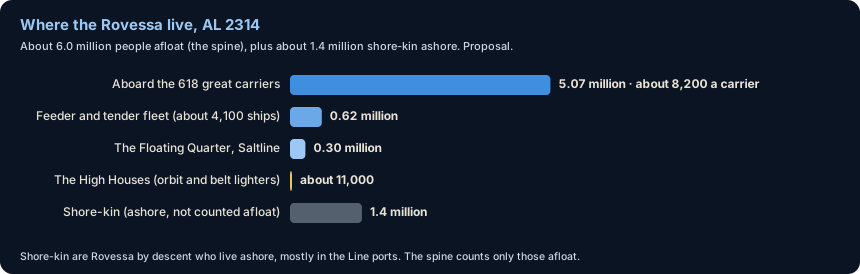
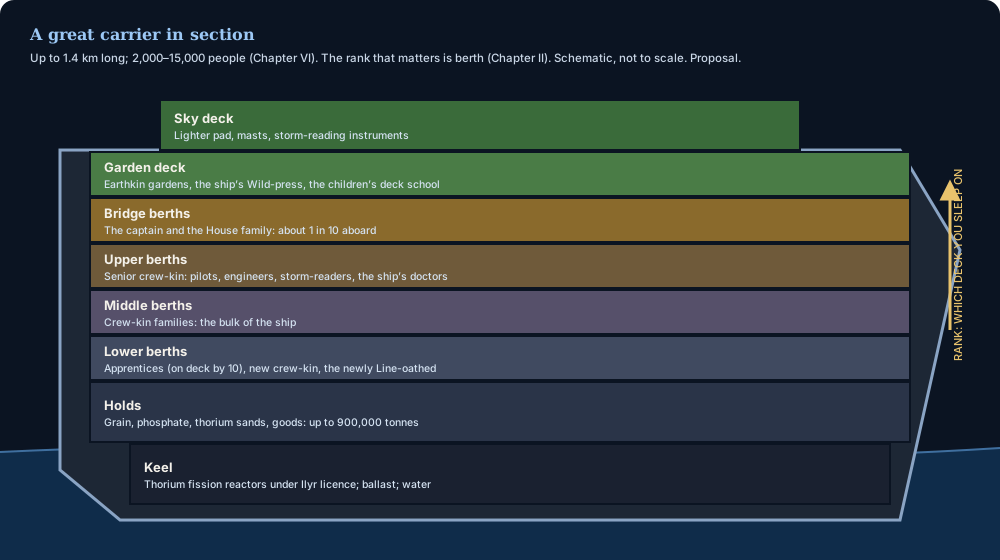
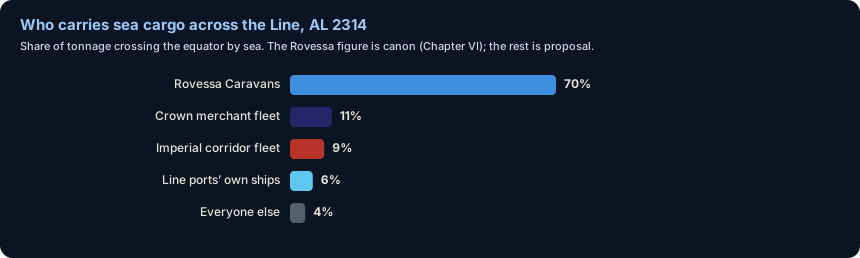
On the plan The sheet is 54 × 37 km. The three isles hold 346 km² of dry land: North Isle 130 km², Middle Isle 70 km² and South Isle 146 km². The stilt-towns cover another 17 km² over the shallows and the Floating Quarter 14 km², and the lagoon holds 541 km² of water. The plan shows 3,445 streets and walks, about 4,210 km of them. 3,389 have names, which is every one longer than 80 m. 66 km² of the isles are still farmed. (All proposal.)

The three isles and the lagoon#

The isles and what stands on each follow the almanac's figure (30:35). The districts' names and bounds are proposals.

Isle District What is there Its streets are named for
North Isle Congress Hill The league's quarter: the Tide Congress (canon, 30:80), with the Armistice Commission "under the Assembly's seal and the Tide Congress's roof" (canon, 44:101); the Tide Court and the Common Hall (canon institutions, 30:93, 30:30) the Portreeves of the Line since 1242 (29:218–232), by their doubled Line names: Mbeki-Brightwater Lane, Quenell-Osei Street, Ngata-Tamaru Lane, Castell-Achebe Street
The Exchange Quarter The Saltline Exchange and its Wall of Flags (canon, 30:81, 30:215); Banner Hall with the Banner Court beside it (canon, 50:114–115); the Imperial Trade House (canon, 14:105); the finance houses (24:174) the great carriers and the Founders' ships: Long Patience Street, Evenkeel Lane, Grain Mother Lane, Unbeholden Street, Lodestar Street
Old Saltline The oldest streets, round the lower slopes of the Cone. Chapel Row holds a chapel or hall of every faith (canon: "Every faith has a chapel or a hall at Saltline", 29:295) the league and its law: Tide Sheet Lane, Fair Tide Street, Port-note Street, Signers Street, Freight Street
The Cone An old volcanic cone at the isle's heart, about 265 m high, under native rainforest that no one eats (Line-wide canon: 29:146, 29:168) none: no street climbs it
The North Stilts The stilt quarter along the lagoon shore (canon: the figure's "stilt quarters ... lagoon walkways") fish of the stocked shoals (29:169), and the tidehound: Snapper Walk, Sardine Walk, Tidehound Walk
Westerly The outer end of the isle: paddies, terraced gardens and estates see How the streets are named
Middle Isle The Yards The Saltline yards (canon, 31:49), which build the Rovessa's sea-carriers, up to 1.4 km long, "about six great carriers a year" (24:183). Five building slips open on the lagoon. the shipwright's trade: Slipway Lane, Gantry Lane, Sail Loft Street, Plater Street
Saltline Launch The spaceport (canon, 30:83), "open to all who pay", on the isle's seaward shore; four pads; Vesper's Launch Office (canon, 42:127) the moons, suns and sky, by both their names: Theia Lane and Sól Lane, Máni Lane, Surtr Street, Kethra Lane, Vesper Lane
Slipside The yard hands' town at the isle's north end, laid out on a plan numbered, First Street by the lagoon to Twenty-first Street by the sea, crossed by avenues of the yards' trades
Gatehead The pilots' and harbour guards' quarter at the isle's south tip, over the Gate: the Harbour Guard's Gate station (canon Guard, 31:40) the sea and its rigging: Girdle Street, Undertow Street, Leeward Lane, Mast Street
South Isle Tableside The Captains' Table (canon, figure; 23:74) on the lagoon shore, facing the anchorage; the Salt Field (canon, 50:116); Saltline Airfield the Rovessa's carrier Houses: Adebayo Street, Oda Street, Sundqvist Street, Iskander Lane, Kaimana Lane
The Salt Pans The salt pans (canon, 31:48), on the isle's flat east end none: the pans are worked from their bunds
The South Stilts The stilt-towns of South Isle (canon: figure; 29:103) the sea: Pilot Walk, Undertow Walk, Shoal Walk, Swell Walk
Paddyfield The outer end of the isle: rice paddies (07:189), gardens and estates see How the streets are named
The lagoon The Carrier Roads The anchorage "where the great Rovessa sea-carriers lie in the lagoon" (canon, 25:46). The plan shows 87 carriers moored in tiers, heads to the easterly wind.
Outside the reef The Floating Quarter "Moored hulks and pontoons off the south shore of Saltline, beside the Carrier Roads" (canon, 25:28), leased from the port (30:110). The plan puts 48 hulks in rows, with pontoon walks between them. the Rovessa's own words: Tender Walk, Voyage Walk, Grain Flag Walk, Empty Roads Walk, Helm Walk

Getting around#

  • The tenders. Most people cross the lagoon by water: "Tender racing | In every harbour" (30:227). The plan shows three tender routes (proposal):

    • the Congress ferry, from the quay below the Tide Congress to the Captains' Table;
    • the yards ferry, from the Exchange Quarter to the yards;
    • the Table ferry, from Tableside to the yards.
  • The causeways (proposal). There are no bridges or causeways in the canon. The plan proposes two, built along the reefs that close the lagoon:

    • the Reef Causeway, 24 km along the western reef from North Isle to South Isle;
    • the North Causeway, 3 km across the reef from North Isle to Middle Isle.

    The Gate itself is never bridged, because the carriers pass through it.

  • Walking. On the isles, the streets of the old quarters climb the hills along their contours. In the stilt-towns and the Floating Quarter the streets are boardwalks. A boardwalk is a Walk or a Row, and a short dead end over the water is a Jetty or a Landing.

  • Air. It is 4 hours by air from Aletheia to Saltline (04:112), and Tessmere and Stellan fly here too (33:166). No airport is named in the canon. The plan proposes Saltline Airfield on South Isle, with a runway laid east and west into the trade wind.

  • Space. Saltline Launch opened in AL 2046 (29:104) and flies about 41% of Kethra's launches (30:147); since all spaceports fly about 2,900 (42:216), that is some 1,190 a year, three a day. It is "about three hours by launch craft" to Vesper, and drop-capsules come down "about 40 minutes ... to a Line lagoon" (41:87). The Saltline Tether Yard is in low orbit, not on the plan (30:84; 41:140).

  • By sea (23:136–141). The Line Road runs west to Tern Harbour and east to Glasswater, the Stair Crossing north to Aletheia, and the Southern Crossing south to Oathwater Quay. The plan marks each at the edge of the sheet.

Where the city builds upward (proposal)#

"Sometimes big cities build upwards instead of sprawling outwards", as Briana put it on 19 September 2026, naming New York, Chicago and Tokyo. Saltline has more reason than most: 2.9 million people live on 346 km² of island.

  • The Exchange towers fill the Exchange Quarter round the Saltline Exchange, where the finance houses (24:174) and the carrier syndicates keep their offices. There are about 250 of them in the plan.
  • The Tableside towers are a smaller group of about 90 by the Salt Field and the airfield on South Isle.
  • How they are built. The towers are white reefstone-lime and glass, like everything on the Line (04:127, 04:148). They carry storm shutters for the Girdle storms, which "can stall over the Line Isles for days" (01:114).
  • What stays low. Congress Hill stays low round the Tide Congress, and so do the stilt-towns, which stand on blackreed stilts.

On the plan the towers show as dark footprints in blocks built almost to the street. Zoom in on the Exchange Quarter to see them.

The water: the Gate, the reef and the roads#

  • The Carrier Roads (canon) is "the great anchorage" (24:75).
    • "Every seven years, in Firstred", the whole fleet of 618 great carriers gathers here for the Great Mooring (24:202; 23:77). The last was in AL 2310 (24:28), and the next, in AL 2317, "will fill the lagoon" (29:111).
    • The plan's lagoon, 541 km² of water, holds the whole fleet moored in tiers.
    • The Gap Swim is swum between two moored carriers at the Great Mooring (24:234).
  • The Gate (canon, figure) is "the lagoon's one channel". The plan puts it between Middle Isle's south tip and a spit of South Isle, about 1.5 km wide. At a double spring no ship can pass it (29:34).
  • The reef. Reefstone rings the isles (01:60). On the plan it also closes the lagoon on the west and across the gap between North Isle and Middle Isle (proposal). "Safe passages through the reefs are House knowledge, passed down and never written in full." (23:130)
  • The Quarantine Roads (canon) lie outside the Gate, "where ships flying the grey pennant wait" (29:198). The Water Wardens of 1432 founded them after the Salt Fever (29:237).
  • The Floating Quarter (canon) lies outside the reef, off South Isle's western end, as the figure places it: "west-south-west, outside the lagoon".
  • Armed ships stay outside. "Nothing armed berths inside a harbour." (51:95) The plan puts the berth of the Armistice Commission's 20 cutters (48:95) on Middle Isle's seaward shore, outside the Gate (proposal). The Free Banner Guild's escort hulls also "lie outside the reef" (51:95).
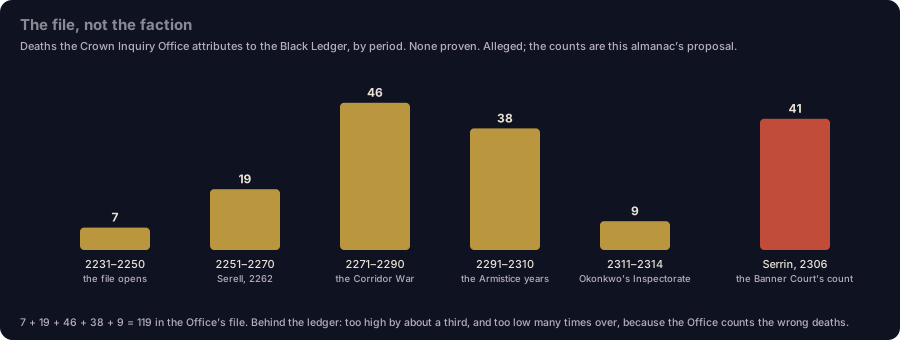
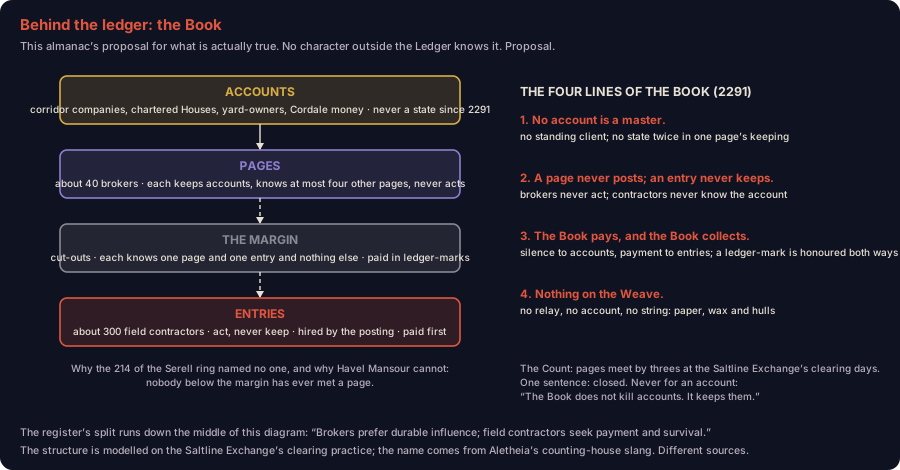
Landmarks#

Canon places are marked canon. Their position on the plan is a proposal unless the figure or the text gives it.

Place Where on the plan Note
The Tide Congress (canon) North Isle, Congress Hill, above the lagoon quay "Where the twelve free ports meet. Chaired by the Portreeve of the Line." (31:54) It meets "At Saltline, at every double spring tide" (30:41).
The Armistice Commission (canon) A wing of the Tide Congress It inspects "the phosphate deliveries, the fuel clauses and the corridors" under the Armistice of Saltline (30:82).
The Tide Court (canon) Congress Hill, beside the Congress "Half of Kethra's cross-border contracts name the Tide Court as their court." (30:93)
The Common Hall (canon) Congress Hill "Vetoes taxes and water prices." (30:30) The Stilt Riots of 1903–1904 won the Common Halls (29:238).
The Saltline Exchange (canon) North Isle, the Exchange Quarter "Insurance, freight and the port-note: the neutral market of Kethra" (30:81). It holds the Wall of Flags (30:215) and prints the Tide Sheet (30:185). "Debts are settled at the Exchange, never in the street." (30:235)
Banner Hall and the Banner Court (canon) North Isle, the Exchange Quarter's east end, side by side The Free Banner Guild's "Roll, the Hall's treasury, the hiring floor" (50:114); the Court sits "beside the Hall" (50:115).
The Imperial Trade House (canon) The Exchange Quarter, by the quays "For phosphate and fuel sales" (14:105): "the Imperium's eyes on the Line" (16:98).
The School of Navigation (canon) Congress Hill (29:310)
Chapel Row (proposal) Old Saltline Its chapels and halls are canon: "Every faith has a chapel or a hall at Saltline" (29:295).
The Saltline yards (canon) Middle Isle, on the lagoon Five building slips (proposal).
Saltline Launch (canon) Middle Isle, the seaward shore Four pads and Vesper's Launch Office (42:127).
The Harbour Guard (canon) The Gate station at Gatehead (proposal) "The largest of the free ports' harbour guards. Unarmed against ships by the ports' own law." (31:40)
The Captains' Table (canon) South Isle, Tableside, on the lagoon shore "The hall is rented from the free port for one tally a year." (23:74) The Armistice was signed "on the Captains' Table itself, because it was the only neutral table on Kethra" (23:112), in AL 2291 (29:109).
The Salt Field (canon) South Isle, beside the salt pans The Guild's frame ground: "drill, trials, and the Guild's own examinations" (50:116).
The salt pans (canon) South Isle, its east end "Sea-salt from the Line, iodine-rich and fine." (31:48)
The Floating Quarter (canon) Outside the reef, south-west (25:28)
The Quarantine Roads (canon) Outside the Gate, south-east (29:198)
The Cone, Congress Green, the desalination works, Saltline Airfield North Isle, the hilltops and the north shore; South Isle Proposals.

How the streets are named (proposal)#

These rules, as Briana set out on 19 September 2026, hold for every city plan:

  • streets are often numbered;
  • famous people, leaders above all, get streets, and those streets sit together;
  • an estate takes a theme, such as flowers;
  • many streets keep the name of whoever first laid the road;
  • some streets simply stop at a field whose owner never sold, and the suburbs have their cul-de-sacs.

In Saltline the rules take this form:

  • The leaders' streets sit together:
    • The Portreeves of the Line fill Congress Hill, round the Tide Congress. Their names are the Line's doubled names, "joining both parents' families" (29:214), so the streets are too: Mbeki-Brightwater Lane, Ngata-Tamaru Lane.
    • The two holders of office today, the Portreeve of Saltline and the chair of the Congress, have no streets.
    • The Rovessa's carrier Houses fill Tableside, round the Captains' Table: Adebayo Street, Oda Street, Sundqvist Street.
  • Slipside has numbered streets. They run from First Street by the lagoon to Twenty-first Street by the sea. It is the only numbered district.
  • Each quarter names its streets for what it does:
    • the Exchange Quarter for the great carriers;
    • Old Saltline for the league's law and trade;
    • the yards for the shipwright's trade;
    • Gatehead for the sea;
    • the stilt-towns for the fish of the stocked shoals.
  • The Launch uses both names. Its streets carry the capital's name and the frontier's side by side (Theia Lane and Sól Lane, Pandia and Máni), because every sign on the Line prints both (29:61).
  • The outer isles grew the way outer cities grow. Westerly, on North Isle, and Paddyfield, on South Isle, began as paddies and terraced gardens crossed by old lanes.
    • The lanes keep the names of the families who first laid them (Kovac's Lane, Fairweather's Lane, Yelland's Lane).
    • Developers bought fields a few at a time and built estates of curving streets and cul-de-sacs, each with its own theme: garden flowers (Hibiscus Drive, Moonflower Drive), herbs (Comfrey Drive), stones (Agate Drive, Malachite Close), sea birds (Tern Road, Lapwing Way), Kethra's native life (Duskwood Drive, Reefstone Drive), and the sky by both its names (Surtr Way, Kethra Court).
    • Paddies whose owners never sold are still worked, with the estates all round them.
  • Every street and walk longer than 80 m has a name: 3,389 of 3,445. A name is used once on the isles. The outer estates may repeat a name found far off, never within 6 km or in the same locality, as in Aletheia.

The names avoid everything the naming rules and the canon forbid:

  • Nothing is taken from Earth's places or history (05:266).
  • No new name uses the crowded families: "-gate", "-mere", "Salt-", "Grey-" and "Hollow-".
  • The pools also leave out the ports whose names are crowded, Ambergate, Morrowport and Scarrow, and the Harrow and Salt families among the Portreeves.
  • No Linecant word has been made up. The canon records none, and "Every carrier House has its own words." (05:26)

What the plan does not settle#

These are open for Briana; the plan follows the text and the figure in each case:

  • Settled, 19 September 2026 (the harbour repair). The Atlas's city marker was 190 km from open water and its institutions spread over some 280 km (the Handoff Addendum); the equator ran 120 km south of the city. Neither is true now: Saltline moved to the island's own east shore, at the equator itself (matching the Crossing Swim, "across the Line itself, off Saltline", 30:230), and every satellite institution moved with it to the same shore. The island's land shape and its lack of a drawn lagoon are unchanged; a lagoon was not part of this repair.
  • The Captains' Table. The figure puts it on South Isle; the Atlas puts it beside the Tide Congress. The plan follows the figure. Settled.
  • The Floating Quarter. The text says "off the south shore"; the figure draws it west-south-west, outside the lagoon. The plan puts it off South Isle's western end, which fits both. Settled.
  • The Commission's cutters. Whether they are armed, and where they berth, is not stated. The plan berths them outside the Gate. Settled as the plan's own proposal.

Guidance for AI actors#

  • A Saltliner gives an address by isle and quarter: "North Isle, Congress Hill", "the South Stilts". Across the lagoon people go by tender, and they time the trip by the tide.
  • At a double spring the Gate is shut to shipping and the Tide Congress sits (29:34). When a double spring meets a Girdle storm, low towns flood (01:117). Saltline's quays, pans and lower streets are the parts at risk (29:155).
  • Signs and dates come in both forms. A Saltliner may use either name, and choosing one is noticed (00:164–167).
  • The Floating Quarter is the Rovessa's. It is leased from the port (30:110), and its people are counted with the Rovessa, not as port citizens (29:77).
  • Nothing armed berths inside the harbour, and the Harbour Guard is unarmed against ships (31:40; 51:95).
  • What is canon, and what is only the plan: the three isles, the lagoon and the Carrier Roads, the Gate, the Floating Quarter and the Quarantine Roads, and the institutions marked canon are canon. The districts' names and bounds, the streets and their names, the causeways, the airfield and the exact positions are the plan's proposals.

Sources#

The almanac, approved 19 September 2026:

  • the Introduction (01) and Chapters III and IV (04–05);
  • the Line Free Ports (29–31), with the figure of Saltline (30:35);
  • the Rovessa Caravans (23–25);
  • the Vardane Imperium (14, 16), the Vesper Orbital Compact (41–42), the Homeworld Assembly (44–45), Homeguard Command (48) and the Free Banner Guild (50–52);
  • the Atlas's places at Saltline.

The plan is built by _build/make_cityplans.js from _build/city_specs/saltline.js, which lists every canon line it keeps.

City Plan: Vardenhold#

Kethra Almanac • City plans • Approved 19 September 2026 • drafted 19 September 2026

Status: approved. Briana approved the city plans on 19 September 2026 (City Plans and Map Styles Approval). Where this page calls something a proposal, read it as approved. The points under What the plan does not settle are being settled on her instruction of the same day.

Status before approval: This street plan is new material, so it waits for Briana's approval (Almanac Approval Decision). That covers every street, its name, and every district and building not marked canon below. What it takes from the approved almanac is cited to file and line (for example 13:132 is the Imperium almanac, Part 1, line 132), and nothing here overrides canon. The Atlas spreads its markers for the city's institutions 73–101 km from the city so they can be read at world scale. This plan puts them inside the rings, where a 60-km rampart course needs them.

The street plan opens on this page in the website (City plans in the menu). It is drawn from the source files by _build/make_cityplans.js.

Using the plan. Drag to move, and zoom with the mouse wheel, the + and − buttons, or a pinch. Names come in as you zoom, each set lettered to read at the same size on screen:

  • Whole city: the gorge, the rings and the districts.
  • About 2½ times: main streets, the great buildings and the marshal quarters.
  • About 6 times: the longer streets and the smaller places.
  • About 12 times: the name of nearly every street.

The ⤢ button fills the screen. North is up, and the scale bar bottom left is always true. The rings are small on the whole sheet, so zoom in on the middle to see them.

The city at a glance#

What it is The capital of the Vardane Imperium, "Varden's hold" (13:25). It is "Seat of the Imperator, the Marshal Council and the Council of Corridors." (16:22)
People 9.8 million in the metropolitan area (13:62). The First Holding, which is "The capital, the gorge and the Citadel", holds 34.5 million (14:82).
Where "A fortress-city on an Oreth river gorge." (04:53) The gorge is "A gorge cut by the River Vard through basalt plateaus, about 1,950 km from Gorgehead to where the railway leaves it at Corridor Post Four. Vardenhold's concentric walls climb its sides." (13:132) The Vard flows south past the city: Gorgehead is "the upper Vard gorge" (14:314), and Corridor Post One lies "below Vardenhold" (16:53).
Climate 33° N, mean 14 °C, 690 mm of rain a year: a "Walled city in a rain shadow" (13:149). Winters are cold, with lit red nights (13:143). Summer dust storms from the interior basins, the "yellow wind", carry phosphate dust (13:142).
Look "Concentric walls, basalt, rank-coloured banners, severe geometry" (14:260). Basalt is the Imperium's fortress stone (04:124). Its colours are black, ochre and red: "Basalt, phosphate, blood" (13:47).
The streets "Its streets are grids built to be defended." (04:53)
Time "Vardenhold time." The Imperium keeps one time across all its holdings (13:71).
On the plan The sheet is 48 × 42 km. The plan shows 13,037 streets, about 14,000 km of them. 12,859 have names, which is every street longer than 80 m. About 1,090 km² is built up, and 914 km² of the plateaus is still farmed (proposal).

The rings#

  • Four rings of walls. "Vardenhold's four rings make a 60-km course" for rampart running, the races along the tops of the city walls (14:267). The plan's rings measure 6.0, 11.9, 18.2 and 24.2 km round, 60.3 km in all. That makes them 1.9, 3.8, 5.8 and 7.7 km across (proposal).
  • The flag and the arms. The flag's "two ochre concentric rings around a solid ochre centre" are "Vardenhold's walls, and the centre is what they protect" (13:43). The arms show "within two ochre rings, a walled tower" (13:44). The plan puts that tower, the Tower, at the heart of the Citadel (proposal).
  • The walls climb the gorge. In the plan the gorge has a flat floor 3.4 km wide, then three benches of basalt, each above a cliff. The rim stands about 620 m above the river (proposal). The First Ring stands on the Citadel's island, the Second on the gorge floor, and the Third and Fourth on the benches. So the walls climb the gorge sides, as the canon has it.
  • The Mosaic Mile. "Basalt and ochre mosaics cover the inner faces of city walls, recording each holding's Roll of honour. Vardenhold's Mosaic Mile is the greatest artwork of the Imperium." (14:249) The plan puts the Mile on the inner face of the Second Ring, facing the Citadel on the north-east, 1.55 km long (proposal).
  • Wall-ovens. Gorge bread is "Dense wheat bread baked in wall-ovens" (14:239). The ovens are built into the rings.
Within District What is there Its streets are named for
The First Ring The Citadel The Citadel (canon), "The Imperator's citadel and the First Holding" (16:71), on an island where the Vard parts round it: the Tower and the Imperator's Hall none: the island is the Citadel
The Second Ring The Second Ring The seats of power, round the Citadel: the Marshal Council (canon, 13:66), the Council of Corridors (canon, 16:96), Imperial Army headquarters (canon, 16:57), the Office of the Marshal Watch (canon, 16:76), the Imperial Corridor Bank (canon, 14:190) and the Court of the Articles (canon, 14:65). Their places are proposals. the Imperators, elected for life since AL 760 (13:221–295): Ilsabet Lane, Mirela Street, Leofric Street, Aldren Street, Oderic Street, Torvin Lane
The Third Ring The twelve marshal quarters "Marshal quarters" (canon, 04:53), one for each of the twelve holdings' marshals (13:300–313). Each faces roughly toward its holding: the Northreach Quarter to the north, the Tolvard Quarter to the south-west, the Halvek Quarter to the east (proposal). The Imperial Academy (canon, AL 1204, 13:391) stands in the north-east. the Imperial Families (13:221–314): Castrel Alley, Kessrin Rise, Tarsk Passage, Sethe Alley; then the holdings' towns: Serrin Stair, Casrin Stair
The Fourth Ring The Fourth Ring The Citizens' city within the walls; the Voice of the Walls, the state broadcaster (canon, 14:215) the walls and their law: Oath Street, Merlon Lane, Collar Way, Tower Road

Beyond the walls#

District What is there Its streets are named for
The Foundries (the gorge floor, north) "Vardenhold and the corridor foundries": military frames, artillery and phosphate processing (canon, 07:147). The plan has the frame foundries and the phosphate works. the foundry: Rolling Mill Lane, Ingot Lane, Breech Street, Mould Street
The Railheads (the gorge floor, south) The "phosphate railheads" (canon, 04:53): the corridor yards, Vardenhold Corridor Station, the bond-yards of the Bonded who work the corridor (canon, 14:142), a Bond Infirmary run by the corridor company (canon, 13:379) and a Corridor Guard post (canon, 14:142) the railway: Points Way, Signal Lane, Wagon Street, Ballast Way
The North Benches and the South Benches Citizens' terraces up the gorge sides, above and below the rings colours of stone (Ochre Road, Flint Road, Crimson Way) in the north; the harvest of the plateaus (Honey Way, Flax Way, Rye Road) in the south
The East Rim The Citizens' town along the top of the gorge on the east. The Field of the Hand, a parade ground for the Day of the Hand, when "Piloted frames parade in silence" (14:228), is a proposal. numbered: First Street at the rim, out to Thirtieth Street
The West Rim The same on the west the holdings and their towns: Veskir Way, Stavren Way, Serrin Way, Draemor Way
The plateaus Gardenland in fields, crossed by old lanes, with the hedge-fort villages of Durrek, Maskel and Vornal to the east and Halbrin, Rendek and Sadrek to the west (proposals). "Hedge-forts line the gardenland edge." (13:158) Vardenhold Airfield is on the west plateau (proposal: no airport is stated). see How the streets are named

Where the city builds upward (proposal)#

"Sometimes big cities build upwards instead of sprawling outwards", as Briana put it on 19 September 2026, naming New York, Chicago and Tokyo. For a metropolis of 9.8 million in a gorge, the plan builds upward where the roads and the railway meet the city, as Tokyo's towers stand round its stations:

  • The East Rim towers and the West Rim towers stand at the heads of the Halvek and Marrach Roads, where they top the gorge. This is where the corridor companies keep their offices. There are about 360 of each in the plan.
  • The Corridor Station towers, about 130, stand round Vardenhold Corridor Station on the gorge floor.
  • How they are built. They are basalt and ochre, in the "severe geometry" of the Imperium (14:260).
  • No towers in the rings. No tower stands inside the four rings, because nothing may overlook the Citadel.

On the plan the towers show as dark footprints in blocks built almost to the street. Zoom in on either rim to see them.

Getting around#

  • The phosphate corridor (canon) "runs from Gorgehead through Vardenhold to the southern railhead" (13:113). On the plan it runs down the east side of the gorge floor, through the gates of all four rings.
  • The Western corridor (canon) starts at the city and runs west to Marrach (atlas). On the plan it crosses the Vard below the rings and climbs the gorge's west wall on a long ledge to the plateau (proposal).
  • The gorge roads (proposal): the Gorgehead Road north up the gorge and the Tolvard Road south down it, both on the west bank, named for where they lead.
  • The rim roads (proposal): the Halvek Road east and the Marrach Road west, climbing the gorge sides in switchbacks.
  • Bridges (proposal): the Imperator's Bridge and the Marshals' Bridge join the Citadel's island to the two banks. The Foundry Bridge and the Railhead Bridge cross the Vard outside the rings. No bridge is named in the canon.
  • Stairs. A cross street that climbs a cliff is a Stair or Steps, a Hill or a Rise if it carries traffic, and an Incline in the works.
  • By air. No airport is stated for Vardenhold. The plan proposes one on the west plateau.

Landmarks#

Canon places are marked canon. Their position on the plan is a proposal unless the text gives it.

Place Where on the plan Note
The Citadel (canon) The island in the Vard, within the First Ring The Imperator's citadel and the seat of the First Holding (16:71). Imperator Casimir IV, of House Kessrin, elected AL 2303, reigns (13:67).
The Tower and the Imperator's Hall The Citadel Proposals. The Tower is the walled tower of the arms (13:44).
The Marshal Council (canon) The Second Ring, north "a Marshal Council of twelve" (13:66). It can depose an Imperator "by a vote of nine" (14:28).
The Council of Corridors (canon) The Second Ring, north-east "Runs the supply routes, the Bonded and the phosphate trade." (16:96) Its members are the heads of the corridor companies (14:29).
Imperial Army headquarters (canon) The Second Ring, west "Seat of the Marshal Council's general staff." (16:57)
The Office of the Marshal Watch (canon) The Second Ring, south-west "Imperial intelligence and internal security" (16:76).
The Imperial Corridor Bank (canon) The Second Ring, south-east It issues the Imperial mark, "pegged loosely to the price of phosphate" (14:190).
The Court of the Articles (canon) The Second Ring, north-west "Constitutional questions. Five Imperial Family elders." (14:65) Its place is not stated in the canon.
The Mosaic Mile (canon) The Second Ring's inner face, north-east (14:249)
The Imperial Academy (canon) The Third Ring, north-east Founded AL 1204: "Law, the Articles, history, the Roll" (13:391).
The Voice of the Walls (canon) The Fourth Ring, east The state broadcaster (14:215).
The corridor foundries (canon) The Foundries (07:147)
The phosphate railheads (canon) The Railheads (04:53)

How the streets are named (proposal)#

These rules, as Briana set out on 19 September 2026, hold for every city plan:

  • streets are often numbered;
  • famous people, leaders above all, get streets, and those streets sit together;
  • an estate takes a theme, such as flowers;
  • many streets keep the name of whoever first laid the road;
  • some streets simply stop at a field whose owner never sold, and the suburbs have their cul-de-sacs.

In Vardenhold the rules take this form:

  • The leaders' streets sit together. The Imperators fill the Second Ring, round the Citadel. The Imperial Families fill the Third Ring's marshal quarters.
    • The Imperium's streets use the name alone, with no honorific.
    • The reigning Imperator's name, Casimir, is shared with three earlier Imperators.
  • The East Rim is numbered, First Street to Thirtieth Street outward from the gorge's rim. The Imperium numbers readily: its holdings, its corridor posts, its bond-yards (14:82; 16:50–55; 16:148).
  • Each district names its streets for what it is: the walls in the Fourth Ring, the foundry and the railway on the gorge floor, stone and harvest on the benches.
  • The plateaus grew the way outer cities grow. They began as gardenland crossed by old lanes, with hedge-fort villages.
    • The lanes keep the names of the families who first laid them: Roth's Lane, Lenz's Lane, Voss's Lane. They are Orethi names, some of them shared with the free coast, as the canon says family names are (32:188).
    • Estates were laid out in grids, as the Imperium builds, each with its own theme: trees (Beech Way, Cherry Way), stones (Chalk Road, Whinstone Road), colours (Sable Way, Rust Road), the harvest (Wheat Court, Linseed Road), herbs (Sage Road) and birds (Dove Way).
    • Farms whose owners never sold are still fields, even where the city has grown round them.
    • The villages keep their own streets: Pound Lane, Oven Street, Smithy Lane.
  • Every street longer than 80 m has a name: 12,859 of 13,037. A name is used once within the rings and the named districts. The plateau estates may repeat a name found far off, never within 6 km or in the same locality.

The names avoid everything the naming rules and the canon forbid:

  • Nothing is taken from Earth's places or history (05:266).
  • No new name uses the crowded families: "-gate", "-mere", "Salt-", "Grey-" and "Hollow-".
  • The houses whose names the canon's near-identical groups crowd have no streets: Brannic, Harkin, Veyl and Ormond.
  • "The First Walls" are at Gorgehead, not here (13:188), and no street takes their name.

What the plan does not settle#

These are open for Briana; the plan follows the text in each case:

  • Two rings or four. The flag shows "two ochre concentric rings" (13:43), but "Vardenhold's four rings make a 60-km course" (14:267). Settled: the plan has four, as the course requires, and reads the flag's two as a device rather than a count.
  • "Marshal quarters" (04:53) are not defined anywhere. Settled: the plan makes them the Third Ring's twelve quarters, one for each marshal, beside the marshals' own seats in their holdings (16:65).
  • Where frames are built. "Vardenhold and the corridor foundries" build military frames (07:147), but so do the Kessard Frame Foundries, "Where most Imperial military frames are built" (16:91). Both are true: the plan gives Vardenhold frame foundries of its own alongside Kessard's larger works. Settled.
  • Settled, 19-20 September 2026 (the harbour repair and after). The gorge was "900-km" (13:132) and the river "about 3,400 km" (13:137); the Atlas measures 1,950 km from Gorgehead to Corridor Post Four and 4,110 km for the full river. Both figures now read the Atlas's own measurement.
  • The Atlas's markers. The Citadel, the Council of Corridors, Army headquarters and the Marshal Watch sit 73–101 km from the city's own marker on the world-scale Atlas — it spreads a city's institutions out from one marker so their names don't collide at that scale. The plan places them at their true in-story locations inside the city. Settled.

Guidance for AI actors#

  • Rank shapes every meeting.
    • "Rank-honorifics are required in formal address": "Captain-of-Corridor Asken", "Citizen Marl", "Bondsman Tey" (13:357).
    • "Guests sit by collar." (14:281) Collars are black edged with gold for the Imperial Families, ochre for the officer caste, grey for Citizens and brown for the Bonded (13:72).
  • Where someone lives in the rings says who they are (proposal: the canon does not say how the ranks are housed).
    • The Imperial Families and the state live within the Second Ring.
    • The officer caste lives in the marshal quarters.
    • Citizens live in the Fourth Ring, on the benches and on the rims.
    • The Bonded live in the bond-yards by the railheads.
  • A Vardenholder gives an address by ring and quarter: "the Third Ring, the Kessard Quarter"; "the East Rim, Fourteenth Street".
  • Security is everywhere: "locks and watchmen. Informers are common. Officer families have household troops." (04:179)
    • The Watch is the civil police (14:72). The Office of the Marshal Watch handles intelligence and internal security (14:73).
  • The national network is "the Walled Weave, a filtered national network" (14:213).
  • What is canon, and what is only the plan: the gorge, the four rings, the Citadel, the Mosaic Mile, the institutions marked canon, the corridor foundries, the railheads and the two corridors are canon. The benches, the districts' names and bounds, the marshal quarters' order, the streets and their names, the bridges and the exact positions are the plan's proposals.

Sources#

The almanac, approved 19 September 2026:

  • Chapter III (04) and Chapter IV (05);
  • the Vardane Imperium (13–14) and its Register of Holdings (16);
  • the Free Oreth Coast States (32), for the shared family names;
  • the Atlas's places at Vardenhold.

The plan is built by _build/make_cityplans.js from _build/city_specs/vardenhold.js, which lists every canon line it keeps.

City Plan: Ilyrion#

Kethra Almanac • City plans • Approved 19 September 2026 • drafted 19 September 2026

Status: approved. Briana approved the city plans on 19 September 2026 (City Plans and Map Styles Approval). Where this page calls something a proposal, read it as approved. The points under What the plan does not settle are being settled on her instruction of the same day.

Status before approval: This street plan is new material, so it waits for Briana's approval (Almanac Approval Decision). That covers every street, its name, and every district and building not marked canon below. What it takes from the approved almanac is cited to file and line (for example 21:34 is the Ilyr Sanctum almanac, Part 2, line 34), and nothing here overrides canon. The Atlas spreads its markers for the Archive Mount and the city's institutions 68–177 km from the city so they can be read at world scale. This plan follows the text: "The Archive Mount ... sits at its centre." (04:60)

The street plan opens on this page in the website (City plans in the menu). It is drawn from the source files by _build/make_cityplans.js.

Using the plan. Drag to move, and zoom with the mouse wheel, the + and − buttons, or a pinch. Names come in as you zoom, each set lettered to read at the same size on screen:

  • Whole city: the Mount, the terraces and the country round them.
  • About 2½ times: main streets and the great buildings.
  • About 6 times: the longer streets and the smaller places.
  • About 12 times: the name of nearly every street and stair.

The ⤢ button fills the screen. North is up, and the scale bar bottom left is always true.

The city at a glance#

What it is The capital of the Ilyr Sanctum. It is "Built into terraced volcanic hillsides on Aelos. The Archive Mount, the sealed repository of the Founders' records, sits at its centre." (04:60)
People 3.1 million (20:68), in the Archive Charge, which holds 12.5 million (20:282). Aelos has the oldest people of any major state, with a median age of 46 (20:276).
Where The central highlands of Aelos: "Young basalt, terraced for farming. Ilyrion and the Mount." (20:132) The Archive Mount is "An older, extinct cone, riddled with vaults" (20:134). Aelos is "Cut off from every other land by open ocean." (20:123)
Climate 11 °C in the coldest month, 22 °C in the warmest, 1,420 mm of rain a year (20:146–148). "Red nights are softened by sea cloud." (20:143) After Mount Irrin erupts, "Volcanic haze ... dims the highlands for months." (20:144)
Look "Houses cut into volcanic terraces." "Restrained, precise, almost without ornament." (04:146) Houses have "interior gardens under clear domes" (21:193). Basalt is "Ilyr's building stone" (20:168).
Time "Ilyrion time, one zone for all of Aelos" (20:79).
On the plan The sheet is 44 × 36 km. The city climbs six terraces round the Mount, 187 km² in all. The plan shows 8,860 streets and stairs, about 6,770 km of them. 8,612 have names, which is every one longer than 80 m, and 1,054 of them are stairs. Beyond the terraces, 329 km² of the plateau is still farmed, and the native Wild covers the rest of the sheet (proposal).

The Mount and its terraces#

  • The Archive Mount (canon) was begun when "The keepers find caves in the young basalt of the Mount and begin the Archive Mount." Then "Ilyrion grows on its terraces." (20:90) "The Archive Mount was chosen because the vaults could be sealed in rock and kept cool." (20:185)

  • The levels inside the Mount (canon, the figure of the Archive Mount). "The deeper the level, the higher the Key needed to enter it." (21:27) From the top down:

    • the Public Reading Halls: "Released findings, copies, schooling · First Key";
    • the Licensing Stacks: "Designs behind every licence · Second and Third Key";
    • the Founder Stores: "Data in Founder formats; readers are few · Fourth Key";
    • the Sealed Vaults: "Closed since the Silence; contents unknown · Fifth Key, by Conclave vote".

    Below them the figure marks "The Unmapped Door?", which is rumoured. Whether it exists is open (05:247).

  • The terraces. The figure draws six terrace bands on the Mount's flanks, "houses cut into basalt". The plan gives the city six terraces, numbered from the foot of the Mount upward, with the summit above them (proposal).

    • Each terrace is a flat shelf about a kilometre wide.
    • A basalt terrace wall about 75 m high rises between one terrace and the next.
    • The summit stands about 2,035 m above sea level and the plateau about 1,500 m (proposal heights).
Terrace District What is there Its streets are named for
The summit The Archive Mount The Public Reading Halls (canon) and Conclave Hall, "Ilyrion, on the Mount" (canon, 21:34). The Office of Keys and the Keeping Treasury (canon; their places are proposals). The Reading Court (proposal). The doors of the Mount (canon: "The arch is the door of the Archive Mount", 20:55). none: the summit is the Archive's
6 The Sixth Terrace The Hall of Keys, the elected chamber of 150 (canon, 21:44; its place is a proposal) the First Custodians, by their full names, as Ilyr records them: Liesl Nakamura Street, Nadia Okafor Street, Mei Seel Lane, Farah Quist Avenue
5 The Fifth Terrace The Charge House of the Archive Charge's Warden and Council (proposal; canon Charge, 21:48) keeping and the record: Record Lane, Folio Street, Release Lane, Seal Street, Key Street
4 The Fourth Terrace Houses of the archive families the archive families: Ibarra Lane, Achterberg Street, Istrin Lane, Drummond Lane
3 The Third Terrace the towns and works of Aelos: Halcyon Street, Idrenne Street, Deepwell Street, Eastshore Road
2 The Second Terrace The Quiet Cells, the prison (canon, 21:81; its place is a proposal) the terrace crops: Rice Road, Citrus Lane, Paddy Street, Orange Avenue
1 The First Terrace The foot of the Mount, and the funiculars' lower stations on the Circuit the dome gardens: Fern Way, Iris Avenue, Glasshouse Lane, Pergola Lane
The Keyworks The Keyworks (canon, 21:173): "Link-socket cores, medical technology and fusion controls", made under the Sanctum's own licences, in a planned works town on the plateau to the south-east numbered, First Street to Twenty-sixth Street, crossed by the works' trades: Socket, Coil, Relay, Valve

Getting around#

  • The stairs. "Terrace-running | Racing up the stairs of Ilyrion" (21:243). Every street that climbs a terrace wall is a Stair or Steps, and a Hill or a Rise if it carries traffic.
  • The funiculars (canon: "funiculars on Ilyrion's terraces", 21:188). The plan runs four of them straight up the Mount, from the Circuit at the foot to the summit: the North, East, South and West Funiculars (proposal names).
  • The rack railways (canon: "rack railways into the highlands", 21:188). The plan brings in the Castaly line from the south-west to Ilyrion Terminus, and the Orlo line from the north-east to Ilyrion East (proposal routes and stations).
  • The roads (proposal). The Circuit runs round the foot of the Mount. The Castaly Road goes south-west toward Castaly, by Vessan, a "Market town on the road from Castaly to the highlands" (22:31). The Orlo Road runs north-east. The Keyworks Road goes to the Keyworks.
  • Air. Passenger aircraft fly "between all major cities" (04:112), but no airport is named. The plan proposes Ilyrion Airfield on the plateau to the north-west.

Beyond the terraces#

  • The plateau. "Earthkin crops on the terraces: rice, barley, tea, citrus, vines." "Few grazing animals: the terraces cannot spare the land." (20:158) In the plan the plateau round the Mount is terraced fields, crossed by old lanes, with the villages of Sevry, Quenna, Amaun, Irvel and Delmey (proposals).
    • The lanes keep the names of the archive families and others who first laid them: Drummond's Lane, Sorrel's Lane, Lune's Lane.
    • Estates were built a few fields at a time, each with its own theme: dome-garden plants (Jasmine Drive, Fig Way), terrace crops (Grape Way), stones (Jasper Road, Tourmaline Way), birds (Kingfisher Drive, Lark Court), herbs (Hyssop Road) and Kethra's native life (Gloamwing Close, Glassmoth Drive).
    • Fields whose owners never sold are still farmed.
  • The Wild. "Native Wild covers 92% of Aelos." (20:156) Beyond the farmed plateau the plan shows native forest, which no one eats (20:156–158).

Landmarks#

Canon places are marked canon. Their position on the plan is a proposal unless the text gives it.

Place Where on the plan Note
The Archive Mount (canon) The middle of the city "Sealed vaults of the Founders' records. Some have not been opened since the Silence." (22:52) It is guarded by the Order of the Veiled Sun (20:92, 20:187).
The Public Reading Halls (canon) The summit "The Public Reading Halls of the Archive Mount." (20:344) The Charter of Keeping (AL 351) is a "public text in the Reading Halls" (21:301).
Conclave Hall (canon) The summit The seat of the Custodial Conclave: 21 members, with 3 seats for the Listening Bench (21:31). Its powers are "Law, the licences, the Order's mandates, and every decision to open a sealed vault." (21:33)
The Office of Keys (canon) The summit "They are issued and policed by the Office of Keys." (21:88) The text names no city for it.
The Keeping Treasury (canon) The summit (21:180)
The Reading Court (proposal) The summit Where the year's released findings are read in public on Release Day, 1 Reaping (21:214). The canon names no venue.
The Hall of Keys (canon) The Sixth Terrace "An elected chamber of 150 members, chosen every five years by every adult" (21:44).
The Quiet Cells (canon) The Second Terrace The prison (21:81).
The Keyworks (canon) The plateau, south-east (21:173; 07:148)

Not in Ilyrion (the plan leaves them out): the Quiet College, in Idrenne (20:305); the Examination Halls, in Keldry (20:342); the Order's seat, the Citadel (21:128); and the Castaly Quarter and the Castaly Licence Exchange (22:54).

How the streets are named (proposal)#

These rules, as Briana set out on 19 September 2026, hold for every city plan:

  • streets are often numbered;
  • famous people, leaders above all, get streets, and those streets sit together;
  • an estate takes a theme, such as flowers;
  • many streets keep the name of whoever first laid the road;
  • some streets simply stop at a field whose owner never sold, and the suburbs have their cul-de-sacs.

In Ilyrion the rules take this form:

  • The leaders sit highest. The First Custodians have the Sixth Terrace, just below Conclave Hall. Ilyr keeps whole names, so the streets carry them whole: Liesl Nakamura Street, Nadia Okafor Street.
  • Each terrace names its streets for one thing. Going down: keeping and the record, the archive families, the towns of Aelos, the terrace crops and the dome gardens.
  • The Keyworks is numbered, First Street to Twenty-sixth Street, as a planned works town would be.
  • Every street and stair longer than 80 m has a name: 8,612 of 8,860.
    • A name is used once on the terraces.
    • The plateau's estates may repeat a name found far off, never within 6 km or in the same locality.

The names avoid everything the naming rules and the canon forbid:

  • Nothing is taken from Earth's places or history (05:266).
  • No new name uses the crowded families: "-gate", "-mere", "Salt-", "Grey-" and "Hollow-".
  • The archive families the canon's near-identical groups crowd have no streets: Marrow, Orrel, Tessel and Venn. Delacroix is also left out, because it would read as a famous Earth name.
  • Sennet, a harbour town that shares its name with the word for grief for Earth, is left out, and so is Tamsk, which names two different towns.

What the plan does not settle#

These are open for Briana; the plan follows the text in each case:

  • The Atlas's markers. The Archive Mount's marker is about 108 km from the city's. Conclave Hall's is 68 km away, the Keyworks' 177 km and the Office of Keys' 78 km. The text puts the Mount at the city's centre, Conclave Hall "on the Mount" and the Keyworks in Ilyrion. Settled: the same world-scale spreading as every other city (see the harbour repair's marker-offset note) — the plan places them at their true in-story locations, inside the city.
  • The age of the rock. The Mount is "young basalt" (20:90, 20:132) and also "An older, extinct cone" (20:134). Settled: "older" reads as older than Irrin, the active volcano nearby — young in the age of the Mount's own range, older than its still-active neighbour.
  • Seen from the sea. Sailors call the Mount "the first thing seen from the sea" (20:44), but on the Atlas the city is about 1,570 km from the nearest coast — too far for a literal sightline regardless of the Mount's height. Settled: read as sailors' saying, the Mount's height and fame carrying the claim rather than a literal line of sight; it is not a claim about Ilyrion having its own coast.
  • Mount Irrin. "Its terraces feed Ilyrion." (22:64) Its marker is about 500 km away — a plausible trade distance for produce, not a claim of adjacency. Settled.

Guidance for AI actors#

  • Speech is Archival: "old, precise and a little cold" (05:25). Ilyr say "it is recorded that…" (21:255).
  • "Never photograph the doors of the Mount." (21:254) Key marks are stamped on every document, door and data-store. "Key marks appear on documents, not on people." (21:251)
  • Foreigners stay in the Castaly Quarter "unless an Ilyr sponsor obtains a guest key for them", and "Wandering beyond it is an offence." (21:253) A foreigner in Ilyrion carries a guest key.
  • "Once a year the Order flies its frames over Ilyrion." It is the only frame display in the Sanctum (21:245). On the Unmapping, "the whole day is silent" (21:211).
  • An Ilyrioner gives an address by terrace: "the Fourth Terrace, Istrin Lane".
  • What is canon, and what is only the plan: the Mount and its levels, the terraces, the funiculars, the rack railways, and the institutions marked canon are canon. The terraces' number and names, the heights, the streets and their names, and the exact positions are the plan's proposals.

Sources#

The almanac, approved 19 September 2026:

  • Chapter III (04) and Chapter IV (05);
  • the Ilyr Sanctum (20–21), with the figure of the Archive Mount, and its Register (22);
  • the Atlas's places at Ilyrion.

The plan is built by _build/make_cityplans.js from _build/city_specs/ilyrion.js, which lists every canon line it keeps.

City Plan: Eldhaven#

Kethra Almanac • City plans • Approved 19 September 2026 • drafted 19 September 2026

Status: approved. Briana approved the city plans on 19 September 2026 (City Plans and Map Styles Approval). Where this page calls something a proposal, read it as approved. The points under What the plan does not settle are being settled on her instruction of the same day.

Status before approval: This street plan is new material, so it waits for Briana's approval (Almanac Approval Decision). That covers every street, its name, and every district and building not marked canon below. What it takes from the approved almanac is cited to file and line (for example 26:130 is the Southern Holds almanac, Part 1, line 130), and nothing here overrides canon. The Atlas spreads its markers for the town's institutions 42–114 km from the town so they can be read at world scale. This plan puts them in the town.

The street plan opens on this page in the website (City plans in the menu). It is drawn from the source files by _build/make_cityplans.js.

Using the plan. Drag to move, and zoom with the mouse wheel, the + and − buttons, or a pinch. Names come in as you zoom, each set lettered to read at the same size on screen:

  • Whole town: the Hedge, the river, the districts and the old Holds.
  • About 2½ times: the dray-roads and the great buildings.
  • About 6 times: the longer streets and the smaller places.
  • About 12 times: the name of nearly every street.

The ⤢ button fills the screen. North is up, and the scale bar bottom left is always true.

The town at a glance#

What it is "The largest frontier town, on the Eldvang rift." (04:63) It is the seat of the Holds Compact (28:22) and of the Rift Reach (27:63).
People 1.7 million (26:75). The Rift Reach holds 34.0 million free-folk (26:257), and it is "The richest and most crowded Reach." (26:130) A hearth averages 6.1 people (26:252), and a third of the people are children (27:332).
Where The Eldvang rift: "The rift valley: springs, terraces, the Rift Railway, Eldhaven and the rare-earth works." (26:130) The rift is "well watered ... along the rift" (01:185).
Climate 2 °C in the coldest month, 29 °C in the warmest, 640 mm of rain a year (26:153–155).
Seasons In the red summer, "The ember-storm season. People work at night and sleep in cool-cellars." (26:145) In the dark winter, "Blackfrost. Long, cloudless, bitterly cold nights with no red light." (26:147)
Look "It sits low and wide, built for ember seasons." (04:63) Frontier houses are "Low and wide, half-buried, built of earth and blackreed, with wind-towers" (04:147), with "Thick walls with small windows. White reefstone-lime render." (04:137) "Doors are painted with the family's Gift-line mark." (04:147)
Water "Wells, rift springs and cisterns; rights allocated by the Moot" (27:195). "Houses sit on rift terraces, above flash floods." (04:139)
On the plan The sheet is 44 × 36 km. The Hedge encloses about 505 km², of which about 208 km² is built up. Another 235 km² is seeded fields still farmed, and 60 km² is the river's flood flats. The plan shows 4,540 streets, about 3,000 km of them. 4,335 have names, which is every street longer than 80 m. (Proposal.)

A Hold grown into a town#

Chapter III lays out every Hold the same way (04:70–75): "The Hold-house at the centre: the Moot hall, granary and ember shelter", family houses round it, "Seeded fields in a ring", then the Hedge, "a cleared, burnt and patrolled boundary strip, 200–500 m wide" (04:72), and the Wild beyond. The plan draws Eldhaven as that pattern grown large (proposal):

  • The Old Hold is the first Hold. The Compact House stands at its centre in its fire-ring: "a cleared fire-ring of 60 m around every Hold-house" (04:138). Beside it is the Old Moot Hall, the first Hold's own Hold-house (proposal).
  • The old Holds round about are Wellholm, Draymoot, Seedholt, Coldspring, Riftby and Wolfring (proposals). The town has grown out and taken them in, and each keeps its Hold-house in its fire-ring.
  • The seeded fields fill the ring between the town and the Hedge. Some Holds sold their fields for houses and some never did, so estates and fields lie side by side (see How the streets are named).
  • The Hedge runs round the whole town, cleared and burnt. The plan makes it 350 m wide; the canon allows 200–500 m (04:72). The dray-roads cross it at the Hedge posts.
  • The Wild lies beyond it: emberscrub, native growth that no one eats.
  • The Fire Ring (proposal) is a wide avenue round the old town, 36 km long, a fire line of the kind the Guild's work-frames clear (51:301).
District What is there Its streets are named for
The Old Hold The Compact House (canon): "A long low hall built for ember seasons" (28:76), where "the Holds Compact meets twice a year, at the spring and autumn moons". Also the Sharing House (canon, 26:302), the Old Moot Hall (proposal) and the offices of the Eldhaven Ember (canon paper, 27:199; the office is a proposal). the Speakers of the Holds Compact since 1856, by the given names the frontier uses (26:213–223): Nell Street, Wynne Street, Birk Lane, Calder Lane, Aurek Lane
The Terraces Family houses on the terraces north of the Old Hold. The College of the Holds (canon, founded 1902, 26:101) stands here. the Gift-lines (26:219–224): Wren Lane, Lisbet Lane, Hesket Lane, Ondra Lane, Yewen Road
Emberside Family houses on the terraces to the south the frontier's moons and its names for the sky (05:214): Thaw Moon Street, Ash Moon Street, Frost Moon Lane, Hati Street, Máni Lane
The Springs The rift springs and the cisterns, on the terraces above the river water: Channel Way, Pump Lane, Rill Street, Weir Street, Conduit Street
Railside The Rift Railway and Eldhaven Station, the dray yards where the dray-roads meet the railway, and the Guild hall of the Free Banner Guild with its frame yard (canon Guild hall, 51:301) the dray and its harness: Halter Street, Stable Street, Axle Street, Spoke Street, Byre Road
Westbank The town across the river the Holds of the frontier: Hartsfall Street, Lowgard Avenue, Brandvik Street, Wolfwatch Lane
The Flats The river's flood flats, left as pasture: houses sit on the terraces, "above flash floods" (04:139) none

Getting around#

  • The Rift Railway (canon) runs through the town: "The Rift Railway, AL 1890s, runs 3,200 km through the Eldvang rift and is the frontier's spine." (04:111) It is "the frontier's one railway" (27:190). Eldhaven Station and the dray yards are proposals.
  • The dray-roads (canon: "Holds are linked by dray-roads and by the rift railway", 04:75). The plan names four for where they go (proposal):
    • the Stavholm road, north up the rift toward the railway's northern end;
    • the Ember Crossing road, south toward the railway's southern depot;
    • the Highland road, east toward the Highland Reach;
    • the Charterlands road, west over the river toward the Crown Charterlands "just west of the rift" (26:122).
  • Air. It is nine hours by air from Aletheia to Eldhaven, at Cr 640 (27:192). No airport is named in the canon. The plan proposes Eldhaven Airfield inside the Hedge to the north-east.
  • Water. Only the Rift river crosses the sheet. The Holds reach the sea through Oathwater Quay and the coastal Holds' quays (27:193), far to the north.

Landmarks#

Canon places are marked canon. Their position on the plan is a proposal unless the text gives it.

Place Where on the plan Note
The Compact House (canon) The Old Hold, in its fire-ring It seats 130 speakers: 121 from the six Reaches and 9 on the Charter Bench (27:34). "Eight silent speakers ... attend anyway and stand at the back." (27:36) "At the Compact every sitting opens with The Long Run, a call-and-answer sung by the whole hall." (26:58)
The Sharing House (canon) The Old Hold It "keeps Gift cultures from every line that will lend them" (26:302).
The College of the Holds (canon) The Terraces "Higher learning
The Compact Muster (canon) The seeded fields, east "Last called in 1856. Its ground at Eldhaven is kept ready." (27:136)
The Hedge companies (canon) By the Compact Muster The Holds Compact's Homeguard contingent, about 8,000 (48:93).
The Guild hall (canon) Railside "Civil work-frames for Hedge-clearing and the fire lines, for Holds free and chartered" (51:301).
The Eldhaven Ember (canon) The Old Hold "the Holds' leading paper" (27:199), "moon-dated, continuous since 1874" (27:314).

How the streets are named (proposal)#

These rules, as Briana set out on 19 September 2026, hold for every city plan:

  • streets are often numbered;
  • famous people, leaders above all, get streets, and those streets sit together;
  • an estate takes a theme, such as flowers;
  • many streets keep the name of whoever first laid the road;
  • some streets simply stop at a field whose owner never sold, and the suburbs have their cul-de-sacs.

In Eldhaven the rules take this form:

  • The leaders' streets sit together. The Speakers of the Compact ring the Compact House. Frontier names follow the Gift-line: "a given name and the line of the founding Gift-mother" (26:215). A street takes the given name alone: Nell Street, Birk Lane.
  • The lanes keep their founders' given names, as a frontier family would say them: Corra's Lane, Runa's Lane, Yara's Lane.
  • The old Holds keep their own streets: Moot Street, Granary Street, Wind-tower Street, Cistern End.
  • Estates were built on the fields that sold, each with a theme:
    • the moons (Hedge Moon Road, Green Moon Drive);
    • the Gift-lines (Adaeze Road, Nkemdi Drive);
    • herbs (Fennel Drive, Yarrow Close);
    • birds (Curlew Drive, Finch Court);
    • the harvest (Buckwheat Road, Honey Road);
    • Kethra's native life (Gloamwing Road, Emberscrub Road);
    • frontier words (Hedge Court, Peace Court).
  • Fields whose Holds never sold are still sown, with the estates on every side.
  • No "Stair". No street in Eldhaven is called a Stair. The frontier calls the north "the Stair" (26:45), and a Stair would read as northern.
  • No numbered district. Eldhaven has none; its planned streets are named for the dray and the railway.
  • Every street longer than 80 m has a name: 4,335 of 4,540. In the old town each name is used once. The estates may repeat a name found far off, never within 6 km or in the same locality.

The names avoid everything the naming rules and the canon forbid:

  • Nothing is taken from Earth's places or history (05:266).
  • No new name uses the crowded families: "-gate", "-mere", "Salt-", "Grey-" and "Hollow-".
  • The Brenna line has no street, because the canon's Brannock group crowds it.

What the plan does not settle#

These are open for Briana; the plan follows the text in each case:

  • Settled, 19-20 September 2026. Chapter III said "AL 2090s" (04:111) for the Rift Railway; the Holds almanac's own timeline gives "1890s" twice, independently, with more detail (26:100, 26:203). Chapter III now reads 1890s too, matching the Holds' own record of a railway they built and are still repaying charter debt on.
  • How far it runs. "From Stavholm to Ember Crossing" (27:190) names the line's two best-known stops, not a claim that it stops there — the Atlas's drawn line runs on to Lowgard, 3,200 km in all, matching Chapter III (04:111) exactly. No contradiction; settled as read.
  • Settled. Eldhaven is called a "town" in prose everywhere (04:63; 26:75, "the largest frontier town") — describing its character and scale, not denying that it seats the Holds Compact. The one place that named a formal type, the Atlas Gazetteer (09:451), said "City"; that now reads "Capital", matching the Atlas's own marker and the Southern Holds' own "Seat" (26:75).
  • How Eldhaven governs itself. The Guild's banners are chartered "3 at Eldhaven, by the Hold's Moot" (50:70), which implies Eldhaven has a Hold's Moot of its own. Settled: the plan's inference stands; the canon does not describe the Moot itself further.
  • Hulls inland. The Guild lists 4 hulls at Eldhaven (51:113), about 1,900 km from the sea. Settled: read as a Guild registration, not physical ships at the town — Eldhaven, deep in the Eldvang interior, is where the hulls' ownership and dues are recorded, not where they float.

Guidance for AI actors#

  • Speech is Southspeech: "Slower, with open vowels. Frontier names for everything (Kethra, Sól, Surtr)." (05:23) "Say Kethra, Sól, Surtr. Saying Selenne marks you as from the Stair." (27:258) "Dates are given in moons." (26:278)
  • "Doors are unlocked within the Hold, and barred against the Wild" (27:256). A family's Gift-line mark is painted on its door (04:147).
  • In the red summer the town works at night and sleeps in the cool-cellars (26:145). "Blackouts during ember storms are routine" (04:104). "Hedge signal fires still carry an ember warning faster than any network." (27:201)
  • The Compact sits at the Thaw Moon and the Ash Moon (27:34). The play Charter is "performed at every Thaw Moot" (27:241). In AL 2314 a new Speaker is chosen at the Thaw Moon, and "The Wolfsmonth is due" (26:110).
  • The Eldhaven Ember is "Distrusted on the Stair" (09:250) and banned in the Imperium (14:215).
  • An Eldhaven address names the district or the old Hold: "the Old Hold, Nell Street"; "Seedholt, Cellar Lane".
  • What is canon, and what is only the plan: the rift, the terraces above the flash floods, the Hold pattern, the Hedge and the Wild, the Rift Railway and the institutions marked canon are canon. The districts, the old Holds' names, the streets and their names, the Fire Ring and the exact positions are the plan's proposals.

Sources#

The almanac, approved 19 September 2026:

  • the Introduction (01), Chapter III (04) with the figure of a Hold, and Chapter IV (05);
  • the Southern Holds (26–27) and their Register (28);
  • the Free Banner Guild (50–51) and Homeguard Command (48);
  • the Atlas's places at Eldhaven.

The plan is built by _build/make_cityplans.js from _build/city_specs/eldhaven.js, which lists every canon line it keeps.

City Plan: Tessmere#

Kethra Almanac • City plans • Approved 19 September 2026 • drafted 19 September 2026

Status: approved. Briana approved the city plans on 19 September 2026 (City Plans and Map Styles Approval). Where this page calls something a proposal, read it as approved. The points under What the plan does not settle are being settled on her instruction of the same day.

Status before approval: This street plan is new material, so it waits for Briana's approval (Almanac Approval Decision). That covers every street, its name, and every district and building not marked canon below. What it takes from the approved almanac is cited to file and line (for example 32:129 is the Free Oreth Coast States almanac, Part 1, line 129), and nothing here overrides canon. The Atlas puts the city's marker about 250 km inland (see What the plan does not settle). This plan follows the text: a harbour on a drowned river mouth.

The street plan opens on this page in the website (City plans in the menu). It is drawn from the source files by _build/make_cityplans.js.

Using the plan. Drag to move, and zoom with the mouse wheel, the + and − buttons, or a pinch. Names come in as you zoom, each set lettered to read at the same size on screen:

  • Whole city: the harbour, the districts and the Duskwood.
  • About 2½ times: main streets and the great buildings.
  • About 6 times: the longer streets and the smaller places.
  • About 12 times: the name of nearly every street.

The ⤢ button fills the screen. North is up, and the scale bar bottom left is always true.

The city at a glance#

What it is The capital of the Tessmere Republic, "The walled republic." (33:38) It is the largest of the three free Oreth coast states.
People 3.8 million, "the largest city on the coast" (33:32). "Proud, crowded" (33:38). The Republic holds 29.0 million (33:36). About 40,000 runaways a year still come down the Underground Roads (32:176).
Where "The northern coast: the Greywall, the yards, the capital" (32:121). The harbour is one of the coast's "Drowned river mouths" (32:129). The coast ranges fall "steeply to the sea" (32:128), and "the coast faces east" (32:50).
Climate 6 °C in the coldest month, 24 °C in the warmest, 1,100 mm of rain a year (32:141). There is sea fog, and in summer "yellow-wind dust blowing down from the Imperial interior" (32:136).
The flag "a grey wall with an open gate; a white moon": "The Greywall, and the gate that is never shut to a runaway" (32:51). The anthem is The Open Gate (32:55).
Speech Orethi "without the rank-honorifics. Dropping them is the oldest political act on the coast." (32:76) The greeting is "Door's open." and the reply "And the lamp's lit." (32:42)
On the plan The sheet is 44 × 36 km. About 294 km² is built up, roughly 13,000 people to the square kilometre. 433 km² of the hills is still farmed, and the Duskwood covers 298 km². The plan shows 4,366 streets, about 4,980 km of them. 4,220 have names, which is every street longer than 80 m. (Proposal.)

The harbour, the walls and the gate#

  • The harbour is a drowned river mouth that runs some 18 km inland from the sea. In the plan it is 1.5 km wide at the mouth and narrows to half a kilometre at its head, where the river comes down out of the ranges (proposal).
  • The Old Wall (proposal name; canon walls). "Tessmere's walls hold." in the Burning of the Beaches, in the 1390s (32:90), and Tessmere's defenders "Held the walls" (32:234). The plan draws the walled old city on the harbour's south shore, the wall 8.3 km round.
  • The Open Gate (proposal as a real gate). The flag's open gate is "the gate that is never shut to a runaway" (32:51). The plan makes it the landward gate of the Old Wall, where the Refuge Road comes down from the coast ranges. The Refuge Office, which "Registers runaways as free" (33:257), and a Refuge House (32:286) stand just inside it.
  • The Greywall. The canon's Greywall is "The fortified line facing Coastwatch" (33:109), which the Atlas puts 181 km north-west. It is not on this sheet.

The districts#

District What is there Its streets are named for
The Old City Within the Old Wall: the Senate of 180 senators (canon, 33:34), with the Burning Tapestry, 60 m long (33:202); the Open Gate, the Refuge Office and a Refuge House; the Lamp Theatre (proposal name), where Nine Days "has run at Tessmere every night since" it opened (33:206) the First Consuls of Tessmere since 1398 (32:186–202), by their whole names, since a Shore person "calls a stranger by name" (32:266): Pieter Ruel Street, Jana Holt Street, Senna Tey Lane, Pieter Voss Lane
The Harbour The quays of the harbour's south shore, and the Line trade's hulls the harbour: Wharf Street, Pier Street, Net Road, Chandler Lane
The Yards The Tessmere yards (canon): "Duskwood and steel; hulls for the Line trade" (33:148). The Harbour Guard, the coast's joint navy (canon, 33:112). Homeguard's Tessmere patrol squadron (canon, 48:94). The Guild yard of the Free Banner Guild's coast banners and the Corridor Pennon (canon, 50:119). the shipwright's trade: Hull Street, Keel Street, Caulk Lane, Slipway Lane
Northside Across the harbour: the Tessmere Academy (canon, 32:295) and, on the hill, the mast of Lamp Radio, the refuge broadcasts (canon, 33:173; the mast is a proposal) the refuge: Door Street, Hearth Road, Threshold Lane, Knock Street, Harbourlight Lane
The Landing The beaches south of the city. Tessmere claims the Western Landing came ashore here in AL 541 (32:85; the beach is a proposal). the beaches and the Burning: First Ashore Street, Beacon Fire Street, Shingle Lane, Dune Street
The New Town The planned town on the plateau west of the Old Wall, round Tessmere Station on the Shore Line numbered, First Street to Thirtieth Street, crossed by roads named for the coast's towns: Aldport Road
Southside The city south of the Old Wall the towns and cantons of the three Shores: Fennick Street, Tollis Lane, Wendle Way, Stellan Lane
The Duskwood "Duskwood on the northern slopes" (32:131), native forest cut for the yards: "Duskwood timber Tessmere

Where the city builds upward (proposal)#

"Sometimes big cities build upwards instead of sprawling outwards", as Briana put it on 19 September 2026, naming New York, Chicago and Tokyo. Tessmere is "Proud, crowded" (33:38), and it builds upward:

  • The Station towers stand round Tessmere Station in the New Town, about 300 of them.
  • The Harbour towers, about 70, stand on the quays east of the Old Wall.
  • What stays low. Nothing tall stands inside the Old Wall.

On the plan the towers show as dark footprints in blocks built almost to the street.

Getting around#

  • The Shore Line (canon), "from Northgate to Aldport along the coast: the one railway" (33:164). It crosses the harbour upstream of the Old Wall and stops at Tessmere Station (proposal).
  • The roads (proposal):
    • the Northgate road runs north along the coast to Northgate, Tessmere's border town;
    • the Kelsby road runs south to Kelsby;
    • the Refuge Road comes down from the coast ranges to the Open Gate.
  • The Ria Bridge and the Quay (proposal) cross and line the harbour.
  • Air. "Tessmere and Stellan airports; flights to Aletheia, Saltline and Castaly" (33:166). The plan puts Tessmere Airport on the plateau to the south-west (proposal place).

Landmarks#

Canon places are marked canon. Their position on the plan is a proposal unless the text gives it.

Place Where on the plan Note
The Senate (canon) The Old City "180 senators elected every four years" (33:34). The death penalty's abolition "was the first law the Tessmere Senate passed in 1398" (33:82), and the Senate passed the Refuge Law in 1881 (32:176). First Consul Ilse Varro has held office since 2311 (33:33).
The Burning Tapestry (canon) In the Senate "60 m long" (33:202).
The Refuge Office (canon) By the Open Gate (33:257)
The Tessmere Academy (canon) Northside (32:295)
The Tessmere yards (canon) The Yards (33:148)
The Harbour Guard (canon) The Yards, at the harbour mouth The coast's joint navy: "12,000; 34 hulls" (33:112).
The Guild yard (canon) The Yards (50:119)
Tessmere Airport (canon) The plateau, south-west (33:166)

How the streets are named (proposal)#

These rules, as Briana set out on 19 September 2026, hold for every city plan:

  • streets are often numbered;
  • famous people, leaders above all, get streets, and those streets sit together;
  • an estate takes a theme, such as flowers;
  • many streets keep the name of whoever first laid the road;
  • some streets simply stop at a field whose owner never sold, and the suburbs have their cul-de-sacs.

In Tessmere the rules take this form:

  • The leaders' streets sit together. The First Consuls fill the Old City round the Senate, by their whole names, with no titles: "No honorifics, no ranks." (33:219)
  • The New Town is numbered, First Street to Thirtieth Street.
  • The old lanes of the hills keep their founders' names. They are the coast's own family names, many shared with the Imperium (32:188): Dunstan's Lane, Lind's Lane, Doral's Lane.
  • The old villages keep their own streets: Chapel Lane, Lamp Lane, Boat Lane, Net End. The villages are Stonybrook, Brackenby, Thornleigh, Longacre and Fernly (proposals).
  • Estates were built on the fields that sold, each with a theme:
    • flowers (Lavender Way, Daisy Court);
    • trees (Cedar Close, Walnut Close);
    • birds (Swallow Road, Linnet Way);
    • stones (Topaz Road, Quartz Way);
    • herbs (Angelica Way);
    • Kethra's native life (Tidehound Way, Shaleback Court).
  • Fields whose owners never sold are still farmed, among the estates.
  • Every street longer than 80 m has a name: 4,220 of 4,366. A name is used once in the city. The estates may repeat a name found far off, never within 6 km or in the same locality.

The names avoid everything the naming rules and the canon forbid:

  • Nothing is taken from Earth's places or history (05:266).
  • No new name uses the crowded families: "-gate", "-mere", "-combe", "Salt-", "Grey-" and "Hollow-".
  • First Consuls of the Varro and Brennan families have no streets, because the canon's near-identical groups crowd them. Ilse Varro, in office, has none either.

What the plan does not settle#

These are open for Briana; the plan follows the text in each case:

  • Settled, 19 September 2026 (the harbour repair). The Atlas's city marker was about 250 km from the coast. A ria (a drowned river valley, matching the text) is now cut into the coast up to the city, about 256 km long; the marker itself moved the last 22 km onto its new bank. Its satellite institutions moved with it to the new shore.
  • What the Greywall is. The flag's "grey wall with an open gate" (32:51) and the novel The Greywall (33:205) could be the city's own wall. But the Greywall is also "The fortified line facing Coastwatch" (33:109), far to the north-west. Settled: the plan calls the city's wall the Old Wall and leaves the Greywall where the Atlas has it.
  • "The unwalled." The Imperium calls the coast "the unwalled" (32:36), yet Tessmere is "The walled republic." (33:38). Settled: the plan reads the Imperial name as a sneer, not a description.

Guidance for AI actors#

  • Call people by their names: "A Shore person calls a stranger by name." (32:266) "Do not wear a rank-collar, even as a joke." (33:222)
  • "A lamp in the window means 'you may knock here'." (33:221) On Lamp Night, 3 Fall, there is "A lamp in every window." (33:186)
  • The Burning, 18 Blaze, is kept with "Beach fires, and silence." (33:187) Charter Day is 12 Bloom (33:184).
  • A Tessmerian gives an address by district: "the Old City, Jana Holt Street"; "the New Town, Fifth Street".
  • The 42nd Games are Tessmere's, in 2316 (45:200).
  • What is canon, and what is only the plan: the drowned river mouth, the walls, the flag's open gate, the Duskwood, and the institutions marked canon are canon. The Old Wall's line, the Open Gate as a real gate, the districts, the streets and their names, and the exact positions are the plan's proposals.

Sources#

The almanac, approved 19 September 2026:

  • Chapter IV (05);
  • the Free Oreth Coast States (32–33) and their Register (34);
  • the Free Banner Guild (50), Homeguard Command (48) and the Homeworld Assembly (45);
  • the Atlas's places at Tessmere.

The plan is built by _build/make_cityplans.js from _build/city_specs/tessmere.js, which lists every canon line it keeps.

City Plan: Low Merrin#

Kethra Almanac • City plans • Approved 19 September 2026 • drafted 19 September 2026

Status: approved. Briana approved the city plans on 19 September 2026 (City Plans and Map Styles Approval). Where this page calls something a proposal, read it as approved. The points under What the plan does not settle are being settled on her instruction of the same day.

Status before approval: This street plan is new material, so it waits for Briana's approval (Almanac Approval Decision). That covers every street, its name, and every district and building not marked canon below. What it takes from the approved almanac is cited to file and line (for example 33:46 is the Free Oreth Coast States almanac, Part 2, line 46), and nothing here overrides canon. The canon does not say whether Low Merrin is on the coast; the Atlas puts it 162 km inland. This plan sets it in one of Merrin's fertile valleys.

The street plan opens on this page in the website (City plans in the menu). It is drawn from the source files by _build/make_cityplans.js.

Using the plan. Drag to move, and zoom with the mouse wheel, the + and − buttons, or a pinch. Names come in as you zoom, each set lettered to read at the same size on screen:

  • Whole town: the valley, the districts and the villages.
  • About 2½ times: main streets and the great buildings.
  • About 6 times: the longer streets and the smaller places.
  • About 12 times: the name of nearly every street.

The ⤢ button fills the screen. North is up, and the scale bar bottom left is always true.

The town at a glance#

What it is The capital of the Merrin Confederacy: "seat of the Diet of Merrin and the Three Shores Council" (33:46).
People 1.6 million (33:46). The Confederacy holds 23.5 million (33:49). A Merrin person is called a Merrin, "the same word as the state" (32:28).
Where Merrin is "Upland valleys and a warm coast, in thirteen cantons" (32:122). "The Merrin valleys: short, fertile, and each a canton." (32:130) Low Merrin is the lower of the two Merrins; High Merrin is an "Upland canton town" (34:27).
Climate 13 °C in the coldest month, 27 °C in the warmest, 1,350 mm of rain a year (32:142).
Farming "Valley farming
Speech Orethi "without the rank-honorifics" (32:76). "Door's open." "And the lamp's lit." (32:42)
On the plan The sheet is 44 × 36 km. About 450 km² is built up, and 1,122 km² of the valley is still vines, orchards and fields. The plan shows 8,046 streets, about 8,150 km of them. 7,806 have names, which is every street longer than 80 m. (Proposal.)

The districts#

The town lies on both banks of the valley's river. Vines climb the sunny slopes to the north, and orchards the slopes to the south (proposal). The river is not named in the canon, and the plan does not name it.

District What is there Its streets are named for
The Diet Quarter The Diet of Merrin (canon): "three delegates from each canton, 39 in all" (33:48). The Three Shores Council (canon): "11 councillors: Tessmere 5, Merrin 4, Stellan 2" (33:71). The Shore Court (canon): "for disputes between the three" (33:80). The Staff Green in front of the Diet, where "Merrin's new Presider takes the staff" on Canton Day (33:188; the green is a proposal). A Refuge House (canon, 32:286). the other twelve cantons, whose streets meet at the Diet: Kestrelhead Street, Brakewater Road, Oldharbour Lane, Fennick Lane, Tollis Lane, High Merrin Lane, Saltcombe Close
Riverside Both banks of the river through the town, with the Diet Bridge the river and its mills: Mill Street, Leat Street, Otter Lane, Osier Street, Alder Street
The New Quarter The planned town by Low Merrin Station. The Merrin Cantonal School (canon, 32:295) stands at its edge. numbered, First Street to Thirteenth Street, crossed by roads named for the cantons
The Vine Terraces The north slopes, facing the sun the vineyard: Grape Way, Cask Street, Cellar Lane, Must Street, Pickers Lane
The Orchards The south slopes the orchard: Apple Avenue, Pear Street, Quince Lane, Medlar Street, Ladder Road
The valley Vines, orchards and fields up and down the valley. The old villages are Willowby, Presshill, Osier End, Damson Cross and Vinehurst (proposals). see How the streets are named

Getting around#

  • The Stellan road (canon name). Fennick is a "Southern canton town on the Stellan road" (34:26). On the plan the road leaves the town south-west, by Fennick, for Stellan.
  • The High Merrin road (proposal) runs up the valley to High Merrin.
  • The Tessmere road (proposal) runs north-east toward Tessmere and the northern coast.
  • The Shore Line (canon), "the one railway" of the coast (33:164). The canon runs it "from Northgate to Aldport along the coast" and does not name Low Merrin as a stop. The plan brings it through the town, as the proposal roads map does, with Low Merrin Station in the New Quarter.
  • Air. The canon names only "Tessmere and Stellan airports" (33:166). Low Merrin has none.

Landmarks#

Canon places are marked canon. Their position on the plan is a proposal unless the text gives it.

Place Where on the plan Note
The Diet of Merrin (canon) The Diet Quarter "Where the thirteen cantons meet; its Presider changes every year." (34:48)
The Three Shores Council (canon) The Diet Quarter "The league of the three coast states, sworn in AL 1402." (34:51) It decides by "Two of three states" (33:72). In AL 2314 Tessmere holds the chair (33:73).
The Shore Court (canon) The Diet Quarter (33:80)
The Merrin Cantonal School (canon) The New Quarter (32:295)
The Staff Green (proposal) Before the Diet Canton Day's ceremony (33:188); the green is a proposal.

How the streets are named (proposal)#

These rules, as Briana set out on 19 September 2026, hold for every city plan:

  • streets are often numbered;
  • famous people, leaders above all, get streets, and those streets sit together;
  • an estate takes a theme, such as flowers;
  • many streets keep the name of whoever first laid the road;
  • some streets simply stop at a field whose owner never sold, and the suburbs have their cul-de-sacs.

In Low Merrin the rules take this form:

  • The cantons' streets meet at the Diet. Merrin's leaders are its cantons. The Presidership passes round them "in the order they joined the Confederacy" (32:223), and the Diet is "Where the thirteen cantons meet" (34:48). The streets that meet at the Diet are named for the other twelve cantons: the town's own canton needs no street of its own.
  • The New Quarter is numbered, First Street to Thirteenth Street.
  • Each district names its streets for its work: the river and its mills, the vineyard, the orchard.
  • The valley's old lanes keep their founders' names. They are the coast's own family names: Dunstan's Lane, Doral's Lane, Ruel's Lane.
  • The old villages keep their own streets: Press Street, Cider Lane, Chapel Lane, Ford End.
  • Estates were built on the fields that sold, each with a theme:
    • flowers (Marigold Road, Daisy Road);
    • trees (Walnut Drive);
    • the orchard (Grafter Road);
    • birds (Heron Close, Swift Close);
    • herbs (Marjoram Way);
    • stones (Jasper Drive).
  • Fields and orchards whose owners never sold are still worked, with the estates round them.
  • Every street longer than 80 m has a name: 7,806 of 8,046.
    • A name is used once in the town.
    • The estates may repeat a name found far off, never within 6 km or in the same locality.
  • No towers. Low Merrin does not build upward; its growth has gone into the valley.

The names avoid everything the naming rules and the canon forbid:

  • Nothing is taken from Earth's places or history (05:266).
  • Reedcombe and Saltcombe are canon cantons, so their streets keep their names. No other new name uses the crowded families: "-gate", "-mere", "-combe", "Salt-", "Grey-" and "Hollow-".

What the plan does not settle#

These are open for Briana; the plan follows the text in each case:

  • Coast or inland. Merrin has "a warm coast" (32:122) and an Oldharbour canton, but the canon never says whether Low Merrin itself is on the coast. Checked as part of the 19 September 2026 harbour repair and left as the plan has it: nothing in the text calls Low Merrin a port, so its marker did not move, and it stays the 171 km inland the corrected Atlas now shows (up slightly from 162 km, because the coast it's measured against shifted elsewhere in the repair). Whether the town itself should be coastal is still Briana's to decide.
  • Where the Presider sits. The AL 2314 Presider, Anneke Doral, heads Fennick canton (33:47). The Diet at Low Merrin is where "its Presider changes every year" (34:48), but the canon does not say where the Presider works. Settled: the plan's own Diet Quarter (see Guidance for AI actors below) is where the Presider sits while in office, alongside the Diet itself.
  • The Refuge Law's register. The "common register" is a Council power (33:74), but Tessmere's Refuge Office "Registers runaways as free" (33:257). Settled: read as two tiers — the Council sets the common register's policy for all three states, and each state's own office, Tessmere's included, keeps its own local entries within it.

Guidance for AI actors#

  • "Call people by their names. No honorifics, no ranks." (33:219)
  • Canton Day, 1 Firstred, is when "Merrin's new Presider takes the staff" (33:188). Three Shores Day is 9 Greening (33:185).
  • A Merrin gives an address by district: "the Diet Quarter, Fennick Lane"; "the Vine Terraces, Cellar Lane".
  • What is canon, and what is only the plan: the valley farming, the Diet, the Three Shores Council, the Shore Court and the School are canon. The valley's shape, the districts, the streets and their names, the railway's route and the exact positions are the plan's proposals.

Sources#

The almanac, approved 19 September 2026:

  • the Free Oreth Coast States (32–33) and their Register (34);
  • the Atlas's places at Low Merrin.

The plan is built by _build/make_cityplans.js from _build/city_specs/lowmerrin.js, which lists every canon line it keeps.

City Plan: Stellan#

Kethra Almanac • City plans • Approved 19 September 2026 • drafted 19 September 2026

Status: approved. Briana approved the city plans on 19 September 2026 (City Plans and Map Styles Approval). Where this page calls something a proposal, read it as approved. The points under What the plan does not settle are being settled on her instruction of the same day.

Status before approval: This street plan is new material, so it waits for Briana's approval (Almanac Approval Decision). That covers every street, its name, and every district and building not marked canon below. What it takes from the approved almanac is cited to file and line (for example 33:61 is the Free Oreth Coast States almanac, Part 2, line 61), and nothing here overrides canon. The Atlas puts the city's marker 47 km from the coast and its harbour marker 117 km away. This plan follows the text: a harbour on a drowned river mouth.

The street plan opens on this page in the website (City plans in the menu). It is drawn from the source files by _build/make_cityplans.js.

Using the plan. Drag to move, and zoom with the mouse wheel, the + and − buttons, or a pinch. Names come in as you zoom, each set lettered to read at the same size on screen:

  • Whole city: the harbour, the walled city and the country round it.
  • About 2½ times: the twenty wards, the main streets and the great buildings.
  • About 6 times: the longer streets and the smaller places.
  • About 12 times: the name of nearly every street.

The ⤢ button fills the screen. North is up, and the scale bar bottom left is always true.

The city at a glance#

What it is Stellan Free City, "The coast's great trading harbour, facing the Line." (34:45) It is the southern state of the three free Oreth coast states.
People 3.1 million, "a trading port" (33:59). The Free City holds 8.5 million (33:62). The others say it is "Rich, quick, and the least brave of the three" (33:64). A Stellan person is a Stellani (32:28).
Where "The southern harbour, facing the Line and the Imperial port of Hesk" (32:123), on one of the coast's "Drowned river mouths" (32:129). The Imperium's Hesk Holding lies to the south (32:114).
Climate Tropical: 24 °C in the coldest month, 29 °C in the warmest, 2,050 mm of rain a year (32:143). "Girdle storms reach Stellan in the late summer." (32:137)
History "When the Imperium founded Hesk Holding in 1470, Stellan walled itself and became a Free City." (32:170) The flag is "a white anchor
Government "The Syndics of Stellan: 60 syndics, 40 chosen by the guilds and the Exchange" and "20 by the wards" (33:61). First Syndic Dalia Salas has held office since 2309 (33:60).
On the plan The sheet is 44 × 36 km. About 305 km² is built up across twenty wards and the estates beyond them, and 720 km² of the coast country is still farmed. The plan shows 5,634 streets, about 5,500 km of them. 5,487 have names, which is every street longer than 80 m. (Proposal.)

The walled city and the twenty wards#

  • The Free City Wall (proposal name; canon walls of 1470–1471). The plan draws the wall round the old city on the harbour's west shore, 10.9 km round. The Quays run along the harbour below it.
  • The twenty wards (proposal). The canon has twenty syndics chosen "by the wards" (33:61). The plan gives the city twenty wards, numbered as a trading city would number them:
    • the First to Fourth Wards are inside the wall;
    • the Fifth to Eleventh ring the wall, on both sides of the harbour;
    • the Twelfth to Twentieth lie beyond them, on the landward side.
Ward What is there Its streets are named for
First Ward Inside the wall, by the harbour: the Stellan Exchange (canon), "The coast's market, and the leak in every blockade" (34:47); the Bank of the Three Shores (canon), which issues the shore-note (33:156; 34:46); the office of the Stellan Exchange Letter (canon paper, 33:172; the office is a proposal) the First Syndics since 1471, by their whole names (32:204–220): Jana Holt Lane, Tobiah Marl Lane, Oswin Lind Street
Second Ward Inside the wall: the Syndics' Hall (the Syndics are canon, 33:61; the hall is a proposal) the First Syndics: Talia Holt Street, Mira Tey Street, Emrik Ruel Lane
Third Ward Inside the wall: the City Guard, the Stellan City Guard of 9,000 (canon, 33:111), and a Refuge House (canon, 32:286) the First Syndics: Tobiah Doral Lane, Emrik Maro Street, Konrad Holt Street
Fourth Ward Inside the wall: the Stellan School of Commerce (canon, 32:295) the First Syndics: Teodor Dunstan Street, Esra Holt Lane, Konrad Voss Street
Fifth Ward North of the wall, round Stellan Station the harbour: Quay Street, Bollard Street, Pilot Lane
Sixth Ward Across the harbour, facing the Exchange trade: Scrip Lane, Factor Lane, Tariff Lane, Bond Avenue
Seventh Ward Across the harbour the guilds' crafts: Tanner Street, Dyer Lane, Wheeler Lane, Scrivener Lane
Eighth Ward Down the harbour toward the sea the Line's ports and great carriers: Glasswater Street, Tern Lane, Farstep Lane
Ninth Ward West of the harbour mouth the towns and cantons of the three Shores: Tessmere Street, Oldharbour Lane, Ashvale Lane
Tenth Ward West of the wall the garden flowers of the tropics: Hibiscus Street, Lantana Way, Tuberose Lane
Eleventh Ward North-west of the wall the coast's family names: Rivas Street, Asken Street, Holt Way
Twelfth Ward The planned ward by the Aldport road numbered, First Street to Twenty-ninth Street, crossed by roads named for the cantons
Thirteenth to Twentieth Wards The outer wards, one theme each fruit (Lemon Street, Coconut Street), birds (Finch Lane, Rook Way), stones (Basalt Avenue, Onyx Street), herbs (Yarrow Lane, Hyssop Street), native life (Tidehound Street, Glassmoth Lane), flowers (Peony Street, Snowdrop Lane), trees (Cherry Road, Linden Street), the harvest (Dairy Street, Hops Lane)

Where the city builds upward (proposal)#

"Sometimes big cities build upwards instead of sprawling outwards", as Briana put it on 19 September 2026, naming New York, Chicago and Tokyo. Stellan is rich and quick, and it builds upward:

  • The Exchange towers, about 90 of them, stand round the Exchange inside the old wall. Stellan keeps its money where its walls are, as old trading cities do.
  • The Station towers, about 170, stand round Stellan Station in the Fifth Ward.

The towers carry storm shutters for the Girdle storms. On the plan they show as dark footprints in blocks built almost to the street.

Getting around#

  • The Merrin road (canon: "the Stellan road", 34:26) runs north by Fennick to Low Merrin.
  • The Aldport road (proposal) runs west along the coast to Aldport, "Stellan's southern town, a few days' sail from the Imperial port of Hesk" (34:25).
  • The Harbour Bridge and the East road (proposal) cross the harbour and lead east.
  • The Shore Line (canon), "the one railway" of the coast, runs "to Aldport" (33:164). The canon does not name Stellan as a stop; the plan brings it through Stellan Station (proposal).
  • Air. "Tessmere and Stellan airports" (33:166). The plan puts Stellan Airport on the coast plain to the west (proposal place).
  • By sea. Stellan's food "comes in on Rovessa decks" (33:98). "Stellan trades with everyone, the Imperium included" (33:64).

Landmarks#

Canon places are marked canon. Their position on the plan is a proposal unless the text gives it.

Place Where on the plan Note
The Stellan Exchange (canon) The First Ward During the Corridor War "The Crown accuses the Stellan Exchange of leaking Imperial phosphate through its blockade." (32:100) With Cordale's banks, it holds the Vesper Compact's Ring bonds (42:208).
The Bank of the Three Shores (canon) The First Ward "issued since 1911 by the Bank of the Three Shores at Stellan" (33:156)
The Syndics' Hall (proposal) The Second Ward The seat of the 60 Syndics (33:61).
The Stellan School of Commerce (canon) The Fourth Ward (32:295)
The Stellan City Guard (canon) The Third Ward 9,000 (33:111).
Stellan Airport (canon) The coast plain, west (33:166)

How the streets are named (proposal)#

These rules, as Briana set out on 19 September 2026, hold for every city plan:

  • streets are often numbered;
  • famous people, leaders above all, get streets, and those streets sit together;
  • an estate takes a theme, such as flowers;
  • many streets keep the name of whoever first laid the road;
  • some streets simply stop at a field whose owner never sold, and the suburbs have their cul-de-sacs.

In Stellan the rules take this form:

  • The leaders' streets sit together. The First Syndics fill the four wards inside the wall, by their whole names, with no titles.
  • Everything is numbered that can be. The wards are numbered, and so are the Twelfth Ward's streets, First Street to Twenty-ninth Street.
  • Each ward has its own theme, so a Stellani can tell a ward by its street names.
  • The coast country's old lanes keep their founders' names: Marl's Lane, Maro's Lane.
  • The old villages keep their own streets: Cane Street, Boat Lane, Chapel Street. The villages are Canefield, Heronby, Mangrove Cross and Palmhurst (proposals).
  • Estates were built on the fields that sold, each with a theme, and fields whose owners never sold are still farmed.
  • Every street longer than 80 m has a name: 5,487 of 5,634.
    • A name is used once in the city.
    • The estates may repeat a name found far off, never within 6 km or in the same locality.

The names avoid everything the naming rules and the canon forbid:

  • Nothing is taken from Earth's places or history (05:266).
  • No new name uses the crowded families: "-gate", "-mere", "-combe", "Salt-", "Grey-" and "Hollow-".
  • First Syndics of the Varro and Brennan families have no streets, because the canon's near-identical groups crowd them.

What the plan does not settle#

These are open for Briana; the plan follows the text in each case:

  • Settled, 19 September 2026 (the harbour repair). The city's marker was 47 km from the coast, and its harbour marker 117 km away. A ria (matching the text's drowned river mouth) now reaches the city, about 47 km long; the marker moved the last 14 km onto its new bank, and its harbour marker moved with it.
  • "A day's sail from Hesk." Settled, 20 September 2026. It was said of both Stellan (33:64) and Aldport (34:25) — identically, despite the two towns sitting at different distances from Hesk Holding. On the corrected Atlas, Stellan is about 1,278 km from Hesk and Aldport about 680 km; neither reads as a single day's sail. Stellan's line now reads "a week's sail from Hesk", and Aldport's "a few days' sail from the Imperial port of Hesk" — distinct figures for two distinct distances.
  • How many wards. The canon gives twenty ward syndics (33:61), not the number of wards. Settled: the plan assumes one ward for each.

Guidance for AI actors#

  • "Call people by their names. No honorifics, no ranks." (33:219)
  • "The Imperial mark (IM) circulates in Stellan and Aldport, where the Hesk trade is." (33:157) The shore-note is the coast's own money, "pegged to the crown" (34:46).
  • A Stellani gives an address by ward: "the Sixth Ward, Factor Lane"; "the Twelfth, Fifteenth Street".
  • What is canon, and what is only the plan: the harbour on a drowned river mouth, the walls, the ward syndics, and the institutions marked canon are canon. The wall's line, the twenty wards' bounds and numbers, the streets and their names, and the exact positions are the plan's proposals.

Sources#

The almanac, approved 19 September 2026:

  • the Free Oreth Coast States (32–33) and their Register (34);
  • the Vesper Orbital Compact (42);
  • the Atlas's places at Stellan.

The plan is built by _build/make_cityplans.js from _build/city_specs/stellan.js, which lists every canon line it keeps.

City Plan: Arvenne#

Kethra Almanac • City plans • Approved 19 September 2026 • drafted 19 September 2026

Status: approved. Briana approved the city plans on 19 September 2026 (City Plans and Map Styles Approval). Where this page calls something a proposal, read it as approved. The points under What the plan does not settle are being settled on her instruction of the same day.

Status before approval: This street plan is new material, so it waits for Briana's approval (Almanac Approval Decision). That covers every street, its name, and every district and building not marked canon below. What it takes from the approved almanac is cited to file and line (for example 18:47 is the Lesser Crowns almanac, Part 2, line 47), and nothing here overrides canon. The canon names only the old town and the upper steps inside the city, so nearly all the detail here is proposal.

The street plan opens on this page in the website (City plans in the menu). It is drawn from the source files by _build/make_cityplans.js.

Using the plan. Drag to move, and zoom with the mouse wheel, the + and − buttons, or a pinch. Names come in as you zoom, each set lettered to read at the same size on screen. The ⤢ button fills the screen. North is up, and the scale bar bottom left is always true.

The city at a glance#

What it is The capital of the Kingdom of Arvenne, "eldest of the Lesser Crowns" (atlas), and the seat of the Council of the Lesser Crowns (18:388). Arvenne is the Seven's state "most like the Crown" (18:55).
People 4.1 million, the largest city of a state of 31 million (17:665; 18:47). Queen Clemence I, of House Carrow, has reigned since 2302 (18:48).
Where "Built in terraces on the upper steps of the Stair" (18:47). The Stair is "a staircase of raised beaches: bands of old shoreline that climb the coasts like steps" (00:74), and the steps "are flat, well drained and easy to build on" (01:66). There are "Vineyards on the upper steps" (17:156).
Climate 4 °C in the coldest month, 23 °C in the warmest, 720 mm of rain a year (17:174): "Warmer and drier on the Stair coast" (17:167).
Country The Hollow Downs: "Chalk downs grazed by Earthkin sheep since the Kindling. Arvenne's wool country." (17:157) The Kingdom's old wealth is wool and cloth: Arven broadcloth (18:260).
Speech "Stair burr in Arvenne, Cordale and Brightwick: soft, and close to the capital's speech" (17:676).
On the plan The sheet is 40 × 32 km. About 467 km² is built up, and 813 km² of the steps is still vines, downs and fields. The plan shows 7,899 streets, about 7,450 km of them. 7,686 have names, which is every street longer than 80 m. (Proposal.)

The steps#

The plan draws the upper steps as bands running north-east to south-west, each rising some 26 m above the one below it at a short steep face (proposal heights). The city climbs them to the north-west. The streets run along the steps and straight up them, and a street that climbs a step face is a Stair or Steps.

District What is there Its streets are named for
The Old Town "the old town" (canon, 18:47), on a middle step the Kings and Queens of Arvenne since AL 861 (17:243–314): Gaspard Street, Tancred Lane, Odo Lane, Ysolde Street, Maelle Street
The Upper Steps "The Stair Accord Secretariat stands on the city's upper steps" (canon, 17:74), "above the old town" (18:47). The Council of the Lesser Crowns meets there (19:73), with the Accord Fund (canon, 18:275) beside it. The Royal Arvenne Guard, the household regiments, 52,000 strong (canon, 18:201), has its barracks here (proposal place). the states and the Crown that sit in the Council, and its offices: Sallow Street, Hastholm Road, Council Street, Speaker Avenue, Seven Crowns Street, First on the Stair Lane
Broadcloth The wool district below the old town. The Wool Hall, the Kingdom's parliament of 212 (canon, 18:50), stands here (proposal place), with the Crowning Green beside it, where Crowning Day keeps Aveline I's crowning (18:307; the green is a proposal). wool and cloth: Fleece Street, Broadcloth Street, Spindle Street, Woad Lane, Shears Lane
The Lower Steps The new city round Arvenne Station on the Stair Railway numbered, First Street to Thirtieth Street down the steps, crossed by roads named for the downs
The Vineyards and the steps below Vines on the upper steps (17:156), downs and fields below, crossed by old lanes. The villages are Tresk, Lanwen, Carnvel and Penvellan (proposals). see How the streets are named

Where the city builds upward (proposal)#

"Sometimes big cities build upwards instead of sprawling outwards", as Briana put it on 19 September 2026. Arvenne builds upward as Aletheia does:

  • The Station towers, about 250 of them, stand round Arvenne Station on the lower steps.
  • Not on the old steps. None stand on the steps of the old town or above it.

Getting around#

  • The Stair Railway (canon): "The Stair Railway (1890s) links all seven capitals. Electrified, not maglev." (18:281) Arvenne Station is a proposal.
  • The Western Road (canon): "from Arvenne to Westhaven" (18:282).
  • The Arvenmouth road (proposal) goes down the Stair toward Arvenmouth, "Arvenne's port on the south coast" (19:29).
  • The Brightwick road (proposal) runs north-east to the Free City, which lies "entirely inside Arvenne" (17:150).
  • Air. There is an airport at Arvenne (18:284). The plan puts Arvenne Airport on the steps to the south-east (proposal place).

How the streets are named (proposal)#

These rules, as Briana set out on 19 September 2026, hold for every city plan:

  • streets are often numbered;
  • famous people, leaders above all, get streets, and those streets sit together;
  • an estate takes a theme, such as flowers;
  • many streets keep the name of whoever first laid the road;
  • some streets simply stop at a field whose owner never sold, and the suburbs have their cul-de-sacs.

In Arvenne the rules take this form:

  • The leaders' streets sit together. The Kings and Queens of Arvenne fill the old town. The reigning Queen has no street.
  • The Council's streets meet at the Secretariat, named for the states and the Crown that sit in it.
  • The Lower Steps are numbered, First Street to Thirtieth Street.
  • The old lanes keep their founders' names. They come from mixed pools, as the canon's rosters do (17:241): Jago's Lane, Pascoe's Lane, Morvan's Lane.
  • The villages keep their own streets: Fold Lane, Press Street, Stile Street.
  • Estates were built on the fields that sold. On the upper steps they take the vineyard's words: Trellis Drive, Cellar Close, Grape Road. Elsewhere they take flowers, trees, birds, herbs and stones. Fields whose owners never sold are still farmed.
  • Every street longer than 80 m has a name: 7,686 of 7,899.

The names avoid everything the naming rules and the canon forbid:

  • Nothing is taken from Earth's places or history (05:266).
  • No new name uses the crowded families.
  • House Carrow has no street, because the canon's Harrow group crowds it.

What the plan does not settle#

  • Settled, 19-20 September 2026 (the harbour repair). Arvenne itself is an upper-Stair city, 624 km from the sea, and stays that way — the Kingdom's own "short stretch" of coast belongs to Arvenmouth, its port town, which moved onto its actual shore in the harbour repair along with its naval station. The plan's choice to draw only the upper steps and leave the sea off Arvenne's own sheet was already right; Arvenmouth's page carries the coast.
  • The Secretariat. The text puts it "above the old town" (18:47); the Atlas marker was 70 km south-west, the same world-scale spreading as every other city's institutions. The plan follows the text and places it in the city. Settled.
  • The College of Arvenne (17:713) and the royal residence are not placed in the city by the canon, and the plan leaves them out. Settled as left out.

Guidance for AI actors#

  • Arvenne is the Seven's state "most like the Crown" (18:55): "Arvennish families marry into the Chartered Houses." The speech is soft Stair burr (17:676).
  • At Council sessions "a wordless hymn, The Steps, is played" (17:52). Crowning Day is 20 Bloom (18:307).
  • An Arvennish address names the district and the street: "the Old Town, Gaspard Street"; "the Lower Steps, Sixth Street".
  • What is canon, and what is only the plan: the terraces on the upper steps, the old town, the Secretariat above it, the vineyards, and the institutions marked canon are canon. The steps' heights and shapes, the districts, the streets and their names, and the exact positions are the plan's proposals.

Sources#

The almanac, approved 19 September 2026:

  • the Read Me First (00), the Introduction (01) and Chapter IV (05);
  • the Lesser Crowns (17–18) and their Register (19);
  • the Atlas's places at Arvenne.

The plan is built by _build/make_cityplans.js from _build/city_specs/arvenne.js, which lists every canon line it keeps.

City Plan: Cordale#

Kethra Almanac • City plans • Approved 19 September 2026 • drafted 19 September 2026

Status: approved. Briana approved the city plans on 19 September 2026 (City Plans and Map Styles Approval). Where this page calls something a proposal, read it as approved. The points under What the plan does not settle are being settled on her instruction of the same day.

Status before approval: This street plan is new material, so it waits for Briana's approval (Almanac Approval Decision). That covers every street, its name, and every district and building not marked canon below. What it takes from the approved almanac is cited to file and line (for example 18:64 is the Lesser Crowns almanac, Part 2, line 64), and nothing here overrides canon. The canon says little about the city itself: it is "a quiet inland seat", while "Money and ships live in Port Serell" (18:64). Nearly all the detail here is proposal.

The street plan opens on this page in the website (City plans in the menu). It is drawn from the source files by _build/make_cityplans.js.

Using the plan. Drag to move, and zoom with the mouse wheel, the + and − buttons, or a pinch. Names come in as you zoom, each set lettered to read at the same size on screen:

  • Whole city: the districts and the villages.
  • About 2½ times: main streets and the great buildings.
  • About 6 times: the longer streets and the smaller places.
  • About 12 times: the name of nearly every street.

The ⤢ button fills the screen. North is up, and the scale bar bottom left is always true.

The city at a glance#

What it is The capital of the Principality of Cordale: "a quiet inland seat. Money and ships live in Port Serell (3.6 million)." (18:64)
People 2.2 million (17:666; 18:64), in a state of 22 million (18:67). Princess Valeska III, of House Amberline, has reigned since 2296 (18:65).
Government "The Princess rules with the Council of Guarantors: 30 seats, 20 held by shipping and banking houses and 10 elected." The Chancellor is Isaura Penhale. (18:66)
Where Inland, in dry country above the Stair coast (proposal). "Cordale's dry coast depends on the Ambrey aqueducts." (18:287) The state was "founded by the ship-owners of Port Serell" in AL 1022 (17:111).
Climate The canon gives only the state's coastal station, Port Serell: 8 °C in the coldest month, 26 °C in the warmest, 610 mm of rain a year (17:175).
Speech "Stair burr in Arvenne, Cordale and Brightwick: soft, and close to the capital's speech" (17:676). "Old Cordalese families still keep their song-lines." (17:680)
On the plan The sheet is 40 × 32 km. About 246 km² is built up, and 1,032 km² of the dry country is still groves and fields. The plan shows 5,527 streets, about 4,980 km of them. 5,380 have names, which is every street longer than 80 m. (Proposal.)

The districts#

The old seat stands on a hill above a stream, in a shallow valley that falls to the stream from both sides (proposal). The Ambrey aqueduct comes down from the uplands to the north, ends in a cistern on the summit, and runs on toward the coast.

District What is there Its streets are named for
The Old Seat The hill, ringed by streets and climbed by others. The Cistern Garden is on the summit, round the aqueduct's cistern (proposal). The Council of Guarantors (canon, 18:66) meets just below it (the hall is a proposal). the Princes and Princesses of Cordale since AL 1022 (17:316): Oriana Street, Florian Street, Tobin Street, Nerys Lane, Delphine Lane, Isaura Crescent
The Bank Quarter East of the hill. The Bank of Cordale (canon) stands here, as it does beside the capital on the Atlas. It "rivals the Bank of Aletheia" (18:68) and issues the ducat (18:273). The Guild yard of the Free Banner Guild (canon, 50:118) is at the quarter's edge, with its frame ground. money: Mint Avenue, Vault Street, Credit Lane, Surety Road, Underwriter Street, Ducat Avenue, Guarantor Lane
The Serell Quarter West and north of the hill: the ship-owners' town houses, named for House Serell, the Principality's first house (proposal) the sea that pays for the city: Convoy Lane, Harbour Road, Quay Street, Carrier Street, Pennon Street, Ship-owner Street, and Serell Water Street for the anthem (17:62)
Fountains South of the hill, down to the stream, watered from the cistern (proposal) the dry country and its water: Cistern Lane, Fountain Lane, Almond Lane, Carob Street, Olive Street, Rosemary Street, Fig Road
The New Seat The planned town east of the Bank Quarter, round Cordale Station on the Stair Railway numbered, First Street to Twenty-fifth Street, crossed by avenues named for the dry country: Lavender Avenue, Cistern Avenue, Conduit Avenue, Juniper Avenue
The groves Groves, vines and fields round the city, crossed by old lanes. The villages are Olivar, Mireval, Sollan and Cabrenc (proposals). see How the streets are named

Getting around#

  • The Stair Railway (canon): "The Stair Railway (1890s) links all seven capitals. Electrified, not maglev." (18:281) On the plan it keeps to the valley of the stream, and Cordale Station (proposal) is in the New Seat.
  • The Port Serell road (proposal) runs south-east down to the port.
  • The Irondown road (proposal) runs north beside the aqueduct, toward Irondown in Hastholm.
  • The Ambrey road (proposal) runs west toward Ambrey, the "Vineyard town on the Stair of the western coast" (atlas), and on to Westhaven.
  • Water. The Ambrey aqueduct is canon in name: "Cordale's dry coast depends on the Ambrey aqueducts." (18:287) Its course past the capital and the cistern on the summit are proposals.
  • Air. The canon lists no airport at Cordale. The Principality's is at Port Serell (18:284).

Landmarks#

Canon places are marked canon. Their position on the plan is a proposal unless the text gives it.

Place Where on the plan Note
The Bank of Cordale (canon) The Bank Quarter "Shipping, insurance and carrier finance through the Bank of Cordale, which rivals the Bank of Aletheia and lends to Line carriers and Cinderbelt haulers" (18:68). The Atlas marks it beside the capital.
The Council of Guarantors (canon) Below the summit 30 seats, 20 of them held by shipping and banking houses (18:66). The hall is a proposal.
The Guild yard (canon) The Bank Quarter's edge "Banners chartered under Cordalese contract law, whose banks insure their belt work" (50:118). The Guild counts four banners and 55 frames at Cordale (51:110).
The Cistern Garden (proposal) The summit The aqueduct's cistern, and the garden round it.
Cordale Station (proposal) The New Seat On the Stair Railway (18:281).

How the streets are named (proposal)#

These rules, as Briana set out on 19 September 2026, hold for every city plan:

  • streets are often numbered;
  • famous people, leaders above all, get streets, and those streets sit together;
  • an estate takes a theme, such as flowers;
  • many streets keep the name of whoever first laid the road;
  • some streets simply stop at a field whose owner never sold, and the suburbs have their cul-de-sacs.

In Cordale the rules take this form:

  • The princes' streets ring the hill. The Princes and Princesses of Cordale fill the Old Seat, and its winding streets are Lanes and Crescents. The reigning Princess has no street.
  • Each quarter names its streets for its trade: the Bank Quarter for money, the Serell Quarter for the sea, Fountains for the dry country and its water.
  • The New Seat is numbered, First Street to Twenty-fifth Street.
  • The old lanes keep their founders' names. They are the Stair's mixed family names: Ferrer's Lane, Delorme's Lane, Vilar's Lane, Castagna's Lane.
  • The villages keep their own streets: Olive Press Lane, Cistern End, Fountain End, Well End.
  • Estates were built on the fields that sold, each with a theme:
    • the dry country (Pomegranate Green, Aqueduct Way);
    • herbs (Marjoram Drive, Parsley Avenue);
    • trees (Hazel Gardens, Oak Avenue);
    • flowers (Violet Gardens);
    • birds (Swift Avenue, Redstart Drive).
  • Groves and fields whose owners never sold are still worked, with the estates round them.
  • Every street longer than 80 m has a name: 5,380 of 5,527.
    • A name is used once in the city.
    • The estates may repeat a name found far off, never within 6 km or in the same locality.
  • No towers. Cordale is "a quiet inland seat" (18:64). The money that raises towers lives in Port Serell.

The names avoid everything the naming rules and the canon forbid:

  • Nothing is taken from Earth's places or history (05:266).
  • No new name uses the crowded families: "-gate", "-mere", "-combe", "Salt-", "Grey-" and "Hollow-".
  • House Amberline has no street, because the canon's Amberline, Ambergate and Ambrey are close already.
  • Prince Anselm has no street. The canon gives the name to princes of the Crown and of Cordale, and gives Ansel to kings of Ormsby, so a street would not say which it meant.

What the plan does not settle#

These are open for Briana; the plan follows the text in each case:

  • Where the money is. "Money and ships live in Port Serell" (18:64), but the Atlas puts the Bank of Cordale beside the capital. Both are true: the plan keeps the Bank in the capital and leaves the trading and insurance houses at the port. Settled.
  • The Guild yard's hulls. The Guild counts 5 hulls at Cordale (51:110), but the yard's marker is inland. Settled: the plan gives the yard a frame ground and no berth, and Port Serell — with its own naval station and Rovessa berth since the harbour repair — carries the water side.
  • The aqueducts. The canon names them for Ambrey, which the Atlas puts west of the city, but does not say where they start or whether they water the capital. Settled: the plan brings one down from the uplands to the north, which stand high enough to feed the summit.
  • Harbour walls. "Cordale's harbour walls were built for them" (17:169) cannot mean the inland seat. Settled: the plan takes them to be Port Serell's, whose own coastal position is now correct.
  • The Cordale School of Navigation and Finance (17:714) and the Serell Ledger (18:292) are not placed by the canon, and the plan leaves them out. Settled as left out.

Guidance for AI actors#

  • Cordale is "Sea-facing, clever, cold. Cordale thinks in ledgers and remembers debts." (18:70) The motto is The Sea Pays, and the anthem is Serell Water (17:62).
  • Sail Day, 2 Blaze, blesses the boats at Port Serell, not in the capital (18:308).
  • A Cordalese address names the quarter and the street: "the Old Seat, Oriana Street"; "the New Seat, Ninth Street".
  • What is canon, and what is only the plan: the inland seat, the Bank, the Council of Guarantors, the Guild yard and the Ambrey aqueducts are canon. The hill, the stream, the aqueduct's course, the districts, the streets and their names, and the exact positions are the plan's proposals.

Sources#

The almanac, approved 19 September 2026:

  • Chapter IV (05);
  • the Lesser Crowns (17–18) and their Register (19);
  • the Free Banner Guild (50–51);
  • the Atlas's places at Cordale.

The plan is built by _build/make_cityplans.js from _build/city_specs/cordale.js, which lists every canon line it keeps.

City Plan: Pellmoor#

Kethra Almanac • City plans • Approved 19 September 2026 • drafted 19 September 2026

Status: approved. Briana approved the city plans on 19 September 2026 (City Plans and Map Styles Approval). Where this page calls something a proposal, read it as approved. The points under What the plan does not settle are being settled on her instruction of the same day.

Status before approval: This street plan is new material, so it waits for Briana's approval (Almanac Approval Decision). That covers every street, its name, and every district and building not marked canon below. What it takes from the approved almanac is cited to file and line (for example 18:79 is the Lesser Crowns almanac, Part 2, line 79), and nothing here overrides canon. The canon gives the city one line, "a grey stone city at the edge of the moors" (18:79), so nearly all the detail here is proposal.

The street plan opens on this page in the website (City plans in the menu). It is drawn from the source files by _build/make_cityplans.js.

Using the plan. Drag to move, and zoom with the mouse wheel, the + and − buttons, or a pinch. Names come in as you zoom, each set lettered to read at the same size on screen:

  • Whole city: the moor, the districts and the villages.
  • About 2½ times: main streets and the great buildings.
  • About 6 times: the longer streets and the smaller places.
  • About 12 times: the name of nearly every street.

The ⤢ button fills the screen. North is up, and the scale bar bottom left is always true.

The city at a glance#

What it is The capital of the Pellmoor Republic, "a grey stone city at the edge of the moors" (18:79). It is the only parliamentary republic in the Seven.
People 2.4 million (17:667; 18:79), in a state of 19 million (18:83). President Liz Hale has held office since 2313 (18:80).
Government "The People's Moot: 160 members elected every five years; the Moot elects the President for five years." (18:81) The Pit Union Party governs with the Moor Liberals (18:82).
Where At the edge of the high moors: "Peat and heather over tin and coal. Mist half the year." (17:158)
Climate 1 °C in the coldest month, 19 °C in the warmest, 1,180 mm of rain a year (17:176), the wettest of the Seven.
Speech "Moor-talk in Pellmoor: fast, clipped, full of mining words" (17:677). Everyone is "citizen" in formal speech, including visiting royalty (18:362).
On the plan The sheet is 40 × 32 km. About 241 km² is built up, the moor covers 441 km², and 598 km² of the vale is still farmed. The plan shows 4,630 streets, about 4,270 km of them. 4,463 have names, which is every street longer than 80 m. (Proposal.)

The districts#

The moor rises to the north-west in a ragged edge, with intakes of farmland pushed up into it and fingers of heather reaching down (proposal). The old pits lie along that edge, with their engine houses and spoil heaps. The city spreads south-east into the vale.

District What is there Its streets are named for
The Moot Quarter The heart of the Republic: the People's Moot (canon, 18:81; the hall is a proposal) and the office of the Pit Lamp, the labour paper (canon, 18:292) the Presidents of the Republic since 1788 (17:421), by the plain names the Republic uses: Rhys Hale Street, Ada Dace Avenue, Tom Maddox Lane, Liz Tarran Street, Gwyn Wexley Lane, Olwen Tarran Road, Nell Penhale Street
The Old Town The grey stone town of the kings, north-west of the Moot. The Miners' Institute, "founded by the unions, now a university" (canon, 17:715), stands at its top (its place is a proposal). the Kings and Queens of Pellmoor, 912–1788 (17:379): Albrecht Street, Branwen Street, Rhodri Street, Odile Lane, Gerant Lane, Owain Crescent, Pell Street. The Republic kept the old town's names, even the deposed Albrecht's. Beside them is Maren Pryce Street, for the miner who read the Proclamation and "refused office" (17:640).
Pithead The old pits along the moor's edge, with their engine houses and spoil heaps (proposal) the mine: Pit Lane, Tin Road, Level Avenue, Gallery Street, Putter Street, Engine House Lane, Collier Street, Stope Street
The Rows The miners' terraces, laid out in rows south-east of the Moot, round Pellmoor Station numbered, First Street to Thirtieth Street, crossed by avenues named for the mine: Drift Avenue, Cage Road, Hewer Road, Winding Avenue, Shaft Avenue
Moorside The slopes below the moor, north-east of the Old Town. The Republican Guard drill hall stands here (canon Guard, 18:206; the hall is a proposal). the moor: Ghyll Road, Mist Street, Scar Street, Grouse Lane, Tor Street, Heather Lane, Cotton-grass Lane, Lapwing Street
Lowside The low town south and west of the Moot the Republic: Moot Way, Proclamation Lane, Ballot Street, Citizen Lane, Purple Lane, No Crown Street, Union Street, Maren Pryce Way
The Moor Peat and heather to the north-west, with no streets. Three tracks cross it: the Peat Road, the Tinners' Way and the Cairn Track (proposals).
The vale Fields and farms south and east of the city, crossed by old lanes. The villages are Carnlow, Tregarn, Maesdwy and Brynhedd (proposals). see How the streets are named

Getting around#

  • The Stair Railway (canon): "The Stair Railway (1890s) links all seven capitals. Electrified, not maglev." (18:281) Pellmoor Station (proposal) is in the Rows.
  • The Grimholt road (proposal) runs north-west over the moor to Grimholt, where "The Republic is proclaimed" in 1788 (17:120).
  • The Westhaven road (proposal) runs west to Westhaven, the Republic's port.
  • The Arvenne road (proposal) runs east-south-east toward Arvenne.
  • The moor tracks (proposals) are dashed on the plan: the Peat Road up to the peat cuttings, the Tinners' Way west from the old pits, and the Cairn Track.
  • Air. There is an airport at Pellmoor (18:284). The plan puts Pellmoor Airport in the vale to the south-east (proposal place).

Landmarks#

Canon places are marked canon. Their position on the plan is a proposal unless the text gives it.

Place Where on the plan Note
The People's Moot (canon) The Moot Quarter 160 members, elected every five years (18:81). The hall is a proposal.
The Miners' Institute (canon) The top of the Old Town "founded by the unions, now a university" (17:715). Its place is a proposal.
The Pit Lamp (canon) The Moot Quarter The labour paper (18:292). Its office is a proposal.
The Republican Guard (canon) Moorside "18,000 · Plus 180,000 citizen reservists, the largest reserve in the Seven" (18:206). The Atlas marks the Guard's barracks 92 km north-north-east; the drill hall in the city is a proposal, for the reserve.
The old pits (proposal) Pithead Four engine houses and two spoil heaps at the moor's edge.
Pellmoor Airport (canon) The vale, south-east An airport at Pellmoor (18:284). Its place is a proposal.

How the streets are named (proposal)#

These rules, as Briana set out on 19 September 2026, hold for every city plan:

  • streets are often numbered;
  • famous people, leaders above all, get streets, and those streets sit together;
  • an estate takes a theme, such as flowers;
  • many streets keep the name of whoever first laid the road;
  • some streets simply stop at a field whose owner never sold, and the suburbs have their cul-de-sacs.

In Pellmoor the rules take this form:

  • The Presidents' streets sit round the Moot, by their plain names: "Rhys Hale Street", never a title. The sitting President has no street.
  • The kings keep the Old Town. The Republic did not rename the streets it inherited.
  • The Rows are numbered, First Street by the Moot to Thirtieth Street at the Rows' far edge.
  • Each district names its streets for its work or its ground: the mine in Pithead and the Rows, the moor in Moorside, the Republic in Lowside.
  • The old lanes keep their founders' names. They are the moor's family names: Morgan's Lane, Powell's Lane, Gethin's Lane, Rees's Lane, Hopkin's Lane.
  • The villages keep their own streets: Pit Row Lane, Lamp End, Fold Lane, Stile Street.
  • Estates were built on the fields that sold, each with a theme:
    • the moor (Heather Avenue, Fell Avenue, Beck Way);
    • flowers (Columbine Way, Marigold Drive);
    • trees (Chestnut Drive);
    • birds (Heron Way, Starling Close);
    • herbs (Coriander Road);
    • stones (Marble Road).
  • Fields whose owners never sold are still farmed, with the estates round them.
  • Every street longer than 80 m has a name: 4,463 of 4,630.
    • A name is used once in the city.
    • The estates may repeat a name found far off, never within 6 km or in the same locality.
  • No towers. Pellmoor does not build upward; it is a grey stone city, and its growth has gone into the vale.

The names avoid everything the naming rules and the canon forbid:

  • Nothing is taken from Earth's places or history (05:266).
  • No new name uses the crowded families: "-gate", "-mere", "-combe", "Salt-", "Grey-" and "Hollow-".
  • The Brennan and Carrick Presidents have no streets, because the canon's Brannock and Harrow groups crowd those names already.

What the plan does not settle#

These are open for Briana; the plan follows the text in each case:

  • The mines. The Atlas puts the Pellmoor tin and coal mines 423 km west of the city, its own true location — the plan's Pithead is a separate thing, the city's own old pits, now closed (proposal). Settled: two sites, not one displaced.
  • The Republican Guard. The Atlas marks the Guard's barracks 92 km north-north-east, the same world-scale spreading as every other city's institutions. Settled: the plan adds a drill hall in the city for the citizen reserve, and the barracks stay where the Atlas has them.
  • The Miners' Institute (17:715) is not placed by the canon. Settled: the plan puts it in the Old Town.

Guidance for AI actors#

  • Pellmoor is "Plain-spoken, suspicious of crowns, including the big one." (18:87) Its motto is No Crown on the Moor, its anthem The Pit and the Hearth, and its colour purple (17:63).
  • In formal speech everyone is "citizen", visiting royalty included (18:362). Proclamation Day, 12 Blaze, brings brass bands to Grimholt (18:309).
  • A Pellmoor address names the district and the street: "the Moot Quarter, Rhys Hale Street"; "the Rows, Ninth Street".
  • What is canon, and what is only the plan: the grey stone city at the moor's edge, the Moot, the Miners' Institute, the Pit Lamp, the Republican Guard and the airport are canon. The moor's line, the old pits, the districts, the streets and their names, and the exact positions are the plan's proposals.

Sources#

The almanac, approved 19 September 2026:

  • Chapter IV (05);
  • the Lesser Crowns (17–18) and their Register (19);
  • the Atlas's places at Pellmoor.

The plan is built by _build/make_cityplans.js from _build/city_specs/pellmoor.js, which lists every canon line it keeps.

City Plan: Sallow#

Kethra Almanac • City plans • Approved 19 September 2026 • drafted 19 September 2026

Status: approved. Briana approved the city plans on 19 September 2026 (City Plans and Map Styles Approval). Where this page calls something a proposal, read it as approved. The points under What the plan does not settle are being settled on her instruction of the same day.

Status before approval: This street plan is new material, so it waits for Briana's approval (Almanac Approval Decision). That covers every street, its name, and every district and building not marked canon below. What it takes from the approved almanac is cited to file and line (for example 18:112 is the Lesser Crowns almanac, Part 2, line 112), and nothing here overrides canon. The canon places the city "on causeways at the eastern edge of the Sallow Meres" (18:112) and says little more, so nearly all the detail here is proposal.

The street plan opens on this page in the website (City plans in the menu). It is drawn from the source files by _build/make_cityplans.js.

Using the plan. Drag to move, and zoom with the mouse wheel, the + and − buttons, or a pinch. Names come in as you zoom, each set lettered to read at the same size on screen:

  • Whole city: the Meres, the districts and the villages.
  • About 2½ times: main streets, the causeways and the great buildings.
  • About 6 times: the longer streets and the smaller places.
  • About 12 times: the name of nearly every street.

The ⤢ button fills the screen. North is up, and the scale bar bottom left is always true.

The city at a glance#

What it is The capital of the Kingdom of Sallow, "on causeways at the eastern edge of the Sallow Meres" (18:112). The kingdom takes its name from Ingrid Sallow, "captain of the Lodestar, one of the Three Captains who brought the ships down" (17:215).
People 1.3 million (17:670; 18:112), in a state of 14 million (18:115). Queen Nesta IV, of House Callow, has reigned since 2299 (18:113).
Government "The Meremoot: 90 members, elected every four years, and First Minister Cadell Rook." (18:114)
Where On the Meres: "About 74,000 km² of lakes, channels and blackreed beds", "The kingdom's heart and its moat." (17:160) "The Meres have never been taken by an army." (18:119)
Climate −3 °C in the coldest month, 21 °C in the warmest, 880 mm of rain a year (17:177). "Mere fog in Sallow is thick enough to close the rail line for days in autumn." (17:170)
Speech "Mere-speech in Sallow: slow, with old words the capital has lost" (17:678).
On the plan The sheet is 40 × 32 km. The Meres and the town's channels take 554 km² of it. About 279 km² is built up, and 446 km² of the fen country and the far isles is still farmed. The plan shows 5,123 streets, about 4,830 km of them. 4,973 have names, which is every street longer than 80 m. (Proposal.)

The districts#

The Meres fill the west of the sheet: open water, isles and blackreed beds, with channels between the beds (proposal). The old town stands on the Mere Isle, just off the eastern shore. Causeways join it to the shore and to the near isles, and three channels run from the Meres into the town on the shore.

District What is there Its streets are named for
The Mere Isle The old town, in rings round the Moot Green. The Meremoot (canon, 18:114) stands on the green (the hall is a proposal). The Mere Wardens (canon), "who patrol the channels by boat" (18:117), keep their station and their boats on the isle's west shore (proposal). the Kings and Queens of Sallow (17:496), with the Captain and her house: Ingrid Street, Elin Street, Oskar Street, Lucan Street, Perrine Lane, Morwen Lane, Idwal Crescent, Meresby Avenue
The Isles The three near isles, joined to the Mere Isle by causeways, each town ringed round its own green (proposal) the Meres and the boats on them: Punt Street, Coot Lane, Warden Street, Reed Lane, Choir Street, Pike Lane, Oar Way, Channel Road, Fog Crescent
The Staithes The eastern shore, with its landings and the three channels. Two reed-paper mills (canon trade, 18:116) stand on the channels. reed-paper: Watermark Way, Sheet Street, Quire Avenue, Pulp Lane, Deckle Street, Drying Loft Lane, Folio Lane
The New Town The planned town east of the Staithes, round Sallow Station numbered, First Street to Thirtieth Street, crossed by roads named for the fen's plants: Alder Road, Osier Road, Withy Road, Reedmace Road, Watermint Road
Eastside The town round the New Town, north, east and south the fen's plants: Frogbit Street, Willow Lane, Withy Lane, Watermint Lane, Fen Lane, Carr Lane, Kingcup Lane, Meadowsweet Lane
The far isles Isles out in the Meres, farmed the old families: Dafydd's Lane, Ifan's Lane, Gethin's Lane
The fen country Fields and farms east of the town, crossed by old lanes. The villages are Kingcup Staithe, Sedge End, Osierby and Coots Green (proposals). see How the streets are named

Getting around#

  • The causeways (canon: the city stands "on causeways", 18:112). The plan names five (proposals):
    • Captain's Causeway, from the Mere Isle to the shore, for Ingrid Sallow;
    • the Lodestar Causeway, for her ship;
    • the Isle Causeway, out across the Meres from isle to isle;
    • the North Causeway and the South Causeway, to the near isles.
  • Boats. The Mere Wardens patrol the channels by boat (18:117), and mere-racing is "Reed boats on the Sallow channels" (18:350).
  • The Stair Railway (canon): "The Stair Railway (1890s) links all seven capitals. Electrified, not maglev." (18:281) Mere fog closes it for days in autumn (17:170). Sallow Station (proposal) is in the New Town.
  • The Wychford road (proposal) runs east toward Wychford, the "Forest town on the Sallow border" (atlas).
  • Meremouth, the "Lake port of Sallow, where the Meres drain west into the Wild" (19:37), lies far to the south-west, off the sheet.
  • Air. The canon lists no airport at Sallow (18:284).

Landmarks#

Canon places are marked canon. Their position on the plan is a proposal unless the text gives it.

Place Where on the plan Note
The Meremoot (canon) The Mere Isle, on the Moot Green 90 members, elected every four years (18:114). The hall is a proposal.
The Mere Wardens (canon) The Mere Isle, west shore "who patrol the channels by boat" (18:117). Their station is a proposal.
The reed-paper mills (canon trade) The Staithes Reed-paper is one of the kingdom's trades (18:116). The mills are proposals.
The Choir Water (proposal) West of the Mere Isle Where "Sallow's Mere Choirs sing the Canon from boats on Song-Night: the most famous sight in the Seven" (17:695).
The blackreed beds (canon) Out in the Meres, and round every shore The Meres are "lakes, channels and blackreed beds" (17:160). The beds' shapes are proposals.

How the streets are named (proposal)#

These rules, as Briana set out on 19 September 2026, hold for every city plan:

  • streets are often numbered;
  • famous people, leaders above all, get streets, and those streets sit together;
  • an estate takes a theme, such as flowers;
  • many streets keep the name of whoever first laid the road;
  • some streets simply stop at a field whose owner never sold, and the suburbs have their cul-de-sacs.

In Sallow the rules take this form:

  • The rulers' streets ring the Mere Isle. The Kings and Queens of Sallow fill the old town, with the Captain herself (Ingrid Street) and House Meresby, which claimed her descent (17:110). The reigning Queen has no street.
  • Each district names its streets for its work or its ground: the boats and the Meres on the Isles, reed-paper in the Staithes, the fen's plants in Eastside and the New Town.
  • The New Town is numbered, First Street to Thirtieth Street.
  • The old lanes keep their founders' names, the given names of the fen families: Hywel's Lane, Madoc's Lane, Seren's Lane, Tomos's Lane, Iolo's Lane.
  • The villages keep their own streets: Staithe End, Reed End, Ferry Street, Boat Lane.
  • Estates were built on the fields that sold, each with a theme:
    • flowers (Violet Road, Larkspur Way, Kingcup Gardens);
    • stones (Obsidian Grove, Sunstone Way);
    • trees (Walnut Road);
    • herbs (Sage Way);
    • birds (Owl Avenue, Tern Drive).
  • Fields whose owners never sold are still farmed, with the estates round them. The canon says Sallow's farmers "are still draining reedland" (18:120).
  • Every street longer than 80 m has a name: 4,973 of 5,123.
    • A name is used once in the city.
    • The estates may repeat a name found far off, never within 6 km or in the same locality.
  • No towers. Sallow is "Old, poor, stubborn" (18:119), and the poorest per head of the Seven (18:116). It does not build upward.

The names avoid everything the naming rules and the canon forbid:

  • Nothing is taken from Earth's places or history (05:266).
  • No new name uses the crowded families: "-gate", "-mere", "-combe", "Salt-", "Grey-" and "Hollow-". The canon's own Meres, Meremouth and Meresby keep their names.
  • House Callow and King Bran have no streets, because the canon's Sallow and Brannock groups crowd those names already.
  • No village takes a name beside the canon's Wychford or its Brightwick.

What the plan does not settle#

These are open for Briana; the plan follows the text in each case:

  • Settled, 19 September 2026 (the harbour repair). The Atlas marked the Meres 335 km west-south-west of the city and Reedwater 312 km south-west. The Meres (four linked lakes, matching "lakes, channels and blackreed beds", 17:160) now reach the city's own eastern edge, as the plan's street layout already assumed, and Reedwater and the Mere Wardens moved to their own shores. Meremouth, the Meres' own lake port (17:149), moved to the western shore, 28 km from its old mark.
  • The Royal Fens Garrison (18:117) is Sallow's royal regiment. The Atlas marks it 127 km south-south-east. Settled: a garrison posted out in the Fens it's named for, away from the capital, needs no explaining, and the plan is right to leave it off the city sheet.

Guidance for AI actors#

  • Sallow is "Old, poor, stubborn and proud of the Captain." Its queens "sit first at Landfall Day in Aletheia, and Sallow never lets anyone forget it." (18:119)
  • The motto is The Mere Keeps Us, the anthem Ingrid's Crossing, and the emblem blackreed (17:65). Captain's Day, 8 Sowing, is "For Ingrid Sallow. Boats light the Meres." (18:311)
  • A Sallow address names the district and the street, and on the water the isle: "the Mere Isle, Ingrid Street"; "the Staithes, Quire Avenue".
  • What is canon, and what is only the plan: the causeways at the Meres' eastern edge, the Meremoot, the Mere Wardens, reed-paper and the blackreed beds are canon. The isles, the channels, the causeways' names and courses, the districts, the streets and their names, and the exact positions are the plan's proposals.

Sources#

The almanac, approved 19 September 2026:

  • Chapter IV (05);
  • the Lesser Crowns (17–18) and their Register (19);
  • the Atlas's places at Sallow.

The plan is built by _build/make_cityplans.js from _build/city_specs/sallow.js, which lists every canon line it keeps.

City Plan: Ormsby#

Kethra Almanac • City plans • Approved 19 September 2026 • drafted 19 September 2026

Status: approved. Briana approved the city plans on 19 September 2026 (City Plans and Map Styles Approval). Where this page calls something a proposal, read it as approved. The points under What the plan does not settle are being settled on her instruction of the same day.

Status before approval: This street plan is new material, so it waits for Briana's approval (Almanac Approval Decision). That covers every street, its name, and every district and building not marked canon below. What it takes from the approved almanac is cited to file and line (for example 18:128 is the Lesser Crowns almanac, Part 2, line 128), and nothing here overrides canon. The canon gives the city its heated streets and covered markets (18:128) and little else, so nearly all the detail here is proposal.

The street plan opens on this page in the website (City plans in the menu). It is drawn from the source files by _build/make_cityplans.js.

Using the plan. Drag to move, and zoom with the mouse wheel, the + and − buttons, or a pinch. Names come in as you zoom, each set lettered to read at the same size on screen:

  • Whole city: the pinewoods, the districts and the villages.
  • About 2½ times: main streets, the markets and the great buildings.
  • About 6 times: the longer streets and the smaller places.
  • About 12 times: the name of nearly every street.

The ⤢ button fills the screen. North is up, and the scale bar bottom left is always true.

The city at a glance#

What it is The capital of the Northern Kingdom of Ormsby: "Ormsby, 1.9 million. Heated streets and covered markets for the long winter." (18:128) The kingdom was "founded by the timber lords of the north" in AL 1203 (17:114).
People 1.9 million (17:668; 18:128), in a state of 17 million (18:131). King Asger XI, of House Whitlock, has reigned since 2279; he is 71 and unwell, and Crown Princess Petra is 44 (18:129).
Government "The Rimemoot: 120 members, elected every five years, and First Minister Signe Holm." (18:130)
Where On the northern upland, below "Native high forest, and Earthkin pine plantations cut from it" (17:162). The plan sets the city near 1,000 m, in a shallow river valley (proposal).
Climate −17 °C in the coldest month, 15 °C in the warmest, 540 mm of rain a year (17:179). "In Ormsby, the winter nights are never fully dark." (17:168)
Speech Northern: "the frontier's names for the stars (Sól, Surtr, Máni, Hati) are common here, though these are not frontier people." (17:679) "Ormsbyans use Sól and Surtr as often as Theia and Hyperion." (18:135)
On the plan The sheet is 40 × 32 km. About 282 km² is built up, the pinewoods cover 312 km², and 679 km² of the rye country is still farmed. The plan shows 5,702 streets, about 4,960 km of them. 5,539 have names, which is every street longer than 80 m. (Proposal.)

The districts#

The pine plantations close the north of the sheet. A river comes down from the north-west, through the town's valley, and away to the south-east (proposal). The Old Town stands on its north bank. Every main street in the city is heated, as the canon has it (18:128); the plan draws them in a warmer colour.

District What is there Its streets are named for
The Old Town The kings' town on the river's north bank. The Rimemoot (canon, 18:130) stands at its middle (the hall is a proposal). the Kings and Queens of Ormsby since AL 1203 (17:562): Hollis Road, Ragna Road, Corvin Lane, Maud Street, Tove Street, Leif Street
The Markets East of the Old Town: the covered markets (canon, 18:128). The plan roofs three halls, the Winter Market, the Rye Market and the Fur Market, and the Long Arcade, a whole street roofed over from the Old Town (proposals). the winter and what keeps it out: Sledge Street, Snowshoe Street, Pelt Lane, Stove Lane, Chimney Street, Boiler Avenue, Thaw Street, Sleet Lane
Timberside The yards along the river, where the timber comes down from the pines, with the falls power station upstream (proposal) timber and the river's power: Log Street, Raft Way, Lumber Lane, Resin Lane, Tar Street, Flume Street, Weir Way, Falls Street, Pylon Street
The New Town The planned town north-west of the Old Town numbered, First Street to Twenty-third Street out from the Old Town, crossed by avenues named for both skies: Sól Avenue, Theia Avenue, Máni Avenue, Pandia Avenue, Hyperion Avenue, Long Night Avenue
Rimeside The town north of the river, up toward the pines both skies, the capital's names and the frontier's side by side: Theia Road, Sól Street, Hyperion Street, Surtr Lane, Pandia Street, Máni Street, Ersa Street, Hati Street, Red Night Road, Watchfire Street
The South Bank The town south of the river, round Ormsby Station rye and what is made of it: Rye Lane, Sheaf Avenue, Quern Road, Bakehouse Street, Malt Street, Stook Lane, and Fell Water Street, for the pine-resin spirit (18:329)
The Pinewoods Earthkin pine, cut from the northern forest (17:162), with no streets
The rye country Fields and farms round the city, crossed by old lanes. The villages are Larchby, Hallsten, Rimedale and Frosthaugh (proposals). see How the streets are named

Getting around#

  • The Stair Railway (canon): "The Stair Railway (1890s) links all seven capitals. Electrified, not maglev." (18:281) On the plan it comes in from Hastholm to the south-east and leaves toward Sallow to the south-west, with Ormsby Station (proposal) on the South Bank. Out on the upland, the plan marks shaleback crossings: "Shalebacks, six-legged armoured grazers, cross the Hastholm and Ormsby uplands in herds. Railways stop for them." (17:186)
  • The Rime road (proposal) runs north through the pines toward the Rime marches.
  • The Whitefell road (proposal) runs west toward Whitefell, "The northernmost town, below the peak" (18:407). The canon has "seasonal roads in the north" (18:282).
  • The Northcombe road (proposal) runs east toward Northcombe, the market town (18:397).
  • The Wychford road (proposal) runs south toward Wychford, on the Sallow border.
  • Air. There is an airport at Ormsby (18:284). The plan puts Ormsby Airport in the rye country to the east (proposal place).

Landmarks#

Canon places are marked canon. Their position on the plan is a proposal unless the text gives it.

Place Where on the plan Note
The Rimemoot (canon) The Old Town 120 members, elected every five years (18:130). The hall is a proposal.
The covered markets (canon) The Markets "Heated streets and covered markets for the long winter." (18:128) The Winter, Rye and Fur Markets and the Long Arcade are proposals.
The falls power station (proposal) Timberside, upstream Ormsby sells "hydroelectric power ... south" (18:132). The station is a proposal.
Ormsby Airport (canon) The rye country, east An airport at Ormsby (18:284). Its place is a proposal.

How the streets are named (proposal)#

These rules, as Briana set out on 19 September 2026, hold for every city plan:

  • streets are often numbered;
  • famous people, leaders above all, get streets, and those streets sit together;
  • an estate takes a theme, such as flowers;
  • many streets keep the name of whoever first laid the road;
  • some streets simply stop at a field whose owner never sold, and the suburbs have their cul-de-sacs.

In Ormsby the rules take this form:

  • The kings' streets fill the Old Town. The reigning King has no street, and neither has the Crown Princess.
  • Both skies meet in Rimeside and the New Town. Ormsby names the stars and moons both ways, so Theia Road runs beside Sól Street, and Hyperion Street beside Surtr Lane.
  • The New Town is numbered, First Street to Twenty-third Street.
  • Each district names its streets for its work: the winter in the Markets, timber and power in Timberside, rye on the South Bank.
  • The old lanes keep their founders' names, the north's family names: Dahl's Lane, Stenner's Lane, Brekke's Lane, Lund's Lane, Berg's Lane.
  • The villages keep their own streets: Bathhouse Lane, Kiln End, Lamp Street, Fold Lane.
  • Estates were built on the fields that sold, each with a theme:
    • the winter (Snow Place, Thaw Gardens, Frost Close);
    • flowers (Larkspur Grove, Honeysuckle Way);
    • trees (Hazel Way, Hawthorn Drive);
    • herbs (Chervil Drive, Borage Road);
    • stones (Carnelian Road, Mica Drive);
    • birds (Curlew Way, Wren Way).
  • Fields whose owners never sold are still farmed, with the estates round them.
  • Every street longer than 80 m has a name: 5,539 of 5,702.
    • A name is used once in the city.
    • The estates may repeat a name found far off, never within 6 km or in the same locality.
  • No towers. Ormsby is "Quiet, hardy" (18:135), and does not build upward; it keeps its streets heated instead.

The names avoid everything the naming rules and the canon forbid:

  • Nothing is taken from Earth's places or history (05:266).
  • No new name uses the crowded families: "-gate", "-mere", "-combe", "Salt-", "Grey-" and "Hollow-".
  • Houses Orm and Whitlock, and King Ansel, have no streets. The canon's Orm group, its Whitlock and Whitefell, and its Ansel and Anselm crowd those names already.

What the plan does not settle#

These are open for Briana; the plan follows the text in each case:

  • The Rime Guard. The Ormsby Rime Guard, "Winter and mountain regiments" of 30,000 (18:205), is the kingdom's force. The Atlas marks its base 94 km north of the city, toward the Rime marches it presumably watches (now drawn on the Atlas — see the Cape Merrow note in the Crown almanac). Settled: the plan leaves it off the sheet, correctly, as a national force stationed away from the capital.
  • The river. The canon names no river at Ormsby. Settled: the plan's river, the falls and the power station stand as its own proposal, drawn for the hydroelectric power the kingdom sells (18:132).
  • The Observatory and Whitefell. The Ormsby Observatory, which "listens and never transmits" (17:716), and the Long Night's "Fires on Whitefell" (18:313) are far from the city on the Atlas. Settled: both are genuinely remote sites by their own description (an observatory built for clear skies, a named peak with its own fire-lighting custom), not city buildings mislaid by the Atlas, so the plan is right to leave them off Ormsby's own sheet.

Guidance for AI actors#

  • Ormsby is "Quiet, hardy, and nearer the frontier in spirit than any other state." (18:135) Its motto is We Keep the Long Night, its anthem Red Winter, and its emblem the peak (17:67).
  • The Long Night, at midwinter, is "The longest red night" (18:313). Rye loaves and fell water, "a pine-resin spirit", are the city's food and drink (18:329).
  • "A succession is coming." (18:136) An Ormsbyan speaks of the King with care.
  • An Ormsby address names the district and the street: "the Old Town, Maud Street"; "Rimeside, Surtr Lane".
  • What is canon, and what is only the plan: the heated streets, the covered markets, the Rimemoot, the northern forest, the shaleback crossings and the airport are canon. The upland's shape, the river and the falls, the districts, the markets' halls, the streets and their names, and the exact positions are the plan's proposals.

Sources#

The almanac, approved 19 September 2026:

  • Chapter IV (05);
  • the Lesser Crowns (17–18) and their Register (19);
  • the Atlas's places at Ormsby.

The plan is built by _build/make_cityplans.js from _build/city_specs/ormsby.js, which lists every canon line it keeps.

City Plan: Hastholm#

Kethra Almanac • City plans • Approved 19 September 2026 • drafted 19 September 2026

Status: approved. Briana approved the city plans on 19 September 2026 (City Plans and Map Styles Approval). Where this page calls something a proposal, read it as approved. The points under What the plan does not settle are being settled on her instruction of the same day.

Status before approval: This street plan is new material, so it waits for Briana's approval (Almanac Approval Decision). That covers every street, its name, and every district and building not marked canon below. What it takes from the approved almanac is cited to file and line (for example 18:96 is the Lesser Crowns almanac, Part 2, line 96), and nothing here overrides canon. The canon puts the city "beneath Hastholm Keep" (18:96) and says little more, so nearly all the detail here is proposal.

The street plan opens on this page in the website (City plans in the menu). It is drawn from the source files by _build/make_cityplans.js.

Using the plan. Drag to move, and zoom with the mouse wheel, the + and − buttons, or a pinch. Names come in as you zoom, each set lettered to read at the same size on screen:

  • Whole city: the Keep, the districts and the villages.
  • About 2½ times: main streets, the walls and the great buildings.
  • About 6 times: the longer streets and the smaller places.
  • About 12 times: the name of nearly every street.

The ⤢ button fills the screen. North is up, and the scale bar bottom left is always true.

The city at a glance#

What it is The capital of the Duchy of Hastholm: "Hastholm, 1.1 million, in the shadow of Hastholm Keep." (18:96) The Keep is "The Duke's fortress and the bloc's strongest land garrison." (19:55)
People 1.1 million (17:669; 18:96), in a state of 16 million (18:99). The largest city of the Duchy is Irondown, with 2.0 million (18:96). Duke Osric VII, of House Wychwood, has reigned since 2288; he is 63, and commanded Hastholm's volunteer frames in the Corridor War (18:97).
Government "The Duke governs in person, with the Estates of Hastholm (an elected chamber and a chamber of guild and landholding families) able to block taxes and laws. The strongest executive in the Seven." (18:98)
Where On the uplands, where "Shalebacks, six-legged armoured grazers, cross the Hastholm and Ormsby uplands in herds." (17:186) The plan sets the city near 960 m, below a crag (proposal).
Climate The canon gives only the Duchy's station at Irondown: −6 °C in the coldest month, 20 °C in the warmest, 790 mm of rain a year (17:178).
Speech Northern: "the frontier's names for the stars (Sól, Surtr, Máni, Hati) are common here, though these are not frontier people." (17:679) "Only Hastholm insists on "Your Grace"." (18:361)
On the plan The sheet is 40 × 32 km. About 233 km² is built up, and 1,047 km² of the uplands is still farmed. The plan shows 5,125 streets, about 4,700 km of them. 4,986 have names, which is every street longer than 80 m. (Proposal.)

The districts#

The Keep stands on a crag to the north-north-east of the old town, 70 m above it on a steep face, inside its own curtain wall (proposal). The walled old town lies at the crag's foot, and the city spreads south and west across the upland.

District What is there Its streets are named for
The Keep Hastholm Keep (canon, 19:55) on the crag's top, with the Keep barracks (canon garrison, 18:200; the barracks are a proposal) and the curtain wall. The Keep Road climbs the crag's face from the old town in a switchback (proposal).
The Old Town Inside the town wall (proposal), below the crag. The Estates of Hastholm (canon, 18:98) sit here (the hall is a proposal). the Dukes and Duchesses of Hastholm since AL 1109 (17:435), with House Hast: Godric Street, Mireille Street, Warin Avenue, Aldith Lane, Hild Lane, Ivo Lane, Cassian Lane, Tamsin Lane, Hast Street
Musterside East of the old town, under the crag. The Muster Field is here, where the Duke's Muster parades below the Keep (canon Muster, 18:310; the field is a proposal). the Duchy's soldiering: Muster Lane, Garrison Street, Volunteer Road, Pike Street, Shield Lane, Postern Avenue, Drum Street, Duty Street, Stand Fast Lane, and Struck Again Street, for the motto (17:64)
The Forges The works by the railway, south-west of the old town the anvil and the steel: Forge Lane, Anvil Way, Bloom Street, Quench Street, Iron Street, Steel Lane, Farrier Avenue, Rolling Mill Avenue
The New Town The planned town south of the old town, round Hastholm Station numbered, First Street to Twenty-fourth Street, crossed by avenues named for the upland: Shaleback Avenue, Whinstone Avenue, Sheepfold Avenue, Bracken Avenue, Heath Avenue
Westside The town west and north-west of the old town the upland: Cairn Street, Crag Street, Scree Lane, Ghyll Lane, Beck Street, Juniper Lane, Larch Street, Shaleback Lane, Plover Street
The uplands Fields and farms round the city, crossed by old lanes. The villages are Aldersyke, Hartsell, Wethercote and Cragfoot (proposals). see How the streets are named

Getting around#

  • The Stair Railway (canon): "The Stair Railway (1890s) links all seven capitals. Electrified, not maglev." (18:281) On the plan it crosses the city west to east, with Hastholm Station (proposal) in the New Town. Out on the upland, the plan marks shaleback crossings, where "Railways stop for them." (17:186)
  • The Hastholm road (canon name) runs south-west toward Tarn Cross, the "Market town on the Hastholm road" (19:42), and on to Pellmoor.
  • The Irondown road (proposal) runs west-south-west to Irondown, the Duchy's largest city and its forges (18:96; 18:100).
  • The Kellmoor road (proposal) runs east-south-east toward Kellmoor, the "Ducal market town" (19:36).
  • The Wychford road (proposal) runs west toward Wychford, on the Sallow border.
  • The Ormsby road (proposal) runs north-west over the uplands toward Ormsby.
  • Air. The canon lists no airport at Hastholm; the Duchy's is at Irondown (18:284).

Landmarks#

Canon places are marked canon. Their position on the plan is a proposal unless the text gives it.

Place Where on the plan Note
Hastholm Keep (canon) On the crag, north-north-east of the old town "The Duke's fortress and the bloc's strongest land garrison." (19:55) The Duke governs from it in person (18:98). The Atlas marks it 76 km north-north-east, spread for legibility.
The Keep barracks (canon garrison) On the crag The Hastholm Ducal Army and Hastholm Keep: 64,000, "The largest land force" (18:200). The barracks are a proposal.
The Estates of Hastholm (canon) The Old Town Two chambers, "able to block taxes and laws" (18:98). The hall is a proposal.
The Muster Field (proposal) Musterside, below the crag Where the Duke's Muster, 30 Reaping, parades at the Keep (18:310).
The town wall and the Keep's curtain wall (proposals) Round the old town, and round the crag's top 8.3 km and 5.9 km on the plan.

How the streets are named (proposal)#

These rules, as Briana set out on 19 September 2026, hold for every city plan:

  • streets are often numbered;
  • famous people, leaders above all, get streets, and those streets sit together;
  • an estate takes a theme, such as flowers;
  • many streets keep the name of whoever first laid the road;
  • some streets simply stop at a field whose owner never sold, and the suburbs have their cul-de-sacs.

In Hastholm the rules take this form:

  • The Dukes' streets fill the walled old town, with House Hast, the Duchy's first house. The reigning Duke has no street.
  • Musterside names its streets for soldiering, and the Forges for the anvil, the Duchy's emblem (17:64).
  • The New Town is numbered, First Street to Twenty-fourth Street.
  • The old lanes keep their founders' names, the upland's family names: Scaife's Lane, Nattrass's Lane, Birkett's Lane, Garnett's Lane, Outhwaite's Lane, Metcalfe's Lane.
  • The villages keep their own streets: Cross Lane, Forge End, Fold Street, Stile Lane.
  • Estates were built on the fields that sold, each with a theme:
    • the upland (Beck View, Crag Grove, Heath Walk);
    • flowers (Clover Road, Violet Way, Foxglove Drive);
    • trees (Hawthorn Gardens);
    • herbs (Caraway Grove);
    • stones (Agate Gardens);
    • birds (Warbler Drive).
  • Fields whose owners never sold are still farmed, with the estates round them.
  • Every street longer than 80 m has a name: 4,986 of 5,125.
    • A name is used once in the city.
    • The estates may repeat a name found far off, never within 6 km or in the same locality.
  • No towers. Hastholm is "Martial, dutiful, landlocked" (18:103). It keeps the height for its Keep.

The names avoid everything the naming rules and the canon forbid:

  • Nothing is taken from Earth's places or history (05:266).
  • No new name uses the crowded families: "-gate", "-mere", "-combe", "Salt-", "Grey-" and "Hollow-".
  • House Wychwood has no street, so that it is not confused with the town of Wychford.
  • Only the road up to the fortress, the Keep Road, carries the word "Keep". In the Crown the Keeps are prisons (03:161), so no other street takes it.

What the plan does not settle#

These are open for Briana; the plan follows the text in each case:

  • Settled, 19-20 September 2026. The text called the city "beneath Hastholm Keep" (18:96), but the Atlas marks the Keep 76 km north-north-east — too far to read as literal. That line now reads "in the shadow of Hastholm Keep", which the plan's own choice (following the text's direction, not its distance) already matched.
  • The Hastholm road. The canon calls Tarn Cross a "Market town on the Hastholm road" (19:42) without saying where the road runs. Settled: the plan takes it to be the road from the capital south-west toward Tarn Cross.
  • The Estates' hall is not named in the canon. Settled: the plan puts the Estates in the old town.

Guidance for AI actors#

  • Hastholmers "make the steel and expect to be the ones who stand in the gap." (18:103) The motto is Struck, and Struck Again, the anthem The Duke's March, and the emblem the anvil (17:64).
  • The Duke is "Your Grace", and only in Hastholm (18:361). The Duke's Muster, 30 Reaping, brings "Parades at Hastholm Keep" (18:310) and the black pudding of the Estates (18:328).
  • A Hastholmer gives an address by district: "the Old Town, Godric Street"; "the New Town, Twelfth Street".
  • What is canon, and what is only the plan: the Keep above the city, the Duke's rule, the Estates, the Muster and the shaleback crossings are canon. The crag, the walls, the Muster Field, the districts, the streets and their names, and the exact positions are the plan's proposals.

Sources#

The almanac, approved 19 September 2026:

  • Chapter IV (05);
  • the Lesser Crowns (17–18) and their Register (19);
  • the Atlas's places at Hastholm.

The plan is built by _build/make_cityplans.js from _build/city_specs/hastholm.js, which lists every canon line it keeps.

City Plan: Brightwick#

Kethra Almanac • City plans • Approved 19 September 2026 • drafted 19 September 2026

Status: approved. Briana approved the city plans on 19 September 2026 (City Plans and Map Styles Approval). Where this page calls something a proposal, read it as approved. The points under What the plan does not settle are being settled on her instruction of the same day.

Status before approval: This street plan is new material, so it waits for Briana's approval (Almanac Approval Decision). That covers every street, its name, and every district and building not marked canon below. What it takes from the approved almanac is cited to file and line (for example 18:144 is the Lesser Crowns almanac, Part 2, line 144), and nothing here overrides canon. The canon names the Free City's institutions but not its districts, so the wards, the streets and the towers are proposals.

The street plan opens on this page in the website (City plans in the menu). It is drawn from the source files by _build/make_cityplans.js.

Using the plan. Drag to move, and zoom with the mouse wheel, the + and − buttons, or a pinch. Names come in as you zoom, each set lettered to read at the same size on screen:

  • Whole city: the old city, the outer wards and the villages.
  • About 2½ times: every ward, the main streets and the great buildings.
  • About 6 times: the longer streets and the smaller places.
  • About 12 times: the name of nearly every street.

The ⤢ button fills the screen. North is up, and the scale bar bottom left is always true.

The city at a glance#

What it is The Free City of Brightwick, a guild republic: "7.9 million in the city. The state is the city and its 63,000 km² of farmland, an enclave inside Arvenne." (18:144) It "was Arvenne's wool market until its guilds bought the city's freedom in AL 1344" (17:213).
People 7.9 million (17:671; 18:144), in a state of 9 million (18:147). First Burgess Lark Vintner has held office since 2304; her ten-year term ends in AL 2314 (18:145).
Government "The Guild Council of 64 seats: 40 for the guilds and 24 elected by wards. The Council elects the First Burgess for ten years. Seat: the Guildhall of Brightwick." (18:146)
Where "Brightwick lies entirely inside Arvenne, 63,000 km² of city and farmland in the Arvennish downs" (17:150). Its land gives "Glass sand and indigo" (17:200).
Climate The canon gives none for the city. Arvenne's, the nearest station, is 4 °C in the coldest month and 23 °C in the warmest, with 720 mm of rain (17:174).
Speech "Stair burr in Arvenne, Cordale and Brightwick: soft, and close to the capital's speech" (17:676).
On the plan The sheet is 44 × 36 km. About 589 km² is built up: the old city 18 km², the eight wards round it 80 km², the ten outer wards 249 km², and the estates beyond them 239 km². 995 km² of the downs is still farmed. The plan shows 8,769 streets, about 9,540 km of them. 8,576 have names, which is every street longer than 80 m. (Proposal.)

The wards#

The Guild Council has "24 elected by wards" (18:146), and the plan draws twenty-four wards, each named for a guild (proposals). The twelve guilds the canon names give the old city and most of the wards round it: Weavers, Glaziers, Mercers, Dyers, Chandlers, Cordwainers, Coopers, Fletchers, Tanners, Vintners and Brewers from the First Burgesses' names (17:617), and Carters from "coopers and carters" (18:151). The other twelve are proposals.

The old city is the six wards inside the Freedom Ring, round the Guildhall (proposal). Their streets are named for the guild's own First Burgesses, whole names, since "First Burgesses take their guild's name as a surname in office" (17:617):

Ward What is there Its streets
Weavers' Ward North of the Guildhall Niall Weaver Lane, Elspeth Weaver Street, Jem Weaver Street, Rosamund Weaver Avenue, and Wool Market Street for the city's first trade
Glaziers' Ward North-east. The City Watch (canon, 18:149) keeps its watch-house here (proposal). Elspeth Glazier Street, Hollis Glazier Avenue, Iona Glazier Lane, Greer Glazier Street, and Great Window Close
Mercers' Ward South-east Rosamund Mercer Street, Iona Mercer Street, Bryn Mercer Street, Greer Mercer Lane, and Forty Lane for the Brightwick Forty (17:639)
Dyers' Ward South Bryn Dyer Avenue, Lark Dyer Lane, Cass Dyer Street, Quill Dyer Way
Chandlers' Ward South-west Cass Chandler Street, Alder Chandler Lane, Quill Chandler Street, Hollis Chandler Street
Cordwainers' Ward North-west. The Stair Court (canon, 18:170) sits here (its place is a proposal). Dorian Cordwain Street, Elspeth Cordwain Street, Fenn Cordwain Street, Jem Cordwain Street

The eight wards round the old city are laid out on grids that face the Guildhall (proposal). Their streets take the guild's own words:

Ward What is there Its streets
Coopers' Ward North Stave Lane, Barrel Avenue, Hogshead Street, Firkin Street, Truss Way
Fletchers' Ward North-east. Worlders' Hall (canon, 56:116) stands here. Arrow Street, Quiver Street, Nock Street, Butts Lane, Bowyer Lane
Masons' Ward East, with the Exchange towers Ashlar Street, Keystone Road, Lintel Street, Buttress Street, and Sea-stone Street for the Stair's limestone (08:223)
Tanners' Ward South-east Currier Way, Fellmonger Street, Vellum Lane, Parchment Lane, Tan Pit Street
Brewers' Ward South Malt Lane, Brewhouse Street, Wort Street, Barm Street, Ale Avenue
Carters' Ward West, round Brightwick Station, with the Station towers Wagon Street, Wain Street, Dray Lane, Harness Street, Milestone Lane
Smiths' Ward North-west Forge Street, Hammer Avenue, Bellows Lane, Horseshoe Street, Anvil Street
Vintners' Ward North-north-west Vintage Street, Cork Street, Claret Street, Cellar Lane, Pipe Road

The ten outer wards reach out to the downs. The Printers' Ward is numbered; the others take their guild's words:

Ward What is there Its streets
Bakers' Ward North, on the Skellan road, with the North Road towers Oven Lane, Flour Street, Bakehouse Street, Bread Street, Dough Avenue
Butchers' Ward North-east Shambles Street, Flesher Street, Cleaver Lane, Larder Lane, Mutton Lane
Goldsmiths' Ward East Assay Street, Hallmark Lane, Touchstone Street, Crucible Street, Chalice Street
Saddlers' Ward East-south-east Saddle Lane, Bridle Lane, Stirrup Lane, Halter Street, Girth Lane
Joiners' Ward South-east Dovetail Street, Tenon Street, Mortise Street, Walnut Street, Cabinet Lane
Printers' Ward South numbered, First Street to Twenty-fourth Street out from the old city, crossed by Quire Avenue, Galley Avenue, Broadsheet Avenue, and Crier Avenue for the city's paper (18:292)
Potters' Ward South-west. The glassworks (canon, 19:67) stand here. Clay Street, Glaze Street, Brick Street, Crock Lane, and Glass Sand Road for the glassworks' sand (17:200)
Ropers' Ward West Rope Lane, Hemp Street, Twine Street, Hawser Street, Ropewalk Street
Clockmakers' Ward West-north-west Clock Street, Dial Lane, Escapement Street, Gear Street, and Guildhall Bells Avenue for the anthem (17:66)
Drapers' Ward North-west Linen Street, Serge Street, Broadcloth Street, Thimble Street, Tailor Lane

Beyond the wards are the estates and the downs, farmland with its old lanes. The villages are Woadley, Sanderly, Lynchet and Dewford (proposals).

Where the city builds upward (proposal)#

"Sometimes big cities build upwards instead of sprawling outwards", as Briana put it on 19 September 2026. Brightwick is the largest city on the plans, and the richest per head in the Seven (18:148), so it builds upward in three places:

  • The Exchange towers, about 360 of them, stand in the Masons' Ward, just outside the Freedom Ring. The Brightwick Exchange is "the Seven's stock market" (18:274), and its firms build beside the Guildhall where it trades.
  • The Station towers, about 250, stand round Brightwick Station in the Carters' Ward.
  • The North Road towers, about 150, stand on the Skellan road in the Bakers' Ward.
  • What stays low. Nothing tall stands in the old city. The Guildhall and its Great Window keep their sky.

On the plan the towers show as dark footprints in blocks built almost to the street.

Getting around#

  • The Stair Railway (canon): "The Stair Railway (1890s) links all seven capitals. Electrified, not maglev." (18:281) On the plan it comes in from Arvenne to the south-west and leaves to the north, with Brightwick Station (proposal) in the Carters' Ward.
  • The Freedom Ring (proposal) is the avenue round the old city, named for the purchase of 1344.
  • The Arvenne road (proposal) runs south-west to Arvenne, which the Free City lies wholly inside (17:150).
  • The Kellmoor road (proposal) runs west toward Kellmoor, in Hastholm.
  • The Skellan road (proposal) runs north toward Skellan, the timber town in Ormsby.
  • The East road (proposal) runs east across the downs.
  • Air and sea. The canon lists no airport at Brightwick (18:284), and the city is landlocked (17:149).

Landmarks#

Canon places are marked canon. Their position on the plan is a proposal unless the text gives it.

Place Where on the plan Note
The Guildhall of Brightwick (canon) The centre, where the six old wards meet The seat of the Guild Council (18:146), "Seat of the Free City's guild council and its Exchange" (19:74). Its Great Window, of 1520, shows the Brightwick Forty (18:335). The Atlas marks it 27 km north-east, spread for legibility.
The Brightwick Exchange (canon) In the Guildhall "The Brightwick Exchange is the Seven's stock market." (18:274)
Forty Square (proposal) Before the Guildhall For the Brightwick Forty, "The forty guild masters who signed the city's purchase of freedom" (17:639).
The Stair Court (canon) Cordwainers' Ward "seven judges, one from each state, plus a Crown judge for disputes that involve the Crown" (18:170).
The City Watch (canon) Glaziers' Ward The City Watch and the guild companies, 6,000 (18:209). The watch-house is a proposal.
The Brightwick Crier (canon) Mercers' Ward, by the Guildhall The city's paper (18:292). Its office is a proposal.
Worlders' Hall (canon) Fletchers' Ward "The Movement in the one Lesser Crown that supports the Bill" (56:116). The Atlas marks it 52 km north-east.
The glassworks (canon) Potters' Ward "Indigo glass for half the Crown's windows." (19:67) The Atlas marks the works 32 km south-west, spread for legibility.

How the streets are named (proposal)#

These rules, as Briana set out on 19 September 2026, hold for every city plan:

  • streets are often numbered;
  • famous people, leaders above all, get streets, and those streets sit together;
  • an estate takes a theme, such as flowers;
  • many streets keep the name of whoever first laid the road;
  • some streets simply stop at a field whose owner never sold, and the suburbs have their cul-de-sacs.

In Brightwick the rules take this form:

  • The First Burgesses' streets sit together, by guild. Each old ward names its streets for its own guild's First Burgesses, by their whole names.
  • Every ward takes its guild's words. The wards round the old city and beyond it name their streets for their guild's craft.
  • The Printers' Ward is numbered, First Street to Twenty-fourth Street.
  • The old lanes on the downs keep their founders' names: Abbott's Lane, Quennell's Lane, Goodhew's Lane, Redfern's Lane, Wakeham's Lane.
  • The villages keep their own streets: Dew Pond End, Fold End, Cross Street, Stile Street.
  • Estates were built on the fields that sold, each with a theme:
    • the downs (Indigo Field Grove, Hurdle Avenue);
    • flowers (Poppy Way, Campion Avenue, Speedwell Gardens);
    • trees (Alder Grove);
    • herbs (Comfrey Way, Sage Road);
    • stones (Onyx Gardens, Slate Drive);
    • birds (Swift Road, Plover Way).
  • Fields whose owners never sold are still farmed, with the estates round them.
  • Every street longer than 80 m has a name: 8,576 of 8,769.
    • A name is used once in the city.
    • The estates may repeat a name found far off, never within 6 km or in the same locality.

The names avoid everything the naming rules and the canon forbid:

  • Nothing is taken from Earth's places or history (05:266). The guilds' words leave out cloths named for Earth's towns.
  • No new name uses the crowded families: "-gate", "-mere", "-combe", "Salt-", "Grey-" and "Hollow-". The Salters have no ward; the Carters take their place.
  • Three First Burgesses have no streets: Lark Vintner, who holds the office, and Rosamund Glazier and Perrin Cooper, who stand for it at the year's end (18:151).

What the plan does not settle#

These are open for Briana; the plan follows the text in each case:

  • Settled, 19 September 2026. The great-cities list is fixed: Chapter III's "Other great cities" now names Brightwick (7.9 million) alongside Corran Mouth, Arvenne, Tessmere, Port Serell and Stellan, the six cities named after the table was first drafted.
  • Indigo glass. The capital calls indigo glass "A Crown speciality" (04:129), while Brightwick makes "Indigo glass for half the Crown's windows" (17:200). Both are true: the Crown's houses buy Brightwick's glass. Settled.
  • The wards. The canon gives "24 elected by wards" (18:146) but no ward names. The plan's twenty-four guild wards stand as its own proposal. Settled.
  • The Atlas's marker spread. The Guildhall, the glassworks and Worlders' Hall sit 27 to 52 km from the city's own marker on the world-scale Atlas — it spreads a city's institutions out from one marker so their names don't collide at that scale. The plan keeps their real directions and places them inside the city, which is the map to trust for position. Settled.

Guidance for AI actors#

  • Brightwick is "Bright, crowded, argumentative. The Seven's merchants, lawyers and artists. Arvenne has never forgiven the sale of 1344, and Brightwick has never let it forget that it paid in full." (18:150)
  • The motto is Weighed and Found True, the flag gold scales on red, and the anthem The Guildhall Bells, "no words, only bells" (17:66). Freedom Day, 16 Mist, keeps "The purchase of 1344. Glass lanterns in every window." (18:312)
  • The election for First Burgess falls at the end of AL 2314, between Rosamund Glazier and Perrin Cooper, and "The winner decides the city's Council vote." (18:151)
  • A Brightwicker gives an address by ward: "Glaziers' Ward, Elspeth Glazier Street"; "Printers' Ward, Ninth Street".
  • What is canon, and what is only the plan: the enclave in the downs, the Guildhall and its Great Window, the Exchange, the Stair Court, the City Watch, the glassworks, Worlders' Hall and the 24 ward seats are canon. The wards' names and bounds, the Freedom Ring, the towers, the streets and their names, and the exact positions are the plan's proposals.

Sources#

The almanac, approved 19 September 2026:

  • Chapter III (04), Chapter IV (05) and the Caldren Crown almanac (08);
  • the Lesser Crowns (17–18) and their Register (19);
  • the Living Worlds Movement (56);
  • the Atlas's places at Brightwick.

The plan is built by _build/make_cityplans.js from _build/city_specs/brightwick.js, which lists every canon line it keeps.