The Definitive Country Almanac: The Lesser Crowns — Part 1#
Kethra Almanac • Approved 19 September 2026 • drafted 18 September 2026 • Sections 1–4 (Sections 5–8 are in Part 2)
Status: approved. Briana approved the whole almanac on 19 September 2026 (the Almanac Approval Decision). Where this file calls something a proposal, read it as approved, except the open points that decision lists.
Status before approval:
- Established in earlier files, and taken as given here (proposals there too, unless the spine's canon table covers them): the Lesser Crowns are seven small monarchies and republics west and north-west of the Caldren Crown, with 128 million people, all members of the Homeworld Assembly and bound to the Crown by the Stair Accord (AL 2032).
- Proposal: everything else, including the names of the seven states. It is built on the spine and agrees with the Caldren Crown almanac.
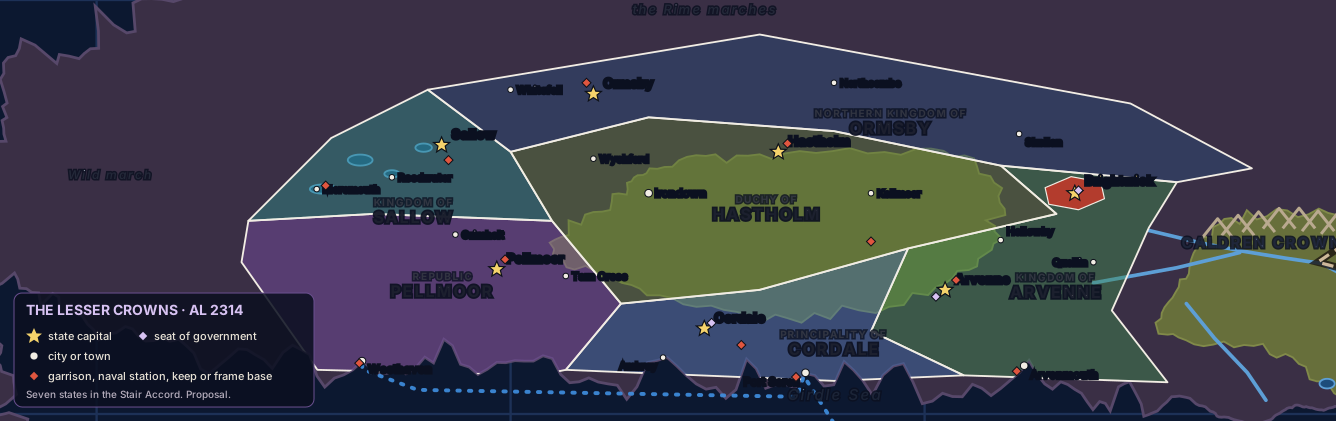
Reading note. The Lesser Crowns are not one country. They are seven sovereign states that trade as one market and speak with one voice in the Council of the Lesser Crowns. This almanac answers every section for the bloc, then gives each state its own profile. Every city, town, garrison and port named here is in the interactive Atlas, and the complete list is the generated Register of the Lesser Crowns.
Section 1: National Overview & Identity#
Official Name & Etymology#
- Formal name of the bloc: The Council of the Lesser Crowns under the Stair Accord
- Short name: the Lesser Crowns, or the Seven.
- Adjective: Crownish is avoided; people say "Stair-side", or name their own state. People: Arvennish, Cordalese, Pellmoorish, Hastholmer, Sallowman or Sallowwoman, Ormsbyan, Brightwicker.
Where the name comes from. After the Salt Wars, the Treaty of Hollowby (AL 1242) fixed the order in which monarchs would be seated at Crown ceremonies. The Crown's heralds wrote the western kings and princes into the rolls as the lesser crowns of the Stair. It was a ranking of precedence and it was meant to sting. For eight centuries the western states resented it.
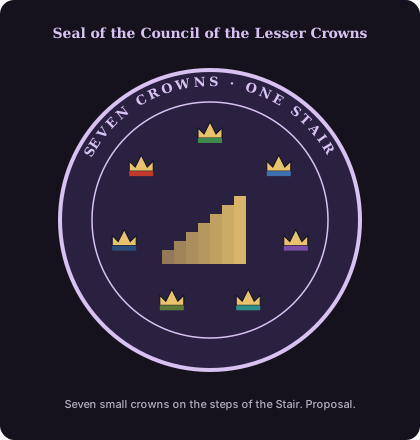
In AL 2032, when the seven signed the Stair Accord, they took the name on purpose. Queen Liane IV of Arvenne said at the signing: "Lesser in size. Not in standing." The phrase is on the Council's seal.
What others call them:
| Who | Name | Meaning |
|---|---|---|
| The capital (Selenne) | "the Lesser Crowns", "the Seven" | Formal, and faintly fond |
| The frontier (Kethra) | "the Little Kings" | Eldvang settlers mock anyone who still keeps a throne |
| The Vardane Imperium | "the Crown's porch" | The land an army would cross first |
| Themselves | "the Seven", "Stair-side" | Solidarity, or the Stair coast they share |
Name check (principle 3). Ormsby is a real English place name, and sallow is an English word for a willow; both suit these states and neither is a prominent name in fiction or games. No prominent clashes were found for Arvenne, Cordale, Pellmoor, Hastholm or Brightwick. The choice stays Briana's.
National Symbols#
There is no single flag of a state, because there is no single state. The bloc flies the Stair Accord flag, and each member flies its own.
| Symbol | Description | Meaning |
|---|---|---|
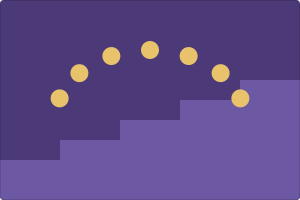
| Bloc flag: the Stair Accord flag | A purple field; a lighter purple stair of five steps rising to the right; seven gold discs in an arc above it | The raised beaches of the Stair coast that all seven share, and the seven states |
| Seal of the Council | Seven small gold crowns, each on a band of its state's colour, in a ring around a golden stair of seven steps | Seven equals, climbing together |
| Motto | Seven Crowns, One Stair | Adopted AL 2032 |
| Unofficial motto | Lesser in size, not in standing | Queen Liane IV's words at the signing |
| Anthem | None shared. At Council sessions a wordless hymn, The Steps, is played, so that no state's words come first. | |
| Bloc colour | Purple | Chosen in 2032 because no member's flag used it as a main colour. Pellmoor adopted purple later, in 2071, and is still teased for it. |
The seven flags#
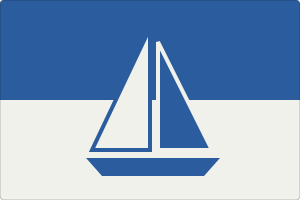
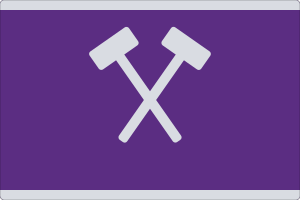
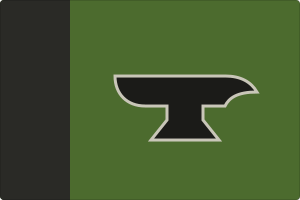
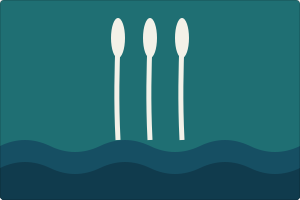

| State | Flag | Motto | Anthem | Emblem |
|---|---|---|---|---|
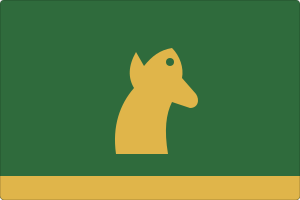
| Arvenne | A gold horse head on green, a gold band at the foot | First on the Stair | The Green Downs | The Earthkin horse, brought down in the Covenant's holds |
| Cordale | Blue over white; a carrier sail in the colours reversed | The Sea Pays | Serell Water | The sail |
| Pellmoor | Purple; two crossed silver hammers; silver edges | No Crown on the Moor | The Pit and the Hearth | The hammer. The republic's colour is purple. |
| Hastholm | Green; a black band at the hoist; a black anvil edged in steel | Struck, and Struck Again | The Duke's March | The anvil |
| Sallow | Three white reeds over blue-green waves | The Mere Keeps Us | Ingrid's Crossing | Blackreed |
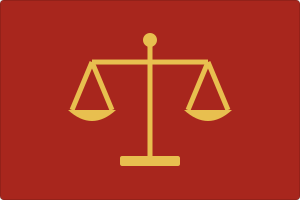
| Brightwick | Gold scales on red | Weighed and Found True | The Guildhall Bells (no words, only bells) | The scales |
| Ormsby | Dark blue; a white peak (Whitefell); a red disc in the corner for Hyperion | We Keep the Long Night | Red Winter | The peak |
The State Profile#
| What it is | A bloc of seven sovereign states: three kingdoms (Arvenne, Sallow, Ormsby), a principality (Cordale), a duchy (Hastholm), a republic (Pellmoor) and a free city (Brightwick). |
| Seat of the Council | Arvenne, the eldest capital. The Stair Accord Secretariat stands on the city's upper steps. |
| Speaker of the Council, AL 2314 | President Liz Hale of Pellmoor. The Speakership rotates every year in order of seniority, beginning with Arvenne in AL 2033. Sallow follows in 2315. (Proposal.) |
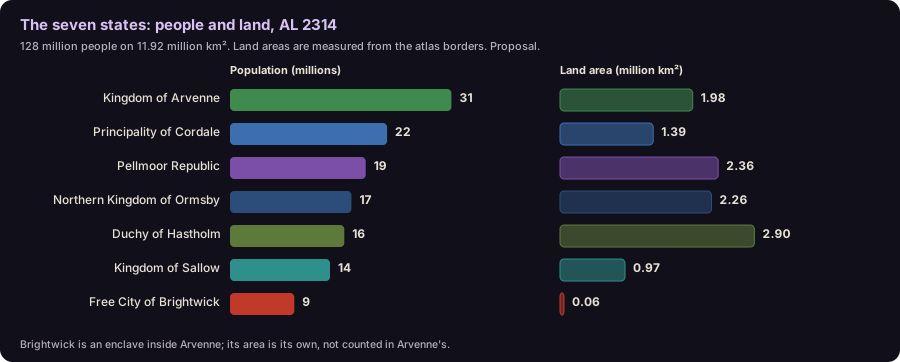
| Population | 128.0 million (AL 2314) |
| Land area | 11.92 million km², measured from the Atlas borders. Larger than the Crown's 5.9 million km², but far emptier. |
| Gardenland | 4.6 million km², 39% of the land. The rest is native Wild, much of it moor, mere and northern forest. |
| Language | Landspeech, with strong regional forms (see Section 4) |
| Currency | The crown (Cr) in six states under the Accord. Cordale keeps its own ducat, pegged at 1 ducat = Cr 1.20. |
| Combined GDP | Cr 4.02 trillion; Cr 31,400 per head (see Part 2) |
| Calendar | The Crown Reckoning (AL) in all seven. Sallow's fens and Ormsby's north still keep moon-dating informally. |
| Time | Two zones: Stair time (Arvenne, Cordale, Brightwick, Hastholm) and West time (Pellmoor, Sallow, Ormsby), one hour behind. |
| Memberships | All seven are members of the Homeworld Assembly (seven of its 15 votes). All seven belong to the Stair Accord with the Crown. |
The seven states at a glance#
| State | Capital | Government | Head of state, AL 2314 | Population (millions) | Land (million km²) | Gardenland share |
|---|---|---|---|---|---|---|
| Kingdom of Arvenne | Arvenne | Constitutional monarchy | Queen Clemence I (since 2302) | 31 | 1.98 | 52% |
| Principality of Cordale | Cordale | Principality with a Council of Guarantors | Princess Valeska III (since 2296) | 22 | 1.39 | 47% |
| Pellmoor Republic | Pellmoor | Parliamentary republic (since 1788) | President Liz Hale (since 2313) | 19 | 2.36 | 33% |
| Northern Kingdom of Ormsby | Ormsby | Constitutional monarchy | King Asger XI (since 2279) | 17 | 2.26 | 28% |
| Duchy of Hastholm | Hastholm | Ducal monarchy with an Estates | Duke Osric VII (since 2288) | 16 | 2.90 | 31% |
| Kingdom of Sallow | Sallow | Constitutional monarchy | Queen Nesta IV (since 2299) | 14 | 0.97 | 44% |
| Free City of Brightwick | Brightwick | Guild republic (a city-state) | First Burgess Lark Vintner (since 2304) | 9 | 0.06 | 60% |
| Total | 128 | 11.92 | 39% |
Working for the gardenland share. Each state's gardenland, in million km²: Arvenne 1.03, Cordale 0.65, Pellmoor 0.78, Ormsby 0.63, Hastholm 0.90, Sallow 0.43, Brightwick 0.04. They sum to 4.46; the other 0.14 is Accord land held in common along the borders (roads, the rail corridors and the Stair Accord Frame Company's ranges). Total 4.6. Calathe as a whole has 7.2 million km² of gardenland (Chapter I): the Crown's 2.6 plus the Lesser Crowns' 4.6.
Chronological Timeline#
| AL | Event |
|---|---|
| 0 | Landfall at the Thess mouth, in what is now the Crown. Captain Ingrid Sallow of the Lodestar is one of the Three Captains. |
| 41–about 400 | The Silence. Survivors cluster on the Stair coast. |
| about 400–812 | The Kindling. Families push west along the Stair coast and up the rivers. Walled farmsteads, then chiefdoms. |
| 861 | Aveline I is crowned at Arvenne, 49 years after the Charter of Caldren. The eldest of the Lesser Crowns. |
| 912 | The first Kings of Pellmoor (House Pell) |
| 1015 | The Kingdom of Sallow. House Meresby claims descent from Captain Ingrid Sallow and gives the kingdom her name. |
| 1022 | The Principality of Cordale (House Serell), founded by the ship-owners of Port Serell |
| 1109 | Hastholm breaks away from Arvenne as a march-duchy and keeps the ducal title out of pride |
| 1180–1242 | The Salt Wars between the Crown, the Imperium and the Line ports. The western states stay out and sell to both sides. |
| 1203 | The Northern Kingdom of Ormsby (House Orm) is founded by the timber lords of the north |
| 1242 | The Treaty of Hollowby. The Crown's heralds record the western rulers as "the lesser crowns of the Stair". |
| 1344 | Brightwick buys its freedom from Gaspard IV of Arvenne. The guilds pay 40 years of wool revenue and the city becomes free. |
| 1390s | The Oreth Crossing Wars. Cordale's fleet carries Crown landings to Oreth and loses a third of its ships. |
| 1466–1471 | The War of the Seven: Hastholm and Pellmoor fight over the Irondown iron and the moor tin, and everyone else is drawn in. It ends at Tarn Cross. |
| 1588–1702 | The Vault Openings in the Crown. The Lesser Crowns get the new learning a generation later. |
| 1788 | The Pellmoor Revolution. The moor miners depose King Albrecht VII. The Republic is proclaimed at Grimholt. |
| 1840–1856 | The Charter Wars in Eldvang. The Lesser Crowns hold no charters, but Cordale banks finance both sides. |
| 1877–1880 | The Wet Winter Flu. Worst in Sallow's fens. |
| 1890s | The Stair Railway links all seven capitals |
| 1911 | The Moor Strikes in Pellmoor. The Republic's labour code follows. |
| 2032 | The Stair Accord: a customs union with the Crown. The Council of the Lesser Crowns is founded at Arvenmouth. The seven take "the Lesser Crowns" as their own name. |
| 2141–2146 | The Iron Winter. Lesser Crowns volunteers crew frames in the planetary response. |
| 2150 | All seven are founding members of the Homeworld Assembly |
| 2152 | The Stair Accord Frame Company is founded as a joint force |
| 2279–2291 | The Corridor War. Cordale sends frames and escorts. Imperial raiders sink the Serell convoys in the Girdle Sea. |
| 2285–2290 | The Lean Years. The phosphate cut hits the Lesser Crowns' thin soils harder than the Crown's. About 1.1 million excess deaths. |
| 2291 | The Armistice of Saltline |
| 2296–2304 | A generation of new rulers: Valeska III of Cordale (2296), Nesta IV of Sallow (2299), Clemence I of Arvenne (2302), Lark Vintner of Brightwick (2304) |
| 2313 | Liz Hale is elected President of Pellmoor on a promise to resist the Shield Clause |
| 2314 | The present. The Council debates the Crown's proposed Shield Clause (Crown garrisons on Stair-side soil) and the Crown's Seeding Limits Bill, which the Seven fear will be pressed on them next. Brightwick elects a First Burgess at the year's end. |
Section 2: Geography & Environment#
Physical Geography#
The Lesser Crowns fill the north-west of Calathe, the northern heartland continent where Landfall happened.
| Extent | From the Girdle Sea coast (about 33° N) to the edge of the Rime marches (about 57° N), and from the Crown's border (about 13° W to 25° W) to the Wild march (about 79° W) |
| Borders | The Caldren Crown to the east and south-east. The Rime marches to the north. The Wild march, unclaimed native Wild, to the west. The Girdle Sea to the south. |
| Coast | Only three states touch the sea, all on the Girdle Sea: Pellmoor (the longest coast), Cordale and Arvenne (a short stretch at Arvenmouth). Hastholm, Sallow, Ormsby and Brightwick are landlocked; the Rime marches lie between Ormsby and the northern sea. Sallow's "port", Meremouth, is a lake port on the Sallow Meres. |
| Enclave | Brightwick lies entirely inside Arvenne, 63,000 km² of city and farmland in the Arvennish downs |
Topography & Landforms#
| Landform | Where | Notes |
|---|---|---|
| The Stair coast | Arvenne, Cordale, Pellmoor | The raised beaches of past hot eras, step above step. Vineyards on the upper steps. The youngest step, about 12 m up, will flood again in the coming hot era. |
| The Hollow Downs | Arvenne | Chalk downs grazed by Earthkin sheep since the Kindling. Arvenne's wool country. |
| The Pellmoor high moors | Pellmoor | Peat and heather over tin and coal. Mist half the year. |
| The Irondown hills | Hastholm | Iron ore and old forest. The Duchy's forges. |
| The Sallow Meres | Sallow | About 74,000 km² of lakes, channels and blackreed beds, the largest outside the Crown's Lowfen. The kingdom's heart and its moat. |
| Whitefell | Ormsby | The highest peak of the Lesser Crowns (5,210 m), on Ormsby's flag |
| The northern forest | Ormsby | Native high forest, and Earthkin pine plantations cut from it |
| The Wild march | West of Pellmoor and Sallow | Unclaimed native Wild running to Calathe's west coast |
Climate & Weather#
- Continental. Warmer and drier on the Stair coast; cold, wet and long-wintered in the north.
- Red nights. Northern winters are lit by Hyperion's red nights. In Ormsby, the winter nights are never fully dark. Old Ormsbyans say the red nights are brighter than in their youth, and they are right: Hyperion is approaching (see the spine).
- Ember storms come off the Girdle Sea in late summer. Cordale's harbour walls were built for them.
- Mere fog in Sallow is thick enough to close the rail line for days in autumn.
| Place | Coldest month mean | Warmest month mean | Rain and snow a year |
|---|---|---|---|
| Arvenne | 4 °C | 23 °C | 720 mm |
| Port Serell | 8 °C | 26 °C | 610 mm |
| Pellmoor | 1 °C | 19 °C | 1,180 mm |
| Sallow | −3 °C | 21 °C | 880 mm |
| Irondown | −6 °C | 20 °C | 790 mm |
| Ormsby | −17 °C | 15 °C | 540 mm |
Flora & Fauna#
- Earthkin (Earth-descended) life fills the gardenland: wheat, barley, vines, apples, sheep, horses, cattle and bees.
- Native Wild covers the rest. Native life is mostly indigestible to humans and some of it is toxic (see Chapter I).
- Blackreed grows in the Sallow Meres as well as the Crown's Lowfen. It is the building reed of the north, used for the dark eaves in Crown architecture.
- Shalebacks, six-legged armoured grazers, cross the Hastholm and Ormsby uplands in herds. Railways stop for them.
- Gloamwings swarm on red nights. Their wing-dust causes rustlung in forest and reed workers.
- Protected Wild: the Whitefell Wild (Ormsby, 210,000 km²) and the Inner Meres (Sallow, 18,000 km²).
Natural Resources#
| Resource | Where | Notes |
|---|---|---|
| Wool and cloth | Arvenne | The Kingdom's old wealth |
| Stair wine | Cordale, Arvenne | Rivals the Crown's own vintages |
| Tin and coal | Pellmoor | Deep mines under the moors; the source of the Republic's labour movement |
| Iron | Hastholm (Irondown) | The main iron of Calathe outside the Crown |
| Timber | Ormsby, Hastholm | Earthkin pine plantations |
| Blackreed | Sallow | Building material and fibre |
| Glass sand and indigo | Brightwick | Indigo glass for half the Crown's windows |
| Gardenland | All | The Seven keep converting Wild to gardenland, which is why the Crown's Seeding Limits Bill alarms them |
Section 3: History & Chronology#
The Kindling and the First Crowns#
When the Silence ended, the Stair coast west of the Thess was the Founders' outer edge. Families moved west in the Kindling (about AL 400–812), following the raised beaches and the rivers. They carried Earthkin sheep, vines and horses, and walled their farmsteads against the Wild.
- Arvenne was the first chiefdom to take a crown, in AL 861. It is still "the eldest".
- Pellmoor followed in 912, Sallow in 1015, Cordale in 1022, Hastholm in 1109, Ormsby in 1203.
- Brightwick was never a kingdom. It was Arvenne's wool market until its guilds bought the city's freedom in AL 1344.
Sallow and the Captain. The Kingdom of Sallow takes its name from Ingrid Sallow, captain of the Lodestar, one of the Three Captains who brought the ships down (Chapter IV). House Meresby claimed her descent. Whether it is true no one can prove; the claim is the reason Sallow's queens sit first at Landfall Day in Aletheia, ahead of monarchs of larger states. (Proposal.)
Founding & Sovereignty#
The seven are old states with separate histories. They became a bloc only in the modern era.
- The Treaty of Hollowby (1242) ranked them as "lesser crowns" in Crown ceremony.
- The War of the Seven (1466–1471) taught them what fighting each other costs. The Peace of Tarn Cross created a standing Conference of the Stair that met every seven years.
- The Pellmoor Revolution (1788) made one of them a republic. The other monarchs feared it would spread; it did not, but every monarchy in the bloc has had a written constitution since the 1800s.
- The Stair Accord (2032) turned the Conference into the Council of the Lesser Crowns, and made a customs union with the Crown.
Modern Era#
The Iron Winter (2141–2146). The Lesser Crowns had no frame industry. Their volunteers crewed borrowed Crown and mixed-nation frames against the Sentinels. The lesson produced the Stair Accord Frame Company in 2152.
The Corridor War (2279–2291). The Seven were not attacked on land, but they paid:
- Cordale sent its frame company and convoy escorts. Imperial raiders sank most of the Serell convoys in 2283–2284.
- The Lean Years (2285–2290). The Imperium's phosphate cut starved the Lesser Crowns' thin northern soils. About 1.1 million excess deaths across the Seven, more in proportion than in the Crown.
- The Seven learned that "safety behind the Crown" also means being the land an army would cross first.
The present (2314). A new generation of rulers took office after the war. The Council faces two Crown proposals:
- The Shield Clause: Crown garrisons on Stair-side soil, paid for by the Crown. Arvenne and Cordale favour it; Pellmoor and Sallow oppose it; Hastholm wants its own army strengthened instead.
- The Seeding Limits Bill: now before the Crown's Hall of Voices, it would cap new gardenland. It does not bind the Seven, but the Crown wants the Accord to follow. The Seven's farmers want to keep seeding.
Historical Rulers & Leaders#
Complete rosters for every state. Regnal numbers count each name separately within each state. A name in bold is the ruler in AL 2314. (All proposal. The rosters were generated from a fixed seed with mixed name pools, so that no single Earth culture owns any state; see the naming principles.)
Kings and Queens of Arvenne (complete)#
Houses: Arven (861), Ellery (1240), Dunmore (1702), Carrow (2066).
| # | Monarch | House | Reign | Years |
|---|---|---|---|---|
| 1 | Aveline I | Arven | 861–867 | 6 |
| 2 | Piran I | Arven | 867–889 | 22 |
| 3 | Brisa I | Arven | 889–905 | 16 |
| 4 | Brisa II | Arven | 905–930 | 25 |
| 5 | Ysolde I | Arven | 930–943 | 13 |
| 6 | Rhosyn I | Arven | 943–971 | 28 |
| 7 | Piran II | Arven | 971–978 | 7 |
| 8 | Aveline II | Arven | 978–1007 | 29 |
| 9 | Odo I | Arven | 1007–1016 | 9 |
| 10 | Piran III | Arven | 1016–1038 | 22 |
| 11 | Gaspard I | Arven | 1038–1062 | 24 |
| 12 | Brisa III | Arven | 1062–1093 | 31 |
| 13 | Gaspard II | Arven | 1093–1113 | 20 |
| 14 | Gaspard III | Arven | 1113–1132 | 19 |
| 15 | Rhosyn II | Arven | 1132–1171 | 39 |
| 16 | Piran IV | Arven | 1171–1198 | 27 |
| 17 | Liane I | Arven | 1198–1234 | 36 |
| 18 | Ysolde II | Arven | 1234–1262 | 28 |
| 19 | Piran V | Ellery | 1262–1280 | 18 |
| 20 | Rhosyn III | Ellery | 1280–1302 | 22 |
| 21 | Ysolde III | Ellery | 1302–1311 | 9 |
| 22 | Corentin I | Ellery | 1311–1330 | 19 |
| 23 | Aveline III | Ellery | 1330–1338 | 8 |
| 24 | Gaspard IV | Ellery | 1338–1366 | 28 |
| 25 | Liane II | Ellery | 1366–1393 | 27 |
| 26 | Piran VI | Ellery | 1393–1410 | 17 |
| 27 | Odo II | Ellery | 1410–1417 | 7 |
| 28 | Corentin II | Ellery | 1417–1444 | 27 |
| 29 | Maelle I | Ellery | 1444–1454 | 10 |
| 30 | Aveline IV | Ellery | 1454–1483 | 29 |
| 31 | Odo III | Ellery | 1483–1516 | 33 |
| 32 | Piran VII | Ellery | 1516–1548 | 32 |
| 33 | Eamon I | Ellery | 1548–1584 | 36 |
| 34 | Gaspard V | Ellery | 1584–1597 | 13 |
| 35 | Ysolde IV | Ellery | 1597–1620 | 23 |
| 36 | Tancred I | Ellery | 1620–1652 | 32 |
| 37 | Maelle II | Ellery | 1652–1664 | 12 |
| 38 | Piran VIII | Ellery | 1664–1671 | 7 |
| 39 | Ysolde V | Ellery | 1671–1703 | 32 |
| 40 | Ysolde VI | Dunmore | 1703–1734 | 31 |
| 41 | Liane III | Dunmore | 1734–1761 | 27 |
| 42 | Rhosyn IV | Dunmore | 1761–1784 | 23 |
| 43 | Aveline V | Dunmore | 1784–1814 | 30 |
| 44 | Rhosyn V | Dunmore | 1814–1851 | 37 |
| 45 | Piran IX | Dunmore | 1851–1858 | 7 |
| 46 | Piran X | Dunmore | 1858–1868 | 10 |
| 47 | Corentin III | Dunmore | 1868–1884 | 16 |
| 48 | Rhosyn VI | Dunmore | 1884–1904 | 20 |
| 49 | Odo IV | Dunmore | 1904–1914 | 10 |
| 50 | Piran XI | Dunmore | 1914–1946 | 32 |
| 51 | Piran XII | Dunmore | 1946–1956 | 10 |
| 52 | Eamon II | Dunmore | 1956–1988 | 32 |
| 53 | Tancred II | Dunmore | 1988–2008 | 20 |
| 54 | Liane IV | Dunmore | 2008–2034 | 26 |
| 55 | Piran XIII | Dunmore | 2034–2046 | 12 |
| 56 | Ysolde VII | Dunmore | 2046–2075 | 29 |
| 57 | Maelle III | Carrow | 2075–2083 | 8 |
| 58 | Liane V | Carrow | 2083–2120 | 37 |
| 59 | Tancred III | Carrow | 2120–2157 | 37 |
| 60 | Eamon III | Carrow | 2157–2184 | 27 |
| 61 | Piran XIV | Carrow | 2184–2214 | 30 |
| 62 | Aveline VI | Carrow | 2214–2226 | 12 |
| 63 | Rhosyn VII | Carrow | 2226–2252 | 26 |
| 64 | Ysolde VIII | Carrow | 2252–2271 | 19 |
| 65 | Jory I | Carrow | 2271–2302 | 31 |
| 66 | Clemence I | Carrow | 2302– | 12 so far |
Princes and Princesses of Cordale (complete)#
Houses: Serell (1022), Amberline (1618).
| # | Monarch | House | Reign | Years |
|---|---|---|---|---|
| 1 | Matthias I | Serell | 1022–1045 | 23 |
| 2 | Florian I | Serell | 1045–1056 | 11 |
| 3 | Anselm I | Serell | 1056–1081 | 25 |
| 4 | Tobin I | Serell | 1081–1109 | 28 |
| 5 | Delphine I | Serell | 1109–1116 | 7 |
| 6 | Oriana I | Serell | 1116–1143 | 27 |
| 7 | Anselm II | Serell | 1143–1172 | 29 |
| 8 | Anselm III | Serell | 1172–1207 | 35 |
| 9 | Oriana II | Serell | 1207–1215 | 8 |
| 10 | Tobin II | Serell | 1215–1249 | 34 |
| 11 | Crispin I | Serell | 1249–1289 | 40 |
| 12 | Crispin II | Serell | 1289–1300 | 11 |
| 13 | Isaura I | Serell | 1300–1320 | 20 |
| 14 | Crispin III | Serell | 1320–1335 | 15 |
| 15 | Delphine II | Serell | 1335–1362 | 27 |
| 16 | Anselm IV | Serell | 1362–1378 | 16 |
| 17 | Delphine III | Serell | 1378–1402 | 24 |
| 18 | Matthias II | Serell | 1402–1432 | 30 |
| 19 | Delphine IV | Serell | 1432–1443 | 11 |
| 20 | Isaura II | Serell | 1443–1452 | 9 |
| 21 | Florian II | Serell | 1452–1494 | 42 |
| 22 | Nerys I | Serell | 1494–1512 | 18 |
| 23 | Florian III | Serell | 1512–1544 | 32 |
| 24 | Isaura III | Serell | 1544–1555 | 11 |
| 25 | Isaura IV | Serell | 1555–1580 | 25 |
| 26 | Florian IV | Serell | 1580–1593 | 13 |
| 27 | Nerys II | Serell | 1593–1625 | 32 |
| 28 | Crispin IV | Amberline | 1625–1663 | 38 |
| 29 | Florian V | Amberline | 1663–1679 | 16 |
| 30 | Isaura V | Amberline | 1679–1711 | 32 |
| 31 | Nerys III | Amberline | 1711–1733 | 22 |
| 32 | Nerys IV | Amberline | 1733–1764 | 31 |
| 33 | Nerys V | Amberline | 1764–1787 | 23 |
| 34 | Florian VI | Amberline | 1787–1824 | 37 |
| 35 | Crispin V | Amberline | 1824–1856 | 32 |
| 36 | Matthias III | Amberline | 1856–1874 | 18 |
| 37 | Tobin III | Amberline | 1874–1879 | 5 |
| 38 | Florian VII | Amberline | 1879–1911 | 32 |
| 39 | Oriana III | Amberline | 1911–1925 | 14 |
| 40 | Crispin VI | Amberline | 1925–1943 | 18 |
| 41 | Crispin VII | Amberline | 1943–1957 | 14 |
| 42 | Florian VIII | Amberline | 1957–1979 | 22 |
| 43 | Delphine V | Amberline | 1979–2006 | 27 |
| 44 | Matthias IV | Amberline | 2006–2027 | 21 |
| 45 | Valeska I | Amberline | 2027–2056 | 29 |
| 46 | Florian IX | Amberline | 2056–2076 | 20 |
| 47 | Nerys VI | Amberline | 2076–2099 | 23 |
| 48 | Tobin IV | Amberline | 2099–2139 | 40 |
| 49 | Oriana IV | Amberline | 2139–2157 | 18 |
| 50 | Tobin V | Amberline | 2157–2165 | 8 |
| 51 | Crispin VIII | Amberline | 2165–2201 | 36 |
| 52 | Valeska II | Amberline | 2201–2227 | 26 |
| 53 | Matthias V | Amberline | 2227–2257 | 30 |
| 54 | Crispin IX | Amberline | 2257–2279 | 22 |
| 55 | Tobin VI | Amberline | 2279–2296 | 17 |
| 56 | Valeska III | Amberline | 2296– | 18 so far |
Kings and Queens of Pellmoor, 912–1788 (complete)#
House Pell, until the Revolution.
| # | Monarch | House | Reign | Years |
|---|---|---|---|---|
| 1 | Albrecht I | Pell | 912–947 | 35 |
| 2 | Odile I | Pell | 947–961 | 14 |
| 3 | Branwen I | Pell | 961–985 | 24 |
| 4 | Albrecht II | Pell | 985–1026 | 41 |
| 5 | Albrecht III | Pell | 1026–1036 | 10 |
| 6 | Gerant I | Pell | 1036–1078 | 42 |
| 7 | Isolt I | Pell | 1078–1106 | 28 |
| 8 | Simeon I | Pell | 1106–1145 | 39 |
| 9 | Owain I | Pell | 1145–1183 | 38 |
| 10 | Albrecht IV | Pell | 1183–1190 | 7 |
| 11 | Isolt II | Pell | 1190–1211 | 21 |
| 12 | Branwen II | Pell | 1211–1250 | 39 |
| 13 | Odile II | Pell | 1250–1269 | 19 |
| 14 | Rhodri I | Pell | 1269–1295 | 26 |
| 15 | Gerant II | Pell | 1295–1318 | 23 |
| 16 | Simeon II | Pell | 1318–1330 | 12 |
| 17 | Odile III | Pell | 1330–1367 | 37 |
| 18 | Rhodri II | Pell | 1367–1398 | 31 |
| 19 | Branwen III | Pell | 1398–1411 | 13 |
| 20 | Isolt III | Pell | 1411–1439 | 28 |
| 21 | Isolt IV | Pell | 1439–1465 | 26 |
| 22 | Isolt V | Pell | 1465–1501 | 36 |
| 23 | Simeon III | Pell | 1501–1512 | 11 |
| 24 | Simeon IV | Pell | 1512–1551 | 39 |
| 25 | Odile IV | Pell | 1551–1556 | 5 |
| 26 | Odile V | Pell | 1556–1582 | 26 |
| 27 | Rhodri III | Pell | 1582–1613 | 31 |
| 28 | Simeon V | Pell | 1613–1654 | 41 |
| 29 | Isolt VI | Pell | 1654–1667 | 13 |
| 30 | Isolt VII | Pell | 1667–1691 | 24 |
| 31 | Rhodri IV | Pell | 1691–1717 | 26 |
| 32 | Albrecht V | Pell | 1717–1729 | 12 |
| 33 | Albrecht VI | Pell | 1729–1740 | 11 |
| 34 | Owain II | Pell | 1740–1772 | 32 |
| 35 | Albrecht VII | Pell | 1772–1788 | 16 |
Presidents of the Pellmoor Republic, 1788– (complete)#
106 terms of five years. A name that appears twice in a row is a president who was re-elected.
| Century | Presidents, with the year each took office |
|---|---|
| 1700s | Seb Holm (1788) · Hugh Brennan (1793) · Olwen Stoke (1798) |
| 1800s | Nell Maddox (1803) · Tom Thorne (1808) · Jos Rook (1813) · Nell Dace (1818) · Ada Myers (1823) · Sam Dace (1828) · Ada Thorne (1833) · Gwyn Hale (1838) · Maren Carrick (1843) · Tom Pryce (1848) · Seb Myers (1853) · Liz Pryce (1858) · Hugh Brennan (1863) · Maren Garside (1868) · Rhys Hale (1873) · Ada Stoke (1878) · Ada Wexley (1883) · Dai Wexley (1888) · Bet Dace (1893) · Bet Penhale (1898) |
| 1900s | Gwyn Dace (1903) · Liz Stoke (1908) · Nell Thorne (1913) · Olwen Lusk (1918) · Sam Myers (1923) · Olwen Thorne (1928) · Gwyn Carrick (1933) · Maren Tarran (1938) · Maren Wexley (1943) · Gwyn Lusk (1948) · Ada Myers (1953) · Wren Carrick (1958) · Kit Penhale (1963) · Kit Brennan (1968) · Bet Wexley (1973) · Kit Wexley (1978) · Gwyn Wexley (1983) · Wren Lusk (1988) · Ada Holm (1993) · Bet Rook (1998) |
| 2000s | Ada Garside (2003) · Seb Stoke (2008) · Seb Penhale (2013) · Rhys Rook (2018) · Gwyn Penhale (2023) · Rhys Brennan (2028) · Liz Carrick (2033) · Dai Tarran (2038) · Nell Dace (2043) · Rhys Tarran (2048) · Nell Penhale (2053) · Seb Maddox (2058) · Dai Dace (2063) · Wren Dace (2068) · Sam Brennan (2073) · Sam Wexley (2078) · Kit Dace (2083) · Sam Rook (2088) · Ada Pryce (2093) · Ada Carrick (2098) |
| 2100s | Ada Stoke (2103) · Olwen Pryce (2108) · Hugh Wexley (2113) · Maren Maddox (2118) · Wren Lusk (2123) · Hugh Pryce (2128) · Dai Dace (2133) · Seb Penhale (2138) · Dai Pryce (2143) · Olwen Thorne (2148) · Dai Wexley (2153) · Rhys Maddox (2158) · Hugh Brennan (2163) · Ada Tarran (2168) · Wren Holm (2173) · Hugh Brennan (2178) · Olwen Tarran (2183) · Tom Holm (2188) · Ada Myers (2193) · Jos Lusk (2198) |
| 2200s | Seb Carrick (2203) · Wren Penhale (2208) · Hugh Maddox (2213) · Wren Myers (2218) · Seb Rook (2223) · Seb Wexley (2228) · Ada Dace (2233) · Tom Wexley (2238) · Jos Dace (2243) · Gwyn Carrick (2248) · Wren Carrick (2253) · Sam Rook (2258) · Liz Tarran (2263) · Nell Dace (2268) · Liz Garside (2273) · Gwyn Tarran (2278) · Kit Hale (2283) · Rhys Dace (2288) · Dai Penhale (2293) · Tom Hale (2298) |
| 2300s | Tom Maddox (2303) · Ada Carrick (2308) · Liz Hale (2313) |
Dukes and Duchesses of Hastholm (complete)#
Houses: Hast (1109), Wychwood (1561).
| # | Monarch | House | Reign | Years |
|---|---|---|---|---|
| 1 | Tamsin I | Hast | 1109–1120 | 11 |
| 2 | Godric I | Hast | 1120–1149 | 29 |
| 3 | Tamsin II | Hast | 1149–1163 | 14 |
| 4 | Mireille I | Hast | 1163–1198 | 35 |
| 5 | Aldith I | Hast | 1198–1220 | 22 |
| 6 | Aldith II | Hast | 1220–1249 | 29 |
| 7 | Ivo I | Hast | 1249–1255 | 6 |
| 8 | Ivo II | Hast | 1255–1268 | 13 |
| 9 | Tamsin III | Hast | 1268–1278 | 10 |
| 10 | Osric I | Hast | 1278–1311 | 33 |
| 11 | Ivo III | Hast | 1311–1343 | 32 |
| 12 | Aldith III | Hast | 1343–1369 | 26 |
| 13 | Mireille II | Hast | 1369–1406 | 37 |
| 14 | Godric II | Hast | 1406–1412 | 6 |
| 15 | Godric III | Hast | 1412–1439 | 27 |
| 16 | Hild I | Hast | 1439–1462 | 23 |
| 17 | Godric IV | Hast | 1462–1470 | 8 |
| 18 | Ivo IV | Hast | 1470–1498 | 28 |
| 19 | Warin I | Hast | 1498–1523 | 25 |
| 20 | Osric II | Hast | 1523–1539 | 16 |
| 21 | Tamsin IV | Hast | 1539–1549 | 10 |
| 22 | Mireille III | Hast | 1549–1559 | 10 |
| 23 | Tamsin V | Hast | 1559–1580 | 21 |
| 24 | Mireille IV | Wychwood | 1580–1620 | 40 |
| 25 | Tamsin VI | Wychwood | 1620–1643 | 23 |
| 26 | Ivo V | Wychwood | 1643–1668 | 25 |
| 27 | Osric III | Wychwood | 1668–1693 | 25 |
| 28 | Cassian I | Wychwood | 1693–1702 | 9 |
| 29 | Aldith IV | Wychwood | 1702–1738 | 36 |
| 30 | Tamsin VII | Wychwood | 1738–1752 | 14 |
| 31 | Osric IV | Wychwood | 1752–1764 | 12 |
| 32 | Hild II | Wychwood | 1764–1791 | 27 |
| 33 | Cassian II | Wychwood | 1791–1806 | 15 |
| 34 | Cassian III | Wychwood | 1806–1841 | 35 |
| 35 | Osric V | Wychwood | 1841–1861 | 20 |
| 36 | Ivo VI | Wychwood | 1861–1896 | 35 |
| 37 | Cassian IV | Wychwood | 1896–1921 | 25 |
| 38 | Tamsin VIII | Wychwood | 1921–1960 | 39 |
| 39 | Warin II | Wychwood | 1960–1977 | 17 |
| 40 | Aldith V | Wychwood | 1977–2015 | 38 |
| 41 | Cassian V | Wychwood | 2015–2023 | 8 |
| 42 | Tamsin IX | Wychwood | 2023–2042 | 19 |
| 43 | Mireille V | Wychwood | 2042–2072 | 30 |
| 44 | Tamsin X | Wychwood | 2072–2097 | 25 |
| 45 | Aldith VI | Wychwood | 2097–2121 | 24 |
| 46 | Mireille VI | Wychwood | 2121–2157 | 36 |
| 47 | Mireille VII | Wychwood | 2157–2183 | 26 |
| 48 | Osric VI | Wychwood | 2183–2192 | 9 |
| 49 | Aldith VII | Wychwood | 2192–2224 | 32 |
| 50 | Mireille VIII | Wychwood | 2224–2230 | 6 |
| 51 | Godric V | Wychwood | 2230–2263 | 33 |
| 52 | Tamsin XI | Wychwood | 2263–2275 | 12 |
| 53 | Cassian VI | Wychwood | 2275–2288 | 13 |
| 54 | Osric VII | Wychwood | 2288– | 26 so far |
Kings and Queens of Sallow (complete)#
Houses: Meresby (1015), Callow (1490).
| # | Monarch | House | Reign | Years |
|---|---|---|---|---|
| 1 | Elin I | Meresby | 1015–1023 | 8 |
| 2 | Elin II | Meresby | 1023–1042 | 19 |
| 3 | Idwal I | Meresby | 1042–1057 | 15 |
| 4 | Cadell I | Meresby | 1057–1070 | 13 |
| 5 | Oskar I | Meresby | 1070–1089 | 19 |
| 6 | Oskar II | Meresby | 1089–1117 | 28 |
| 7 | Perrine I | Meresby | 1117–1132 | 15 |
| 8 | Nesta I | Meresby | 1132–1166 | 34 |
| 9 | Idwal II | Meresby | 1166–1174 | 8 |
| 10 | Elin III | Meresby | 1174–1187 | 13 |
| 11 | Oskar III | Meresby | 1187–1209 | 22 |
| 12 | Cadell II | Meresby | 1209–1216 | 7 |
| 13 | Oskar IV | Meresby | 1216–1243 | 27 |
| 14 | Perrine II | Meresby | 1243–1275 | 32 |
| 15 | Elin IV | Meresby | 1275–1281 | 6 |
| 16 | Cadell III | Meresby | 1281–1307 | 26 |
| 17 | Lucan I | Meresby | 1307–1337 | 30 |
| 18 | Lucan II | Meresby | 1337–1354 | 17 |
| 19 | Oskar V | Meresby | 1354–1371 | 17 |
| 20 | Bran I | Meresby | 1371–1391 | 20 |
| 21 | Bran II | Meresby | 1391–1420 | 29 |
| 22 | Morwen I | Meresby | 1420–1426 | 6 |
| 23 | Bran III | Meresby | 1426–1454 | 28 |
| 24 | Idwal III | Meresby | 1454–1493 | 39 |
| 25 | Idwal IV | Callow | 1493–1510 | 17 |
| 26 | Morwen II | Callow | 1510–1531 | 21 |
| 27 | Perrine III | Callow | 1531–1567 | 36 |
| 28 | Nesta II | Callow | 1567–1587 | 20 |
| 29 | Bran IV | Callow | 1587–1612 | 25 |
| 30 | Elin V | Callow | 1612–1622 | 10 |
| 31 | Lucan III | Callow | 1622–1646 | 24 |
| 32 | Morwen III | Callow | 1646–1651 | 5 |
| 33 | Morwen IV | Callow | 1651–1657 | 6 |
| 34 | Perrine IV | Callow | 1657–1669 | 12 |
| 35 | Oskar VI | Callow | 1669–1704 | 35 |
| 36 | Perrine V | Callow | 1704–1726 | 22 |
| 37 | Lucan IV | Callow | 1726–1746 | 20 |
| 38 | Lucan V | Callow | 1746–1761 | 15 |
| 39 | Nesta III | Callow | 1761–1792 | 31 |
| 40 | Cadell IV | Callow | 1792–1807 | 15 |
| 41 | Morwen V | Callow | 1807–1840 | 33 |
| 42 | Lucan VI | Callow | 1840–1865 | 25 |
| 43 | Elin VI | Callow | 1865–1890 | 25 |
| 44 | Idwal V | Callow | 1890–1912 | 22 |
| 45 | Elin VII | Callow | 1912–1939 | 27 |
| 46 | Perrine VI | Callow | 1939–1980 | 41 |
| 47 | Perrine VII | Callow | 1980–2014 | 34 |
| 48 | Oskar VII | Callow | 2014–2030 | 16 |
| 49 | Oskar VIII | Callow | 2030–2054 | 24 |
| 50 | Bran V | Callow | 2054–2069 | 15 |
| 51 | Elin VIII | Callow | 2069–2099 | 30 |
| 52 | Elin IX | Callow | 2099–2135 | 36 |
| 53 | Elin X | Callow | 2135–2171 | 36 |
| 54 | Elin XI | Callow | 2171–2213 | 42 |
| 55 | Elin XII | Callow | 2213–2222 | 9 |
| 56 | Bran VI | Callow | 2222–2247 | 25 |
| 57 | Perrine VIII | Callow | 2247–2266 | 19 |
| 58 | Bran VII | Callow | 2266–2299 | 33 |
| 59 | Nesta IV | Callow | 2299– | 15 so far |
Kings and Queens of Ormsby (complete)#
Houses: Orm (1203), Whitlock (1644).
| # | Monarch | House | Reign | Years |
|---|---|---|---|---|
| 1 | Asger I | Orm | 1203–1208 | 5 |
| 2 | Ragna I | Orm | 1208–1245 | 37 |
| 3 | Asger II | Orm | 1245–1257 | 12 |
| 4 | Tove I | Orm | 1257–1294 | 37 |
| 5 | Ragna II | Orm | 1294–1300 | 6 |
| 6 | Maud I | Orm | 1300–1342 | 42 |
| 7 | Maud II | Orm | 1342–1367 | 25 |
| 8 | Hollis I | Orm | 1367–1398 | 31 |
| 9 | Tove II | Orm | 1398–1439 | 41 |
| 10 | Ragna III | Orm | 1439–1459 | 20 |
| 11 | Ansel I | Orm | 1459–1474 | 15 |
| 12 | Tove III | Orm | 1474–1492 | 18 |
| 13 | Leif I | Orm | 1492–1516 | 24 |
| 14 | Hollis II | Orm | 1516–1546 | 30 |
| 15 | Ansel II | Orm | 1546–1562 | 16 |
| 16 | Hollis III | Orm | 1562–1583 | 21 |
| 17 | Tove IV | Orm | 1583–1603 | 20 |
| 18 | Asger III | Orm | 1603–1626 | 23 |
| 19 | Ragna IV | Orm | 1626–1652 | 26 |
| 20 | Maud III | Whitlock | 1652–1694 | 42 |
| 21 | Corvin I | Whitlock | 1694–1721 | 27 |
| 22 | Maud IV | Whitlock | 1721–1747 | 26 |
| 23 | Hollis IV | Whitlock | 1747–1777 | 30 |
| 24 | Ansel III | Whitlock | 1777–1802 | 25 |
| 25 | Tove V | Whitlock | 1802–1828 | 26 |
| 26 | Maud V | Whitlock | 1828–1853 | 25 |
| 27 | Tove VI | Whitlock | 1853–1861 | 8 |
| 28 | Asger IV | Whitlock | 1861–1866 | 5 |
| 29 | Asger V | Whitlock | 1866–1894 | 28 |
| 30 | Asger VI | Whitlock | 1894–1920 | 26 |
| 31 | Corvin II | Whitlock | 1920–1938 | 18 |
| 32 | Tove VII | Whitlock | 1938–1972 | 34 |
| 33 | Hollis V | Whitlock | 1972–1990 | 18 |
| 34 | Tove VIII | Whitlock | 1990–2017 | 27 |
| 35 | Asger VII | Whitlock | 2017–2051 | 34 |
| 36 | Asger VIII | Whitlock | 2051–2088 | 37 |
| 37 | Hollis VI | Whitlock | 2088–2114 | 26 |
| 38 | Ansel IV | Whitlock | 2114–2122 | 8 |
| 39 | Petra I | Whitlock | 2122–2160 | 38 |
| 40 | Leif II | Whitlock | 2160–2170 | 10 |
| 41 | Tove IX | Whitlock | 2170–2182 | 12 |
| 42 | Corvin III | Whitlock | 2182–2204 | 22 |
| 43 | Asger IX | Whitlock | 2204–2231 | 27 |
| 44 | Hollis VII | Whitlock | 2231–2257 | 26 |
| 45 | Asger X | Whitlock | 2257–2279 | 22 |
| 46 | Asger XI | Whitlock | 2279– | 35 so far |
First Burgesses of Brightwick, 1344– (complete)#
97 terms of ten years. First Burgesses take their guild's name as a surname in office, which is why so many are called Glazier, Vintner or Weaver. The current term ends in AL 2314.
| Century | First Burgesses, with the year each took office |
|---|---|
| 1300s | Niall Weaver (1344) · Elspeth Glazier (1354) · Rosamund Mercer (1364) · Bryn Dyer (1374) · Rosamund Chandler (1384) · Fenn Cooper (1394) |
| 1400s | Rosamund Fletcher (1404) · Iona Mercer (1414) · Lark Dyer (1424) · Niall Glazier (1434) · Alder Fletcher (1444) · Dorian Cordwain (1454) · Cass Dyer (1464) · Bryn Salter (1474) · Mabyn Tanner (1484) · Bryn Cordwain (1494) |
| 1500s | Lark Mercer (1504) · Elspeth Cordwain (1514) · Cass Chandler (1524) · Greer Vintner (1534) · Greer Mercer (1544) · Mabyn Tanner (1554) · Rosamund Brewer (1564) · Cass Chandler (1574) · Iona Glazier (1584) · Elspeth Salter (1594) |
| 1600s | Hollis Glazier (1604) · Mabyn Brewer (1614) · Niall Mercer (1624) · Quill Dyer (1634) · Lark Fletcher (1644) · Hollis Cordwain (1654) · Jem Weaver (1664) · Rosamund Salter (1674) · Alder Cordwain (1684) · Rosamund Chandler (1694) |
| 1700s | Dorian Tanner (1704) · Jem Cordwain (1714) · Niall Weaver (1724) · Lark Cooper (1734) · Quill Chandler (1744) · Rosamund Weaver (1754) · Elspeth Weaver (1764) · Jem Cooper (1774) · Greer Cooper (1784) · Alder Chandler (1794) |
| 1800s | Quill Chandler (1804) · Rosamund Dyer (1814) · Bryn Mercer (1824) · Cass Tanner (1834) · Niall Vintner (1844) · Elspeth Salter (1854) · Perrin Glazier (1864) · Mabyn Brewer (1874) · Perrin Mercer (1884) · Alder Vintner (1894) |
| 1900s | Rosamund Salter (1904) · Alder Tanner (1914) · Perrin Fletcher (1924) · Iona Fletcher (1934) · Alder Weaver (1944) · Dorian Fletcher (1954) · Quill Weaver (1964) · Perrin Tanner (1974) · Bryn Mercer (1984) · Rosamund Mercer (1994) |
| 2000s | Fenn Cordwain (2004) · Perrin Cooper (2014) · Quill Cordwain (2024) · Bryn Fletcher (2034) · Cass Cordwain (2044) · Elspeth Tanner (2054) · Iona Tanner (2064) · Perrin Cordwain (2074) · Mabyn Brewer (2084) · Rosamund Dyer (2094) |
| 2100s | Elspeth Tanner (2104) · Perrin Fletcher (2114) · Greer Mercer (2124) · Rosamund Fletcher (2134) · Bryn Brewer (2144) · Perrin Cooper (2154) · Niall Fletcher (2164) · Niall Dyer (2174) · Hollis Chandler (2184) · Greer Glazier (2194) |
| 2200s | Mabyn Brewer (2204) · Greer Cooper (2214) · Rosamund Glazier (2224) · Greer Brewer (2234) · Jem Brewer (2244) · Iona Cordwain (2254) · Bryn Tanner (2264) · Lark Weaver (2274) · Fenn Brewer (2284) · Rosamund Salter (2294) |
| 2300s | Lark Vintner (2304) |
Figures every Stair-side child knows#
| Figure | Dates | Why remembered |
|---|---|---|
| Aveline I of Arvenne | reigned 861–867 | The first crown west of the Thess |
| Captain Ingrid Sallow | Landfall | One of the Three Captains; claimed ancestor of Sallow's kings |
| The Brightwick Forty | 1344 | The forty guild masters who signed the city's purchase of freedom |
| Maren Pryce | 1788 | The miner who read the Proclamation of the Republic at Grimholt (not a president; she refused office) |
| Queen Liane IV of Arvenne | 2032 | "Lesser in size. Not in standing." |
| Captain Oriel Dace | 2284 | Commanded the last escort of the Serell convoys. Brought 11 of 40 ships home. |
Section 4: Demographics & Society#
Population Metrics#
| Metric | Value |
|---|---|
| Total population | 128.0 million (AL 2314) |
| Density | 10.7 per km² of land; 27.8 per km² of gardenland (128 ÷ 4.6), about a third of the Crown's 82 |
| Urbanisation | 61% |
| Median age | 39 |
| Fertility | 1.9 births per woman |
| Life expectancy at birth | 71 K-yr (about 78 Earth years) |
Working for urbanisation. Calathe as a whole is 68% urban (Chapter I) and the Crown is 72%. (0.68 × 342 − 0.72 × 214.3) ÷ 128 = 61%.
| State | Population (millions) | Urban share | Largest city | Other cities and towns |
|---|---|---|---|---|
| Arvenne | 31 | 63% | Arvenne (4.1 million) | Arvenmouth, Quellin, Hollowby |
| Cordale | 22 | 71% | Port Serell (3.6 million) | Cordale (the capital, 2.2 million), Ambrey |
| Pellmoor | 19 | 58% | Pellmoor (2.4 million) | Westhaven, Grimholt, Tarn Cross |
| Ormsby | 17 | 49% | Ormsby (1.9 million) | Northcombe, Skellan, Whitefell |
| Hastholm | 16 | 55% | Irondown (2.0 million) | Hastholm (the capital, 1.1 million), Kellmoor, Wychford |
| Sallow | 14 | 47% | Sallow (1.3 million) | Meremouth, Reedwater |
| Brightwick | 9 | 88% | Brightwick (7.9 million) | — |
Language & Descent#
- Landspeech everywhere, with regional forms:
- Stair burr in Arvenne, Cordale and Brightwick: soft, and close to the capital's speech;
- Moor-talk in Pellmoor: fast, clipped, full of mining words;
- Mere-speech in Sallow: slow, with old words the capital has lost;
- Northern in Ormsby and Hastholm: the frontier's names for the stars (Sól, Surtr, Máni, Hati) are common here, though these are not frontier people.
- Songed descent. The Great Charter abolished the Songed and Unsonged distinction in the Crown in 1733. Arvenne followed in 1741, Cordale not until 1820. Old Cordalese families still keep their song-lines.
Religion & Belief Systems#
| Belief | Adherents |
|---|---|
| The Cantorate | 66% |
| of whom Literalist on the Return | about 70% of the faithful: the farming north and west |
| of whom Stewardship school | about 30% of the faithful, strongest in Brightwick and Cordale |
| The Wolf Rite | 2%, mostly in the Ormsby timber camps |
| The Ashward | 1% |
| Plain Reckoners | 6%, strongest in Pellmoor |
| Other | 3% |
| No affiliation | 22% |
- Sallow's Mere Choirs sing the Canon from boats on Song-Night: the most famous sight in the Seven.
- The Literalist north sees the Seeding as a duty, which is why the Seeding Limits Bill is a religious question here as well as a farming one.
Public Health#
- Each state runs its own health service. All seven accept Hearth Care cards from the Crown under the Accord.
- Rustlung is the worst occupational disease, in the Ormsby forests and the Sallow Meres.
- The Lean Years left a generation shorter than its parents. Doctors call people born 2284–2290 "the lean-born".
Education#
| Metric | Value |
|---|---|
| Literacy | 97.1% |
| School | Free and compulsory from 5 to 15 (K-yr) in all seven |
| Tertiary enrolment | 36% of young people |
Great institutions:
- The College of Arvenne (founded AL 1102), the oldest west of the Thess
- The Cordale School of Navigation and Finance
- The Pellmoor Miners' Institute, founded by the unions, now a university
- The Ormsby Observatory, which listens and never transmits. It studies the sky under the long red winters.