Introduction: Origins and Environmental Catalysts#
Kethra Almanac • Approved 19 September 2026 • drafted 18 September 2026
Status: approved. Briana approved the whole almanac on 19 September 2026 (the Almanac Approval Decision). Where this file calls something a proposal, read it as approved, except the open points that decision lists.
Status before approval: §0.1 restates canon. Everything else is a proposal built on the spine.
0.1 Cosmic Context & Planetary Metrics#
Canon except where marked.
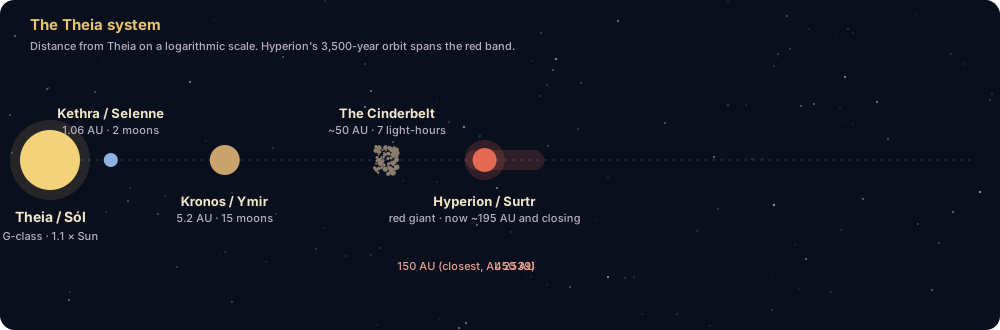
The Aion system. Kethra orbits Theia (frontier name: Sól), a yellow-white G-class star. Theia is about 5.5 billion years old and about 10% brighter than our Sun is today. Far outside Kethra's orbit, the red giant Hyperion (frontier name: Surtr) swings between about 150 and 450 AU, completing one orbit in about 3,500 Earth years (about 3,204 Kethran years). The system also contains:
- a gas giant at about 5 AU, named Kronos in the capital and Ymir on the frontier (these names are a proposal);
- the Cinderbelt, a rubble belt at about 50 AU, at the edge of Theia's system.
| Metric | Value |
|---|---|
| Distance from Theia | 1.06 AU |
| Orbital eccentricity | about 0.03 |
| Sunlight received | about 98% of what Earth receives, plus Hyperion's contribution |
| Year | about 368 Kethran days (about 399 Earth days) |
| Day | 26 hours |
| Axial tilt | 27° |
| Seasons | four, each about 92 days long at mid-latitudes |
| Moons | Pandia/Máni: large, bright, phase cycle of 30.5 days. Ersa/Hati: small, dark, phase cycle of about 3.1 days, rising about every 1.5 days. |
| Red-night season | 4–5 months a year. It falls in the northern winter in the present era, so the south has red summers. |
| Radius, gravity, area (proposal) | about 6,340 km; about 1.00 g; about 505 million km², of which 66% is ocean |
| Atmosphere (proposal) | about 0.95 Earth atmospheres; 23% oxygen |
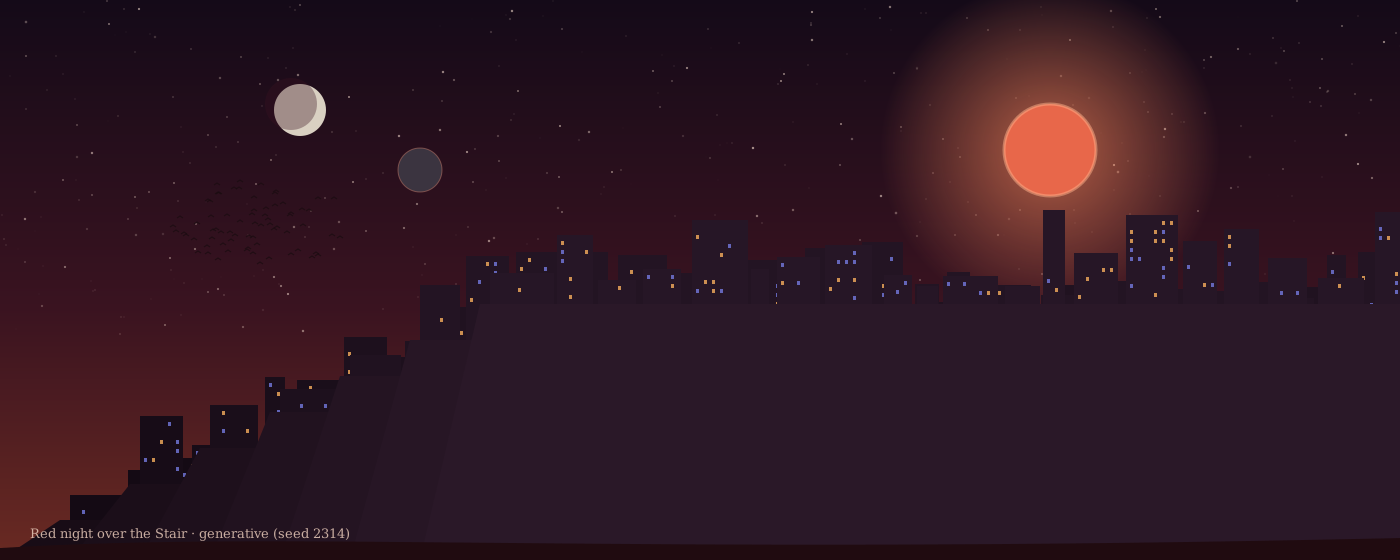
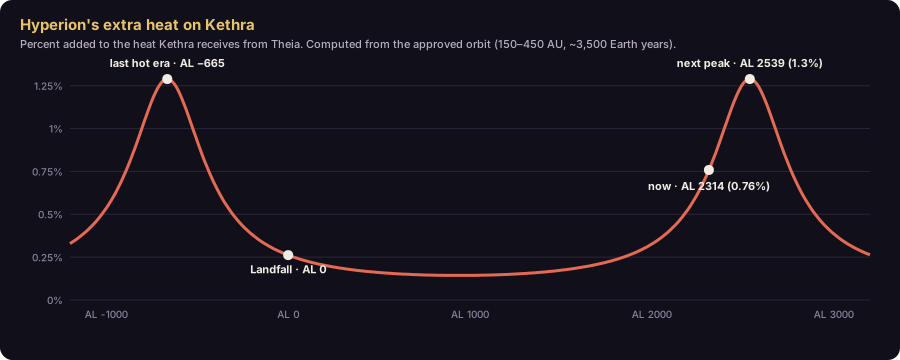
Where Hyperion is now (proposal, AL 2314). Hyperion is about 195 AU away and closing. It adds about 0.76% to the heat Kethra receives, and red nights are about 250 lux: roughly the light of a dim room, coloured deep red-orange. It will reach its closest point around AL 2539. Over a single human lifetime the red nights brighten by about a fifth. That is enough for any grandparent to notice, and enough to argue about.
0.2 The Cradle: Original Habitats & Geography#
The ground itself#
Kethra is geologically alive. Plate tectonics recycles its crust, which keeps its carbon cycle and climate stable over long ages, as on Earth.
| Continent | Geology |
|---|---|
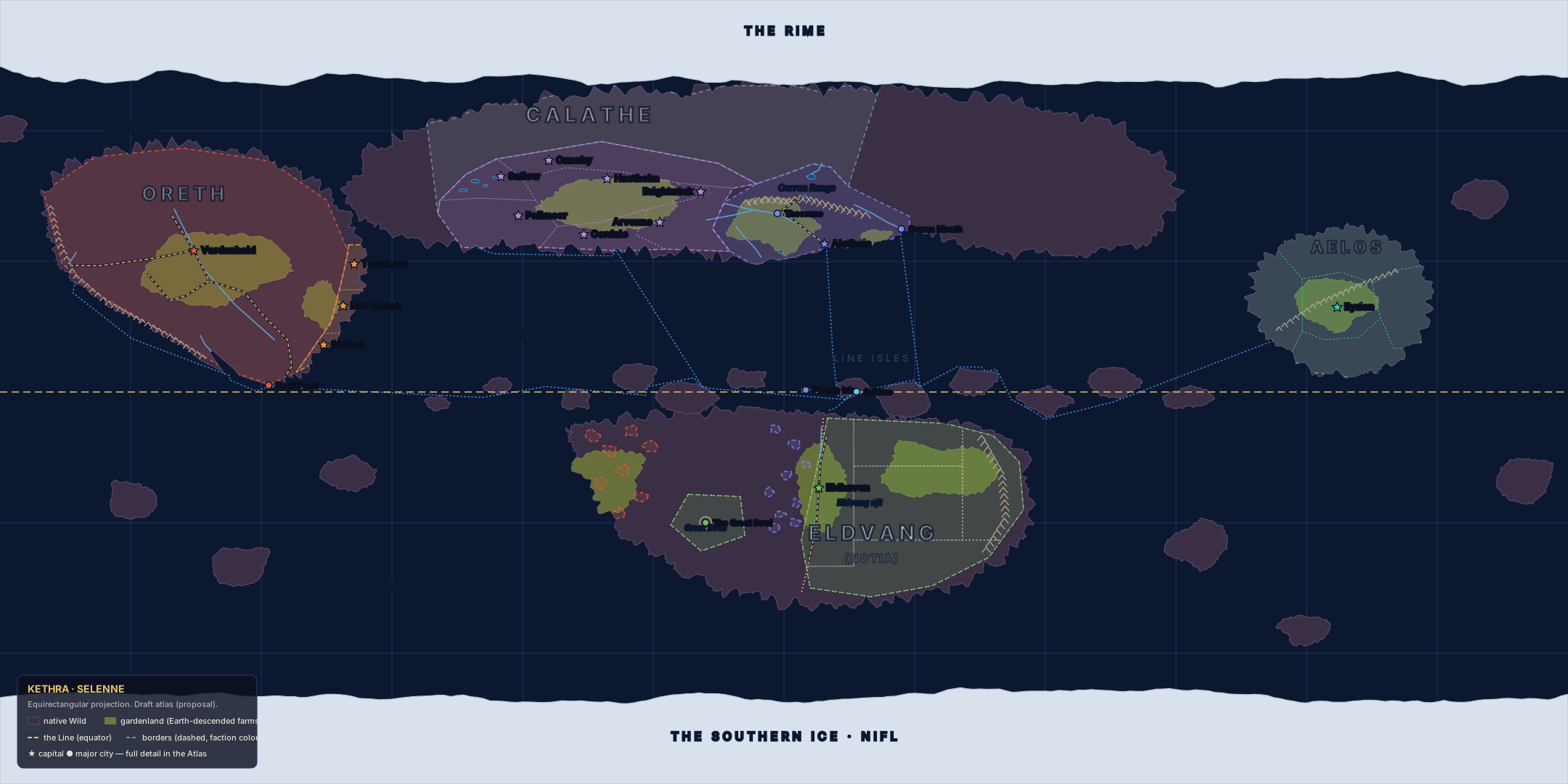
| Calathe (north) | An old, stable continental core, fringed on its south by the Corran Range. The Corran is a young, high range of folded mountains; its tallest peak, Mount Corran, reaches 7,120 m. Below it runs the long valley of the River Thess, about 3,900 km from source to sea. Its mouth forms a wide, funnel-shaped estuary with some of the strongest tides on the planet. |
| Oreth (west) | An active margin. A chain of volcanoes runs along its western coast, and earthquakes are frequent. Its interior basins hold Kethra's richest phosphate beds, the reason Oreth's supply routes matter to everyone. |
| Aelos (east) | An island continent raised by a volcanic hotspot. It is mountainous, fertile in the lowlands, and cut off from the rest of the world by open ocean. |
| The Line Isles (equator) | Volcanic island arcs along the Girdle Sea. They are ringed by reefstone: vast, living native structures similar to coral. The best spaceport sites on the planet are here, because launching from the equator gets the most help from Kethra's spin. |
| Notia / Eldvang (south) | A continent split by a great rift valley. Its interior is a dry plateau, and highlands rise on its eastern edge. At its heart lies the Great Bowl, a 300 km crater left by an impact in the bombardment era. |
| The Rime and the Southern Ice (poles) | Ice-covered land. The Southern Ice holds metal-rich rock that is mined in the short summers. |
The Stair#
Every warm era raises the seas and every cool one lowers them, while the land along Calathe's southern coast slowly rises. Over hundreds of thousands of years this has left a staircase of raised beaches: bands of old shoreline stepping up the coasts. These are called the Stair. The youngest step, from the last hot era about 3,000 Earth years ago, stands about 12 m above today's sea. The oldest steps in the Thess estuary stand about 140 m up, and the slopes between steps are steep. The steps are flat, well drained and easy to build on. The Founders built on them, and so has almost everyone since. Aletheia, the capital, rises in terraces up the Thess estuary Stair.
The working behind these dates: Hyperion's last closest approach was around AL −665, about 726 Earth years before Landfall. Add the roughly 2,528 Earth years since Landfall and the peak was about 3,250 Earth years ago. Seas lag behind temperature by centuries, so the seas stood highest a few centuries after the peak, roughly 2,800 to 3,100 Earth years ago. They were still falling when the Founders arrived.
Native biomes#
Native plants are dark: deep purple, bronze and near-black. Their pigments absorb both Theia's yellow-white light and Hyperion's red. Native biomes were named in Landspeech by the Founders:
| Biome | Where | Character |
|---|---|---|
| Duskwood | Temperate Calathe, eastern Oreth, Aelos | Tall, dark forest with a canopy that almost never lets light through. It is quiet in the day and loud with animals on red nights. |
| Reedland | River valleys and estuaries | Giant hollow reeds, some higher than a house. Marsh, ambush predators, and the source of blackreed timber. |
| Salt-steppe | Interior Calathe and the Eldvang plateau | Dry grassland on salty soil, home to vast herds of shalebacks. |
| Emberscrub | The Eldvang lowlands | Low, oily, fire-adapted scrub. It burns in the red summers and grows back from its roots. |
| Reefstone shallows | The Girdle Sea | Warm, clear, full of life. All of it is inedible to humans. |
| Wild tundra | The polar margins | Moss-like mats, dormant for half the year |
The first habitats#
Why the Founders chose Landfall. They picked the south coast of Calathe at the mouth of the Thess, for four reasons:
- It is temperate.
- The river gives fresh water.
- The Stair offered flat, freshly exposed ground where native life was thin and Earth soil cultures could take hold quickly.
- The deep tidal estuary made a harbour.
The Seven Terraces. The first settlement was built on seven steps of the Stair above the estuary. It is still called the Seven Terraces, and it is now a quarter of the town of Landfall.
Spreading out. From Landfall, settlement spread up the Thess valley and along the Calathe coast. It moved only as fast as native ground could be seeded with Earth life (see 0.4). This is why the old heartland is a long chain of river-valley farmland, with Wild on either side.
0.3 Climatological Drivers#
What makes Kethra's weather different from Earth's#
- Slower spin. A 26-hour day gives slightly weaker spin effects on the winds than Earth's. As a result:
- the tropical wind belts are wider;
- the dry subtropical deserts sit a little further from the equator, at about 33–38° latitude instead of Earth's 30°;
- tropical storms grow larger and move more slowly.
- Stronger tilt. At 27°, summers are hotter and winters colder than at the same latitude on Earth. Polar nights are longer.
- Richer air. With 23% oxygen, fires ignite more easily and burn hotter.
- Two moons. Tides are strong and complex, and shallow coasts mix constantly with the open ocean.
- Hyperion. It gives light through the red-night season and a slowly rising share of heat over the centuries.
Severe weather#
| System | Where and when | What it does |
|---|---|---|
| Girdle storms | The Girdle Sea, in late summer of each hemisphere | Huge, slow tropical cyclones. They can stall over the Line Isles for days. The Rovessa read their signs better than any weather service. |
| Ember storms | Worst in the Eldvang lowlands, in the red summers. They occur in the north as well (canon since 19 September 2026). There they come in late summer, in the dry country of the northern continents: above all the drier stretches of the Stair coast, and Calathe's interior. Aelos, oceanic and mild, has fewer. | Wildfires that make their own weather. Hot air rises off the fire and pulls wind in behind it, so the fire drives itself forward. They are fed by high oxygen and by built-up fuel. In the south that fuel is emberscrub dried over the red summer; in the north, it is grass, scrub and forest dried over the summer. Northern ember storms usually start from the lightning of late-summer storms blowing in off the Girdle Sea, which is why northerners say they "come off the sea". Frontier towns are designed around them (see Chapter III). |
| Blackfrost | Eldvang and southern Oreth, in winter | The southern winter falls in the dark season, with no red light. Nights are long, cloudless and bitterly cold. Frost kills crops and livestock in hours. |
| Double springs | Every coast, whenever both moons line up with Theia | Tide ranges peak. In funnel-shaped estuaries like the Thess, the incoming tide can rise as a single travelling wave (a tidal bore) up to 9 m high: the Thess Bore. When double springs coincide with a storm, low cities flood. |
| Longstorms | Northern Calathe, in autumn | Slow, persistent weather systems bringing weeks of rain. They feed the northern rivers. |
Ocean and air currents#
- The Girdle Current runs westward along the equator. Every Rovessa route is built around it.
- The Warm Reach carries warm, wet tropical water along the southern and eastern coasts of Calathe. Rain-bearing winds come off it all year. This is why the Thess coast, where Aletheia stands at 34° N, is green and humid rather than part of the dry subtropical belt. The deserts at that latitude lie in the continental interiors and on the west-facing coasts.
- The Southern Cold flows up from the Southern Ice along western Eldvang. It keeps that coast foggy, dry and rich in native sea life.
- Winds follow bands like Earth's, but wider: easterlies in the tropics, westerlies at mid-latitudes, and polar easterlies near the poles.
How the seasons turn#
| Season | Northern character (the Crown heartlands) | Southern character (Eldvang, at the same time of year) |
|---|---|---|
| Winter in the north / summer in the south | Lit winter. Long, cold nights glowing red from Hyperion. Snow in the north of Calathe. Native plants keep growing at night. | Red summer. Heat by day, red nights, emberscrub drying out. The ember-storm season. |
| Spring in the north / autumn in the south | Thaw and planting. Hyperion rises later each night and fades from the nights. | Harvest, and the fire season ending |
| Summer in the north / winter in the south | Short, fully dark nights. The northern crop-growing peak. Late in the season, the north's ember storms. | Dark winter. Blackfrost. The hardest season. |
| Autumn in the north / spring in the south | Harvest. Hyperion returns to the evening sky. | Thaw and planting, racing to finish before the red summer |
Why the red nights matter to farming#
Native plants photosynthesise in Hyperion's deep red light. Earth crops barely can. During every red-night season the native Wild keeps growing through the night, while Earth fields merely rest, so the Wild presses in on the farmland. As Hyperion brightens, the Wild's advantage grows. This is the practical engine of Kethra's environmental politics:
- The farmers of the capital call it "the Creep".
- The Living Worlds Movement calls it the planet reasserting itself.
Long cycles#
Hyperion and the gas giant together stretch and relax Kethra's orbit over tens of thousands of years. Combined with the slow wobble of Kethra's axis, this produces ice ages and warm periods. Ilyr scholars have reconstructed several of these cycles from sediment cores. The Cantorate's position is that they are of no religious concern.
0.4 Natural Resources & Abundance Variances#
The chemistry that shapes everything#
Native life on Kethra is built from carbon, water and proteins, like Earth life, but it evolved separately:
- Its sugars are mirror images of Earth's.
- It uses three amino acids that Earth life never uses.
The consequence is that most native food is indigestible to humans, and some is poisonous. Humans live on Earth-descended crops and livestock, grown in seeded ground called gardenland. Processed native foods can be eaten only because of the Gift, the Founder-engineered gut flora described in Chapter I. Even then, they have to be leached and cooked first.
Seeding the ground#
Native soil does not support Earth crops until it has been converted. Farmers do this with Earth soil cultures: bacteria, fungi and worms descended from the Founders' soil banks. Converting a field is known as the Seeding. It takes about 30 years to reach full yield. As a result:
- Farmland is precious and inherited.
- Taking another state's gardenland is the oldest reason for war.
- Converting new land is a multi-generation investment. The capital's banks lend against it.
Minerals and materials#
| Resource | Where | Notes |
|---|---|---|
| Iron, copper, aluminium | Calathe (Corran foothills), Oreth | Plentiful. The Relearning was built on Corran iron. |
| Phosphate | Oreth interior basins | Scarce and strategic. Earth crops need phosphorus, and Kethra's surface keeps little of it. Whoever controls the Oreth phosphate corridors feeds the planet. This was the root of the Corridor War. |
| Iodine | Earth-stock kelp farms along the Calathe and Line coasts | Native life does not concentrate iodine, so there is almost none in the food chain unless kelp is farmed. Iodine deficiency and its effects were endemic in the Silence. Salt is iodised by law in the Crown. |
| Thorium | Beach sands of Aelos and eastern Eldvang | Fuel for fission reactors, and plentiful. Uranium is scarce. |
| Rare earths | The Eldvang rift | Needed for frames, electronics and magnets. A major source of frontier wealth, and of disputes over charters. |
| Coal and "old-dark" (oil) | Calathe, Oreth, Eldvang | Formed from ancient native life. They powered the Relearning. Now mostly replaced by other fuels, though Vardane still burns them. |
| Blackreed | Reedlands | Native timber. It is structurally sound, and rot-proof, because Earth fungi cannot digest it. A prized building material. |
| Reefstone | The Girdle Sea | Cut and burned to make lime and cement for Line construction |
| Helium-3 and hydrogen | The atmosphere of Kronos/Ymir | Fusion fuel, harvested by skimmer stations |
| Nickel-iron, platinum-group metals, water ice | The Cinderbelt | The richest materials in the system. It takes weeks to months to get them home. |
Water#
- Calathe: abundant rivers, fed by the Corran snows and the northern longstorms.
- Oreth: a wet western coast and a dry interior.
- The Line Isles: heavy rainfall, and cisterns in every town.
- Eldvang: well watered in the eastern highlands and along the rift; arid across the interior plateau. Water rights are the frontier's second great source of disputes, after the charters.
Energy reserves in brief#
Tidal power is Kethra's great renewable resource, and the Thess estuary is the best site on the planet. Fusion fuel comes from Kronos/Ymir. Thorium is plentiful. Solar power works, but gives less than it would on Earth at the same latitudes because of the long winter nights.
0.5 Flora and Fauna Trajectories#
Two kingdoms of life#
Naturalists divide all life on Kethra into two separate trees:
| Capital term | Frontier term | |
|---|---|---|
| Life descended from the Founders' stocks | Earthkin | Songborn |
| Native life | Selenekin | Wildborn |
Native animals#
Most native land animals have six limbs. Some walk on all six; others walk on four and handle things with two. Native animals find humans as inedible as humans find them. Native predators therefore attack people to defend territory, or by mistake, not to eat them. Most learn to avoid humans. The exceptions are the ones people fear.
| Animal | Where | Notes |
|---|---|---|
| Shaleback | Salt-steppe | A large six-legged grazer with overlapping armour plates. It moves in herds of thousands. A stampede flattens anything in its path. |
| Tidehound | Tidal flats, especially at double springs | An amphibious pack hunter that strikes at anything moving in the shallows. It bites, kills and leaves the body, because it cannot eat humans. That is why it horrifies people. |
| Reedlurker | Reedland | An ambush predator. Its venom is merely painful to native prey but can stop a human heart. |
| Gloamwing | Everywhere, in the red-night season | Night-flying pollinators that swarm by the million in red light. Harmless, but their wing-dust (duskdust) triggers lung disease (see Chapter I). |
| Ember beetle | Emberscrub | Lays its eggs in freshly burnt ground and is drawn to fire. Frontier children call the first swarms after a fire "the embers' children". |
| Glassmoth | Duskwood | Transparent-winged. It catches Hyperion's light like stained glass. A common image in capital art. |
| Finners | Every sea | The generic name for native fish-like animals. They are inedible, and they swarm around Earth fish pens. |
Domesticated species#
| Species | Origin | Role |
|---|---|---|
| Dray | Native. The only native animal ever domesticated. | A six-legged draught beast that eats native plants, so it can work land that has not been seeded. It pulls ploughs through the Wild. Its hide and bone are used; it is never eaten. It is the frontier's working animal and its symbol. |
| Goats, sheep, pigs, poultry, ducks | Earthkin | The common livestock |
| Cattle | Earthkin | Few in number, because they need a lot of seeded land. Beef is a luxury in the capital and almost unknown on the frontier. |
| Horses | Earthkin | Rare. Kept for ceremony and sport, not for work. |
| Dogs and cats | Earthkin | Everywhere. Frontier dogs are bred to scent reedlurkers and tidehounds. |
| Honeybees | Earthkin | Critical. Earth crops depend on them, and they are fragile. The Hive Wardens are one of the oldest guilds (see Chapter VI). |
| Earth fish: carp, tilapia, trout lines | Earthkin | Farmed in pens and seeded lakes. Seafood from the open sea is native and inedible. |
Earthkin that went wild#
- Rats arrived with the Founders against every precaution. They are the most successful Earth animal outside the gardenland, living on human stores and waste.
- Feral goats strip seeded ground at the edges of the Wild.
- Earth grasses invade the margins of the Wild. The Living Worlds Movement treats this as a harm to the native Wild.
Where the two kinds of life meet: the Hedge#
The boundary between gardenland and Wild is called the Hedge, and it is a live front. Earth weeds and feral animals push outward from the fields. Native growth, including blackthatch, a fast native creeper, pushes inward during every red-night season. Hedge work is its own trade: clearing, burning and re-seeding the boundary.
Where things are heading#
| Trend | Consequence |
|---|---|
| Hyperion is brightening | Longer and stronger red-night growth for native plants. More fuel in the south, so more ember storms. The Creep accelerates. |
| Seas are rising, about 0.3 m per century now and accelerating | The lowest steps of the Stair will flood again. Coastal farmland is lost to salt. |
| Warming | Earth crops shift toward the poles. Blackfrost weakens in the south; red summers become hotter. |
| Human expansion | Seeding continues at about 60,000 km² a year planet-wide. It is slowed by the phosphate supply and the 30-year conversion time. |
The Living Worlds Movement argues that the coming hot era is the native Wild's season, and that humanity must set limits on the Seeding before the planet sets them instead. The Cantorate teaches that the Father's Return will be a time of plenty. Farmers watch the Hedge.
Guidance for AI actors#
- Every scene has a red-night status. In the northern winter nights are red-lit; in the northern summer they are black. In the south it is the reverse. Characters plan around it.
- Food is never casual. Everyone knows which foods are Earthkin and which are processed native. Offering someone the wrong food is an insult, or a danger.
- Tides. People living on the coast know the moons' positions the way people on Earth know the weather.
- What a person knows about native animals depends on where they live. A capital clerk has never seen a tidehound. A frontier child can imitate its call.
Prepared by Claude.